
Calculate House Rent in the UK: Looking for a rental home in the UK is not only about checking the monthly cost. Before selecting an apartment, house, or shared Living space, it is important to learn how to Calculate House Rent in the UK and understand the full cost of living in that house. Together with rent, you may need to pay local tax, gas and electricity bills, water costs, internet, contents Protection, and other monthly costs.
A house that looks reasonably priced at first can become costly once these extra costs are added. That is why estimating your total housing cost before approving a rental agreement can help you prevent financial planning problems later. It also makes it easier to compare different rental properties and choose an option that fits your income.
In this guide, you will learn how to calculate house rent in the UK step by step, including how to convert weekly rent into monthly rent, estimate additional bills, calculate upfront moving costs, and work out how much rent you can practically afford.
Click Here:House Share Rent Calculator UK
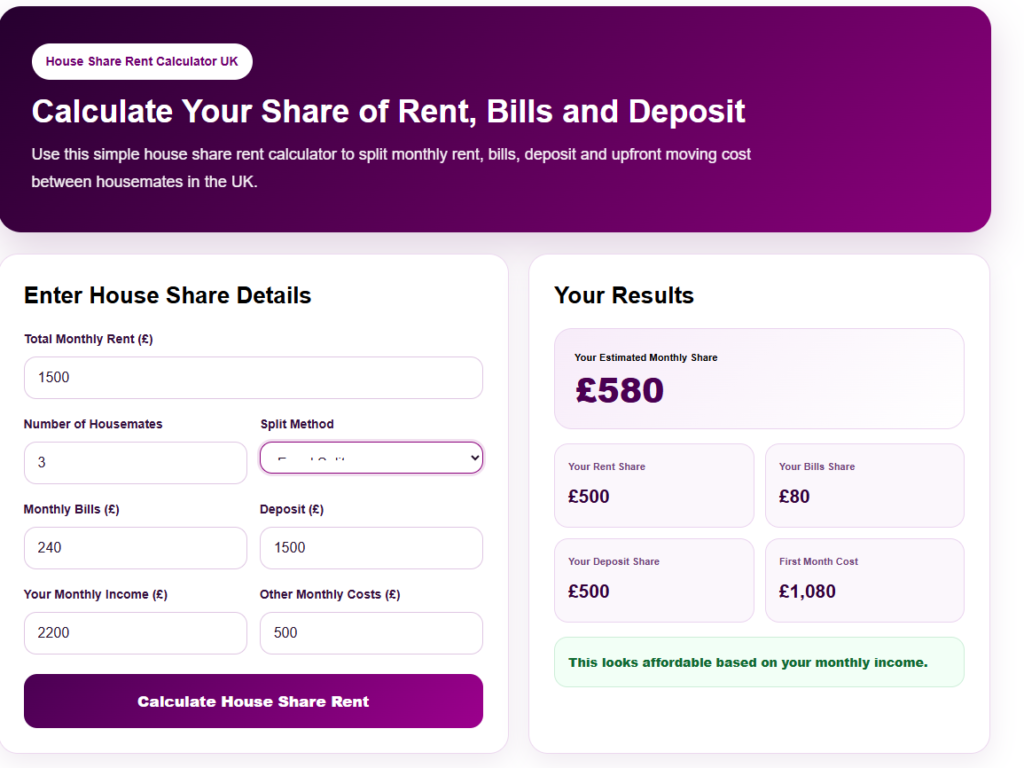
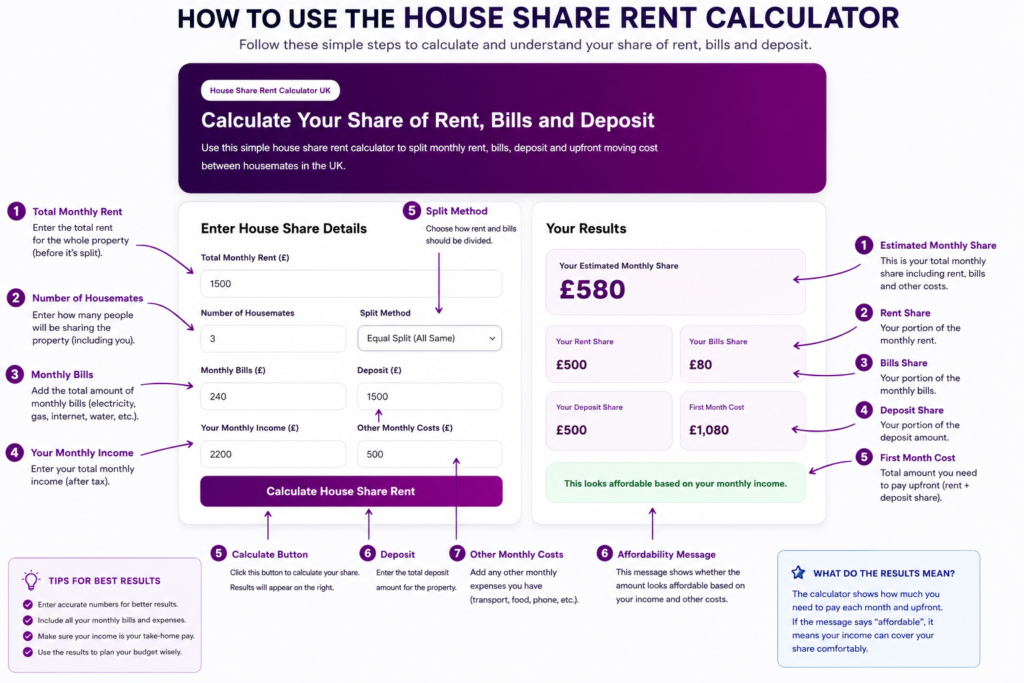
HOW TO USE THE HOUSE SHARE RENT CALCULATOR
How Is House Rent Calculated in the UK?
| Section | Content |
|---|---|
| Introduction | House rent in the UK is normally announced as a weekly, monthly, or annual amount. |
| Payment Pattern | But renters normally pay rent monthly, usually in advance at the start of each rental month. |
| Purpose | To understand if a property fits your financial plan, it is important to know how these different rent figures work and what impacts the final cost. |
| Heading | Monthly, Weekly and Annual Rent: The Basic Concept |
| Monthly Rent Explanation | Monthly rent is the amount you pay each month to live in a property. For example, if a flat is advertised at £1,200 per month, you will usually pay £1,200 every month throughout your rental agreement. |
| Weekly Rent Conversion | Some properties, generally shared houses and rooms, may show rent as a weekly amount. To estimate the monthly rent, use this formula: |
| Formula 1 | Weekly Rent × 52 ÷ 12 = Monthly cost |
| Example 1 | For example, if the weekly rent is £250: |
| Calculation 1 | £250 × 52 ÷ 12 = £1,083.33 per month |
| Annual Rent Formula | Monthly Rent × 12 = Final Rent |
| Example 2 | For example, a property costing £1,200 per month would have a final rent of: |
| Calculation 2 | £1,200 × 12 = £14,400 per year |
Read more:Wage Calculator UK – Instantly Calculate Your Earnings (2026/27)Property Type, Area and Tenant Demand
The rent price depends greatly on the type of property you choose when you Calculate House Rent in the UK.
A room in a Joint house is normally Lower-priced than a studio apartment.
A one-bedroom, two-bedroom, or family house will normally cost more.
house with extra space, gardens, parking, Current kitchens, furnished rooms, or bills included may also have a higher cost.
Location is another major factor when you Calculate House Rent in the UK.
Rent is regularly higher in London, city centres, areas near train stations, universities, business areas, and popular Areas.
Read more:Salary-to-Rent Ratio UK – How Much Should You Spend on RentAdvertised Rent vs Actual Total Cost
- The advertised rent is the amount shown on the property records, but it may not include every housing cost.
- For example, an apartment advertised at £1,000 per month may seem affordable, but your exact monthly cost could be much higher after adding local tax, gas, electricity, water, internet, and other bills.
Practical Example: A Cheaper House May Not Always Be Cheaper
Imagine you are choosing between two similar properties. House A costs £850 per month but is far from your workplace, so you spend another £180 on transport each month. House B costs £950 but is close to work and only requires £60 in monthly travel costs. Although House A has the lower advertised rent, your combined housing and travel cost could be £1,030 compared with £1,010 for House B. This shows why renters should compare the total cost of living, rather than choosing a property based only on the advertised rent.
| Included Items in Monthly Housing Cost |
|---|
| Announced monthly rent |
| local tax |
| Gas and electricity bills |
| Water bill |
| Internet costs |
| Contents protection |
Check Exactly What “Bills Included” Means
A rental advertisement that says “bills included” does not always mean every household expense is covered. Before comparing the property with other rentals, ask the landlord or letting agent exactly which bills are included and whether any usage limits apply. Check whether the rent covers council tax, Utilities or other services. Getting these details in writing can make it much easier to calculate your real monthly housing cost and avoid unexpected bills after moving in.
Find the Average Rent in Your Area
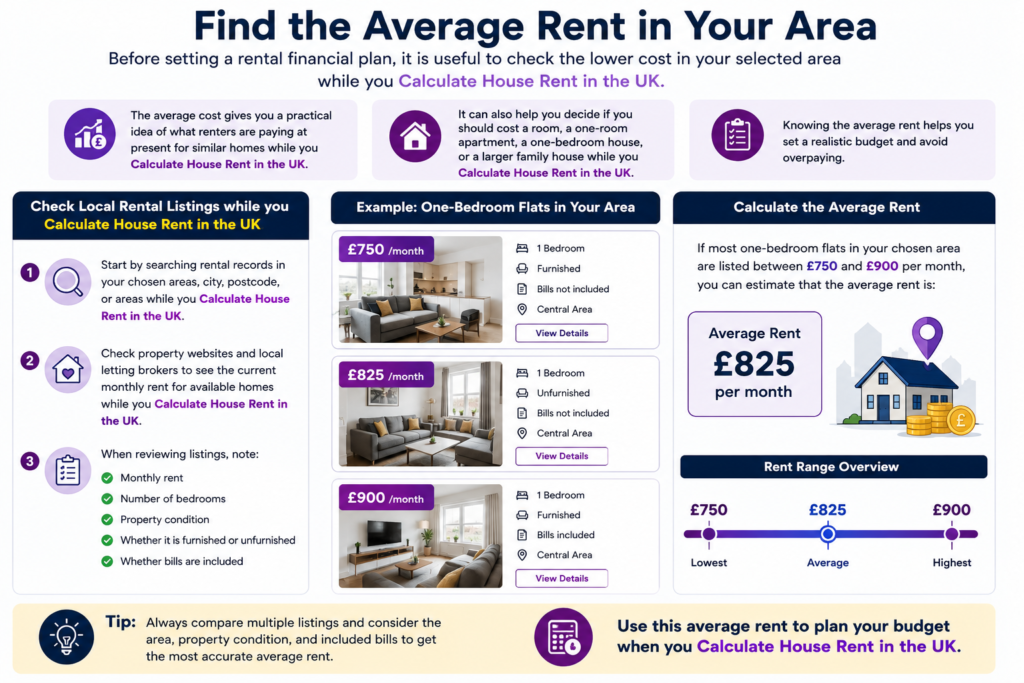
Before setting a rental financial plan, it is useful to check the lower cost in your selected area while you Calculate House Rent in the UK.
The average cost gives you a practical idea of what renters are paying at present for similar homes while you Calculate House Rent in the UK.
It can also help you decide if you should rent a room, a one-room apartment, a one-bedroom house, or a larger family house while you Calculate House Rent in the UK.
Check Local Rental Listings while you Calculate House Rent in the UK
Start by searching rental records in your chosen areas, city, postcode, or areas while you Calculate House Rent in the UK.
Check property websites and local letting brokers to see the current monthly rent for available homes while you Calculate House Rent in the UK.
When reviewing listings, note:
Monthly rent
Number of bedrooms
Property condition
Whether it is furnished or unfurnished
Whether bills are included
For example, if most one-bedroom flats in your chosen area are listed between £750 and £900 per month, you can estimate that the average rent is around £825 per month.
Read more:How Much Rent Can I Charge UK – Simple and Powerful Rent Pricing GuideCompare Similar Property Types
| Category | Details |
|---|---|
| Compare Similar Property Types | Consider important differences such as: |
| Number of bedrooms and washrooms | Number of bedrooms and washrooms |
| Furnished or not furnished house | Furnished or Not furnished house |
| Shared Rental property or private rental agreement | Shared Rental property or private rental agreement |
| House, flat, or apartment | House, flat, or apartment |
| Garden, parking, terrace, or storage space | Garden, parking, terrace, or storage space |
| Bills included or bills excluded | Bills included or bills excluded |
| Property condition and recent renovations | Property condition and recent renovations |
| Example | Description |
|---|---|
| Example comparison | A newly restored Apartment with furniture, parking, and bills included may have a higher monthly cost than an older unfurnished property in the same area. |
| Conclusion | Comparing similar property types helps you avoid Impractical rent estimates. |
Consider Location, Transport and Nearby Facilities
Even within the same area or city, cost can change greatly from one area to another.
Houses close to central areas, train stations, bus stations, universities, hospitals, Office parks, and popular shopping areas often have higher rental costs.
Transport costs should also be reviewed when choosing a lower-priced property further away from work or study.
A lower rent may not save you money if you need to spend a large amount each month on Train ticket prices, fuel, parking, or bus travel.
Calculate Your Monthly Rent Budget
Before searching for a rental property, calculate how much rent you can comfortably manage each month.
A Practical rent Financial plan helps you reduce spending too much of your income on housing and leaves enough money for bills, food, transport, savings, Loan repayments, and unplanned costs
Your rent Financial plan should be based on your regular income after tax, not only your gross salary.
Plan for the First Month, Not Just the Monthly Rent
One of the easiest ways to underestimate the cost of renting is to focus only on the regular monthly payment. Your first month can be much more expensive because you may need to pay a tenancy deposit, first month’s rent, moving expenses, furniture, kitchen items, cleaning supplies, and other essentials. For example, a property with £900 monthly rent could require several thousand pounds in available funds when the deposit and other legitimate upfront costs are combined. Creating a separate moving budget before signing the agreement can reduce the risk of using credit or borrowing money to cover basic moving expenses.
Read more:Powerful Fair Rent Calculator UK – Calculate a Fair Monthly Rent| Section | Content |
|---|---|
| Use the 30% Income Rule | A common piece of advice is to spend no more than 30% of your monthly income on rent. |
| Formula | Monthly Income × 30% = Suggested Monthly Rent Budget |
| Example | For example, if your monthly take-home income is £2,500: £2,500 × 30% = £750 |
| Result | Based on the 30% rule, a rent budget of around £750 per month may be more manageable. |
| Important Note | However, this is only a general guideline. |
| Limitation | In high-rent areas, some tenants may need to spend more than 30% of their income, while others may prefer to spend less so they can save more money. |
Calculate Rent Based on Your Take-Home Pay
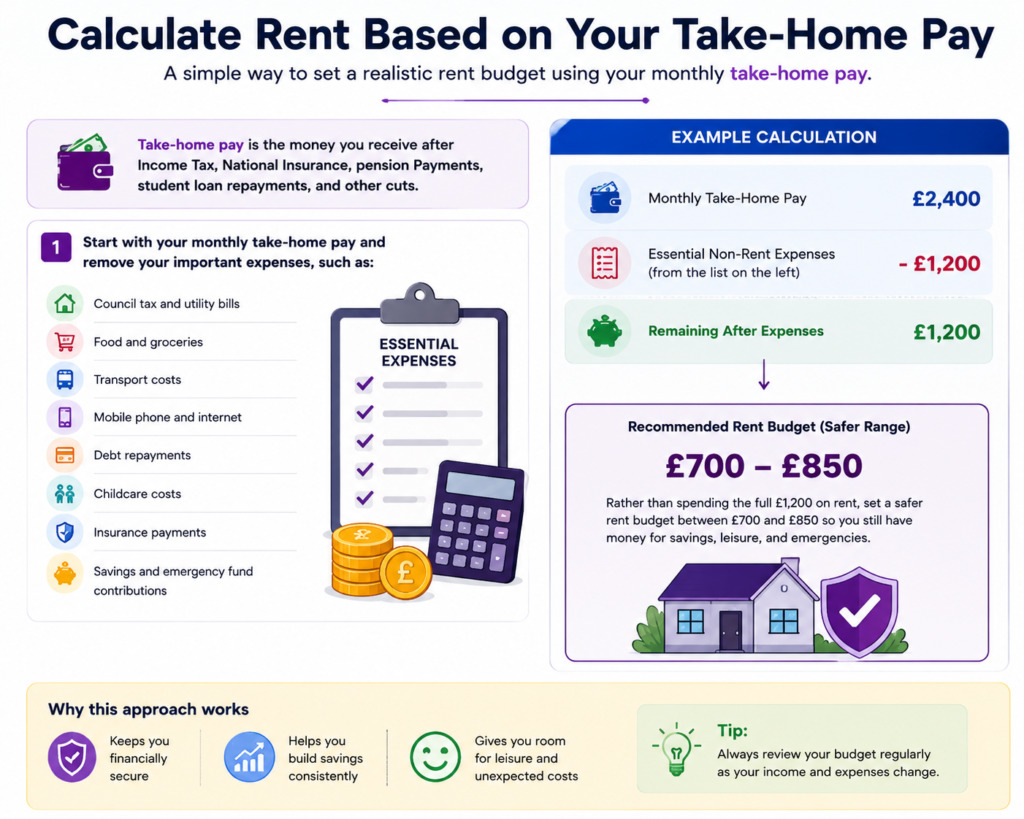
Take-home pay is the money you receive after Income Tax, National Insurance, pension Payments, student loan repayments, and other cuts.
Start with your monthly take-home pay and remove your important expenses, such as:
- Council tax and utility bills
- Food and groceries
- Transport costs
- Mobile phone and internet
- Debt repayments
- Childcare costs
- Insurance payments
- Savings and emergency fund contributions
For example, if your take-home pay is £2,400 per month and your essential non-rent expenses are £1,200, you have £1,200 remaining.
Rather than spending the full £1,200 on rent, you may set a safer rent budget between £700 and £850 so you still have money for savings, leisure, and emergencies.
Consider Household Income for Couples or Families
| Section | Content |
|---|---|
| Couples and families rent calculation | Couples and families can calculate a reasonable rent cost using the combined household take-home income. |
| Example income | For example, if one person earns £2,000 per month after tax and the other earns £1,500, the total household income is £3,500 per month. |
| 30% guideline calculation | Using the 30% guideline: £3,500 × 30% = £1,050 |
| Result | This means a monthly rent of around £1,050 may be a sensible starting point. |
| Important consideration | But households should also consider shared expenses and responsibilities. |
| Additional family costs | Families may have higher costs for: |
| Childcare | Childcare |
| School travel | School travel |
| Larger utility bills | Larger utility bills |
| Food | Food |
| Council tax | Council tax |
| Transport | Transport |
Convert Weekly Rent to Monthly Rent
Many UK rental records show rent as a Weekly amount, especially for rooms in shared houses, student Housing, and some short-term lets.
Because most renters pay rent monthly, converting the weekly amount into a monthly amount helps you compare properties properly and plan your finances.
A more accurate calculation uses 52 weeks in a year and divides the total by 12 months.
Read more:Guarantor for Renting in the UK –7 Best Essential GuideWeekly Rent to Monthly Rent Formula
| Section | Content |
|---|---|
| Formula | Use the following formula to convert weekly rent into monthly rent: |
| Calculation Method | Weekly Rent × 52 ÷ 12 = Monthly Rent |
| Example | For example, if the weekly rent is £200: |
| Result Calculation | £200 × 52 ÷ 12 = £866.67 per month |
| Important Note | This calculation gives you a more practical monthly rent calculation than multiplying £200 by four, which would only give £800. |
Monthly Rent to Weekly Rent Formula
If a property is advertised with a monthly rent and you want to compare it with weekly records, use this formula:
Monthly Rent × 12 ÷ 52 = Weekly cost
For example, if the monthly rent is £1,000:
£1,000 × 12 ÷ 52 = £230.77 per week
This is useful when comparing a monthly rental property with a room or shared accommodation advertised every week.
Example: Calculating £250 Per Week Rent
| Section | Content |
|---|---|
| Example weekly rent | Suppose you find a room advertised at £250 per week. |
| Monthly rent calculation | To work out the estimated monthly rent: £250 × 52 ÷ 12 = £1,083.33 per month |
| Monthly result | So, a property advertised at £250 per week costs approximately £1,083 per month in rent. |
| Annual rent calculation | The annual rent would be: £250 × 52 = £13,000 per year |
| Important explanation | This example shows why it is important to convert weekly rent correctly. |
| Key insight | Although £250 per week may sound lower than £1,000 per month, the actual monthly cost is more than £1,080. |
How Much Rent Can I Afford in the UK?
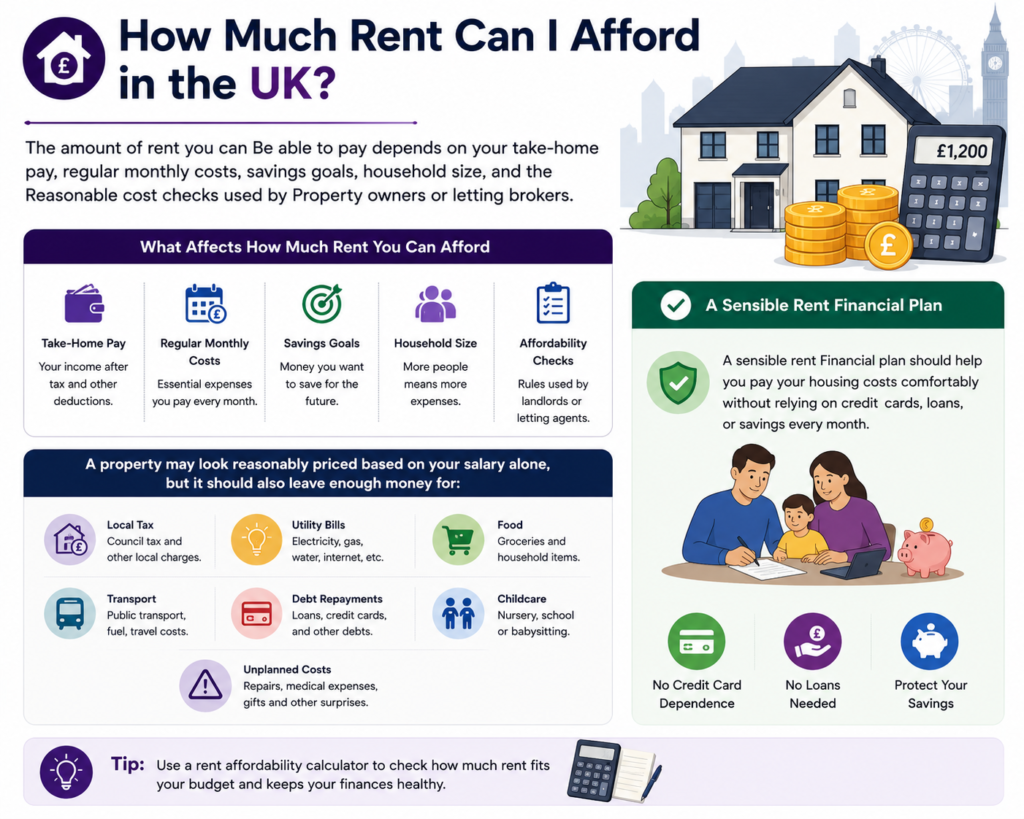
The amount of rent you can afford to pay depends on your take-home pay, regular monthly costs, savings goals, household size, and the Reasonable cost checks used by Property owners or letting brokers.
A property may look reasonably priced based on your salary alone, but it should also leave enough money for:
- local tax
- Utility bills
- Food
- Transport
- Debt repayments
- Childcare
- Unplanned costs
A sensible rent Financial plan should help you pay your housing costs comfortably without relying on credit cards, loans, or savings every month.
Read more:House Share Rent Calculator UK – 7 Best Rent Split TipsRent Affordability Based on Salary
| Section | Content |
|---|---|
| Starting point rule | A simple starting point is to keep rent at around 30% of your monthly take-home pay. This is not a strict legal rule, but it can help you create a safer budget. |
| Example | For example, if your monthly take-home pay is £2,500: £2,500 × 30% = £750 |
| Result | This suggests that a rent budget of around £750 per month may be manageable. |
| High-cost areas | But if you live in a high-cost city, you may need to spend more than 30% of your income on rent. |
| In that condition, actions | In that Condition, it becomes even more important to: |
| Reduce other expenses | Reduce other expenses |
| Choose shared accommodation | Choose shared accommodation |
| Look at cheaper areas | Look at areas with lower rental prices |
| Extra consideration | You should also consider your fixed monthly commitments. |
| Income comparison | Someone earning £2,500 per month with no loan and low travel costs may be able to pay more rent than someone with the same income but high childcare, car finance, or student loan payments. |
The 30x Annual Rent Rule
Many UK letting brokers and property owners use the 30x annual rent rule during value-for-money cost checks. This means your total annual income may need to be at least 30 times the monthly rent.
Use this formula:
Monthly Rent × 30 = Minimum Required Annual Income
For example, if the rent is £1,000 per month:
£1,000 × 30 = £30,000 per year
This means you may need a gross annual salary of at least £30,000 to pass the value-for-money check for a property costing £1,000 per month.
You can also work out the maximum monthly rent based on your total annual income:
Annual Gross Income ÷ 30 = Estimated Maximum Monthly Rent
For example, if your annual salary is £36,000:
£36,000 ÷ 30 = £1,200 per month
Keep in mind that value-for-money rules can vary between property owners and letting brokers. Some may use a different income multiplier, consider combined household income, or accept a Surety if your income does not meet their required level.
Rent Affordability Example for Different Salaries
The table below shows calculated maximum monthly rent using the 30x annual rent rule:
| Annual Gross Salary | Calculated Maximum Monthly Rent |
| £24,000 | £800 |
| £30,000 | £1,000 |
| £36,000 | £1,200 |
| £45,000 | £1,500 |
| £60,000 | £2,000 |
These figures are useful for understanding what a property owner or letting broker may consider reasonably priced.
However, passing an affordability check does not always mean the rent is comfortable for your personal budget.
For example, a person earning £30,000 per year may pass the affordability check for £1,000 monthly rent, but after tax, council tax, bills, transport, groceries, and other expenses, that rent may still feel expensive.
Always calculate your full monthly budget before applying for a property.
House Rent Calculation Example
The Next examples show how to calculate the total monthly housing cost for different types of renters in the UK. Remember that cost is only one part of the cost. Local tax, Household bills, internet, Protection, and other costs should also be included when planning your financial plan.
Example for a Single Tenant
Suppose a single tenant rents a one-bedroom flat for £850 per month. The tenant also pays the following monthly costs:
| Monthly Expense | Estimated Cost |
| Rent | £850 |
| Council tax | £120 |
| Gas and electricity | £130 |
| Water bill | £35 |
| Internet | £30 |
| Mobile phone | £25 |
| Contents insurance | £10 |
| Total Monthly Housing Cost | £1,200 |
Example for a Couple Sharing Rent
Now consider a couple renting a two-bedroom flat for £1,200 per month. They share the rent and household bills equally.
| Monthly Expense | Total Cost | Cost Per Person |
| Rent | £1,200 | £600 |
| Council tax | £160 | £80 |
| Gas and electricity | £160 | £80 |
| Water bill | £40 | £20 |
| Internet | £35 | £17.50 |
| Contents insurance | £15 | £7.50 |
| Total Monthly Housing Cost | £1,610 | £805 |
Example for a Family Renting a House
Suppose a family rents a three-bedroom house for £1,500 per month. Because the property is larger and more people live there, the household bills may be higher.
| Monthly Expense | Estimated Cost |
| Rent | £1,500 |
| Council tax | £190 |
| Gas and electricity | £250 |
| Water bill | £55 |
| Internet | £35 |
| Contents insurance | £20 |
| TV Licence | £15 |
| Total Monthly Housing Cost | £2,065 |
Important UK Tenant Rights to Know
- Know your rights before renting a home in the UK.
- Your rights help protect your money and your home.
- Most tenants should have:
- A written tenancy agreement.
- A safe property.
- A protected deposit.
Deposit Protection
- Your Property owner must usually protect your Advance payment in a government-approved scheme.
- Your deposit can only be deducted for valid reasons, such as:
- Unpaid rent.
- Damage beyond normal wear and tear.
- Missing items.
- Take photos when you move in and keep all Rental agreement documents.
Rent Increases
- A property owner cannot increase the cost every time they want.
- During a fixed-term Rental agreement, rent usually increases only if the agreement allows it or you agree.
- For a rolling Rental agreement, the property owner must give proper notice.
Repairs
- The property owner is responsible for major repairs, including:
- Roofing and walls.
- Heating and hot water.
- Gas, electricity, and Water system.
- Report repair problems as soon as possible.
Notice and Tenancy Agreement
- Read your tenancy agreement before signing.
- It explains your rent, deposit, bills, and notice period.
- If you want to leave, give the required notice.

Common Mistakes When Calculating House Rent
| Mistake Category | Details |
|---|---|
| Only Looking at the Advertised Rent | Don’t look at rent alone. Check if bills are included. Compare the total monthly cost. |
| Ignoring Council Tax and Utility Bills | Include local tax, gas, electricity, water, and internet in your financial plan. Check the property’s energy Performance if possible. |
| Forgetting Deposit and Moving Costs | Financial plan for: Advance payment, First month’s rent, moving costs, Basic household items |
| Spending Too Much on Rent | Don’t spend most of your income on monthly payments. Make sure you Up to now have money for bills, food, transport, and savings. |
| Not Reading the Tenancy Agreement | Read the rental agreement before signing. Check: Rent amount, Bills included, Notice period, Deposit terms, Repair responsibilities |
Read more:Rent Affordability Calculator London – How Much Rent Can You Afford in LondonHow much rent can I afford on my salary in the UK?
A good rule is to spend about 30% of your monthly take-home pay on rent. Also consider your bills, transport, food, and other monthly expenses.
Is rent paid weekly or monthly in the UK?
Most tenants pay rent monthly in advance, although some properties are advertised with weekly rent.
Does house rent include council tax in the UK?
Usually no. Council tax is normally paid separately unless the property is advertised as bills included.
How much deposit can a landlord ask for in the UK?
Most landlords can ask for up to 5 weeks’ rent as a deposit. The deposit should normally be protected in an approved scheme.
Can I negotiate rent with a landlord in the UK?
Yes. You can ask if the rent is negotiable, especially if you have a stable income, good references, or can sign a longer tenancy.
What bills should I budget for when renting a house?
Besides rent, budget for:
Council tax
Gas and electricity
Water
Internet
Mobile phone
TV Licence (if needed)
Contents insurance
Food and transport
Do letting agents charge extra fees on top of rent?
Letting agents may charge for referencing checks, tenancy renewals, or administrative work, though many upfront agent fees to tenants were banned under the Tenant Fees Act. It’s worth asking upfront what, if any, additional charges apply before signing an agreement.
Does rent typically increase every year in the UK?
Not automatically. Rent increases depend on what’s written in the tenancy agreement. In a fixed-term contract, rent usually can’t rise unless the contract allows it; in a rolling (periodic) tenancy, the landlord must follow proper notice procedures, typically giving at least one month’s notice for rent reviews.
Is it cheaper to rent a furnished or unfurnished property?
Unfurnished properties are often slightly cheaper on paper, but tenants need to budget for furniture and appliances upfront, which can offset the savings. Furnished properties cost more monthly but reduce initial moving expenses.
Can students get a discount on council tax when renting?
Yes, full-time students are usually exempt from council tax altogether. If a household has a mix of students and non-students, a discount may still apply, so it’s worth checking with the local council.
Conclusion
Calculating a house monthly payment in the UK involves more than checking the promoted monthly price. To understand if a property is truly reasonably priced, you should include local tax, gas and electricity, water, internet, contents protection, transport costs, and other regular expenses in your financial plan.
Before renting, compare similar properties in your Chosen area, convert weekly rent into monthly rent correctly, and check how much rent you can Be able to pay based on your take-home income. You should also prepare for upfront costs, including the Rental agreement deposit, first month’s rent, moving costs, and important household items.
Reading the rental agreement carefully and knowing your renter rights can help you avoid unplanned costs and Arguments. By calculating your full housing costs before approving an agreement, you can choose a rental property that suits your financial plan and gives you greater financial protection.