

A guarantor for renting in the UK is something many renters only discover after applying for a property. Oliver had finally found a rental apartment that matched his financial plan and was close to his new place of work. After going to the viewing and sending all the required documents, he was confident that he would soon receive the place. The letting broker emailed him with one unplanned request: “Please provide a surety before we can approve your rental agreement “
Oliver had never rented a property before and had no idea why someone else needed to be involved in his application. Like many first-time renters, he wondered if his earnings were enough and what duties a surety would have.
If you’re looking for a Guarantor for renting in the UK, you’re not alone. Students, career starters, independent workers, and even full-time workers are regularly asked to provide a surety before their rental agreement is accepted. Understanding why property owners request one and how the process works can make your rental journey much easier
This helps explain everything you need to know about a rental agreement, including who can act as one, the requirements they must meet, and the financial duties involved.
Click Here: Rent Affordability Calculator UK
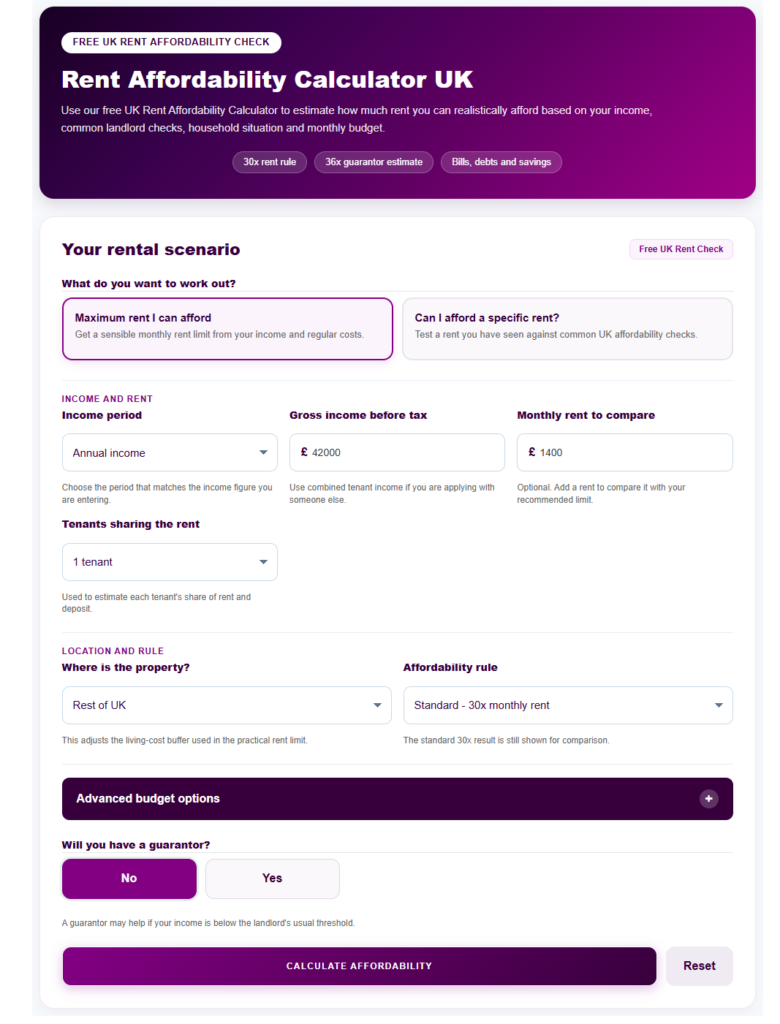
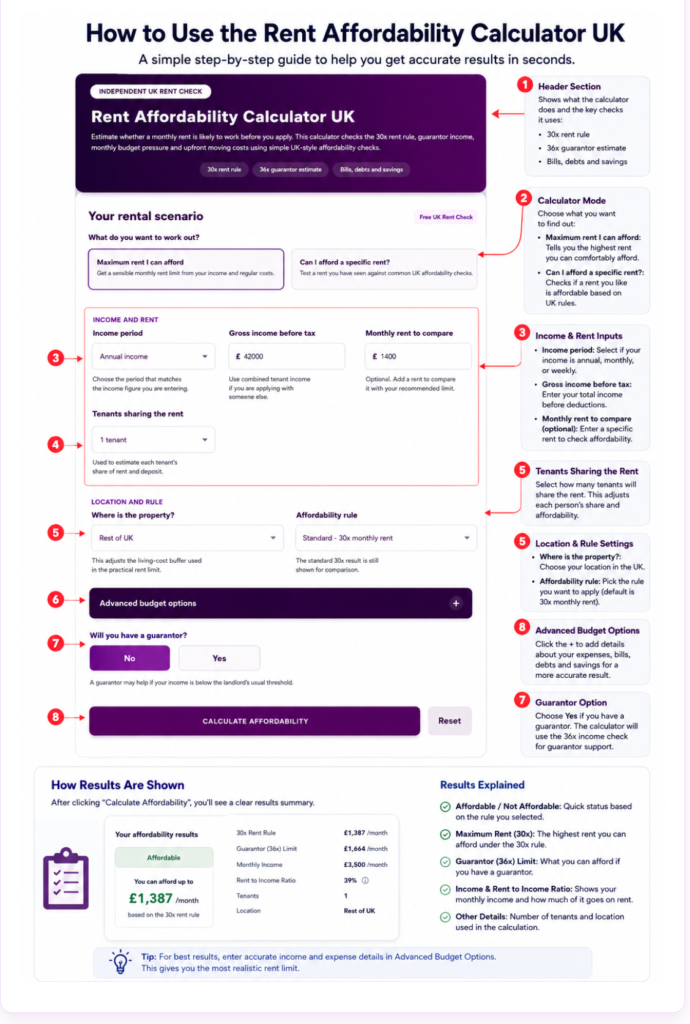
How to Use the Rent Affordability Calculator UK
What Is a Guarantor for Renting in the UK?
| Section | Details |
|---|---|
| Definition | A Guarantor for renting in the UK is a person who signs a legal agreement to take financial responsibility if a renter cannot meet the responsibilities of the rental agreement. Their role is to provide property owners with confidence that rental fees and other accepted costs will still be paid if the renter experiences financial difficulties. |
| Legal Responsibility | A surety normally signs a legally binding agreement before the rental agreement begins. If the renter skips rent payments or breaks certain financial terms, the property owners can ask the surety to cover those costs. |
| Why Do Tenants Need a Guarantor? | A property owner may request a surety if the renter:• Has a limited rental history.• Is a student.• Has recently started a new job.• Is self-employed or has irregular income.• Does not meet the property owner’s payability requirements. |
| Important Things to Know | • Having a surety does not mean the renter is unstable.• Anyone agreeing to become a surety should carefully read the agreement and understand the legal and financial duties before approving. |
Read more:GPA Scale Explained – 4.0, 5.0 and Percentage Conversion GuideWhy Do Landlords Require a Guarantor?
Guarantor for Renting in the UK: Property owners invest a great deal of time and money into their rental properties. Asking for a surety helps reduce financial risk by providing an additional layer of protection if rent is not paid.
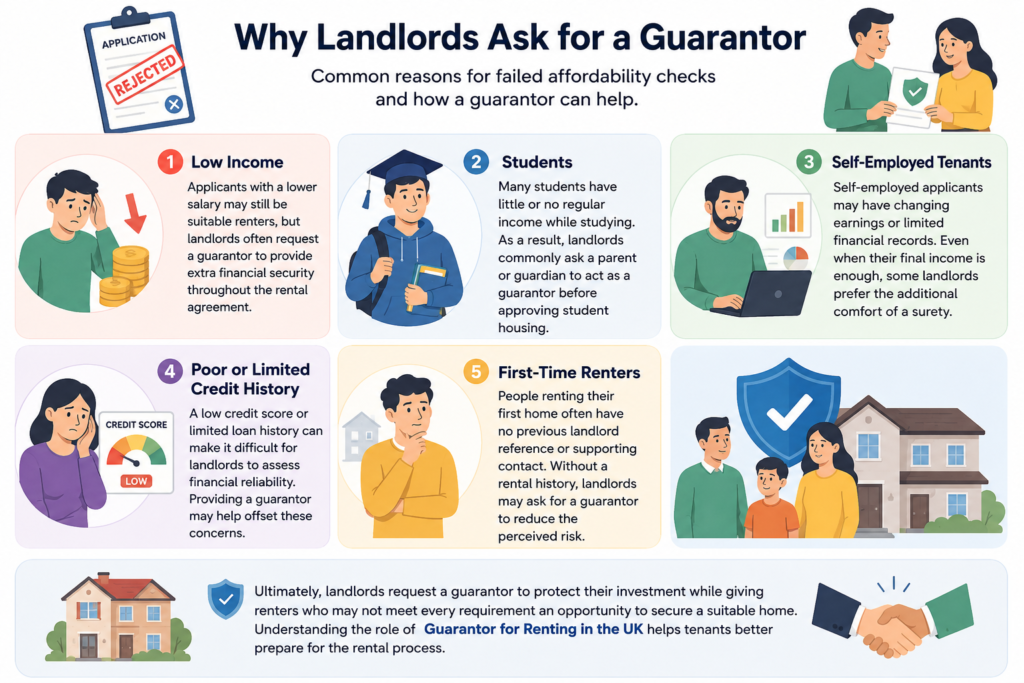
There are several situations where a property owner or letting broker may request a surety. A guarantor for renting in the UK plays an important role in many of these cases.
Failed Affordability Checks
Most landlords carry out affordability checks to compare a renter’s income with the monthly rent. If an applicant does not meet the required income threshold, a surety can strengthen the application and improve the chances of acceptance.
Low Income
Applicants with a lower salary may still be suitable renters, but property owners often request a surety to provide extra financial security throughout the rental agreement.
Students
Many students have little or no regular income while studying. As a result, property owners commonly ask a parent or guardian to act as a guarantor before approving student housing.
Self-Employed Tenants
Self-employed applicants may have changing earnings or limited financial records. Even when their final income is enough, some landlords prefer the additional comfort of a surety.
Poor or Limited Credit History
A low credit score or limited loan history can make it difficult for property owners to assess financial reliability. Providing a surety may help offset these concerns.
First-Time Renters
People renting their first home often have no previous property owner supporting contact. Without a rental history, property owners may ask for a surety to reduce the perceived risk.
Finally, property owners request surety to protect their investment while giving renters who may not meet every requirement an opportunity to secure a suitable home. Understanding the role of a guarantor for renting in the UK helps tenants better prepare for the rental process.
A landlord’s decision to request a guarantor is usually based on the overall risk associated with a tenancy rather than on one factor alone. Income, employment history, credit information, previous rental experience and the length of time an applicant has been financially established can all influence the decision. Two applicants with similar salaries may therefore receive different requirements depending on their individual circumstances. A guarantor gives the landlord another source of financial security when the tenant’s circumstances are less straightforward.
Read more:£30,000 Salary Rent UK – Best Ultimate Rent GuideWho Can Be a Guarantor?
| Who Can Be a Guarantor? | Details |
|---|---|
| Overview | A surety is usually someone with a stable financial background who is ready to accept legal responsibility if the renter fails to meet their duties. Although each property owner may have slightly different requirements, most expect the surety to be financially secure and easy to verify. |
| Common People Who Act as Guarantors | • Parent or guardian• Brother or sister• Other close family member• Trusted friend• Employer (less common)• Homeowner with a stable income• UK resident with a good credit history |
Typical Guarantor Eligibility
| Requirement | Why It Matters |
| UK resident | Easier to enforce the agreement if necessary |
| Stable income | Demonstrates the ability to cover missed rent |
| Good credit history | Shows financial reliability |
| Over 18 years old | Required to enter a legal contract |
| Permanent address | Helps complete identity and referencing checks |
Before agreeing to become a guarantor, the individual should fully understand the financial and legal responsibilities involved.
Choosing a guarantor should not be treated as a simple favour between friends or family members. The person you choose must be comfortable with the possibility of having to meet financial obligations if you fail to do so. It is also important to check the landlord’s requirements before asking someone to take on the role, because a person may be willing to help but still fail the referencing criteria. Discussing the expected income, residency, credit and documentation requirements in advance can prevent delays later in the application.
Requirements to Become a Guarantor
Property owners and letting brokers usually carry out referencing checks on sureties in much the same way as they do for tenants. The exact requirements vary, but most sureties are expected to meet several common requirements. A guarantor for renting in the UK is an important part of the rental approval process in many cases.
| Requirement | Details |
|---|---|
| Be at Least 18 Years Old | A surety must be of legal age to enter into a legally required contract. |
| Have a Stable Income | Many property owners require a surety to have a regular income that comfortably covers the renter’s rent if they ever need to step in. This is especially important in the case of a Guarantor for Renting in the UK arrangement. |
| Pass a Credit Check | A good credit history provides comfort that the surety manages their finances responsibly and is likely to meet any future requirements. |
| Live in the UK | Many landlords prefer sureties who have a permanent UK address because legal agreements are generally easier to enforce in a Guarantor for Renting in the UK setup. |
| Provide Proof of Identity | The surety is normally asked to provide documents, such as a travel document or driving licence, to confirm their identity. |
| Complete Referencing Checks | Most letting brokers verify job details, income, address history, and loan records before accepting someone as surety. |
Meeting these requirements does not ensure approval, but it greatly increases the likelihood that the property owner will accept the proposed surety. Understanding the role of a Guarantor for Renting in the UK helps both tenants and guarantors prepare properly.
Read more:House Share Rent Calculator UK – 7 Best Rent Split TipsWhat Does a Guarantor Agree to Pay?
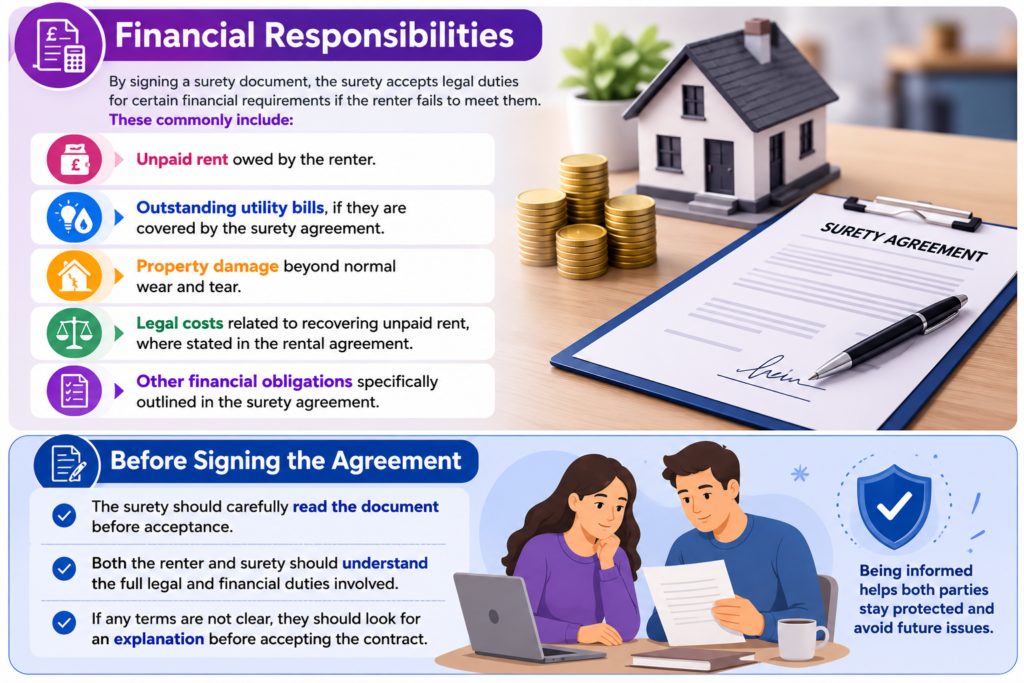
Financial Responsibilities
By signing a surety document, the surety accepts legal duties for certain financial requirements if the renter fails to meet them. These commonly include:
- Unpaid rent owed by the renter.
- Outstanding utility bills, if they are covered by the surety agreement.
- Property damage beyond normal wear and tear.
- Legal costs related to recovering unpaid rent, where stated in the rental agreement.
- Other financial obligations specifically outlined in the surety agreement.
Before Signing the Agreement
- The surety should carefully read the document before acceptance
- Both the renter and surety should understand the full legal and financial duties involved.
- If any terms are not clear, they should look for an explanation before accepting the contract.
The exact extent of a guarantor’s responsibility depends on the wording of the agreement they sign. This is particularly important because some agreements may cover more than simply missed rent. Depending on the terms, the guarantee could also relate to other costs connected with the tenancy. For this reason, a guarantor should never assume that their responsibility is limited to one missed monthly payment. Reading the agreement carefully and understanding when the liability starts, what it covers and when it ends is essential before signing.
How Does the Guarantor Process Work?
| Step | Details |
|---|---|
| Overview | The surety process is usually simple, even though the exact steps may vary a little between property owners and letting brokers. Understanding each stage can help both the renter and the surety prepare the required documents and avoid delays. |
| Submit a Rental Application | The renter completes a housing application and gives information such as job, earnings, and last rental record. |
| Affordability and Referencing Checks | The property owner or letting broker reviews the renter’s income, loan history, job status, and sources. If the renter does not meet the affordability requirements or has limited financial history, a surety may be requested. |
| Provide Guarantor Details | The renter submits the surety contact information. The surety must agree to undergo referencing checks before the application can continue. |
| Guarantor Referencing | The property owner verifies the surety’s identity, income, job, address, and loan history to ensure they are financially capable of supporting the rental agreement if required. |
| Surety Guarantor Agreement | If the surety successfully passes the checks, they sign a legally required surety agreement planning their responsibilities and financial requirements. |
| Tenancy Begins | Once all checks are complete and the necessary agreements have been signed, the property owner approves the application and the rental agreement can begin. |
Documents Required for a Guarantor
To complete the referencing process, property owners and letting brokers usually ask a surety to provide several documents that verify their identity and financial stability.
| Document | Purpose |
| Passport or Driving Licence | Proof of identity |
| Proof of Address | Confirms UK residency |
| Recent Payslips | Verifies regular income |
| Bank Statements | Demonstrates financial stability |
| Employment Letter | Confirms employment status |
| Credit Check Consent | Allows financial referencing |
Some landlords may request additional documents depending on the tenancy agreement or the guarantor’s employment status.
Read more:30x Rent Rule UK – What It Means and How Letting Agents Calculate AffordabilityWhen Do You Need a Guarantor?
A surety is not required for every rental agreement. But property owners often ask for one when they believe additional financial security is needed.
You may need a Guarantor for renting in the UK if you fall into one of the following categories. The requirement for a Guarantor for renting in the UK depends on your financial situation and rental background.
Students
Most students have limited or no regular income, making guarantors a common requirement for a place to stay.
First-Time Renters
People applying with no rental history may be asked to provide a surety because property owners cannot assess their previous payment record.
Low Income
If your salary does not meet the property owners’ affordability requirements, a guarantor can strengthen your application for a Guarantor for renting in the UK process.
Self-Employed Applicants
Although many self-employed people have a good income, irregular earnings sometimes lead landlords to request additional financial security.
Poor or Limited Credit History
A guarantor can reassure landlords if your credit record is limited or contains previous financial issues.
International Tenants
People moving to the UK often have no UK loan history or rental history, making a guarantor a common requirement.
How a Guarantor Can Affect Your Rental Application
Having a guarantor can change how a landlord views an application when the tenant’s financial circumstances are difficult to assess. For example, a renter may have recently moved into a new job, changed from employment to self-employment, or started renting after living with family for several years. In these situations, the applicant may not have the usual combination of income records and rental history that a landlord expects to see. A suitable guarantor can provide another level of financial reassurance, but the tenant should still demonstrate that they intend and are able to meet the rent themselves. The guarantor should support the application rather than be treated as the main source of rent.
Can You Rent Without a Guarantor?
| Section | Details |
|---|---|
| Can You Rent Without a Guarantor? | Yes, renting without a guarantor is possible in many situations. Whether you need one depends on your financial situation and the property owner’s conditions. If you have a stable income, a strong loan history, and satisfy affordability checks, many property owners will approve your application without requesting a guarantor. However, if a guarantor is required, there are still several alternatives that may help secure the rental agreement. |
| Alternative: Pay Rent in Advance | Some landlords accept six or even twelve months’ rent upfront instead of requiring a guarantor. |
| Alternative: Use a Professional Guarantor Service | Several companies offer surety services for allowed renters in return for a fee. This option is mainly useful for global students or people applying without family in the UK. |
| Alternative: Choose a More Affordable Property | Applying for a property with a lower monthly rental fee may help you pass affordability checks without needing a surety. |
| Alternative: Find a Flexible Landlord | Some private landlords assess tenants individually and may accept additional proof of income, savings, or employment instead of requesting a guarantor. |
Comparison of Alternatives
| Option | Best For | Cost |
| Guarantor | Most applicants | Usually free |
| Rent in Advance | Tenants with savings | High upfront cost |
| Guarantor Service | International tenants | Service fee applies |
| Lower Rent Property | Budget-Alert renters | Lower monthly costs |
Responsibilities of a Guarantor
Before approving to become a surety, it is important to understand the legal responsibilities involved.
A surety may be responsible for:
- Paying unpaid rent if the renter fails to do so.
- Covering financial losses specified in the rental agreement.
- Paying certain legal costs where stated in the contract.
- Meeting requirements until the guarantor agreement ends.
These responsibilities can continue throughout the rental agreement and, in some cases, even after a fixed-term agreement has expired if the surety agreement allows for it.
Because of these legal Promises, the surety should carefully read every clause before signing.
Read more:Rent Affordability Calculator London – How Much Rent Can You Afford in LondonBenefits for Tenants
Why a Guarantor Can Help
Having a surety can greatly improve your chances of getting a rental property. Some of the key benefits include:
- Improves affordability approval by providing extra financial security to the property owner
- Increases landlord confidence that rent will be paid if financial difficulties arise.
- Expands your rental options by allowing you to apply for properties that require a guarantor.
- Supports students and first-time renters who have little or no rental record
- Helps self-employed people applying whose income may vary from month to month.
- Speeds up the application process by addressing ability-to-pay concerns early.
- Strengthens applications with limited loan history, making approval more likely.

Final Thought
For many renters, having a surety can be the deciding factor between an accepted application and a rejected one.
Risks of Being a Guarantor
| Section | Details |
|---|---|
| Overview | Although acting as a surety helps someone secure a home, it also carries important financial and legal risks. |
| Financial Responsibility | If the renter misses rent payments, the surety may be legally required to pay the outstanding amount. |
| Credit Impact | If payments are not made when required, legal action could affect the surety’s own financial situation. |
| Legal Action | Property owners may take legal action against the guarantor to recover unpaid rent or other costs covered by the document. |
| Long-Term Commitment | Some guarantor documents continue beyond the initial fixed term of the tenancy. It is important to understand exactly when the promise begins and ends before signing. |
| Important Reminder | Anyone considering becoming a surety should ensure they are financially able to accept these responsibilities and fully understand the terms of the document before making a promise. |
Real-Life Example
How a Guarantor Helped Secure a Rental Property
Sarah had accepted her first graduate job with a final salary of £24,000. She found a one-bedroom apartment she loved, but during the viewing process, the letting broker explained that her income did not meet the property owner’s affordability requirement.
In place of rejecting her application, the landlord offered an alternative solution—a guarantor.
Sarah’s father had a stable income, owned his home, and had a strong loan history. After passing the required referencing checks and signing the surety agreement, Sarah’s rental agreement was approved.
Key Takeaway
- Needing a surety does not mean your rental application will be rejected.
- A surety provides property owners with additional financial security.
- Having a suitable surety can improve your chances of securing a rental property, even if you do not fully meet the affordability requirements.
Read more:Rent vs Buy Calculator UK – Should You Rent or Buy a HomeCommon Mistakes to Avoid
| Section | Details |
|---|---|
| Overview | Many renters and security providers ignore important details during the application process. Avoiding these common mistakes can help speed up the process, reduce confusion, and avoid unplanned financial requirements. |
| Not Reading the Guarantor Agreement | Never sign a surety document without reading it carefully. Make sure you understand exactly what financial duties are covered and how long they last. |
| Choosing Someone Who Doesn’t Meet the Requirements | A surety who fails affordability checks or has a poor credit history may not be accepted by the landlord. Always confirm the property owner’s approval status requirements before selecting someone. |
| Assuming the Guarantor Has No Financial Risk | Some people believe a surety simply signs paperwork as a formality. In reality, they may become, by law, responsible for unpaid rental fees or other costs if the renter breaks the rental agreement. |
| Providing Incomplete Documents | Missing documents can delay the checking process. Preparing personal details, income, and address documents in advance helps the application move more easily. |
| Waiting Until the Last Minute | If you think a surety may be required, discuss it early with the person you plan to ask. This gives them enough time to prepare and complete the necessary checks. |
Tips Before Asking Someone to Be Your Guarantor
If you require a Guarantor for renting in the UK, selecting the suitable person is just as important as searching for the right home. Before asking a person to approve this responsibility, consider the following useful tips
- Explain why the Property owner requires a surety
- Be honest about your financial condition
- Make sure they understand the by-law duties involved.
- Share a copy of the surety document before they sign.
- Confirm they fulfil the property owner’s qualification requirements.
- Prepare all needed documents in advance.
- Answer any questions they may have before continuing
- Thank them for taking on an important financial promise

A clear and open conversation helps both the tenant and the surety understand their responsibilities before the rental agreement begins.
What is a Guarantor for Renting in the UK?
A Guarantor for renting in the UK is someone who legally agrees to cover certain financial obligations, such as unpaid rent, if the tenant cannot meet the terms of the tenancy agreement. Landlords often request a guarantor when a tenant has a low income, limited rental history, or does not meet affordability requirements.
Who can be a guarantor?
A guarantor is usually a parent, close family member, or trusted friend with a stable income, good credit history, and a permanent UK address. Each landlord may have slightly different eligibility requirements.
Does a guarantor have to be a homeowner?
Not always. While many landlords prefer homeowners because they are often seen as financially stable, some also accept non-homeowners who meet the required income and credit criteria.
Can a friend be my guarantor?
Yes. A friend can act as your guarantor if they satisfy the landlord’s referencing checks and are willing to accept the legal and financial responsibilities.
Can I rent without a guarantor?
Yes. Many tenants rent successfully without a guarantor if they meet affordability checks, have a strong credit history, or choose alternatives such as paying rent in advance.
What happens if I don’t pay my rent?
If the tenant fails to pay rent and the tenancy agreement includes a guarantor, the landlord may ask the guarantor to cover the outstanding amount. If payment is still not made, legal action may be taken.
Does a guarantor need a good credit score?
In most cases, yes. Letting agents often carry out credit checks to ensure the guarantor is financially reliable and capable of meeting any future obligations.
Can a guarantor withdraw after signing?
Generally, a guarantor cannot withdraw once the agreement has been signed unless the landlord agrees or the tenancy ends according to the terms of the guarantor agreement.
Can more than one tenant share the same guarantor?
In some cases, yes. A landlord may allow one guarantor to cover more than one tenant, especially if they are renting the same property. However, the guarantor must usually meet the required income and referencing criteria for all tenants involved.
Can an overseas guarantor be accepted?
Some landlords accept overseas guarantors, but many prefer a UK-based guarantor because legal agreements are generally easier to enforce. If an overseas guarantor is not accepted, a professional guarantor service may be an alternative.
Conclusion
Knowing how a Guarantor for renting in the UK works can make the rental process far less difficult
If you’re a student, a new renter working for yourself, or sending an application with a lower income, having the right surety can greatly improve your chances of getting a rental agreement
Before signing any document, both the renter and the surety should carefully check the Conditions, understand their responsibilities, and get ready with the needed documents.
Taking these steps helps make the rental easier and gives both people involved greater trust during the rental agreement