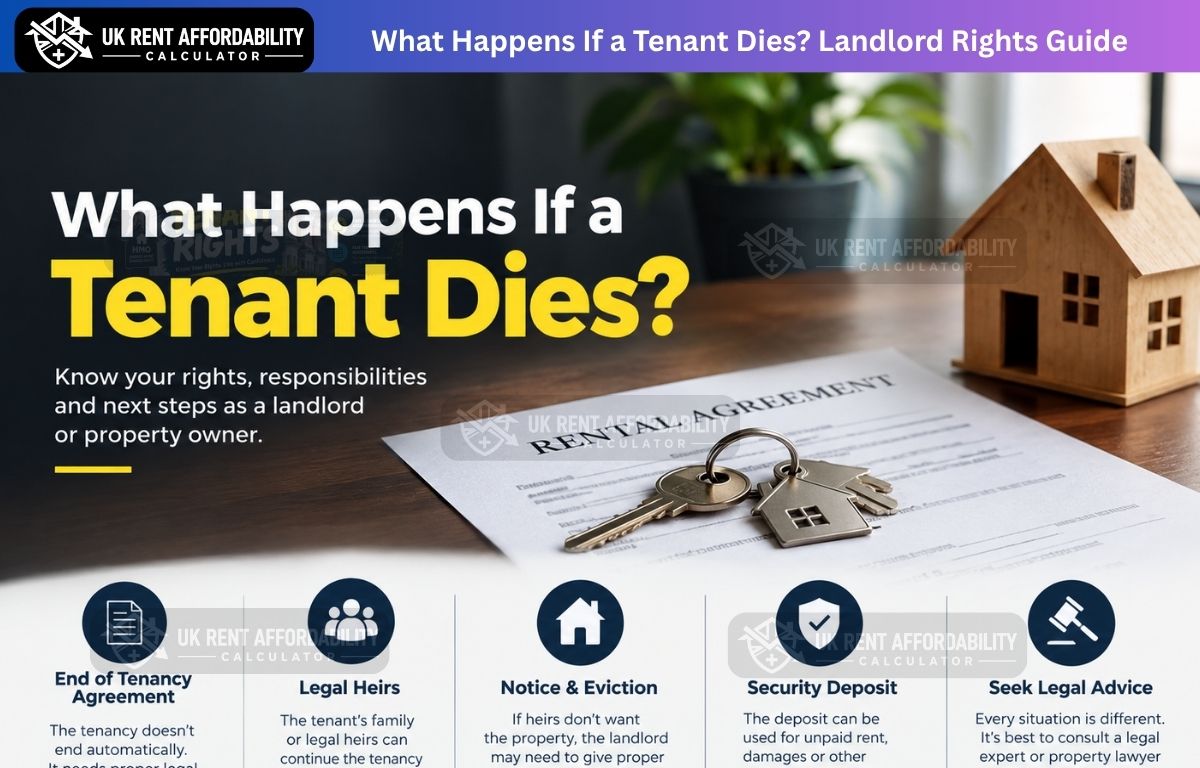
When Vivian’s brother died suddenly, the family were grieving — and, within days, also facing practical questions nobody had prepared them for. Could Vivian’s sister-in-law stay in the rented flat? Who had to pay the rent? Who could end the tenancy, clear the flat, and claim back the deposit? The landlord, meanwhile, was asking when the property would be empty. Nobody in that conversation was being unreasonable. They simply did not know what happens if a tenant dies, or that a tenancy does not end when a tenant dies.
This guide is for families, executors and surviving partners in that position. It explains, in plain language, what happens if a tenant dies across the UK — starting with England, where the rules are set out in full — how succession works, what the executor must do, what rent is still payable, what the landlord can and cannot do, and how Scotland, Wales and Northern Ireland differ. It is about the tenant’s death — the opposite situation from a landlord dying, which follows different rules and is covered separately.
Quick Answer: A tenancy does not automatically end when a tenant dies. If there were joint tenants, the tenancy continues for the survivor. If the tenant was a sole tenant under a periodic assured tenancy in England, a spouse, civil partner or partner living with them as their only or principal home may succeed to the tenancy under section 17 of the Housing Act 1988 — but only once, and only if the tenant was not already a successor.
If nobody qualifies to succeed, the tenancy passes to the tenant’s personal representative (executor or administrator), rent remains payable from the estate until the tenancy lawfully ends, and the landlord must use a lawful route — such as Ground 7 in England, within 12 months — to recover possession.
Does the Tenancy End When a Tenant Dies?
In most cases, no. Death does not, by itself, bring a private tenancy to an end. What happens if a tenant dies depends on three things: whether the tenancy was joint or sole, whether it was periodic or fixed-term, and whether anyone qualifies to succeed to it.
If the tenant was a joint tenant, the tenancy continues for the surviving joint tenant or tenants. If the tenant was a sole tenant, the tenancy either passes to a qualifying successor by law, or it passes to the tenant’s estate and is dealt with by their personal representative until it is lawfully ended by notice, surrender or a court order. A landlord cannot simply change the locks, clear the flat or re-let the property the day after a death. Until the tenancy has lawfully ended, the landlord’s rights are limited, and anyone living there lawfully is entitled to remain.
That is also why speed matters for the family, in a practical rather than a legal sense: while the tenancy continues, rent continues to accrue against the estate. Acting promptly — confirming who the personal representative is, telling the landlord, and deciding whether anyone will succeed or the tenancy will be ended — protects the estate from unnecessary rent and protects anyone living in the home from uncertainty.
| Situation at death | What happens to the tenancy |
|---|---|
| Joint tenancy, one tenant dies | Continues for the surviving joint tenant(s) by survivorship |
| Sole periodic tenancy, qualifying spouse/partner lives there | Tenancy vests in that person by succession (England, section 17) |
| Sole periodic tenancy, nobody qualifies | Tenancy passes to the personal representative (executor/administrator) |
| Sole fixed-term tenancy | Tenancy continues until the term ends, then becomes periodic; succession and possession rules then apply |
| No personal representative appointed yet | Tenancy still continues; the landlord may need to deal with the Public Trustee or await appointment |
If There Were Joint Tenants: Survivorship
When two or more people hold a tenancy jointly, they own the tenancy together as one legal interest, not as separate shares. On the death of one joint tenant, the tenancy automatically continues in the name of the survivor or survivors. This is called survivorship, and it is not the same as succession: no new tenancy is created, and the survivor does not need to “apply” to inherit anything.
The surviving joint tenant takes on the whole tenancy, including its responsibilities. That means they become liable for the full rent, not just their former share, and for any arrears outstanding at the date of death. If the survivor cannot afford the full rent alone, they should speak to the landlord early: a landlord may agree to a new sole tenancy, a replacement joint tenant, or a payment plan, but none of those is automatic. Our guide to joint tenancies explains how joint liability works in ordinary circumstances, and the same principle applies after a death.
Survivorship also counts for succession purposes. If a joint tenant becomes sole tenant by survivorship and later dies, the tenancy cannot then pass again by succession to a spouse or partner, because the tenant is already treated as a successor under the Housing Act 1988. Families sometimes miss this point and assume a second succession is available. It is not — the one-succession rule, explained below, has already been used.
Who Can Succeed to a Sole Tenancy in England?
Succession is the legal process by which a tenancy passes to someone else on the tenant’s death, by operation of law, rather than under the will. For a periodic assured tenancy in England (which, since 1 May 2026, is the standard form of private tenancy following the Renters’ Rights Act 2025, with former assured shorthold tenancies converted to assured periodic tenancies), section 17 of the Housing Act 1988 gives a narrow succession right.
A person succeeds if all of these conditions are met:
- The tenant who died was the sole tenant under an assured periodic tenancy.
- Immediately before the death, the tenant’s spouse or civil partner — or a person living with the tenant as if they were a spouse or civil partner — was occupying the home as their only or principal home.
- The tenant who died was not themselves a successor.
If those conditions are met, the tenancy vests in the spouse or partner automatically. It does not pass under the will, and the will cannot give it to someone else instead. The successor takes over the same tenancy, on the same terms, including any arrears that were outstanding.
| Who can succeed (England, assured periodic tenancy) | Conditions |
|---|---|
| Spouse or civil partner | Living in the home as their only or principal home immediately before the death |
| Partner living as spouse/civil partner | Same occupation condition; the relationship must be as husband/wife or civil partners, not merely housemates |
| Adult child, sibling, parent or other family member | No statutory right under section 17 — only if the tenancy agreement itself gives a wider succession right |
| Friend, lodger or housemate | No statutory right under section 17 |
| Someone who moved in after the death | No succession right — they were not occupying the home immediately before the death |
Two common misunderstandings are worth correcting. First, a family member who lived with the tenant for years does not automatically succeed under section 17: the statutory right is for a spouse, civil partner or partner living as such. A tenancy agreement may give wider rights — some do, particularly older or social housing agreements — so always read the agreement itself. Second, a person who was not living in the home as their main home immediately before the death cannot succeed, even if they are the tenant’s next of kin or executor. Next of kin status alone gives no right to the tenancy.
The One-Succession Rule
Only one succession is permitted under the Housing Act 1988. A tenant counts as a successor if the tenancy came to them by succession, or under the will or intestacy of a previous tenant, or by survivorship from a joint tenancy. If the tenant who died was already a successor, there can be no further statutory succession on their death.
Worked example — Marina and the one-succession rule: Marina’s husband held a periodic assured tenancy and died in 2022. Marina, who lived with him as her main home, succeeded to the tenancy under section 17. Marina then dies in 2026, leaving an adult son who has lived in the flat throughout. The son cannot succeed under section 17, because Marina was herself a successor.
Unless the tenancy agreement gives him a separate contractual right, the tenancy passes to Marina’s personal representative, and the landlord may seek possession through the lawful route described below. This feels harsh, and it is one reason families should check the tenancy agreement and get advice early rather than assuming the home can be passed on again.
A successor also takes the tenancy as it stands, including its history. If there were arrears when the original tenant died, the successor inherits the liability for them, and the landlord may pursue those arrears against the successor as tenant, not merely against the estate.
If Nobody Qualifies to Succeed
If there is no qualifying successor, the tenancy does not vanish. It devolves under the tenant’s will or intestacy rules to their personal representative — the executor named in the will, or the administrator appointed where there is no will or no executor able to act. The personal representative steps into the tenant’s shoes for the purposes of the tenancy: they can pay the rent from the estate, they can end the tenancy by giving notice or agreeing a surrender with the landlord, and they are the person the landlord should deal with about keys, belongings and the deposit.
A next of kin who is not the executor or administrator cannot end the tenancy on their own authority, however well-meaning they are. If no personal representative has been appointed yet, the family should tell the landlord who is applying, keep the property secure, and avoid making commitments — such as promising a vacant date — until someone has authority to give them. Where there is genuinely no one to administer the estate, the Public Trustee may become involved, and the landlord can serve notice on the Public Trustee to bring the tenancy to an end.
For a fixed-term tenancy, the position is slightly different in timing but not in principle: the tenancy continues for the remainder of the fixed term, passing to the personal representative in the same way. The landlord cannot use Ground 7 (below) during the fixed term, because that ground applies to periodic tenancies; once the term ends and the tenancy becomes periodic, Ground 7 may become available if still within the time limit.
The Executor’s Job, Step by Step
Being an executor after a bereavement is difficult enough without a tenancy to manage. The steps below cover the tenancy side only; the wider estate — probate or letters of administration, debts, tax and distribution — is a separate process on which a solicitor can advise.
| Step | What to do |
|---|---|
| 1. Tell the landlord promptly | Send a copy of the death certificate, say who the personal representative is (or who is applying), and give a contact address |
| 2. Secure the property | Make sure it is locked, insured and safe; tell the insurer and utility suppliers |
| 3. Check for succession | Establish whether anyone living there qualifies to succeed, and tell the landlord either way |
| 4. Keep paying rent from the estate | Rent continues until the tenancy lawfully ends; do not let arrears build up unnecessarily |
| 5. Decide: end or surrender | Give proper notice or agree a written surrender with the landlord |
| 6. Clear and return keys | Clear belongings by agreement, take final meter readings, return all keys and get a receipt |
| 7. Settle the deposit | Agree deductions, if any, and have the balance returned to the estate |
Notice given by an executor must be valid for the tenancy type. For a periodic assured tenancy in England, the executor can end the tenancy by serving a notice to quit in the usual way for that tenancy, or — usually faster and cleaner — by agreeing a surrender in writing with the landlord, recording the agreed end date and that no further rent will be charged after it. A surrender should always be in writing and signed by both sides: a verbal agreement to “just hand the keys back” can lead to a dispute about whether the tenancy really ended and whether further rent is due.
Callout: Do not clear the flat or dispose of belongings before you have authority and, ideally, agreement with the landlord. Belongings belong to the estate, not to the landlord and not automatically to the next of kin. Photograph the property, list valuable items, and keep receipts for any storage or clearance costs — they may be legitimate estate expenses.
Rent: Who Pays, and for How Long?
Rent remains payable until the tenancy lawfully ends. The estate, not the family personally, is liable — provided family members have not separately guaranteed the rent or taken over the tenancy themselves. That distinction matters: an executor who pays rent from estate funds is administering the estate; a relative who moves in and starts paying rent may inadvertently create a new occupation arrangement and should get advice first.
Arrears that existed before the death remain debts of the estate. Rent that accrues after the death, up to the date the tenancy ends, is also payable from the estate. If the landlord agrees an early surrender, rent stops on the agreed date. If the tenancy is ended by notice, rent stops when the notice expires. Delay costs money, which is why an early conversation with the landlord about a surrender date is usually in everyone’s interest.
Worked example — Vivian’s brother’s estate: Vivian’s brother paid £1,200 per month. He died owing £600 in arrears. The tenancy continued for two further full months before the executor and landlord agreed a surrender, so rent for those two months was 2 × £1,200 = £2,400. The total rent claim against the estate was £600 + £2,400 = £3,000. If the executor had agreed the surrender a month earlier, the estate would have saved one month’s rent: £3,000 − £1,200 = £1,800. That arithmetic is the practical reason to act promptly, even while grieving.
If the tenant was receiving Housing Benefit, it stops on the Sunday following the death, and if they were receiving Universal Credit, the housing element for the deceased person stops — the estate cannot rely on benefit payments to cover rent after the tenancy should have ended. A surviving partner who succeeds to the tenancy must make their own claim in their own name; a surviving partner who does not succeed cannot continue the deceased person’s claim. Our guide to how much rent Universal Credit will pay explains how a new claim is assessed, and our guide to rent arrears explains what happens when rent falls behind.
Deposit, Keys, Belongings and Clearing the Property
The deposit belongs to the tenancy, not to the landlord. On the tenancy ending, the deposit should be returned to the estate, less any properly evidenced deductions for unpaid rent, damage beyond fair wear and tear, or missing items. The personal representative should ask the landlord or agent which scheme holds the deposit, agree the check-out position, and use the scheme’s dispute process if deductions are disputed. A deduction cannot be taken simply because the tenant died, and the estate is entitled to the same evidence — inventory, photographs, invoices — as any departing tenant.
Worked example — deposit return: The deposit held for Vivian’s brother’s flat was £1,500. The landlord claimed £240 for professional cleaning and £180 for a damaged worktop, a total of £240 + £180 = £420. The estate was therefore due £1,500 − £420 = £1,080. If the executor disputed either item, the deposit scheme’s free adjudication process would decide the split on the evidence, and the undisputed balance should not be held back while the disputed part is resolved.
Keys should be returned in person where possible, with a written receipt recording the date, time and number of keys. That receipt is the executor’s proof of when possession was given back, and it protects the estate against a later claim for rent after that date. Final meter readings should be taken on the same day and sent to the suppliers, mail should be redirected, and if belongings cannot be cleared immediately, agree a written timetable with the landlord covering insurance, security and whether rent continues in the meantime.
What Can the Landlord Do?
A landlord who wants possession of a tenancy that has passed to an estate in England has a specific route: Ground 7 of Schedule 2 to the Housing Act 1988, which applies where a periodic tenancy has devolved under the will or intestacy of a former tenant. The landlord serves a Section 8 notice citing Ground 7, giving two months’ notice, and if the property is not vacated, applies to the county court for a possession order.
Ground 7 carries a strict time limit: possession proceedings must be begun within 12 months of the death, or within 12 months of the date the landlord became aware of the death — serving the notice within that window is not enough; the claim itself must be issued in time. If the landlord misses the window, Ground 7 is no longer available, and they must rely on another ground or on agreement with the estate. Ground 7 does not apply where someone has succeeded to the tenancy, and it does not apply during a fixed term.
| Landlord option | When it applies | Notice/time limit |
|---|---|---|
| Accept a surrender from the executor | Any tenancy, by agreement | Agreed date, in writing |
| Accept notice to quit from the executor | Periodic tenancy | Notice period for that tenancy |
| Ground 7 possession (England) | Periodic tenancy devolved to the estate, no successor | 2 months’ Section 8 notice; proceedings within 12 months of death or knowledge of it |
| Another Section 8 ground (for example, serious arrears) | If that ground is genuinely made out | Notice period for that ground |
| Offer a new tenancy to an occupier | Any tenancy, by agreement | New agreement, new terms |
A landlord must not use self-help: changing locks, removing belongings, cutting off utilities or harassing occupants to leave is unlawful, and the estate or a successor can seek remedies for illegal eviction. Equally, a landlord is entitled to be told promptly what is happening, to be paid rent due from the estate, and to recover the property lawfully once the tenancy has ended. Most of these cases resolve by agreement — a surrender date, a deposit settlement and a clean handover — and both sides benefit from keeping the conversation factual and in writing.
One point families sometimes raise is a guarantor. Whether a guarantor remains liable after a tenant’s death depends on the wording of the guarantee deed: some guarantees end on the tenant’s death, some continue until the tenancy lawfully ends, and some continue only for arrears accrued before death. Do not assume either way — read the guarantee, and get advice before paying or promising anything under it. Our guide to guarantors explains how guarantee wording is interpreted, but a guarantee tied to a specific tenancy needs its own wording checked.
Benefits, Council Tax and Other Bills
When a sole tenant dies, benefit payments made to that person stop. Housing Benefit stops on the Sunday following the death. Universal Credit is claimed by an individual, so the deceased person’s claim ends and any surviving partner must claim in their own right if they remain in the home as successor or under a new tenancy. Tell the Department for Work and Pensions and the local council promptly, ideally through the Tell Us Once service offered when the death is registered, so overpayments do not build up and have to be repaid from the estate.
Council tax follows a separate set of rules. If the property becomes empty after the tenant’s death, it may qualify for a Class F exemption: no council tax is payable while the property remains unoccupied and before probate or letters of administration are granted, and for up to six months after the grant, provided the property stays unoccupied and has not been sold, transferred or re-let. For a rented property, the exemption ends earlier if the tenancy ends or another person becomes liable for council tax. If someone continues to live in the property, they become liable in their own right, and any single-person discount or Council Tax Support must be claimed afresh.
Our guide to council tax for renters explains liability and discounts in more detail.
| Payment | What happens on the tenant’s death |
|---|---|
| Rent | Continues from the estate until the tenancy lawfully ends |
| Housing Benefit | Stops on the Sunday following the death |
| Universal Credit (deceased person’s claim) | Ends; a survivor must claim in their own name |
| Council tax (property empty) | Class F exemption: until probate, then up to 6 months after, while unoccupied and not transferred |
| Council tax (someone still living there) | That person becomes liable; discounts/support must be re-claimed |
| Utilities | Final readings on handover; estate pays up to that date unless a successor takes over the accounts |
Fixed-Term and Periodic Tenancies: Why the Difference Matters
The distinction between a fixed-term and a periodic tenancy shapes what the executor and the landlord can do, and when. During a fixed term, the tenancy is locked in: the executor cannot simply end it by notice unless the agreement contains a break clause or the landlord agrees a surrender, and the landlord cannot use Ground 7. Once the fixed term ends, the tenancy becomes periodic (or, under older arrangements, a statutory periodic tenancy), and the periodic rules — succession, notice to quit, Ground 7 — apply in full.
In practice, most families dealing with a death in 2026 will be dealing with a periodic tenancy, because former assured shorthold tenancies converted to assured periodic tenancies on 1 May 2026. But if the agreement still shows a fixed term running — for example, a tenancy granted with a fixed term that has not yet expired, or a social tenancy with different terms — check the term before assuming a notice will work.
If you are unsure, ask the landlord for a copy of the agreement and take advice before serving anything. Our guides to ending a tenancy early and what happens when a fixed term ends explain the mechanics for ordinary cases, and the same mechanics apply when the tenant has died and the executor is acting.
How Scotland, Wales and Northern Ireland Differ
Do not apply English rules to a tenancy elsewhere in the UK. The four nations have different statutes, different names for the tenancy, and different succession rules.
In Scotland, a Private Residential Tenancy does not automatically end on the tenant’s death. A partner, family member or resident carer who lived in the property as their only or principal home may succeed, with priority given to a partner, then family members, then a carer. Spouses and civil partners have no qualifying period; other qualifying persons must have occupied the home for a qualifying period that was 12 months and, for deaths on or after 6 October 2026, is 6 months, and the landlord must have been notified in writing of their occupation before the death.
The notification requirement is a trap for the unwary: time lived in the home before the landlord was told does not count. If nobody succeeds, the tenancy passes to the executor and the landlord must follow the Scottish tribunal process.
In Wales, a sole occupation contract-holder’s death is governed by the Renting Homes (Wales) Act 2016. The contract ends one month after the death, or earlier if the landlord is notified by the authorised persons, unless someone qualifies to succeed. A priority successor — a spouse, civil partner or partner living as such who occupied the home as their only or principal home at death — succeeds first.
If there is no priority successor, a reserve successor — a family member or carer who lived in the home as their principal home for the 12 months before the death — may succeed. If the contract-holder was themselves a reserve successor, no further succession is possible. Joint contract-holders continue by survivorship, as in England.
In Northern Ireland, private tenancies are governed by separate legislation and the succession position is narrower and more fact-specific: much depends on the type of tenancy and whether it is a protected or statutory tenancy under the Rent Order. Families in Northern Ireland should take local advice promptly rather than relying on English succession rules, and should check whether the tenancy agreement itself provides for succession. The practical steps — tell the landlord, secure the property, identify the personal representative, do not dispose of belongings without authority — are the same everywhere.
| Nation | Tenancy | Who can succeed | Key point |
|---|---|---|---|
| England | Assured periodic tenancy | Spouse/civil partner/partner living as such, occupying as main home, one succession only | Section 17, Housing Act 1988; Ground 7, 12-month limit |
| Scotland | Private Residential Tenancy | Partner, then family member, then resident carer | 6-month qualifying period for deaths on/after 6 Oct 2026; landlord must have been notified in writing |
| Wales | Occupation contract | Priority successor, then reserve successor (family/carer, 12 months) | Contract ends 1 month after death unless someone succeeds |
| Northern Ireland | Private tenancy under the Rent Order | Depends on tenancy type; take local advice | Do not assume English rules apply |
What to Do First: A Short Checklist
If you have just learned that a tenant has died, you do not need to resolve everything today. Do these things first, in this order, and the rest becomes manageable:
- Tell the landlord or agent, in writing, that the tenant has died, and give them a contact name and address.
- Establish whether anyone living in the home was a joint tenant or may qualify to succeed — and tell the landlord either way.
- Identify the personal representative, or who is applying to become one, and do not let anyone without authority end the tenancy or dispose of belongings.
- Keep paying rent from the estate, or agree a surrender date quickly, so rent does not accumulate needlessly.
- Secure the property, inform the insurer and suppliers, and take meter readings when the property is handed back.
- Agree the deposit return in writing, and use the deposit scheme’s dispute process if deductions are disputed.
- Tell the council and the Department for Work and Pensions, ideally via Tell Us Once, so benefits and council tax are corrected.
If the landlord is pressing for immediate vacant possession, or if someone living in the home is told they must leave at once, get advice before agreeing to anything. Shelter, Citizens Advice and a housing solicitor can all help, and in Scotland the First-tier Tribunal and Shelter Scotland are the relevant routes. A short delay to get the law right is almost always cheaper — for the estate and for the landlord — than an unlawful eviction or a disputed surrender.
Frequently Asked Questions
Does a tenancy end automatically when a tenant dies?
No, not in most cases. A joint tenancy continues for the survivor, a qualifying partner may succeed to a sole tenancy, and otherwise the tenancy passes to the tenant’s personal representative until it is lawfully ended by notice, surrender or a court order.
Can a husband, wife or partner stay in the home after the tenant dies?
In England, a spouse, civil partner or partner living with the tenant as their only or principal home immediately before the death succeeds to a periodic assured tenancy under section 17 of the Housing Act 1988, provided the tenant was not already a successor. The successor takes the same tenancy, including any arrears.
Can an adult child succeed to their parent’s tenancy?
Not under section 17 in England, which covers only a spouse, civil partner or partner living as such. An adult child can succeed only if the tenancy agreement itself gives a wider contractual right, or under the different rules that apply in Scotland or Wales, or for certain social tenancies. Always check the agreement.
What is the one-succession rule?
Only one statutory succession is allowed for an assured tenancy. If the tenant who died was already a successor — by succession, under a will or intestacy, or by survivorship from a joint tenancy — there can be no further succession on their death, and the tenancy passes to their personal representative.
Who pays the rent after a tenant dies?
The tenant’s estate pays rent until the tenancy lawfully ends, including any arrears from before the death. Family members are not personally liable unless they guaranteed the rent or took over the tenancy themselves. Agreeing an early surrender is the usual way to stop rent accruing.
What is Ground 7 and how long does a landlord have to use it?
Ground 7 in Schedule 2 to the Housing Act 1988 lets a landlord in England seek possession of a periodic tenancy that has devolved to a deceased tenant’s estate, where nobody has succeeded. The landlord must serve two months’ Section 8 notice and begin court proceedings within 12 months of the death or of learning of it.
Can the landlord just change the locks or clear the flat?
No. Until the tenancy has lawfully ended, changing locks, removing belongings or cutting off services to force occupants out is unlawful. The landlord must agree a surrender, accept valid notice, or obtain a court order.
Who can end the tenancy if there is no successor?
The tenant’s personal representative — the executor named in the will or the administrator appointed by the court — can end it by notice or by agreeing a surrender in writing with the landlord. A next of kin who is not the personal representative cannot end it on their own authority.
What happens to the deposit?
The deposit is returned to the estate, less any properly evidenced deductions for unpaid rent, damage beyond fair wear and tear or missing items. The personal representative should use the deposit scheme’s dispute process if deductions are disputed.
Does Housing Benefit or Universal Credit continue after the tenant dies?
No. Housing Benefit stops on the Sunday following the death, and the deceased person’s Universal Credit claim ends. A surviving partner who succeeds or takes a new tenancy must claim in their own name.
What happens to council tax if the property is left empty?
The property may qualify for a Class F exemption: no council tax while it remains unoccupied before probate is granted, and for up to six months after the grant, provided it stays unoccupied and is not sold, transferred or re-let. For a rented property the exemption ends when the tenancy ends or someone else becomes liable.
Does the position differ in Scotland and Wales?
Yes. In Scotland, a partner, family member or resident carer may succeed to a PRT, with a 6-month qualifying period for deaths on or after 6 October 2026 and a written-notification requirement. In Wales, an occupation contract ends one month after the sole contract-holder’s death unless a priority or reserve successor qualifies. Northern Ireland has its own, narrower rules — take local advice.
Final Thoughts
A tenant’s death is a human event first and a legal event second, and the law, for once, gives families time: the tenancy does not end on the day of death, a qualifying partner can stay, and an executor can wind the tenancy up in an orderly way. The risks come from the two opposite mistakes — assuming the tenancy has ended and clearing the flat, or assuming nothing needs to be done and letting rent accumulate. Avoid both by telling the landlord promptly, establishing succession early, and agreeing an end date in writing.
If you are an executor, keep a simple file: the tenancy agreement, the death certificate, your appointment documents, every letter to and from the landlord, the deposit scheme details, meter readings and the key receipt. That file is what turns a difficult few weeks into a clean handover. And if you are a surviving partner or family member who hopes to stay, check succession first, before you spend money on the assumption that the home is yours — the answer depends on the tenancy type, your occupation before the death, and whether a succession has already been used, and getting that answer early protects everyone.
This guide is about a tenant dying. If instead it is the landlord who has died, the position is different — the tenancy continues, rent is paid to the landlord’s estate, and the tenant’s rights are largely unchanged — and our separate guide to what happens if a landlord dies explains that situation.
Further Reading
- What to do after someone dies — GOV.UK: https://www.gov.uk/after-a-death
- Dealing with the affairs of someone who has died — Citizens Advice: https://www.citizensadvice.org.uk/scotland/family/death-and-wills/after-death-dealing-with-an-estate/
- Refer a deceased person’s estate to the Treasury Solicitor — GOV.UK guidance: https://www.gov.uk/guidance/refer-a-deceased-persons-estate-to-the-treasury-solicitor