

When Rob’s warehouse shifts were cut from five days to three, his wages dropped by £400 a month overnight. His rent stayed the same: £850, due on the 1st. The first month he paid it two weeks late. The second month he paid half. By the third month, he owed £1,275 — and he stopped opening his landlord’s emails altogether.
Rob’s story is painfully common. Rent arrears rarely start with irresponsibility; they start with a lost job, cut hours, an illness, a relationship breakdown, or a benefit payment that arrives late. What turns a shortfall into a crisis is usually not the missed payment itself — it is doing nothing about it. This guide explains exactly what to do if you can’t pay your rent: who to talk to first, what help you can claim, what your landlord can and cannot legally do, and how eviction for arrears actually works across the UK in 2026.
Quick answer: If you can’t pay your rent, act early: tell your landlord in writing, work out exactly what you owe, and treat rent as a priority debt — it comes before credit cards and loans. You may be able to get Universal Credit (including an advance or direct payments to your landlord), a Crisis and Resilience Fund Housing Payment from your council (England), or breathing space — 60 days of legal protection from creditor action while you get advice. Your landlord cannot change the locks, remove your belongings or evict you without a court order — doing so is a criminal offence. In England, eviction for arrears now requires at least 3 months’ unpaid rent and a court process.
Rent arrears law differs between England, Scotland, Wales and Northern Ireland, and England’s rules changed significantly in 2026. This guide reflects the position as of October 2026 and is general information, not legal or financial advice. If you are facing eviction, get free advice straight away — see the help section below.
Why Rent Arrears Happen (and Why You’re Not Alone)
Falling behind on rent carries a stigma it doesn’t deserve. In most cases, arrears are caused by events outside anyone’s control:
- Work changes — redundancy, reduced hours, zero-hours rotas, self-employed income drying up
- Benefit problems — the five-week wait for a first Universal Credit payment, sanctions, overpayment deductions, or a claim that hasn’t been processed
- Health and family — illness, disability, a relationship breakdown, bereavement, or new caring responsibilities
- Rising costs — rent rising faster than wages while energy, food and council tax climb too
None of these make you a bad tenant, and none of them mean you automatically lose your home. What matters — to your landlord, to the council, and to a court — is what you do next. Tenants who communicate early, show their budget, and make realistic offers to repay are in a far stronger position than those who go silent.
Step 1: Talk to Your Landlord Before They Chase You
This is the single most important step, and the one people avoid most. Contact your landlord or letting agent as soon as you know you will struggle — before the rent is even late, if you can. A landlord who hears from you first is far more likely to agree to a plan than one who has to chase you.
Keep it short, honest, and in writing (email is ideal — it creates a record):
- Say what has happened — one or two sentences about why (lost hours, waiting on Universal Credit, illness).
- Say what you can pay — the full rent if possible, or a realistic part-payment with a date.
- Propose a plan — for example, “I can pay £850 rent plus £50 a month off the arrears until it’s cleared.”
- Ask what they need — some landlords will want to see a budget or proof of a benefit claim.
Don’t promise what you can’t deliver. A landlord would rather hear “I can pay £400 now and the rest on the 15th” than receive silence followed by a bounced promise. And keep copies of everything — every email, every agreement, every payment.
Step 2: Work Out Exactly What You Owe
Before you agree to anything, get the numbers right. Ask your landlord or agent for a rent statement showing every payment due and every payment received. Check it against your own bank statements, because errors are common:
| Check | Why it matters |
|---|---|
| Payments you made but aren’t shown | Bank transfers can be misallocated, especially after a landlord changes agents |
| Housing Benefit or UC housing payments | If benefit was paid late or to the wrong account, the “arrears” may not be your fault |
| Charges that aren’t rent | Late-payment “admin fees” or invented charges may be unlawful — challenge them |
| The exact arrears total | You need one agreed figure before any repayment plan makes sense |
If your landlord won’t provide a statement, write down your own from bank records — date, amount due, amount paid, running balance. This record is also what a court will want to see if things go that far.
Treat Rent as a Priority Debt
Not all debts are equal. Rent is a priority debt — missing it can cost you your home. Credit cards, store cards, payday loans and overdrafts are non-priority: the consequences of missing them are serious, but nobody loses their home over them directly.
| Priority debts — pay these first | Non-priority debts — deal with after |
|---|---|
| Rent/mortgage | Credit cards and store cards |
| Council tax | Personal loans and payday loans |
| Energy bills (to avoid disconnection) | Overdrafts |
| Court fines | Buy-now-pay-later and catalogues |
| Child maintenance | Money owed to family or friends |
This ordering surprises people who have been diligently paying their credit card while the rent slides. If money is tight, the rent comes before the credit card, every time. A debt adviser (see the free help section) can help you negotiate reduced payments or freezes on non-priority debts while you stabilise the rent.
Make a Budget That Faces Reality
You cannot fix arrears without knowing where your money goes. List all income (wages, benefits, tax credits, any other money coming in) and all outgoings for a month — rent, council tax, energy, water, food, transport, phone, debt payments. Be brutally honest; a budget built on wishful thinking helps no one.
Two things to look for:
- The true housing cost. Add rent, council tax, energy, and water together. Many renters discover their “affordable” rent was never affordable once bills are included. Our rent budget after bills calculator and rent and bills affordability tool do this maths for you.
- What you can genuinely offer off the arrears. Even £20 a month, paid reliably, shows good faith and counts in your favour with landlords and courts.
If the budget shows the rent is simply unaffordable long-term — not just a bad month — that is important information too. It may mean looking for cheaper accommodation, asking the council about help, or both. Facing that early gives you options; facing it after eviction proceedings start does not.

Help From Universal Credit
If you are on a low income, out of work, or working but struggling, Universal Credit (UC) can include a housing costs element to help with rent. If you haven’t claimed, check whether you’re eligible — many working renters don’t realise they qualify. Our guides to rent affordability on benefits and affording rent on Universal Credit walk through the wider picture.
If you’re already claiming, or about to, three UC features matter for arrears:
- New claim advance. You normally wait around five weeks for a first UC payment. If you can’t manage, you can get an advance of up to 100% of your estimated first payment — an interest-free loan repaid from future UC over up to 24 months. If repayments would cause hardship, you can ask for them to be delayed for up to 3 months.
- The Fair Repayment Rate. Since 30 April 2025, total deductions from UC (advances, overpayments and arrears repayments combined) are capped at 15% of your standard allowance — down from 25%. If deductions leave you unable to afford essentials, tell your work coach.
- Budgeting advances. For one-off costs while on UC, advances of up to £348 (single), £464 (couple) or £812 (with children) may be available.
Illustrative example — Amina, Birmingham. Amina’s UC claim took six weeks to process and her £900 rent fell two months behind. She took a new claim advance of £1,100 to stop the arrears growing, repaying it over 24 months at around £46 a month — within the 15% deductions cap. The advance didn’t erase the debt, but it stopped it growing while her housing element kicked in.
An advance is borrowing from your future self — take only what you need, and factor the repayments into your budget.
Getting Your UC Housing Payment Sent Straight to Your Landlord
One of the most useful arrears tools is also one of the least known. If budgeting the monthly UC payment is part of the problem, you can ask for your housing element to be paid directly to your landlord — called an Alternative Payment Arrangement or managed payment.
- You can ask via your UC online journal, at a Jobcentre appointment, or by calling the UC helpline on 0800 328 5644 — when you first claim or at any point after.
- Tell the DWP if you find budgeting hard, keep missing rent, have at least 2 months’ rent arrears, or have vulnerabilities such as a mental health condition, addiction, or experience of domestic abuse or homelessness.
- Your landlord can also ask — if you owe at least 2 months’ rent, the landlord can request direct payment and deductions from your UC toward the arrears. The DWP does not need your permission for this, though you can dispute the arrears figure.
Direct payment doesn’t clear existing arrears, but it stops them growing — and a landlord who knows the rent will arrive reliably is far less likely to start eviction proceedings.
The Crisis and Resilience Fund Housing Payment (England)
If your Housing Benefit or UC housing element doesn’t cover your full rent, your council may be able to bridge the gap. From 1 April 2026, Discretionary Housing Payments (DHPs) in England were replaced by the Housing Payment strand of the Crisis and Resilience Fund (CRF) — a three-year national programme running to March 2029.
| Discretionary Housing Payment | What to know |
|---|---|
| What it is | Extra, discretionary help with housing costs from your local council — a limited fund for people in severe financial difficulty |
| Who can get it | You must be receiving Housing Benefit or Universal Credit with a housing costs element and still struggling with rent |
| What it can cover | Rent shortfalls — and in some councils, rent arrears (you must have been receiving HB/UC housing element for the period the arrears relate to), deposits or moving costs |
| How to apply | Contact your local council — each runs its own scheme and application process |
| How long it lasts | Usually a fixed number of months; it is short-term emergency help, not a permanent top-up |
In Scotland and Wales, councils may still use the Discretionary Housing Payment name — the CRF change applies to England. Wherever you are, apply as early as possible: funds are limited, decisions are discretionary, and awards are usually time-limited.
Breathing Space: 60 Days Free From Creditor Pressure
If debt pressure is making it impossible to think straight, the government’s Breathing Space scheme (the Debt Respite Scheme, in force since May 2021) gives you legal protection while you get advice. Rent arrears are a qualifying debt.
| Breathing Space | Standard Breathing Space |
|---|---|
| What you get | Up to 60 days where most enforcement action is paused, creditor contact stops, and interest and charges are frozen |
| Who it’s for | Anyone in England or Wales with problem debt who can’t (or likely can’t) repay as debts fall due |
| How to get it | Through a debt adviser authorised by the Financial Conduct Authority (e.g. StepChange, National Debtline, Citizens Advice) — you can’t apply directly |
| What it stops your landlord doing | Serving a Section 8 notice on rent-arrears grounds, starting or continuing possession proceedings, or pursuing money judgments for the arrears |
| What it doesn’t do | It’s not a payment holiday — ongoing rent is still due, and it doesn’t write off the arrears |
| Limits | One standard Breathing Space per 12 months |
There is also a mental health crisis Breathing Space for people receiving crisis treatment: it lasts for the duration of treatment plus 30 days, with stronger protections, and someone can apply on your behalf. Your landlord is notified when Breathing Space starts — this is often the moment stalled negotiations restart, because the legal pause gives both sides room to agree a plan.
Illustrative example — Sam, Cardiff. Sam owed £2,400 after a relationship breakdown left him covering the full rent alone. A StepChange adviser set up a 60-day Breathing Space, which stopped his landlord’s Section 8 notice in its tracks. In those 60 days, Sam claimed UC with a housing element, arranged a managed payment to his landlord, and agreed £40 a month off the arrears. The debt didn’t vanish — but the eviction threat did.
What Your Landlord Can and Can’t Do
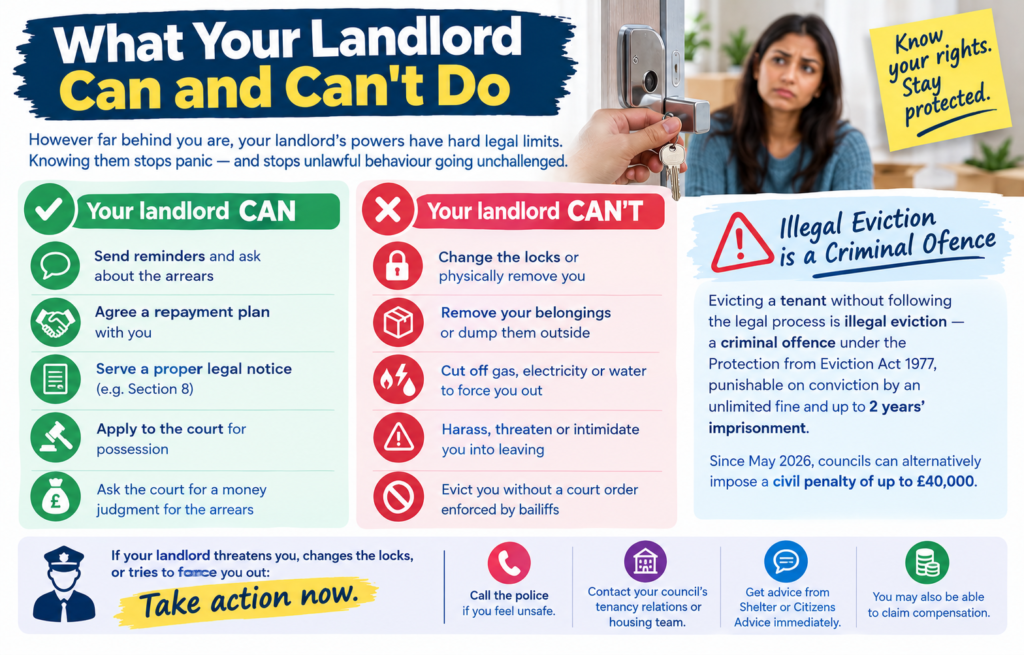
However far behind you are, your landlord’s powers have hard legal limits. Knowing them stops panic — and stops unlawful behaviour going unchallenged.
| Your landlord CAN | Your landlord CAN’T |
|---|---|
| Send reminders and ask about the arrears | Change the locks or physically remove you |
| Agree a repayment plan with you | Remove your belongings or dump them outside |
| Serve a proper legal notice (e.g. Section 8) | Cut off gas, electricity or water to force you out |
| Apply to the court for possession | Harass, threaten or intimidate you into leaving |
| Ask the court for a money judgment for the arrears | Evict you without a court order enforced by bailiffs |
Evicting a tenant without following the legal process is illegal eviction — a criminal offence under the Protection from Eviction Act 1977, punishable on conviction by an unlimited fine and up to 2 years’ imprisonment. Since May 2026, councils can alternatively impose a civil penalty of up to £40,000. If your landlord threatens you, changes the locks, or tries to force you out: call the police if you feel unsafe, contact your council’s tenancy relations or housing team, and get advice from Shelter or Citizens Advice immediately. You may also be able to claim compensation.
If You’re Served an Eviction Notice: Section 8 in England
Since 1 May 2026, when the Renters’ Rights Act 2025 abolished “no-fault” Section 21 evictions, Section 8 is the only eviction route in England. For rent arrears, three grounds matter:
| Ground | Type | What it needs | Notice period |
|---|---|---|---|
| Ground 8 | Mandatory — the court must order possession | At least 3 months’ rent unpaid (or 13 weeks if you pay weekly), both when the notice is served and at the court hearing | 4 weeks |
| Ground 10 | Discretionary — the court decides | Any rent overdue when the notice is served and proceedings begin | 4 weeks |
| Ground 11 | Discretionary — the court decides | A pattern of persistently late rent payments | 4 weeks |
Three things that help tenants here. First, arrears caused purely by delays in Universal Credit housing payments you’re entitled to are disregarded for Ground 8. Second, if you pay the arrears below the 3-month threshold before the hearing, the mandatory ground falls away (though discretionary grounds may remain). Third, on discretionary grounds the court must consider whether eviction is reasonable — your efforts to pay, your circumstances, and any repayment plan all count.
If you get a Section 8 notice, do not ignore it — and do not move out. A notice is not an eviction. You don’t have to leave when it expires; only a court can order possession, and only bailiffs can enforce it. What you should do:
- Get advice immediately — Shelter, Citizens Advice, or a solicitor. Many areas have free court duty advice schemes.
- Keep paying what you can — rent plus something off the arrears, every month, without fail.
- Go to the hearing. If you don’t turn up, the judge only hears your landlord’s side. Take your rent records, budget, and evidence of every effort you’ve made.
- Ask the judge for time or a suspended order. If you can pay the rent going forward plus regular arrears repayments, the court can make a suspended possession order — you stay as long as you keep to its terms. (On mandatory Ground 8 the court’s hands are tied, but it can still delay enforcement briefly.)
Illustrative example — Rob, Sheffield. Remember Rob, £1,275 behind after his hours were cut? He emailed his landlord before the third rent date, showed a budget, and offered £850 rent plus £75 a month off the arrears — clearing them in 17 months. His landlord accepted. No notice was ever served, because the arrears never reached the 3-month threshold while Rob kept paying the plan.
Rent Arrears and Eviction Across the UK: England, Scotland, Wales, Northern Ireland
Eviction law is devolved, so the notice rules change at the border:
| England | Scotland | Wales | Northern Ireland | |
|---|---|---|---|---|
| Main route | Section 8 notice (Housing Act 1988, as amended 2026) | Notice to leave → First-tier Tribunal | Possession notice (Renting Homes (Wales) Act 2016) | Notice to quit → court |
| Arrears threshold | 3 months’ rent (Ground 8); any arrears (Grounds 10/11) | Unpaid rent for 3 months in a row (private residential tenancy) | Serious rent arrears: 2 months’ rent (monthly) or 8 weeks (weekly) | Substantial arrears: 2 months’ rent (monthly) or 8 weeks (weekly) |
| Notice period | 4 weeks for arrears grounds | At least 4 weeks (28 days) | 14 days for serious arrears | 1 month (special-case notice) |
| Key protection | UC payment delays disregarded; court must grant Ground 8 only at threshold | Pre-action requirements: landlord must give clear arrears info, try to agree a repayment plan, and point you to advice — the tribunal can refuse eviction if they didn’t | Court must order possession if seriously in arrears at notice and hearing — but paying below the threshold first defeats it | Paying all arrears before the notice period ends makes the notice invalid |
| Who enforces | County court bailiffs | Sheriff officers | County court bailiffs | Court + Enforcement of Judgments Office |
Wherever you are, the golden rule is the same: only a court (or tribunal) order, enforced by official bailiffs/officers, can lawfully remove you. A notice, however official it looks, is not an eviction.
Where to Get Free Help Now
You don’t have to face arrears alone. All of these are free:
| Organisation | What they offer | How to reach them |
|---|---|---|
| Citizens Advice | Free, confidential advice on benefits, debt and housing; can check you’re getting everything you’re entitled to | Search “rent arrears” on citizensadvice.org.uk or visit your local branch |
| Shelter England | Specialist housing advice, including emergency help if you’re facing eviction | england.shelter.org.uk — emergency helpline for urgent cases |
| Shelter Scotland | Housing and debt advice in Scotland | scotland.shelter.org.uk — helpline 0808 800 4444 |
| StepChange | Free, FCA-authorised debt charity; can set up Breathing Space and debt plans | stepchange.org |
| MoneyHelper | Government-backed free money guidance, including budget planners | moneyhelper.org.uk |
| National Debtline | Free debt advice by phone and webchat | nationaldebtline.org |
If court action has started, ask about the court duty advice scheme — free last-minute advice at the court on the day of your hearing. And if you’re at immediate risk of homelessness, your council has duties to help: ask for a homelessness assessment rather than waiting until you’re actually evicted.

Frequently Asked Questions
Will I be evicted if I miss one month’s rent?
Almost certainly not — not legally, anyway. In England your landlord needs at least 3 months’ arrears for a mandatory eviction order, plus a 4-week notice and a court hearing. One missed month is a warning sign to act on, not an eviction. Talk to your landlord now, before a second month is missed.
Can my landlord change the locks if I don’t pay rent?
No. Changing the locks, removing your belongings, or cutting off utilities to force you out is illegal eviction — a criminal offence under the Protection from Eviction Act 1977. Only court bailiffs acting on a court order can lawfully evict you. If your landlord tries, call the police if you feel unsafe and contact your council and Shelter immediately.
What is a Section 8 notice for rent arrears?
It’s the legal notice a landlord in England must serve before asking a court for possession because of arrears. It must state the ground (usually Ground 8, 10 or 11) and give at least 4 weeks’ notice. It is not an eviction — you don’t have to leave when it expires, and only a court can order possession.
How many months behind on rent before my landlord can evict me?
In England, the mandatory route (Ground 8) needs at least 3 months’ unpaid rent at both the notice date and the court hearing, plus 4 weeks’ notice. In Scotland, the arrears ground needs 3 months in a row unpaid. In Wales, “serious rent arrears” means 2 months (monthly tenancies). In Northern Ireland, “substantial arrears” means 2 months. In every nation, only a court or tribunal order can actually evict you.
Can I stop an eviction by paying off the arrears?
Often, yes. In England, if you clear the arrears below the 3-month threshold before the hearing, the mandatory Ground 8 falls away. In Northern Ireland, paying everything before a 1-month arrears notice ends makes the notice invalid. Even after a possession order, courts can sometimes suspend eviction if you agree and keep to a repayment plan — get advice fast.
What is breathing space and does it cover rent arrears?
Breathing Space is a government scheme giving up to 60 days of legal protection from creditor action while you get debt advice — and rent arrears are a qualifying debt. During it, your landlord can’t serve a Section 8 arrears notice or start possession proceedings. You apply through an FCA-authorised debt adviser (e.g. StepChange), not directly. Ongoing rent is still due.
Can I get help paying rent arrears on Universal Credit?
Yes, in several ways: a new claim advance (up to 100% of your estimated first payment, repaid interest-free over up to 24 months), a budgeting advance for one-off costs, and managed payments where your housing element is paid straight to your landlord. Since April 2025, total UC deductions are capped at 15% of your standard allowance. Ask via your UC journal or on 0800 328 5644.
What is the Crisis and Resilience Fund Housing Payment?
From 1 April 2026 in England, it replaced Discretionary Housing Payments. It’s extra, discretionary help from your local council with housing costs — including rent shortfalls and sometimes arrears — for people receiving Housing Benefit or Universal Credit with a housing element. It’s short-term emergency help, not a permanent top-up; apply to your council. Scotland and Wales may still use the DHP name.
Should I pay my rent or my credit card first?
Your rent — always. Rent is a priority debt: missing it can cost you your home. Credit cards, loans and overdrafts are non-priority debts. If you’re choosing between them, pay the rent and get free debt advice about managing the rest.
Can my landlord take unpaid rent from my tenancy deposit?
At the end of the tenancy, yes — unpaid rent is one of the legitimate deductions a landlord can make from a protected deposit, though they must evidence it and you can dispute unfair claims through the deposit scheme. During the tenancy, the deposit can’t be raided to cover ongoing arrears. Our tenancy deposit protection guide explains how deposits work.
What happens at a possession hearing?
It’s usually short — around 10 minutes. The landlord’s representative speaks first, then you or your adviser respond. The judge looks at the evidence from both sides. Bring your rent records, your budget, and proof of everything you’ve done to address the arrears. The judge can grant an outright order, a suspended order (you stay if you keep to repayment terms), adjourn, or dismiss the case.
Where can I get free advice about rent arrears?
Citizens Advice (benefits, debt and housing advice), Shelter (specialist housing advice — England and Scotland), StepChange (free debt charity that can arrange Breathing Space), MoneyHelper (government-backed money guidance) and National Debtline. If court action has started, ask about the free court duty advice scheme on the hearing day.
Final Thoughts
Rent arrears feel overwhelming because they threaten the roof over your head — but they are also one of the most solvable debt problems, precisely because so much help exists: repayment plans landlords actually accept, Universal Credit advances and direct payments, the Crisis and Resilience Fund, Breathing Space, and courts that would rather see a realistic plan than an eviction. Every one of those doors opens wider the earlier you walk through it.
So if you’re behind — or can see it coming — do the three things today: tell your landlord in writing, work out the exact figure, and talk to one free advice service. Then build the full picture of what your home really costs with our rent budget after bills calculator, check what support you might be missing with our benefits rent guide, and browse more practical help in our rent guides. Falling behind on rent is a setback, not a verdict — and you have more rights, and more options, than it feels like right now.
Further Reading
- Breathing Space (Debt Respite Scheme) — GOV.UK
- Getting Universal Credit paid direct to your landlord — Shelter England
- Stopping eviction for rent arrears — Shelter Scotland
- Crisis and Resilience Fund guidance for councils (England) — GOV.UK
- Citizens Advice also publishes step-by-step guidance on dealing with rent arrears — search “rent arrears” on citizensadvice.org.uk for their current advice pages.