What Is a Rent to Income Ratio?
A rent to income ratio shows how much of your monthly income is spent on rent. It helps you understand whether a property is affordable by comparing your rent with your earnings.
Why Rent to Income Ratio Matters
Rent affordability is not only about being able to pay the rent this month. It is about whether you can continue paying it comfortably every month without putting pressure on the rest of your budget. A good Rent to Income Ratio means you should still have enough money left for essential living costs and unexpected expenses.
Many renters focus only on the monthly rent and forget about the full cost of living. In real life, your budget may also include gas and electricity, water, broadband, council tax, mobile phone bills, transport, groceries, credit cards, personal loans, car finance, insurance, and savings. When these costs are added together, the rent may feel much higher than it looked at first.
This is why a Rent to Income Ratio is a helpful financial filter. It allows you to check whether a rental property fits your income before emotions take over. Instead of choosing a home only because it looks good, you can check whether it is financially realistic for your situation.
"If you're unsure how much you can comfortably spend each month, the free budgeting advice from MoneyHelper can help you plan your finances."
Why This Calculator Goes Beyond a Basic Percentage
A basic rent ratio is useful, but it does not always show the complete picture. Two people can have the same rent ratio but very different financial situations. One person may have low bills and no debt, while another may have high transport costs, loan repayments, or expensive utility bills.
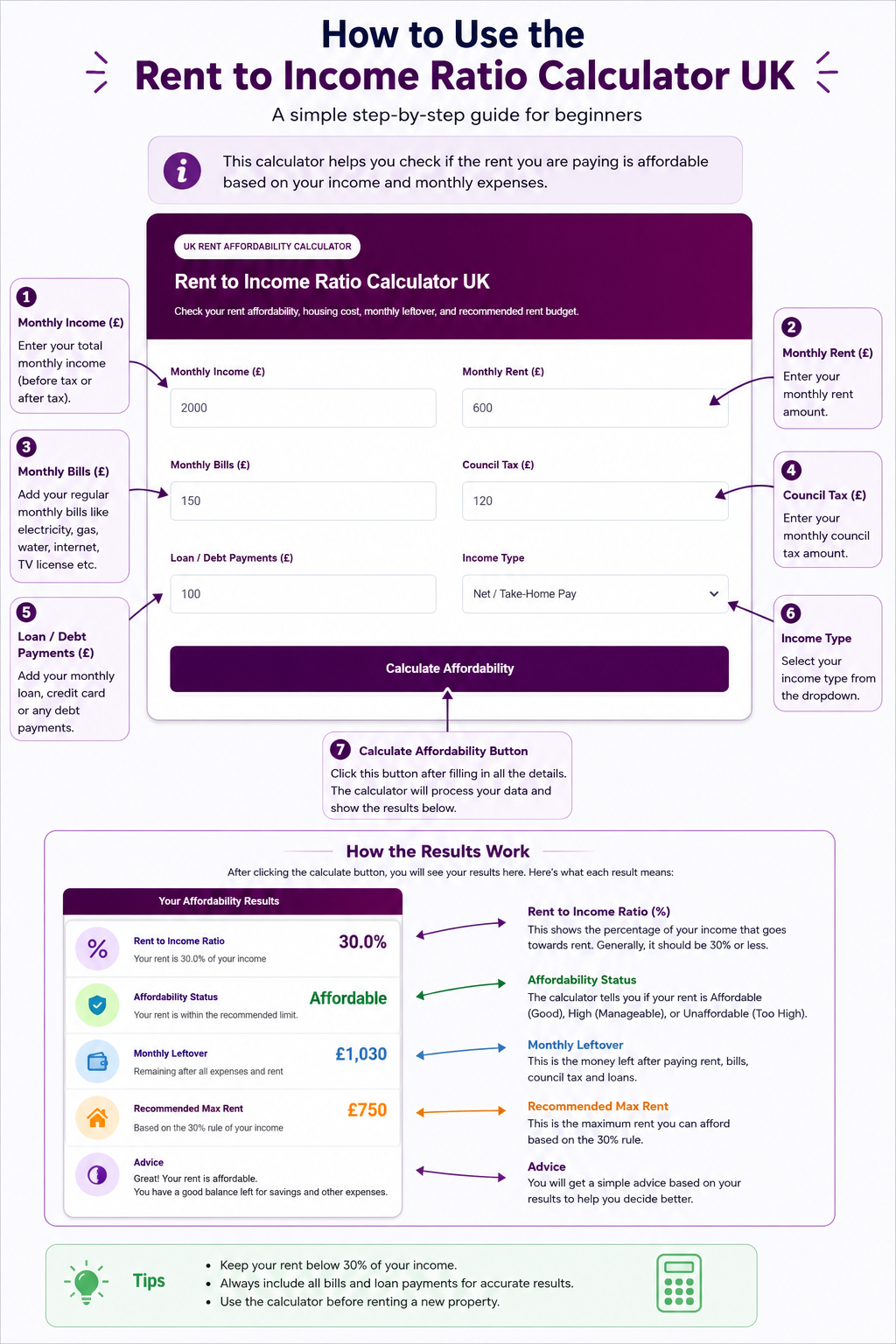
That is why a stronger rent affordability calculator should also consider housing-related costs and estimated leftover income. Looking at rent, bills, council tax, debt payments, annual rent, estimated deposit, and monthly leftover gives a more realistic view of affordability.
This calculator is designed to support practical rental decisions in the UK. It does not replace personal financial advice, but it gives a clear starting point before choosing a property, applying through a letting agent, or deciding whether your current rent is still comfortable for your income.
Gross Income vs Net Income
One of the most important things to understand when calculating your Rent to Income Ratio is the difference between gross income and net income. Gross income is your income before tax and deductions. Net income is your take-home pay after deductions. Many affordability checks may look at gross income, but for personal budgeting, net income usually gives a more realistic picture.
If you use gross income, your rent ratio may look lower and more comfortable. But once tax, National Insurance, pension contributions, or other deductions are removed, your actual spending money may be smaller. This can make the property feel more expensive than the first calculation suggests.
For your own planning, it is often safer to calculate your Rent to Income Ratio using take-home pay. This shows what you actually have available each month after deductions. If the rent looks affordable using net income, you are likely to have a stronger and more realistic budget.
Why Bills and Council Tax Matter
Rent is only one part of housing cost. A tenant may find a property where the rent ratio looks acceptable, but the total monthly housing cost becomes much higher when bills and council tax are included. This is why the calculator also includes monthly bills, council tax, and debt payments.
Utility bills can include gas, electricity, water, and heating costs.
Council tax can vary by property band and local authority.
Broadband and phone costs can add regular monthly pressure.
Transport costs can be higher if the cheaper property is far from work.
A realistic affordability check should not stop at rent alone. Looking at the total housing cost gives a better idea of how the property will affect your monthly life. A lower rent may not always be cheaper if the location increases travel costs or the property has high energy bills.
How the Rent to Income Ratio Calculator Works
The calculator works by comparing your monthly rent with your monthly income. You enter your income and rent, then the tool calculates the percentage of income used for rent. A lower percentage usually means the rent is easier to manage, while a higher percentage means more of your income is being used for housing.
Example
| Monthly Income | Monthly Rent | Calculation | Rent Ratio |
|---|---|---|---|
| £2,000 | £500 | 500 ÷ 2000 × 100 | 25% |
| £2,500 | £750 | 750 ÷ 2500 × 100 | 30% |
These examples show how the same rule can apply to different income levels. If rent stays close to 30% of income, it is usually considered more balanced. If the percentage moves above 40%, the rent may start to create pressure, especially when other monthly expenses are included.
What Is a Good Rent to Income Ratio in the UK?
A good rent to income ratio depends on your income, location, lifestyle, household size, and other monthly commitments. However, many renters use the 30% guideline as a simple starting point. This means your monthly rent should ideally stay around 30% of your monthly income or lower.
This does not mean a ratio above 30% is always impossible. In some areas of the UK, especially expensive cities, renters may pay more than this. However, once rent moves above 30%, the rest of your budget needs closer attention. Bills, council tax, transport, groceries, insurance, and debts can quickly reduce the money left after rent.
| Rent Ratio | Affordability Level | What It Usually Means |
|---|---|---|
| 30% or less | Comfortable | Your rent is usually well balanced with income, leaving more room for bills, savings, and daily costs. |
| 30% to 40% | Stretched | Your rent may still be manageable, but your budget needs to be controlled carefully. |
| Above 40% | High pressure | A large part of your income is going towards rent, which may reduce financial flexibility. |
"For more guidance about renting in England, Shelter provides independent renting advice.".
Real-Life Rent Ratio Examples
Examples make the calculation easier to understand. The same rent can feel very different depending on income, bills, and other commitments.
| Monthly Income | Monthly Rent | Rent Ratio | Result |
|---|---|---|---|
| £2,000 | £500 | 25% | Usually comfortable |
| £2,000 | £700 | 35% | Manageable but tighter |
| £2,000 | £900 | 45% | High financial pressure |
| £3,000 | £900 | 30% | Balanced guideline level |
Factors That Can Affect Your Rent to Income Ratio
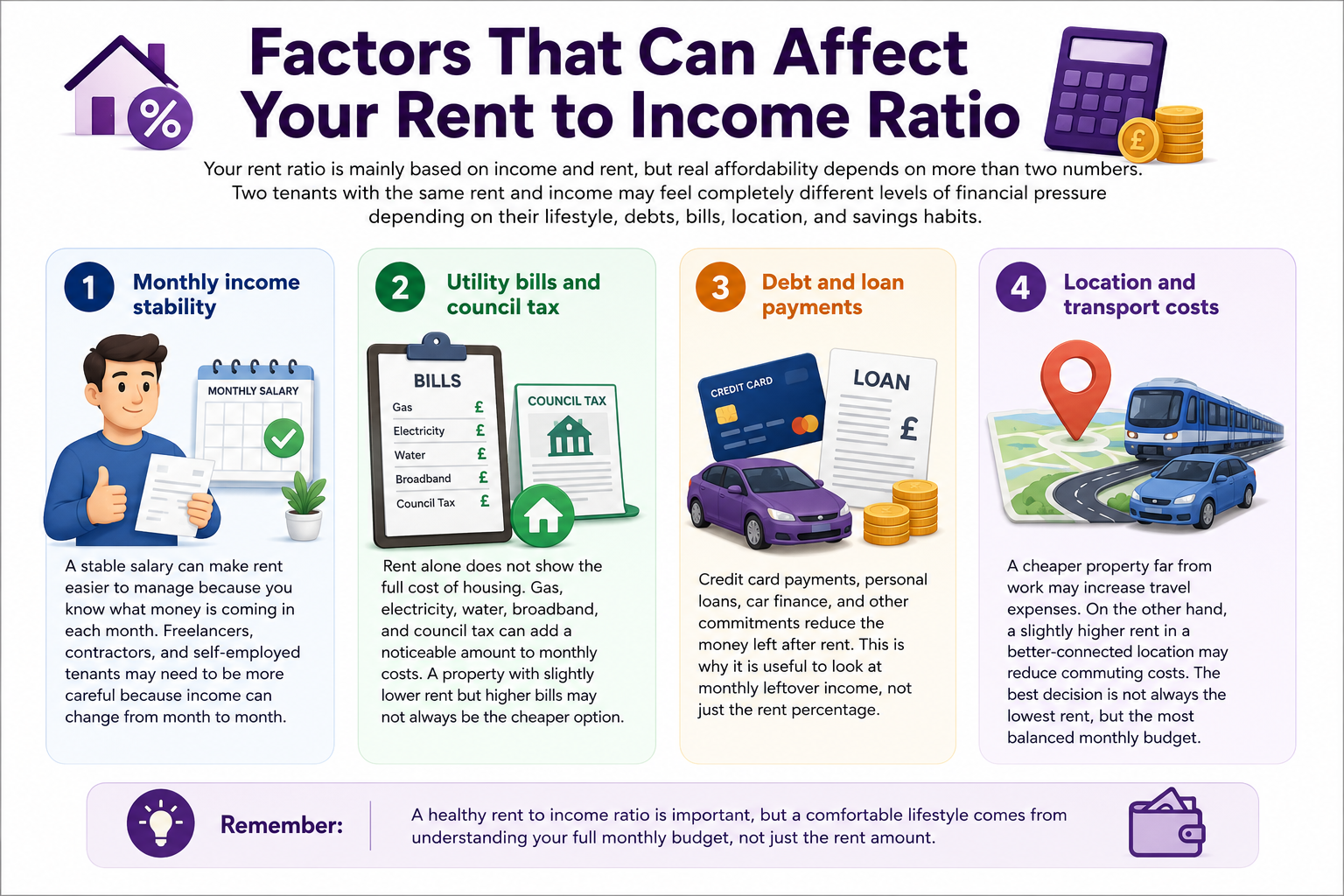
Your rent ratio is mainly based on income and rent, but real affordability depends on more than two numbers. Two tenants with the same rent and income may feel completely different levels of financial pressure depending on their lifestyle, debts, bills, location, and savings habits.
-
Monthly income stability
A stable salary can make rent easier to manage because you know what money is coming in each month. Freelancers, contractors, and self-employed tenants may need to be more careful because income can change from month to month. -
Utility bills and council tax
Rent alone does not show the full cost of housing. Gas, electricity, water, broadband, and council tax can add a noticeable amount to monthly costs. A property with slightly lower rent but higher bills may not always be the cheaper option. -
Debt and loan payments
Credit card payments, personal loans, car finance, and other commitments reduce the money left after rent. This is why it is useful to look at monthly leftover income, not just the rent percentage. -
Location and transport costs
A cheaper property far from work may increase travel expenses. On the other hand, a slightly higher rent in a better-connected location may reduce commuting costs. The best decision is not always the lowest rent, but the most balanced monthly budget.
How to Improve Your Rent to Income Ratio
If your Rent to Income Ratio is higher than expected, there are several ways to improve it. The right option depends on your income, location, personal commitments, and how flexible you are with the type of property you want.
Choose a lower-rent property: Even a small rent reduction can make a big difference over a full year. Consider shared accommodation: Sharing rent and bills can reduce individual housing costs. Reduce non-essential spending: Cutting unused subscriptions or extra monthly costs can improve your leftover budget.
Pay down expensive debt: Reducing debt payments can make your monthly budget more comfortable. Increase income: Extra freelance work, overtime, or a second income source can improve your Rent to Income Ratio and overall affordability. Compare total housing costs: Look at rent, bills, council tax, and travel together before deciding.
| Problem | Possible Solution |
|---|---|
| Rent is above 40% of income | Look for a cheaper property, shared housing, or a higher income option. |
| Bills are making housing expensive | Compare energy costs, council tax bands, and property efficiency before applying. |
| Leftover income is too low | Review debt payments, subscriptions, transport costs, and food spending. |
| Application may look risky | Prepare proof of income, savings evidence, references, or a guarantor if needed. |
Why Landlords and Letting Agents Check Rent Affordability
Rent affordability is not only useful for tenants. Landlords and letting agents also use income checks to understand whether a tenant is likely to manage rent payments comfortably. The aim is usually to reduce the risk of late payments, rent arrears, or a tenancy becoming financially difficult for both sides.
In many UK rental applications, an applicant may be asked to show proof of income, employment details, payslips, bank statements, or references. Some letting agents also use income multiples, where the tenant’s yearly income needs to be a certain number of times higher than the yearly rent. This is why checking your rent to income ratio before applying can help you understand whether a property is realistic before spending time on viewings or applications.
"If you're applying for a rental property, Citizens Advice explains how tenant referencing works.
Common Mistakes When Calculating Rent Affordability
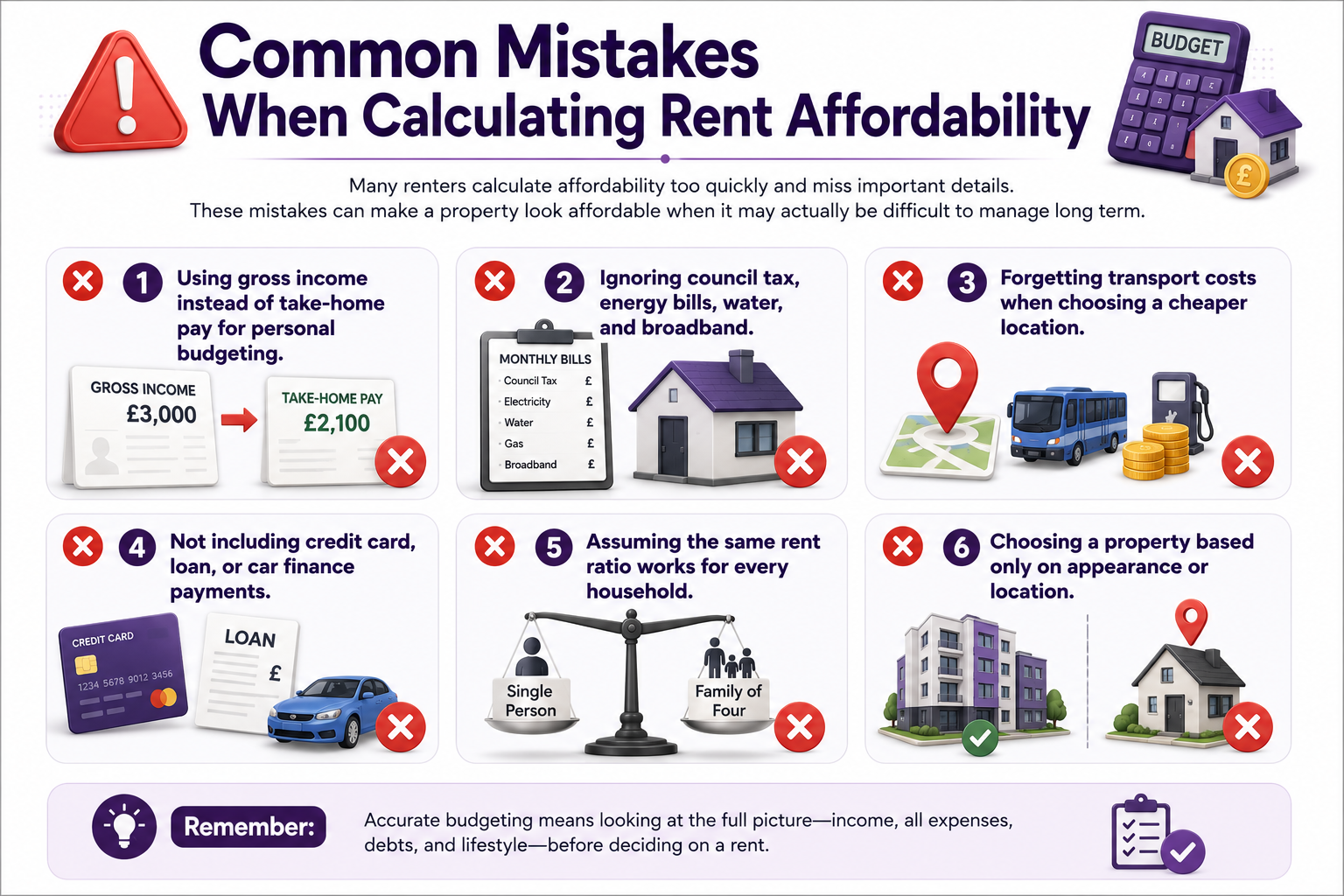
Many renters calculate affordability too quickly and miss important details. These mistakes can make a property look affordable when it may actually be difficult to manage long term.
Using gross income instead of take-home pay for personal budgeting..
Ignoring council tax, energy bills, water, and broadband.
Forgetting transport costs when choosing a cheaper location.
Not including credit card, loan, or car finance payments.
Assuming the same rent ratio works for every household.
Choosing a property based only on appearance or location.
Frequently Asked Questions
A good rent to income ratio is usually around 30% or less. This means your rent takes a manageable share of your income and leaves more room for bills, food, travel, savings, and emergencies.
A 40% rent ratio can be high for many renters, especially if bills, council tax, debts, or transport costs are also expensive. It may still work in some situations, but it needs careful budgeting.
Landlords and letting agents may look at gross income, but net income is usually better for personal budgeting because it shows the money you actually receive after tax and deductions.
Bills do not always count in a basic rent ratio, but they matter in real life. Utility bills, broadband, water, council tax, and other household costs can change whether a property is truly affordable
Many landlords and letting agents use affordability checks before approving tenants. They may compare income with rent to decide whether the tenant can manage payments consistently.
It may still be possible, but the application could be harder. Some landlords may ask for a guarantor, stronger proof of income, advance rent, or other reassurance before accepting the tenancy.
No, the 30% rule is not a UK law. It is a common affordability guideline used to help renters understand whether rent is likely to be comfortable compared with income.
Yes, this calculator allows you to add council tax separately. This helps show a more realistic housing cost instead of only calculating rent by itself.
Before You Choose a Rental Property
Before signing a tenancy agreement, it is worth checking more than the monthly rent. Look at the full monthly cost of the property, including bills, council tax, travel, parking, insurance, and any regular debt payments. A property that looks affordable at first can become difficult if the total monthly cost leaves very little money for normal living. Checking your Rent to Income Ratio before you sign can help you decide whether the property is truly affordable for your budget.
"Checking your overall budget alongside MoneyHelper's cost of living guidance can help you avoid financial pressure.".