University Grade Calculator
Our University Grade Calculator helps you calculate your overall university grade based on your marks and their individual weightings. Simply enter your assessment scores and their percentages to instantly estimate your weighted average and understand which degree classification your result may fall into.
What is a University Grade Calculator
Calculating your overall university grade can involve several assessments, each with a different mark and weighting. A University Grade Calculator makes this process easier by combining your results and showing your estimated overall grade.
Our University Grade Calculator calculates:
Assessment Marks
Assessment Weightings
Weighted Grades
Overall University Grade
Estimated Degree Classification
Remaining Marks Needed
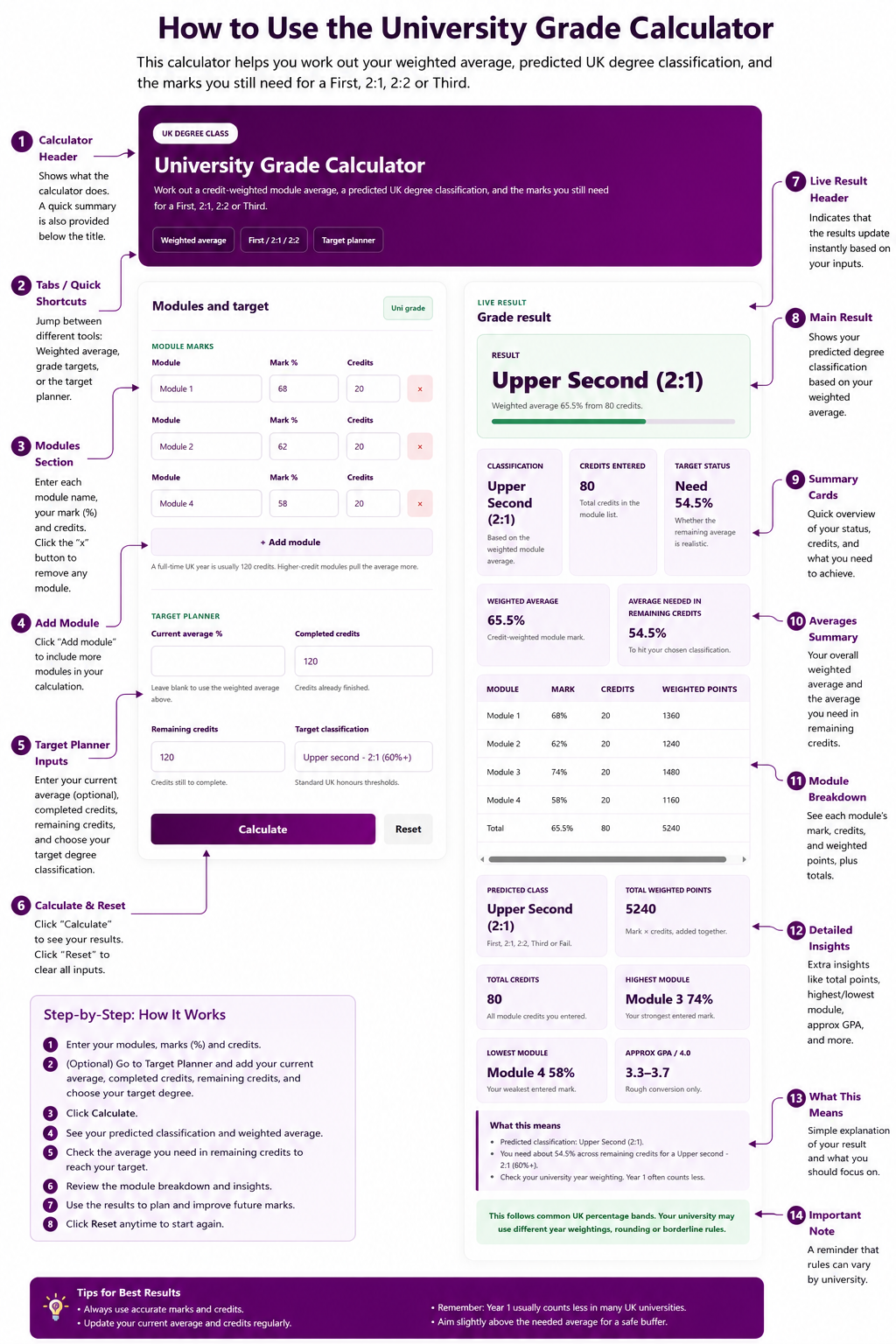
How to Use the University Grade Calculator
Calculate Your Overall University Grade in Minutes
Enter your assessment marks.
Enter the weighting percentage for each assessment.
Add all your completed assignments, exams, or modules.
Click Calculate Grade to view your weighted average instantly.
Review your estimated overall university grade and degree classification.
What the Calculator Shows
After entering your assessment details, you'll receive an easy-to-understand breakdown including:
The marks you achieved in each assignment, exam, or module.
The percentage each assessment contributes to your overall grade.
The contribution of each assessment to your final university grade.
Your estimated overall percentage based on the marks and weightings entered.
Your estimated university classification based on your overall grade.
Why Calculate Your University Grade?
University grades are often based on multiple assignments, exams, and modules, each contributing a different percentage to your final result.
Using this calculator helps you:
Track your academic performance
Understand how each assessment affects your final grade
Estimate your overall university result
Identify the marks you may need in future assessments
Plan your study goals more effectively
Common University Grade Components
Your overall university grade may be based on:
Assignments
Coursework
Exams
Presentations
Projects
Practical Assessments
Module Grades
Final-Year Assessments
Example Calculation
Suppose a university student has completed three assessments with different marks and weightings:
| Assessment | Mark | Weighting | Weighted Contribution |
|---|---|---|---|
| Assignment | 70% | 20% | 14% |
| Midterm Exam | 65% | 30% | 19.5% |
| Final Exam | 75% | 50% | 37.5% |
| Overall Grade | — | 100% | 71% |
How the Calculation Works
The calculator multiplies each assessment mark by its weighting and then adds the results together.
For example:
Assignment: 70 × 20% = 14%
Midterm Exam: 65 × 30% = 19.5%
Final Exam: 75 × 50% = 37.5%
Overall Grade: 14 + 19.5 + 37.5 = 71%
In this example, the student's estimated overall university grade is 71%. Depending on the university's grading system, this percentage may correspond to a particular degree classification.
The calculator makes it easier to understand how individual assessment results contribute to the final grade and can also help students estimate what marks they may need in remaining assessments.
University Grading Explained
Universities calculate final grades by combining marks from different assessments. Each assessment may have a different weighting, meaning some assignments or exams can have a greater effect on your overall result than others.
Assessment Weighting
Each assessment is given a percentage that shows how much it contributes to your final grade.
Weighted Marks
Your mark is multiplied by the assessment weighting to calculate its contribution to your overall grade.
Overall University Grade
The weighted contributions from all assessments are added together to calculate your estimated overall percentage.
Degree Classification
Your final percentage may then be compared with your university's grading boundaries to determine the relevant degree classification.
The calculator helps you understand how different marks and weightings affect your overall university result without needing to work through the calculations manually.
Degree classification rules can vary between universities, so students should check their university's official degree classification guidance when interpreting their results.
Who Can Use This Calculator?
Our University Grade Calculator is designed for students who want a clear estimate of their overall academic grade based on their assessment marks and weightings. Whether you're an undergraduate student checking your current performance, a postgraduate student calculating module results, or a student preparing for final exams, this calculator can help you understand your grades more easily.
It can be useful for students who want to calculate the impact of assignments, coursework, exams, projects, presentations, and other assessments on their overall university result. By entering your marks and the percentage weighting of each assessment, you can quickly estimate your weighted average and see how your results may affect your final grade.
Students can also refer to official higher education information when checking how their course and assessment system works.
The calculator can also help students set realistic academic goals. For example, if you have completed some assessments but still have exams or coursework remaining, you can use your current results to understand what marks you may need to achieve a particular overall percentage.
Whether you're checking your current university performance, preparing for final results, or planning your study targets, our University Grade Calculator provides a simple and convenient way to estimate your overall grade without performing the calculations manually.
Assessment Weighting Explained
Assessment weighting refers to the percentage that each assignment, exam, project, or other piece of coursework contributes to your overall university grade. Not every assessment has the same importance, so understanding the weighting can help you see how individual marks affect your final result.
For example, an assignment may contribute 20% of your overall grade, while a final exam may contribute 50%. A higher-weighted assessment will have a greater impact on your final percentage, which means performing well in it can significantly improve your overall result.
When using our University Grade Calculator, enter the mark you received for each assessment along with its weighting. The calculator then works out the weighted contribution of each result and combines them to estimate your overall university grade.
It is important to enter the correct weighting percentages because even a small error can change the final calculation. Make sure the assessment weightings you enter match the information provided by your university or course.
Weighted Grade & Overall Grade Explained
A weighted grade shows how much an individual assessment contributes to your overall university result. It is calculated by multiplying the mark you achieved by the percentage weighting assigned to that assessment.
For example, if you receive 70% in an assignment worth 20% of your final grade, its weighted contribution is 14 percentage points toward your overall result.
Your overall university grade is calculated by combining the weighted contributions from all relevant assessments. Once each assessment has been calculated according to its weighting, the contributions are added together to produce an estimated overall percentage (e.g., 14% + 19.5% + 37.5% = 71%).
Using the calculator makes it easier to track your academic progress, understand how individual results affect your final grade, and set realistic targets for remaining assessments.
Why Calculating Your University Grade Matters
University students often receive marks for several assignments, exams, projects, and other assessments throughout their course. Because each assessment can have a different weighting, it can be difficult to understand how individual results affect your overall university grade.
Using a University Grade Calculator helps you estimate your current or final grade, understand the impact of different assessments, and plan your academic goals more effectively.
- Assignment Marks
- Coursework Results
- Exam Marks
- Assessment Weightings
- Module Grades
- Project Results
- Presentation Marks
- Practical Assessment Results
- Current Weighted Average
- Estimated Overall University Grade
- Possible Degree Classification
- Marks Needed for Future Assessments
By calculating your weighted grades, you can get a clearer picture of your academic performance and identify which assessments may have the biggest impact on your final result.
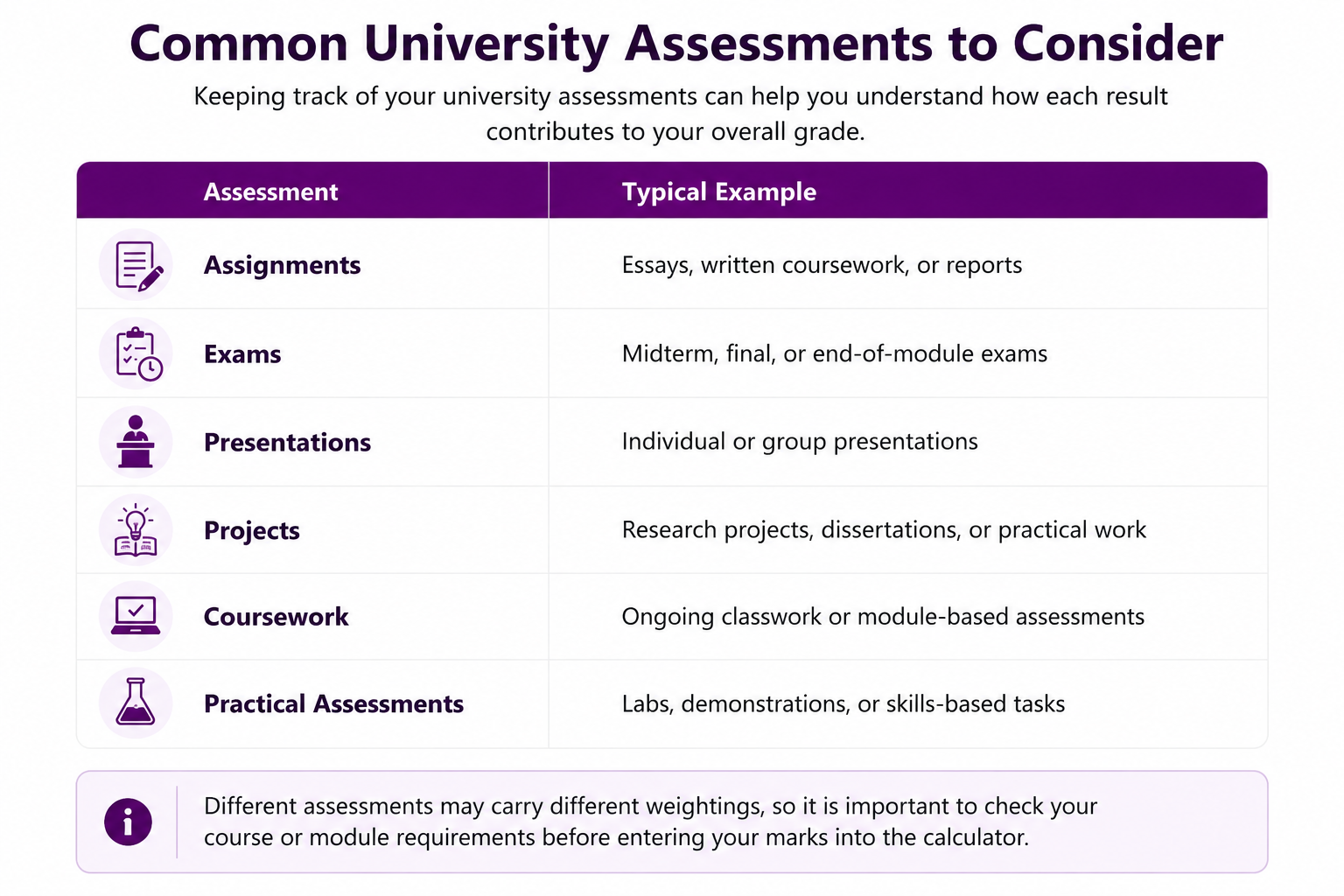
Common University Assessments to Consider
Keeping track of your university assessments can help you understand how each result contributes to your overall grade.
| Assessment | Typical Example |
|---|---|
| Assignments | Essays, written coursework, or reports |
| Exams | Midterm, final, or end-of-module exams |
| Presentations | Individual or group presentations |
| Projects | Research projects, dissertations, or practical work |
| Coursework | Ongoing classwork or module-based assessments |
| Practical Assessments | Labs, demonstrations, or skills-based tasks |
Different assessments may carry different weightings, so it is important to check your course or module requirements before entering your marks into the calculator.
How Our Calculator Works
| What to Do | Details |
|---|---|
| Enter Your Assessment Mark |
• Enter the percentage mark you received for an assignment, exam, project, or other assessment. • The calculator uses this mark to work out its contribution to your overall grade. |
| Enter the Assessment Weighting |
• Enter the percentage weighting assigned to the assessment. • This shows how much the assessment contributes to your final university grade. |
| Add Your Other Assessments |
• Enter additional assignments, exams, coursework, projects, or modules with their marks and weightings. • Each result is calculated according to its individual weighting. |
| Check Your Weighted Contributions |
• The calculator works out how much each assessment contributes to your overall result. • This makes it easier to see which assessments have the greatest impact on your grade. |
| Calculate Your Overall Grade |
• Click the Calculate Grade button to combine your weighted results. • The calculator provides an estimated overall university percentage and may show the corresponding degree classification based on the grading scale used. |
Example 1 – Undergraduate Student
| Assessment | Value |
|---|---|
| Assignment Mark | 70% |
| Assignment Weighting | 20% |
| Assignment Contribution | 14% |
| Midterm Exam Mark | 65% |
| Midterm Exam Weighting | 30% |
| Midterm Exam Contribution | 19.5% |
| Final Exam Mark | 75% |
| Final Exam Weighting | 50% |
| Final Exam Contribution | 37.5% |
| Overall University Grade | 71% |
In this example, the student's three assessments contribute 14%, 19.5%, and 37.5% to the final result. After adding these weighted contributions together, the estimated overall university grade is 71%.
This example shows how assessments with different weightings can affect your final university grade. A higher-weighted assessment has a greater impact on the overall result, even when the marks achieved are similar.
Benefits of Using This Calculator
Instant Grade Calculations
Calculate your weighted average quickly without doing the maths manually.
Easy-to-Understand Results
View your assessment contributions and overall grade in a clear format.
Detailed Grade Breakdown
See how each assignment, exam, or project affects your final result.
No Manual Calculations
Simply enter your marks and weightings, and the calculator does the calculations for you.
Helps You Track Academic Progress
Understand your current performance and identify areas where you may need to improve.
Works With Different Assessment Weightings
Calculate grades for assessments that contribute different percentages to your final result.
Helps Set Future Grade Targets
Use your current results to estimate the marks you may need in remaining assessments.
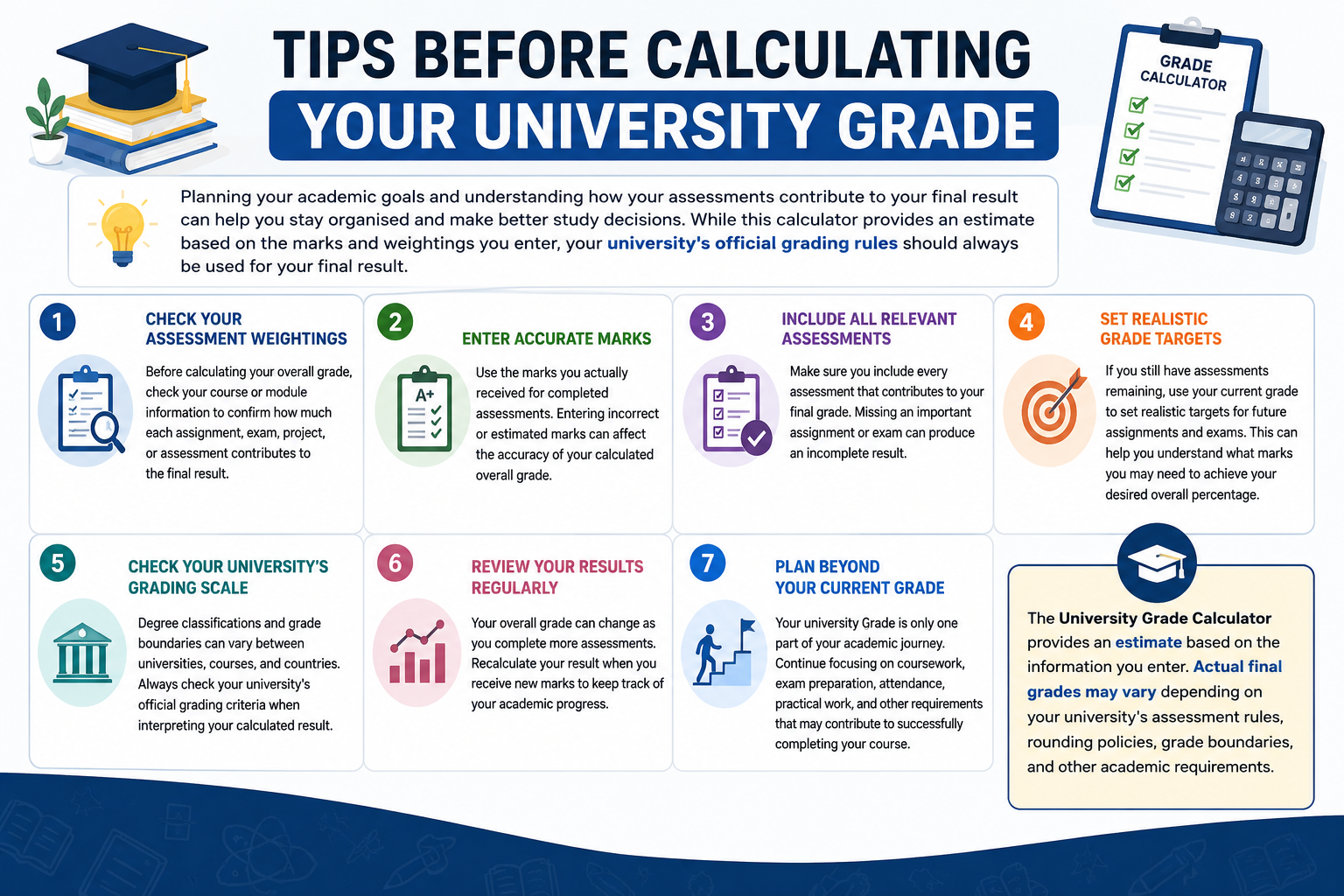
Tips Before Calculating Your University Grade
Planning your academic goals and understanding how your assessments contribute to your final result can help you stay organised and make better study decisions. While this calculator provides an estimate based on the marks and weightings you enter, your university's official grading rules should always be used for your final result.
-
Check Your Assessment Weightings
Before calculating your overall grade, check your course or module information to confirm how much each assignment, exam, project, or assessment contributes to the final result. -
Enter Accurate Marks
Use the marks you actually received for completed assessments. Entering incorrect or estimated marks can affect the accuracy of your calculated overall grade. -
Include All Relevant Assessments
Make sure you include every assessment that contributes to your final grade. Missing an important assignment or exam can produce an incomplete result. -
Set Realistic Grade Targets
If you still have assessments remaining, use your current grade to set realistic targets for future assignments and exams. This can help you understand what marks you may need to achieve your desired overall percentage. -
Check Your University's Grading Scale
Degree classifications and grade boundaries can vary between universities, courses, and countries. Always check your university's official grading criteria when interpreting your calculated result. -
Review Your Results Regularly
Your overall grade can change as you complete more assessments. Recalculate your result when you receive new marks to keep track of your academic progress. -
Plan Beyond Your Current Grade
Your university grade is only one part of your academic journey. Continue focusing on coursework, exam preparation, attendance, practical work, and other requirements that may contribute to successfully completing your course.
Common Mistakes to Avoid
Many students make simple mistakes when calculating their overall university grade, especially when assessments have different marks and weightings. Avoiding these mistakes can help you get a more accurate estimate and better understand your academic performance.
| Common Mistake | Why It Matters |
|---|---|
| Ignoring Assessment Weightings | Each assignment, exam, or project may contribute a different percentage to your final grade. Using the wrong weighting can significantly change your overall result. |
| Entering the Wrong Marks | A small error when entering an assessment mark can affect the calculated weighted contribution and final grade. |
| Forgetting an Assessment | Leaving out an assignment, exam, or project that contributes to your final grade can produce an incomplete or inaccurate result. |
| Adding Weightings Incorrectly | The assessment weightings should normally add up to the required total for the calculation. Check your course information before entering them. |
| Treating Every Assessment Equally | A 70% mark in an assessment worth 10% does not have the same impact as a 70% mark in an assessment worth 40%. |
| Ignoring Remaining Assessments | If you still have exams or coursework left, your current grade may not represent your final result. Consider the weight of assessments that are still outstanding. |
| Assuming the Calculator Gives an Official Result | The calculator provides an estimate. Your university's official result may depend on specific grading, rounding, classification, or assessment rules. |
Frequently Asked Questions
Your overall university grade is calculated by multiplying each assessment mark by its weighting and then adding the weighted contributions together.
Yes. You can enter different weightings for assignments, exams, coursework, projects, and other assessments.
Yes. You can include multiple assessments to calculate a more complete estimate of your overall university grade.
Yes. You can use your completed assessment marks and weightings to estimate your current weighted average.
The calculator can help you understand your current position and estimate the impact of future assessment marks on your overall result.
A weighted grade represents how much an individual assessment contributes to your overall university result based on its assigned percentage weighting.
Each assessment is calculated according to its individual weighting. Assessments with higher weightings have a greater impact on your overall grade.
For a complete final-grade calculation, the weightings of all assessments included should normally represent the full grading structure. Check your university's course requirements for the correct weighting.
Yes. The calculator can be used for many university courses as long as you know the marks and weightings for your assessments.
It can provide an estimated classification based on the overall percentage, but degree classification rules vary between universities and courses.
Your university's degree classification rules should be used to confirm how your overall percentage translates into a final award.
No. The calculator provides an estimate based on the information you enter. Your official result is determined by your university's grading and assessment rules.
Yes. It can be used for postgraduate coursework, assignments, exams, projects, and other assessments where marks and weightings are available.
Ready to Calculate Your University Grade?
Stop guessing what your assessment marks mean for your overall university result.
You can use the University Grade Calculator to understand how individual assignments, exams, coursework, projects, and other assessments contribute to your overall grade.
Whether you're checking your current academic performance, preparing for final exams, or planning the marks you need in your remaining assessments, our University Grade Calculator helps you calculate your weighted average quickly and clearly.