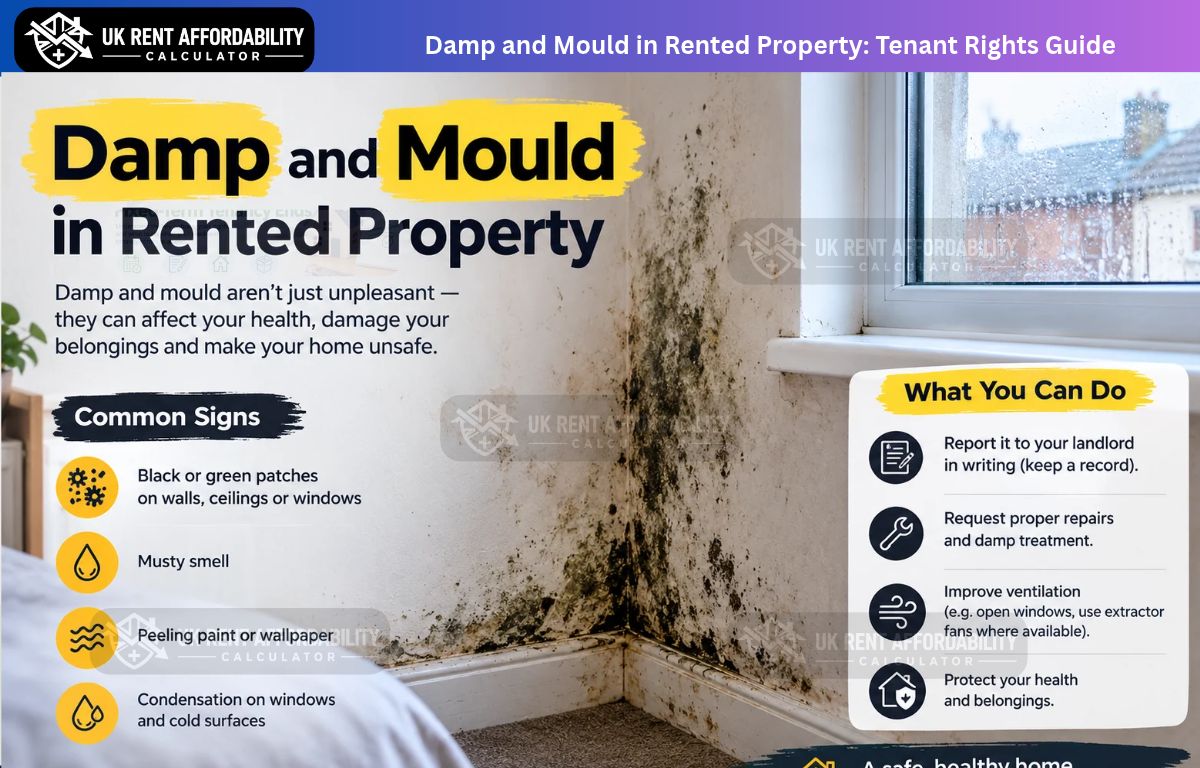
Josie had lived in her Leeds flat for eighteen months when black spots appeared above the skirting board. She wiped the mould away, but it came back within a week. Her landlord told her to open a window. Six weeks later, the patch covered half the wall and her son’s cough was worse every night. Damp and Mould in Rented Property
If that sounds familiar, this guide is for you.
Quick Answer: In almost every case, damp and mould in a rented home are your landlord’s problem to fix. Under section 11 of the Landlord and Tenant Act 1985 your landlord must keep the structure and exterior in repair, and your home must stay fit to live in throughout the tenancy. Report it in writing and keep dated photos. If your landlord does not act, your council can inspect and order repairs. Social tenants in England and all tenants in Scotland have fixed deadlines under Awaab’s Law; private tenants in England do not yet, but the fitness, repair and council routes already apply today.
The Three Types of Damp — and How to Tell Them Apart
Rising damp comes up from the ground when the damp-proof course has failed or is missing. It usually reaches no higher than about a metre, leaves a “tide mark” with white salts, and damages skirting boards at the bottom of the wall. It is almost always structural — your landlord’s responsibility. Damp and Mould in Rented Property
Penetrating damp comes in sideways, through a leaking roof, cracked render, damaged guttering or a broken pipe. It shows up as patches that grow after rain, at any height. Again, the cause sits in the structure or exterior.
Condensation damp is the most common type in rented homes. Warm, moist air from cooking, showering and drying clothes indoors hits a cold surface — a window, an outside wall, a corner behind furniture — and turns into water droplets, and black mould grows on the damp surface. It is usually driven by cold surfaces, poor insulation, broken extractor fans and inadequate heating — all the landlord’s job to sort out.
| Type of damp | What it looks like | Usual cause | Who normally pays |
|---|---|---|---|
| Rising damp | Tide mark and salts up to about 1 metre high | Failed damp-proof course | Landlord |
| Penetrating damp | Patches that grow after rain, at any height | Leaks, cracked render, broken guttering | Landlord |
| Condensation damp | Black mould on cold surfaces | Cold surfaces, poor ventilation, weak heating | Usually landlord |
Never accept a diagnosis from a landlord who has only looked at a photo — damp needs a proper inspection. The government has said it is totally unreasonable to blame damp and mould on a tenant’s lifestyle.
Is Damp and Mould Bad for Your Health?
Yes. Damp and mould mainly affect the airways and lungs: they can trigger asthma attacks, worsen existing asthma, and increase the risk of respiratory infections. Government health guidance estimated that damp and mould in English homes were associated with around 5,000 asthma cases and around 8,500 lower respiratory infections in 2019 alone. The NHS says almost one in three homes in England has damp and mould, more often in rented homes. Babies, children and pregnant women are most at risk. Mould can also cause sore eyes and eczema.
If anyone in your household has asthma, is very young, elderly or pregnant, say so in your written report. Keep a note of symptoms and GP visits, with dates.
Who Has to Fix Damp and Mould — You or Your Landlord?
In almost every case, your landlord. Two laws do most of the work. Under section 11 of the Landlord and Tenant Act 1985, your landlord must keep the structure and exterior in repair, and the water, gas, electricity, sanitation and heating installations in working order. Your landlord cannot contract out of section 11.
On top of that sits the fitness for human habitation duty: your home must be fit to live in when you move in and throughout the tenancy, and serious damp and mould can make a home unfit. You can take your landlord to court yourself, without waiting for the council. Our landlord repairs guide explains both duties in more depth.
Your responsibilities are narrow: heat the home reasonably, ventilate it, and report problems promptly. You are not responsible for the building’s fabric, insulation, heating or ventilation. If your landlord says the damp is your fault, ask them in writing to explain the cause.
| Who pays for what | Landlord pays | Tenant pays |
|---|---|---|
| Cause of the damp | Structure, roof, gutters, damp-proof course, insulation, heating, ventilation | Nothing, unless you caused the damage |
| Mould removal | Professional mould treatment after repair | Day-to-day cleaning of surfaces |
Awaab’s Law: The Deadlines That Apply Right Now
Awaab’s Law is named after Awaab Ishak, a two-year-old who died in December 2020 after prolonged exposure to mould in his Rochdale social housing flat.
Awaab’s Law currently applies to social housing in England only, and to homes in Scotland. It does not yet apply to private rented homes in England. Several landlord blogs claim otherwise, citing figures like 14 days to investigate and 7 days to repair. Those figures are wrong.
For social housing tenants in England, the rules have applied since 27 October 2025:
- Emergency hazards: investigate and make safe within 24 hours.
- Significant damp and mould: investigate within 10 working days.
- Written summary: give you a written summary within 3 working days of the investigation ending.
- Safety work: make the home safe within 5 working days of the investigation ending.
- Longer work: start within 5 working days, and physically no later than 12 weeks after the investigation.
- Alternative accommodation: if the home cannot be made safe in time, the landlord must provide it.
Phase 2 extends the same deadlines to more hazards, including excess cold, excess heat, falls, fire and electrical hazards, from 30 November 2026, subject to parliamentary approval. Phase 3, planned for 2027, covers the rest.
For private tenants in England, the Renters’ Rights Act 2025 gives the government power to extend Awaab’s Law, but the regulations setting the deadlines have not yet been made. A consultation opened in October 2026 and closes on 18 December 2026; the earliest feasible start is 2027. Until then, private tenants are protected by the fitness duty, section 11 and council enforcement.
From 6 October 2026, Awaab’s Law applies in Scotland to social and private rented homes, covering damp and mould: investigate within 10 working days, written summary within 3 working days, begin repairs within 5 working days. The Repairing Standard now also requires a Scottish rented home to be substantially free from damp and mould.
| Awaab’s Law position | England — social housing | England — private rented | Scotland (social and private) |
|---|---|---|---|
| In force since | 27 October 2025 | Not yet — consultation ends 18 Dec 2026 | 6 October 2026 |
| Investigate significant damp and mould | Within 10 working days | No fixed deadline yet | Within 10 working days |
| Safety work | Within 5 working days | No fixed deadline yet | Begin within 5 working days |
What to Do Step by Step When You Find Damp or Mould
Step 1: Photograph everything, today. Take dated photos and short videos of every affected area. Photograph damaged belongings and any visible cause, such as a leaking gutter. A cheap hygrometer gives dated humidity readings: aim for roughly 40 to 60 per cent relative humidity.
Step 2: Report it in writing. Email or letter beats a phone call: it proves when your landlord knew. Describe each affected room, when you first noticed the problem, and anyone whose health is affected. Ask for an inspection and a written plan with dates. Keep a copy of everything you send and every reply.
Step 3: Keep a damp diary. Note the date, what you saw, and what your landlord said. This diary becomes the backbone of any complaint, council referral or court claim.
Step 4: Do the reasonable things that are yours to do. Heat the home when you can, ventilate rooms, use extractor fans, and wipe condensation from windows. None of this fixes a structural problem, but it shows you acted reasonably.
Step 5: Chase in writing, with a deadline. If nothing happens within a reasonable time, send a second message. Set out the history, attach the photos, and give a clear date by which you expect an inspection or a repair plan. Say that if nothing happens you will contact the council.
Never stop paying your rent because of damp or mould. Withholding rent is almost never lawful. Keep paying and use the routes in this guide.
If Your Landlord Won’t Act: The Council Route
If your landlord ignores you, your local council is your most powerful ally, and it costs you nothing. Contact the environmental health team and ask for an inspection under the Housing Health and Safety Rating System (HHSRS).
Damp and mould growth is one of the hazards the HHSRS covers. The system was updated on 23 June 2026, cutting the hazard categories from 29 to 21. If the council finds a hazard at the most serious level, it must act. It can serve an improvement notice ordering specific works by a set date.
Councils can also fine a private landlord up to £7,000 for failing to keep a home free of the most serious hazards, under the Renters’ Rights Act 2025 — a penalty in force since June 2026.
Send the council the same evidence file: dated photos, your diary, and your written reports. The council will usually inspect within a few weeks, faster if the problem is severe or a child is affected. Our guide on how to complain about your landlord walks through every route.
Taking Your Landlord to Court
Court is the last resort, but it is a real one, and you do not need a lawyer to start. Under the fitness for human habitation rules, you can ask the county court to order repairs and pay you compensation. You can also claim under section 11.
Compensation is usually a percentage reduction in rent for the period the home was unfit, plus damaged belongings and, in serious cases, damages for discomfort and health effects. There is no fixed tariff. Get advice before you file — Shelter, Citizens Advice, or a housing solicitor offering a free first appointment can tell you if your case is strong.
Two Worked Examples
Rex: a private tenant’s compensation claim
Rex rents a one-bedroom flat in Manchester for £950 a month. In October 2026 he reports black mould across his bedroom wall and a leaking gutter outside. His landlord sends a cleaner to wipe the mould but does nothing about the gutter. By January 2027 the mould is back, worse than before, and his belongings are ruined.
Rex’s claim has two parts. First, the loss of use of his bedroom: his adviser suggests a 25 per cent rent reduction for the three months it was seriously affected. That is £950 × 25% = £237.50 a month, and £237.50 × 3 = £712.50. Second, his damaged belongings: a mattress at £180, clothes at £120 and books at £120, which comes to £420. His total claim is £712.50 + £420 = £1,132.50. Those figures are illustrative — a court decides case by case. But the maths shows why evidence matters: without dated photos, a written report and a diary, Rex could not have proved the three months, the cause, or the £420 of losses.
Gwen: a social tenant’s Awaab’s Law timeline
Gwen rents a housing association flat in Bristol. She reports significant damp and mould in her bathroom and her daughter’s bedroom on a Monday. As a social housing tenant in England, Awaab’s Law gives her fixed deadlines.
The association must investigate within 10 working days — roughly two working weeks. Suppose the investigation ends on a Friday. The written summary is due within 3 working days, by the following Wednesday. Safety work must be completed within 5 working days, by the following Friday. Longer work must start within the same 5 working days, and physically no later than 12 weeks after the investigation. If the home cannot be made safe in time, the association must offer alternative accommodation at its own expense. Gwen should report in writing, keep the reference number, and note the date of every visit and letter. If a deadline passes, she can complain to the Housing Ombudsman, free of charge.
Damp, Mould and Your Deposit at Check-Out
If mould is present when you leave, your landlord may try to deduct cleaning costs from your deposit. Whether they can depends on the cause. Mould caused by a structural problem, a leak or poor ventilation is not your fault, and your landlord cannot charge you for fixing their building. If you failed to heat or ventilate the home when you reasonably could have, that is a different matter — but your landlord still needs evidence.
Protect yourself with the same evidence file: your check-in inventory, dated photos from during the tenancy, your written reports, and photos at check-out. Your deposit must have been protected in a government-backed scheme within 30 days in England and Wales, and in England it cannot exceed five weeks’ rent. Challenge any deduction through the scheme’s free dispute service. Our tenancy deposit protection and fair wear and tear guides explain how to challenge it.
Damp and Mould in Scotland, Wales and Northern Ireland
Scotland has gone furthest: since 6 October 2026, its version of Awaab’s Law covers damp and mould in both social and private rented homes, with the same 10, 3 and 5 working-day deadlines, and the Repairing Standard now requires a home to be substantially free from damp and mould. If your Scottish landlord does not act, you can apply to the First-tier Tribunal for Scotland, which can order the repair and restrict the rent until it is done.
In Wales, every rented home must be fit for human habitation under the Renting Homes (Wales) Act 2016, in force since 1 December 2022. Damp and mould growth is one of the 29 matters a landlord must consider, and a landlord cannot let an unfit home. If your Welsh landlord will not act, your council can enforce, and you can apply to the county court.
In Northern Ireland, a rented home must be free from damp that could damage the occupier’s health, and homes built before 1 January 1945 usually need a certificate of fitness, applied for within 28 days of the tenancy starting. Your district council can inspect and serve notices.
| Nation | Main damp and mould protection | Fixed deadlines? |
|---|---|---|
| England | Awaab’s Law for social housing since 27 October 2025; fitness duty; section 11; HHSRS; £7,000 penalty | Social: yes — 24 hours, 10, 3 and 5 working days; private: not yet |
| Scotland | Awaab’s Law since 6 October 2026 (social and private); Repairing Standard | Yes — 10, 3 and 5 working days |
| Wales | Fitness for human habitation since 1 December 2022 | No fixed deadlines — fitness duty and council enforcement |
| Northern Ireland | Fitness standard; certificate of fitness for pre-1945 homes | No fixed deadlines — council enforcement |
Frequently Asked Questions
Is mould the landlord’s responsibility in a rented property?
In almost every case, yes. Under section 11 your landlord must keep the structure and exterior in repair, and the home fit to live in.
Does Awaab’s Law apply to private tenants?
Not yet in England. It covers social housing in England since 27 October 2025, and social and private homes in Scotland since 6 October 2026.
How long does my landlord have to fix damp and mould?
Social landlords in England must investigate within 10 working days and complete safety work within 5 working days; in Scotland, landlords must investigate within 10 working days and begin repairs within 5 working days. Private tenants in England have no fixed deadline yet.
Can I stop paying rent until my landlord fixes the mould?
No. There is no general right to withhold rent, and stopping payment can put you in arrears and hand your landlord grounds to evict you.
What is the difference between rising damp, penetrating damp and condensation?
Rising damp comes up from the ground, leaving a tide mark and white salts. Penetrating damp comes in through leaks and grows after rain. Condensation is moist air hitting cold surfaces.
Can damp and mould make my children ill?
Yes. Damp and mould can trigger asthma and increase the risk of respiratory infections. Government guidance linked them to around 5,000 asthma cases in England in 2019.
What evidence should I keep about damp and mould?
Dated photos and videos of every affected area, a written report to your landlord, copies of all replies, a diary of what happened, and notes of any GP visits.
Can the council force my landlord to fix damp?
Yes. Your council’s environmental health team can inspect under the Housing Health and Safety Rating System and serve an improvement notice ordering specific works.
Can my landlord deduct mould cleaning costs from my deposit?
Only if the mould was genuinely your fault. Mould caused by a structural problem, a leak or poor ventilation is your landlord’s responsibility.
What should I do if my landlord blames my lifestyle for the mould?
Ask them in writing to explain exactly what is causing the damp. The government has said it is totally unreasonable to blame damp and mould on a tenant’s lifestyle.
Final Thoughts
Damp and mould are not a cosmetic problem, and they are not your fault by default. In almost every case, your landlord has to fix the cause, and the law gives you a clear ladder: report in writing, build your evidence, chase with a deadline, involve the council, and go to court only if you must. Social tenants in England and all tenants in Scotland now have fixed legal deadlines. Private tenants in England do not yet — but the fitness duty, the repairing duty and council enforcement already give you real power.
Start today: photograph the damp, send the report, and start the diary. If your home is making you or your children ill, get medical help first and keep the record. If you are unsure about any step, Shelter and Citizens Advice both give free housing advice. Our landlord safety certificates and renters’ rights guides cover the wider picture, and our renting with children guide covers the extra protections for families.
Further Reading
- GOV.UK — Extending Awaab’s Law to private rented tenancies (consultation): https://www.gov.uk/government/consultations/extending-awaabs-law-to-private-rented-tenancies-and-to-licences/extending-awaabs-law-to-private-rented-tenancies-and-to-licences
- Shelter England — Damp and mould problems: https://england.shelter.org.uk/professional_resources/legal/housing_conditions/responsibility_for_repairs/damp_and_mould_problems
- Citizens Advice — If you have damp or mould in your rented home: https://www.citizensadvice.org.uk/housing/repairs-in-rented-housing/repairs-common-problems/repairs-damp/