
Philippa had rented her two-bedroom flat in London for two years when her letting agent sent the check-out report. Her £1,400 deposit was being hit for £900: £250 for a “professional clean”, £400 for repainting the whole living room, and £250 towards a brand-new carpet in the bedroom. The flat was tidy. The paint had scuffs. The carpet was five years old when she moved in. She suspected the maths favoured the landlord — and she was right: most deductions labelled “damage” are actually fair wear and tear.
Quick Answer: Fair wear and tear is deterioration caused by normal everyday living — faded paint, worn carpets, small scuffs — and your landlord cannot deduct for it. They can only deduct for damage beyond fair wear and tear, unpaid rent, missing items, or cleaning if you left the property worse than the check-in standard. Where damage is real, the deduction must be apportioned for the item’s age and remaining lifespan — never “new for old”. If you disagree, the deposit scheme’s free dispute service decides, and adjudicators side with whoever has the evidence.
What does “fair wear and tear” actually mean?
It is not just a phrase in your tenancy agreement — it is a legal principle. The House of Lords defined fair wear and tear as damage arising from “reasonable use of the premises by the tenant and the ordinary operation of natural forces”. Back in the 1950s, Lord Denning put it even more plainly: a tenant must take proper care of the place and not damage it wilfully or negligently, but if it falls into disrepair through fair wear and tear or lapse of time, the tenant is not liable to repair it.
Shelter’s version is simpler still: fair wear and tear means changes caused by normal living. It is not your fault. Their examples include small scuffs on walls, faded curtains or furniture, and worn flooring or frayed carpets.
The upshot: a home changes because people live in it — paint fades, carpets flatten, handles loosen. None of that is damage, and your deposit cannot reverse time. The deposit is your money: Shelter stresses that deductions must be reasonable and relate to actual money lost. If your deposit was protected (as it must be, within 30 days — see our tenancy deposit protection guide for the protection rules and the 10-day return rule), the scheme’s adjudicator applies exactly this test.
The five factors adjudicators weigh
When a dispute reaches adjudication, the assessor does not guess — they work through a standard set of considerations that the deposit schemes publish:
| Factor | What it means for you |
|---|---|
| Age of the item | An older item attracts a higher allowance for wear. A five-year-old carpet is judged very differently from a brand-new one. |
| Quality of the item | A cheap £12.99-per-metre carpet wears faster than premium flooring. Invoices prove quality — without them, adjudicators assume standard quality. |
| Who lived there | A family with three young children and a dog will reasonably wear a home faster than a single professional. Schemes weigh occupants and pets. |
| Expected lifespan of the item | Every item has a shelf life. MyDeposits’ published baseline for décor and carpet starts at five years, adjusted for quality and evidence. |
| Length of the tenancy | More years, more natural wear. A carpet after a one-year tenancy should look far better than after four years. |
Two identical marks can produce two different outcomes: scuffs after six months look like carelessness; after four years they look like life. Run your situation through these five factors yourself — it is the lens the adjudicator will use. And check what your agreement promised about condition — our tenancy agreement guide explains how the wording shapes claims.
Fair wear and tear vs damage: where is the line?
The line is avoidability. MyDeposits’ published guidance says a deduction should only be proposed where deterioration was avoidable and caused by the tenant’s actions or omissions — not merely by living in the property. Use this test:
| Fair wear and tear (no deduction) | Damage (deduction possible) |
|---|---|
| Caused by normal use, happens over time | Caused by negligence, misuse or accidents — often sudden |
| Faded paint from sunlight | Cigarette burns or large holes in walls |
| Worn carpet in high-traffic areas | Stained, burned or torn carpet |
| Small scuff marks from furniture | Deep gouges or chipped plaster |
| Loose door handles, worn oven knobs | Broken doors, smashed tiles |
A landlord can never charge the full cost of restoring the property to its check-in condition — the deposit is not an insurance policy and never buys “new for old”.
Room by room: wear vs damage in practice
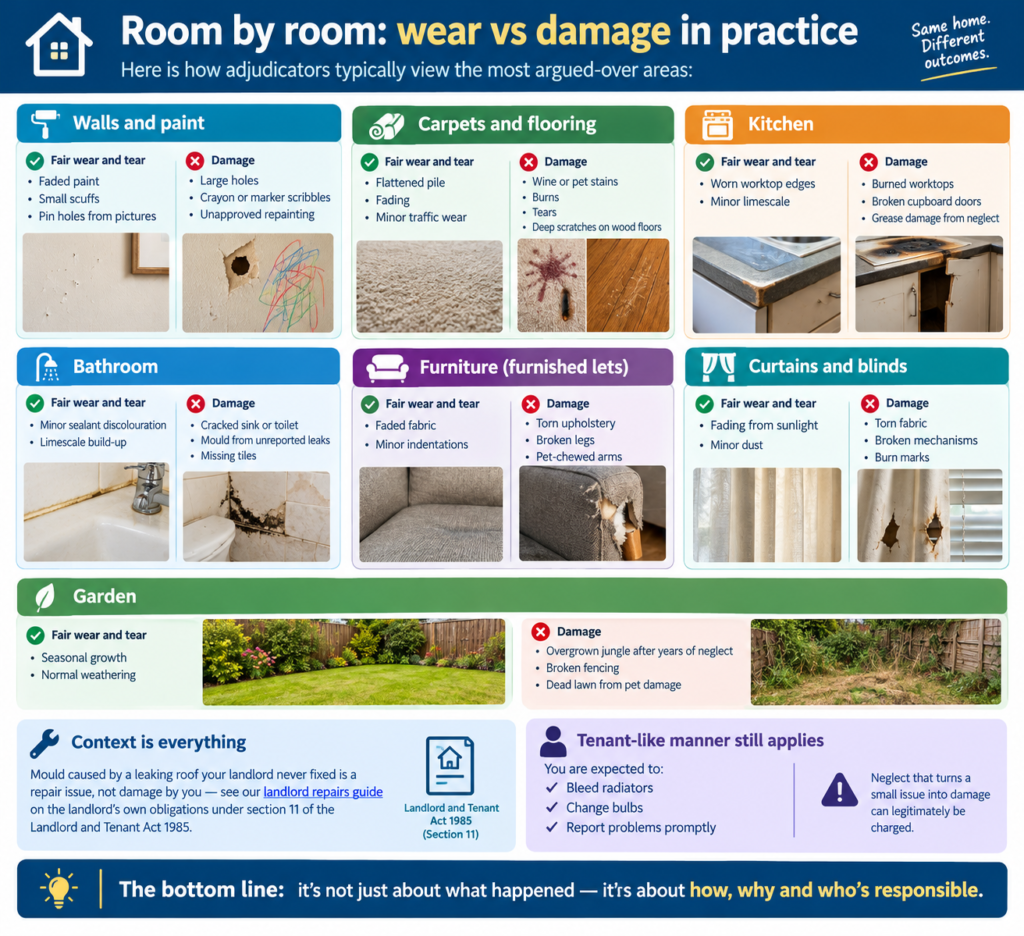
Here is how adjudicators typically view the most argued-over areas:
| Area | Fair wear and tear | Damage |
|---|---|---|
| Walls and paint | Faded paint, small scuffs, pinholes from pictures | Large holes, crayon or marker scribbles, unapproved repainting |
| Carpets and flooring | Flattened pile, fading, minor traffic wear | Wine or pet stains, burns, tears, deep scratches on wood floors |
| Kitchen | Worn worktop edges, minor limescale | Burned worktops, broken cupboard doors, grease damage from neglect |
| Bathroom | Minor sealant discolouration, limescale build-up | Cracked sink or toilet, mould from unreported leaks, missing tiles |
| Furniture (furnished lets) | Faded fabric, minor indentations | Torn upholstery, broken legs, pet-chewed arms |
| Curtains and blinds | Fading from sunlight, minor dust | Torn fabric, broken mechanisms, burn marks |
| Garden | Seasonal growth, normal weathering | Overgrown jungle after years of neglect, broken fencing, dead lawn from pet damage |
Two subtleties matter. First, context is everything: mould caused by a leaking roof your landlord never fixed is a repair issue, not damage by you — see our landlord repairs guide on the landlord’s own obligations under section 11 of the Landlord and Tenant Act 1985. Second, “tenant-like manner” still applies to you: bleeding radiators, changing bulbs and reporting problems promptly are your jobs, and neglect that turns a small issue into damage can legitimately be charged.
The cleaning rule that trips everyone up
Cleaning catches more tenants than anything else — it features in 54% of TDS disputes. The rule: fair wear and tear applies to condition, not to cleanliness. The property must be returned to the check-in cleaning standard, whether you lived there one year or six. Dust and grease do not become acceptable with time.
But landlords routinely overreach here, so know the limits:
| Can be charged | Cannot be charged |
|---|---|
| Cleaning costs where you left the property worse than the check-in standard, evidenced by the inventory | A “professional clean” when the property was only domestically clean at check-in — that is betterment |
| Professional cleaning where the property was professionally cleaned at the start and this was clearly documented | Any mandatory professional-cleaning clause in the tenancy agreement — banned under the Tenant Fees Act 2019 |
| A reasonable, evidenced cleaning cost (quotes or invoices) | Being forced to use the landlord’s chosen cleaning company |
| The actual cost of remedying poor cleaning (e.g. a grimy oven) | Vague, unitemised “cleaning fees” with no evidence of the standard at check-in |
One nuance: a property tribunal has ruled that deposit deductions are not “payments” under the Tenant Fees Act 2019, so a genuine, evidenced cleaning deduction is not an illegal fee. What the Act bans is clauses forcing you to pay for professional cleaning regardless of condition, or to use a particular company. Shelter’s position is blunt: you do not have to pay for professional cleaning.
Worked example — Philippa, London. Philippa’s check-in report recorded the flat as “domestically clean” except the oven, which was “professionally cleaned” with a receipt attached. At check-out the oven was greasy but the flat was otherwise in the same domestically-clean state. The agent charged £120 for the oven clean and £250 for a full professional clean of the flat. Philippa accepted the £120 — the oven was worse than check-in, and the claim was evidenced. She challenged the £250: the flat was never professionally cleaned at the start, so the charge was betterment — and the tenancy’s professional-cleaning clause was unenforceable under the Tenant Fees Act 2019. The £250 was dropped.
Betterment: why “new for old” claims fail
Betterment is the deposit world’s most important word. It means leaving the landlord financially or materially better off at your expense — for example, replacing a five-year-old carpet with a brand-new one and billing you the full amount. Adjudicators test every claim against three things: fair wear and tear, the most appropriate remedy, and that the landlord is neither financially nor materially better off than at the start of the tenancy.
In practice, this means:
- Like-for-like, not upgrades. A £28.99-per-metre carpet is replaced with a similar-quality carpet, not premium flooring.
- Repair beats replacement. Where a repair is possible and sensible, the landlord should repair. Full replacement of a damaged item is only justified where it is beyond economic repair or unusable.
- Age is deducted. The years of life you did not use are not your bill.
A published DPS adjudication case shows how this bites. A landlord claimed £168 to replace a bedroom carpet after a wine spill but produced no check-in evidence of the carpet’s age, and the check-out photos showed a carpet that looked tired, faded and worn. The adjudicator found for the tenant: a brand-new carpet at full cost was unreasonable, and the tenant’s £50 offer — roughly 30% of the cost, reflecting the one or two years of life left — was the fair contribution. No evidence of age, no full claim.
How apportionment maths actually works
When genuine damage shortens an item’s life, adjudicators apportion the cost. The formula is simple:
Tenant’s fair share = (remaining useful life ÷ expected lifespan) × like-for-like replacement cost
Everything else — the years already used, the wear that would have happened anyway — falls to the landlord.
Worked example — Reuben, Manchester. The check-in inventory noted the bedroom carpet was fitted four years earlier, with the landlord’s invoice showing a £500 fitted cost. With a five-year expected lifespan, one year of useful life remained. Reuben’s iron left a burn mark beyond repair; the landlord demanded the full £500.
Apportionment: (1 year remaining ÷ 5-year lifespan) × £500 = £100. That is Reuben’s fair contribution — the value of the carpet life his damage destroyed. The £400 of life already used up before his tenancy is not his bill, and the full £500 claim was betterment. Reuben paid £100, not £500.
Two traps to avoid: landlords who present replacement quotes for better-quality items than were damaged (insist on like-for-like), and quotes that bundle labour for whole rooms when only one area was damaged (you can be charged for the isolated area, not the whole carpet or wall).
Redecorating claims: the most abused deduction
Redecoration appears in 31% of TDS disputes and is the most inflated deduction. Minor scuffs after a reasonable tenancy are wear, full stop. Genuine damage — crayon, smoke staining, unapproved colours — may be charged, apportioned for the décor’s age.
Worked example — Anwen, Cardiff. Anwen lived in her flat for four years. At check-out the landlord wanted £600 to repaint the whole living room because of scuffs and marks. With décor’s five-year expected life, only one year remained. For ordinary scuffs, the correct answer is £0 — they are wear, and the walls were near the end of their expected life anyway.
Now imagine Anwen’s toddler had instead covered two walls in crayon — damage beyond fair wear and tear, and repainting those walls was genuinely needed. The redecoration quote was £600. Apportionment: (1 year remaining ÷ 5-year lifespan) × £600 = £120. The landlord absorbs £480 of used-up décor life; Anwen pays £120 for the life her damage destroyed. If she had done the same after a one-year tenancy in a freshly painted flat, her share would have been far higher — which is exactly why tenancy length matters.
Also note: a landlord cannot charge you for repainting an entire room because of marks on one wall. The remedy must be proportionate — touch-up or partial redecoration first.
What your landlord CAN deduct
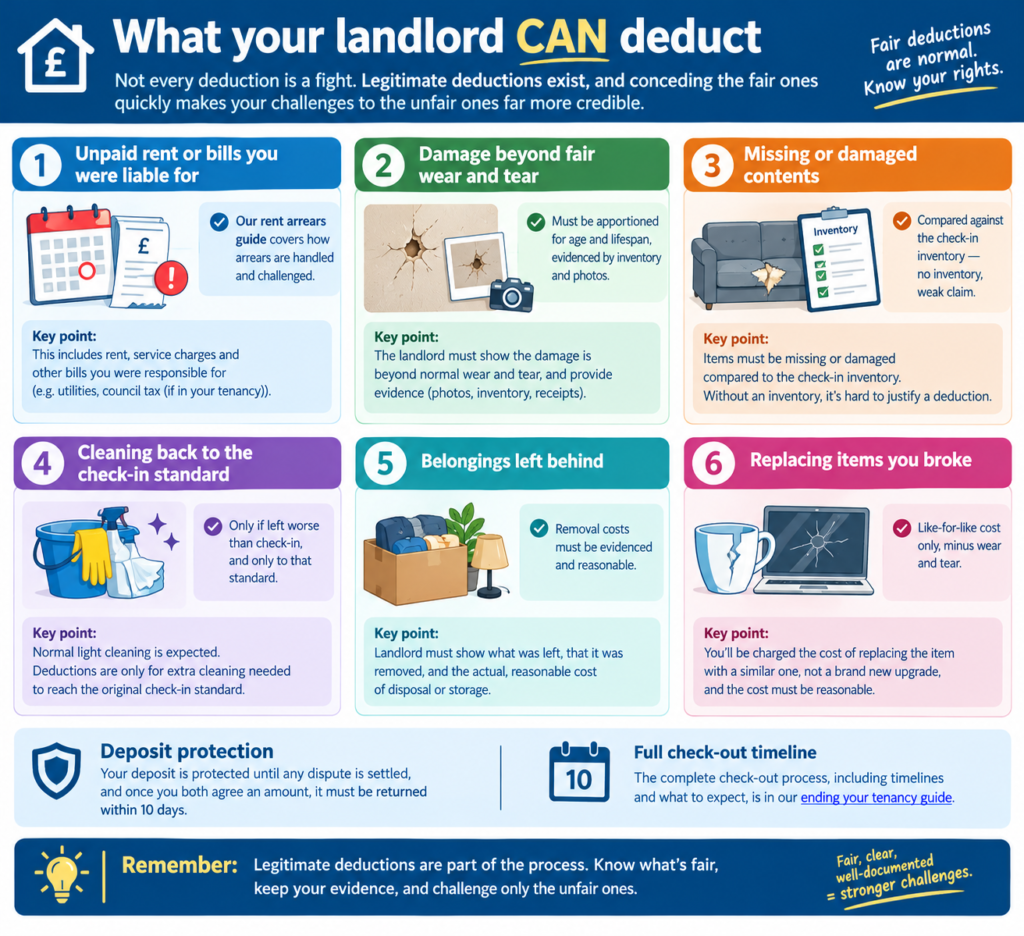
Not every deduction is a fight. Legitimate deductions exist, and conceding the fair ones quickly makes your challenges to the unfair ones far more credible:
| Legitimate deduction | Notes |
|---|---|
| Unpaid rent or bills you were liable for | Our rent arrears guide covers how arrears are handled and challenged |
| Damage beyond fair wear and tear | Must be apportioned for age and lifespan, evidenced by inventory and photos |
| Missing or damaged contents | Compared against the check-in inventory — no inventory, weak claim |
| Cleaning back to the check-in standard | Only if left worse than check-in, and only to that standard |
| Belongings left behind | Removal costs must be evidenced and reasonable |
| Replacing items you broke | Like-for-like cost only, minus wear and tear |
And a linked practical point: the deposit is protected until any dispute is settled, and once you both agree an amount, it must be returned within 10 days — the full check-out timeline is in our ending your tenancy guide.
What your landlord CANNOT deduct
This is the list to keep on your phone during any negotiation:
- Fair wear and tear — faded paint, worn carpets, small scuffs, loosened handles. Charging for wear is not just unfair; it is on the Tenant Fees Act’s banned list.
- The landlord’s own repair duties — anything covered by section 11 of the Landlord and Tenant Act 1985 (structure, exterior, water, gas, electrics, heating, sanitation) is the landlord’s bill, never a deposit deduction. If damp or a broken boiler caused the “damage”, that is a repairs issue — see our landlord repairs guide.
- Betterment and improvements — upgrades, full replacements where repair would do, “new for old”.
- Pre-existing damage — anything already there at check-in. Without a signed inventory recording it, the landlord’s claim is built on sand.
- Invented or blanket charges — vague “check-out fees”, automatic deductions with no itemisation and no evidence. A recent tribunal ordered a letting agent to return an automatic £125 deduction it could not justify or even explain.
The deposit is the tenant’s money. The burden of proof sits with the landlord: what the condition was at move-in, what it is at move-out, and that each deduction is fair, reasonable and accounts for wear and tear. “I remember it was fine when they moved in” wins nothing.
Evidence: the hierarchy that wins disputes
Adjudicators decide on paper, not on memory. This is what actually moves a decision:
| Evidence | Why it wins |
|---|---|
| Signed check-in inventory | The baseline everything is measured against. No baseline, no reliable deduction. |
| Dated photos and video, in and out | Objective proof of condition. Take your own set at both ends — never rely solely on the agent’s. |
| Check-out report | Shows what changed. Attend the check-out inspection if you can and agree the notes on the spot. |
| Invoices and receipts | Prove age and quality of items, and the real cost of like-for-like remedy. Ask the landlord for theirs. |
| Written communications | Your negotiation emails show reasonableness — and a landlord’s silence or vague replies weaken their case. |
Your move-in routine: photograph everything on day one (inside ovens, behind doors, carpet close-ups), check and annotate the inventory before signing it, and store it all where you will find it in two years. Tenants who do this win disputes; tenants who don’t lose them.
Challenging deductions, step by step
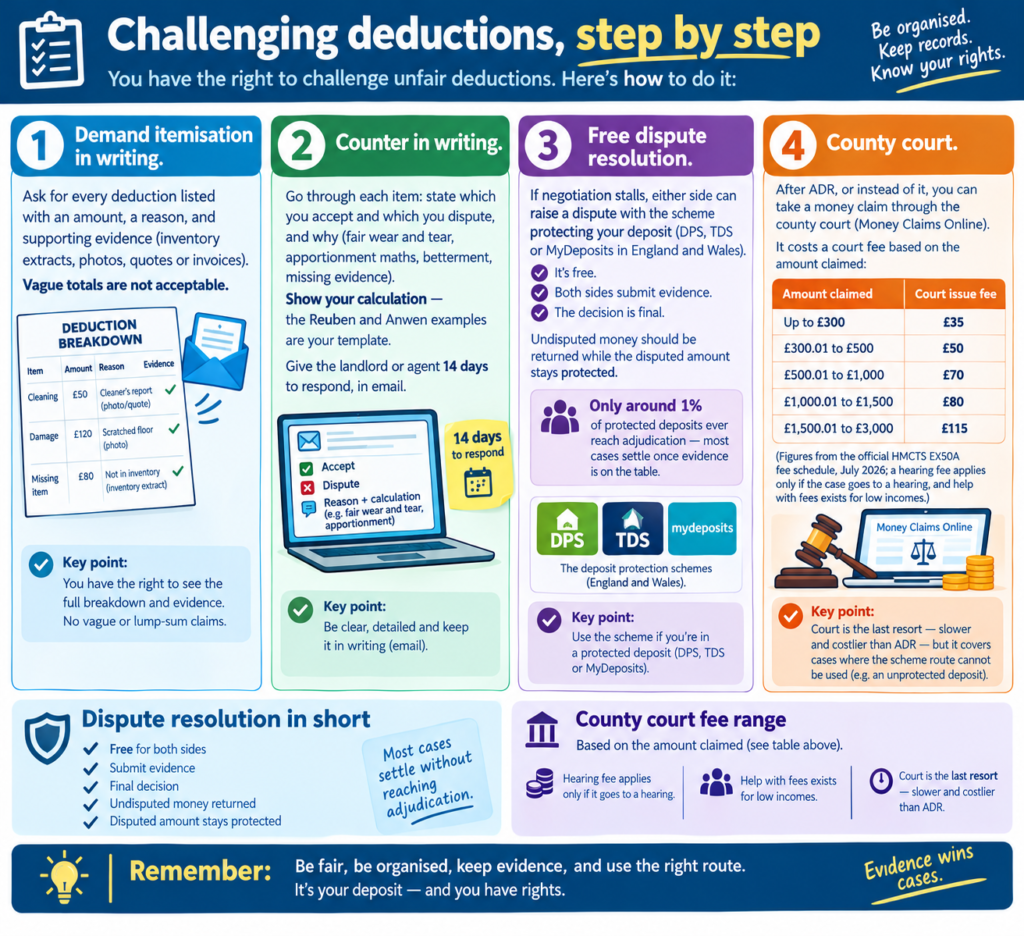
Step 1 — Demand itemisation in writing. Ask for every deduction listed with an amount, a reason, and supporting evidence (inventory extracts, photos, quotes or invoices). Vague totals are not acceptable.
Step 2 — Counter in writing. Go through each item: state which you accept and which you dispute, and why (fair wear and tear, apportionment maths, betterment, missing evidence). Show your calculation — the Reuben and Anwen examples are your template. Give the landlord or agent 14 days to respond, in email.
Step 3 — Free dispute resolution. If negotiation stalls, either side can raise a dispute with the scheme protecting your deposit (DPS, TDS or MyDeposits in England and Wales). It is free, both sides submit evidence, and the decision is final. Undisputed money should be returned while the disputed amount stays protected. Only around 1% of protected deposits ever reach adjudication — most cases settle once evidence is on the table.
Step 4 — County court. After ADR, or instead of it, you can take a money claim through the county court (Money Claims Online). It costs a court fee based on the amount claimed:
| Amount claimed | Court issue fee |
|---|---|
| Up to £300 | £35 |
| £300.01 to £500 | £50 |
| £500.01 to £1,000 | £70 |
| £1,000.01 to £1,500 | £80 |
| £1,500.01 to £3,000 | £115 |
(Figures from the official HMCTS EX50A fee schedule, July 2026; a hearing fee applies only if the case goes to a hearing, and help with fees exists for low incomes.) Court is the last resort — slower and costlier than ADR —, but it covers cases where the scheme route cannot be used, such as an unprotected deposit.
How long each route takes
| Route | Typical time | Cost |
|---|---|---|
| Direct negotiation | 1–3 weeks | Free |
| Scheme dispute resolution (custodial) | Around 15–21 days for a decision | Free |
| Scheme dispute resolution (insured) | Around 55–59 days (longer assessment stage) | Free |
| County court money claim | Several months | Court fee from £35 |
(Resolution times: mydeposits’ published figures, summer 2025.) The lesson: negotiate hard and early — every formal route takes weeks you could have spent with the money back.
The deposit dispute numbers
NRLA data (April 2026): around 47,000 deposit disputes were recorded across England and Wales in 2025, with the average deposit at a record £1,175. The top dispute topics were cleaning (54%), damage (49%) and redecoration (31%) — all wear-and-tear territory. Yet TDS figures show only about 1% of protected deposits ever reach adjudication, and mydeposits reports 90% of tenants get all or part of their deposit back — landlords win 100% of their claim less than 20% of the time. The system favours whoever can evidence their position. Be that person.
What about Scotland, Wales and Northern Ireland?
The principles are the same; the schemes differ. Scotland uses SafeDeposits Scotland, MyDeposits Scotland or the Letting Protection Service — and the NRLA notes Scotland’s dispute rate ran higher at 2.44% in 2025, so evidence matters even more there. Northern Ireland has required deposit protection since April 2013; Wales uses the England-and-Wales schemes. Our tenancy deposit protection guide covers the nation-by-nation detail.
Frequently asked questions
What is the legal definition of fair wear and tear?
The House of Lords defined it as “reasonable use of the premises by the tenant and the ordinary operation of natural forces”. Deposit scheme adjudicators apply this by weighing the item’s age, quality, the occupants, its expected lifespan and the length of the tenancy.
Can my landlord charge me for a professional clean?
Only to return the property to the check-in standard. If check-in was only domestically clean, a professional-clean charge is betterment and fails. Clauses forcing professional cleaning regardless of condition are banned under the Tenant Fees Act 2019, and you can never be required to use a particular cleaning company.
What is betterment in deposit disputes?
Betterment is where a deduction leaves the landlord better off at your expense — for example, replacing a five-year-old carpet with a brand-new one and billing you the full cost. Adjudicators require deductions to reflect wear and tear, the most appropriate remedy, and like-for-like replacement.
How is apportionment calculated?
Tenant’s fair share = (remaining useful life ÷ expected lifespan) × like-for-like replacement cost. For example, a £500 carpet with a five-year lifespan that was four years old when damaged: (1 ÷ 5) × £500 = £100. The years of life already used are the landlord’s cost, not yours.
What evidence do I need to challenge a deduction?
A signed check-in inventory, your own dated move-in and move-out photos, the check-out report, the landlord’s invoices or receipts (proving age and quality), and your written correspondence. The burden of proof is on the landlord — but your evidence wins.
How do I dispute deposit deductions for free?
Ask for itemised deductions in writing, counter in writing with your reasons and maths, then raise a dispute with the scheme protecting your deposit (DPS, TDS or mydeposits). Either side can start it, it is free, and the adjudicator’s decision is final.
How long does deposit dispute resolution take?
Negotiation: one to three weeks. Custodial-scheme disputes: around 15–21 days; insured-scheme: 55–59 days (mydeposits figures). A county court claim: several months.
Can my landlord deduct for damage caused by my children or pets?
Yes, if it goes beyond reasonable wear — adjudicators allow more wear for households with children or pets, but genuine damage (torn upholstery, pet-stained carpets) can still be charged, apportioned for the item’s age and lifespan.
What if my landlord never protected my deposit?
The free scheme dispute route is then unavailable and the 30-day protection rule has been broken. You can take a county court claim for the deposit’s return — the court can order the landlord to pay you up to three times the deposit as a penalty. Get advice first; see our deposit protection guide for the full process.
Can deductions be taken for repainting the whole room?
Only where damage genuinely requires it, apportioned for the décor’s age — and the remedy must be proportionate (touch-up or partial redecoration, not a full room for marks on one wall). Ordinary scuffs after a reasonable tenancy are wear, worth £0.
Does fair wear and tear apply in Scotland, Wales and Northern Ireland?
Yes — the principle applies UK-wide, though the protection schemes differ by nation (for example, SafeDeposits Scotland). Adjudicators use the same tests of age, quality, occupants, lifespan and tenancy length everywhere.
Can my landlord deduct for fair wear and tear?
No. Deterioration from normal everyday living — faded paint, worn carpets, small scuffs — cannot be charged to your deposit. It is an implied term of every tenancy, and charging for wear is on the Tenant Fees Act 2019’s banned list.
Final Thoughts
Deposit disputes are rarely about what happened — they are about what can be proved and how the maths is done. Three rules: wear is not damage, cleaning is judged against the check-in standard, and no deduction survives without apportionment for age and lifespan. Run every proposed deduction through those tests before agreeing to a penny, and put your counter in writing with the numbers shown.
Prevention beats disputes every time. Before your next tenancy, work out what deposit you can actually afford — our rent affordability rules guide and rent-to-income ratio calculator help you set a realistic budget, so a withheld deposit never becomes a cash-flow crisis. And when you move in, take those photos.
Further Reading
- GOV.UK — Tenancy deposit protection: disputes and problems — the official guide to free dispute resolution through your protection scheme.
- Shelter England — What can a landlord keep from your deposit? — what deductions are allowed and how fair wear and tear is assessed.