

When Daniel moved into his two-bedroom flat in Manchester, the spare room looked fine. By autumn, black speckles were spreading across the wall behind the wardrobe, the paint was bubbling, and his daughter’s cough was getting worse every night. His landlord’s answer was always the same: “Just open a window — it’s condensation, nothing to do with me.”
Daniel didn’t know that the law disagrees. In England and Wales, landlords have strict, long-standing legal duties to keep rented homes in repair — and they cannot simply blame “lifestyle” when damp appears. In Scotland, tough new damp and mould deadlines started applying to all landlords, private ones included, on 6 October 2026. And in England, Awaab’s Law is already forcing social landlords to act within days, with private landlords next in line.
This guide explains exactly which landlord repairs your landlord must do, who is responsible for damp and mould, the new Awaab’s Law deadlines across the UK, and what to do step by step when your landlord ignores you.
Quick answer: In England and Wales, the rules on landlord repairs mean your landlord must keep the structure, exterior and key installations (water, gas, electricity, sanitation, heating) in repair — but the duty generally starts when you report the problem, and they must act within a reasonable time. You can also take your landlord to court directly under the Homes (Fitness for Human Habitation) Act 2018. Awaab’s Law sets strict damp and mould deadlines: in force for social housing in England since 27 October 2025, in force for all landlords in Scotland (including private) since 6 October 2026, and confirmed as coming for private landlords in England — but the start date and timescales there are not yet law.
Rules differ between England, Scotland, Wales and Northern Ireland, and some changed in 2026. This guide reflects the position as of October 2026 and is general information, not legal advice.
Which Landlord Repairs Are Legally Required?
In England and Wales, Section 11 of the Landlord and Tenant Act 1985 writes repair duties into every tenancy of under seven years — even if your written agreement says nothing about repairs, and even if it tries to say otherwise. Clauses that attempt to reduce these duties are void. This is the legal foundation of landlord repairs in England and Wales.
| Your landlord must | What it covers |
|---|---|
| Keep the structure and exterior in repair | Walls, roof, foundations, drains, gutters and external pipes |
| Keep water, gas and electricity installations in working order | The supply installations themselves — not appliances that merely use the supply |
| Keep sanitation in working order | Basins, sinks, baths and WCs |
| Keep space heating and hot water installations in working order | Boilers, radiators, fitted heaters and hot-water systems |
Three points tenants often miss. First, “keep in repair” is a continuing duty — it means maintaining the standard throughout the tenancy, and it can include full renewal or replacement, plus making good decorations damaged by the repair work. Second, the duty generally only bites once you have told the landlord about the disrepair — the law then requires them to act within a reasonable time. Third, your landlord needs access to do the work, so you must allow reasonable entry for inspections and repairs.
Tenant Duties vs Landlord Repairs: What Counts as Your Job
Not every job counts as landlord repairs — the law expects you to play your part too.
| Your responsibility | Examples |
|---|---|
| Use the home in a “tenant-like manner” | Basic upkeep: ventilating rooms, using extractor fans, not blocking air vents, keeping the home reasonably heated |
| Fix damage you cause | Anything broken or damaged by you, your household or your visitors — and usually internal decoration |
| Report problems promptly | Tell the landlord in writing as soon as you notice disrepair, leaks, damp or faulty installations |
| Allow access | Let the landlord (or their contractor) in at reasonable times to inspect and carry out repairs |
What the landlord does not have to do under Section 11: rebuild after fire, storm or flood, or repair anything you are entitled to remove yourself. And while light bulbs, smoke-alarm batteries and garden upkeep usually fall to you (check your agreement), anything structural or installation-related stays firmly with the landlord. These limits define the edges of landlord repairs duties under Section 11.
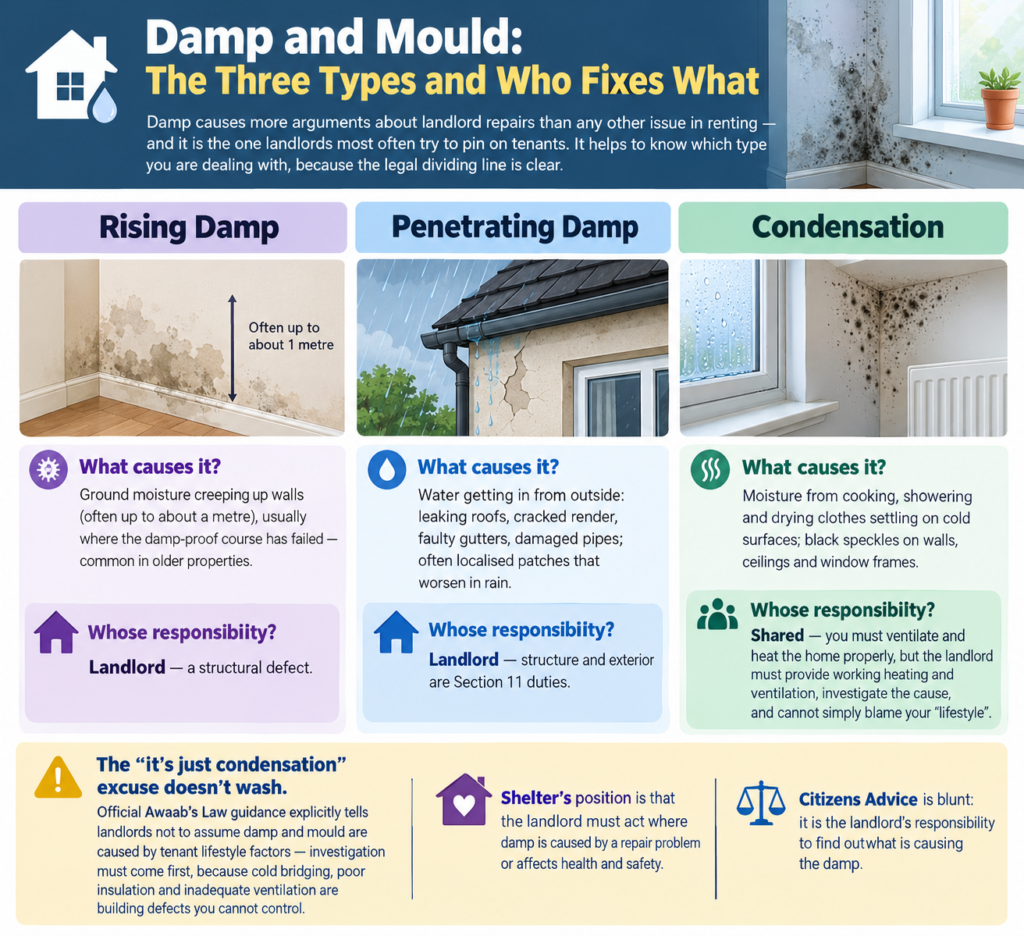
Damp and Mould: The Three Types and Who Fixes What
Damp causes more arguments about landlord repairs than any other issue in renting — and it is the one landlords most often try to pin on tenants. It helps to know which type you are dealing with, because the legal dividing line is clear.
| Type | What causes it | Whose responsibility |
|---|---|---|
| Rising damp | Ground moisture creeping up walls (often up to about a metre), usually where the damp-proof course has failed — common in older properties | Landlord — a structural defect |
| Penetrating damp | Water getting in from outside: leaking roofs, cracked render, faulty gutters, damaged pipes; often localised patches that worsen in rain | Landlord — structure and exterior are Section 11 duties |
| Condensation | Moisture from cooking, showering and drying clothes settling on cold surfaces; black speckles on walls, ceilings and window frames | Shared — you must ventilate and heat the home properly, but the landlord must provide working heating and ventilation, investigate the cause, and cannot simply blame your “lifestyle” |
The “it’s just condensation” excuse doesn’t wash. Official Awaab’s Law guidance explicitly tells landlords not to assume damp and mould are caused by tenant lifestyle factors — investigation must come first, because cold bridging, poor insulation and inadequate ventilation are building defects you cannot control. Shelter’s position is that the landlord must act where damp is caused by a repair problem or affects health and safety. Citizens Advice is blunt: it is the landlord’s responsibility to find out what is causing the damp.
Awaab’s Law: The New Damp and Mould Deadlines
Awaab’s Law is named after two-year-old Awaab Ishak, who died in 2020 after prolonged exposure to mould in his family’s social housing flat in Rochdale. It replaces vague “reasonable time” arguments about landlord repairs with hard, legally enforceable deadlines for dealing with damp, mould and dangerous hazards.
England: social housing (in force now). Phase 1 has applied since 27 October 2025: emergency hazards investigated and made safe within 24 hours of the landlord becoming aware; damp and mould investigated within 10 working days; a written summary to the tenant within 3 working days of the investigation concluding; safety work carried out within 5 working days where a significant hazard is found; and suitable alternative accommodation at the landlord’s own expense if the home cannot be made safe.
Phase 2 starts 30 November 2026, extending the same timescales to excess cold and heat, falls, structural collapse, fire, electrical hazards and domestic hygiene risks. Phase 3 follows in 2027, covering all remaining hazards under the Housing Health and Safety Rating System except overcrowding.
England: private rented sector (not yet in force). This is the part many articles get wrong. The Renters’ Rights Act 2025 contains the enabling power to extend Awaab’s Law to private landlords — but the exact timescales and the start date will be set by regulations after government consultation, and neither is confirmed yet. Figures you may see quoted — investigate within 14 days, begin repairs within 7 days, emergency action within 24 hours — are the proposed timeframes, not law. That does not leave private tenants unprotected: Section 11, the Homes (Fitness for Human Habitation) Act 2018 and council environmental health enforcement all apply right now.
Scotland: all landlords (in force from 6 October 2026). Scotland has gone further than England. The Investigation and Commencement of Repair (Scotland) Regulations 2026 took effect on 6 October 2026 and apply to councils, housing associations and private landlords.
The trigger is the landlord becoming aware that a home may be affected by damp or mould: a competent person must investigate within 10 working days; the tenant must receive a written summary within 3 working days of the investigation ending; if substantial damp or mould is found, repair work must commence within 5 working days; for social landlords, the home must be substantially free from damp and mould within 20 working days of work commencing, and for private landlords, repairs must be completed within a reasonable time.
The regulations also add “substantially free from damp and mould” to the Scottish Repairing Standard — the benchmark for landlord repairs in Scotland.
Awaab’s Law and Landlord Repairs at a Glance: England vs Scotland
| England — social housing | England — private rented sector | Scotland — all landlords | |
|---|---|---|---|
| Status (Oct 2026) | In force since 27 Oct 2025 | Not yet in force — start date and timescales to be set by regulations | In force since 6 Oct 2026 |
| Emergency hazards | Made safe within 24 hours | Use existing routes below | Report urgent hazards immediately; damp/mould timeframes apply |
| Investigate damp/mould | Within 10 working days | Proposed 14 days — not law yet | Within 10 working days |
| Written summary to tenant | Within 3 working days | Not yet law | Within 3 working days |
| Start repairs | Safety work within 5 working days | Proposed 7 days — not law yet | Within 5 working days |
| Complete repairs | Within a reasonable period | Not yet law | Social: 20 working days; private: reasonable time |
One related point of confusion: the Decent Homes Standard is sometimes reported as already applying to private rentals in England. It does not — enforcement for the private rented sector has been delayed, with 2035 now the expected date. Your current rights come from the laws in this guide, not from that standard.
You Can Take Your Landlord to Court Yourself
Before 2019, tenants in England usually had to persuade the council’s environmental health team to act before anything happened. The Homes (Fitness for Human Habitation) Act 2018 changed that: it implies a covenant into the tenancy that your home is fit for human habitation at the start and throughout — and courts judge fitness against matters including freedom from damp. The practical difference is enormous: you can go to court directly and ask for an order forcing your landlord to do the repairs, plus compensation (damages) for the period you lived with the disrepair. You do not need the council to act first. For serious landlord repairs disputes, this direct court route is often faster than waiting for council action.
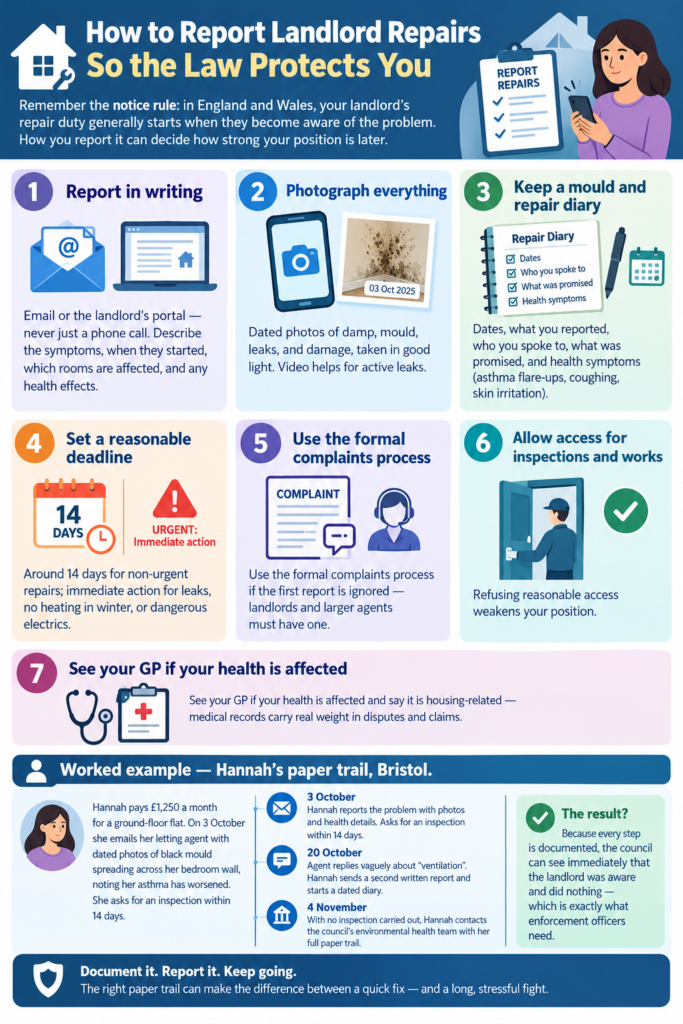
How to Report Landlord Repairs So the Law Protects You
Remember the notice rule: in England and Wales, your landlord’s repair duty generally starts when they become aware of the problem. How you report it can decide how strong your position is later.
| Step | Action |
|---|---|
| 1. Report in writing | Email or the landlord’s portal — never just a phone call. Describe the symptoms, when they started, which rooms are affected, and any health effects. |
| 2. Photograph everything | Dated photos of damp, mould, leaks, and damage, taken in good light. Video helps for active leaks. |
| 3. Keep a mould and repair diary | Dates, what you reported, who you spoke to, what was promised, and health symptoms (asthma flare-ups, coughing, skin irritation). |
| 4. Set a reasonable deadline | Around 14 days for non-urgent repairs; immediate action for leaks, no heating in winter, or dangerous electrics. |
| 5. Use the formal complaints process | Use the formal complaints process if the first report is ignored — landlords and larger agents must have one. |
| 6. Allow access for inspections and works | Refusing reasonable access weakens your position. |
| 7. See your GP if your health is affected | See your GP if your health is affected and say it is housing-related — medical records carry real weight in disputes and claims. |
Worked example — Hannah’s paper trail, Bristol. Hannah pays £1,250 a month for a ground-floor flat. On 3 October she emails her letting agent with dated photos of black mould spreading across her bedroom wall, noting her asthma has worsened. She asks for an inspection within 14 days. The agent replies vaguely about “ventilation”. Hannah sends a second written report on 20 October, starts a dated diary, and on 4 November — with no inspection carried out — she contacts the council’s environmental health team with her full paper trail. Because every step is documented, the council can see immediately that the landlord was aware and did nothing — which is exactly what enforcement officers need.
Landlord Repairs Ignored? Your Escalation Routes
When landlord repairs are ignored, you are not limited to asking nicely. Work through these routes in order — each one raises the pressure.
| Route | When to use it | What it can achieve |
|---|---|---|
| Council environmental health | Landlord ignores written reports; damp, hazards or serious disrepair | Housing Health and Safety Rating System inspection; improvement notices; prohibition orders; emergency action |
| Court action (England) | Serious disrepair; landlord refuses to act | Order forcing repairs plus compensation, under Section 11 and the Homes (Fitness for Human Habitation) Act 2018 — no need to wait for the council |
| First-tier Tribunal (Scotland) | Home fails the Repairing Standard, including the new damp and mould requirement | Repairing Standard Enforcement Order; rent relief orders cutting rent (real orders have reached 90% reductions); breach of an order is a criminal offence |
| Housing Ombudsman | Social housing tenants in England | Independent investigation of the landlord’s handling of your complaint |
| Rent Repayment Order | Landlord commits certain offences (e.g. ignoring an improvement notice, unlicensed HMO) | Tribunal orders the landlord to repay rent — up to 12 months’ rent for offences before 1 May 2026, up to 24 months’ rent for offences on or after that date. No criminal conviction is needed |
Worked example — Daniel fights back, Manchester. Daniel’s £950-a-month flat has had penetrating damp for eight months. His paper trail shows five written reports, all ignored. The council inspects, finds a Category 1 damp hazard, and serves an improvement notice — which the landlord also ignores. Daniel applies to the First-tier Tribunal for a Rent Repayment Order. The tribunal is satisfied beyond reasonable doubt that the landlord breached the improvement notice and orders repayment of six months’ rent: 6 × £950 = £5,700 (within the 12-month cap, as the offence predates 1 May 2026). The paper trail made the case.
The Penalties Landlords Face for Ignoring Landlord Repairs
Councils in England can impose civil penalties of up to £30,000 per offence as an alternative to prosecution — for example, for breaching an improvement notice. Under the Renters’ Rights Act 2025, the maximum rises to £40,000 for offences committed on or after 1 May 2026, and councils gained a separate power to fine up to £7,000 where a landlord could reasonably have removed a Category 1 hazard but failed to do so. Where a Category 1 hazard is found, the council is under a legal duty to take enforcement action — it is not optional. These powers give councils real leverage when landlord repairs are ignored.
The devolved nations have their own teeth. In Wales, no rent is payable for any period during which the property is not fit for human habitation. In Scotland, ignoring a Repairing Standard Enforcement Order is a criminal offence, and rent relief orders can slash the rent until compliance. In Northern Ireland, a home that fails the fitness standard can be placed under rent control, with the Rent Officer setting the maximum rent until a certificate of fitness is issued.
The One Thing You Must Not Do: Stop Paying Rent
Do not withhold rent to force repairs. It is the single most common — and most dangerous — mistake tenants make. Withholding rent puts you in breach of your tenancy, and your landlord can start eviction proceedings for arrears even when they are the ones at fault. Keep paying your rent in full and on time, and escalate through the routes above instead. If you are struggling to pay for other reasons, our rent arrears guide explains your options.
Landlord Repairs: Your Rights Across the UK at a Glance
| England | Wales | Scotland | Northern Ireland | |
|---|---|---|---|---|
| Main repair law | Landlord and Tenant Act 1985 s.11; Homes (Fitness for Human Habitation) Act 2018 | Renting Homes (Wales) Act 2016 ss.91–92; 2022 fitness regulations (29 prescribed matters) | Repairing Standard; Investigation and Commencement of Repair (Scotland) Regulations 2026 | Private Tenancies (NI) Order 2006 (default repair terms) |
| Damp/mould deadlines | Awaab’s Law: social housing only (in force); private sector pending | Fitness for human habitation duties apply now | Awaab’s Law for all landlords since 6 Oct 2026 | Via the fitness standard; rent control if it fails |
| Enforcement | Council environmental health; courts (direct claims); Rent Repayment Orders | Council enforcement; no rent payable while unfit | First-tier Tribunal: enforcement orders, rent relief, criminal offence for breach | Housing Executive repair notices (≥21 days to comply); district council environmental health |
| Retaliation protection | Renters’ Rights Act framework | Court may refuse possession where the claim is retaliatory (s.217) | Wrongful-termination fines apply | Limited — seek advice |
| CO detectors | Required in rooms with fuel-burning appliances | Required (mains-wired interlinked smoke alarms; CO alarms in rooms with gas/oil/solid-fuel appliances) | Required | Required in rooms with fuel-burning appliances — in non-HMOs since 1 Sept 2024 |
Worked example — Oliver’s Awaab’s Law timeline, Glasgow. Oliver reports spreading black mould to his private landlord on Thursday 8 October 2026, with photos. Under Scotland’s new regulations: a competent person must investigate by Thursday 22 October (10 working days); Oliver must receive a written summary by Tuesday 27 October (3 working days after the investigation); and repair work must commence by Thursday 29 October (5 working days after the investigation). As a private tenant, the work must then be completed within a reasonable time — and if the landlord misses these deadlines, Oliver can apply to the First-tier Tribunal, which can issue an enforcement order and cut his rent until the work is done.

Frequently Asked Questions
How long does my landlord legally have to fix a repair?
In England and Wales there is no single fixed deadline for landlord repairs in private tenancies — the law says a “reasonable time” after you report the problem, which depends on urgency: a major leak or no heating in winter means days, not weeks. Social tenants in England now have Awaab’s Law deadlines (24 hours for emergencies, 10 working days to investigate damp and mould). In Scotland, all landlords must investigate damp and mould within 10 working days, summarise in writing within 3 working days, and start repairs within 5 working days.
Can I stop paying rent until my landlord does the repairs?
No — do not do this. Withholding rent breaches your tenancy agreement and your landlord can begin eviction proceedings for arrears even though they are at fault for the disrepair. Keep paying in full and escalate through written complaints, the council’s environmental health team, or the courts.
My landlord says the mould is my fault for not opening windows. Is that the end of it?
No. Your landlord must investigate the actual cause before blaming you — official guidance explicitly warns landlords not to assume “lifestyle” causes. If the mould comes from a leaking roof, failed gutter, broken damp-proof course, inadequate heating or poor ventilation, that is the landlord’s repair duty. Ventilate and heat the home properly, but put your report in writing and ask for an investigation.
Does Awaab’s Law apply to private landlords?
In Scotland, yes — since 6 October 2026 it applies to private landlords as well as social landlords. In England, it currently applies to social housing only; the extension to private landlords is confirmed in principle under the Renters’ Rights Act 2025, but the start date and timescales are not yet law. In Wales and Northern Ireland, equivalent fitness and repair duties apply through their own legislation.
Do I have to let my landlord in to do repairs?
Yes — you must allow reasonable access for inspections and repair work, usually with at least 24 hours’ written notice (check your agreement). Refusing access weakens your position if you later complain or go to court, and can delay the very repairs you want.
Can I just get the repair done myself and deduct the cost from my rent?
For landlord repairs, this is risky and not a recognised general right. A few solicitors describe a very limited “repair and deduct” approach as an absolute last resort with a strict procedure, but the mainstream advice from Shelter and Citizens Advice is clear: keep paying rent and escalate through complaints, the council, or the courts. Get independent legal advice before attempting anything like this.
What counts as an emergency repair?
Anything that makes the home unsafe or uninhabitable: a major water leak, no heating or hot water in cold weather, dangerous electrics, a broken boiler leaking carbon monoxide, sewage backing up, or a broken external door or window that leaves you insecure. Report these immediately by phone and follow up in writing — for social tenants in England, Awaab’s Law requires emergency hazards to be made safe within 24 hours.
What evidence should I keep about disrepair?
Everything in writing: emails or portal messages (not just phone calls), dated photographs and videos, a diary of when problems started and what was promised, copies of any inspection reports, and GP records if your health is affected. This paper trail is what councils, tribunals and courts rely on — claims routinely fail for lack of evidence, not lack of merit.
Can my landlord evict me for complaining about repairs?
Retaliatory eviction is restricted. In Wales, the court may refuse a possession order where it considers the claim retaliatory. In England, the Renters’ Rights Act 2025 framework strengthens protections against eviction following legitimate complaints. In Scotland, tribunals can fine landlords 3 to 36 months’ rent for wrongful termination. Always complain in writing so there is a record.
Does my landlord have to redecorate after doing repairs?
Often, yes in effect: the Section 11 duty to “keep in repair” can include making good decorations damaged as a result of repair work — for example, replastering and repainting a wall that had to be opened up to fix a leak. Normal redecoration from wear and tear during the tenancy is usually your responsibility, so check your agreement.
What if I caused the damage — do I still have rights?
You are responsible for damage caused by you, your household or your visitors, and your landlord can charge you for putting it right (or deduct it from your deposit at the end of the tenancy — see our tenancy deposit protection guide). But damage you caused does not cancel your landlord’s separate repair duties for everything else.
Where does the Renters’ Rights Act fit into all of this?
The Act is the vehicle bringing Awaab’s Law to private landlords in England (timing to be confirmed), raised council civil penalties to up to £40,000 for offences from 1 May 2026, and doubled maximum Rent Repayment Orders to 24 months’ rent for offences from the same date. Our Renters’ Rights Act 2025 guide explains the full picture.
Final Thoughts
Damp patches and broken heating are miserable to live with — but when it comes to landlord repairs, you are far from powerless. Report problems in writing, build your paper trail from day one, give your landlord a fair deadline, and then escalate without hesitation: councils, tribunals and courts all have real powers, and the 2026 deadlines in Scotland (and coming to England) mean landlords can no longer stall indefinitely. The tenants who win disrepair disputes are rarely the ones with the worst problems — they are the ones with the best evidence.
Budgeting for a home that needs work? Our rent budget after bills calculator shows what you will really have left each month, the rent upfront cost calculator totals what a move costs, and if disrepair is pushing you towards moving, moving house costs are worth checking before you decide. For the fees side of renting, see our letting agent fees guide and the landlord register guide to check who you are renting from.
Further Reading
- GOV.UK — Private renting: repairs
- Shelter England — Repairs and housing conditions
- Citizens Advice — Repairs and housing conditions if you’re renting