Rent Budget After Bills Calculator
Rent Budget After Bills Calculator helps you quickly estimate how much rent you can afford after paying your essential monthly bills and expenses. It takes into account your monthly income, regular household bills, and other important costs to show how much money may be available for rent. This can help you set a realistic rental budget and avoid taking on rent that puts too much pressure on your finances.
What is a Rent Budget After Bills Calculator?
Working out how much rent you can afford can be difficult when you have several monthly bills and essential expenses to pay. Before choosing a rental property, it is important to understand how much money you have available for rent after covering your regular costs.
A Rent Budget After Bills Calculator provides a simple way to estimate your available rent budget based on your monthly income and expenses.
Instead of calculating everything manually, this calculator helps you see how much of your income remains after paying essential bills such as utilities, council tax, transport, food, debt payments, and other regular expenses.
Whether you are a student, first-time renter, working professional, family, or someone trying to manage a limited monthly budget, the Rent Budget After Bills Calculator can help you understand what rent amount may fit within your finances.
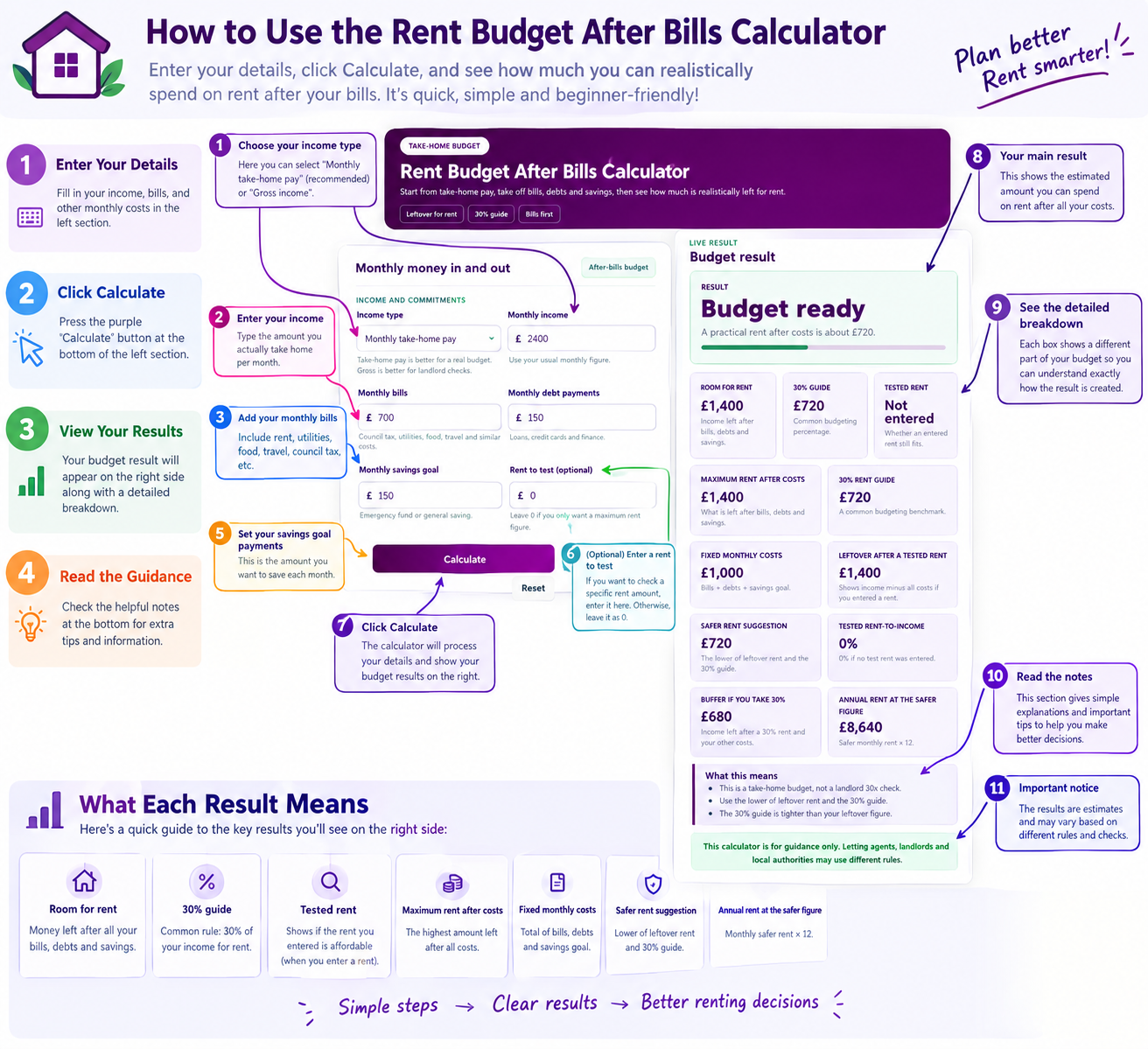
How to Use the Rent Budget After Bills Calculator
Knowing how much money remains after paying your regular monthly bills can help you set a realistic rent budget. Your affordable rent amount may vary depending on your income, household expenses, and other financial commitments.
Our Rent Budget After Bills Calculator brings these calculations together in one place, allowing you to understand:
The total monthly income available before paying your regular expenses.
The amount you spend on essential bills and regular monthly expenses.
See how much of your income remains after your monthly expenses have been deducted.
Understand how much money may be available to put towards your monthly rent.
Get an instant calculation without manually adding and subtracting your income and expenses.
Calculate Your Rent Budget After Bills
Not sure how much rent you can afford after paying your monthly bills?
Simply enter your monthly income and regular expenses into our Rent Budget After Bills Calculator, and it will estimate how much money you may have available for rent after your essential costs.
Practical Example
Monthly Income: £2,500
Monthly Bills: £1,200
The calculator estimates that around £1,300 remains after your regular bills.
This gives you a clearer starting point when deciding how much rent may fit within your monthly budget.
Check Your Available Rent Budget for a Property
Already found a house or flat?
Enter your monthly income and regular bills into the Rent Budget After Bills Calculator to understand how much money remains for rent.
Practical Example
James earns £2,800 per month and has regular monthly bills and essential expenses of £1,400.
Using the calculation:
£2,800 − £1,400 = £1,400
This means James has an estimated £1,400 remaining after bills that could be considered when setting his rent budget.
The amount you can comfortably spend on rent may be lower because you may also need to account for savings, unexpected costs, lifestyle expenses, and other financial commitments.
How Our Rent Budget After Bills Calculator Helps
Understand Your Budget After Bills
Your monthly income needs to cover regular bills and essential expenses before you decide how much rent you can afford.
Example
| Details | Amount |
|---|---|
| Monthly Income | £2,500 |
| Monthly Bills | £1,200 |
| Money Left After Bills | £1,300 |
This means approximately £1,300 remains after regular bills and expenses. This amount can help you understand your starting point when setting a realistic rent budget.
Estimate Your Available Rent Budget Quickly
Instead of adding up your income and expenses manually, the calculator allows you to enter your monthly income and bills and receive an estimated amount left after expenses.
This can be useful when planning a move, comparing rental properties, or checking whether a particular rent fits within your monthly finances.
Compare Different Monthly Expenses
The calculator can also help you understand how your available rent budget changes when your bills or income change.
Higher monthly expenses generally leave less money available for rent, while lower expenses may leave more money available within your budget.
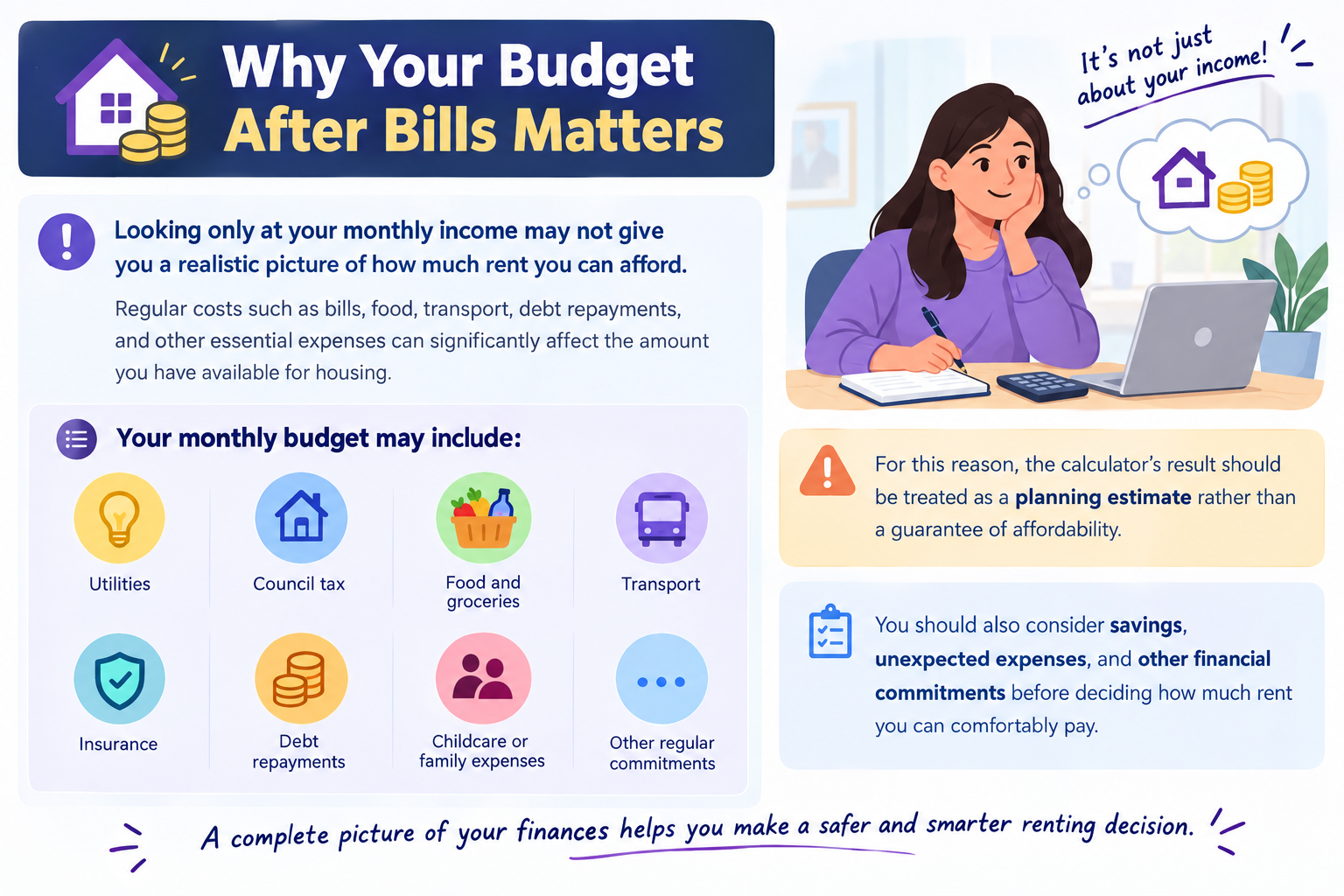
Why Your Budget After Bills Matters
Looking only at your monthly income may not give you a realistic picture of how much rent you can afford.
Regular costs such as bills, food, transport, debt repayments, and other essential expenses can significantly affect the amount you have available for housing.
When planning your rental budget, it is also important to consider rent, bills, Council Tax and deposit costsrather than looking at rent alone.
Your monthly budget may include:
- Utilities
- Council tax
- Food and groceries
- Transport
- Insurance
- Debt repayments
- Childcare or family expenses
- Other regular commitments
For this reason, the calculator's result should be treated as a planning estimate rather than a guarantee of affordability. You should also consider savings, unexpected expenses, and other financial commitments before deciding how much rent you can comfortably pay.
Rent Budget After Bills Examples
The table below shows example amounts of money remaining after monthly bills and essential expenses. These figures are general examples to help with quick planning, but your actual available rent budget will depend on your income and personal expenses.
| Monthly Income | Monthly Bills | Money Left After Bills | Common Situation |
|---|---|---|---|
| £1,800 | £900 | £900 | Lower-cost rental or shared accommodation |
| £2,000 | £950 | £1,050 | Room or smaller property |
| £2,500 | £1,200 | £1,300 | One-bedroom property |
| £2,800 | £1,400 | £1,400 | One-bedroom flat or shared household |
| £3,000 | £1,500 | £1,500 | Larger flat or higher-rent property |
| £3,500 | £1,700 | £1,800 | Family rental or larger property |
| £4,000 | £2,000 | £2,000 | Higher-cost rental |
| £5,000 | £2,500 | £2,500 | Expensive city or larger family home |
How Our Calculator Works
| What to Do | Details |
|---|---|
| Enter Monthly Income | Enter your total monthly income before calculating your available budget. |
| Enter Monthly Bills | Add your regular bills and essential monthly expenses. |
| Calculate Money Left | The calculator subtracts your monthly expenses from your income. |
| Review Your Result | Check the estimated amount remaining after bills. |
| Plan Your Rent Budget | Use the result to help decide what rent may fit within your finances. |
| Compare Expenses | Change your income or expenses to see how your available budget changes. |
Formula Used
Example
Monthly Income: £3,000
Monthly Bills: £1,400
Calculation: £3,000 − £1,400 = £1,600
Money left after bills: £1,600 per month
This gives you an estimated amount remaining after regular bills and expenses. You should also consider savings, unexpected costs, and other financial commitments when deciding how much of this amount to spend on rent.
Practical Rent Budget After Bills Examples
Example 1 – £2,500 Monthly Income
| Item | Value |
|---|---|
| Monthly Income | £2,500 |
| Monthly Bills | £1,200 |
| Money Left After Bills | £1,300 |
| Result | £1,300 remaining |
After paying regular bills and expenses, approximately £1,300 remains from the monthly income. This can help when setting a realistic rent budget.
Example 2 – £3,000 Monthly Income
| Item | Value |
|---|---|
| Monthly Income | £3,000 |
| Monthly Bills | £1,400 |
| Money Left After Bills | £1,600 |
| Result | £1,600 remaining |
Higher monthly income combined with controlled expenses can leave more money available after bills.
Example 3 – £3,500 Monthly Income
| Item | Value |
|---|---|
| Monthly Income | £3,500 |
| Monthly Bills | £1,700 |
| Money Left After Bills | £1,800 |
| Result | £1,800 remaining |
This example shows why checking your income and expenses before choosing a rental property can be useful. The amount remaining after bills provides a clearer starting point for planning your rent budget.
Understanding Your Rent Budget After Bills
Your rent budget after bills is the amount of money that remains from your monthly income after paying your regular bills and essential expenses.
The calculation helps you understand how much money is available before deciding what rent you may be able to afford.
Formula
Practical Example
| Item | Amount |
|---|---|
| Monthly Income | £3,000 |
| Monthly Bills | £1,400 |
| Money Left After Bills | £1,600 |
If your monthly income is £3,000 and your regular bills total £1,400, you have approximately £1,600 remaining after bills.
However, having £1,600 left does not necessarily mean you should spend the full amount on rent. You may also need to allow for savings, unexpected expenses, lifestyle costs, and other financial commitments.
Income vs Money Left After Bills
The table below provides a simple guide showing how much money remains after different levels of monthly expenses.
| Monthly Income | Monthly Bills | Money Left After Bills |
|---|---|---|
| £1,800 | £900 | £900 |
| £2,000 | £1,000 | £1,000 |
| £2,200 | £1,100 | £1,100 |
| £2,500 | £1,200 | £1,300 |
| £2,800 | £1,400 | £1,400 |
| £3,000 | £1,500 | £1,500 |
| £3,200 | £1,600 | £1,600 |
| £3,500 | £1,700 | £1,800 |
| £4,000 | £2,000 | £2,000 |
| £4,500 | £2,200 | £2,300 |
| £5,000 | £2,500 | £2,500 |
What Should You Include in Your Monthly Bills?
When calculating your available rent budget, it can be useful to consider your regular household and essential expenses.
Depending on your circumstances, these may include Council Tax and utility bills as well as other regular household expenses.
- Council tax
- Gas and electricity
- Water bills
- Internet and phone costs
- Food and groceries
- Transport costs
- Insurance
- Debt repayments
- Childcare or family expenses
- Other regular commitments
Including these expenses can give you a more realistic picture of how much money remains after bills.
Why Your Remaining Budget Matters
Knowing how much money remains after bills can help you make a more informed rental decision.
A property may appear affordable based only on your monthly income, but regular expenses can significantly reduce the amount available for rent.
For this reason, the Rent Budget After Bills Calculator should be used as a planning tool rather than a guarantee that a particular rent amount will be affordable or accepted by a landlord or letting agent.
Who Can Use This Rent Budget After Bills Calculator?
This calculator is designed for renters and households who want to understand how much money may remain for rent after paying their regular monthly bills and essential expenses.
Students with a limited monthly budget can use the calculator to understand how much money may remain after regular expenses.
If you are renting for the first time, the calculator can help you estimate what rent may fit within your monthly budget after bills.
If you have a regular income but several monthly expenses, you can estimate how much money remains after paying your essential costs.
Families can use the calculator to consider household income and regular expenses when planning their rental budget.
If your monthly expenses take up a large part of your income, the calculator can help you understand what remains for rent.
You can use the calculator when comparing different properties to see how your potential rent fits into your overall monthly budget.
Tips Before Choosing a Rental Property
-
Check Your Budget After Bills
Calculate how much money remains after your regular monthly bills before deciding how much rent you can afford. -
Include Regular Expenses
Remember to include essential costs such as utilities, council tax, food, transport, insurance, and debt repayments. -
Consider Additional Costs
Rent is not the only cost of renting. You may also need to budget for tenancy deposits and other permitted rental payments moving costs, utilities, and other household expenses.
-
Keep Some Money for Unexpected Costs
Avoid using your entire remaining income for rent. Keeping some money available can help with unexpected expenses. -
Compare Rental Properties
If a property's rent takes up too much of your available budget, comparing properties with lower rent may help you find a more manageable option.
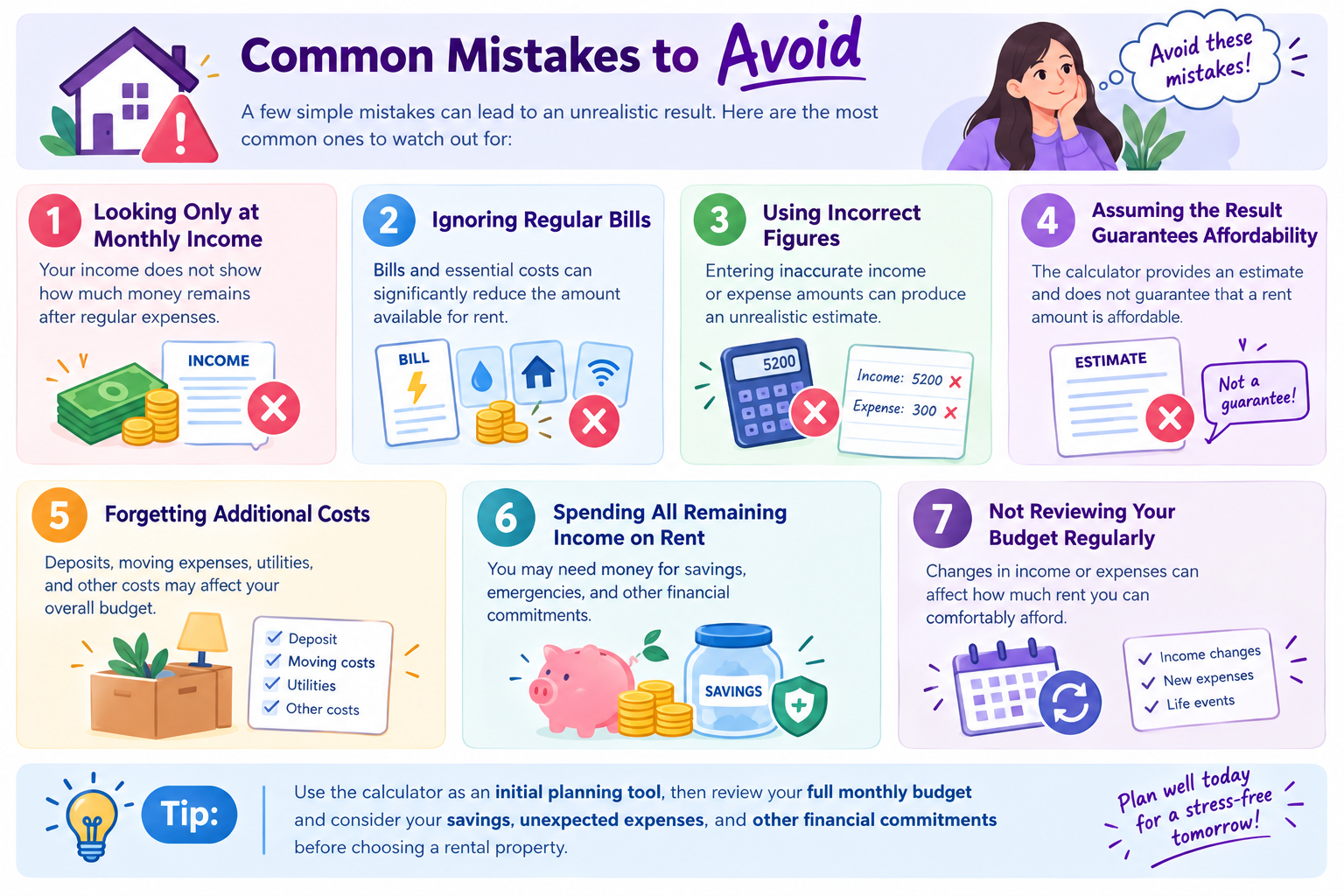
Common Mistakes to Avoid
| Common Mistake | Why It Matters |
|---|---|
| Looking Only at Monthly Income | Your income does not show how much money remains after regular expenses. |
| Ignoring Regular Bills | Bills and essential costs can significantly reduce the amount available for rent. |
| Using Incorrect Figures | Entering inaccurate income or expense amounts can produce an unrealistic estimate. |
| Assuming the Result Guarantees Affordability | The calculator provides an estimate and does not guarantee that a rent amount is affordable. |
| Forgetting Additional Costs | Deposits, moving expenses, utilities, and other costs may affect your overall budget. |
| Spending All Remaining Income on Rent | You may need money for savings, emergencies, and other financial commitments. |
| Not Reviewing Your Budget Regularly | Changes in income or expenses can affect how much rent you can comfortably afford. |
Frequently Asked Questions
A Rent Budget After Bills Calculator estimates how much money you may have available for rent after deducting your regular monthly bills and essential expenses from your income.
Subtract your total monthly bills and essential expenses from your monthly income. The remaining amount shows how much money you have left before considering your rent budget.
The basic formula is:
Monthly Income − Monthly Bills = Money Left After Bills
You can include regular expenses such as council tax, utilities, food, transport, insurance, debt repayments, childcare, and other essential monthly commitments.
No. The calculator provides an estimate of the money remaining after bills. Your actual affordable rent may also depend on savings, unexpected costs, lifestyle expenses, and other financial commitments.
Yes. Students can use the calculator to estimate how much money remains after their regular expenses when planning a rental budget.
Yes. Families and households can enter their combined income and regular expenses to estimate the money remaining after bills.
Yes. You can use it before viewing or applying for a property to get an initial idea of how a potential rent may fit into your monthly budget.
Not necessarily. Your regular bills and other expenses also affect the amount of money available for rent.
Higher monthly expenses will generally reduce the amount of money remaining after bills, which may affect the rent you can comfortably budget for.
The calculator focuses on your regular monthly budget after bills. A tenancy deposit, moving costs, and other upfront rental costs should be considered separately.
Yes. You can enter different income, expense, or rent figures to compare how different rental options may fit within your budget.
Yes. Self-employed renters can use the calculator by entering their average monthly income and regular expenses.
Not necessarily. You may need to keep money available for savings, emergencies, unexpected expenses, and other financial commitments.
No. The calculator is a budgeting and planning tool. Landlords and letting agents may use their own affordability criteria when assessing a rental application.
Ready to Check Your Rent Budget After Bills?
Stop guessing and get a quick estimate of how much money may remain after paying your regular monthly bills and essential expenses.
Enter your monthly income and regular expenses into our Rent Budget After Bills Calculator to calculate the estimated amount left after bills. In just a few moments, you can see your remaining budget and use the result to plan your potential rent more realistically.
Whether you are a student, first-time renter, working professional, family, or someone managing a tight monthly budget, our calculator can help you understand your available budget before choosing a rental property.