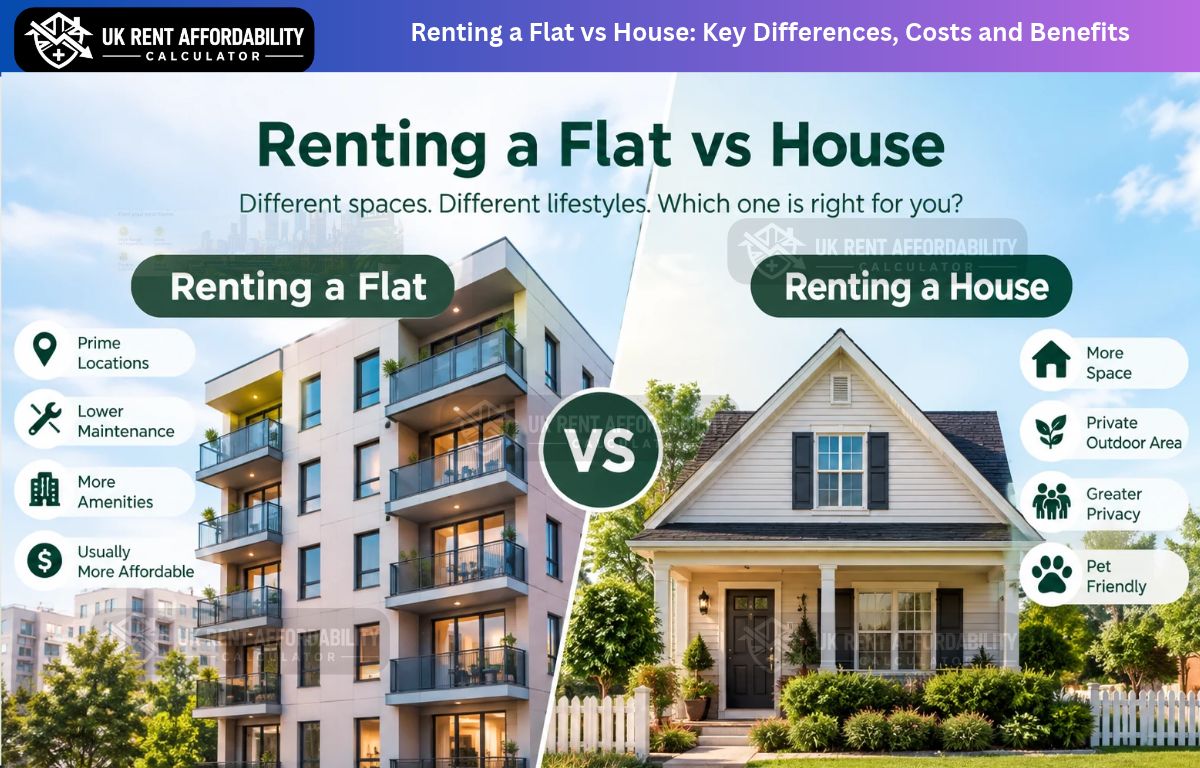
Ivo had rented a one-bed flat in Bristol for two years when his landlord gave him notice to leave. He liked the flat, but he wanted a spare room for his desk and somewhere to keep his bike. A two-bed house on the same street was advertised at £200 a month more. Was it worth it, or would the house cost far more once you added council tax, heating, and water? Renting a Flat vs House
This guide compares what flats and houses cost to rent, how council tax, energy, and water differ, what leasehold service charges mean for flat renters, space and noise, who fixes what, and which type suits your life stage. Every figure is labelled with its source.
Quick Answer: Flats are usually cheaper to rent than houses in the same area, because they are smaller and have no garden — but the gap is smaller than the rent difference suggests. A one-bed flat’s true monthly cost is often only £250–£350 less than a two-bed house once council tax, energy and water are added.
Is It Cheaper to Rent a Flat or a House?
In most cases, yes — a flat is cheaper than a house in the same area. Flats are usually smaller, have no garden, and cost less to heat, so both the rent and the bills are lower. The ONS bulletin for August 2026 put the average monthly private rent for flats and maisonettes at £1,361, against £1,256 for terraced houses, £1,336 for semis and £1,581 for detached houses. Those are UK averages across all tenancies, as reported from the ONS bulletin. Compare two homes on the same street, not national averages. Renting a Flat vs House
The honest way to compare is to price the whole month, not just the rent. A flat at £1,100 a month and a house at £1,300 look £200 apart — but the house will usually sit in a higher council tax band, so the real gap is often £300 or more. The table below shows the typical shape of the difference, using planning estimates from national averages, not quotes for a specific home.
| Monthly cost | 1-bed flat (typical) | 2-bed house (typical) | Difference |
|---|---|---|---|
| Rent | £1,100 | £1,300 | £200 |
| Council tax | £120 | £185 | £65 |
| Gas and electricity | £110 | £150 | £40 |
| Water and sewerage | £40 | £53 | £13 |
| Broadband | £30 | £32 | £2 |
| Contents insurance | £8 | £10 | £2 |
| Total | £1,408 | £1,730 | £322 |
Rent: What Flats and Houses Actually Cost
Rent is set by size, location and condition, not by the label “flat” or “house”. A one-bed flat in a city centre can cost more than a two-bed house a few miles away. The pattern is still consistent: in the same area, a flat of a given size is usually cheaper than a house of the same size, because the house comes with more space, a garden and often a driveway. By size, one-bedroom properties averaged £1,132 a month across the UK, two-bedroom £1,258, three-bedroom £1,389, and four or more bedrooms £2,067. Size matters more than type.
Two things can push a flat’s rent above a similar house: new-build city-centre blocks, where the rent covers the concierge, gym and lifts, and location — a flat above a station commands a premium, while a house on the edge of town is cheaper. Remember the affordability check: an annual income of 30 times the monthly rent — £33,000 a year on a £1,100 flat, £39,000 on a £1,300 house.
| Property type | Average monthly rent, UK |
|---|---|
| Flats and maisonettes | £1,361 |
| Terraced houses | £1,256 |
| Semi-detached houses | £1,336 |
| Detached houses | £1,581 |
Worked example 1 — Ivo’s one-bed flat. Ivo rents a one-bed flat for £1,100 a month, with council tax of £120 after the 25% single-person discount. He budgets £110 for gas and electricity, £40 for water, £30 for broadband and £8 for contents insurance. His true monthly cost is £1,100 + £120 + £110 + £40 + £30 + £8 = £1,408 a month, or £16,896 a year. His upfront cost is a deposit of up to five weeks’ rent (£1,269: weekly rent £1,100 × 12 ÷ 52 = £253.85, × 5) plus one month’s rent in advance (£1,100), a total of £2,369. The affordability check is £1,100 × 30 = £33,000 a year, and Ivo earns £36,000.
Council Tax, Energy and Water
Council tax is where the flat usually wins clearly. In England it is charged in bands A to H, based on the property’s value in April 1991, and each band pays a set fraction of the local Band D rate — Band A pays 6/9, Band D the full rate, and Band H 18/9, or double. Flats are usually in lower bands than houses in the same area. The average council tax per dwelling in England in 2026/27 is about £156 a month. If you live alone, you get a 25% single-person discount: a single person in a Band B flat may pay less than £120 a month, while a couple in a Band D house may pay £200 or more. Scotland and Wales use different band systems, and Northern Ireland uses domestic rates instead of council tax. Our council tax guide for renters explains the bands and discounts.
| Council tax band (England) | 1991 value | Fraction of Band D |
|---|---|---|
| Band A | Up to £40,000 | 6/9 |
| Band B | £40,001–£52,000 | 7/9 |
| Band C | £52,001–£68,000 | 8/9 |
| Band D | £68,001–£88,000 | 9/9 |
| Bands E–H | £88,001 and over | 11/9 to 18/9 |
Energy is the second clear win for flats: fewer outside walls, less volume to heat, and neighbours heating the homes around you. Ofgem’s typical-use price-cap equivalent was about £144 a month for October to December 2026 — a benchmark, not a fixed bill. A well-insulated one-bed flat may cost £100–£120 a month, while a draughty three-bed house can cost £180 or more. Water is usually cheaper in a flat too, and the England and Wales average is about £53 a month. The EPC rating tells you more than the property type, so always check it before you sign. Our energy bills guide explains how to switch suppliers and cut costs.
Worked example 2 — Noor’s two-bed house. Noor rents a two-bed terraced house for £1,300 a month, with council tax of £185 — a Band D house, no discount. She budgets £150 for gas and electricity, £53 for water, £32 for broadband and £10 for contents insurance. Her true monthly cost is £1,300 + £185 + £150 + £53 + £32 + £10 = £1,730 a month, or £20,760 a year. Her upfront cost is a deposit of up to five weeks’ rent (£1,500: weekly rent £300 × 5) plus one month’s rent in advance (£1,300), a total of £2,800. Compared with Ivo’s flat (£1,408 a month), Noor’s house costs £322 a month more, or £3,864 a year — and £431 more upfront.
Leasehold Flats: Service Charges and Ground Rent
Most flats in England are leasehold, while most houses are freehold, and that difference matters for renters. In a leasehold flat, the landlord pays a service charge to the freeholder for maintaining the building — cleaning hallways, maintaining the lift, insuring the building and repairing the roof. Since 1 June 2019, under the Tenant Fees Act 2019, that service charge must sit inside the headline rent on new tenancies in England: your landlord cannot charge it to you separately. But a high service charge still pushes the rent up, because the landlord passes the cost on — so ask what the charge is and what it covers.
Ground rent is a separate charge, and the rules changed on 30 June 2022. Under the Leasehold Reform (Ground Rent) Act 2022, ground rent on most new long residential leases in England and Wales cannot be more than one peppercorn a year — effectively nothing. But existing leases keep the ground rent written into them, and some older leases have ground rents that double every ten or twenty years. As a tenant, you do not pay ground rent directly, but a flat with a punishing ground rent is a flat whose landlord is under financial pressure, which can show up as delayed repairs. If you are renting a leasehold flat, read our leasehold flat guide and our service charges guide before you sign.
Space, Storage and Gardens
Space is the house’s strongest card. A house gives you more rooms, more storage, a loft or garage, and usually a garden — which matters if you work from home, have children, or own a bike or a car. Flats, especially new-build ones, are often short on storage: no loft, no garage, a small hallway cupboard and fewer kitchen cupboards. About four in five households in the UK live in houses and one in five in flats — most people choose a house when they can afford one, because space is what they want most.
But space has a cost beyond the rent: a bigger home takes longer to clean, costs more to heat, and needs more furniture, and a garden needs mowing and weeding — in most tenancies the garden is your responsibility. A flat, by contrast, is easy to keep: fewer rooms, no garden, and the building’s exterior is someone else’s problem. If you travel a lot or work long hours, a flat’s smaller footprint is a genuine advantage. Think about how you actually live: a garden you never use is £3,864 a year spent on grass you mow out of duty, while a spare room you use as an office every day is money well spent.
Noise, Privacy and Neighbours
Noise is the flat’s biggest weakness, and privacy is the house’s biggest strength. In a flat you share walls, floors and ceilings with neighbours, so you hear footsteps above you, music through the wall and conversations in the hallway. Purpose-built flats are usually better insulated for sound than converted houses, and top-floor flats avoid the footsteps problem — but no flat is as quiet as a detached house. If you are a light sleeper, work night shifts or have a baby, this matters more than the rent.
A house gives you more privacy in both directions: nobody hears you, and you hear nobody. You also get your own front door, your own bins and your own post. Flats, on the other hand, often have better security: a locked communal entrance and neighbours who notice strangers. Ground-floor flats are the exception. When you view a flat, visit at a different time of day if you can, and listen. When you view a house, check the garden fences, the side gate and whether the street feels safe after dark.
Repairs: Who Fixes What
Who fixes what does not depend on whether you rent a flat or a house — the law is the same for both. Under Section 11 of the Landlord and Tenant Act 1985, your landlord must keep the structure and exterior in repair, and the heating, hot water, gas, electricity and sanitation in working order. What changes is who does the work: in a flat, some repairs need the freeholder or the managing agent — a leaking roof, a broken lift or a faulty communal entrance — which can slow things down. In a house, your landlord deals with everything directly, which is usually faster.
Your own responsibilities are the same in both: keep the home reasonably clean, report problems promptly, and do not cause damage. The practical jobs differ: in a house you are usually responsible for the garden and the driveway; in a flat you share responsibility for communal areas — do not block fire escapes or leave rubbish in the hallway. Ground-floor and basement flats can be more prone to damp, while poorly insulated houses can be just as bad. Report damp in writing as soon as you see it, and read our landlord repairs guide for the step-by-step process.
Pets, Children and Families
Pets and children are where the house usually wins — and where the law has recently changed in your favour. Since 1 May 2026, tenants in England have the right to ask to keep a pet, and the landlord cannot unreasonably refuse. That applies to flats and houses alike. But in practice, a house with a garden is a far better home for a dog than a second-floor flat, and landlords know it. If you have a pet, be honest about the animal — a landlord who discovers a pet later is far less forgiving than one who agreed upfront.
The same Act banned landlords in England from refusing tenants because they have children. But a flat may still be the wrong home: no garden for play, no spare room for a nursery, stairs with no lift for a pushchair, and neighbours who complain about noise. A house gives children a garden, a bedroom each as they grow, and space for the things families accumulate. If you are renting with children, read our renting with children guide. If you or a family member has a disability, a house is often easier to adapt — though modern flats may already have lifts and level access. Our renting with a disability guide explains your rights to reasonable adjustments.
Which Is Right for You?
There is no single right answer — only the right answer for your life right now. Use the table to narrow your search, then compare two real homes on the same street using the true monthly cost method from the first section.
| Your situation | Usually better | Why |
|---|---|---|
| Single, first home, tight budget | Flat | Lowest rent, bills and deposit |
| Couple, both working, no children | Flat | Low upkeep, good location, cheaper bills |
| Working from home full-time | House | Spare room for an office |
| Family with young children | House | Garden, bedrooms, space to grow |
| Dog owner | House | Garden, easier pet permission |
| Frequent traveller | Flat | Lock up and leave, no garden |
| Limited mobility | Flat (modern block) | Lift, level access, no stairs |
| Light sleeper or night-shift worker | House | No neighbours above or through the wall |
Before you decide, view both types and ask the right questions. For a flat, ask: what is the service charge and what does it cover? Are major works planned? How thick are the walls? Is there a lift or parking? For a house, ask: who maintains the garden, the fences and the driveway? How old is the boiler? Is the loft insulated? Are the windows double-glazed? For either type, ask for the council tax band, the EPC rating and the gas safety certificate before you apply.
Frequently Asked Questions
Is it cheaper to rent a flat or a house in the UK?
Usually, yes — a flat is cheaper than a house in the same area, because it is smaller and has no garden. But once council tax, energy and water are added, a one-bed flat often costs only £250–£350 a month less than a two-bed house.
Why is council tax higher for a house than a flat?
Bands are based on the property’s value in April 1991, and houses were usually worth more, so they sit in higher bands. A flat is often in Band A or B, while a similar house may be in Band C or D.
Do I pay service charges when renting a flat?
Not separately. Since 1 June 2019, service charges on new tenancies in England must sit inside the headline rent.
Is a flat or a house better for working from home?
Usually a house, because it is more likely to have a spare room for an office. A one-bed flat leaves you working from the kitchen table or the sofa.
Are flats noisier than houses?
Generally, yes. In a flat, you share walls, floors and ceilings with neighbours. Purpose-built flats are usually better insulated for sound than converted houses, and top-floor flats avoid footsteps from above.
Can I keep a pet in a rented flat?
Yes, you can ask. Since 1 May 2026, tenants in England have the right to request a pet, and the landlord cannot unreasonably refuse. In practice, a house with a garden is a better home for a dog.
Is a house better than a flat for children?
Usually, yes. A house gives children a garden, a bedroom each as they grow, and space for their things. A flat can still work, especially a larger one with a nearby park.
Do flats or houses cost more to heat?
Houses usually cost more to heat, because they are bigger and have more outside walls. A flat keeps heat better, with neighbours heating the homes around you. The EPC rating matters more than the type, so always check it.
What should I check when viewing a flat?
Ask about the service charge and what it covers, whether major works are planned, how thick the walls are, and whether there is a lift or parking. Check the EPC and council tax band, listen for noise, and look for damp.
What should I check when viewing a house?
Ask who maintains the garden, fences, and driveway, how old the boiler is, whether the loft is insulated, and whether the windows are double-glazed. Check the EPC and council tax band, and look for damp and roof problems.
Final Thoughts
A flat is usually cheaper than a house — but not by as much as the rent suggests. In our worked examples, the one-bed flat cost £1,408 a month all-in and the two-bed house £1,730 — a gap of £322 a month, or £3,864 a year. That £3,864 buys a second bedroom, a garden, more storage and more privacy; whether it is worth it depends on your life, not on a rule. If you are single, on a tight budget, or you travel a lot, a flat is the sensible choice. If you work from home, have children or a dog, or simply need space, a house is worth the extra money. Either way, compare the true monthly cost, not the headline rent — ask for the council tax band and the EPC, check the service charge on a flat and the garden duties on a house, and make sure you can pass the affordability check.
Further Reading
- Private renting — GOV.UK — the government’s overview of your rights as a private tenant.
- Private renting advice — Shelter England — guidance on deposits, repairs, eviction and your rights.
- Renting a home — Citizens Advice — help with tenancy problems, deposits and complaining about your landlord.