
Income Required to Rent Calculator UK helps you understand how much you may need to earn before renting a property in the UK. Renting a property in the UK is not just about finding a home you like—it’s also about proving that you can comfortably manage the monthly cost. Before approving your rental agreement application, many property owners and letting brokers review your income to ensure you have enough earnings to meet your rental payments.
Our Income Required to Rent Calculator UK helps you estimate the minimum salary you may need based on your monthly rent. Whether you’re renting your first apartment, moving to a larger home, or comparing properties, this calculator provides a quick and reliable estimate of the income commonly expected by landlords and letting agents.
In this guide, we’ll explain how rental affordability is calculated, why landlords use income multipliers, and provide practical examples to help you understand how much you may need to earn before applying for a rental property.
What Is an Income Required to Rent Calculator?
An Income Required to Rent Calculator is an online tool that helps estimate the minimum annual or monthly income you may need to qualify for a rental property in the UK. By entering your monthly rent, the calculator applies a commonly used rental affordability multiplier to estimate the salary that landlords or letting agents may expect during the tenant referencing process.
This gives you a quick indication of whether a property is likely to fit within your budget before you submit a rental application.
How Does It Work?
The calculator uses your monthly rent as the starting point and applies a common affordability formula.
| Step | Calculation | Result |
|---|---|---|
| Monthly Rent | — | £1,200 |
| Required Annual Income Formula | Monthly Rent × 30 | £1,200 × 30 |
| Required Annual Income | £1,200 × 30 | £36,000 |
| Monthly Income Formula | Annual Income ÷ 12 | £36,000 ÷ 12 |
| Estimated Monthly Income | £36,000 ÷ 12 | £3,000 |
So, an applicant earning around £3,000 per month (or £36,000 per year before tax) may meet the affordability requirement, depending on the landlord’s criteria.
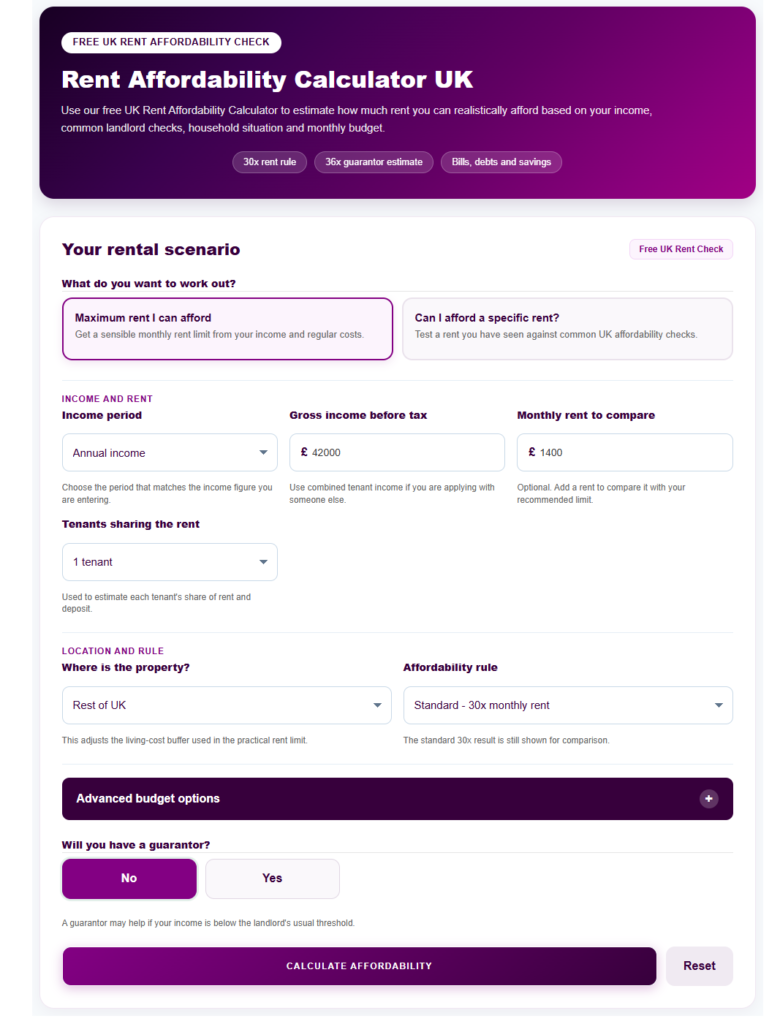
Click Here: Rent Affordability Calculator UK
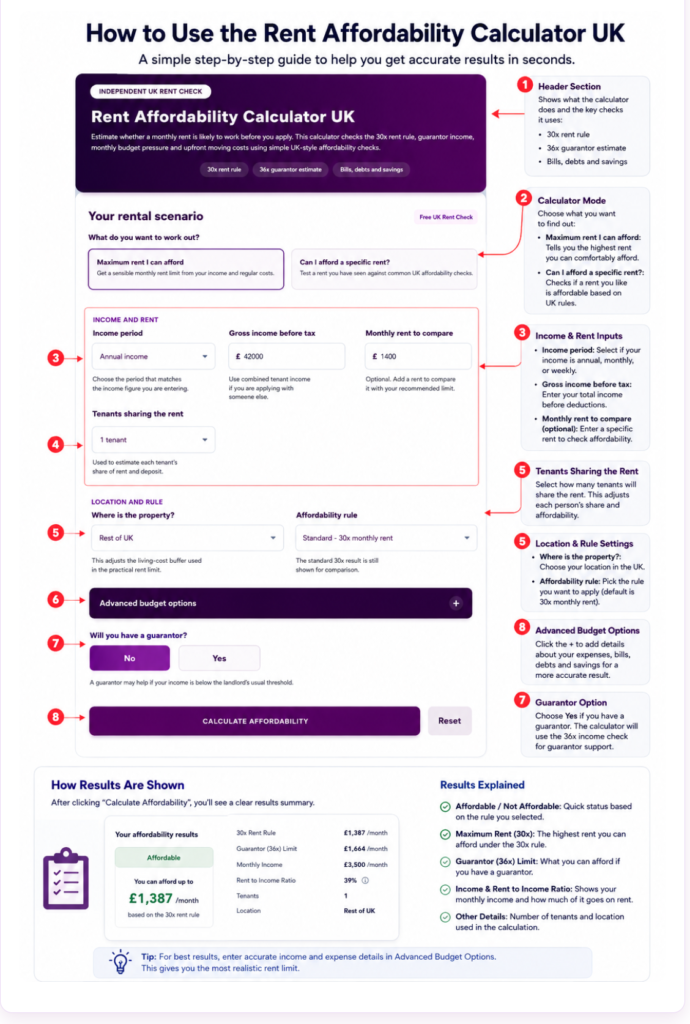
How to Use the Rent Affordability Calculator UK
What Can the Calculator Help You With?
Using an Income Required to Cost Calculator can help you:
- Calculate the salary needed for a Specific rental property.
- Compare different rental options based on your income.
- Plan your housing Financial plan before applying for a Rental agreement.
- Prepare for affordability and referencing checks carried out by Property owners or letting brokers.
- Understand whether a property fits your income, helping you avoid applications that may not meet the ability to pay requirements.
- Save time by finding suitable rental properties before starting the application process.
Whether you’re renting your first home, relocating, or comparing different properties, an Income Required to Rent Calculator UK provides a quick and practical way to calculate the income you may need before signing a rental agreement.
Why Do Landlords Check Your Income?
Before approving a Rental agreement application, Property owners and letting brokers usually assess your income to ensure you can comfortably manage the monthly rent. An Income Required to Rent Calculator UK can help you estimate whether your income is likely to meet common affordability expectations before applying. This process, often called renter referencing or an ability-to-pay check, helps them determine whether you’re likely to make your rent payments on time throughout the Rental agreement.
By verifying your financial situation, Property owners can reduce the risk of missed or late rent payments and make informed decisions when choosing renters.
Read more:University Credits Calculator – Calculate Credits Required for Your DegreeWhat Documents May Be Requested?
| Document | Purpose |
|---|---|
| Recent Payslips | Usually, the last 3–6 months are required to confirm your salary. |
| Employment Confirmation | A letter from your Company confirming your job title, salary, and job status. |
| Bank Statements | Recent statements showing your income and regular financial activity. |
| Tax Returns or SA302 Forms | Commonly requested from self-employed Individuals applying to confirm annual earnings. |
| Proof of Income | This may include pension statements, benefit Achievement letters, investment income, or other evidence of regular earnings. |
| Guarantor Details | If your income does not meet the ability-to-pay requirements, the Property owners may ask for a surety who agrees to cover the rent if you are unable to pay. |
Example
Suppose you’re applying for a property with a monthly rent of £1,100.
Using the common affordability guideline:
Required Annual Income = £1,100 × 30
= £33,000
If your annual salary is £35,000 and you can provide recent payslips and bank statements confirming your income, you’re more likely to satisfy the affordability assessment.
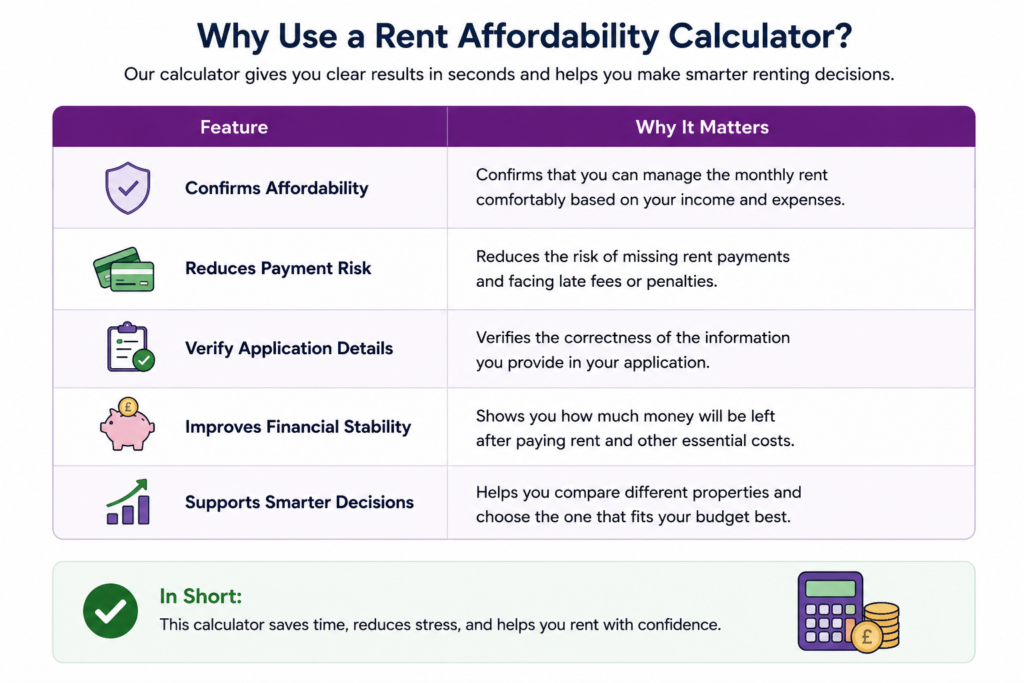
Why Are These Checks Important?
| Reason | Why It Matters |
|---|---|
| Confirm Affordability | Confirm that you can manage the monthly rent. |
| Reduce Payment Risk | Reduce the risk of outstanding rent payments. |
| Verify Application Details | Verify the Correctness of the information provided in your application. |
| Assess Financial Stability | Review your overall financial stability. |
| Ensure Fair Selection | Make the renter selection process fair and consistent. |
| Support a Faster Process | Providing correct, up-to-date documents can speed up the application process. |
Speed up the Background checks process and improve your chances of securing the rental property.
How Is the Required Income Calculated?
Most UK landlords and letting agents use an affordability multiplier to determine whether a tenant can comfortably afford the rent. An Income Required to Rent Calculator UK can help you estimate whether your income meets these affordability guidelines before applying. The most common rule is that your annual gross income should be at least 30 times the monthly rent, which means your rent should generally be no more than 40% of your gross annual income.
Some landlords and referencing companies use different affordability checks, such as 2.5×, 2.75×, or 3× your monthly rent, so the exact requirement can vary depending on the property, landlord, or letting agent.
Formula (Required Annual Income)
Required Annual Income = Monthly Rent × 30
Example:
- Monthly Rent: £1,200
- Calculation: £1,200 × 30 = £36,000
- Required Annual Income: £36,000
Formula (Required Monthly Income)
| Step | Formula / Calculation | Result |
|---|---|---|
| Required Monthly Income Formula | Required Annual Income ÷ 12 | — |
| Alternative Formula | (Monthly Rent × 30) ÷ 12 | — |
| Annual Income Required | — | £36,000 |
| Calculation | £36,000 ÷ 12 | £3,000 |
| Required Monthly Income | — | £3,000 |
Formula (Using a 2.5× Monthly Income Rule)
Some landlords simply require your monthly income to be 2.5 times the monthly rent.
Required Monthly Income = Monthly Rent × 2.5
Example:
- Monthly Rent: £1,200
- Calculation: £1,200 × 2.5 = £3,000
- Required Monthly Income: £3,000
Read more:Calculate House Rent in the UK: Step-by-Step GuideFormula (Using a 3× Monthly Income Rule)
Some letting agents use a stricter affordability check.
Required Monthly Income = Monthly Rent × 3
Example:
- Monthly Rent: £1,200
- Calculation: £1,200 × 3 = £3,600
- Required Monthly Income: £3,600
Formula (Maximum Affordable Rent)
| Step | Formula / Calculation | Result |
|---|---|---|
| Maximum Monthly Rent Formula | Annual Income ÷ 30 | — |
| Annual Salary | — | £45,000 |
| Calculation | £45,000 ÷ 30 | £1,500 |
| Estimated Maximum Monthly Rent | — | £1,500 per month |
Formula (Rent-to-Income Percentage)
This shows what percentage of your gross monthly income goes toward rent.
Rent-to-Income Ratio (%) = (Monthly Rent ÷ Gross Monthly Income) × 100
Example:
- Monthly Rent: £1,200
- Gross Monthly Income: £3,500
Calculation:
(£1,200 ÷ £3,500) × 100 = 34.3%
A lower percentage generally indicates better affordability. Many financial experts recommend keeping housing costs below 30%–35% of gross income where possible, although many UK landlords will accept applicants whose rent is around 40% of their gross income.
Check Your Real Monthly Budget Before Applying
Meeting the 30× rent rule does not necessarily mean that a property is affordable for you in everyday life. Before applying, work out how much money you actually have available after tax and regular household expenses. For example, if you earn £3,000 per month before tax and the rent is £1,000, the rent may meet a standard affordability test, but you still need to budget for council tax, gas and electricity, water, broadband, transport, groceries, insurance, debt repayments, and other regular costs.
A simple way to test the property is to subtract your expected monthly expenses from your take-home income. If there is still a comfortable amount left for savings, emergencies, and unexpected costs, the rent may be more manageable. If very little remains after your essential bills, consider looking at a cheaper property even if you technically pass the landlord’s income requirement.
Why Is the 30× Rent Rule Common?
The 30× rent rule is one of the most commonly used methods by landlords and letting agents to estimate whether a tenant can comfortably afford a rental property. Instead of reviewing every applicant’s financial situation in detail, this simple calculation provides a quick affordability benchmark during the referencing process. An Income Required to Rent Calculator UK uses the same affordability principles to help estimate the income you may need before applying for a rental property.
The idea behind the rule is that your annual gross income should be approximately 30 times your monthly rent. This helps ensure that rent remains an easy-to-handle part of your income, leaving enough money for other living costs such as payments, food, travel, and savings
Formula
Required Annual Income = Monthly Rent × 30
To estimate the required monthly income:
Required Monthly Income = Required Annual Income ÷ 12
Example Calculation
Suppose the monthly rent for a property is £1,000.
Step 1: Calculate the required annual income
£1,000 × 30 = £30,000
Step 2: Calculate the required monthly income
£30,000 ÷ 12 = £2,500
| Result | Amount |
|---|---|
| Monthly Rent | £1,000 |
| Required Annual Income | £30,000 |
| Required Monthly Income | £2,500 |
This means that a tenant earning around £30,000 per year (or £2,500 per month before tax) may meet the affordability requirement for a property with a monthly rent of £1,000, although the final decision depends on the landlord’s or letting agent’s referencing criteria.
Another Example
Monthly Rent: £1,500
Required Annual Income
£1,500 × 30 = £45,000
Required Monthly Income
£45,000 ÷ 12 = £3,750
So, a tenant would generally need an annual income of approximately £45,000 to satisfy the 30× affordability guideline for a property costing £1,500 per month.
Why Do Landlords Use This Rule?
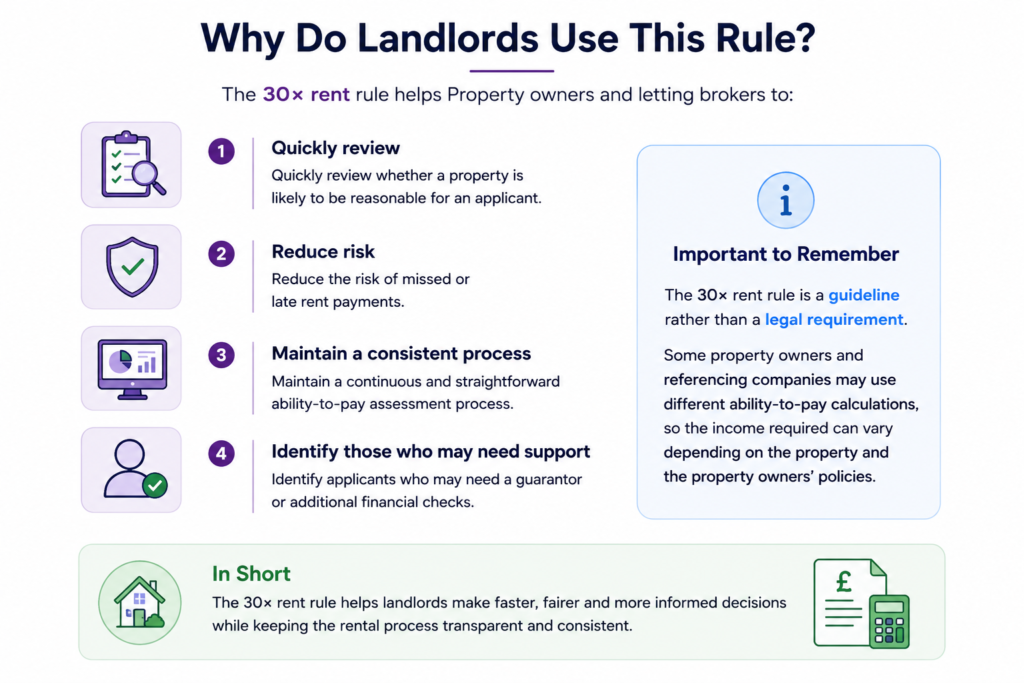
The 30× rent rule helps Property owners and letting brokers to:
- Quickly review whether a property is likely to be Reasonable for an applicant.
- Reduce the risk of missed or late cost payments.
- Maintain a Continuous and straightforward ability-to-pay assessment process.
- Identify applicants who may need a surety or additional financial checks.
It’s important to remember that the 30× rent rule is a guideline rather than a legal requirement. Some property owners and referencing companies may use different ability-to-pay calculations, so the income required can vary depending on the property and the Property owners’ policies.
Read more:£35,000 Salary Rent UK – How Much Rent Can You AffordExample 1 – Monthly Rent £800
| Item | Calculation / Amount |
|---|---|
| Monthly Rent | £800 |
| Annual Income | £800 × 30 = £24,000 |
| Monthly Income | £24,000 ÷ 12 = £2,000 |
| Estimated Annual Salary Required | £24,000 |
| Estimated Monthly Income Required | £2,000 |
Example 2 – Monthly Rent £1,000
Monthly Rent:
£1,000
Calculation:
£1,000 × 30 = £30,000
Monthly Income:
£30,000 ÷ 12 = £2,500
Estimated Salary Required
- Annual Income: £30,000
- Monthly Income: £2,500
Example 3 – Monthly Rent £1,250
Calculation:
£1,250 × 30 = £37,500
Monthly Income:
£37,500 ÷ 12 = £3,125
Required Income:
- £37,500 per year
- £3,125 per month
Example 4 – Monthly Rent £1,500
| Item | Calculation / Amount |
|---|---|
| Annual Income Calculation | £1,500 × 30 = £45,000 |
| Monthly Income Calculation | £45,000 ÷ 12 = £3,750 |
| Required Annual Salary | £45,000 |
| Required Monthly Salary | £3,750 |
Example 5 – Monthly Rent £2,000
Calculation:
£2,000 × 30 = £60,000
Monthly Income:
£60,000 ÷ 12 = £5,000
Estimated Required Income:
- Annual Income: £60,000
- Monthly Income: £5,000
Income Required to Rent Table
| Monthly Rent | Estimated Annual Income | Estimated Monthly Income |
| £600 | £18,000 | £1,500 |
| £700 | £21,000 | £1,750 |
| £800 | £24,000 | £2,000 |
| £900 | £27,000 | £2,250 |
| £1,000 | £30,000 | £2,500 |
| £1,200 | £36,000 | £3,000 |
| £1,500 | £45,000 | £3,750 |
| £1,800 | £54,000 | £4,500 |
| £2,000 | £60,000 | £5,000 |
| £2,500 | £75,000 | £6,250 |
Read more:Salary-to-Rent Ratio UK – How Much Should You Spend on RentWhat If You Don’t Meet the Income Requirement?
If your income is below the Property owner’s Ability to pay requirement, it does not always mean your application will be rejected. Many landlords and letting brokers consider alternative options that can help show your ability to pay the rent.
Example Calculation
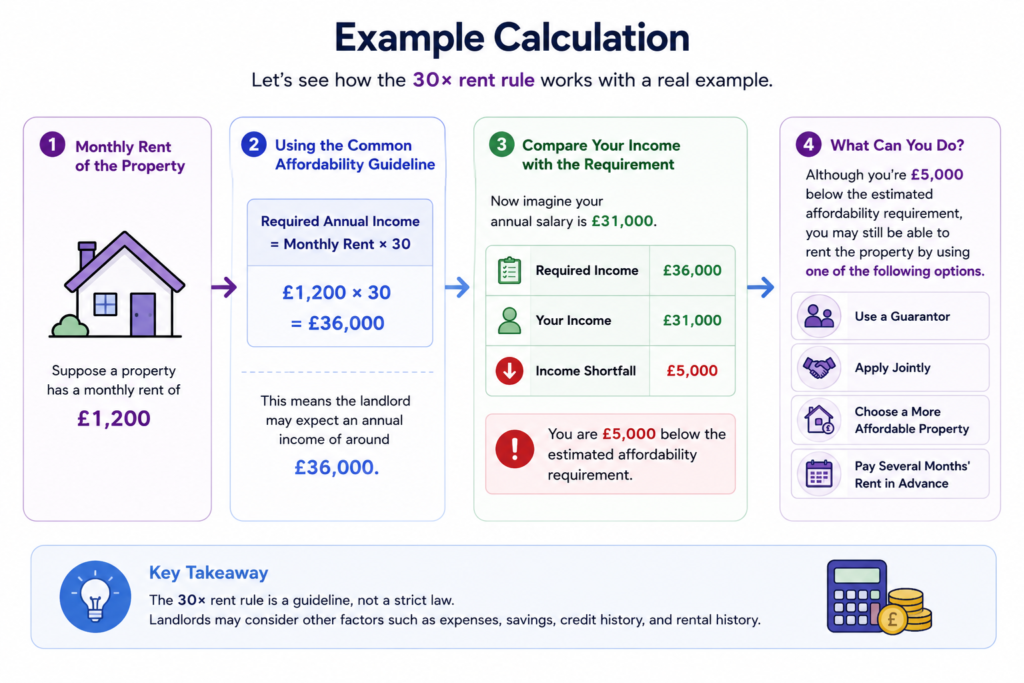
Suppose a property has a monthly rent of £1,200.
Using the common affordability guideline:
Required Annual Income = Monthly Rent × 30
£1,200 × 30 = £36,000
This means the landlord may expect an annual income of around £36,000.
Now imagine your annual salary is £31,000.
Required Income = £36,000
Your Income = £31,000
Income Shortfall = £5,000
Although you’re £5,000 below the estimated affordability requirement, you may still be able to rent the property by using one of the following options.
Use a Guarantor
A surety is someone—usually a parent, family member, or close relative—who agrees to pay the rent if you’re unable to. Having a suitable surety can strengthen your application.
Pay Rent in Advance
Some landlords may agree to accept several months’ rent in advance instead of relying solely on your income. This can provide additional financial security for the landlord.
Example:
Monthly Rent = £1,200
6 Months’ Rent in Advance
£1,200 × 6 = £7,200
Apply with Another Tenant
If you’re renting with a partner, friend, or family member, many letting agents will assess your combined household income.
| Applicant | Income |
|---|---|
| Applicant 1 | £22,000 |
| Applicant 2 | £18,000 |
| Combined Income | £40,000 |
Since the combined income is £40,000, it exceeds the estimated requirement of £36,000, which may improve your chances of approval.
Show Evidence of Savings
If you have substantial savings, some landlords may take this into account during the referencing process. Savings can demonstrate that you have enough funds to cover your rent if your income is lower than expected.
Choose a More Affordable Property
If the required income is significantly higher than your earnings, you may wish to consider a property with a lower monthly rent.
Example:
| Property | Monthly Rent | Required Annual Income |
|---|---|---|
| Current Property | £1,200 | £36,000 |
| Alternative Property | £1,000 | £30,000 |
By choosing the lower-priced property, your income may better match the affordability requirement.
Remember
Every landlord and letting agent has their own affordability criteria and referencing process. Meeting the calculated income requirement does not ensure approval, and falling below it does not automatically mean your application will be declined. Factors such as your credit history, job status, savings, rental record, and the availability of a surety can all influence the final decision.
Calculate the Income Shortfall Before You Apply
If your income is below the landlord’s required amount, calculate the exact shortfall before submitting an application. This can help you understand whether the difference is small enough to address through a guarantor, joint application, savings, or another option.
For example, if the monthly rent is £1,200 and the landlord uses a 30× rule, the estimated required annual income is £36,000. If your gross annual income is £34,000, your shortfall is £2,000. Knowing this figure gives you a clearer idea of what you need to discuss with the letting agent instead of applying without understanding the affordability criteria.
It is also worth asking about the affordability rule before paying any application-related costs. Different landlords and referencing providers may use different income calculations, so confirming the requirement in advance can save you time and avoid an unsuccessful application
What Income Do Letting Agents Accept?
When reviewing your rental application, letting brokers usually look at your total and Dependable income to determine if you can comfortably manage the monthly cost. Depending on the property owner’s criteria, they may accept income from one or more of the following sources.
| Income Source / Document | Description |
|---|---|
| Employment Income | If you are employed, your salary is usually the primary source of income considered during Financial capacity checks. You will generally be asked to provide recent salary slips and proof of employment. |
| Self-Employment Income | Self-employed Individuals applying can often use their business income to meet Financial capacity requirements. Letting brokers may request tax returns, SA302 forms, certified accounts, or recent bank statements as evidence. |
| Pension Income | If you’re retired, regular pension payments may be accepted as proof of income. You may need to provide pension statements or other supporting documents. |
| Benefits and Government Support | Some property owners and letting brokers accept certain state benefits as part of your income. Approval Changes, so it’s important to check the property owner’s rules before applying. |
| Investment or Rental Income | Income earned from investments, savings interest, Profits, or other rental properties may also be considered, particularly if it provides a stable and Regular source of funds. |
| Combined Household Income | For joint rental agreement applications, many letting brokers review the combined income of all Individuals applying. This can make it easier for couples, families, or housemates to meet Financial capacity requirements. |
| Income Verification | During the referencing process, you’ll usually be asked to provide documents to verify your income, such as recent payslips, bank statements, an employment confirmation letter, tax returns or SA302 forms (for self-employed Individuals applying), pension statements, and benefit award letters (where Suitable). |
Providing accurate and up-to-date documents can help speed up the Reference checks process and improve your chances of a successful rental application.
Check the Affordability Rule Before Viewing a Property
Before arranging multiple property viewings, ask the letting agent what affordability calculation they use. A property advertised at £1,200 per month may look affordable based on your personal budget, but the agent could use a specific income multiplier for tenant referencing.
For example, one agent may require annual income of 30 times the monthly rent, while another may use a different calculation or have additional requirements for self-employed applicants, variable income, or joint applications. Asking this question early can help you avoid spending time on properties that you are unlikely to qualify for.
You can also ask whether overtime, bonuses, commission, benefits, pension income, or a second applicant’s income will be included. Getting these details before applying gives you a much clearer picture of your chances of passing the affordability assessment.
Read more:How Much Rent Can I Charge in the UK? Proven Rent Pricing Guide for Landlords 2026Factors That Affect Rental Affordability
Your income is only one part of the affordability assessment. Landlords may also consider:
Employment Status
Permanent employment often provides stronger evidence of stable income, although self-employed applicants can usually qualify with appropriate financial records.
Credit History
A good credit history may strengthen your application.
Existing Financial Commitments
Large loans or ongoing loan repayments can affect Financial capacity.
Household Income
Joint applications often combine incomes to meet affordability requirements.
Guarantor Availability
A guarantor may help if your income alone doesn’t meet the landlord’s requirements.
Benefits of Using Our Income Required to Rent Calculator UK
| Benefit | Description |
|---|---|
| Estimate Your Required Salary Instantly | Quickly find out the estimated income needed to rent your chosen property. |
| Understand Rental Affordability | See whether a property fits within your current income and budget. |
| Compare Different Properties | Compare income requirements for multiple rental properties with ease. |
| Save Time | Get instant results without performing manual calculations. |
| Plan Your Budget Better | Prepare your money before applying for a rental property. |
| Prepare for Referencing Checks | Understand the income landlords may expect during affordability assessments. |
| Make Smarter Rental Decisions | Choose properties that match your financial situation and reduce the risk of unsuccessful applications. |
Tips to Improve Your Rental Application
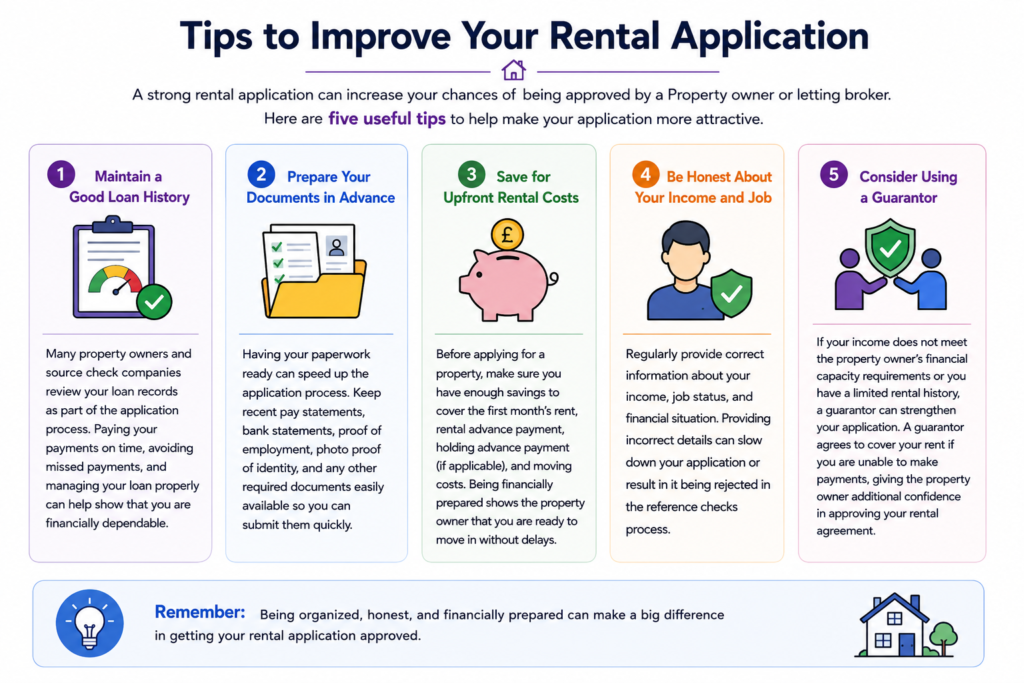
A strong rental application can increase your chances of being approved by a Property owner or letting broker. Here are five Useful advice to help make your application more attractive.
Maintain a Good Loan History
Many property owners and Source check Companies review your loan records as part of the application process. Paying your payments on time, avoiding missed payments, and managing your loan properly can help show that you are financially Dependable.
Prepare Your Documents in Advance
Having your paperwork ready can speed up the application process. Keep recent Pay statements, bank statements, proof of employment, photo Proof of identity, and any other required documents easily Available so you can submit them quickly.
Save for Upfront Rental Costs
Before applying for a property, make sure you have enough savings to cover the first month’s rent, rental advance payment, holding advance payment (if applicable), and moving costs. Being financially prepared shows the property owner that you are ready to move in without delays.
Be Honest About Your Income and Job
Regularly provide correct information about your income, job status, and Financial situation. Providing incorrect details can slow down your application or result in it being rejected in the Reference checks process.
Consider Using a Guarantor
If your income does not meet the property owner’s Financial capacity requirements or you have a limited rental history, a surety can strengthen your application. A surety agrees to cover your rent if you are unable to make payments, giving the property owner additional confidence in approving your rental agreement.
Read more:Ultimate 30x Rent Rule UK Guide – What It Means and How Letting Agents Calculate AffordabilityWhat income do I need to rent a property in the UK?
Many landlords use an affordability guideline of approximately 30 times the monthly rent as the required annual income, although individual requirements may vary.
Is the income based on gross or net salary?
Many affordability checks are based on gross annual income (before tax), but landlords and referencing companies may use different methods.
Can I use combined household income?
Yes. For joint tenancy applications, many landlords consider the combined income of all named tenants.
What if I’m self-employed?
Self-employed applicants are often asked to provide tax returns, SA302 forms, or certified accounts instead of payslips.
Can benefits count as income?
Some landlords and letting agents accept certain benefits as part of your income, while others may have different policies. Always check their requirements.
Will savings help my application?
Yes. Significant savings or paying rent in advance may strengthen your application, depending on the landlord’s criteria.
Can I rent with a guarantor?
Yes. If your income doesn’t meet the affordability requirement, a guarantor may help satisfy the landlord’s referencing conditions.
Is this calculator 100% accurate?
The calculator provides an estimate based on a commonly used affordability multiplier. Actual income requirements vary between landlords, letting agents, and referencing providers.
Does my credit score affect the income requirement?
Not directly — the income multiplier calculation stays the same regardless of credit score. However, a poor credit history may lead a landlord to ask for a higher income buffer, a guarantor, or extra months of rent in advance, even if your income technically meets the 30× threshold.
Do letting agents count overtime, bonuses, or commission?
Some do, but many only count your base salary to keep the assessment conservative. If bonuses or commission make up a large part of your earnings, it’s worth asking the agent directly whether they’ll include a 12-month average of variable income.
A Simple Rental Affordability Check
Before applying for a rental property, use these five checks to make a practical decision:
- Check the required income: Use the calculator to estimate the annual and monthly income commonly associated with the rent.
- Check your take-home pay: Compare the rent with the money you actually receive after tax and other deductions.
- Add your essential expenses: Include council tax, utilities, food, transport, insurance, debt payments, and other regular costs.
- Allow for unexpected expenses: Keep some money available for emergencies, repairs, moving costs, or changes in your income.
- Confirm the landlord’s criteria: Ask the letting agent about their income multiplier and what types of income they accept before submitting your application.
For example, if your gross annual income is £36,000 and the property costs £1,000 per month, you may meet a 30× affordability calculation. However, you should still check your take-home pay and monthly expenses before deciding that the property is affordable. Passing a referencing test and comfortably managing the rent are two different things.
Final Thoughts
Learning how much income you need before applying for a rental property can save time, reduce rejected applications, and help you focus on homes that fit your financial plan. While many property owners use Financial capacity rules such as an annual income of around 30 times the monthly rent, requirements can differ depending on the property owners, reference check company, and your individual situation.
Our Income Required to Rent Calculator UK gives you a quick calculation of the salary you may need, helping you compare properties, prepare your money, and approach the rental process with confidence.