Universal Credit Rent Calculator UK
The Universal Credit Rent Calculator helps you estimate how your Universal Credit housing support affects the rent you can afford. Quickly analyze your monthly rent, household circumstances, and income to make confident housing decisions.
What Is a Universal Credit Rent Calculator?
Paying rent while receiving Universal Credit can make budgeting more complicated, especially when your rent is a large part of your monthly household expenses.
Our Universal Credit Rent Calculator is designed to help you understand your rental budget by considering your rent and basic financial information. It gives you a clearer picture of how your housing costs fit into your overall monthly budget.
Whether you're renting privately, living in social housing, moving to a new property, or checking whether your current rent is manageable, this calculator provides a quick estimate to help with planning.
For official information about how Universal Credit can help with rent and housing costs, see the GOV.UK guidance on housing costs and Universal Credit..
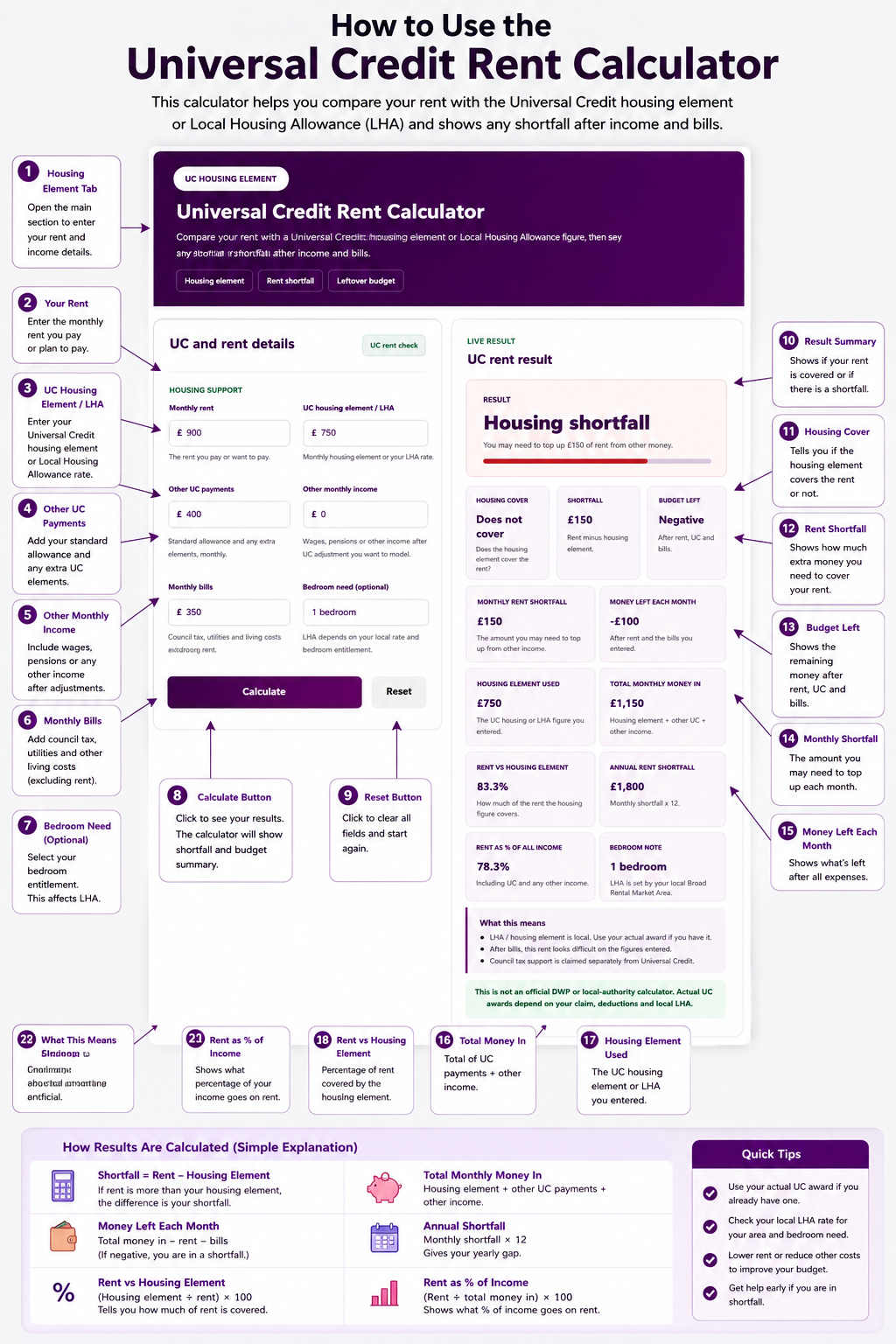
How to Use the Universal Credit Rent Calculator
Before choosing a rental property, it is important to understand how much of your monthly budget will be available for rent and other essential expenses.
Using the Universal Credit Rent Calculator, you can estimate:
See how your chosen rent compares with your available household budget.
Understand how housing costs may affect your overall Universal Credit budgeting.
Consider your household income and earnings when planning your rent.
Estimate how much money may remain after your rent and selected expenses.
Get a simple indication of whether the rent may be manageable within your household budget.
For more information about what housing costs Universal Credit can help with, you can check the official Universal Credit housing costs guidance before making your budget.
Estimate How Much Rent You Can Afford
Not sure what monthly rent you should look for?
Enter your household income, rent, and other requested information into the calculator to help create a realistic rental budget before you start viewing properties.
Practical Example
Monthly Household Income: £1,800 | Monthly Rent: £750
The calculator helps you compare the rent with your available monthly budget and understand how much money may remain for other household costs.
Remember that rent is only one part of your monthly spending. Council Tax, energy, food, transport, internet, and other expenses should also be considered.
Check a Specific Rental Property
Already found a property?
Enter the property's monthly rent into the Universal Credit Rent Calculator to see how it may fit into your budget.
Practical Example
Scenario: Sarah receives Universal Credit and is considering a property with rent of £800 per month.
Rather than looking at the rent alone, she can use the calculator to consider her household income, housing costs, and regular expenses together.
This helps her decide whether the property appears manageable before making a rental application.
How the Universal Credit Rent Calculator Helps
Understand Your Housing Costs
Housing costs can be a major part of a household budget. A calculator can help you organise your figures and understand how rent fits into your overall finances.
Consider Your Household Income
If you have earnings from employment or other household income, these figures can affect your overall Universal Credit calculation.
You can also read the GOV.UK guidance on how wages affect Universal Credit payments to understand how earnings can change your monthly payment.
Entering accurate information helps produce a more useful budgeting estimate.
See Your Remaining Monthly Budget
After considering rent, you may also need money for essential expenses such as Council Tax, energy bills, groceries, transport, internet, mobile phone, insurance, childcare, existing debts, and savings or emergencies.
Looking at these costs together can give you a more realistic picture of what you can afford.
Your remaining budget may also be affected by household bills such as electricity and gas. Energy costs can vary depending on your usage, supplier, and tariff. For official guidance on energy prices and consumer information, you can check Ofgem's energy price information.
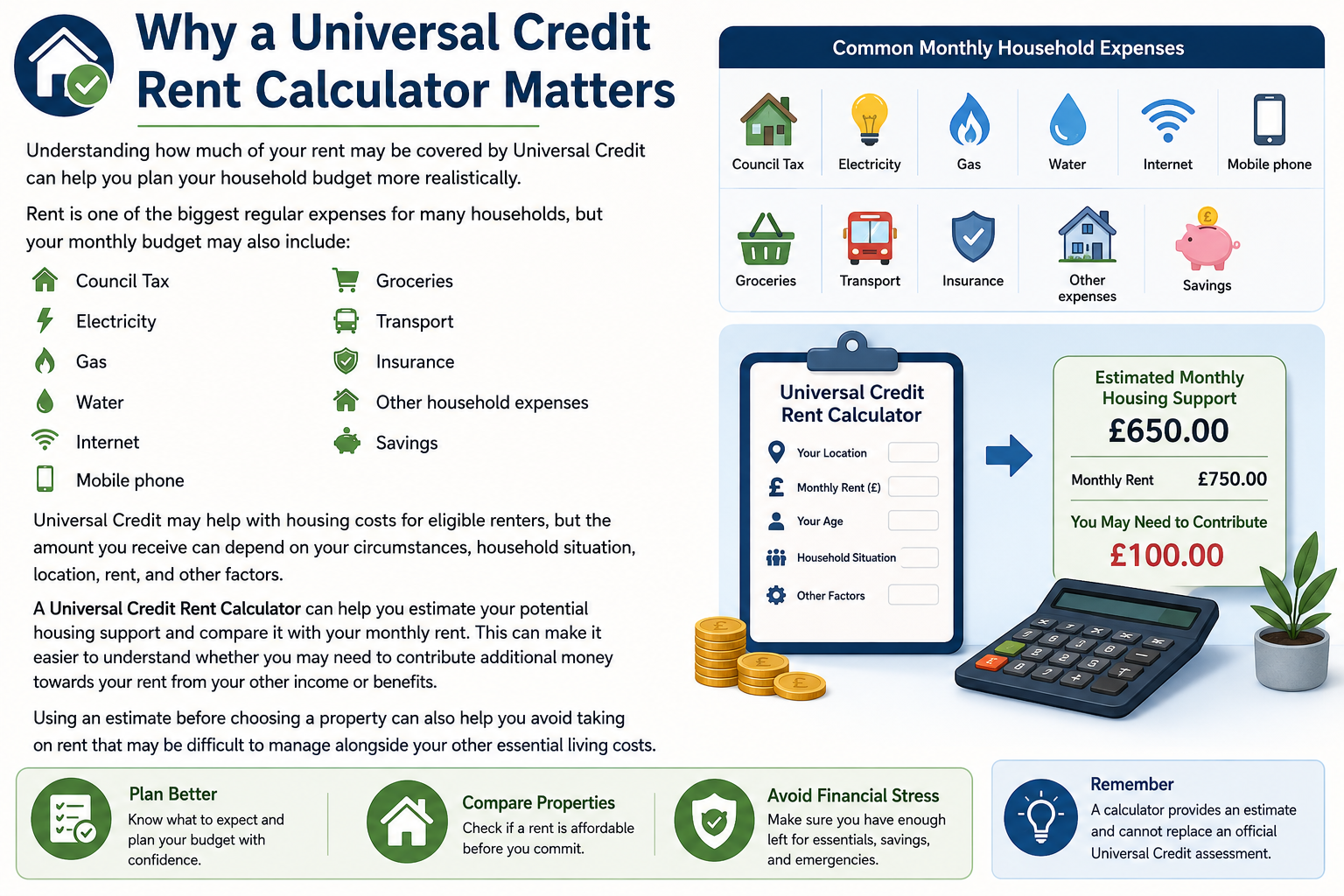
Why a Universal Credit Rent Calculator Matters
Understanding how much of your rent may be covered by Universal Credit can help you plan your household budget more realistically.
Rent is one of the biggest regular expenses for many households, but your monthly budget may also include:
- Council Tax
- Electricity
- Gas
- Water
- Internet
- Mobile phone
- Groceries
- Transport
- Insurance
- Other household expenses
- Savings
Universal Credit may help with housing costs for eligible renters, but the amount you receive can depend on your circumstances, household situation, location, rent, and other factors.
A Universal Credit Rent Calculator can help you estimate your potential housing support and compare it with your monthly rent. This can make it easier to understand whether you may need to contribute additional money towards your rent from your other income or benefits.
Using an estimate before choosing a property can also help you avoid taking on rent that may be difficult to manage alongside your other essential living costs.
Universal Credit Rent Example Table
The table below shows example rent levels alongside estimated household income and budgeting considerations. It provides a quick reference for planning, but you should always run the calculator with your own exact income, benefits, and bill details.
| Monthly Rent | Sample Monthly Income | Estimated Remaining Budget | Typical Property Type |
|---|---|---|---|
| £650 | £1,400 | £750 | Single room or smaller flat |
| £850 | £1,800 | £950 | 1–2 bedroom flat in lower-cost area |
| £1,100 | £2,300 | £1,200 | 2 bedroom home or higher-demand area |
| £1,400 | £2,900 | £1,500 | Family property or major urban center |
How Our Calculator Works
| What to Do | Details |
|---|---|
| Choose Your Calculation Type |
• Estimate affordable rent based on income • Check affordability for a specific rental property |
| Enter Income Details |
• Enter earnings from employment or self-employment • Include other household income or benefit details • Use total combined household income for joint applications |
| Add Rent Information | Enter the monthly rent figure if you have a specific home in mind, or leave it blank to calculate a recommended maximum rent limit. |
| Select Your Household Situation |
• Household size and number of dependents • Property location and Local Housing Allowance (LHA) region • Estimated monthly bills (utilities, council tax, internet) • Personal spending and debt commitments |
| View Your Result |
• Estimated affordability breakdown • Total available household budget • Estimated remaining balance after rent and bills • Personalised rent ceiling guidance |
Example 1 – A More Comfortable Budget
| Item | Value |
|---|---|
| Monthly Household Income | £2,800 |
| Monthly Rent | £900 |
| Housing Support | Estimated |
| Budget After Rent | Positive |
| Overall Result | More Comfortable |
This example shows a household where rent takes a manageable portion of the monthly budget. However, other household expenses should still be considered before deciding whether the property is affordable.
Example 2 – Tight but Possible
| Item | Value |
|---|---|
| Monthly Household Income | £2,200 |
| Monthly Rent | £1,000 |
| Housing Support | May Contribute |
| Budget After Rent | Moderate |
| Overall Result | Tight but Possible |
In this situation, rent represents a larger share of the household budget. Universal Credit housing support may help with eligible housing costs, but the household may still need to cover part of the rent from other income.
Example 3 – Likely Difficult to Manage
| Item | Value |
|---|---|
| Monthly Household Income | £1,800 |
| Monthly Rent | £1,200 |
| Housing Support | May Be Limited |
| Budget After Rent | Limited |
| Overall Result | Potentially Unaffordable |
A high rent compared with available household income can leave less money for essential expenses such as food, energy, transport, and Council Tax. Checking your estimated housing support and full monthly budget before choosing a property can help you make a more informed decision.
Understanding Universal Credit Housing Support
Universal Credit may help eligible renters with some or all of their housing costs. The amount you may receive depends on your individual circumstances and can be affected by factors such as your income, household size, age, rent, property type, and location.
A Universal Credit Rent Calculator can help you make a simple estimate of how your rent may fit into your overall monthly budget.
Housing support does not necessarily mean that your full rent will be covered. You may need to pay some of the rent yourself, particularly when your rent is higher than the amount of housing support included in your Universal Credit.
How the Estimate Works
Practical Example
| Item | Amount |
|---|---|
| Monthly Rent | £1,100 |
| Estimated Housing Support | £800 |
| Rent Not Covered | £300 |
| Amount to Budget Yourself | £300 |
This is a simple example for budgeting purposes only. Your actual Universal Credit award may be different, and the amount of housing support you receive depends on the rules and circumstances that apply to your claim.
Rent vs Household Income
The table below provides simple examples showing how different monthly rents compare with household income. It can be useful for initial planning before you choose a property.
| Monthly Household Income | Monthly Rent | Rent as Share of Income |
|---|---|---|
| £1,500 | £600 | 40% |
| £1,800 | £700 | 39% |
| £2,000 | £800 | 40% |
| £2,200 | £900 | 41% |
| £2,500 | £1,000 | 40% |
| £2,800 | £1,100 | 39% |
| £3,000 | £1,200 | 40% |
| £3,500 | £1,400 | 40% |
| £4,000 | £1,600 | 40% |
| £4,500 | £1,800 | 40% |
Important to Remember
Universal Credit calculations are based on individual circumstances, so a simple rent-to-income comparison cannot confirm your entitlement. Use the calculator as an estimate and consider your complete household budget, including Council Tax, energy, food, transport, and other regular expenses.
Renting with Someone Else
Many people receive Universal Credit as part of a household that includes a partner, family member, or other people they live with. When renting together, your housing situation and household circumstances can affect how housing costs are considered.
Our Universal Credit Rent Calculator allows you to enter relevant household details so you can get a more useful estimate of how your rent may fit into your overall budget.
Example
| Item | Amount |
|---|---|
| Tenant 1 Monthly Income | £1,300 |
| Tenant 2 Monthly Income | £1,100 |
| Combined Household Income | £2,400 |
| Monthly Rent | £1,000 |
| Estimated Housing Support | £750 |
| Rent to Budget Yourself | £250 |
Universal Credit entitlement is not simply based on combined income and rent. The actual amount can depend on factors such as household circumstances, earnings, savings, eligible housing costs, and applicable housing support rules.
Who Can Use This Universal Credit Rent Calculator?
This calculator is designed for people who want a clearer starting point when considering rent alongside Universal Credit and their household budget.
Estimate how your monthly rent may fit into your budget and understand the potential amount you may need to cover yourself.
Consider household income, rent, and other regular costs when planning a shared home.
Use the calculator as a budgeting tool while considering rent alongside food, childcare, transport, energy, and other household expenses.
Get a simple estimate to help assess whether a potential rental property may fit within your available household budget.
Check a proposed monthly rent before committing to a new property and consider how it may affect your remaining budget.
Compare your rent with your estimated housing support and identify the amount you may need to budget from other income.
Use the calculator to consider your individual or household rental costs alongside your available income.
Tips Before Using a Universal Credit Rent Calculator
Taking a few minutes to understand your rent, household income, and regular expenses can help you make a more realistic rental budget.
Before signing a tenancy agreement, renters should understand their legal rights and responsibilities. The GOV.UK renting guidance provides official information about renting, including tenancy agreements, deposits and tenant responsibilities.
-
Know Your Budget
Do not choose a property based only on the advertised rent. Consider how comfortably the rent fits alongside food, energy, Council Tax, transport, and other everyday expenses. -
Keep an Emergency Fund
Unexpected costs can arise at any time. Having some savings available may help you manage moving costs, household emergencies, or temporary changes in your income. -
Check Additional Costs
Remember that rent is only one part of your monthly housing costs. You may also need to budget for Council Tax, electricity, gas, water, internet, insurance, food, transport, and other regular expenses. -
Check Your Housing Costs Carefully
Enter accurate rent and household information when using the calculator. Your estimated housing support may depend on your circumstances, rental situation, location, household size, and other factors. -
Compare Different Properties
If you are considering more than one property, check each monthly rent separately. Comparing different rental costs can help you identify an option that leaves more room in your household budget. -
Be Accurate About Your Income
Use accurate income information when completing the calculator. Changes in earnings can affect Universal Credit, so estimates should always reflect your current circumstances as closely as possible. -
Think Beyond the Maximum Amount
An amount that appears affordable on paper may still leave you with a tight monthly budget. A property with lower rent can provide more room for savings, unexpected expenses, and changes in income.
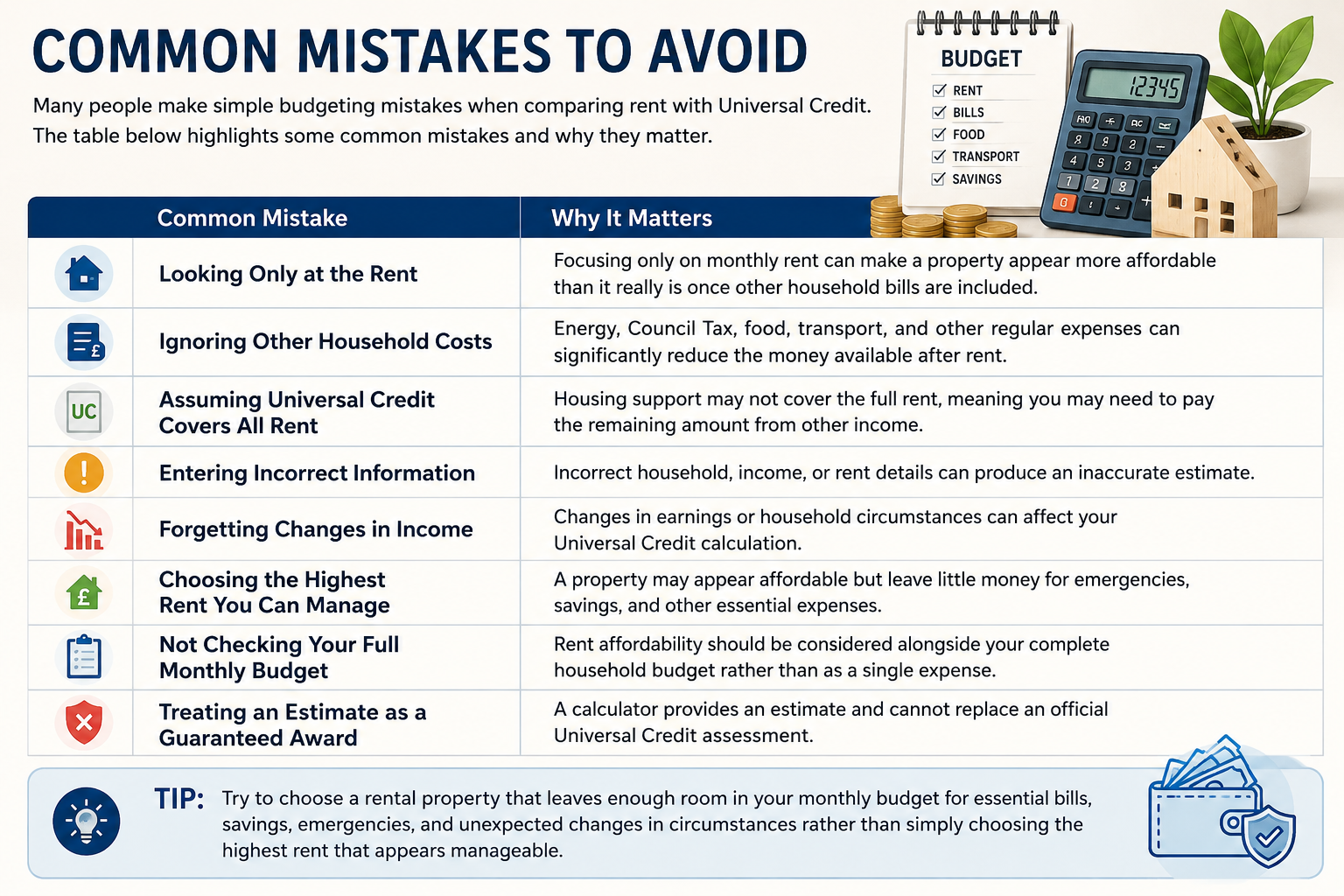
Common Mistakes to Avoid
Many people make simple budgeting mistakes when comparing rent with Universal Credit. The table below highlights some common mistakes and why they matter.
| Common Mistake | Why It Matters |
|---|---|
| Looking Only at the Rent | Focusing only on monthly rent can make a property appear more affordable than it really is once other household bills are included. |
| Ignoring Other Household Costs | Energy, Council Tax, food, transport, and other regular expenses can significantly reduce the money available after rent. |
| Assuming Universal Credit Covers All Rent | Housing support may not cover the full rent, meaning you may need to pay the remaining amount from other income. |
| Entering Incorrect Information | Incorrect household, income, or rent details can produce an inaccurate estimate. |
| Forgetting Changes in Income | Changes in earnings or household circumstances can affect your Universal Credit calculation. |
| Choosing the Highest Rent You Can Manage | A property may appear affordable but leave little money for emergencies, savings, and other essential expenses. |
| Not Checking Your Full Monthly Budget | Rent affordability should be considered alongside your complete household budget rather than as a single expense. |
| Treating an Estimate as a Guaranteed Award | A calculator provides an estimate and cannot replace an official Universal Credit assessment. |
Frequently Asked Questions
The calculator provides an estimate based on the information you enter and the assumptions used by the tool. It is intended for budgeting and planning purposes only. Your actual Universal Credit entitlement may be different because it depends on your individual circumstances and the rules that apply to your claim.
No. The result is an estimate and does not guarantee a particular Universal Credit payment or housing support amount. Your actual entitlement is determined through the official assessment process.
Your income can affect your Universal Credit calculation. Providing accurate income information helps the calculator produce a more useful estimate based on the details you provide.
Not necessarily. Depending on your circumstances and eligible housing costs, Universal Credit may contribute towards your rent, but you may still need to pay some or all of the remaining amount yourself.
Local Housing Allowance (LHA) is used in certain circumstances to help determine the maximum housing costs that can be taken into account for some private renters receiving benefits. The applicable amount can depend on factors such as location and household circumstances.
If you are renting with a partner or as part of a household, your circumstances may be assessed differently from those of someone renting alone. Enter the household information requested by the calculator to receive a more relevant estimate.
Utility bills are generally not included as part of the rent itself. You should separately consider electricity, gas, water, internet, Council Tax, food, transport, and other regular expenses when checking whether a property fits your budget.
Yes. Self-employed people can use the calculator as a general budgeting tool. However, Universal Credit calculations for self-employed claimants can involve additional rules, so the calculator should not be treated as an official entitlement assessment.
Yes. Using the calculator before viewing or applying for a property can help you understand whether the advertised rent may fit within your expected household budget.
Not necessarily. A guarantor is a separate arrangement between a tenant, guarantor, and landlord or letting agent. Whether one is required depends on the landlord or letting agent's individual requirements.
Yes. You can use the calculator to help plan your rental budget for shared accommodation. However, the amount of housing support that may apply can depend on your age, household circumstances, accommodation type, and other factors.
This depends on how the calculator and website are configured. If the calculator does not collect or store personal information, the details you enter are used only to generate the calculation. Check the website's privacy policy for information about data collection, storage, and processing.
Ready to Check Your Rent and Universal Credit?
Stop guessing and get a clearer picture of how your rent may fit into your household budget with our Universal Credit Rent Calculator.
Enter your monthly rent, income, household details, and other basic information to receive an estimated calculation based on the details you provide. In just a few clicks, you can see how your rent compares with your available income and understand the potential amount you may need to budget yourself.
Whether you're renting on your own, living with a partner, raising a family, or considering a new rental property, our Universal Credit Rent Calculator can help you plan your housing costs before making a decision.
Please remember: The calculator provides an estimate for planning purposes only. It does not guarantee your Universal Credit entitlement or replace an official assessment.