
Tenancy deposit protection matters: When Ahmed paid £1,384 as a tenancy deposit for his one-bedroom flat in Leeds, he assumed the money simply sat in his landlord’s bank account until he moved out. Three months later, a friend asked him a question he couldn’t answer: “Is your deposit actually protected?”
Ahmed had never heard of deposit protection. He didn’t know that in England and Wales, landlords are legally required to protect tenancy deposits in a government-approved scheme — or that failing to do so can entitle the tenant to compensation of up to three times the deposit.
This guide explains exactly how tenancy deposit protection works in the UK in 2026: which tenancies are covered, the three approved schemes, what your landlord must do and by when, how much deposit they can legally take, how to check your own deposit in a few minutes, and what to do if it was never protected.
Quick answer: In England and Wales, your landlord must protect your tenancy deposit in one of three government-approved schemes within 30 days of receiving it, and give you written details (the “prescribed information”) within the same 30 days. If they don’t, you can apply to the county court for compensation of 1 to 3 times the deposit. Scotland and Northern Ireland have their own schemes and deadlines, explained below.
Rules differ between England, Scotland, Wales and Northern Ireland, and some changed in 2026. This guide reflects the position as of October 2026 and is general information, not legal advice.
What Is Tenancy Deposit Protection?
Tenancy deposit protection is a legal system that keeps your rental deposit safe during your tenancy and gives you a free way to resolve disputes when you move out.
Instead of your deposit sitting in your landlord’s personal account, it is either held by an independent, government-approved scheme or insured by one. At the end of the tenancy, the deposit can only be released when both sides agree on the amount — or when the scheme’s free dispute service decides.
The system exists for a simple reason: before it was introduced, some tenants struggled to get deposits back from landlords who delayed, made unfair deductions, or simply disappeared. Protection means your money is accounted for from day one.
Which Tenancies Must Have a Protected Deposit?
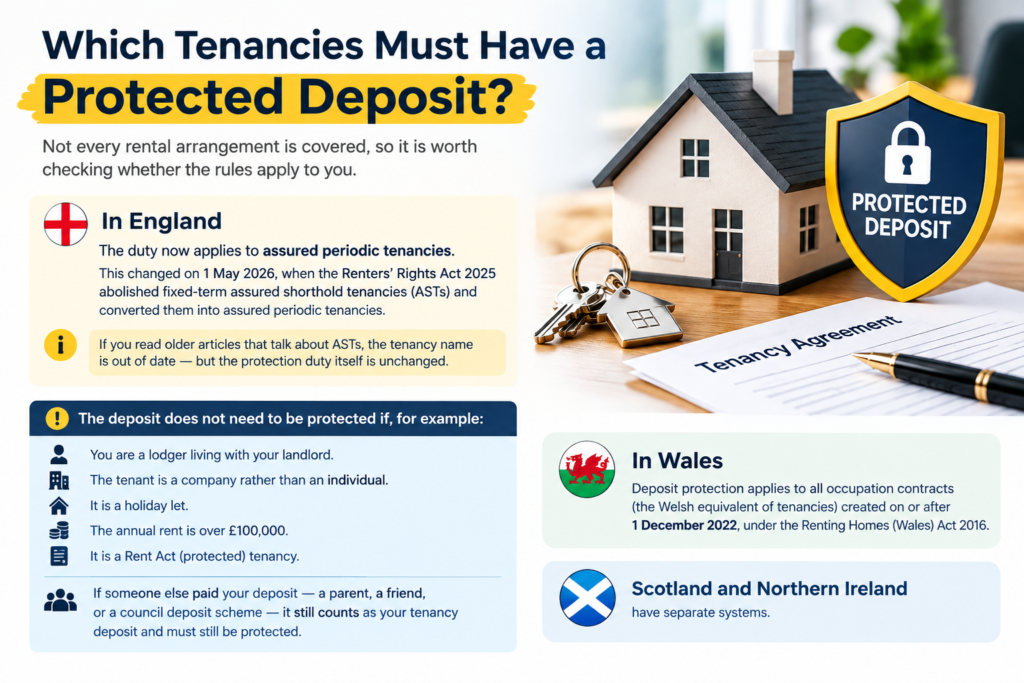
Not every rental arrangement is covered, so it is worth checking whether the rules apply to you.
In England, the duty now applies to assured periodic tenancies. This changed on 1 May 2026, when the Renters’ Rights Act 2025 abolished fixed-term assured shorthold tenancies (ASTs) and converted them into assured periodic tenancies. If you read older articles that talk about ASTs, the tenancy name is out of date — but the protection duty itself is unchanged.
The deposit does not need to be protected if, for example, you are a lodger living with your landlord, the tenant is a company rather than an individual, it is a holiday let, the annual rent is over £100,000, or it is a Rent Act (protected) tenancy. If someone else paid your deposit — a parent, a friend, or a council deposit scheme — it still counts as your tenancy deposit and must still be protected.
In Wales, deposit protection applies to all occupation contracts (the Welsh equivalent of tenancies) created on or after 1 December 2022, under the Renting Homes (Wales) Act 2016. Scotland and Northern Ireland have separate systems, covered in the UK-wide comparison later in this guide.
The 3 Government-Approved Deposit Schemes
In England and Wales, there are exactly three government-approved schemes. Your landlord or letting agent chooses which one to use — you don’t get to pick — but all three offer free dispute resolution, so the brand matters less than you might think.
| Scheme | Run by | How it works |
|---|---|---|
| Deposit Protection Service (DPS) | Computershare | Offers both custodial and insured tenancy deposit protection options |
| Tenancy Deposit Scheme (TDS) | The Dispute Service | Offers both custodial and insured options |
| mydeposits | Hamilton Fraser | Offers both custodial and insured options |
Each scheme works in one of two ways:
| Option | How it works |
|---|---|
| Custodial | The landlord pays your deposit money to the tenancy deposit protection scheme, which holds it in a bank account for the whole tenancy. Nobody can touch it until both sides agree at the end. This option is free. |
| Insured | The landlord keeps your deposit in their own account but pays the tenancy deposit protection scheme a fee to insure it. If the landlord won’t return what you are owed, the scheme pays you and recovers the money from the landlord. |
A solicitor’s client account, a separate savings account, or a written promise is not a substitute for one of the three approved schemes. If your landlord says your deposit is “safe in a separate account” but cannot name one of the schemes above, it is not protected.
What Your Landlord Must Do — and the 30-Day Deadline
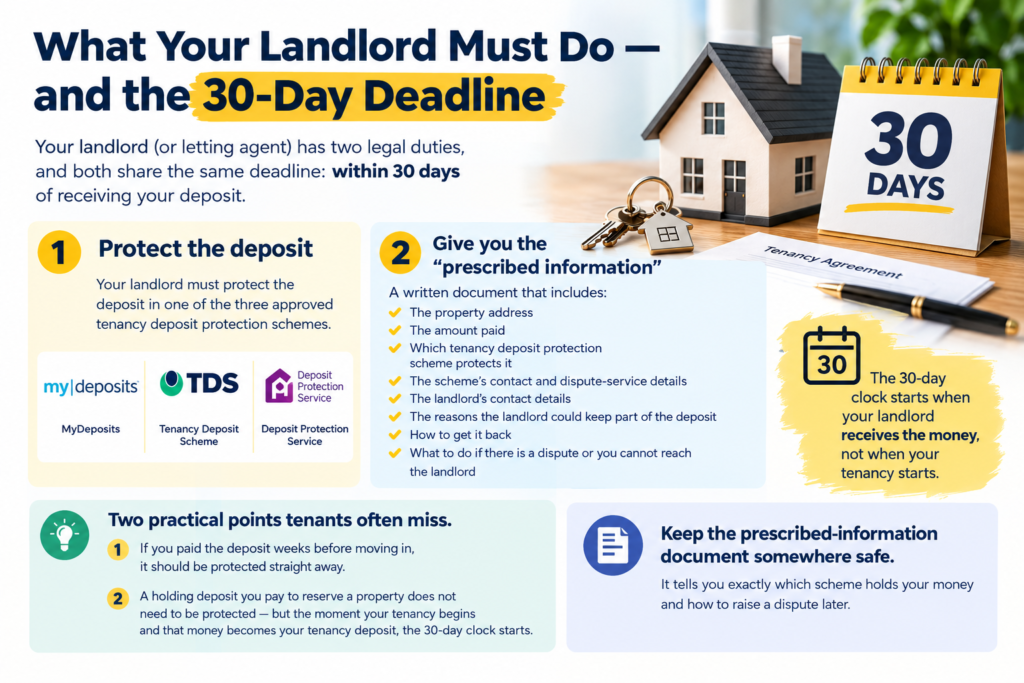
Your landlord (or letting agent) has two legal duties, and both share the same deadline: within 30 days of receiving your deposit.
| Landlord duty | Details |
|---|---|
| 1 | Protect the deposit in one of the three approved tenancy deposit protection schemes. |
| 2 | Give you the “prescribed information” — a written document that includes the property address, the amount paid, which tenancy deposit protection scheme protects it, the scheme’s contact and dispute-service details, the landlord’s contact details, the reasons the landlord could keep part of the deposit, how to get it back, and what to do if there is a dispute or you cannot reach the landlord. |
Two practical points tenants often miss. First, the 30-day clock starts when the landlord receives the money, not when your tenancy starts — if you paid the deposit weeks before moving in, it should be protected straight away. Second, a holding deposit you pay to reserve a property does not need to be protected — but the moment your tenancy begins and that money becomes your tenancy deposit, the 30-day clock starts.
Keep the prescribed-information document somewhere safe. It tells you exactly which scheme holds your money and how to raise a dispute later.
How Much Deposit Can a Landlord Legally Take?
There are legal caps on deposits, and they depend on where you live and how much rent you pay.
In England, under the Tenant Fees Act 2019:
| Your annual rent | Maximum tenancy deposit |
|---|---|
| Below £50,000 per year | 5 weeks’ rent |
| £50,000 per year or more | 6 weeks’ rent |
A holding deposit is capped at one week’s rent. To work out the weekly figure: (monthly rent × 12) ÷ 52.
Worked example — Sarah’s deposit: Sarah rents a flat for £1,100 per month. Her annual rent is £13,200, so the 5-week cap applies. Weekly rent = (£1,100 × 12) ÷ 52 = £253.85. Maximum deposit = £253.85 × 5 = £1,269.23. When her agent asked for £1,500, Sarah knew £230.77 had to be refunded — asking for more than the cap is a prohibited payment.
Other nations: Wales has no statutory cap on the tenancy deposit itself (its holding deposit is capped at one week’s rent). Scotland caps deposits at two months’ rent. Northern Ireland caps them at one month’s rent.
Before you pay anything, it helps to know the full cash picture. Our Rental Deposit Calculator estimates your tenancy deposit, holding deposit, and advance rent, and the Rent Upfront Cost Calculator adds it all up so you know exactly how much cash to prepare. If you are still at the reservation stage, the holding deposit guide explains how holding deposits work.
How to Check If Your Deposit Is Protected
You don’t have to take your landlord’s word for it — you can check directly with the schemes. Because landlords sometimes switch schemes, check all three.
| Scheme | How to check |
|---|---|
| DPS | Use the tenancy deposit protection checker on the DPS website (depositprotection.com). |
| TDS | use the tenancy deposit protection check tool on the TDS website (tenancydepositscheme.com). |
| mydeposits | use “Check your deposit” on the mydeposits website to confirm your tenancy deposit protection — you’ll need your surname, the rental property’s postcode, and the month the deposit was paid. |
You’ll generally need your surname, the property postcode, your tenancy start date, and the deposit amount. If you rent with others and nothing shows under your name, try searching under a housemate’s name — the deposit may be registered under theirs.
Do this within the first few weeks of your tenancy if you haven’t received written confirmation. And take a screenshot if a checker shows “no record found” — it is useful evidence if you later need to make a claim.
What If Your Landlord Didn’t Protect Your Deposit?
If the 30 days have passed and your deposit isn’t in any of the three schemes — or you never received the prescribed information — you have strong options.
You can claim compensation through the county court. If the court finds your landlord breached the rules, it must order them to repay the deposit (or protect it within 14 days) and pay you compensation of between one and three times the deposit amount. There is no defence once a breach is proven — the court only decides the amount, roughly: around 1x for a genuine error, 2x where the landlord should have known better, and 3x for deliberate flouting.
Worked example — James’s claim: James paid a £1,250 deposit and discovered nine months later it had never been protected. The court ordered his landlord to return the deposit and pay compensation. Depending on the circumstances, that compensation would be somewhere between £1,250 and £3,750.
Practical points about claiming:
| Action | Details |
|---|---|
| 1 | To enforce tenancy deposit protection, you apply to the county court using Form N208; the court fee is currently £387 (reclaimable from the landlord if you win, with fee remission available on low incomes or benefits). |
| 2 | Getting your deposit back in full does not cancel the tenancy deposit protection breach — you can still claim. |
| 3 | You can claim after moving out, up to 6 years later. |
| 4 | GOV.UK advises writing to your landlord first and getting legal advice before going to court. Citizens Advice and Shelter both publish free guidance on tenancy deposit protection. |
A note on eviction rules in 2026: older articles often say “an unprotected deposit makes a Section 21 eviction notice invalid.” Since Section 21 was abolished in England on 1 May 2026, that specific rule is now history — but the principle lives on: under the Renters’ Rights Act, landlords must have complied with the deposit-protection rules before they can use most Section 8 possession grounds. (This is based on legal commentary on the Act; GOV.UK’s tenant pages have not yet spelled it out in plain English.)
Getting Your Deposit Back at the End of the Tenancy
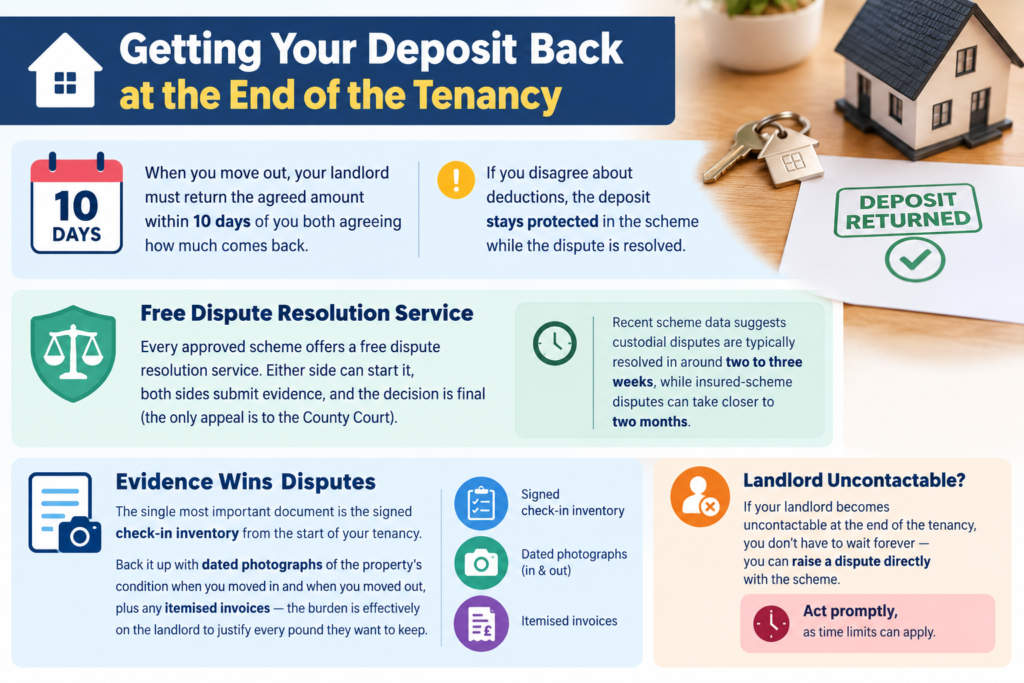
When you move out, your landlord must return the agreed amount within 10 days of you both agreeing how much comes back. If you disagree about deductions, the deposit stays protected in the scheme while the dispute is resolved.
Every approved scheme offers a free dispute resolution service. Either side can start it, both sides submit evidence, and the decision is final (the only appeal is to the County Court). Recent scheme data suggests custodial disputes are typically resolved in around two to three weeks, while insured-scheme disputes can take closer to two months.
Evidence wins disputes. The single most important document is the signed check-in inventory from the start of your tenancy. Back it up with dated photographs of the property’s condition when you moved in and when you moved out, plus any itemised invoices — the burden is effectively on the landlord to justify every pound they want to keep.
If your landlord becomes uncontactable at the end of the tenancy, you don’t have to wait forever — you can raise a dispute directly with the scheme. Act promptly, as time limits can apply.
What Can (and Can’t) Be Deducted From Your Deposit
Landlords can only deduct for genuine, evidenced costs — not for normal use of the property.
| Can be deducted | Cannot be deducted |
|---|---|
| Unpaid rent | Fair wear and tear — gradual deterioration from normal living |
| Damage beyond normal wear and tear | The landlord’s own repair obligations |
| Unpaid bills you were responsible for | “Betterment” — e.g. charging for a brand-new carpet when only cleaning was needed |
| Cleaning costs, if the property wasn’t left in the agreed condition | Renovations the landlord simply decided to do |
Fair wear and tear is the phrase that decides most disputes. A carpet that has flattened where people walk is wear and tear; a carpet with cigarette burns is damage. Faded paint after three years is wear and tear; crayon scribbles on the wall are damage. Adjudicators also reject “betterment” — if a £30 professional clean would fix it, the landlord can’t charge you £400 for a new carpet.
Cleaning is consistently the most disputed deduction category, followed by damage and rent arrears. Shelter England also warns that blanket tenancy clauses demanding “professional cleaning” regardless of the property’s condition can be unfair — and therefore unenforceable — terms.
Deposit Rules Across the UK at a Glance
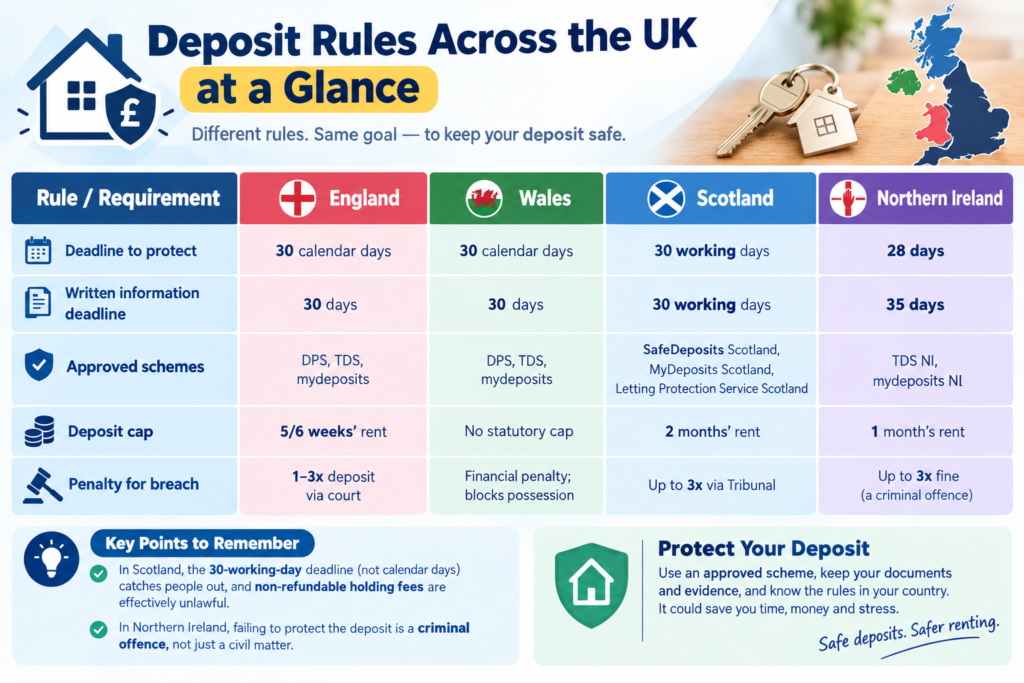
| England | Wales | Scotland | Northern Ireland | |
|---|---|---|---|---|
| Deadline to protect | 30 calendar days | 30 calendar days | 30 working days | 28 days |
| Written information deadline | 30 days | 30 days | 30 working days | 35 days |
| Approved schemes | DPS, TDS, mydeposits | DPS, TDS, mydeposits | SafeDeposits Scotland, MyDeposits Scotland, Letting Protection Service Scotland | TDS NI, mydeposits NI |
| Deposit cap | 5/6 weeks’ rent | No statutory cap | 2 months’ rent | 1 month’s rent |
| Penalty for breach | 1–3x deposit via court | Financial penalty; blocks possession | Up to 3x via Tribunal | Up to 3x fine (a criminal offence) |
In Scotland, the 30-working-day deadline (not calendar days) catches people out, and non-refundable holding fees are effectively unlawful. In Northern Ireland, failing to protect the deposit is a criminal offence, not just a civil matter.
2026 Update: What the Renters’ Rights Act Changed
The Renters’ Rights Act 2025 (England only) received Royal Assent on 27 October 2025, with the first phase taking effect on 1 May 2026:
| Change | Details |
|---|---|
| 1 | Fixed-term assured shorthold tenancies were abolished and converted into assured periodic tenancies. |
| 2 | Section 21 “no-fault” eviction was abolished. |
| 3 | What did not change: the 30-day tenancy deposit protection deadline, the prescribed-information duty, the 1x–3x compensation, and the 5/6-week deposit cap. |
If you’re reading older guides that still say “AST” or warn that “your Section 21 notice is invalid if the deposit wasn’t protected,” that advice is now out of date for England — but the underlying protection duty is exactly as strong as before.
Frequently Asked Questions
How long does a landlord have to arrange tenancy deposit protection?
Under tenancy deposit protection rules, landlords have 30 calendar days from receiving the money in England and Wales, 30 working days from the start of the tenancy in Scotland, and 28 days in Northern Ireland.
What are the three deposit protection schemes?
The approved tenancy deposit protection schemes in England and Wales are the Deposit Protection Service (DPS), the Tenancy Deposit Scheme (TDS), and mydeposits. Scotland and Northern Ireland have their own approved schemes.
How do I check whether tenancy deposit protection covers my deposit?
Use the online tenancy deposit protection checkers on all three schemes’ websites — DPS, TDS and mydeposits. You’ll need details like your surname, the property postcode, tenancy start date and deposit amount.
Can a landlord keep my entire deposit?
Only if they can evidence genuine costs — such as unpaid rent or damage beyond fair wear and tear — totalling the full amount. They cannot keep it without justification, and you can dispute any deduction for free through the tenancy deposit protection scheme.
How much can my deposit be?
Deposit caps under tenancy deposit protection: in England, up to 5 weeks’ rent if your annual rent is under £50,000, or 6 weeks’ rent if it’s £50,000 or more. Scotland: up to 2 months’ rent. Northern Ireland: up to 1 month’s rent. Wales has no statutory cap on the tenancy deposit.
Is a holding deposit the same as a tenancy deposit?
No. A holding deposit reserves the property before you sign (capped at one week’s rent in England and Wales) and doesn’t need to be protected. Once your tenancy begins and it becomes your tenancy deposit, it must be protected within the deadline under tenancy deposit protection rules.
What happens if my landlord didn’t arrange tenancy deposit protection?
You can apply to the county court for compensation of 1 to 3 times the deposit for a tenancy deposit protection breach, even after you’ve moved out (up to 6 years later). Write to your landlord first and consider getting advice from Citizens Advice or Shelter.
How long does a landlord have to return my deposit?
Within 10 days of you both agreeing how much should be returned. If you disagree, the money stays protected under tenancy deposit protection until the dispute is resolved.
What deductions can a landlord make?
The permitted deductions from your tenancy deposit are: unpaid rent, damage beyond fair wear and tear, unpaid bills you were responsible for, and cleaning if the property wasn’t left in the agreed condition. They cannot deduct for fair wear and tear, their own repairs, or improvements.
Can I claim compensation after moving out?
Yes. Getting the deposit back doesn’t cancel the tenancy deposit protection breach, and you have up to 6 years to bring a claim.
What if I can’t contact my landlord at the end of the tenancy?
You can raise a dispute directly with the tenancy deposit protection scheme rather than waiting indefinitely. Check the scheme’s time limits and act promptly.
Do I need to do anything, or is it all the landlord’s job?
Tenancy deposit protection is the landlord’s legal duty, not yours. Your job is simply to check it was done (using the scheme checkers), keep the prescribed-information document, and keep evidence of the property’s condition — photos and the check-in inventory — in case of a dispute.
Final Thoughts
Tenancy deposit protection is one of the strongest rights UK tenants have — but only if you know about it. The checks take a few minutes: confirm which scheme holds your money, keep your paperwork, and photograph the property when you move in and out. If your deposit was never protected, the law is firmly on your side, with compensation of up to three times the deposit available through the courts.
And before you hand over any money at all, make sure the numbers work for your budget. Our Rental Deposit Calculator estimates your deposit and total upfront costs, the first-month rent guide breaks down what you’ll pay on day one, and the Moving House Cost Calculator helps you budget the entire move — see all calculators.
Further reading on tenancy deposit protection: GOV.UK guide, Shelter advice, and Citizens Advice guide.