

Jayden is 27, works in logistics in Manchester, and has just found a two-bedroom flat at £1,050 a month — perfect for him and his partner. The letting agent is enthusiastic, the viewing went well, and then comes the phrase every renter dreads: “We’ll just need to run your references.” Jayden has never missed a rent payment, but he has no idea what the agent will check, whether his credit file is good enough, or what happens if something comes back wrong.
If that sounds familiar, this guide is for you. It explains exactly what UK letting agents and landlords check during tenant referencing in 2026: the identity, credit, affordability, employment and landlord-reference checks, what you can and cannot be charged, the holding-deposit rules that protect your money, the new anti-discrimination rules, and what to do if a reference fails.
Quick answer: Tenant referencing is the set of background checks a landlord or agent runs before offering you a tenancy — identity, credit history, affordability, employment and a previous-landlord reference. It is not a legal requirement anywhere in the UK, but it is standard practice. You cannot be charged for it in England, Scotland or Wales. The most common reason references fail is the affordability test: most agents want your gross annual income to be at least 30 times the monthly rent.
Rules differ between England, Scotland, Wales and Northern Ireland, and some changed in 2026. This guide reflects the position as of October 2026 and is general information, not legal advice.
What Is Tenant Referencing?
Tenant referencing answers three questions about you: are you who you say you are, can you afford the rent, and have you been a reliable tenant before? In practice, that means a credit check, confirmation of your identity and address history, verification of your employment and income, and a reference from your current or previous landlord. If you cannot meet the affordability test on your own, a guarantor is referenced in the same way.
A few things worth knowing upfront:
- Referencing is not required by law — but almost every agent and professional landlord does it, and it is usually a condition of the landlord’s rent-guarantee insurance.
- It is the landlord’s or agent’s cost to bear: since the Tenant Fees Act 2019 (and equivalent rules in Scotland and Wales), you cannot be charged for your own reference — not the credit check, not “administration”.
- A landlord can still decline you if the results concern them — they don’t have to explain why, though many will give feedback.
Referencing and affordability overlap but are not the same thing. Our letting agent affordability checks guide covers the income formulas in depth; this guide covers the whole referencing process around them.
What Letting Agents Actually Check
Most referencing follows the same six checks, whether the agent does it in-house or through a referencing company:
| Check | What they look for | How you prepare |
|---|---|---|
| Identity | Passport, driving licence or other photo ID; proof of address | Have photo ID and a recent utility bill or bank statement ready |
| Credit history | CCJs, defaults, IVAs, bankruptcy, missed payments, electoral roll registration | Check your own file first (see below); register to vote |
| Affordability | Gross income vs rent — usually 30× monthly rent | Know your number before applying (worked example below) |
| Employment | Job title, salary, contract type, start date, whether the role is ongoing | Warn your employer/HR a reference call is coming |
| Previous landlord | Rent paid on time, property condition, any disputes, would they rent to you again | Give your landlord a heads-up and their correct contact details |
| Right to Rent (England) | Legal right to rent in England — documents or share code | See our Right to Rent guide |
Identity and address history are usually the quickest part — but they trip people up when names don’t match across documents or you’ve moved often and can’t evidence three years of addresses. Keep a list of every address for the last three years with dates; agents ask for it on almost every application form.
Employment verification is normally a short call or email confirming your job title, salary, contract type and start date. If you’re on a fixed-term contract ending soon, expect questions about renewal — and if you’re between jobs, be upfront, because the check will find it anyway.
Previous landlord references ask whether you paid on time, looked after the property, and whether the landlord would rent to you again. A single late payment two years ago rarely sinks an application; a pattern of arrears might. If your last landlord was difficult, supply context and evidence (bank statements showing rent paid) alongside.
Credit Checks, Demystified
This is the check renters fear most, and the one surrounded by the most myth. The honest position:
There is no universal credit “score” you must reach, and no single pass/fail threshold set by law. Each agent or referencing company applies its own criteria to your credit history. What they see is your record — not a verdict.
What a credit check typically reveals:
- County Court Judgments (CCJs) — the single most damaging item; they stay on file for six years
- Defaults and missed payments on credit cards, loans, phone contracts or utilities
- Individual Voluntary Arrangements (IVAs) and bankruptcy
- Whether you are on the electoral roll at your current address (not being registered can itself count against you)
- Linked addresses and financial associations
A poor credit history does not automatically mean rejection — but serious, recent or unresolved items may mean the landlord asks for a guarantor or declines. An old, small, satisfied CCJ is viewed very differently from an unsatisfied £4,000 one from last year.
Check your own file before the agent does. You can get your statutory credit report free from each of the three main UK agencies — Experian, Equifax and TransUnion. Look for errors (wrong addresses, accounts that aren’t yours, defaults that should show as settled) and dispute them; corrections can take weeks, so do this before you start flat-hunting. Registering to vote at your current address is the quickest legitimate improvement most renters can make.
The Affordability Maths: Can You Pass?
The affordability test is where most references are won or lost. The industry-standard formula:
Required gross annual income = monthly rent × 30
Some agencies use 36× for premium properties or guarantor checks; a few use 2.5× annual rent (which is the same as 30× monthly). Agents normally use gross income — before tax — because it’s standardised.
Worked example: Jayden in Manchester
Jayden earns £34,000 a year gross. The flat costs £1,050 a month.
| Amount | |
|---|---|
| Monthly rent | £1,050 |
| Required income (30× rule) | £1,050 × 30 = £31,500 |
| Jayden’s gross income | £34,000 |
| Headroom | £34,000 − £31,500 = £2,500 |
Jayden passes with £2,500 to spare. His clean credit file and stable employment history mean the rest of his referencing is straightforward — and because he did the maths before applying, he never paid a holding deposit on a property he couldn’t get.
Before you apply anywhere, run your own figures through the income required to rent calculator. It takes thirty seconds and it is the closest thing to seeing the agent’s side of the desk.

Self-Employed? Here’s How Roisin Proved Her Income
Roisin is 31, a self-employed illustrator in Glasgow. Self-employment doesn’t stop you from renting, but referencing goes deeper because your income fluctuates — and in Scotland, remember, you can’t be charged a penny for any of it.
Instead of payslips, Roisin’s agent asked for:
| Document | What it proves |
|---|---|
| SA302 tax calculations (last 2 years) | HMRC-confirmed profit figures |
| Tax Year Overviews (last 2 years) | Tax owed/paid — cross-checks the SA302 |
| Accountant’s reference | Confirms the figures and that the business is ongoing |
| Business + personal bank statements (3 months) | Income actually landing in her account |
Roisin’s average profit was £41,000 a year. Her flat costs £1,150 a month: £1,150 × 30 = £34,500 required. £41,000 − £34,500 = £6,500 headroom — a pass.
Most agencies want one to two years of trading history; if your business is newer, an accountant’s letter projecting current-year earnings carries real weight. What doesn’t work is a single good month presented as typical — agents average, they don’t cherry-pick.
Right to Rent Checks and Guarantor Referencing
Right to Rent applies in England only: every adult occupier aged 18 or over must have their immigration status checked before the tenancy starts, with follow-up checks for time-limited permission. It runs on documents, an online share code, or the Landlord’s Checking Service. Our Right to Rent guide covers exactly which documents work.
Guarantor referencing mirrors tenant referencing — identity, credit, affordability — but the bar is usually higher: many agents apply the 36× rule (guarantor income ≥ 36 × monthly rent). Guarantors are almost always expected to be UK-based. And since the Tenant Fees Act, you cannot be charged a guarantor fee either.
What You Can Never Be Charged For: The Fee Bans
Since 2019, charging tenants for referencing has been unlawful across most of the UK. The details differ by nation:
| Nation | The rule |
|---|---|
| England | Tenant Fees Act 2019: referencing, credit checks, admin and guarantor fees are prohibited payments — banned even if you agree to pay. Enforcement: Trading Standards, £5,000 first penalty. |
| Scotland | Banned since 2012: anything beyond rent and a refundable deposit is unlawful, including referencing, inventories and tenancy paperwork. |
| Wales | Renting Homes (Fees etc.) (Wales) Act 2019, in force 1 September 2019: bans referencing, admin, guarantor and inventory fees on the same lines as England. |
| Northern Ireland | No equivalent statute — but it is unlawful for letting agents to pass their costs to you (application, credit and guarantor checks included), and tenants have successfully reclaimed fees in court. A proposed ban (Feb 2025) has not become law. |
If anyone asks you to pay for a reference, a credit check, an “admin fee” or a guarantor arrangement in England, Scotland or Wales, that is an unlawful charge — report it to trading standards (England/Wales) or the letting agent register (Scotland). Our letting agent fees guide lists every banned and permitted payment in detail.
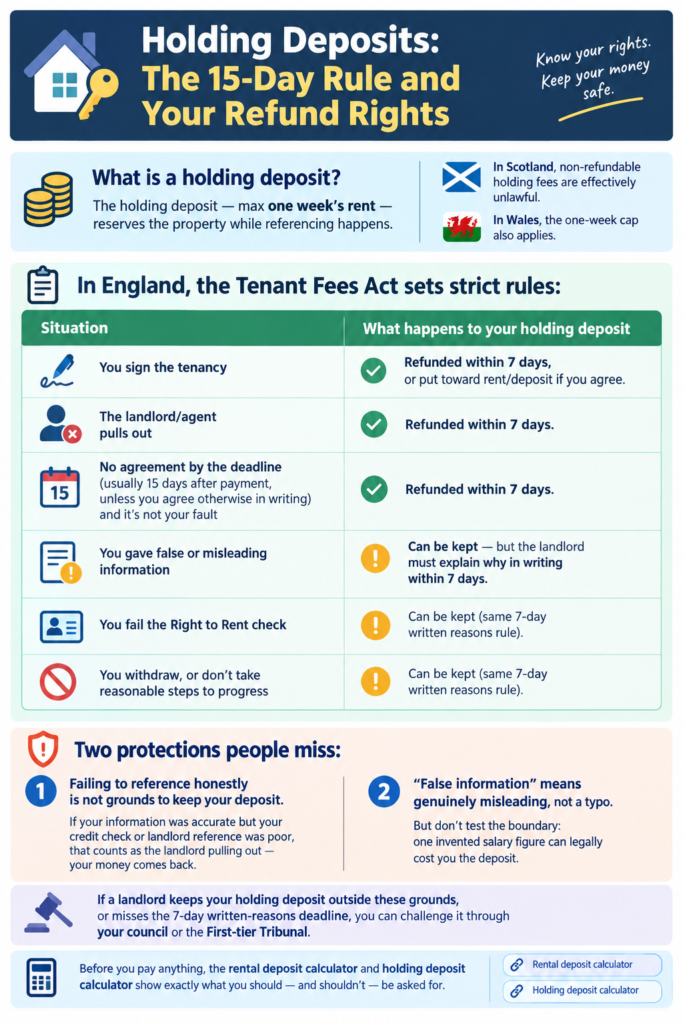
Holding Deposits: The 15-Day Rule and Your Refund Rights
The holding deposit — max one week’s rent — reserves the property while referencing happens. (In Scotland, non-refundable holding fees are effectively unlawful; in Wales the one-week cap also applies.) In England, the Tenant Fees Act sets strict rules:
| Situation | What happens to your holding deposit |
|---|---|
| You sign the tenancy | Refunded within 7 days, or put toward rent/deposit if you agree |
| The landlord/agent pulls out | Refunded within 7 days |
| No agreement by the deadline (usually 15 days after payment, unless you agree otherwise in writing) and it’s not your fault | Refunded within 7 days |
| You gave false or misleading information | Can be kept — but the landlord must explain why in writing within 7 days |
| You fail the Right to Rent check | Can be kept (same 7-day written reasons rule) |
| You withdraw, or don’t take reasonable steps to progress | Can be kept (same 7-day written reasons rule) |
Two protections people miss:
- Failing to reference honestly is not grounds to keep your deposit. If your information was accurate but your credit check or landlord reference was poor, that counts as the landlord pulling out — your money comes back.
- “False information” means genuinely misleading, not a typo. But don’t test the boundary: one invented salary figure can legally cost you the deposit.
If a landlord keeps your holding deposit outside these grounds, or misses the 7-day written-reasons deadline, you can challenge it through your council or the First-tier Tribunal. Before you pay anything, the rental deposit calculator and holding deposit calculator show exactly what you should — and shouldn’t — be asked for.
The 2026 Anti-Discrimination Rules: Benefits and Children
Referencing must now be applied on equal terms. Since the Renters’ Rights Act 2025 anti-discrimination provisions took effect, landlords and agents cannot disadvantage you because you receive benefits or have children — and that bites directly on referencing:
| Nation | In force |
|---|---|
| England | 1 May 2026 |
| Scotland | 1 May 2026 (all tenancy types, including existing agreements) |
| Wales | 1 June 2026 |
| Northern Ireland | No equivalent provision |
What this means in practice:
- “No DSS” / “No benefits” adverts and blanket policies are banned. So are subtler versions: ignoring benefit income in the affordability calculation while counting wages, or demanding a guarantor only from benefit claimants.
- Benefit income must count at full value in affordability assessments, on the same basis as any other income.
- A landlord can still decline you — but only on genuine, evenly applied grounds (affordability, poor references), applied the same way to every applicant.
- The only carve-out is an insurance policy agreed before 1 May 2026 that excludes benefit tenants, lasting only until renewal.
- In England, councils can issue a civil penalty of up to £7,000 for breaches.
If an agent tells you “the landlord doesn’t take Universal Credit”, that is now unlawful in England, Scotland and Wales — see our no-DSS guide for what to do about it.
Your Data and Your Consent
Referencing generates a file on you — and data protection law applies to all of it, including for applicants who never become tenants. Three principles carry the weight:
- Collect only what the decision needs. A payslip or employer reference is usually enough; a full set of bank statements often isn’t. You can ask why each document is needed.
- Be told what’s happening. The agent should be clear upfront about what will be checked and who sees it — especially where a third-party referencing company is used.
- Unsuccessful applicants’ data should be deleted once there’s no reason to keep it, not filed indefinitely.
You must give consent for the checks — usually by signing the application form. Read what you’re signing: it should name the referencing company and the credit reference agencies involved. Landlords who handle referencing themselves may need to register with the Information Commissioner’s Office (ICO).
How Long It Takes — and How to Speed It Up
| Stage | Typical timescale |
|---|---|
| Credit check | Often same day |
| Employer reference | 1–3 working days (faster if you warn HR) |
| Previous landlord reference | 2–5 working days (the slowest link — chase it) |
| Full reference via a referencing company | Up to 7 working days |
The referencing company is only as fast as your referees. Speed yours up with this checklist, ready before you apply:
- Photo ID and proof of address (last 3 months)
- Last 3 months’ payslips (or SA302s + Tax Year Overviews if self-employed)
- Last 3 months’ bank statements
- Employer/HR contact details — with them warned to expect contact
- Previous landlord’s correct contact details — with them warned too
- Right to Rent documents or share code (England)
Every day you spend hunting for a P60 is a day another applicant can take the property.
Students, New Arrivals and Thin Credit Files
No UK credit history doesn’t mean no tenancy — it means a different route:
- Students: a university or college letter confirming your course and funding, plus a UK-based guarantor (usually a parent), is the standard package.
- New arrivals: employment contract, visa/BRP or share code, and references from employers or landlords abroad all help. Expect the guarantor to ask.
- Thin files: electoral-roll registration, a mobile contract paid by direct debit, and time all build history. There is no legitimate shortcut.
One 2026 change to note: on new tenancies in England, landlords can now require no more than one month’s rent in advance — the old route of offering six months upfront to offset a thin file is closed. That makes the guarantor the main tool for borderline applications, which is why lining one up early matters.
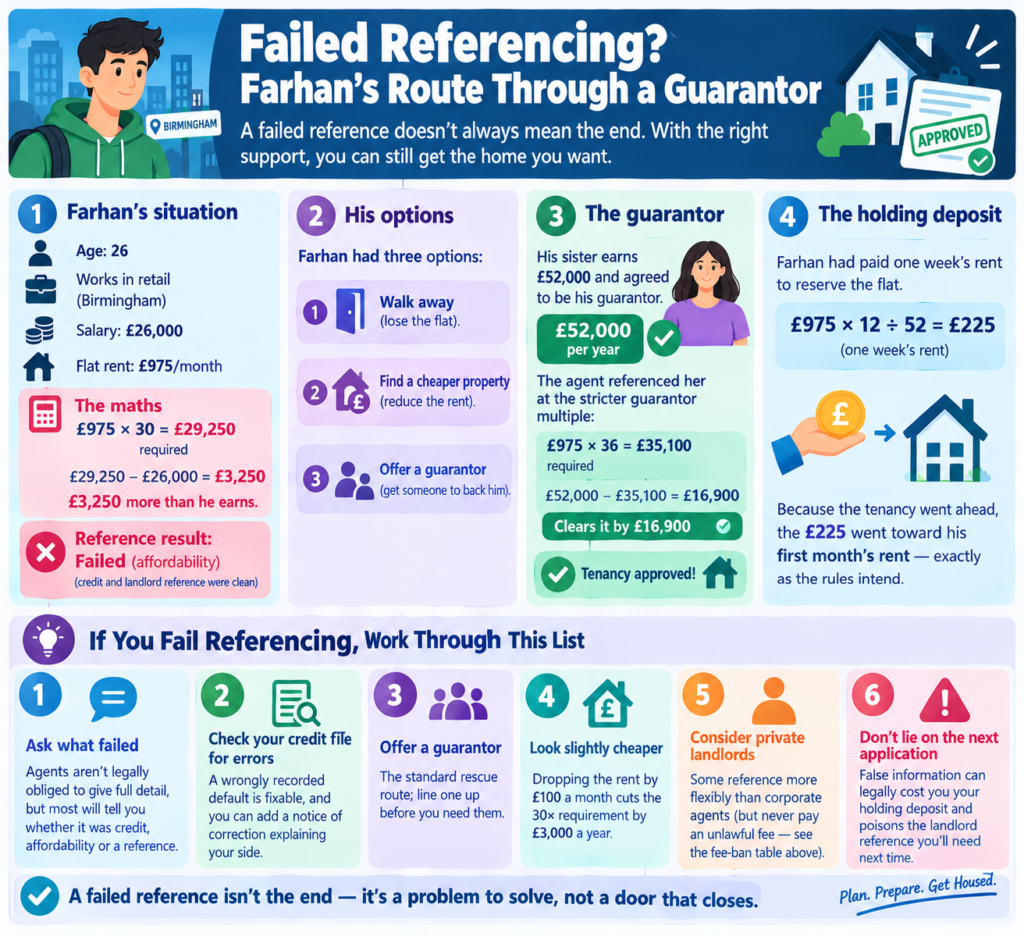
Failed Referencing? Farhan’s Route Through a Guarantor
Farhan is 26, works in retail in Birmingham earning £26,000, and applied for a flat at £975 a month. The maths: £975 × 30 = £29,250 required — £3,250 more than he earns. His reference came back as a fail on affordability (his credit and landlord reference were clean).
Farhan had three options: walk away, find a cheaper property, or offer a guarantor. His sister earns £52,000 and agreed. The agent referenced her at the stricter guarantor multiple: £975 × 36 = £35,100 required — £52,000 clears it by £16,900. Tenancy approved.
And his holding deposit? He had paid one week’s rent (£975 × 12 ÷ 52 = £225) to reserve the flat. Because the tenancy went ahead, the £225 went toward his first month’s rent — exactly as the rules intend.
If you fail referencing, work through this list:
- Ask what failed — agents aren’t legally obliged to give full detail, but most will tell you whether it was credit, affordability or a reference.
- Check your credit file for errors — a wrongly recorded default is fixable, and you can add a notice of correction explaining your side.
- Offer a guarantor — the standard rescue route; line one up before you need them.
- Look slightly cheaper — dropping the rent by £100 a month cuts the 30× requirement by £3,000 a year.
- Consider private landlords — some reference more flexibly than corporate agents (but never pay an unlawful fee — see the fee-ban table above).
- Don’t lie on the next application — false information can legally cost you your holding deposit and poisons the landlord reference you’ll need next time.
The Four Nations at a Glance
| Tenant Rights Comparison | England | Scotland | Wales | Northern Ireland |
|---|---|---|---|---|
| Referencing fees charged to tenants | Banned (Tenant Fees Act 2019) | Banned (since 2012) | Banned (2019 Act) | Agent fees unlawful to pass on; no statute ban on landlords |
| Holding deposit cap | 1 week’s rent; 15-day deadline | Effectively unlawful if non-refundable | 1 week’s rent | No statutory cap — get terms in writing |
| Right to Rent checks | Yes — all adults. 18+ | No | No | No |
| Benefits/children discrimination ban | From 1 May 2026 | From 1 May 2026 | From 1 June 2026 | None |
| Max rent in advance (new tenancies) | 1 month (from 1 May 2026) | No equivalent cap | No equivalent cap | No equivalent cap |
Frequently Asked Questions
What do letting agents check when referencing tenants?
Typically six things: your identity and address history, credit history, affordability (usually income of 30× monthly rent), employment details, a previous landlord reference, and — in England — your Right to Rent. If you need a guarantor, they are referenced the same way.
Can letting agents charge for tenant referencing?
No — not in England (Tenant Fees Act 2019), Scotland (banned since 2012) or Wales (2019 Act). Referencing, credit checks, admin fees and guarantor fees are all the landlord’s or agent’s cost. In Northern Ireland, it is unlawful for letting agents to pass these costs to tenants.
Is there a minimum credit score to rent in the UK?
No. There is no universal credit score threshold set by law. Each agent applies its own criteria to your credit history — CCJs, defaults, IVAs and missed payments are what matter most. Check your own statutory credit report (free from Experian, Equifax and TransUnion) before you apply.
How much income do I need to pass referencing?
Most agents require gross annual income of at least 30 times the monthly rent — so a £1,000/month flat needs roughly £30,000 a year. Guarantors are often tested at a stricter 36× multiple.
How long does tenant referencing take?
Credit checks are often same-day; employer and landlord references take a few days each. A full reference through a referencing company usually takes up to 7 working days — and moves at the speed of your slowest referee.
Can I fail referencing but still get the tenancy?
Yes. The usual rescue routes are offering a guarantor (often tested at 36× monthly rent), choosing a slightly cheaper property, or applying to a private landlord with more flexible criteria. If you fail honestly, your holding deposit must be refunded.
Will I get my holding deposit back if I fail referencing?
If all the information you gave was accurate, yes — a failed reference counts as the landlord pulling out, and the deposit must be refunded within 7 days. It can only be kept if you gave false or misleading information, failed a Right to Rent check, withdrew, or didn’t take reasonable steps.
Can a landlord refuse me for being on Universal Credit?
Not in England, Scotland or Wales — since 1 May 2026 (England and Scotland) and 1 June 2026 (Wales), discriminating against tenants because they receive benefits or have children is unlawful. Benefit income must count at full value in affordability checks.
What documents do I need for referencing?
Photo ID, proof of address, 3 months’ payslips (or SA302s and Tax Year Overviews if self-employed), 3 months’ bank statements, employer and previous landlord contact details, and Right to Rent documents or a share code in England.
I’m self-employed — how do I pass referencing?
Provide SA302 tax calculations and Tax Year Overviews for the last 1–2 years, an accountant’s reference, and business plus personal bank statements. Most agencies want at least a year or two of trading history; an accountant’s letter helps if your business is newer.
Do I have to consent to a credit check?
Yes, effectively — referencing requires your consent, usually given by signing the application form. The form should name the referencing company and credit agencies involved. Without consent, the agent simply won’t process your application.
What should I do if my reference fails because of my credit file?
Ask what failed, get your free statutory credit reports and dispute any errors, add a notice of correction explaining your side, and consider a guarantor or a cheaper property. Never lie on your next application — false information can legally cost you your holding deposit.
Final Thoughts
Jayden passed because he knew his number before he applied. Roisin passed because she had two years of paperwork ready. Farhan failed — and still got the flat, because he understood the guarantor route instead of panicking.
That is really the whole game: referencing rewards preparation, not perfection. Check your credit file, do the 30× maths, warn your referees, and know your rights on fees and holding deposits before you hand over a penny.
Start with the income required to rent calculator to see your number, check the full cost of moving with the rent upfront cost calculator, and read our letting agent fees guide so you can spot an unlawful charge the moment one appears.