
Couple rent affordability: Renting as a couple can make housing more affordable because two people can contribute towards the same monthly rent. But having two Earnings does not naturally mean you should choose the most expensive property you can qualify for.
The better question is:
How much cost can you comfortably manage while paying your bills and enjoying a normal lifestyle?
In 2026, this question matters more than ever. The average UK private rent reached £1,388 per month in June 2026, according to the Office for National Statistics (ONS), with rents rising by 3.3% over the previous 12 months. However, rents vary greatly depending on location and property size.
For couples, the right rent depends mainly on your combined take-home income, existing requirements, and financial goals.
This guide explains how couples can calculate an affordable rent in the UK, with practical examples you can use for your own situation.
This guide explains how couples can calculate an affordable rent in the UK, with practical examples you can use for your own situation. It also covers how letting agents actually assess affordability when you apply, since a rent that fits your budget doesn’t always mean you’ll pass referencing.
This is general budgeting guidance, not financial advice. If your situation is complex — irregular income, existing debt, or benefits — it’s worth speaking to a free service like Citizens Advice or a qualified financial adviser before signing a tenancy.
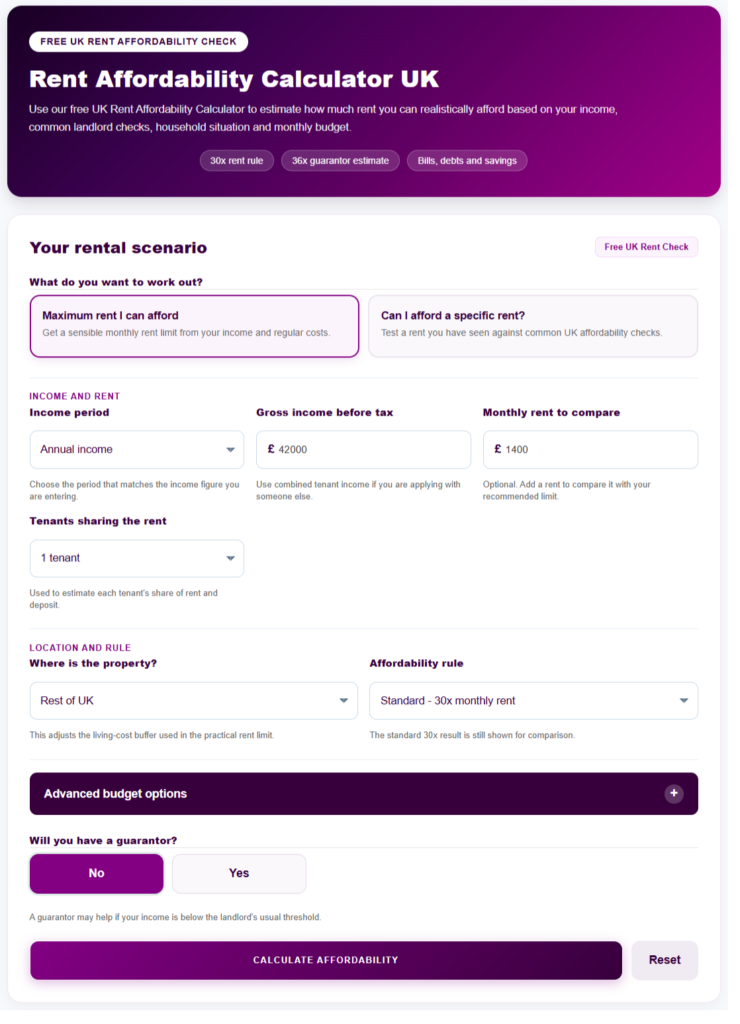
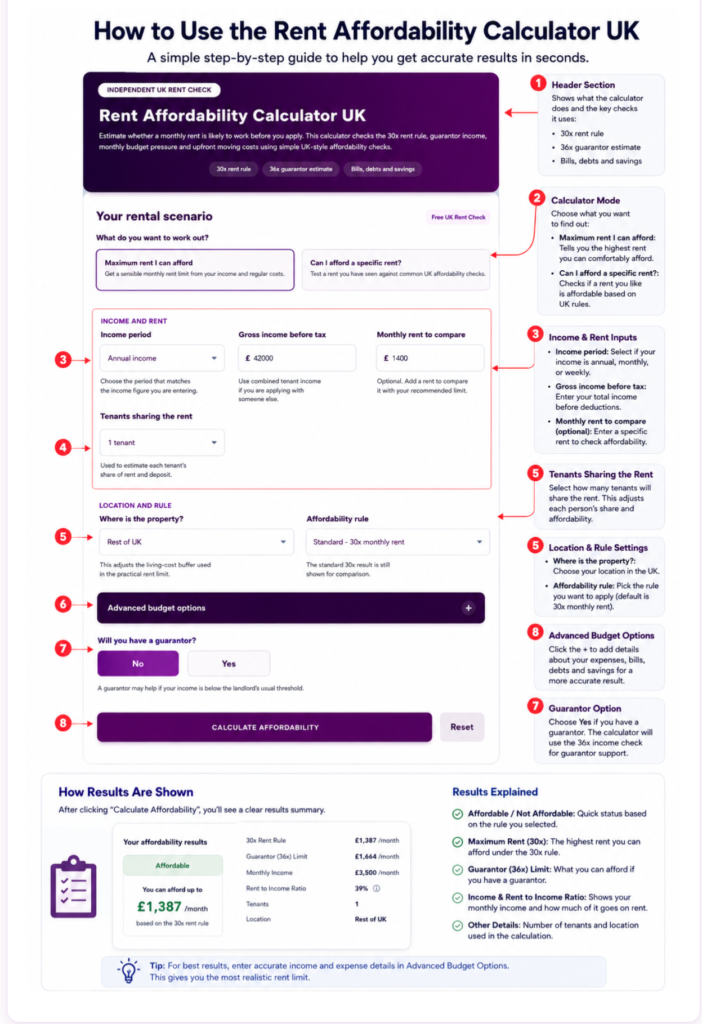
Click now:Rent Affordability Calculator UK
How to Use the Rent Affordability Calculator UK
What Is an Affordable Rent for a Couple?
There is no single rent amount that is affordable for every couple. A couple’s rent affordability depends on income, expenses, and financial goals.
A couple earning £3,000 a month will have a very different housing budget from a couple bringing home £6,000 a month.
A useful starting point is to keep rent around 25% to 30% of your combined take-home income.
For example:
| Combined Monthly Take-Home Income | 25% Rent | 30% Rent |
|---|---|---|
| £2,500 | £625 | £750 |
| £3,000 | £750 | £900 |
| £3,500 | £875 | £1,050 |
| £4,000 | £1,000 | £1,200 |
| £4,500 | £1,125 | £1,350 |
| £5,000 | £1,250 | £1,500 |
| £6,000 | £1,500 | £1,800 |
| £7,000 | £1,750 | £2,100 |
These figures are guidelines rather than official affordability limits.
The important thing is what remains after rent.
If a couple earns £4,000 per month after tax and pays £1,200 in rent, housing takes up 30% of their take-home income. They still have £2,800 available for council tax, utilities, food, transport, insurance, savings, debt repayments, and other spending.
That may be manageable.
But if the same couple has large car finance payments, childcare costs or significant debt, £1,200 could feel much less affordable.
Read more:University Grade Tracker UK: 7 Powerful Ways to Track Your MarksThe 30% Rule: Is It Suitable for Couples?
The 30% rule is commonly used as a simple way to think about housing affordability.
The basic calculation is:
Affordable Rent = Combined Monthly Take-Home Income × 30%
For example:
£4,500 × 0.30 = £1,350
So, a couple earning £4,500 per month could use £1,350 as an initial rent target.
However, couples should not treat 30% as a magic number.
For some households, 30% may be perfectly comfortable. For others, even 25% could be too high.
A couple with low debt and strong savings may be comfortable spending slightly more on rent, while a couple with childcare costs or large debts may need to stay below 30%.
Should Couples Calculate Rent From Gross or Take-Home Income?
For personal financial planning, take-home income is usually more useful because it represents the money that actually reaches your bank accounts.
Suppose two partners earn:
| Partner | Gross Salary |
|---|---|
| Partner 1 | £32,000 |
| Partner 2 | £28,000 |
Their combined gross salary is £60,000.
It can be appealing to calculate rent using the £60,000 figure, but gross salary does not reflect how much money is actually available after Income Tax, pension contributions, and other deductions.
In place of, work with your actual monthly take-home pay.
For example, if the couple’s combined take-home earnings are £4,000 per month:
£4,000 × 30% = £1,200
Their initial rent target would therefore be around £1,200 per month.
Note that this is different from how a landlord or letting agent will assess you — they typically work from gross annual salary. More on that below.
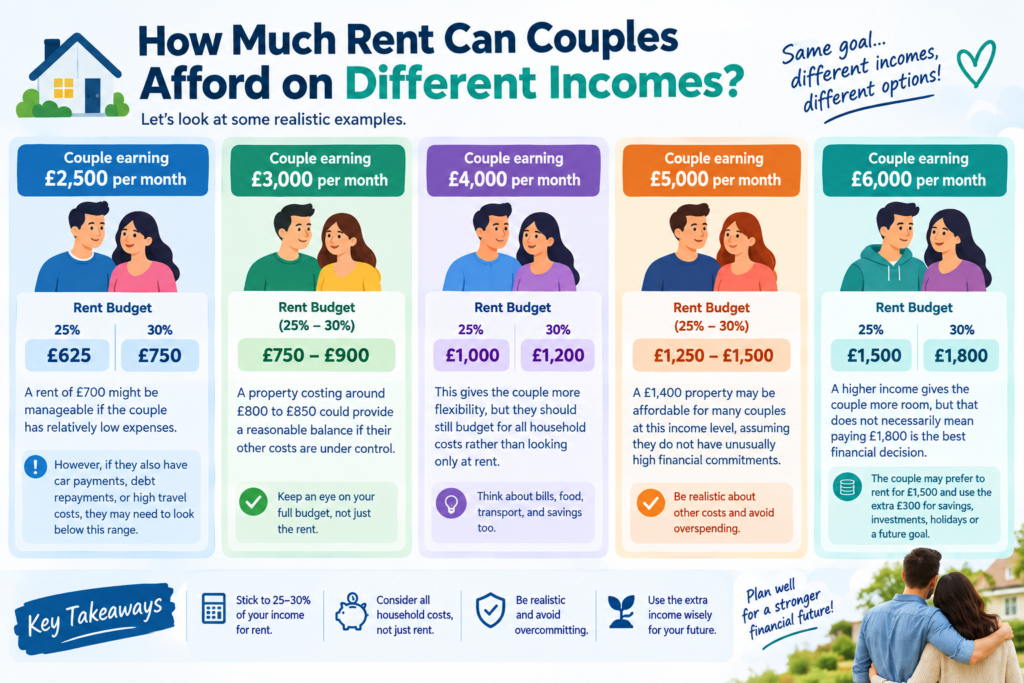
How Much Rent Can Couples Afford on Different Incomes?
Let’s look at some realistic examples.
Couple earning £2,500 per month
| Rent Budget (25%) | Rent Budget (30%) |
|---|---|
| £625 | £750 |
A rent of £700 might be manageable if the couple has relatively low expenses.
However, if they also have car payments, debt repayments, or high travel costs, they may need to look below this range.
Couple earning £3,000 per month
At 25% to 30%:
£750 to £900 per month
A property costing around £800 to £850 could provide a reasonable balance if their other costs are under control.
A couple earning £4,000 per month
| 25% Rent Budget | 30% Rent Budget |
|---|---|
| £1,000 | £1,200 |
This gives the couple more flexibility, but they should still budget for all household costs rather than looking only at rent.
Couple earning £5,000 per month
At 25% to 30%:
£1,250 to £1,500 per month
A £1,400 property may be affordable for many couples at this income level, assuming they do not have unusually high financial commitments.
Couple earning £6,000 per month
| 25% Rent Budget | 30% Rent Budget |
|---|---|
| £1,500 | £1,800 |
A higher income gives the couple more room, but that does not necessarily mean paying £1,800 is the best financial decision.
The couple may prefer to rent for £1,500 and use the extra £300 for savings, investments, holidays or a future house deposit.
What If Only One Partner Works?
This is where rent affordability can change significantly.
Consider a couple where one person earns £3,500 per month after tax, and the other currently has no income.
| Monthly Income | Percentage | Rent Budget |
|---|---|---|
| £3,500 | 30% | £1,050 |
A rent of around £1,050 might appear affordable.
But there is an important consideration: the household depends entirely on one income.
If that person loses their job or their income decreases, the couple could immediately struggle with rent.
For a single-income household, it can therefore be sensible to choose a lower rent and maintain a larger emergency savings.
For example, choosing a £900 property instead of a £1,050 property leaves an extra £150 every month, or £1,800 per year, that could go towards savings.
If your household income includes the housing element of Universal Credit, it’s worth checking your local housing allowance rate before committing, as this can cap how much support you receive toward rent in a given area.
What If Both Partners Work?
Two incomes generally make rent easier to manage because the household’s income is diversified.
For example:
| Partner | Take-Home Pay |
|---|---|
| Partner A | £2,200 |
| Partner B | £1,800 |
| Combined Take-Home Pay | £4,000 |
A 30% rent target would be:
£4,000 × 30% = £1,200
The couple could consider properties around £1,000–£1,200, depending on their other expenses.
But they should also ask what if one partner stopped working for a short time.
This is especially important if they are planning to have children, change careers, on variable income such as bonuses, overtime, or independent work
Read more:Can You Rent with Bad Credit in the UK? Complete Guide (2026)
Don’t Forget Bills When Calculating Affordable Rent
One of the biggest mistakes renters make is treating rent as their entire housing cost.
Your real monthly housing budget may include:
- Rent
- Council Tax
- Gas and electricity
- Water
- Broadband
- Contents insurance
- Parking
- Service charges where applicable
- Other property-related costs
For example, suppose a couple pays:
| Housing Cost | Monthly Amount |
| Rent | £1,200 |
| Council Tax | £180 |
| Energy | £150 |
| Water | £45 |
| Broadband | £35 |
| Contents Insurance | £15 |
| Total Housing Cost | £1,625 |
The rent is £1,200, but the actual housing cost is approximately £1,625 per month.
That difference can completely change whether a property is comfortable for your household budget. Council Tax in particular varies by band and local authority, so it’s worth checking the actual band for a specific property rather than assuming a flat average.
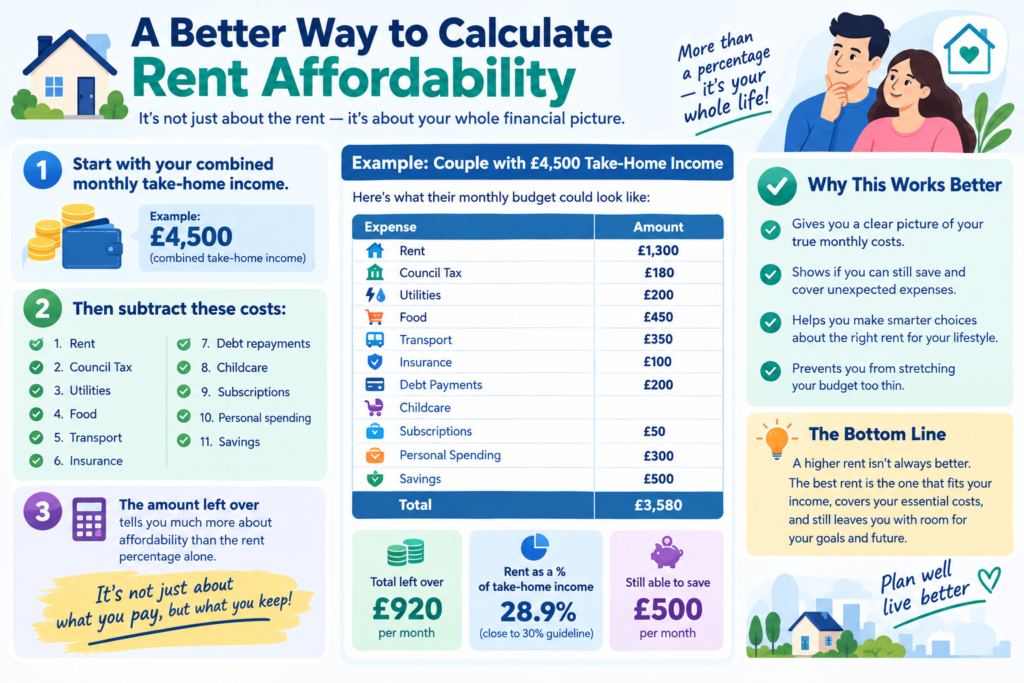
A Better Way to Calculate Rent Affordability
In place of simply asking, “Can we pay the rent?”, ask:
“Can we pay the rent and still have enough money left for everything else?”
Start with your combined monthly take-home income.
Then subtract:
- Rent
- Council Tax
- Utilities
- Food
- Transport
- Insurance
- Debt repayments
- Childcare
- Subscriptions
- Personal spending
- Savings
The amount left over tells you much more about affordability than the rent percentage alone.
Try a “Leftover Money” Check Before Choosing a Property
A rent percentage can give you a useful starting point, but it should not be the only test you use before choosing a property. Once you have calculated your estimated rent limit, test the actual property against your complete monthly budget. Take the proposed rent and add realistic costs for Council Tax, energy, water, broadband, transport, food, insurance, debt repayments and regular savings. Then look at what would still be left from your combined take-home income.
For example, a couple bringing home £4,000 a month might calculate a maximum rent of £1,200 using the 30% guideline. However, if the property would also cost £450 for Council Tax and household bills, £500 for food, £350 for transport, £200 for debt repayments and £500 for planned savings, the household would have only £800 left for everything else. In this situation, a property costing £1,000 may provide a more comfortable balance even though £1,200 is within the initial percentage-based limit.
This simple check is particularly useful when comparing several properties. Instead of asking, “Which property can we qualify for?”, ask, “Which property leaves us with enough money after all essential costs?” That small difference can help you avoid choosing a home that looks affordable on paper but feels financially restrictive every month.
A 3-Minute Practical Rent Test for Couples
Before applying for a rental property, couples can do one final check to see whether the rent is genuinely manageable. Start with your combined monthly take-home income and subtract the proposed rent. Then subtract your expected Council Tax, energy, water, broadband, food, transport, insurance, debt repayments, and other essential expenses. Finally, set aside the amount you want to save each month.
The calculation is simple:
Monthly Take-Home Income − Rent − Essential Expenses − Planned Savings = Money Left Over
For example, if a couple takes home £4,000 per month and is considering a property with £1,100 rent, they should not stop after checking that £1,100 is below 30% of their income. They should also estimate the other monthly costs. If their total essential expenses and planned savings come to another £2,300, they would have around £600 left for unexpected costs, personal spending and other non-essential expenses.
This test becomes even more useful when comparing two properties. A £1,100 property may look attractive because it is within the couple’s percentage-based budget, but a £950 property could leave an additional £150 every month. That is £1,800 over a year, which could contribute towards an emergency fund, future moving costs, a holiday or a house deposit.
Before making an application, run this check using your actual expected costs rather than rough averages. If the remaining amount feels too small for unexpected expenses or your normal lifestyle, consider a cheaper property or review which other costs could realistically be reduced. This gives you a more practical picture of affordability than relying on a rent percentage alone.
Example
Imagine a couple has a combined take-home income of £4,500.
Their monthly budget looks like this:
| Expense | Amount |
| Rent | £1,300 |
| Council Tax | £180 |
| Utilities | £200 |
| Food | £450 |
| Transport | £350 |
| Insurance | £100 |
| Debt Payments | £200 |
| Personal Spending | £300 |
| Savings | £500 |
| Total | £3,580 |
They would have approximately £920 remaining.
The rent itself represents about 28.9% of their take-home income, which is close to the 30% guideline.
More importantly, they are still able to save £500 each month and have money left over for unexpected costs.
That is a much healthier situation than simply qualifying for a higher rent.
How Much Should Couples Spend on Rent in London?
Location makes a huge difference.
The ONS reported an average UK private rent of £1,388 in June 2026, but local rents can be dramatically higher or lower. In May 2026, for example, average rent in Kensington and Chelsea was £3,591, while Dumfries and Galloway had an average of £551.
This means a national affordability rule cannot tell you exactly what you should pay in your local market.
For couples considering London, the 25%–30% guideline may be difficult to follow if they want to live in expensive central areas.
| Comparison | Cost |
|---|---|
| Rent + Commuting Cost | — |
A cheaper property far from work is not necessarily cheaper overall.
For example, saving £250 per month on rent but spending an additional £180 on commuting leaves only £70 of actual savings.
What About Manchester, Birmingham, Leeds and Other Cities?
The same principle applies across the UK.
A couple should compare their income with local rental prices rather than relying on a UK-wide average.
The ONS June 2026 data show that rents vary substantially by region, property type and size. The average UK rent was £1,127 for a one-bedroom property and £2,061 for properties with four or more bedrooms.
A couple without children may only need a one-bedroom property, while a couple with children may need Extra bedrooms.
This is specifically useful for couples because property size can make a major difference.
Choosing the smallest suitable property can greatly decrease housing costs.
How Do Letting Agents Decide If You Can Afford the Rent?
Even after you’ve worked out a rent figure that feels comfortable for your own budget, the letting agent or landlord will run their own affordability check before approving your application — and this uses a different calculation entirely.
Most UK letting agents use an income-multiplier check, commonly known as the “x30 rule”: your combined annual gross salary should be roughly 30 times the monthly rent.
| Monthly Rent | Approx. Required Combined Annual Income (x30) |
| £700 | £21,000 |
| £900 | £27,000 |
| £1,200 | £36,000 |
| £1,500 | £45,000 |
| £1,800 | £54,000 |
If a couple’s income falls short of this threshold — which can happen even when the rent is genuinely affordable in day-to-day terms, especially with only one partner working — the agent may ask for:
A guarantor (someone who agrees to cover the rent if the tenant can’t); a larger deposit; several months’ rent paid upfront; additional proof of income or savings
This referencing check is separate from your own budget, so it’s worth asking the agent about their income requirements before viewing a property you like. Couples who are self-employed, on probation in a new job, or partly reliant on benefits income often face extra document checks, and it helps to ask in advance what evidence is accepted.
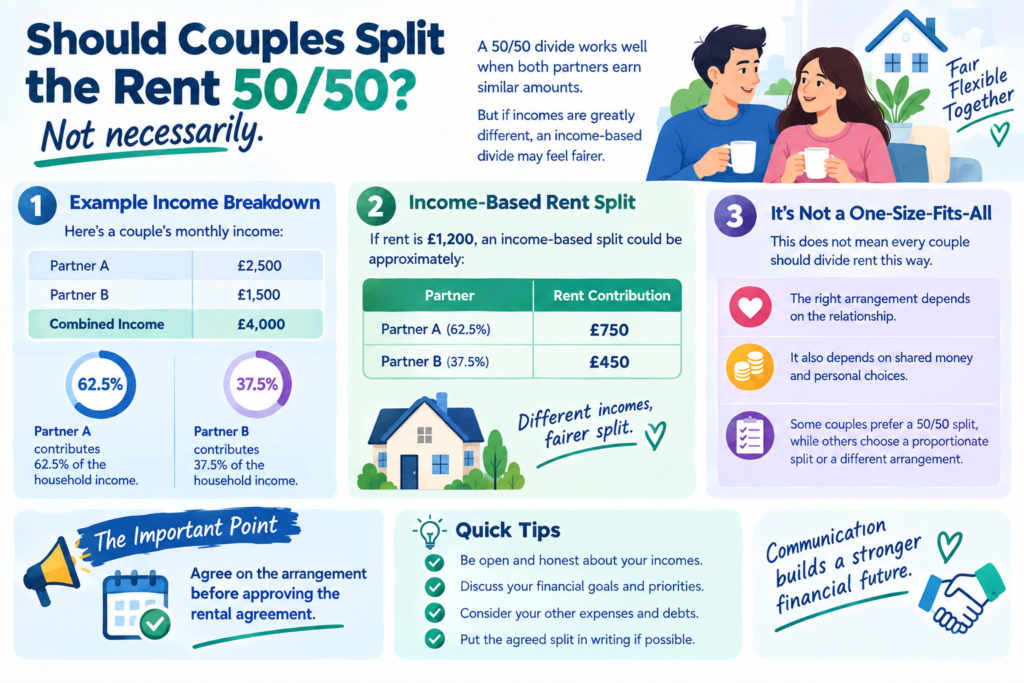
Should Couples Split the Rent 50/50?
Not necessarily.
A 50/50 Divide works well when both partners earn similar amounts.
But if incomes are greatly different, an income-based Divide may feel fairer.
For example:
| Partner | Monthly Income |
|---|---|
| Partner A | £2,500 |
| Partner B | £1,500 |
| Combined Income | £4,000 |
Partner A contributes 62.5% of the household income, while Partner B contributes 37.5%.
If rent is £1,200, an income-based split could be approximately:
| Partner | Rent Contribution |
|---|---|
| Partner A | £750 |
| Partner B | £450 |
This does not mean every couple should divide rent this way. The right arrangement depends on the relationship, shared money, and personal Choices.
The important point is to agree on the arrangement before approving the rental agreement.
How Much Should Couples Save Before Renting?
Rent affordability is not just about monthly income — moving into a rental property usually requires a significant lump sum upfront, on top of your regular budget.
For a property renting at £1,200 per month, a couple might realistically need:
| Upfront Cost | Typical Amount |
| Deposit (up to 5 weeks’ rent) | £1,384 |
| First month’s rent | £1,200 |
| Moving costs (van, cleaning, admin fees) | £300–£600 |
| Furniture and household essentials | £500–£1,500 |
| Utility set-up and first bills | £150–£300 |
| Estimated total before moving in | £3,500–£5,000 |
That figure is before factoring in an emergency fund. A couple that empties its savings to cover the deposit and moving costs can become financially vulnerable if a job loss or unexpected bill follows shortly after.
As a rule of thumb, try to keep at least one to three months’ worth of essential expenses in savings after you’ve moved in — on top of what you’ve spent to secure the tenancy.
Read more:What Salary Do You Need to Rent in the UK? Salary Guide 2026
What Percentage of Income Should Couples Ideally Spend on Rent?
There is no universal percentage that works for every household, but a practical Structure is:
| Rent as % of Income | General Guideline |
|---|---|
| Under 25% | Generally comfortable for many households. |
| 25%–30% | Often a reasonable target. |
| 30%–35% | Can be manageable, but requires closer budgeting. |
| 35%–40% | May start putting pressure on other financial goals. |
| Over 40% | Potentially risky unless the couple has very low other expenses and strong financial security. |
These are budgeting guidelines, not official UK affordability thresholds.
A couple earning £7,000 per month with very low debt may cope with a 35% housing cost differently from a couple earning £3,000 with childcare and car finance.
What If Rent Is More Than 30% of Your Income?
Don’t automatically reject a property because it exceeds 30%.
Instead, look at the complete budget.
| Combined Take-Home Pay | Monthly Rent | Rent as % of Income |
|---|---|---|
| £4,000 | £1,400 | 35% |
But if the couple has no debt, low transport costs, no childcare expenses, and strong savings, the property might still be manageable.
On the other hand, if the couple has £1,000 of monthly debt and childcare commitments, £1,400 rent could be too expensive.
The percentage should therefore be treated as a warning signal, not a final answer.
A Simple Rent Affordability Formula for Couples
| Combined Monthly Take-Home Income | Percentage | Maximum Rent Target |
|---|---|---|
| £4,800 | 30% | £1,440 |
Then adjust the result based on:
- Debt
- Childcare
- Transport
- Savings goals
- Number of dependants
- Location
- Utilities
- Job security
- Other regular expenses
This produces a much more realistic rent budget.
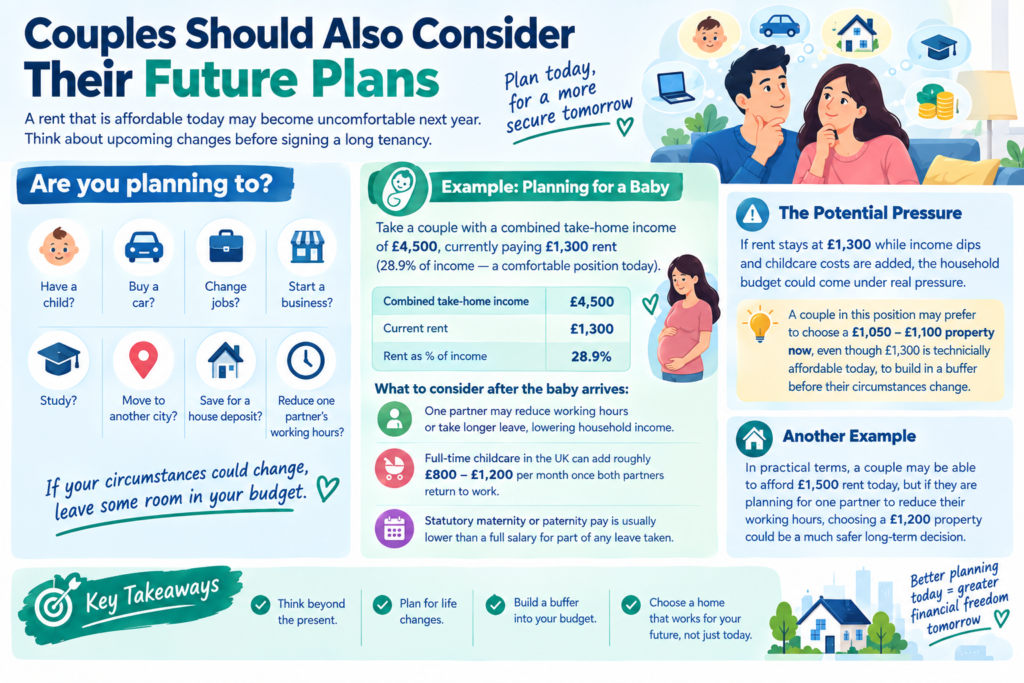
Couples Should Also Consider Their Future Plans
A rent that is affordable today may become uncomfortable next year.
Think about upcoming changes before signing a long tenancy.
Are you planning to:
- Have a child?
- Buy a car?
- Change jobs?
- Start a business?
- Study?
- Move to another city?
- Save for a house deposit?
- Reduce one partner’s working hours?
If your circumstances could change, leave some room in your budget.
Example: Planning for a baby
Take a couple with a combined take-home income of £4,500, currently paying £1,300 rent (28.9% of income — a comfortable position today).
If they’re planning to start a family in the next year, it’s Worth stress-testing the =financial plan against life after the birth:
One partner may reduce working hours or take Longer leave, temporarily lowering household income. Full-time childcare in the UK can add roughly £800–£1,200 per month once both partners return to work. Statutory maternity or paternity pay is usually lower than a full salary for part of any leave taken
If rent stays at £1,300 while income dips and childcare costs are added, the household budget could come under real pressure. A couple in this position may prefer to choose a £1,050–£1,100 property now, even though £1,300 is technically affordable today, to build in a buffer before their circumstances change.
For example, in practical terms, a couple may be able to afford £1,500 rent today, but if they are planning for one partner to reduce their working hours, choosing a £1,200 property could be a much safer long-term decision.
How much rent can a couple afford in the UK?
A useful starting point is around 25% to 30% of the couple’s combined monthly take-home income. For example, if a couple brings home £4,000 per month, a rent of approximately £1,000–£1,200 could be a reasonable starting range. However, debts, childcare, transport, and other expenses should also be considered.
Is 30% of income enough for rent as a couple?
The 30% rule is a useful budgeting guideline, but it is not a fixed UK rule. A couple with low expenses may comfortably spend slightly more, while a household with significant debt or childcare costs may need to spend less.
Should couples calculate affordable rent using gross or net income?
For personal budgeting, take-home (net) income is generally more useful because it represents the money available after deductions such as Income Tax and National Insurance. Landlords or letting agents may use gross income when assessing eligibility, so the two calculations should not be confused.
How much rent can a couple afford on £3,000 a month?
If £3,000 is the couple’s combined take-home income, a 25%–30% guideline gives a rent range of approximately £750–£900 per month. The couple should then check whether this leaves enough money for bills, food, transport, debt repayments and savings.
How much rent can a couple afford on £4,000 a month?
A couple taking home £4,000 per month could use approximately £1,000–£1,200 per month as an initial rent target. The final amount should depend on their other monthly commitments and financial goals.
How much rent can a couple afford on £5,000 a month?
At 25%–30% of combined take-home income, a couple earning £5,000 per month could consider approximately £1,250–£1,500 in rent. They should also budget separately for Council Tax, utilities, food, transport and other expenses.
Can couples afford rent if only one person works?
Yes, but single-income couples should generally budget more cautiously. Because the household depends on one salary, keeping rent lower and maintaining an emergency fund can provide additional financial security.
Should couples split rent 50/50?
Not necessarily. A 50/50 split may make sense when both partners have similar incomes. If their incomes are significantly different, they may prefer an income-based contribution where each person pays a proportion of the rent based on their earnings.
Does affordable rent include bills?
Usually, when people talk about a rent percentage, they mean rent alone. But your actual housing cost can also include Council Tax, energy, water, broadband, insurance and other property-related expenses. These should be included in your overall budget.
What if our rent is more than 30% of our income?
Going above 30% does not automatically mean the property is unaffordable. Look at your complete budget. If you have low debt, strong savings, and relatively low living costs, a higher percentage may still be manageable. However, higher rent leaves less room for unexpected expenses and future savings.
How much should a couple save before renting?
There is no single amount suitable for every couple, but you should budget for upfront rental costs such as the deposit, first rent payment, and moving expenses while keeping money available for emergencies. Ideally, you should still be able to save regularly after moving into the property.
Is rent affordability different in London compared with other UK cities?
Yes. Rental prices vary considerably across the UK. A rent that is reasonable for a couple in one city may be extremely expensive in another. Couples should compare their income with local rental prices and also consider commuting costs when choosing where to live.
Why might a couple be turned down for a rental even if they can afford it?
Affordability for your own budget and a letting agent’s referencing check are different things. Agents commonly require combined annual income to be around 30 times the monthly rent. Couples who fall short — often single-income households, the self-employed, or those new to a job — may still be approved with a guarantor, extra deposit, or rent paid upfront.
The Bottom Line: How Much Rent Can Couples Afford?
For most couples, a sensible starting point is to keep rent around 25% to 30% of combined monthly take-home income.
But the best rent budget is the one that allows you to live comfortably after paying housing costs.
As a quick guide:
| Combined Take-Home Income | Suggested Rent Range |
| £2,500 | £625–£750 |
| £3,000 | £750–£900 |
| £3,500 | £875–£1,050 |
| £4,000 | £1,000–£1,200 |
| £4,500 | £1,125–£1,350 |
| £5,000 | £1,250–£1,500 |
| £6,000 | £1,500–£1,800 |
| £7,000 | £1,750–£2,100 |
Remember that these are starting points, not guarantees of affordability.
The ONS reported that the average UK private rent was £1,388 per month in June 2026, but local rents vary considerably, so couples should always check the actual rental market in the area where they plan to live.
Finally, the best rental property is not automatically the most expensive one you can afford.
It is the one that gives you a comfortable home without giving up your savings, financial security, and plans.
Final Tip
Before applying for a property, calculate your combined take-home income, total housing costs, and remaining Available income. Then check that figure against what a letting agent is likely to require (roughly 30x the monthly rent in combined annual salary), so you’re not caught out at the referencing stage.
If the rent leaves you with enough money for everyday expenses, an emergency fund and regular savings, you are much more likely to enjoy the property without feeling financially stretched.
For a faster calculation, a Rent Affordability Calculator UK can help you estimate a suitable rent range based on your income and financial situation.