It was the scratching that gave it away. Owen, renting a two-bedroom flat in Cardiff, first heard it at about 2 am — a dry rustling inside the kitchen wall. Within a week, he had found droppings behind the kitchen unit and a gap the size of his fist where the pipework met the back wall. His landlord’s reply was brisk: “Read your tenancy agreement. Pest control is your problem.” Owen read it. The agreement did say the tenant was responsible for pest control — so he paid £142 for a private exterminator, and the mice came straight back through the same hole.
Owen’s story is one of the most common disputes in UK renting — and the answer to who pays for pest control in a rented property is more tenant-friendly than most people expect. Who pays doesn’t come down to your tenancy agreement; it comes down to three legal questions.
Who Pays for Pest Control in a Rented Property: The Quick Answer
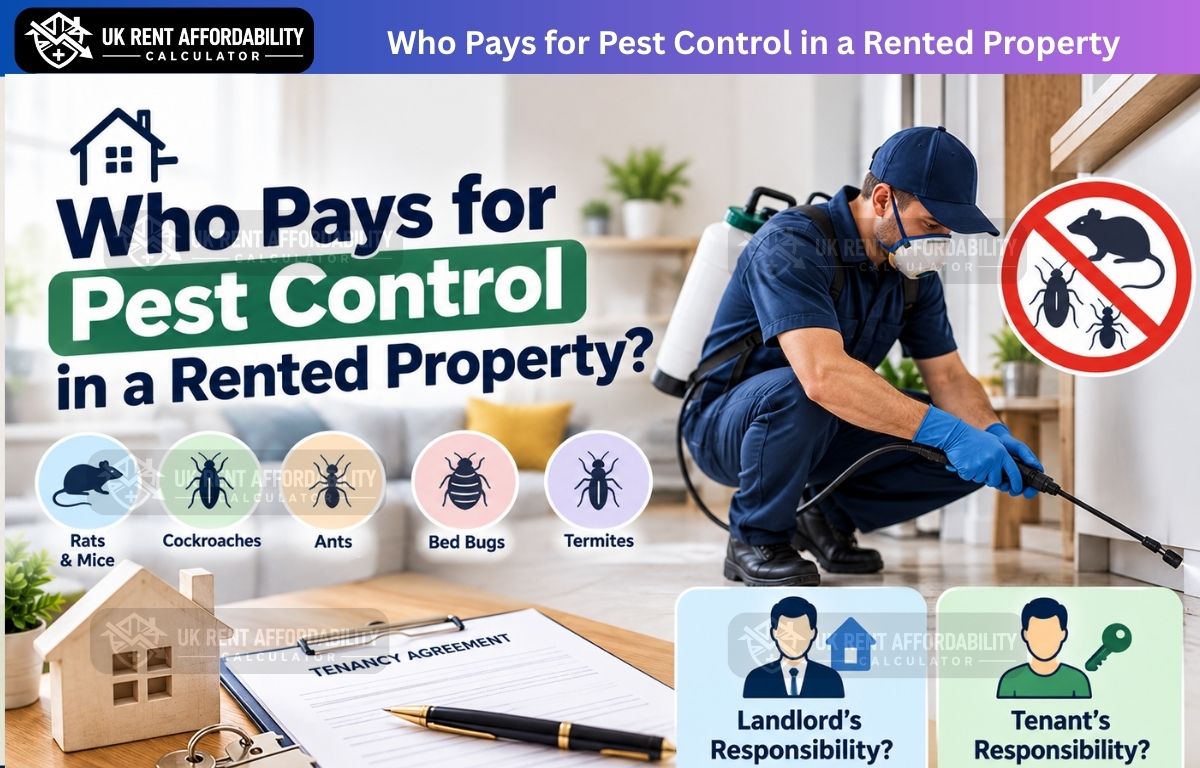
In most cases, your landlord pays for pest control. Your landlord must deal with a pest infestation if it is caused by disrepair they are legally obliged to fix — holes in walls, broken vents, damaged drains — or if the pests were already there when you moved in, or if the infestation is so serious the home is not fit to live in. You pay only where you have encouraged the pests: poor hygiene, rubbish left out, or untreated pets. And no tenancy clause can take these statutory duties away from your landlord.
| Your situation | Who usually pays |
|---|---|
| Mice or rats getting in through holes, gaps, broken vents, or damaged drains | Your landlord |
| Bed bugs present when you moved in, or reported within days | Your landlord |
| Bed bugs appearing months into the tenancy with no building defect | Usually you — but genuinely disputed, so get advice |
| Wasps’ nest mid-tenancy, no building defect involved | Usually you (practical guidance, not settled law) |
| Bees in a chimney or roof space | A beekeeper for live removal; sealing entry points is a landlord repair |
| Fleas from your own pet during the tenancy | You |
| Cockroaches across a whole block of flats | Your landlord or freeholder |
| Any infestation caused by your rubbish, food waste or pets | You |
What the Law Actually Says: The Three-Part Test
Shelter England and councils such as Lambeth use the same three-part test — your landlord must deal with the infestation if any one of these applies:
- It is caused by disrepair. Pests getting in through holes in walls and floors, missing roof tiles, broken air bricks and vents, badly fitted external doors and windows, leaking pipes or damaged drains are the landlord’s problem — these are their repairing obligations under the Landlord and Tenant Act 1985, section 11.
- The pests were there from the start. If you moved into a furnished home and the pests were already there, your landlord should sort it out — bed bugs and fleas are common in furnished properties at the start of a tenancy.
- The home is unfit to live in. Under the Homes (Fitness for Human Habitation) Act 2018, your home must be fit to live in from day one and stay fit throughout the tenancy. A serious infestation can make a home unfit on its own, even where no single repair item is obvious.
The statutory backbone:
| Law | What it means for pests |
|---|---|
| Landlord and Tenant Act 1985, s.11 | Landlord must repair the structure, exterior and key installations — the defects that let pests in |
| Landlord and Tenant Act 1985, s.12 | Clauses trying to exclude s.11 duties are void unless a county court authorised them |
| Landlord and Tenant Act 1985, ss.9A–9C | The home must be fit for human habitation at the start and throughout the tenancy |
| LTA 1985, s.9A(3) | Landlord not liable for unfitness caused mainly by the tenant’s own breach (e.g. filthy conditions) |
| LTA 1985, s.9A(4) | Clauses excluding the fitness duty are void |
| Housing Act 2004 (HHSRS) | “Domestic hygiene, pests and refuse” is one of 29 prescribed hazards councils assess |
| Environmental Protection Act 1990, ss.79–82 | Infestations can be a statutory nuisance; councils must investigate complaints |
| Prevention of Damage by Pests Act 1949 | Councils must keep their area free of rats and mice “as far as practicable” |
Why Your Tenancy Agreement Can’t Override the Law
The statute always wins. For residential tenancies, legislation overrides what is written in the tenancy agreement, unless the agreement gives you additional rights.
Section 12 of the Landlord and Tenant Act 1985 voids any clause that tries to exclude or limit the landlord’s section 11 repair duties — unless a county court authorised it, which effectively never happens in standard tenancies. Section 9A(4) voids any clause that tries to exclude the fitness-for-human-habitation covenant.
Routine “the tenant handles pest control” clauses are common and can set day-to-day expectations for minor issues — but the underlying legal responsibility stays with the property owner: such a clause cannot dump the landlord’s statutory duties on you where disrepair or unfitness is involved. Our tenancy agreement guide explains which clauses carry weight and which don’t.
When You, the Tenant, Pay for Pest Control
You are on the hook where you have encouraged the pests. Shelter England’s line is clear: you could be responsible only if you do something to encourage pests — cover your bins, don’t leave food and rubbish out, use flea treatment on your pets.
In practice that means kitchen ants fed by crumbs, fleas from an untreated cat, or a mouse problem sustained by overflowing bins are tenant-side. And if you breach your tenancy’s cleanliness terms, the fitness protection won’t help you: under s.9A(3), the landlord isn’t liable for unfitness wholly or mainly caused by your own breach.
Two duties sit on you whatever the cause:
- Report in writing as soon as possible. Describe what you’ve seen, when you saw it, and why you think the landlord is responsible. Mention any health effects and damage to your belongings.
- Don’t book and pay for treatment without the landlord’s agreement. Reimbursement is not automatic — you may never see that money again.
Rats and Mice: When Entry Points Make It Your Landlord’s Problem
Mice and rats rarely appear from nowhere. They come through holes in walls and floors, gaps around pipework, broken air bricks and vents, badly fitted doors and windows, and damaged drains — and every one of those is a section 11 repair item for your landlord.
Back to Owen in Cardiff. The fist-sized hole behind his kitchen unit was a disrepair issue — which meant the infestation was his landlord’s responsibility, despite what the tenancy agreement said. Once Owen reported it in writing with dated photos, his landlord paid for both the treatment and the proofing: about £242 that never should have come out of Owen’s pocket.
Owen’s case:
| Item | Illustrative cost | Who paid |
|---|---|---|
| Council survey + mice treatment (example council fee) | £61.68 | Landlord |
| Proofing: sealing the pipework gap and two broken air bricks | £180.00 | Landlord |
| Total | £241.68 | Landlord |
The exception: if your rubbish or food waste is attracting the rodents, the bill is yours.
Bed Bugs: Why Timing Is Everything
Bed bugs are the most disputed pest in renting, and the honest answer is: it depends on the facts.
- Pre-existing at move-in — or reported within days of moving in, especially in a furnished property — points at the landlord.
- Introduced mid-tenancy — second-hand furniture, luggage, clothing — points at the tenant. But this is genuinely hard to prove, which is why bed-bug disputes are so common.
- Spreading between flats in a block — a building issue, so the landlord’s or freeholder’s.
- In borderline cases, shared-cost agreements between landlord and tenant are common.
Lucy moved into a one-bed flat in London and spotted bed bugs on day nine. Her check-in inventory, dated photos and written report on day nine all pointed to a pre-existing problem — so her landlord paid £260 plus VAT (£312 for two visits) and replaced the mattress rather than argue about it.
Note that bed bugs live in sofas, curtains, behind pictures and under wallpaper — not just mattresses — so at move-in, inspect beyond the bed. If your landlord takes bed-bug treatment from your deposit, challenge it: only fair if the infestation was your fault — see our tenancy deposit protection guide.
Wasps and Ants: The Mid-Tenancy Grey Area
Wasps. A nest appearing mid-tenancy is commonly treated as the tenant’s cost — but be clear: that is practical guidance from the pest-control trade and property industry, not settled statute. If the nest results from a building defect — damaged eaves, broken vents — you have a genuine landlord-side argument. Talk to your landlord before you pay.
Ants. Minor kitchen infestations are usually the tenant’s job: supermarket treatments and stricter cleaning. If ants are coming through structural defects, the landlord’s repair duty kicks in.
Arjun found a wasps’ nest under the eaves of his rented house in Birmingham in July. There was no damage to the eaves — the wasps had simply built in a sheltered spot — so this sat squarely in the tenant-pays grey area. He told his landlord first, then booked a private contractor at £119 plus VAT (£142.80 for one visit), and kept the receipt.
The honest position: where there’s a defect, the law is on the landlord; where there isn’t, tenants usually end up paying — but always check with your landlord first.
Bees: Don’t Book an Exterminator — Call a Beekeeper
The British Pest Control Association advises leaving bee nests alone — bees are in decline, and pest controllers will not treat a bee nest unless there is a serious threat to human life.
- Honeybee swarm: contact a British Beekeepers Association (BBKA) swarm collector — often free for swarms.
- Bumblebees: rarely sting and can usually be left alone.
- A colony inside the building fabric: sealing the entry points is a repair job (your landlord’s), while the colony itself is usually a beekeeper job — and best practice is live removal, not extermination.
Fleas, Cockroaches and Blocks of Flats
Fleas. Pre-existing at the start of the tenancy — left behind by the previous tenant’s pets, say — are the landlord’s problem; the landlord should fumigate carpets and upholstery. Fleas from your own pet during the tenancy are yours — keep up the flea treatment.
Cockroaches in flats depend on scale. Building-wide — communal areas, shared pipework, defective shared services — it’s the landlord’s or freeholder’s. One flat with poor hygiene — the tenant’s.
Pigeons and birds in lofts. Entry through roof or eaves defects is a structure-and-exterior repair, so the landlord. (Bats are a protected species and a separate matter — leave them be and get specialist advice.)
What If the Pests Are Coming From Next Door?
If pests are coming from a neighbour’s home:
- Speak to the neighbour first — they may not know.
- If that fails, report it to their landlord or freeholder.
- Then report it to the council — environmental health can investigate and serve notices regardless of whose property the source is.
Councils can treat the pests and recharge the responsible party.
What to Do About It: Your Step-by-Step Plan
- Report in writing as soon as possible. Describe what you’ve seen, when you saw it, and why you think the landlord is responsible.
- Allow reasonable time. No fixed statutory period for pests; reasonableness depends on severity — a county court has held 28 days reasonable for floorboard repairs to stop rats and mice.
- Gather evidence. Dated photos and video, a timeline of sightings, your check-in inventory notes, and ideally a pest-controller’s inspection report.
- Contact your council’s environmental health or pest-control service. Fees usually apply, with concessions for benefits recipients.
- Check your tenancy agreement clause — but remember it cannot override statutory duties.
- If the landlord won’t act: council complaint first, then a court disrepair claim (the pre-action protocol applies — get legal advice first). Our landlord repairs guide covers the disrepair route in detail.
- “Pay and claim back” is a last resort. Maximise recovery: gather evidence, report to the landlord, allow reasonable time, report to environmental health, get three quotes and use the cheapest, request payment, keep every receipt. Claims under £10,000 usually go to the small-claims track — but recovery is not guaranteed.
- Do not withhold rent. It risks possession proceedings for arrears and weakens your position, not your landlord’s. See our rent arrears guide for what to do instead if money is tight.
- Normal access rules apply if your landlord needs to inspect or treat — see can my landlord enter without permission.
Your evidence pack:
| Evidence | Why it matters |
|---|---|
| Dated photos and video | Proves the scale and timing of the infestation |
| Check-in inventory | Shows whether pests were there from the start |
| Written reports to the landlord | Proves you gave notice and allowed time |
| Timeline of sightings | Links the problem to disrepair or move-in |
| Pest-controller’s inspection report | Professional view on the cause |
| Receipts and quotes | Needed for any “pay and claim back” action |
How Much Does Pest Control Cost? Three Worked Examples
All figures below are illustrative — private trade prices are London-based and council fees vary widely. Check your own council’s fees before relying on any number.
Private trade costs (London, typical ranges, excluding VAT where stated):
| Treatment | Illustrative cost |
|---|---|
| Mice (two visits) | £120–£250+ |
| Rats (three visits) | £200–£350+ |
| Bed bugs, chemical (two visits, 1-bed) | £180–£450+ |
| Bed bugs, heat treatment | £600–£1,200+ |
| Cockroaches | £150–£300+ |
| Ants | £120–£250+ |
| Wasps, one nest | £90–£180+ |
Council service examples (fees vary by council — these are examples, not national averages):
| Treatment | Example council fee |
|---|---|
| Rats/mice survey + treatment | £61.68 (Arun District Council) |
| Wasps’ nest | £51.40 (Arun); £122 (Bath & North East Somerset) |
| Cockroaches | £127.93 (Arun); £220 (BathNES) |
| Fleas, 1-bed | £91.38 (Arun) |
| Bed bugs, first room | £177.04 (Arun); 1–2 rooms £220 (BathNES) |
The three worked examples:
- Owen’s mice (Cardiff) — landlord paid: council treatment £61.68 + proofing £180.00 = £241.68.
- Lucy’s bed bugs (London) — landlord paid: chemical treatment £260 + 20% VAT = £312.00 for two visits. (The landlord also replaced the mattress rather than argue.)
- Arjun’s wasps (Birmingham) — tenant paid: one nest removal £119 + 20% VAT = £142.80.
If Your Landlord Won’t Act: Remedies That Actually Work
Never let “there’s nothing you can do” be the end of it. The enforcement ladder runs: written report → council environmental health → court.
| Remedy | Basis |
|---|---|
| Court order requiring pest removal, repairs and compensation | Disrepair claim in the County Court (LTA 1985 s.11 / s.9A) |
| Compensation for distress, health effects, damaged belongings | Same claim; personal-injury angle via Defective Premises Act 1972 s.4 |
| Council improvement notice, prohibition order, or emergency remedial action | Housing Act 2004, following an HHSRS assessment |
| Abatement notice for statutory nuisance | Environmental Protection Act 1990, ss.79–80 |
| Council treats the pests and recharges the responsible party | EPA 1990 / Prevention of Damage by Pests Act 1949 powers |
| Rent repayment order — up to 12 months’ rent | Housing and Planning Act 2016, ss.40–41 — only where the landlord committed a relevant offence, including breaching a Housing Act 2004 improvement notice or prohibition order served for the pest hazard |
| “Pay for treatment and claim back” via small claims | County Court money claim — recovery not guaranteed |
| Housing Ombudsman complaint | Where your landlord is the council itself |
One correction worth knowing: rent repayment orders don’t apply to ordinary disrepair alone, but they do become available if the council serves an improvement notice for the pest hazard and your landlord breaches it — breaching an improvement notice or prohibition order is one of the offences that can trigger an RRO of up to 12 months’ rent, applied for at the First-tier Tribunal within 12 months of the offence (the notice must relate to a hazard on the premises you rent).
Worried about retaliation for complaining? Since 1 May 2026, section 21 “no-fault” evictions have been abolished for private tenancies — see our Renters’ Rights Act 2025 guide and our illegal eviction guide for where you stand.
England, Scotland, Wales and Northern Ireland: How the Rules Differ
| Nation | Key rule |
|---|---|
| England | LTA 1985 ss.11, 12 and 9A + HHSRS + EPA 1990, as set out in this guide |
| Wales | Renting Homes (Wales) Act 2016 s.91: the landlord must keep the home fit for human habitation; “Domestic hygiene, pests and refuse” is item 15 of the 29 fitness matters in the 2022 Regulations. Rent is not payable for days the home is unfit — though a 2025 judgment limited claims for rent already paid |
| Scotland | The Repairing Standard (Housing (Scotland) Act 2006, s.13) doesn’t name pests — but a severe infestation can breach its fitness and structural-repair limbs. Enforce via the First-tier Tribunal (Housing and Property Chamber), which can order repairs and cut your rent until the problem is fixed |
| Northern Ireland | Thinner framework: default repair terms under the Private Tenancies (NI) Order 2006 make the landlord responsible for structural and exterior repairs; the district council can serve a notice on “the person who receives the rent”, carry out the work and charge the landlord. No NI-specific published guidance on pest-cost allocation was found, so use the repair defaults and council-notice route |
Awaab’s Law and the Renters’ Rights Act 2025
Awaab’s Law (in force from October 2025) currently applies to social landlords in England only; pest problems posing an imminent, significant risk to health or safety can count as emergency hazards. Its extension to private renting is phase 3 of the Renters’ Rights Act 2025, date to be announced and subject to consultation. Nothing has been confirmed about what a future Decent Homes Standard will say about pests specifically — treat anyone who tells you otherwise with suspicion.
The Renters’ Rights Act 2025 (royal assent 27 October 2025) is rolling out in phases: phase 1 (live from 1 May 2026) abolished section 21, made tenancies periodic and expanded rent repayment orders to new offences; phase 2 (late 2026, date TBC) brings the landlord database and ombudsman; phase 3 (date TBA) applies the Decent Homes Standard to private renting.
Who pays for pest control in a rented property — landlord or tenant?
Usually the landlord. They must deal with infestations caused by disrepair they must fix, pests present when you moved in, or infestations that make the home unfit to live in. You pay only where you encouraged the pests — poor hygiene, rubbish left out, or untreated pets.
Can my tenancy agreement make me pay for all pest control?
Not where statutory duties are involved. Clauses excluding the landlord’s repair duties (LTA 1985 s.11) or fitness duties (s.9A) are void under ss.12 and 9A(4). A “tenant handles pest control” clause can set day-to-day expectations, but it cannot override the law.
Who pays for mice — landlord or tenant?
Usually the landlord: mice get in through defects the landlord must repair — holes in walls and floors, gaps around pipework, broken vents and air bricks, damaged drains. If your rubbish or food waste is attracting them, the cost is yours.
Who pays for bed bugs in a rented flat?
It depends on timing. Present at move-in or reported within days points to the landlord, especially in furnished properties. Appearing months later — likely brought in with luggage or second-hand furniture — usually falls to the tenant, though this is hard to prove and disputes are common. Spread between flats in a block is the landlord’s or freeholder’s problem.
Who pays for a wasps’ nest in a rented property?
In practice, usually the tenant — a mid-tenancy nest with no building defect is widely treated as a tenant cost. But if the nest is there because of a building defect, such as damaged eaves or vents, the landlord has a genuine repair-based responsibility. Always check with your landlord first.
Should I report pests to the council or my landlord first?
Your landlord first, in writing, giving reasonable time to act. If they won’t, report to your council’s environmental health team — councils must investigate statutory nuisance complaints and can treat the pests and recharge the responsible party.
Can I withhold rent until my landlord sorts the pests?
No — don’t. Withholding rent risks possession proceedings for arrears and weakens your position. Use the enforcement ladder instead: written report, council complaint, then a court disrepair claim or a small claim.
Can I get a rent repayment order for a pest infestation?
Not for ordinary disrepair alone — but yes, potentially, if the council serves a Housing Act 2004 improvement notice or prohibition order for the pest hazard and your landlord breaches it. That offence can trigger an RRO of up to 12 months’ rent (Housing and Planning Act 2016, ss.40–41).
My landlord took pest-control costs from my deposit. Is that allowed?
Only if the infestation was genuinely your fault. Deposit adjudication schemes decide these disputes case by case — challenge any deduction you disagree with.
What if the pests are coming from my neighbour’s flat?
Speak to the neighbour first, then report to their landlord or freeholder, then to the council. Environmental health can investigate and serve notices regardless of which property the source is.
Do the rules differ in Scotland, Wales and Northern Ireland?
The practical test is similar, but the statutes differ. Wales names “domestic hygiene, pests and refuse” as a specific fitness matter; Scotland’s Repairing Standard doesn’t name pests but severe infestations can breach it, enforced via the Housing and Property Chamber tribunal; Northern Ireland relies on default repair terms and district-council notices. The three-part test in this guide is England-focused.
Are bees treated differently from other pests?
Yes. Don’t book an exterminator — pest controllers won’t treat a bee nest unless there’s a serious threat to human life. For a honeybee swarm, contact a British Beekeepers Association swarm collector (often free). Sealing entry points is a landlord repair; the colony itself is usually a beekeeper job.
Final Thoughts
Pest problems in rented homes are stressful, but the law is clearer — and more tenant-friendly — than most tenancy agreements make it look. Remember the three questions: was it caused by disrepair, was it there from the start, or is the home now unfit? If the answer to any of them is yes, it’s your landlord’s bill, whatever your contract says. Report in writing, keep evidence, give reasonable time, and use your council if you’re ignored.
And because pests cost money either way, it pays to know what your rent leaves you with each month. If you’re weighing a move somewhere pest-free, run your numbers through the free rent affordability calculators at rentaffordabilityuk.com — and read our landlord repairs guide so you know which defects your landlord must fix.
Further Reading
- Pests and vermin infestations in rented homes — Shelter England — the tenant-facing advice this guide’s legal test is built on.
- Responsibility for repairs: pests and infestations — Shelter Legal — the detailed legal position behind the three-part test.
- Extending Awaab’s Law to private rented tenancies — GOV.UK consultation — where the future rules stand.