
Holding Deposit Calculator UK helps you understand rental reservation costs before applying. Finding a rental property in the UK often moves quickly. Once you’ve found the perfect home, the Property owner or letting broker may ask you to pay a holding deposit to reserve the property while they complete reference checks and prepare the rental agreement.
Many renters are unsure:
- How much should a holding deposit be?
- Is it refundable?
- Can a landlord keep it?
- What happens if the tenancy doesn’t go ahead?
Our Holding Deposit Calculator UK helps you calculate the maximum legal holding deposit based on your weekly rent in seconds. This guide explains everything you need to know, including the law, calculation examples, refund rules, and frequently asked questions.
Click Here :Rental Deposit Calculator UK
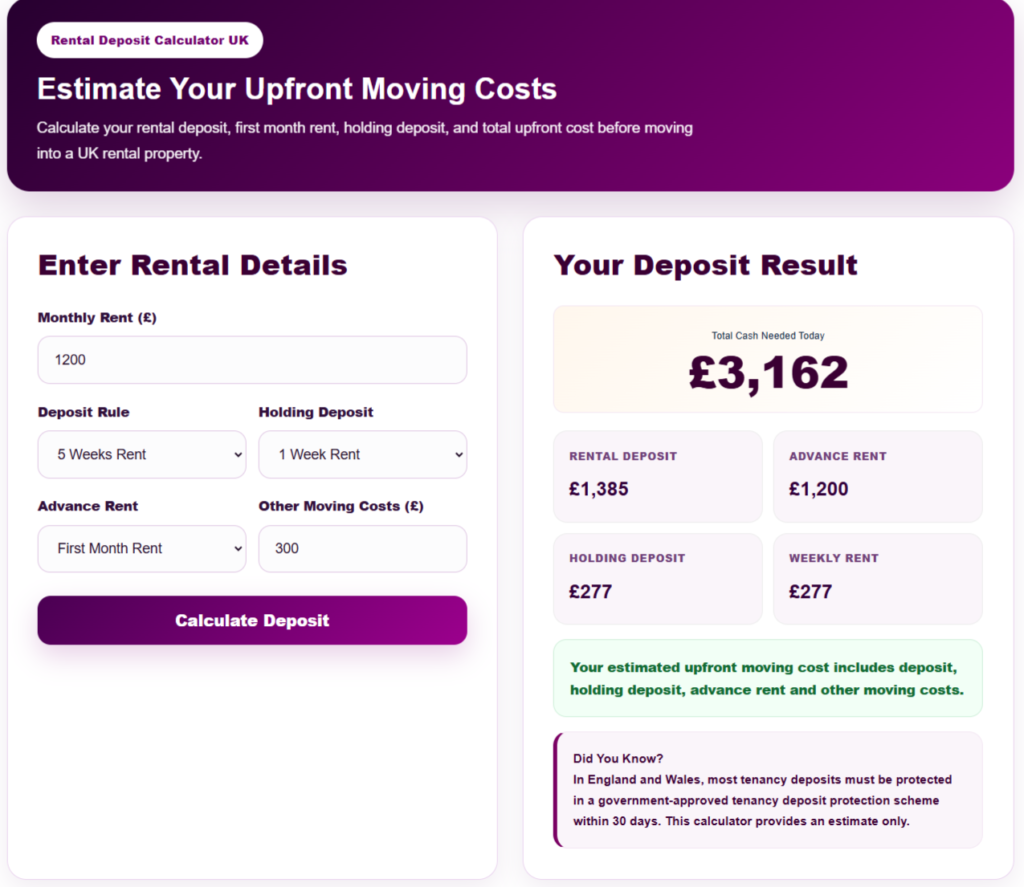
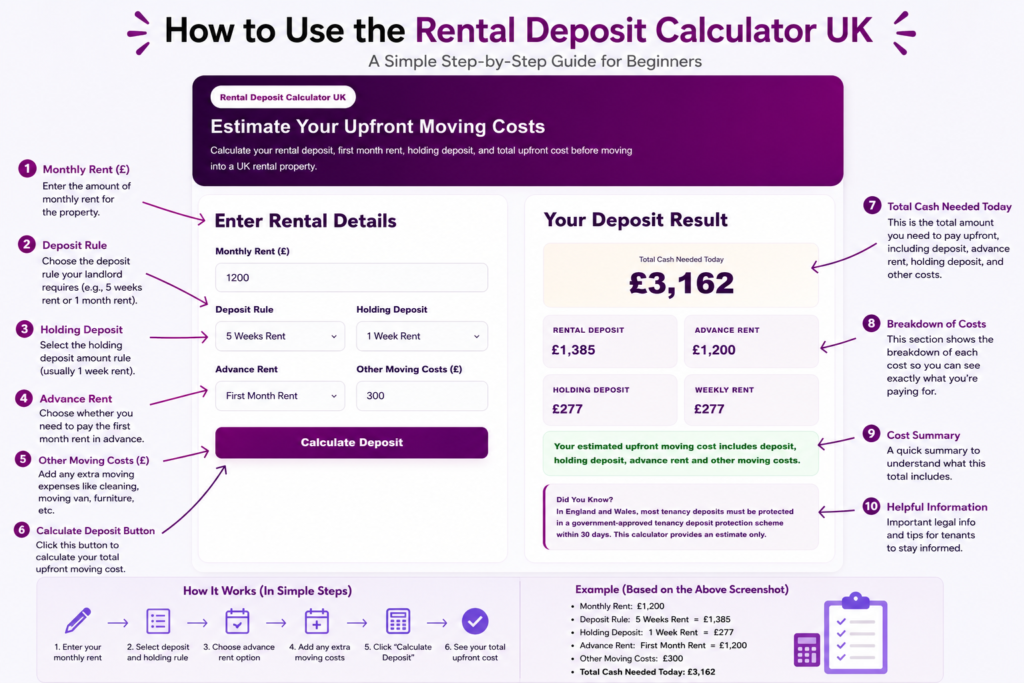
How to Use the Rental Deposit Calculator UK
What Is a Holding Deposit?
A holding payment is a payment made by a Potential renter to reserve a rental property before the rental agreement is signed. It shows your promise to rent the property and allows the Property owner or letting agents, for a short time, to take the property off the market while completing the necessary pre-rental agreement checks.
During this period, the property owner or letting broker will usually carry out several checks to ensure you’re a suitable tenant and to prepare for the rental agreement.
Why Is a Holding Deposit Requested?
| Purpose | Description |
|---|---|
| Carry Out Identification | Verify your rental history and review your suitability as a renter. |
| Perform Value for Money Checks | Ensure your income is enough to comfortably cover the monthly rent. |
| Verify Job Details | Confirm your job status and income with your Company if required. |
| Check Your Credit Records | Review your credit record to identify any financial issues that could affect your rental agreement. |
| Prepare the Rental Agreement | Draft the rental agreement contract and complete the necessary paperwork before you move in. |
Before paying a holding deposit, take a few minutes to confirm exactly what you are paying for. Ask the landlord or letting agent to confirm the weekly or monthly rent, the amount of the holding deposit, the property address, and the deadline for completing the tenancy. It is also sensible to ask whether the holding deposit will be credited towards your first rent payment or tenancy deposit if the tenancy goes ahead. Having these details in writing can prevent misunderstandings later, especially if several people are involved in arranging the rental.
Read more:Final Grade Calculator: 7 Easy Tips to Know What Grade You Need on Your Final ExamIs a Holding Deposit the Same as a Rental Agreement Deposit?
No. A holding advance payment and a rental agreement payment serve different purposes.
- Holding payment: Paid before the rental agreement begins to reserve the property while checks are completed.
- Rental Agreement payments (Security payments ): Paid when the rental agreement starts to protect the property owner against potential damage, unpaid rent, or Breaches of the rental agreement.
Understanding the difference between these two payments can help you plan your rental finances and avoid confusion during the renting process.
Holding Deposit vs Tenancy Deposit
Although the names sound similar, a holding deposit and a rental agreement initial payment have different purposes. Understanding the difference can help you know what you’re paying for and when each payment is required.
| Holding Initial payment | Tenancy Initial payment (Security Deposit) |
| Paid before the rental agreement is signed. | Paid when the rental agreement begins or just before you move in. |
| Used to reserve the property while the Property owner or letting broker completes referencing and other checks. | Acts as financial protection for the landlord against property damage, unpaid rent, or breaches of the rental agreement. |
| For Qualified rental agreements. In England, it is generally capped at one week’s rent. | Usually capped at up to five weeks’ rent (or six weeks for some higher-rent tenancies where applicable). |
| Often deducted from your first month’s rent or rental agreement payment once the rental agreement goes ahead. | Must usually be protected in a government-approved rental agreement deposit protection (TDP) scheme for a qualified rental agreement. |
| Helps show that you’re committed to renting the property. | Is returned at the end of the rental agreement, provided the property’s condition meets the terms of the agreement and there are no outstanding cuts. |
Key Difference
The holding payment is a temporary payment made to reserve a property before your tenancy starts, while the rental agreement payment is a security payment paid at the beginning of the tenancy to protect the Property owner throughout the rental period. In many cases, the holding deposit is later deducted from your first rent payment or your rental agreement deposit if the rental agreement proceeds.
When planning to move into a rental property, do not look at the holding deposit in isolation. A tenant may need to budget for the holding deposit first, followed by the remaining first rent payment, tenancy deposit, moving costs, utility setup, and other household expenses. For example, if your first month’s rent is £1,200 and you have already paid a £276.92 holding deposit, you may still need to prepare £923.08 towards the first month’s rent if the holding deposit is credited against it. Looking at the complete upfront cost gives you a more realistic picture of whether you are financially ready to move.
Read more:£60,000 Salary Rent UK: Ultimate How Much Rent Can You Afford in 2025/26Holding Deposit Calculator Formula
Calculating a holding payment is straightforward once you know your property’s rent. For eligible tenancies in England, the maximum holding Initial payment is generally equal to one week’s rent. If your Property owner promotes the rent monthly (which is common), you’ll first need to convert the monthly rent into a weekly amount.
| Calculation | Formula |
|---|---|
| Holding Initial Payment | Holding Initial Payment = Weekly Rent |
| Weekly Rent (if only Monthly Rent is known) | Weekly Rent = (Monthly Rent × 12) ÷ 52 |
| Final Holding Initial Payment | Holding Initial Payment = Weekly Rent |
Why Is Monthly Rent Multiplied by 12 and Divided by 52?
Most rental properties in the UK advertise rent per calendar month, while the legal holding deposit limit is based on one week’s rent.
To convert monthly cost into weekly rent:
- Multiply by 12 to calculate the total cost for one year.
- Divide by 52 because there are 52 weeks in a year.
This method provides an accurate weekly rental amount and is the standard calculation used by landlords, letting agents, and online holding deposit calculators.
Step-by-Step Example
| Step | Calculation | Result |
|---|---|---|
| Step 1: Calculate the Annual Rent | £1,000 × 12 | £12,000 |
| Step 2: Convert Annual Rent into Weekly Rent | £12,000 ÷ 52 | £230.77 |
| Step 3: Calculate the Holding Deposit | Holding Deposit = Weekly Rent | £230.77 |
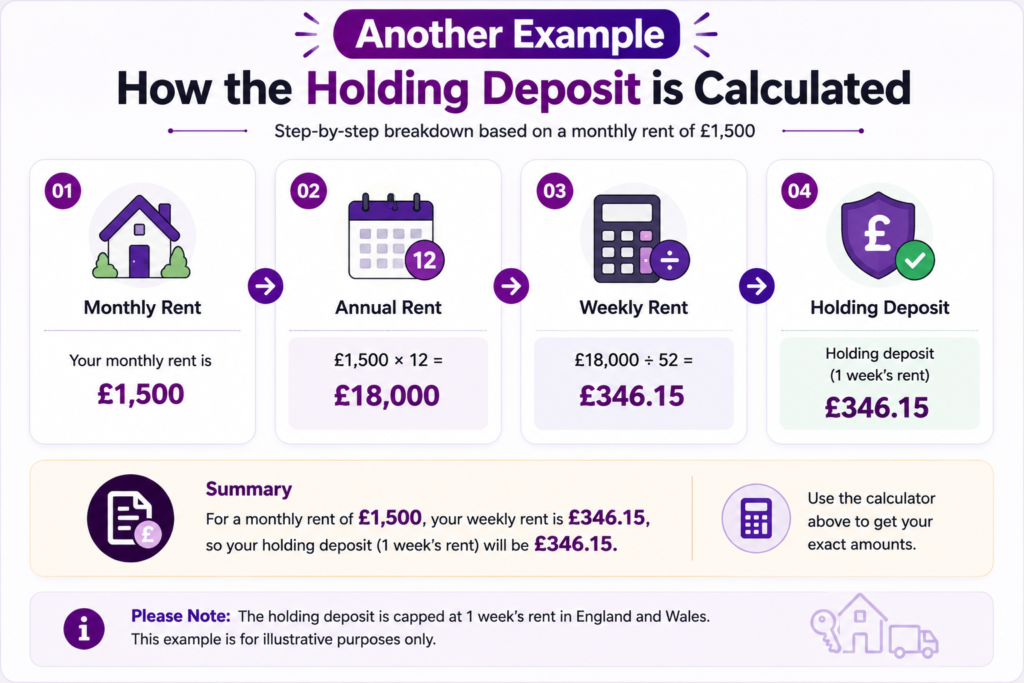
Another Example
Let’s say your monthly rent is £1,500.
Annual Rent
£1,500 × 12 = £18,000
Weekly Rent
£18,000 ÷ 52 = £346.15
Holding Deposit
£346.15
Quick Formula at a Glance
| If You Know | Formula |
| Weekly Rent | Holding Deposit = Weekly Rent |
| Monthly Rent | (Monthly Rent × 12) ÷ 52 |
| Annual Rent | Annual Rent ÷ 52 |
Use Our Holding Deposit Calculator
Instead of calculating everything manually, simply enter your monthly or weekly rent into our Holding Deposit Calculator UK. The calculator instantly applies the correct formula and shows the maximum holding deposit, helping you save time and avoid calculation errors while planning your rental budget.
Read more:£50,000 Salary Rent UK: How Much Rent Can You Really Afford in 2025/26Holding Deposit Calculator Examples
Example 1
Monthly Rent:
£800
Weekly Rent:
(£800 × 12) ÷ 52
= £184.62
Maximum Holding Deposit:
£184.62
Example 2
| Item | Calculation | Result |
|---|---|---|
| Monthly Rent | — | £950 |
| Annual Rent | £950 × 12 | £11,400 |
| Weekly Rent | £11,400 ÷ 52 | £219.23 |
| Holding Deposit | Holding Deposit = Weekly Rent | £219.23 |
Example 3
Monthly Rent:
£1,200
Calculation:
1,200 × 12
= 14,400
14,400 ÷ 52
= £276.92
Holding Deposit:
£276.92
Example 4
| Item | Calculation | Result |
|---|---|---|
| Monthly Rent | — | £1,500 |
| Annual Rent | £1,500 × 12 | £18,000 |
| Weekly Rent | £18,000 ÷ 52 | £346.15 |
| Holding Deposit | Holding Deposit = Weekly Rent | £346.15 |
Holding Deposit Table
| Monthly Rent | Weekly Rent | Maximum Holding Deposit |
| £600 | £138.46 | £138.46 |
| £700 | £161.54 | £161.54 |
| £800 | £184.62 | £184.62 |
| £900 | £207.69 | £207.69 |
| £1,000 | £230.77 | £230.77 |
| £1,100 | £253.85 | £253.85 |
| £1,200 | £276.92 | £276.92 |
| £1,300 | £300.00 | £300.00 |
| £1,400 | £323.08 | £323.08 |
| £1,500 | £346.15 | £346.15 |
| £1,800 | £415.38 | £415.38 |
| £2,000 | £461.54 | £461.54 |
| £2,500 | £576.92 | £576.92 |
| £3,000 | £692.31 | £692.31 |
Monthly Rent:
£2,000
Calculation:
2,000 × 12
= 24,000
24,000 ÷ 52
= £461.54
Maximum Holding Deposit:
£461.54
Read more:£40,000 Salary Rent UK: How Much Rent Can You AffordWhat Is the Maximum Holding Deposit Allowed?
For most Assured Shorthold Rental agreements (ASTs) covered by the Renters (Fees Act 2019 in England, Property owners and letting brokers cannot normally charge more than one week’s rent as an initial holding payment. This legal limit was introduced to protect renters from high upfront costs and to ensure that holding initial payments remain fair and reasonable.
Before paying a holding deposit, it’s a good idea to calculate the correct amount yourself. This helps you confirm that the amount requested by the Property owners or letting agent does not exceed the maximum permitted limit for qualified rental agreements.
How Is the Maximum Holding Deposit Calculated?
| Scenario | Formula / Explanation |
|---|---|
| If You Know the Weekly Rent | Maximum Holding Deposit = One Week’s Rent |
| If You Only Know the Monthly Rent | Weekly Rent = (Monthly Rent × 12) ÷ 52 |
| Maximum Holding Deposit | The resulting weekly rent is the maximum holding deposit that can generally be requested. |
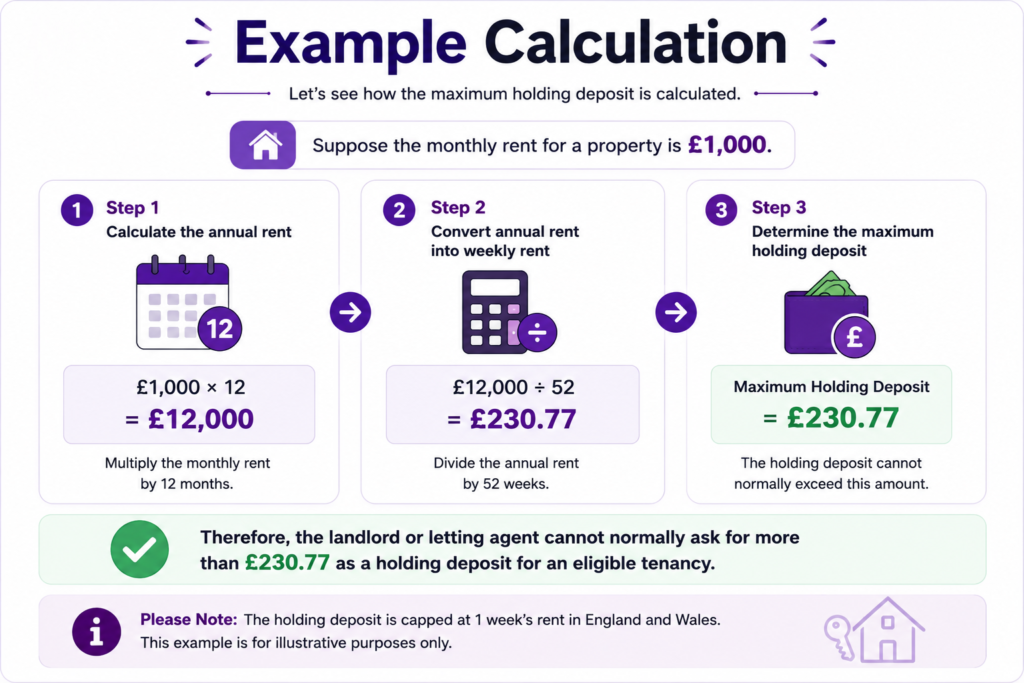
Example Calculation
Suppose the monthly rent for a property is £1,000.
Step 1: Calculate the annual rent
£1,000 × 12 = £12,000
Step 2: Convert annual rent into weekly rent
£12,000 ÷ 52 = £230.77
Step 3: Determine the maximum holding deposit
Maximum Holding Deposit = £230.77
Therefore, the landlord or letting agent cannot normally ask for more than £230.77 as a holding deposit for an eligible tenancy.
More Examples
| Monthly Rent | Maximum Holding Deposit |
| £800 | £184.62 |
| £1,000 | £230.77 |
| £1,250 | £288.46 |
| £1,500 | £346.15 |
| £2,000 | £461.54 |
Why Does This Limit Exist?
The one-week rent limit helps to:
- Protect renters from paying too much in upfront fees.
- Make renting more reasonably priced and transparent.
- Ensure Property owners and letting brokers charge a fair reservation amount.
- Normalize how holding advance payments are calculated across eligible rental agreements.
Use Our Holding Deposit Calculator
Instead of calculating the amount manually, simply enter your monthly or weekly rent into our Holding Initial Payment Calculator UK. The calculator instantly converts your rent into the correct weekly amount and shows the maximum holding Initial payment, helping you budget confidently before reserving a rental property.
Is a Holding Deposit Refundable?
In many situations, yes.
A holding deposit is generally returned or put towards your first rent payment or tenancy deposit once the rental agreement is completed.
Before paying a holding deposit, ask what will happen to the money if the tenancy does not proceed. The important point is not simply whether the deposit is described as “refundable”, but what conditions apply to the refund and how the payment will be dealt with if either side decides not to continue. Ask the landlord or letting agent to explain the relevant conditions and keep their response in writing. This can make the process much clearer if there is a disagreement later.
When Will You Get Your Holding Deposit Back?
| Situation | What Happens to the Holding Deposit |
|---|---|
| Your tenancy begins | It is deducted from your first month’s rent. |
| Your tenancy begins | It is deducted from your tenancy deposit. |
| The landlord decides not to proceed | The holding deposit is usually returned unless a lawful reason applies. |
When Can a Landlord Keep the Holding Deposit?
A landlord or agent may be entitled to retain the holding deposit in certain circumstances, for example if:
- You decide not to rent the property.
- You provide false or misleading information.
- You fail the Right to Rent checks where applicable.
- You do not take reasonable steps to enter into the rental agreement.
Always read the holding deposit agreement carefully before paying.
What Happens If the Landlord Cancels?
If the landlord decides not to proceed with the tenancy without a lawful reason to retain the holding deposit, it will generally need to be returned.
Does the Holding Deposit Count Towards Rent?
Usually, yes.
Many landlords either:
- Deduct it from your first month’s rent, or
- Deduct it from your tenancy deposit.
For example:
| Item | Calculation | Result |
|---|---|---|
| First Month’s Rent | — | £1,200 |
| Holding Deposit Paid | — | £276.92 |
| Remaining First Rent | £1,200 − £276.92 | £923.08 |
Common Mistakes Tenants Make
When paying a holding payment, it’s important to ignore mistakes that could delay your rental agreement or result in losing your advance payment. Here are some of the most common errors renters make:
Paying Without Getting a Written Receipt
Always ask for a Statement or written Approval after paying your holding payment. It should state directly the amount paid, the date of payment, the property address, and the name of the property owner or letting broker. Keeping this record can help resolve any Arguments later.
Not Reading the Holding Deposit Agreement
Before making any payment, carefully read the holding advance payment agreement. Make sure you understand the terms, including how the advance payment will be used, the conditions under which it may be paid back, and any Time limits or conditions you must meet.
| Mistake | Explanation |
|---|---|
| Assuming Every Holding Deposit Is Automatically Refundable | Many renter believe they will l always receive their holding deposit back if the tenancy does not go ahead. In reality, there are situations where the property owner or letting broker may legally keep the advance payment, such as if the renter provides false information or decides to remove themselves from the application without a Reasonable reason. |
| Providing Incorrect or Incomplete Information | Be honest and accurate when completing reference forms or supplying documents. Incorrect details about your income, job, identity, or rental records can delay the application process and, in some cases, impact your Right to a refund. |
| Missing Referencing or Documentation Deadlines | Property owners and letting brokers often set time limits for submitting identification, proof of income, bank statements, or other required documents. Missing these time limits may delay the rental agreement process and could affect your holding advance payment, depending on the agreement. |
Confusing a holding advance payment with a rental agreement advance payment
A holding advance payment reserves the property before the rental agreement begins, while a rental agreement advance payment is paid after the rental agreement is signed to cover Possible damages or unpaid rent. Understanding the difference helps you plan your moving costs more successfully.
Failing to Budget for Other Upfront Costs
A holding advance payment is only one part of the total amount you’ll need when renting a property. You may also need to pay the first month’s rent, a rental agreement advance payment, and moving expenses. Planning your finances can help make the moving process much smoother.
A useful way to plan is to create a simple move-in budget before agreeing to a property. Start with the first month’s rent and tenancy deposit, then add any holding deposit that you may need to pay before the tenancy begins, along with moving expenses and essential household costs. Also remember that a holding deposit is not an extra permanent charge in the same way as rent; where it is credited towards another payment, you should account for that when working out how much money you need overall. Planning the full amount in advance can help you avoid committing to a property that stretches your available cash too far.
Read more:£35,000 Salary Rent UK – How Much Rent Can You AffordBenefits of Using Our Holding Deposit Calculator UK
Our Holding Initial Payment Calculator UK is designed to make the rental process simpler and help you understand exactly how much you may need to pay when reserving a property. In place of spending time calculating weekly rent personally, you can get an accurate calculation in seconds.
Instant and Accurate Calculations
Simply enter your monthly rent, and the calculator will instantly work out the maximum holding Initial Payment based on the one-week rent formula. This saves time and reduces the risk of calculation errors.
No Manual Maths Required
Converting monthly rent into weekly rent can be confusing, particularly if you are unfamiliar with the formula. Our calculator does all the calculations for you immediately, so you don’t need to use a calculator or worksheet.
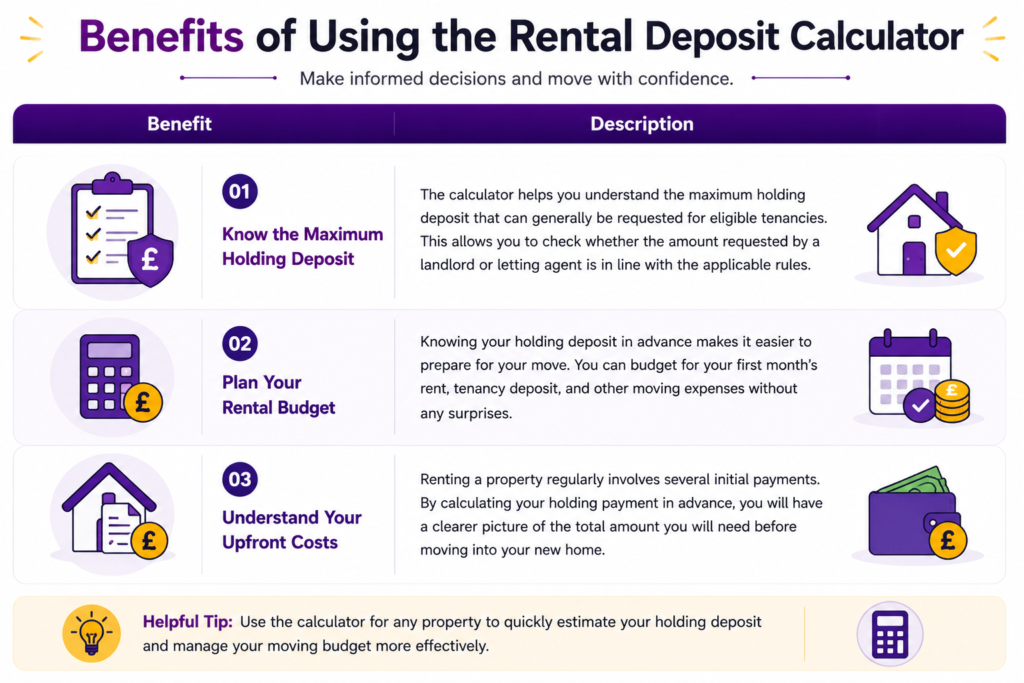
| Benefit | Description |
|---|---|
| Know the Maximum Holding Deposit | The calculator helps you understand the maximum holding deposit that can generally be requested for eligible tenancies. This allows you to check whether the amount requested by a landlord or letting agent is in line with the applicable rules. |
| Plan Your Rental Budget | Knowing your holding deposit in advance makes it easier to prepare for your move. You can budget for your first month’s rent, tenancy deposit, and other moving expenses without any surprises. |
| Understand Your Upfront Costs | Renting a property regularly involves several initial payments. By calculating your holding payment in advance, you will have a clearer picture of the total amount you will need before moving into your new home. |
Compare Different Rental Properties
If you are considering multiple properties with different rental prices, the calculator lets you quickly compare how much holding payment each property may require. This can help you choose an option that fits your financial plan.
Save Time During Your Property Search
Instead of calculating the holding deposit for every property manually, you can get instant results with just a few clicks. This makes comparing rental options faster and more convenient.
Easy to Use on Any Device
If you are searching for a property on your Personal computer, Touchscreen device, or smartphone, the calculator is simple to use and provides quick results anywhere you are.
Read more:Rent-to-Income Percentage UK – Ideal Rent Ratio ExplainedBefore paying a holding deposit, check these points:
- Confirm the property’s full address and advertised rent.
- Check how much holding deposit is being requested.
- Ask when the tenancy is expected to start.
- Confirm what happens to the holding deposit if the tenancy proceeds.
- Check any deadline for completing referencing or providing information.
- Keep a receipt or written confirmation of your payment.
- Keep copies of important messages and documents relating to the application.
- Make sure you have budgeted for the tenancy deposit, first rent payment, moving costs, and other immediate expenses.
- Do not send money until you understand who is receiving it and what the payment is for.
Taking a few minutes to check these details can make the rental process easier and give you a clearer record of what was agreed before you commit to the property
What is a holding deposit?
A payment made to reserve a rental property while the landlord completes referencing and prepares the tenancy.
How is a holding deposit calculated?
Using the formula:
Monthly Rent × 12 ÷ 52
The result is the maximum holding deposit.
Is the holding deposit the same as a security deposit?
No.
A holding deposit reserves the property before the tenancy begins, while a tenancy deposit protects the landlord during the tenancy.
Can a landlord charge more than one week’s rent?
For tenancies covered by the relevant tenancy fee rules in England, the holding deposit is generally capped at one week’s rent.
Will I lose my holding deposit if I change my mind?
Possibly. If you withdraw from the tenancy without a lawful reason, the landlord may be able to retain the holding deposit in certain circumstances
Does the holding deposit reduce my first rent payment?
Usually, yes. Many landlords deduct it from your first month’s rent or from your tenancy deposit.
Can I calculate my holding deposit from monthly rent?
Yes.
Simply multiply your monthly rent by 12 and divide by 52.
Can I negotiate the holding deposit amount?
In some cases, you may be able to discuss the amount with the landlord or letting agent. However, for eligible tenancies in England, they generally cannot request more than one week’s rent as a holding deposit.
Do I have to pay a holding deposit to rent a property?
Not always. Some landlords or letting agents may choose not to request one. Whether a holding deposit is required depends on the individual property and the landlord’s rental process.
What documents are usually required after paying a holding deposit?
After paying a holding deposit, you may be asked to provide proof of identity, proof of income, employment details, previous landlord references, bank statements, and Right to Rent documentation where applicable.
Final Thoughts
A holding advance payment is often the first payment you’ll make when renting a property in the UK. Understanding how it is calculated helps you financially plan confidently and ensures you’re not asked to pay more than the approved amount where the law applies.
With our Holding Deposit Calculator UK, you can directly work out the maximum holding deposit using your monthly rent. If you’re renting your first apartment, moving to a new city, or comparing properties, knowing the correct amount can help you make informed decisions and avoid surprises during the rental process.