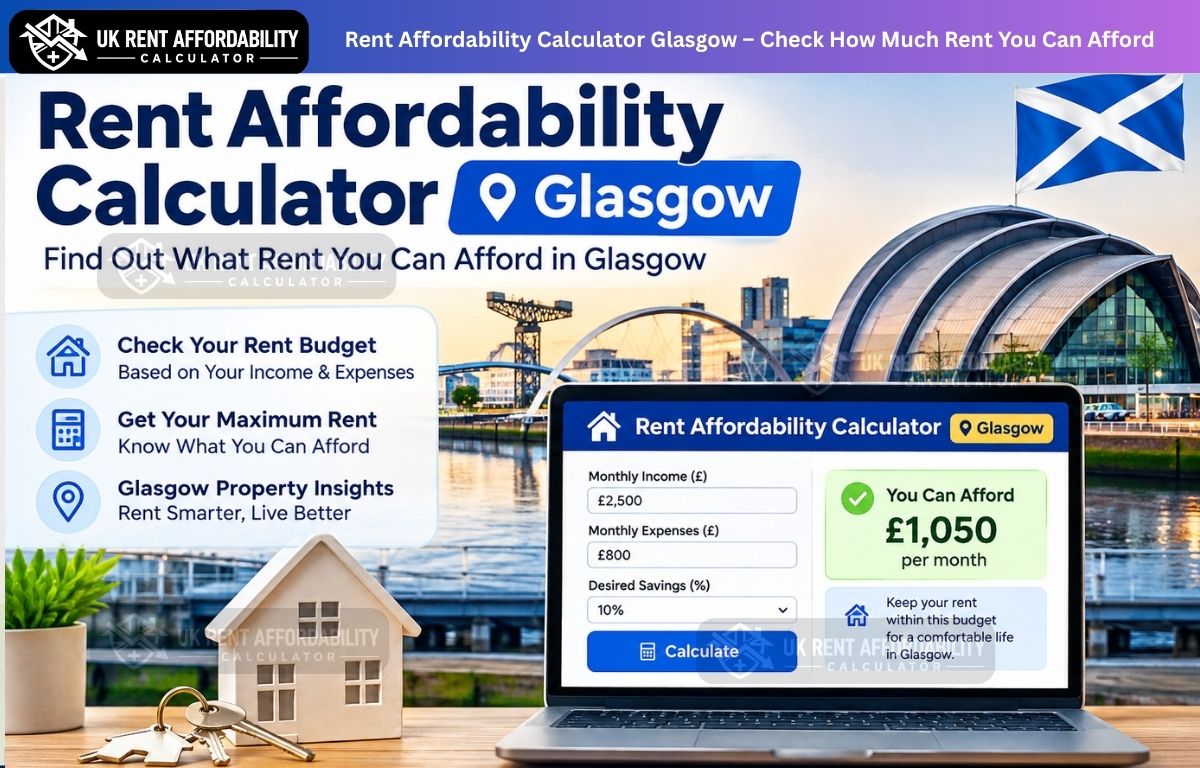
Rent Affordability Calculator Glasgow helps you estimate how much rent fits your budget before you start searching for a new home. Searching for the right rental property in Glasgow is interesting, but it can quickly become stressful if the monthly payment pushes your budget too far. Many renters focus on finding the perfect flat, apartment, or house while ignoring one important question:
Can I actually afford this rent every month?
That’s where a Rent Affordability Calculator Glasgow becomes useful. Instead of relying on guesswork, the calculator estimates how much rent is suitable for your income and helps you avoid financial pressure later.
If you’re a university student moving into your first apartment, a young professional moving for work, a couple searching for a larger home, or a family planning to settle in Glasgow, understanding reasonable rent costs and your rights as a renter under Scotland’s laws before approving a rental agreement can save you from unexpected financial and legal headaches.
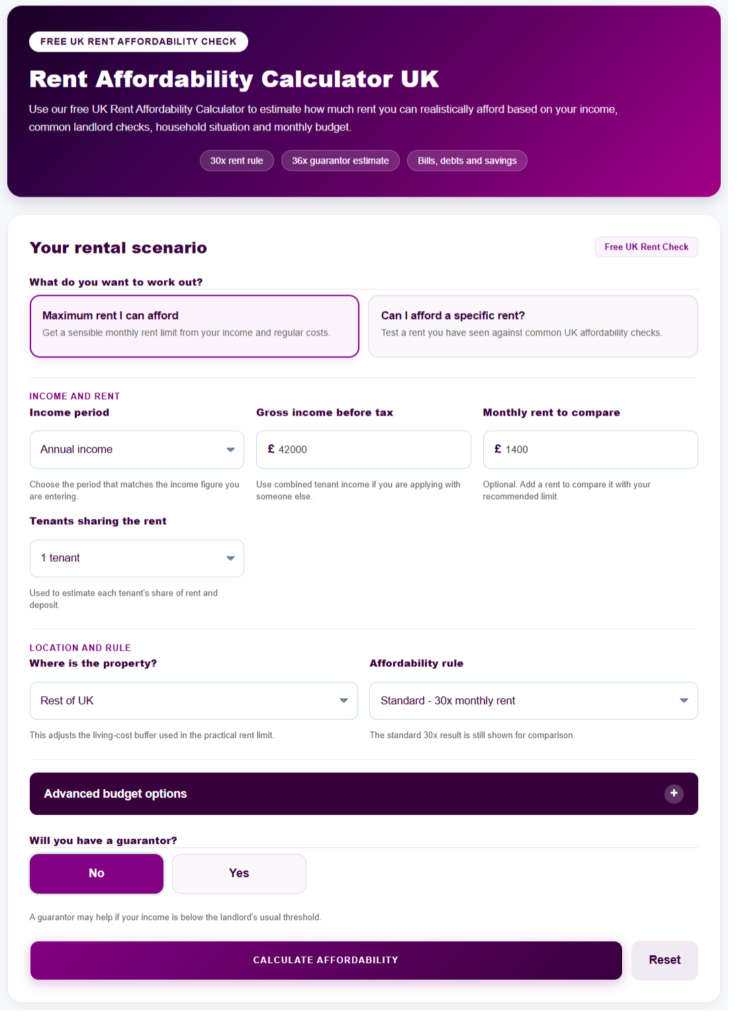
Click Here:Rent Affordability Calculator UK
How to Use the Rent Affordability Calculator UK
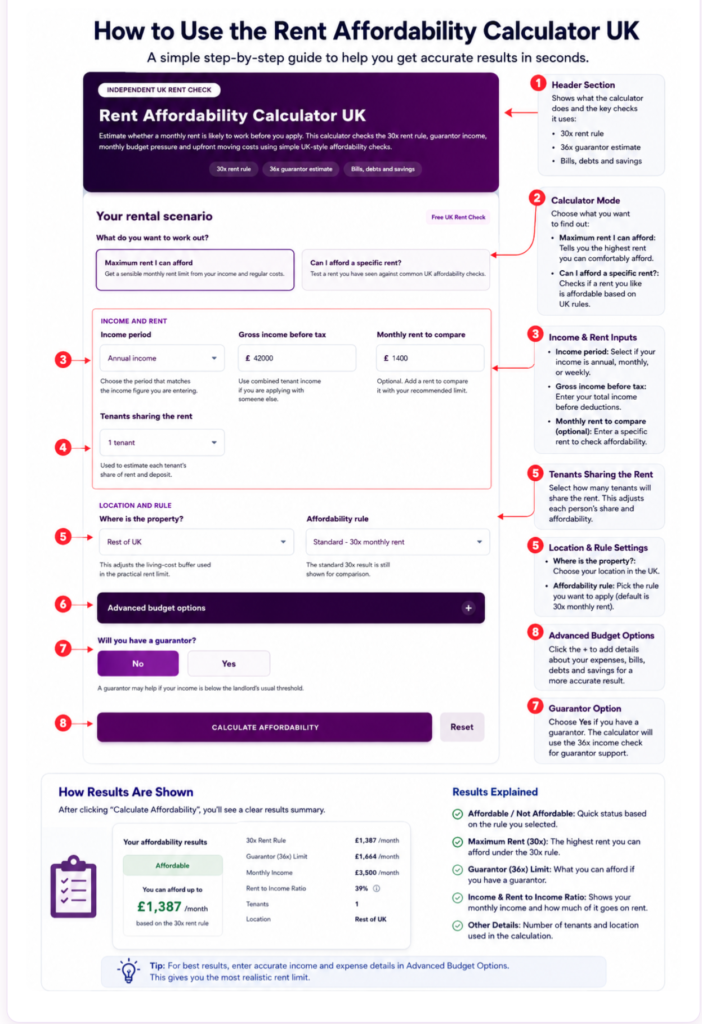
In this guide, you’ll learn:
- What rent affordability means
- How landlords calculate affordability
- How to calculate affordable rent yourself
- Real-life calculation examples
- Common affordability rules
- How Scotland’s tenancy laws affect affordability
- Practical budgeting advice
- Mistakes many renters make
By the end, you’ll know how much rent comfortably fits your income — and where to check the details that a generic calculator can’t tell you.
Read more:University Grade Guide – UK Percentages, GPA and Degree Classes ExplainedWhat Is Rent Affordability?
Rent affordability simply means paying a monthly rent that leaves enough money for all your other living expenses.
| Monthly Expense |
|---|
| Council tax |
| Electricity and gas |
| Internet |
| Water charges |
| Mobile phone |
| Transport |
| Food |
| Insurance |
| Childcare |
| Loan repayments |
| Entertainment |
| Urgent savings |
If your costs use too much of your payment, you may struggle to pay bills or save money for unplanned costs.
A good, reasonable cost calculation helps create a balance between enjoying your home and maintaining financial Balance.
In place of asking:
“Can I pay this month’scost?”
Think about this:
“Can I comfortably pay this cost every month for the Complete rental agreement?”
There is a significant difference.
Don’t Judge a Glasgow Rental by Rent Alone
One of the easiest mistakes when searching for a rental in Glasgow is comparing properties only by their advertised monthly rent. A flat that costs £850 may actually be more expensive to live in than a £900 property if it has higher heating costs, expensive parking, longer commuting costs, or additional household expenses. Before deciding that one property is cheaper, add the rent, council tax, energy, internet, transport, insurance, and other regular costs together. This gives you the true monthly housing cost and makes property comparisons much more realistic.
For example, if Property A costs £850 rent but requires £150 each month in additional travel and energy costs, while Property B costs £900 but only adds £80 in these expenses, Property B may actually cost less overall. A good affordability decision should therefore be based on the complete monthly cost of living, not simply the number shown on the rental listing.
Why Rent Affordability Matters in Glasgow
Glasgow has become one of Scotland’s most attractive cities for renters. Excellent universities, growing job opportunities, Lively areas, and relatively reasonable housing compared with some other UK cities make it a popular choice.
However, rental costs vary significantly depending on the location. A one-bedroom flat in the city centre generally costs much more than a similar property further from central Glasgow, and popular areas regularly command higher rents because of transport links, schools, restaurants, and local Features.
Glasgow City Council has previously designated parts of the city for closer rent monitoring, and rent levels across Scotland are shaped by both market demand and tenancy legislation (more on this below). Without checking affordability — and your legal position as a tenant — first, renters may commit to properties that exceed their financial limits or misunderstand what a landlord can and cannot do once they’ve moved in.
An affordability calculator provides a realistic estimate before you begin property viewings.
What Does a Rent Affordability Calculator Do?
A Rent Affordability Calculator estimates the maximum monthly rent you can reasonably afford based on your income.
| Information Required |
|---|
| Monthly income |
| Annual salary |
| Weekly earnings |
| Household income |
| Other financial commitments |
The calculator then estimates:
- Affordable monthly rent
- Maximum recommended rent
- Rent-to-income percentage
- Whether your chosen rent is affordable
Rather than deciding for you, it gives useful financial guidance.
Read more:Rent Affordability Calculator Liverpool – Calculate Affordable Rent OnlineWho Should Use a Rent Affordability Calculator?
Almost anyone planning to rent in Glasgow can benefit from using one.
| Who Can Benefit? | How the Calculator Helps |
|---|---|
| First-Time Renters | If you’ve never rented before, it can be difficult to estimate what fits your budget. A calculator provides a helpful starting point. |
| Students | Many students receive funding from several sources: student loans, family support, scholarships, and part-time jobs. A calculator helps combine these income sources to estimate affordable rent. |
| Young Professionals | Starting a new job often comes with salary changes. Calculating affordability before signing a lease helps avoid overcommitting. |
| Couples | When renting together, affordability calculations usually consider the combined household income. This provides a more accurate picture of the rent both partners can comfortably manage. |
| Families | Families often have additional expenses including childcare, school costs, groceries, insurance, and transport. Knowing how much of the household income should go toward rent helps maintain financial stability. |
Understanding the Rent-to-Income Ratio
One of the most common ways to measure affordability is the rent-to-income ratio, which compares your monthly rent with your monthly income.
| Formula | Example Calculation |
|---|---|
| Rent-to-Income Ratio = (Monthly Rent ÷ Monthly Income) × 100 | Monthly income: £2,500Monthly rent: £750£750 ÷ £2,500 = 0.300.30 × 100 = 30% |
Many budgeting experts consider around 30% of income spent on rent to be a comfortable benchmark, although the right percentage varies depending on your other expenses and financial goals.
Why Landlords Check Affordability
Many landlords and letting agents assess affordability before approving a rental agreement application. Their goal is to determine whether the candidate is likely to pay rent regularly throughout the rental agreement.
| What Landlords May Review |
|---|
| Annual income |
| Employment status |
| Credit history |
| Existing debts |
| Previous rental history |
| Guarantor availability (if needed) |
| Right to rent / immigration status documentation |
This assessment helps reduce the risk of missed payments while giving tenants confidence that the rent suits their financial situation. In Scotland, most private tenancies are let under a Private Residential Tenancy (PRT), which has no fixed end date and gives tenants specific statutory protections — so it’s worth understanding your affordability position before you commit to what is typically an open-ended agreement, not a fixed short lease.
How Rent Affordability Is Calculated
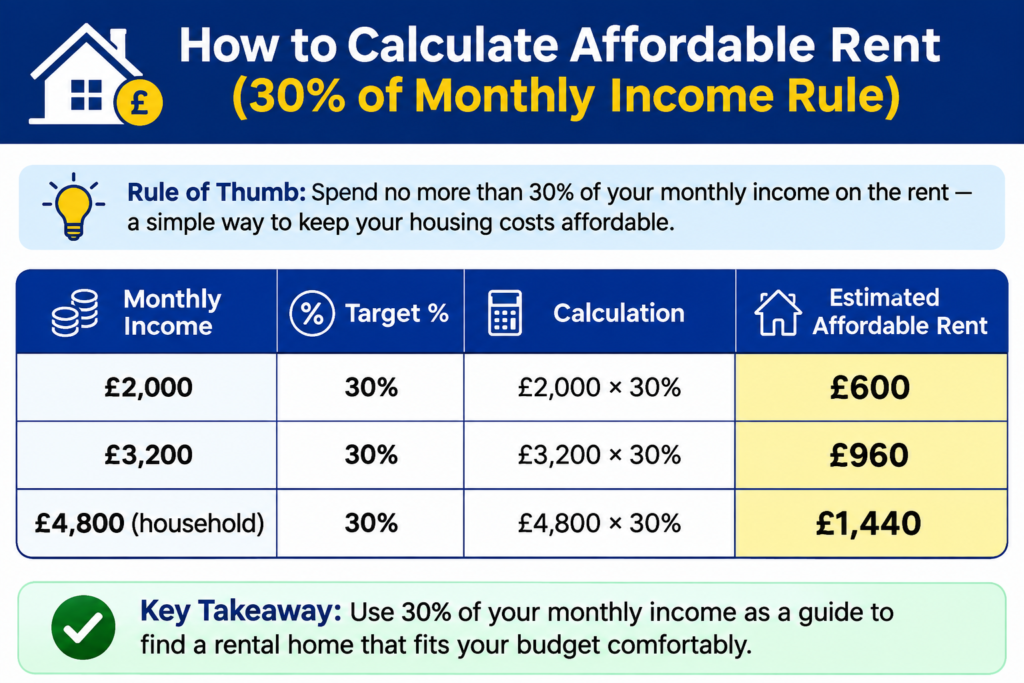
Although different calculators and letting agents may use slightly different methods, the basic idea is the same: compare your income with the proposed rent using a target rent percentage (commonly 30%).
| Monthly Income | Target % | Calculation | Estimated Affordable Rent |
| £2,000 | 30% | £2,000 × 30% | £600 |
| £3,200 | 30% | £3,200 × 30% | £960 |
| £4,800 (household) | 30% | £4,800 × 30% | £1,440 |
Converting Income Into a Monthly Figure
Some people know their annual salary or weekly Salary but not their monthly income. Converting between them is Simple:
| From | Formula | Example | Result |
| Annual salary → Monthly | Annual Salary ÷ 12 | £36,000 ÷ 12 | £3,000/month |
| Weekly income → Monthly | (Weekly Income × 52) ÷ 12 | (£550 × 52) ÷ 12 | £2,383.33/month |
Once you have a monthly figure, apply the same 30% guideline: £3,000 × 30% = £900 recommended rent; £2,383.33 × 30% = approximately £715.
Rent Affordability and Your Rights as a Tenant in Scotland
A calculator can tell you what you can afford today — but Scottish tenancy law affects what you might be asked to pay over time, and it’s a factor renters in Glasgow often overlook.
| Scottish Rental Rules | Details |
|---|---|
| Rent Increases | Rent increases are limited to once every 12 months under a Private Residential Tenancy, and your landlord must give at least 3 months’ written notice using the correct form. |
| Challenging a Rent Increase | You can challenge a rent increase you believe is above the open market rate by applying to Rent Service Scotland for an independent determination, free of charge. |
| Tenancy Deposits | Tenancy deposits must be protected in one of Scotland’s three approved deposit schemes within 30 working days of receiving it. |
| Landlord & Letting Agent Registration | Letting agents must be registered with the Scottish Letting Agent Register, and landlords must be registered with their local council. |
Factoring in the possibility of a future rent increase — rather than only today’s affordability — is a more realistic way to plan a long-term tenancy. For the current rules, Citizens Advice Scotland and mygov.scot publish up-to-date guidance on rent increases, deposits, and tenant rights.
Read more: Ultimate 30x Rent Rule UK Guide – What It Means and How Letting Agents Calculate AffordabilityWhy Spending Too Much on Rent Can Be Risky
| Possible Consequences of Choosing an Unaffordable Property |
|---|
| Difficulty paying monthly bills |
| Reduced savings |
| Increased reliance on credit cards |
| Limited emergency funds |
| Financial stress if your income changes |
| Less flexibility for unexpected expenses |
A home should provide comfort — not constant financial pressure. Planning your budget carefully before signing a tenancy agreement can help you enjoy your new home with greater peace of mind.
Average Rent Prices Across Glasgow
A common error renters make is supposing every area in Glasgow has similar rental payments. In fact, monthly payments can vary greatly depending on the area, property type, and local requirements.
An apartment near the city centre or a major university will normally cost more than a similar property in an outer Housing area. In the same way, newly restored apartments regularly command higher payments than older properties.
The table below gives a general idea of typical monthly cost ranges based on recent recording patterns across the city. Actual cost will vary depending on the property’s size, condition, and location; always check current recording or Rent Service Scotland data for the most accurate local number.
| Area | 1 Bedroom | 2 Bedrooms | 3 Bedrooms |
| Glasgow City Centre | £900–£1,300 | £1,200–£1,700 | £1,700+ |
| Finnieston | £900–£1,250 | £1,200–£1,600 | £1,600+ |
| West End | £850–£1,250 | £1,150–£1,600 | £1,600+ |
| Shawlands | £700–£950 | £900–£1,250 | £1,300–£1,700 |
| Dennistoun | £700–£950 | £900–£1,200 | £1,200–£1,600 |
| Partick | £800–£1,100 | £1,050–£1,450 | £1,500+ |
| Bearsden | £900–£1,300 | £1,200–£1,700 | £1,700+ |
Tip: Use these figures as a guide rather than a guarantee. Rental markets change over time, and prices can fluctuate depending on demand.
Consider Location as Part of Rent Affordability
A cheaper rental is not always the cheaper option if it significantly increases your daily travel costs. When comparing Glasgow properties, consider how far the property is from your workplace, university, childcare, shops, and regular transport connections. A property that saves £100 in rent but adds £140 in monthly transport costs is not actually saving you money.
Before choosing between two homes, estimate the complete monthly travel cost for each one. Also consider the time involved. A slightly more expensive property close to work or a reliable public transport route may provide better overall value because it can reduce both travel spending and commuting time. Affordability should therefore include the cost of reaching the places you regularly need to visit.
The 30% Budgeting Guideline
A commonly used budgeting approach suggests keeping rent around 30% of your monthly income. This isn’t a legal rule, but it’s a practical Standard that leaves room for other essential expenses like food, transport, savings, and household payments.
Example: Monthly income £2,400. 30% of income: £2,400 × 30% = £720 affordable monthly rent.
If you choose a property costing £1,000 per month instead, your rent would account for over 40% of your income, leaving less money for everything else.
Use a Comfortable Rent Limit, Not Just a Maximum Rent
Your calculator may show the highest rent that appears affordable, but that does not necessarily mean you should spend that full amount. A better approach is to create two limits: a maximum rent and a comfortable rent. The maximum is the highest amount you could potentially manage, while the comfortable figure leaves enough room for savings, unexpected bills, and changes in your income.
For example, if your monthly take-home income is £2,800 and your calculations suggest that £900 is affordable, you might choose a property around £800–£850 instead. The difference may seem small, but £50–£100 saved each month can become £600–£1,200 over a year. This extra space in your budget can be particularly useful if energy costs rise, your working hours change, or an unexpected expense appears
Gross Income vs Net Income
When calculating affordability, it’s important to understand the difference between gross income and net income.
| Income Type | Description | Example |
|---|---|---|
| Gross Income | Gross Income is your income before tax and other deductions. | Annual salary £36,000 → gross monthly income £3,000. |
| Net Income | Net Income is the amount you actually receive after deductions such as income tax, National Insurance, pension contributions, and other payroll deductions. | Gross salary £3,000 → take-home pay £2,350. |
If you’re budgeting for everyday living, your net income often provides a more realistic picture of what you can comfortably afford. If part of your income comes from Universal Credit’s housing element, base your calculation on what you actually receive after any deductions or the benefit cap, not the headline entitlement figure.
Monthly Budget Example
Let’s look at a realistic monthly budget for someone renting in Glasgow, on a monthly income of £2,600.
| Expense | Monthly Cost |
| Rent | £780 |
| Council Tax | £150 |
| Gas & Electricity | £130 |
| Internet | £35 |
| Mobile Phone | £25 |
| Transport | £120 |
| Groceries | £280 |
| Entertainment | £150 |
| Savings | £300 |
| Miscellaneous | £180 |
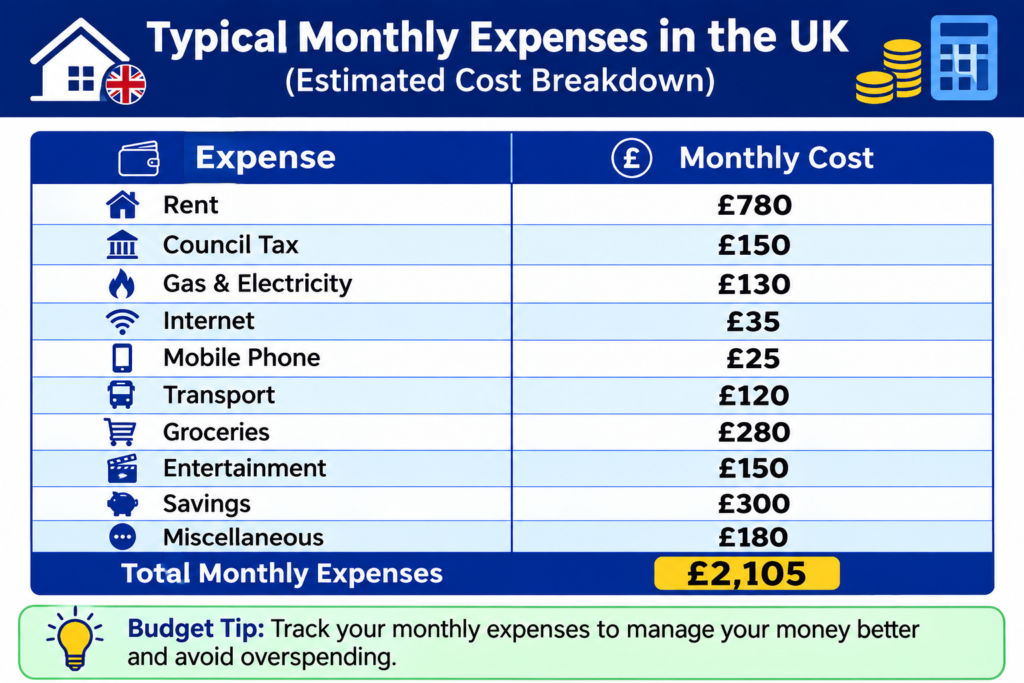
Total Expenses: £2,150 | Money Remaining: £450
This remaining amount can provide flexibility for emergencies, holidays, home furnishings, or unexpected bills.
Signs a Property May Be Outside Your Budget
Before signing a tenancy agreement, think about this:
Will I even now be able to save money each month?
- Can I comfortably pay my household bills?
- Do I have emergency savings?
- Could I manage if an unplanned expense arises?
- Would a temporary drop in income put my rental agreement at risk?
- Could I even now manage the rent if it increased at the next annual review?
If the answer to several of these questions is “no,” it may be worth taking into account a property with a lower monthly rent.
Affordability for Self-Employed Applicants
If you’re self-employed, your monthly income may fluctuate. Instead of using your highest-earning month, calculate an average.
| Calculation Step | Details |
|---|---|
| Monthly Profits (6 Months) | £2,900, £3,100, £2,700, £3,300, £2,800, £3,200 |
| Average Income Calculation | (£2,900 + £3,100 + £2,700 + £3,300 + £2,800 + £3,200) ÷ 6 = £3,000 |
| Affordable Rent Calculation | £3,000 × 30% = £900 |
| Affordable Rent | £900 per month |
Using an average income provides a more stable estimate, especially when earnings vary throughout the year. Many letting agents will ask self-employed applicants for 2–3 years of accounts or an accountant’s reference, so it’s worth having this documentation ready alongside your calculation.
What Is a Guarantor?
Sometimes a landlord may ask for a guarantor if they believe there is additional financial risk. This may happen if:
- You have limited rental history
- You are a student
- You recently started a new job
- You are self-employed with variable income
- Your income doesn’t fully meet the landlord’s affordability requirements
A guarantor agrees to cover rent payments if the tenant is unable to do so. In Scotland, a guarantor’s obligations should be set out clearly in a separate guarantee agreement — it’s worth reading this carefully, as guarantor liability can sometimes extend for the full length of an open-ended PRT unless the agreement states otherwise. Having a guarantor can strengthen a rental application, but it is still important to choose a property that fits your own budget.
Affordability for Students
Students regularly have different sources of payment, such as a, family support, scholarships, and part-time work.
Example:
| Income Source | Monthly Amount |
| Student loan | £700 |
| Part-time work | £500 |
| Family contribution | £400 |
| Total monthly income | £1,600 |
Estimated affordable rent: £1,600 × 30% = £480
Many students choose shared accommodation to keep housing costs lower and reduce utility bills. If you’re a full-time student, you’re generally exempt from Council Tax, but check your exemption status directly with Glasgow City Council if you live with anyone who isn’t a student, as this can affect the bill.
Read more:Rent vs Buy Calculator UK – Should You Rent or Buy a Home?Shared Accommodation vs Private Apartment
| Housing Expenses | Option 1 – Private Apartment | Option 2 – Shared House |
| Rent | £950 | £650 |
| Utilities | £180 | Included |
| Internet | £35 | Included |
| Total housing cost | £1,165 | £650 |
Monthly savings: £1,165 − £650 = £515
For many students and young professionals, sharing accommodation can make living in a desirable area much more affordable.
Emergency Savings Matter
Even if you can manage the monthly rent, in technical terms, it’s wise to maintain an emergency fund for unexpected expenses like car repairs, medical costs, job changes, household repairs, or travel emergencies.
Example: Monthly income £2,700, monthly cost £810, monthly savings £250. After one year: £250 × 12 = £3,000 saved.
Building savings alongside paying rent can improve your financial security.
How to Improve Your Rent Affordability
If your preferred property is slightly beyond your budget, consider ways to strengthen your financial position before applying:
| Ways to Improve Rent Affordability |
|---|
| Increase your savings — a larger advance payment and emergency fund make your finances stronger. |
| Reduce existing debt — paying off a high-interest loan frees up money for housing costs. |
| Consider a different area — areas with slightly lower rents may regularly offer good transport links, schools, and Services. |
| Share Property — living with a roommate can greatly reduce rent and household expenses. |
| Increase your earnings — through extra work hours, freelance projects, part-time work, or new skills for higher-paying roles. |
Comparing Different Rent Levels
| Monthly Income | Rent | Rent Percentage |
| £2,000 | £500 | 25% |
| £2,000 | £600 | 30% |
| £2,000 | £800 | 40% |
| £2,500 | £625 | 25% |
| £2,500 | £750 | 30% |
| £2,500 | £1,000 | 40% |
| £3,500 | £875 | 25% |
| £3,500 | £1,050 | 30% |
| £3,500 | £1,400 | 40% |
This table shows how the same percentage guideline scales with different income levels.
Common Budgeting Mistakes
Ignore these common mistakes when planning your rental budget:
- Focusing only on the monthly rent and ignoring household bills
- Forgetting about council tax or transport costs
- Assuming overtime or bonuses will always be available
- Choosing a property based on your highest-earning month instead of your average income
- Leaving no room for savings or unplanned expenses cost
- Taking on rent that limits your ability to manage other essential living costs
- Not accounting for a possible rent increase at the annual review point
Practical Example: Choosing Between Two Properties
Michael earns £3,000 per month. Using the 30% guideline: £3,000 × 30% = £900.
He has two options:
| Property | Rent | Other Factors |
|---|---|---|
| Property A | £880 | 15-minute walk to work, lower travel costs. |
| Property B | £820 | Longer commute, higher monthly transport expenses. |
Although Property B has a lower advertised rent, the additional commuting costs could reduce the savings. Looking at the overall monthly budget, rather than cost alone, helps identify the more cost-effective option.
How to Use a Rent Affordability Calculator Effectively
A rent affordability calculator is most useful when you enter accurate financial information. Guessing your income or leaving out important expenses can produce unrealistic results.
Before using the calculator, gather:
- Your monthly or annual income
- Income from all household members (if applicable)
- Regular monthly expenses
- Loan or finance repayments
- Estimated utility costs
- Savings goals
- Transport expenses
The more accurate your information, the more useful the affordability estimate will be.
Try the Three-Month Affordability Test
If you are unsure whether a particular rent is comfortable, look at your spending over the previous three months rather than relying on one month’s figures. Add your normal income and regular expenses, then include occasional costs such as clothing, travel, repairs, subscriptions, gifts, and annual payments. This can reveal expenses that are easy to forget when creating a simple monthly budget.
A useful test is to ask yourself whether you could still comfortably pay the proposed rent during a more expensive month. If your budget only works when nothing unexpected happens, the property may be too expensive for your circumstances. A sustainable rental budget should work during ordinary months, not only during your best financial month.
Create a Complete Monthly Budget
Don’t stop after calculating affordable rent. Build a full monthly budget so you understand where your money goes.
| Category | Monthly Amount |
| Monthly Income | £3,000 |
| Rent | £900 |
| Council Tax | £150 |
| Gas & Electricity | £140 |
| Water | £35 |
| Internet | £35 |
| Mobile Phone | £30 |
| Groceries | £300 |
| Transport | £150 |
| Insurance | £40 |
| Entertainment | £150 |
| Savings | £400 |
| Miscellaneous | £170 |
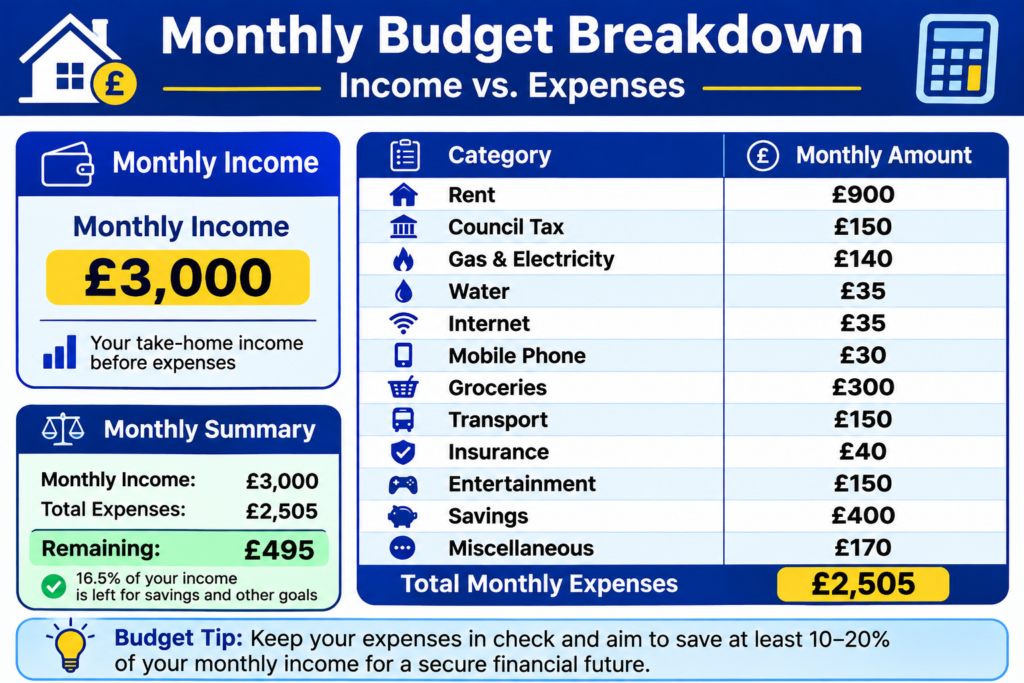
This type of budget makes it easier to see whether your rent leaves enough room for essential expenses and future savings.
Tips for Staying Financially Comfortable
Even after moving into your new home, good financial habits can make renting much easier.
Track your spending — record your monthly expenses to identify areas where you may be overspending.
Review your budget regularly — income and expenses can change over time. Reassessing your budget every few months helps you stay on track.
Build an emergency fund — saving a portion of your income each month provides additional financial security.
Avoid spending every pound you earn — if your calculator says you can afford £1,000 per month, consider choosing a property closer to £900 if it still meets your needs.
Compare several properties — instead of applying for the first available home, compare rent, location, transport links, utility costs, property condition, and local amenities.
Real-Life Scenario: Planning Ahead
Rebecca earns £3,400 per month. The calculator suggests she could afford approximately £3,400 × 30% = £1,020.
She finds two apartments:
| Apartment | Rent | Other Factors |
|---|---|---|
| Apartment A | £995 | Recently renovated, close to work. |
| Apartment B | £890 | Slightly older property, 20-minute longer commute. |
Rebecca calculates that Apartment A would save her around £90 each month in transport costs and reduce commuting time significantly. Even though the cost is higher, the total monthly cost is similar, making Apartment A the better choice for her requirements.
This example shows why reasonable cost should consider overall living costs, not just rent.
1. What is a Rent Affordability Calculator Glasgow?
It is a budgeting tool that estimates how much monthly rent may be suitable based on your income and financial situation. It helps you understand whether a property fits your budget before you apply.
2. How much of my income should go towards rent?
Many budgeting guides use 30% of monthly income as a practical benchmark. However, the ideal percentage depends on your personal expenses, savings goals, and financial commitments.
3. Should I calculate affordability using gross or net income?
Some affordability checks use gross income, while personal budgeting is often easier with net (take-home) income because it reflects the money available after deductions.
4. Can I rent a property if I spend more than 30% of my income on rent?
Yes, some people choose to spend a higher percentage on housing. However, it’s important to ensure you can still comfortably cover your other living costs and maintain savings.
5. Can couples use a rent affordability calculator together?
Yes. Couples or joint applicants can usually estimate affordability using their combined household income, provided both incomes contribute to the rent.
6. Can students use this calculator?
Absolutely. Students can include income from student funding, part-time work, scholarships, and regular family support when estimating their housing budget.
7. What other costs should I budget for besides rent?
Council Tax, gas and electricity, internet, water charges (where applicable), mobile phone, contents insurance, groceries, transport, parking, and household essentials. Considering these alongside rent gives a more realistic view of affordability.
8. Does a higher salary always mean I should choose a more expensive property?
Not necessarily. Selecting a home below your maximum budget can leave more money available for savings, investments, travel, or unexpected expenses.
9. How often can my landlord increase the rent in Scotland?
Under a Private Residential Tenancy, a landlord can generally only increase the rent once every 12 months and must give at least 3 months’ written notice. If you think an increase is unreasonable, you can apply to Rent Service Scotland for an independent rent determination at no cost.
10. Is the calculator’s result guaranteed?
No. A rent affordability calculator provides an estimate to support your budgeting. Individual landlords and letting agents may assess affordability using different criteria and may also consider employment status, rental history, or other financial information.
11. Can improving my finances increase my affordability?
Yes. Reducing debt, increasing savings, maintaining stable income, and managing monthly expenses can improve your overall financial position and make a wider range of rental properties affordable.
12. Why should I calculate affordability before viewing properties?
Knowing your budget in advance helps you focus on homes that match your finances, reducing the risk of disappointment and making your property search more efficient.
Key Takeaways
- Rent affordability is about balancing housing costs with your overall financial wellbeing.
- A calculator provides a helpful starting point, but your personal budget — and your tenancy rights — are equally important.
- Include all regular expenses, not just rent, when deciding what you can comfortably manage.
- Choosing a property within your means can reduce financial pressure and provide greater flexibility for savings and unexpected costs.
- Know the rules on rent increases and deposit protection in Scotland so today’s affordable rent doesn’t become tomorrow’s financial strain.
- Reviewing your finances regularly helps ensure your housing costs remain manageable over time.
Final Thoughts
Finding the right rental home in Glasgow isn’t simply about choosing the nice property — it’s about selecting one that matches your lifestyle and long-term financial plans.
A Rent Affordability Calculator Glasgow can help you estimate a practical rental budget, compare options, and make informed decisions before signing a rental agreement. While no calculator can account for every individual Condition, combining its results with a careful financial plan and a basic understanding of your rights as a renter in Scotland gives you a clearer picture of what you can comfortably afford.
Whether you are living in a rental home, moving for work, or searching for a family home, taking time to review reasonable costs can help you avoid unnecessary financial pressure and feel more confident in your rental agreement.
By planning and keeping your housing costs in line with your financial plan, you will be better prepared to find a home that supports both your current needs and your future financial aims.