

Illegal eviction UK often starts like this: you come home from work, put your key in the lock, and it doesn’t turn. There’s a note taped to the door: your landlord has changed the locks, and you need to “come back never”. Your bags, your work uniform for tomorrow, your child’s school bag — all inside. Panic sets in, then the question that matters: is this even legal?
Almost always, no. If you rent your home in the UK, your landlord cannot lock you out, dump your belongings on the street, or cut off your heating to force you out. The law gives them exactly one lawful route to evict you — and changing the locks isn’t part of it. Skip that route, and they’re committing a criminal offence under illegal eviction UK law; since May 2026, councils can also fine them up to £40,000.
Quick Answer: An illegal eviction happens when your landlord forces you out of your rented home without following the legal process — for example, changing the locks, removing your belongings, cutting off utilities, or threatening you into leaving. Only a court order, enforced by court bailiffs (or sheriff officers in Scotland), can lawfully remove you. Illegal eviction is a criminal offence punishable by up to 2 years in prison, and councils in England can now impose fines of up to £40,000. If it happens to you: document everything, call the police, contact your council’s tenancy relations team, and ask the court for an injunction to get back in.
Illegal Eviction UK: What It Is and Why It’s a Crime
Illegal eviction UK — also called unlawful eviction — is any attempt by a landlord (or someone acting for them, like a letting agent) to force you out of your home without using the proper legal process. Your tenancy gives you a legal right to occupy your home. That right doesn’t evaporate because your landlord is angry, because you’re behind on rent, or because they want to sell up.
The core principle is simple: a notice is not an eviction. Even a valid eviction notice doesn’t end your right to stay. If you don’t leave, your landlord must go to court, win a possession order, and have it enforced by court-appointed bailiffs. Anything short of that — done by the landlord’s own hand — is illegal. That’s the whole point of illegal eviction UK law: a notice is never an eviction.
This matters more than ever since 1 May 2026, when section 21 “no-fault” evictions were abolished in England: landlords must now prove a genuine legal ground. That makes DIY evictions more tempting for frustrated landlords — and recognising them more important for you.
Key point: Being behind on rent, having a fixed term that has ended, or receiving any kind of notice does not give your landlord the right to lock you out. Rent arrears must be dealt with through the courts — never by changing the locks.
Illegal Eviction UK: 8 Tactics to Recognise
Illegal eviction UK isn’t always as dramatic as changed locks — sometimes it’s a slow squeeze. Watch for these eight tactics:
- Changing the locks — new locks fitted while you’re at work or away
- Physical removal — you or your belongings forced out by the landlord
- Cutting off utilities — gas, electricity or water disconnected
- Removing belongings — furniture or boxes put outside or thrown away
- Threats and intimidation — “leave by Friday or else”, turning up with friends
- Blocking access — padlocked rooms, barred from the kitchen or bathroom (partial eviction is still eviction)
- Refusing rent — won’t take your rent, then claims you “stopped paying”
- Fake “notices” — a text saying “be out Sunday” with no court involvement
Any one of these, done to push you out without a court order, can be a criminal offence under the Protection from Eviction Act 1977 (England and Wales). The harassment-style tactics — threats, cutting off services, persistent intimidation — are offences under the same Act, and can also be prosecuted under the Protection from Harassment Act 1997. Note the difference: harassment is behaviour designed to make you leave; illegal eviction is actually depriving you of the home; lawful eviction is the full court process working as intended.
If your landlord is turning up uninvited, letting themselves in, or pressuring you at the door, read our guide on whether your landlord can enter without permission — the two issues often overlap.
The Only Lawful Ways Your Landlord Can Get You Out
There are only a handful of lawful routes, and they all end in the same place: a court. Anything else is illegal eviction UK courts will punish, not a shortcut. Here’s how the process must work in England and Wales:
| Step | What happens | Who does it |
|---|---|---|
| 1. Valid notice | Landlord serves a legally valid notice (now a section 8 notice with a genuine ground — section 21 ended 1 May 2026) | Landlord or agent |
| 2. Court claim | If you don’t leave, the landlord applies to the county court for a possession order | County court |
| 3. Possession order | A judge decides whether the ground is proved; you get to put your side | Judge |
| 4. Enforcement | If you still don’t leave, the landlord gets a warrant and bailiffs carry out the eviction | Court-appointed bailiffs |
Notice what is not on this list: the landlord changing the locks, the landlord’s cousin “having a word”, the agent removing your sofa, or anyone disconnecting your boiler. Enforcement is done by officers of the court — in Scotland by sheriff officers acting on a tribunal or court order — and nobody else.
For the full detail on the notice stage, see our Section 8 eviction notice guide. And if you want to leave on your own terms instead, our guide to ending your tenancy explains how to do it properly so you stay in control.
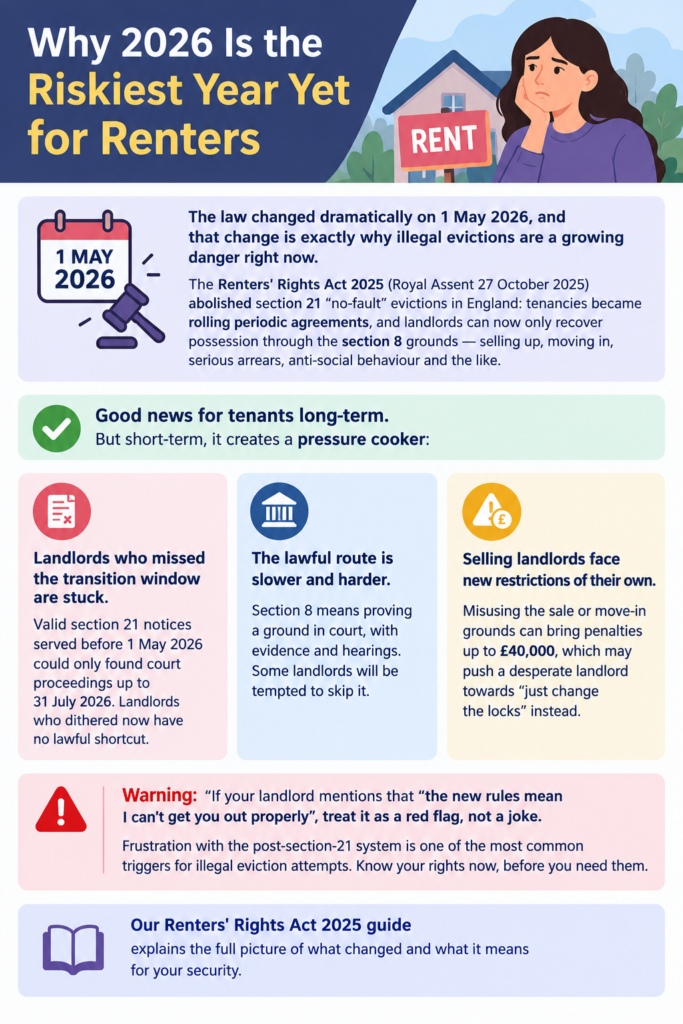
Why 2026 Is the Riskiest Year Yet for Renters
The law changed dramatically on 1 May 2026, and that change is exactly why illegal evictions are a growing danger right now. The Renters’ Rights Act 2025 (Royal Assent 27 October 2025) abolished section 21 “no-fault” evictions in England: tenancies became rolling periodic agreements, and landlords can now only recover possession through the section 8 grounds — selling up, moving in, serious arrears, anti-social behaviour and the like.
Good news for tenants long-term. But short-term, it creates a pressure cooker:
- Landlords who missed the transition window are stuck. Valid section 21 notices served before 1 May 2026 could only found court proceedings up to 31 July 2026. Landlords who dithered now have no lawful shortcut.
- The lawful route is slower and harder. Section 8 means proving a ground in court, with evidence and hearings. Some landlords will be tempted to skip it.
- Selling landlords face new restrictions of their own — misusing the sale or move-in grounds can bring penalties up to £40,000, which may push a desperate landlord towards “just change the locks” instead.
Warning: If your landlord mentions that “the new rules mean I can’t get you out properly”, treat it as a red flag, not a joke. Frustration with the post-section-21 system is one of the most common triggers for illegal eviction attempts. Know your rights now, before you need them.
Our Renters’ Rights Act 2025 guide explains the full picture of what changed and what it means for your security.
What the Law Says: The Protection from Eviction Act 1977
In England and Wales, your shield against illegal eviction UK is the Protection from Eviction Act 1977 — protecting residential occupiers for nearly fifty years:
- Section 1(2) makes it a criminal offence to unlawfully deprive a “residential occupier” of their occupation — or even attempt it. The only defence is proving the landlord genuinely and reasonably believed you’d already moved out.
- Section 1(3) makes it a separate offence to drive you out by other means: interfering with your peace and comfort, or persistently withdrawing services your home needs (heating, hot water, electricity), intending to make you leave or give up your rights.
- Section 1(5) preserves your civil rights — a landlord can face criminal prosecution and your compensation claim at the same time.
“Residential occupier” covers almost everyone who lives in rented accommodation as their home. The main people it does not cover the same way are “excluded occupiers” (more on lodgers below).
Alongside the 1977 Act sits the Protection from Harassment Act 1997: in illegal eviction UK cases, persistent harassment — a course of conduct that alarms or distresses you — is a separate summary offence carrying up to 6 months’ imprisonment and an unlimited fine, and putting someone in fear of violence can mean up to 10 years on indictment.
The Penalties: Prison, Unlimited Fines and the New £40,000 Civil Penalty
Landlords sometimes gamble that the consequences of illegal eviction UK are a slap on the wrist. They are wrong. Here is what an unlawful landlord faces in England and Wales:
| Offence | Court | Maximum penalty |
|---|---|---|
| Unlawful eviction or harassment (Protection from Eviction Act 1977, s.1) | Magistrates’ court (summary) | Unlimited fine and/or up to 6 months’ imprisonment |
| Unlawful eviction or harassment (Protection from Eviction Act 1977, s.1) | Crown Court (on indictment) | Unlimited fine and/or up to 2 years’ imprisonment |
| New: civil penalty for unlawful eviction/harassment (Protection from Eviction Act 1977, s.1A, via Renters’ Rights Act 2025 s.58) | Local council | Up to £40,000 |
| Harassment (Protection from Harassment Act 1997, s.2) | Magistrates’ court | Up to 6 months’ imprisonment and/or unlimited fine |
| Compensation to you (Housing Act 1988, ss.27–28) | County court | Statutory damages — often tens of thousands of pounds |
Three things to note:
- The fines are genuinely unlimited. The 1977 Act still shows an old £400 figure, but section 85 of the Legal Aid, Sentencing and Punishment of Offenders Act 2012 removed magistrates’ court fine caps for offences committed after 12 March 2015 in England and Wales.
- The £40,000 civil penalty is new. From 1 May 2026, English councils can fine a landlord up to £40,000 without a criminal prosecution — they only need to be satisfied “beyond reasonable doubt” it happened.
- No double punishment for the same conduct — prosecution or civil penalty, not both.
Are You Protected? The Lodger Exception
Almost all tenants are fully protected against illegal eviction UK. But there is one important group with weaker rights: excluded occupiers under section 3A of the Protection from Eviction Act 1977.
| Fully protected occupier | Excluded occupier | |
|---|---|---|
| Typical example | Assured tenant renting a whole flat or house | Lodger sharing kitchen/bathroom with a live-in landlord |
| Test | Landlord does not live with you | You share accommodation with the landlord, and it’s their only or principal home (both when you moved in and when asked to leave) |
| Eviction route | Notice + court possession order + bailiffs | Reasonable notice only — no court order needed |
| Can the landlord use force? | Never | Never — force, threats and removing belongings are still offences |
| Harassment protection | Full | Still protected against harassment |
A few critical nuances:
- Sharing only a hallway, stairs or entrance does not make you a lodger — it must be genuine shared living space like a kitchen or bathroom.
- The landlord must really live there as their main home, both when you moved in and when they ask you to leave.
- Even excluded occupiers get reasonable notice (usually a week if you pay weekly, a month if monthly), and a landlord who grabs your bags, shoves you out or threatens you is still breaking the law.
Fictional example — Javed, Birmingham: Javed, 29, rents a room in his landlord’s house, sharing the kitchen and bathroom. The landlord gives him two weeks’ written notice to make room for his brother — lawful, since Javed is an excluded occupier who can be asked to leave on reasonable notice without a court order. But on day five the landlord throws Javed’s suitcases into the garden and changes the bedroom lock. That is not lawful — force and seizing belongings cross into harassment and criminal damage territory, and Javed can report it to the police and council.
If you’re unsure which category you fall into, check your paperwork — our tenancy agreement guide explains how to identify your tenancy type and what rights attach to it.
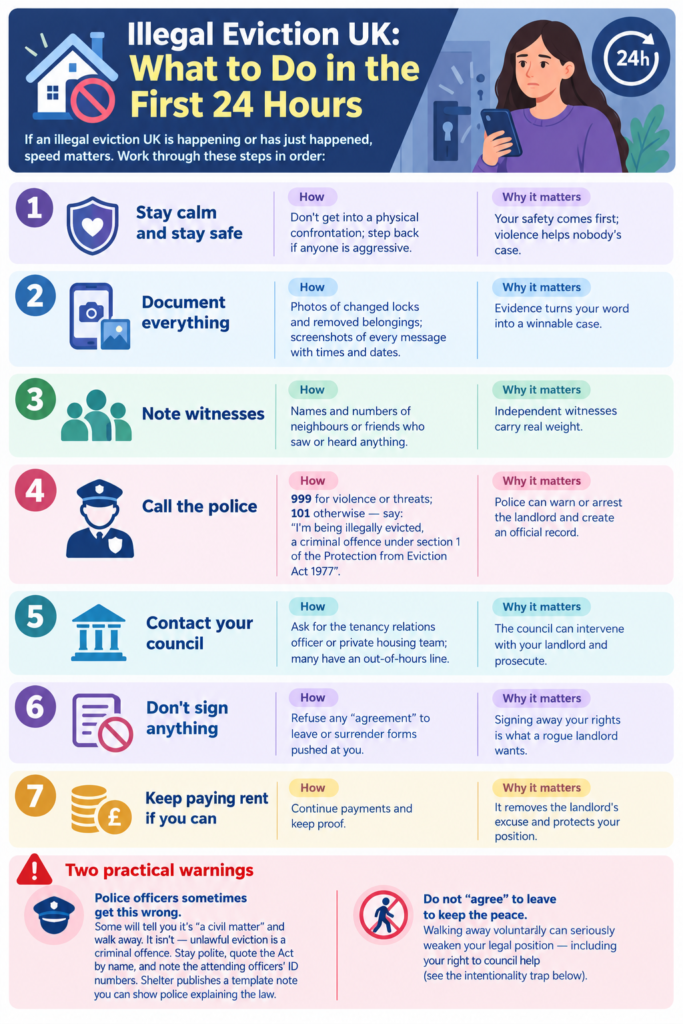
Illegal Eviction UK: What to Do in the First 24 Hours
If an illegal eviction UK is happening or has just happened, speed matters. Work through these steps in order:
| # | Action | How | Why it matters |
|---|---|---|---|
| 1 | Stay calm and stay safe | Don’t get into a physical confrontation; step back if anyone is aggressive | Your safety comes first; violence helps nobody’s case |
| 2 | Document everything | Photos of changed locks and removed belongings; screenshots of every message with times and dates | Evidence turns your word into a winnable case |
| 3 | Note witnesses | Names and numbers of neighbours or friends who saw or heard anything | Independent witnesses carry real weight |
| 4 | Call the police | 999 for violence or threats; 101 otherwise — say: “I’m being illegally evicted, a criminal offence under section 1 of the Protection from Eviction Act 1977” | Police can warn or arrest the landlord and create an official record |
| 5 | Contact your council | Ask for the tenancy relations officer or private housing team; many have an out-of-hours line | The council can intervene with your landlord and prosecute |
| 6 | Don’t sign anything | Refuse any “agreement” to leave or surrender forms pushed at you | Signing away your rights is what a rogue landlord wants |
| 7 | Keep paying rent if you can | Continue payments and keep proof | It removes the landlord’s excuse and protects your position |
Two practical warnings about illegal eviction UK:
- Police officers sometimes get this wrong. Some will tell you it’s “a civil matter” and walk away. It isn’t — unlawful eviction is a criminal offence. Stay polite, quote the Act by name, and note the attending officers’ ID numbers. Shelter publishes a template note you can show police explaining the law.
- Do not “agree” to leave to keep the peace. Walking away voluntarily can seriously weaken your legal position — including your right to council help (see the intentionality trap below).
Illegal Eviction UK: How to Get Back Into Your Home
Being locked out by an illegal eviction in the UK is not the end — but act within hours, not weeks. Once a new tenant moves in, getting the property back becomes far harder.
| Route | How it works |
|---|---|
| Council tenancy relations team | Your fastest free option: they explain the criminal offence to the landlord and warn of prosecution — often enough to get keys handed back |
| The police | Officers can order the landlord to reverse the lock change, and can arrest a landlord who forces entry against your wishes |
| Reasonable force yourself | You may hire a locksmith to regain entry — but speak to the council first: misunderstandings can bring criminal-damage accusations, and you’ll likely pay for damage |
| Court injunction | Apply to the county court for an order letting you back in; courts can act within days, legal aid may be available on low income, and some solicitors take these cases “no win, no fee” |
| Recovering belongings | Your landlord must return possessions or let you collect them — they can’t sell, destroy, keep them for arrears, or dump them on the doorstep |
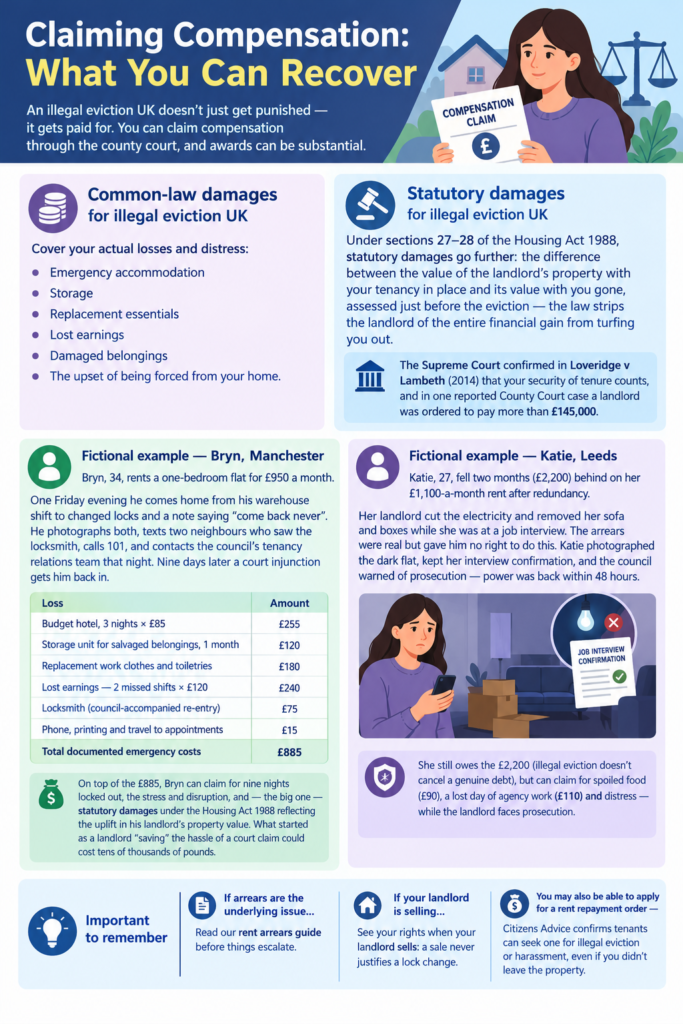
Claiming Compensation: What You Can Recover
An illegal eviction UK doesn’t just get punished — it gets paid for. You can claim compensation through the county court, and awards can be substantial:
Common-law damages for illegal eviction UK cover your actual losses and distress: emergency accommodation, storage, replacement essentials, lost earnings, damaged belongings, and the upset of being forced from your home.
Statutory damages for illegal eviction UK under sections 27–28 of the Housing Act 1988 go further: the difference between the value of the landlord’s property with your tenancy in place and its value with you gone, assessed just before the eviction — the law strips the landlord of the entire financial gain from turfing you out. The Supreme Court confirmed in Loveridge v Lambeth (2014) that your security of tenure counts, and in one reported County Court case a landlord was ordered to pay more than £145,000.
Fictional example — Bryn, Manchester: Bryn, 34, rents a one-bedroom flat for £950 a month. One Friday evening he comes home from his warehouse shift to changed locks and a note saying “come back never”. He photographs both, texts two neighbours who saw the locksmith, calls 101, and contacts the council’s tenancy relations team that night. Nine days later a court injunction gets him back in. His documented losses:
| Loss | Amount |
|---|---|
| Budget hotel, 3 nights × £85 | £255 |
| Storage unit for salvaged belongings, 1 month | £120 |
| Replacement work clothes and toiletries | £180 |
| Lost earnings — 2 missed shifts × £120 | £240 |
| Locksmith (council-accompanied re-entry) | £75 |
| Phone, printing and travel to appointments | £15 |
| Total documented emergency costs | £885 |
On top of the £885, Bryn can claim for nine nights locked out, the stress and disruption, and — the big one — statutory damages under the Housing Act 1988 reflecting the uplift in his landlord’s property value. What started as a landlord “saving” the hassle of a court claim could cost tens of thousands of pounds.
Fictional example — Katie, Leeds: Katie, 27, fell two months (£2,200) behind on her £1,100-a-month rent after redundancy. Her landlord cut the electricity and removed her sofa and boxes while she was at a job interview. The arrears were real but gave him no right to do this. Katie photographed the dark flat, kept her interview confirmation, and the council warned of prosecution — power was back within 48 hours. She still owes the £2,200 (illegal eviction doesn’t cancel a genuine debt), but can claim for spoiled food (£90), a lost day of agency work (£110) and distress — while the landlord faces prosecution.
If arrears are the underlying issue, read our rent arrears guide before things escalate — and if your landlord is selling, see your rights when your landlord sells: a sale never justifies a lock change. You may also be able to apply for a rent repayment order — Citizens Advice confirms tenants can seek one for illegal eviction or harassment, even if you didn’t leave the property.
The Homelessness Safety Net – and the Trap to Avoid
If an illegal eviction UK leaves you with nowhere to sleep, the council has duties to help — but how you act in the first hours decides how much help you get.
The safety net. Councils must try to prevent homelessness — Shelter’s guidance is explicit that your council must try to stop an illegal eviction that would leave you homeless. If you end up homeless through no fault of your own, the council owes you help finding accommodation and, in priority cases, emergency housing.
The trap: “intentional” homelessness. Under section 191 of the Housing Act 1996, you can be found “intentionally homeless” if you deliberately cost yourself a home it would have been reasonable to stay in — and the council’s duty to the intentionally homeless is far more limited. So don’t walk away voluntarily — not when a notice arrives, not when the landlord shouts. Leaving “to keep the peace” can be treated as choosing to make yourself homeless.
England vs Scotland vs Wales vs Northern Ireland
Illegal eviction is against the law everywhere in the UK — but the exact statutes, courts and enforcers differ by nation. Here is how illegal eviction UK law breaks down across the four nations:
| England | Scotland | Wales | Northern Ireland | |
|---|---|---|---|---|
| Main criminal law | Protection from Eviction Act 1977, s.1 (up to 2 years) | Rent (Scotland) Act 1984, ss.22–23A (up to 2 years on indictment) | Protection from Eviction Act 1977, s.1 | Rent (NI) Order 1978, Art.47 (up to 2 years on indictment; £1,000 max fine summarily) |
| New civil penalty | Up to £40,000 (councils, from 1 May 2026) | — | — | — |
| Lawful route | Section 8 notice → county court → bailiffs | Notice to Leave → First-tier Tribunal → sheriff officers | Possession notice → county court → bailiffs | Notice to Quit → county court → Enforcement of Judgments Office |
| Damages | Housing Act 1988, ss.27–28 | Housing (Scotland) Act 1988 (property-value uplift basis) | Housing Act 1988, ss.27–28 | Through the courts; council can prosecute |
| Who to call first | Council tenancy relations + police | Council + police; Shelter Scotland | Council + police | Council environmental health; Housing Rights |
Notes on the devolved nations:
- Scotland: The 1977 Act doesn’t apply — unlawful eviction is a crime under the Rent (Scotland) Act 1984 and a civil wrong under the Housing (Scotland) Act 1988. Only the First-tier Tribunal (Housing and Property Chamber) can order eviction; only sheriff officers can enforce it. The sheriff court can also grant an interdict to stop harassment.
- Wales: Tenancies are “occupation contracts” under the Renting Homes (Wales) Act 2016 — no eviction without a court order except on genuine abandonment, and courts can refuse possession where eviction retaliates against repair requests.
- Northern Ireland: The Rent (NI) Order 1978 criminalises harassing occupiers or evicting without due process; district councils can prosecute, and only a county court order — enforced through the Enforcement of Judgments Office — can remove you.
How to Protect Yourself Before Anything Happens
You can’t control a rogue landlord, but you can make yourself a harder target for illegal eviction UK:
- Know your tenancy type. Dig out your agreement today and confirm what you have — your rights flow from it. Our tenancy agreement guide walks you through it.
- Keep proof you live there. Council tax bills, bank statements, and ID showing your address are what you’ll show police or a locksmith. (See our council tax for renters guide.)
- Save everything in writing. If your landlord only calls, follow up with a text or email summarising what was said. A paper trail is your best weapon.
- Check your deposit is protected. A landlord cutting corners on eviction often cuts corners elsewhere — see our deposit protection guide.
- Save your council’s number now. Find the tenancy relations or private housing team — including any out-of-hours line — before you need it in a panic.
- Consider changing the locks yourself if you feel unsafe; keep the originals to refit when you leave, and check your agreement first (in Scotland, speak to a solicitor first).
- Never ignore official paperwork. If a real court claim arrives, respond and get advice immediately — burying it genuinely helps a landlord evict you lawfully.
Frequently Asked Questions
Is it illegal for my landlord to change the locks while I’m out?
Yes, in almost all cases. If you’re a tenant (not a lodger sharing with a live-in landlord), changing the locks without a court order is unlawful eviction under section 1 of the Protection from Eviction Act 1977 — a criminal offence. Photograph the new lock and call the police and your council immediately.
Can my landlord evict me because I’m behind on rent?
Arrears can be a ground for lawful eviction through the courts (section 8), but never justify a DIY eviction. Changing locks, cutting utilities or removing belongings over unpaid rent is still a criminal offence — and you still owe the arrears.
Should I call the police if my landlord tries to evict me illegally?
Yes — 999 for violence or threats, 101 otherwise. State clearly it’s an illegal eviction, a criminal offence under section 1 of the Protection from Eviction Act 1977. Some officers wrongly call it a “civil matter” — stay calm, quote the Act, and note their ID numbers.
I’ve come home to changed locks. What should I do first?
Don’t force entry or confront anyone. Photograph everything, screenshot all messages, note witnesses, then call the police and your council’s tenancy relations team. Ask about an emergency injunction, and keep receipts for every penny spent — they form your compensation claim.
Can I break back into my own home after an illegal eviction?
You may use reasonable force, such as hiring a locksmith — but speak to your council’s tenancy relations team first, as there are risks around criminal-damage accusations and repair costs. A court injunction is the safest route.
How much compensation can I get for an illegal eviction?
It can be substantial: documented losses (hotels, lost earnings, damaged belongings), damages for distress, plus statutory damages under the Housing Act 1988 based on the increase in the landlord’s property value. Reported awards have exceeded £145,000.
Can I get legal aid for an illegal eviction case?
Possibly — legal aid may be available on a low income, especially for injunction proceedings to get you back in. Shelter and Citizens Advice can point you to housing solicitors, some of whom work “no win, no fee”.
My landlord gave me a notice and says I must leave — is that an eviction?
No. A notice — section 8, a text, a letter — is not an eviction and doesn’t end your right to stay. If you don’t leave, the landlord must get a court possession order enforced by bailiffs. Only leave when a court tells you to, or on proper notice you choose yourself.
Does illegal eviction law apply in Scotland, Wales and Northern Ireland?
Yes, under different laws: Scotland uses the Rent (Scotland) Act 1984 and Housing (Scotland) Act 1988 (First-tier Tribunal, sheriff officers); Wales uses the 1977 Act plus Renting Homes (Wales) Act 2016 occupation contracts; NI uses the Rent (NI) Order 1978 (county court, Enforcement of Judgments Office).
I’m a lodger living with my landlord. Can they just change the locks on me?
Lodgers sharing with a live-in landlord are “excluded occupiers” — the landlord can end things on reasonable notice without a court order. But force, threats, seizing belongings or zero notice are still unlawful — report it to the police and council.
Will the council actually help me, or just give me a leaflet?
Councils have real powers: tenancy relations officers can intervene, warn of prosecution, help with injunctions and prosecute landlords. Since 1 May 2026, English councils can also impose civil penalties up to £40,000 — contact them as early as possible.
Can my landlord keep my belongings until I pay what I owe?
No. They must return your belongings or let you collect them — they can’t sell, destroy, hold them for arrears, or dump them on the doorstep. Claim compensation through the courts if items are lost or damaged.
Final Thoughts
Illegal eviction UK thrives on one thing: tenants not knowing their rights. Now you know the essentials — no court order means no eviction, a notice is not an eviction, and landlords who skip the process face prison, unlimited fines, £40,000 civil penalties and compensation payouts that can reach six figures.
The post-section-21 landscape of 2026 makes this knowledge more valuable than ever. Some landlords are frustrated by the slower lawful route. That frustration is their problem, not yours — and if they take it out on your front door, the full weight of the law is on your side.
If renting stress has you questioning whether your home is even affordable, our free rent affordability calculators show what you can genuinely afford — because the best protection against landlord pressure is rent you can comfortably sustain. And if arrears are the underlying worry, read our rent arrears guide before things reach crisis point.
This guide is general information, not legal advice. If you’re facing an illegal eviction UK right now, contact your council’s tenancy relations team, the police, Shelter or Citizens Advice immediately — and consider speaking to a housing solicitor about an injunction and compensation.
Further Reading
- GOV.UK – Harassment and illegal evictions — the government’s official guidance on your rights and who to contact
- Shelter England – Help after an illegal eviction — step-by-step advice on getting back in, injunctions and compensation
- Citizens Advice – Claim back your rent if your landlord breaks the law — evidence to gather and rent repayment orders for illegal eviction and harassment