
Saffron had done everything right. A single mum of two in Manchester, she worked part-time in a care home, had never missed a rent payment in six years, and could hand over glowing references from two previous landlords. When she spotted a two-bedroom flat at £850 a month — ten minutes from her children’s school — she rang the letting agent the same morning to book a viewing. However, the No DSS Ban UK issue could still affect her chances of securing the property.
“Sorry,” the agent said, “the landlord doesn’t take DSS.”
The flat was still advertised two weeks later. Saffron was not turned away because she could not afford it, or because of anything she had done. She was turned away for one reason only: part of her rent would come from Universal Credit.
If that story sounds familiar, this guide is for you. Since 1 May 2026, turning tenants away because they receive benefits or have children is illegal in England — with matching bans now in force in Scotland and Wales. The blanket “no DSS” and “no children” policies that once dominated rental adverts are banned, and landlords who keep using them face fines of up to £7,000 per breach. This guide explains exactly what the ban covers, what landlords can still lawfully do, and what to do if it happens to you.
Quick answer: Since 1 May 2026, the Renters’ Rights Act 2025 has made it illegal in England for landlords and letting agents to refuse you — or treat you worse — because you receive benefits or have children. The ban covers adverts, property information, viewings and the final tenancy decision, and councils can fine landlords up to £7,000 per breach. Scotland has its own version of the ban (in force 1 May 2026) and Wales followed on 1 June 2026. Landlords can still check that you can genuinely afford the rent — but they must count benefit income exactly the same as wages.
Rules differ between England, Scotland, Wales and Northern Ireland, and some changed in 2026. This guide reflects the position as of October 2026 and is general information, not legal advice.
What Changed on 1 May 2026?
The change comes from Chapter 3 of Part 1 of the Renters’ Rights Act 2025 — the rental discrimination provisions. Two sections do the heavy lifting:
| Section | What it bans |
|---|---|
| Section 33 | Discriminating against someone because they have, or would have, a child living with or visiting them |
| Section 34 | Discriminating against someone because they receive, or might receive, benefits |
For each one, the Act bans both direct refusal and indirect practices that make people in those groups less likely to end up with the tenancy. The ban bites at every stage of the letting process:
| Stage | What landlords and agents must not do |
|---|---|
| Enquiring | Stop you asking whether the property is available to let |
| Information | Withhold details about the property, its availability or its terms |
| Viewing | Refuse you a viewing, or make it unreasonably hard to arrange one |
| Tenancy decision | Refuse to let to you, or offer you worse terms, because of benefits or children |
Three points about who is bound under the No DSS Ban UK are worth knowing. First, the ban covers sitting tenants as well as applicants — if you start claiming benefits or have a child after moving in, you are protected too. Second, liability reaches anyone acting on the landlord’s behalf: the letting agent, the referencing company, even a family member helping informally. If a referencing firm ignores your benefit income and you fail the check, the landlord is the one the council fines. Third, the measures apply to assured and regulated tenancies in England — including ones agreed before 1 May 2026. Social housing and supported accommodation are excluded.
For the bigger picture of the 2026 reforms, our Renters’ Rights Act 2025 guide walks through everything that changed on 1 May 2026.
What Does “No DSS” Actually Mean?
“DSS” stands for the Department of Social Security — a government department renamed back in 2001. The phrase survived for a quarter of a century as letting-agent shorthand for “tenants who pay their rent with benefits”, especially Universal Credit and Housing Benefit. A “DSS tenant” was never a legal category; it was a label, and a stigmatising one — a 2020 survey found 63% of private landlords either operated an outright ban on letting to people receiving housing benefit or said they preferred not to.
If you see “no DSS”, “no benefits” or “working professionals only” on a listing in 2026, you are looking at language the law has moved past. The first two are banned outright; the last is one of the disguised versions the ban also catches, as the next sections explain.
What Counts as Direct Discrimination?
Direct discrimination is the straightforward kind: you are refused, or treated worse, because you receive benefits or have children. Under the Act it is unlawful for a landlord or agent to take steps intended to make you less likely to enter a tenancy on those grounds — including:
- advertising “no DSS”, “no benefits”, “no children” or “no families”
- telling you on the phone that the landlord “doesn’t take benefit tenants”
- refusing to send you the property details once they learn you have children
- declining your application with no reason other than your benefit status
- offering you worse tenancy terms than another applicant to put you off
It is still discrimination even if the landlord is wrong about you. The government’s guidance is explicit: decisions based on a belief that you have children or receive benefits count as discrimination even if the belief is false. Refusing you because the agent assumed you were on benefits is caught just the same.
It is also worth knowing that a landlord cannot dodge liability by blaming someone else. If the landlord instructed the agent to apply a “no DSS” rule, the landlord is liable for the agent carrying it out — which is why written instructions to count benefit income fairly matter.
Indirect Discrimination: The Disguised Kind
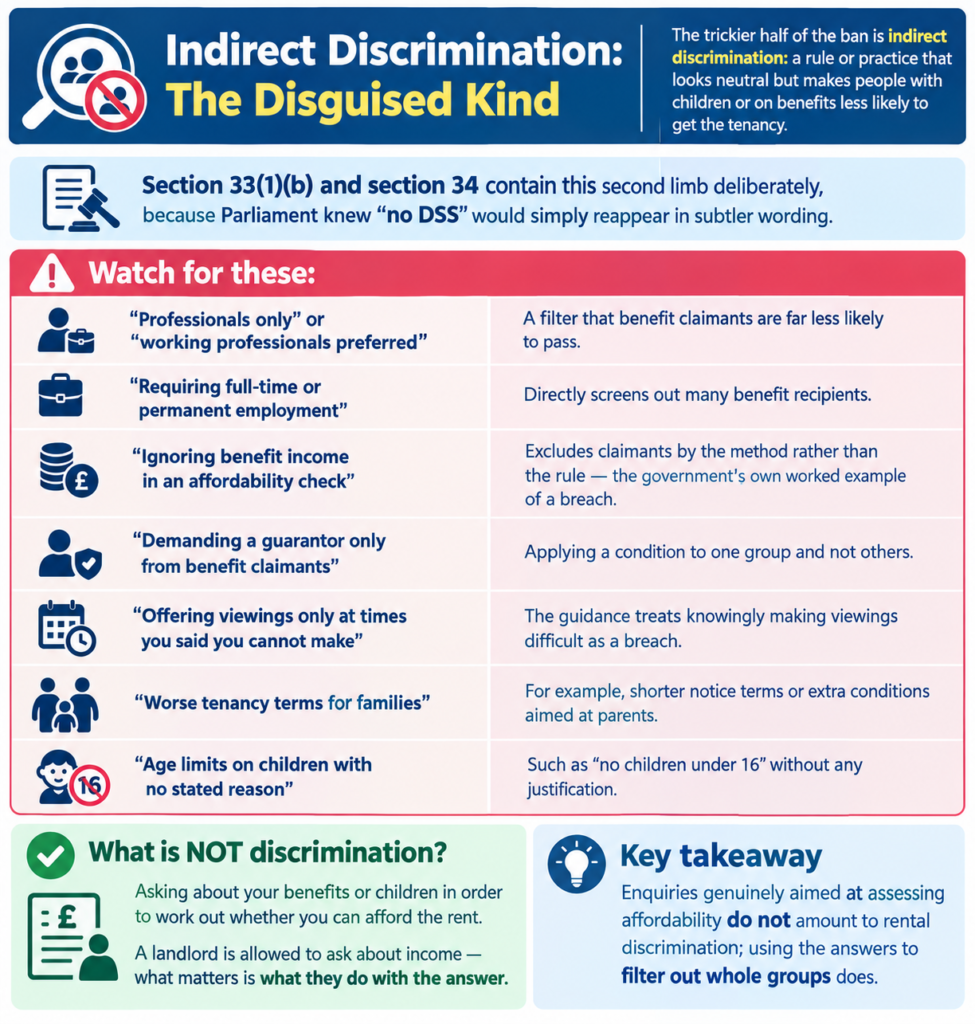
The trickier half of the ban is indirect discrimination: a rule or practice that looks neutral but makes people with children or on benefits less likely to get the tenancy. Section 33(1)(b) and section 34 contain this second limb deliberately, because Parliament knew “no DSS” would simply reappear in subtler wording. Watch for these:
| Practice | Why it is a problem |
|---|---|
| “Professionals only” or “working professionals preferred” | A filter that benefit claimants are far less likely to pass |
| Requiring full-time or permanent employment | Directly screens out many benefit recipients |
| Ignoring benefit income in an affordability check | Excludes claimants by the method rather than the rule — the government’s own worked example of a breach |
| Demanding a guarantor only from benefit claimants | Applying a condition to one group and not others |
| Offering viewings only at times you said you cannot make | The guidance treats knowingly making viewings difficult as a breach |
| Worse tenancy terms for families | For example, shorter notice terms or extra conditions aimed at parents |
| Age limits on children with no stated reason | Such as “no children under 16” without any justification |
One thing that is not discrimination: asking about your benefits or children in order to work out whether you can afford the rent. A landlord is allowed to ask about income — what matters is what they do with the answer. Enquiries genuinely aimed at assessing affordability do not amount to rental discrimination; using the answers to filter out whole groups does.
“No DSS” and “No Children” in Adverts: The Rules
The advert is where most renters first meet discrimination, so it is worth being precise about which wording is banned and what landlords should write instead:
| Banned wording | Why | What to write instead |
|---|---|---|
| “No DSS” / “DSS not accepted” | Direct ban on benefit recipients | “All applicants considered on individual circumstances” |
| “No benefits” / “no Universal Credit” | Direct ban on benefit recipients | “Benefit income counted equally in affordability checks” |
| “Professionals only” / “working professionals preferred” | Indirect filter against claimants | “Applicants must pass affordability and reference checks” |
| “No children” / “no kids” / “no families” | Direct ban on families | Describe the property neutrally: bedrooms, space, facilities |
| “Suit professional couple” | Implies families need not apply | “Two-bedroom flat, available long-term” |
A practical note on the portals: a website that only publishes adverts cannot itself be liable for discrimination — the liability sits with the landlord or agent who placed the wording. Even so, the major property portals removed their “No DSS” search filters several years ago.
If you spot banned wording, screenshot it immediately — adverts can be edited or taken down in minutes, and a time-stamped screenshot with the URL visible is exactly the evidence councils ask for.
Affordability Checks: What Landlords Can Still Do
This is the part landlords misunderstand most — and the part that protects you most. The Act expressly preserves a landlord’s right to take your income into account when deciding whether you can afford the rent. A landlord who turns you down because you genuinely cannot afford the property has not discriminated against you.
What the landlord must not do is rig the test. The government’s guidance sets three conditions for a lawful income check:
- The same income requirement for everyone. The threshold cannot be raised because you have children or receive benefits.
- All income counted equally. Universal Credit, wages, pensions, Child Benefit — every pound counts the same. A check that disregards benefit income is a breach even if you would have failed a fair check anyway.
- No unreasonable refusal of evidence. A landlord should not reject a benefit award letter, bank statement or payslip as proof of income simply because of what it is.
And when several applicants all meet the requirement, the landlord must not use benefits or children as the tiebreaker. Our guide to letting agent affordability checks explains the 30x rent rule and the other formulas agents use — and if you claim Universal Credit, our Universal Credit renting guide walks through working out what you can actually afford.
Worked example — Hetty, Leeds. Hetty works part-time, earning £950 a month (£11,400 a year), and receives Universal Credit of roughly £1,025 a month (£12,300 a year) including her housing element. She applies for a flat at £750 a month, where the agent’s 30x rule requires annual income of £750 × 30 = £22,500. Counted properly, Hetty’s income is £11,400 + £12,300 = £23,700 — she passes. But the agent’s referencing firm ignores her Universal Credit and reports income of £11,400: a fail by £11,100. That is exactly the government’s worked example of discrimination. Even though the method was the referencing firm’s, the liability sits with the landlord who used it.
Referencing, Credit Checks and Guarantors
Referencing is still legal. Credit checks are still legal. Right to rent checks are still mandatory. None of that changed — what changed is that every one of them must be applied consistently to all applicants.
The guarantor question causes the most confusion. A landlord can ask for a guarantor — for example, where an applicant’s references do not meet the normal thresholds — but only if the requirement applies on the same terms to everyone. Demanding a guarantor from benefit claimants while waving employed applicants through is one of the guidance’s textbook examples of discrimination.
Two related points. First, right to rent checks must be carried out on all adults aged 18 or over before the tenancy starts — checking only the applicants the landlord suspects might not be British is itself unlawful. Second, a guarantor arrangement fee charged to you would be a banned payment under the Tenant Fees Act in any case; the discrimination ban is about who gets asked, not the fee.
Worked example — Kester, Birmingham. Kester receives Personal Independence Payment and works 20 hours a week. He finds a one-bedroom flat at £850 a month. The agent tells him the landlord “needs six months’ rent upfront from benefit tenants as security” — £5,100 before he gets the keys. That demand is unlawful twice over. First, it imposes worse terms because he receives benefits: discrimination. Second, since 1 May 2026 no rent can be demanded before the tenancy agreement is signed, and after signing the maximum is one month’s rent. Kester’s lawful move-in cost is his capped deposit — annual rent is £10,200, so five weeks’ rent: (£850 × 12) ÷ 52 × 5 = £980.77 — plus at most one month’s rent of £850: £1,830.77 in total. The £5,100 demand was £3,269.23 more than the law allows.
What If Your Circumstances Change Mid-Tenancy?
The ban does not stop at the front door. It also protects you if your situation changes after you move in — if you start claiming benefits, or a child comes to live with you through birth, adoption, fostering or any other means.
In practice this means:
- Your landlord cannot end your tenancy, or threaten to, because you started claiming Universal Credit.
- Your landlord cannot ban children from living in or visiting your home once the tenancy has begun.
- Your landlord cannot suddenly impose worse terms — a surprise “no children” rule, or pressure to leave — to push you out.
Citizens Advice puts it plainly: if you are already a tenant, your landlord cannot end your tenancy because you get benefits, and cannot ban children from living in or visiting your home. If you are struggling to keep up with rent after a change in circumstances, our rent arrears guide explains your options — including asking for your Universal Credit housing element to be paid straight to your landlord — before arrears become an eviction risk.
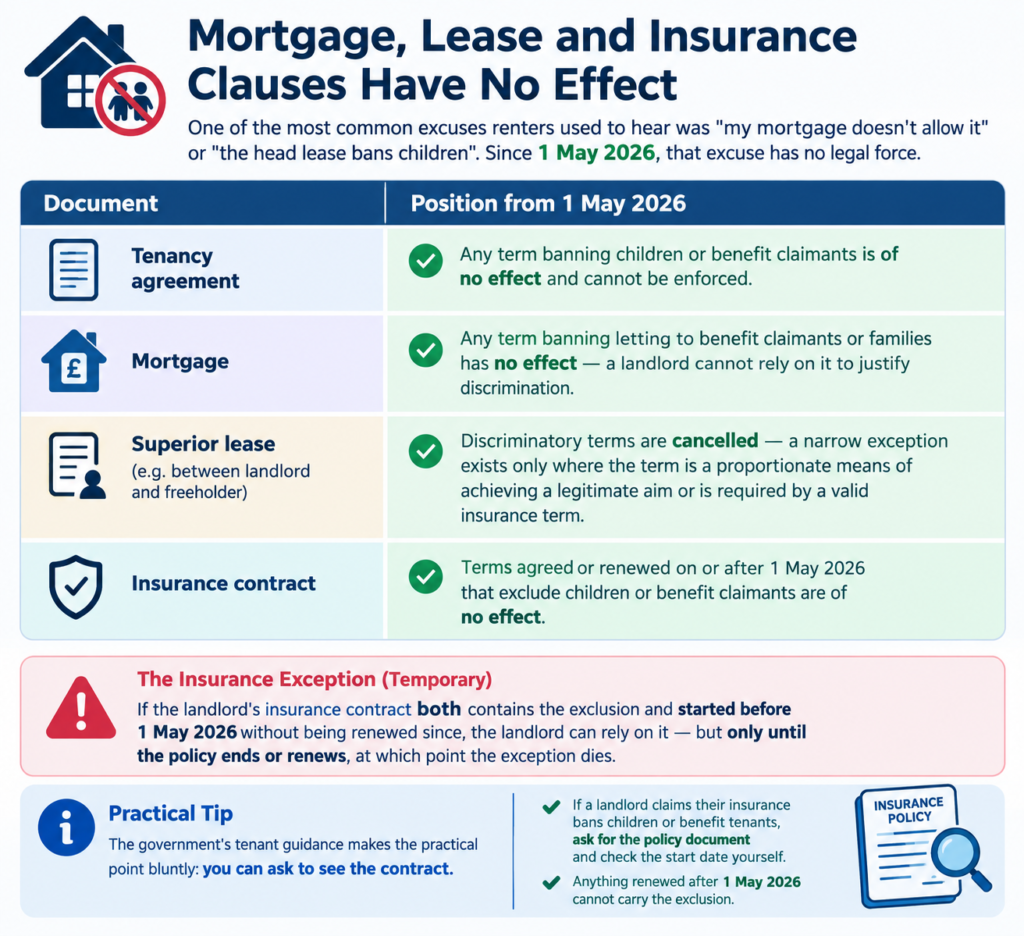
Mortgage, Lease and Insurance Clauses Have No Effect
One of the most common excuses renters used to hear was “my mortgage doesn’t allow it” or “the head lease bans children”. Since 1 May 2026, that excuse has no legal force:
| Document | Position from 1 May 2026 |
|---|---|
| Tenancy agreement | Any term banning children or benefit claimants is of no effect and cannot be enforced |
| Mortgage | Any term banning letting to benefit claimants or families has no effect — a landlord cannot rely on it to justify discrimination |
| Superior lease (e.g. between landlord and freeholder) | Discriminatory terms are cancelled — a narrow exception exists only where the term is a proportionate means of achieving a legitimate aim or is required by a valid insurance term |
| Insurance contract | Terms agreed or renewed on or after 1 May 2026 that exclude children or benefit claimants are of no effect |
The insurance position has one genuine, temporary exception. If the landlord’s insurance contract both contains the exclusion and started before 1 May 2026 without being renewed since, the landlord can rely on it — but only until the policy ends or renews, at which point the exception dies. The government’s tenant guidance makes the practical point bluntly: you can ask to see the contract. If a landlord claims their insurance bans children or benefit tenants, ask for the policy document and check the start date yourself. Anything renewed after 1 May 2026 cannot carry the exclusion.
When Can a Landlord Lawfully Refuse Children?
Here is the single most important asymmetry in the whole regime — and the one most summaries get wrong. The two halves of the ban are not mirror images:
- Children (section 33): a landlord has a defence if the restriction is a proportionate means of achieving a legitimate aim.
- Benefits (section 34): there is no equivalent defence at all. No justification, however commercially sensible the landlord thinks it is, can excuse refusing someone for receiving benefits.
The benefits limb has no “good reason” defence. A landlord with a genuine commercial preference for employed tenants has no legal route to act on it. For children, a narrow justification exists — but the bar is deliberately high.
For a “no children” restriction to be lawful, the landlord must show all of the following, and the council (not the landlord) decides whether the test is met:
- The aim is legitimate — and it must benefit someone other than the landlord. A purely financial aim, such as lowering business costs, is not legitimate.
- The restriction actually achieves the aim.
- It is proportionate — the landlord must have considered whether a narrower restriction would do, and must explain why it applies to your situation specifically.
| Likely to be lawful | Likely to be unlawful |
|---|---|
| A retirement housing community that clearly advertises itself as such, where children may visit but not live | A blanket “no children” rule with no reason given |
| A property that would become statutorily overcrowded if a family moved in | Refusing all children because of a staircase an older child could use safely |
| Student housing where unrelated adults share facilities, with genuine safeguarding concerns | An age limit (“no under-16s”) with no explanation of why |
| HMO licence conditions that genuinely restrict occupation | A financial motive dressed up as a “policy” |
| A property genuinely unsafe for children, where the danger cannot reasonably be mitigated | Assuming children will cause damage, without evidence |
The government’s own example of the defence succeeding is a small housing community for retired people that advertises itself as such — the rule genuinely benefits the residents. The example of it failing is the open staircase: a landlord cannot refuse all children because of a feature that only poses a risk to very young ones.
You Have Been Refused: Gather Evidence First
If you believe a landlord or agent has discriminated against you, evidence is everything — councils decide cases on the balance of probabilities, and the side with the paperwork usually wins:
- Screenshot the advert — with the URL, the date and the offending wording visible. Adverts get edited fast.
- Save every communication — texts, emails, voicemails, portal messages, in date order. Time-stamped copies are what the government’s guidance asks for.
- Write down phone calls — the date, who you spoke to, and what they said, word for word if you can.
- Keep the tenancy paperwork — any agreement, application form or referencing report you were given.
- Put your complaint in writing — email the agent or landlord, describe what happened, and say you believe it is rental discrimination under the Renters’ Rights Act 2025. Shelter publishes free letter templates for exactly this. Give them around 14 days to respond.
Then escalate along the right route — because the route depends on who discriminated:
| Who discriminated | Where to complain |
|---|---|
| Letting agent | Complain to the agent in writing first; if unresolved, escalate free to their redress scheme (The Property Ombudsman or the Property Redress Scheme) — our guide to complaining about a letting agent walks through each step |
| Landlord | Report to the local council where the property is — the council investigates and can fine them |
| Either, and you want compensation | A redress scheme or ombudsman can order an apology or financial compensation; you can also take private legal action — speak to a Law Centre or solicitor |
You can report the same problem to the council more than once if it is not resolved. And if you would rather not involve the council at all, the agent-then-redress-scheme route and private legal action remain open to you.
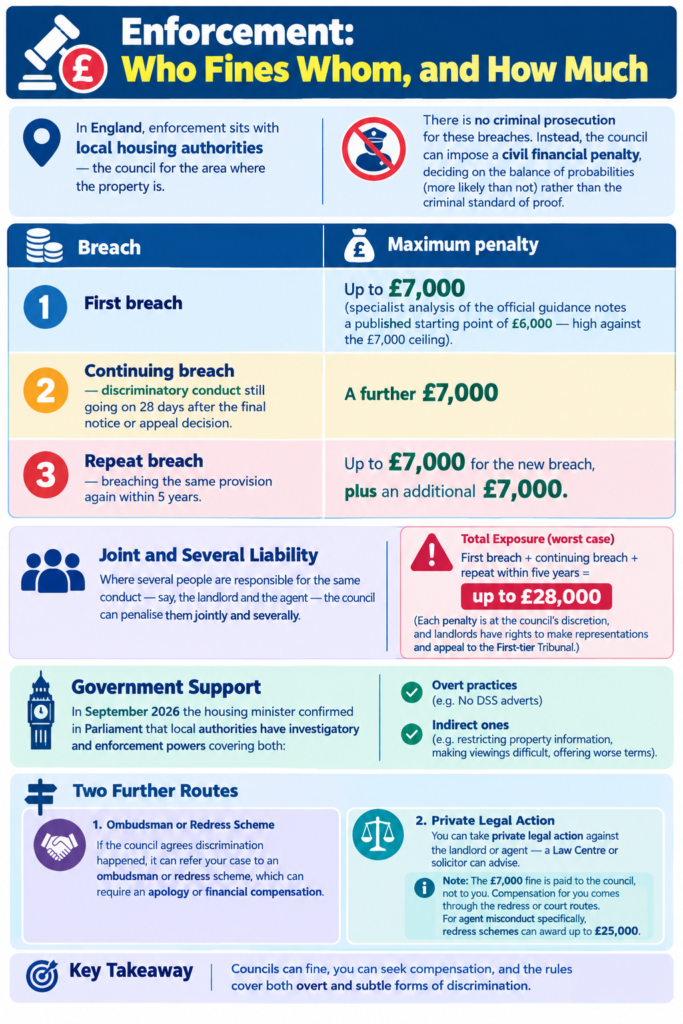
Enforcement: Who Fines Whom, and How Much
In England, enforcement sits with local housing authorities — the council for the area where the property is. There is no criminal prosecution for these breaches; instead the council can impose a civil financial penalty, deciding on the balance of probabilities (more likely than not) rather than the criminal standard of proof:
| Breach | Maximum penalty |
|---|---|
| First breach | Up to £7,000 (specialist analysis of the official guidance notes a published starting point of £6,000 — high against the £7,000 ceiling) |
| Continuing breach — discriminatory conduct still going on 28 days after the final notice or appeal decision | A further £7,000 |
| Repeat breach — breaching the same provision again within 5 years | Up to £7,000 for the new breach, plus an additional £7,000 |
Where several people are responsible for the same conduct — say, the landlord and the agent — the council can penalise them jointly and severally. In a worst-case chain (first breach, conduct continues, then a repeat within five years), total exposure can reach £28,000 — though each penalty is at the council’s discretion, and landlords have rights to make representations and appeal to the First-tier Tribunal.
The government is backing councils to use these powers: in September 2026 the housing minister confirmed in Parliament that local authorities have investigatory and enforcement powers covering both overt practices (No DSS adverts) and indirect ones (restricting property information, making viewings difficult, offering worse terms).
Two further routes sit alongside the council fine. If the council agrees discrimination happened, it can refer your case to an ombudsman or redress scheme, which can require an apology or financial compensation. And you can take private legal action against the landlord or agent — a Law Centre or solicitor can advise. Note the distinction: the £7,000 fine is paid to the council, not to you; compensation for you comes through the redress or court routes. For agent misconduct specifically, the redress schemes can award up to £25,000.
The Ban Across the UK: England, Scotland, Wales and Northern Ireland
The discrimination ban is one of the few Renters’ Rights Act measures that stretches beyond England — but the details, start dates and enforcement differ in each nation:
| England | Scotland | Wales | Northern Ireland | |
|---|---|---|---|---|
| Legal basis | RRA 2025, Chapter 3 (ss 33–42) | RRA 2025, Chapter 5 (ss 50–55) | RRA 2025, Chapter 4 (ss 43–49), inserted into the Renting Homes (Fees etc.) (Wales) Act 2019 | No equivalent ban — separate NI private-tenancy law |
| In force | 1 May 2026 | 1 May 2026 | 1 June 2026 | n/a |
| Enforcement | Local housing authority — civil penalty up to £7,000 | Criminal offence — applies to all tenancy types, with retrospective effect | Local authority / Rent Smart Wales — fixed penalty or prosecution (fine on summary conviction) | General NI equality law; seek advice from the Equality Commission for NI |
| Who decides | Council, on the balance of probabilities | The courts | Council / Rent Smart Wales | n/a |
Two Wales-specific details: from 1 June 2026 all new occupation contracts must include the new anti-discrimination fundamental terms, and landlords had to update existing contracts’ written statements by 14 June 2026. In Scotland, ministers also hold powers to extend the protections to further groups in future.
If you rent in Northern Ireland, the RRA ban does not apply to you. The old routes remain: the 2020 court rulings below were argued under equality law, which has equivalents in NI — but get advice specific to Northern Ireland rather than relying on this guide.
Why the 2020 Court Rulings Still Matter
The 2026 ban did not come out of nowhere. For years, “no DSS” policies were challenged the only way available: through the Equality Act 2010. That matters for two reasons — it explains why the new law was needed, and it gives some renters a second legal route even today.
The Equality Act protects nine protected characteristics: age, disability, gender reassignment, marriage and civil partnership, pregnancy and maternity, race, religion or belief, sex and sexual orientation. Notice what is not on the list: receiving benefits, or having children. Before 2026, a blanket “no DSS” policy was not directly unlawful — challengers had to prove it indirectly discriminated against a protected group, because women and disabled people are statistically more likely to claim benefits.
Two county court cases broke the ground. In July 2020, York County Court, a single disabled mother of two supported by Shelter challenged a letting agent’s long-standing policy of rejecting housing benefit applicants; District Judge Mark ruled it unlawfully indirectly discriminatory on the grounds of sex and disability (Equality Act 2010, sections 19 and 29), and the tenant was awarded compensation. In September 2020, Birmingham County Court, Judge Mary Stacey ruled that a letting agency’s blanket ban on even viewing properties for housing benefit recipients was unlawful indirect discrimination against disabled people.
County court rulings do not bind other courts, but they are persuasive — and in 2023 the Property Ombudsman went further, finding that blanket bans on renting to families breached its code of practice because of their disproportionate effect on women.
The 2026 Act changes the landscape: you no longer need to link your case to sex or disability — being refused for benefits or children is unlawful in its own right. But the Equality Act overlay still matters. If you are, say, a disabled person on benefits who was refused, you may have claims under both regimes, and a solicitor or Law Centre can advise which route — or combination — serves you best.
Before signing anything, it is also worth reading our tenancy agreement guide — any “no DSS” or “no children” clause lurking in an old template is now unenforceable, but spotting it tells you a lot about the landlord.
Frequently Asked Questions
Can a landlord still ask whether I receive benefits or have children?
Yes. The Act does not ban questions — it bans what landlords do with the answers. A landlord may ask about your income to check affordability, and may ask about household size to check the property is suitable. It becomes discrimination only if the answers are used to refuse you, treat you worse, or apply a harsher standard than other applicants face.
Can a landlord refuse me if I genuinely cannot afford the rent?
Yes. The Act expressly preserves the right to take income into account. If the landlord applies the same income requirement to everyone, counts your benefit income equally with wages, and you still fall short, the refusal is lawful. What is unlawful is moving the goalposts — or ignoring part of your income — because of where it comes from.
Is “professionals only” in an advert now illegal?
In effect, yes. It is a classic example of indirect discrimination: a requirement that benefit claimants are far less likely to meet, applied to filter them out. Legal commentary on the Act gives “must have a professional job” as an illustration of the kind of criterion the ban catches.
I was refused before 1 May 2026. Can I still complain?
The English ban applies to conduct from 1 May 2026. For earlier refusals the RRA route is not available — but the Equality Act route used in the 2020 cases may be, particularly if you are a woman or a disabled person. In Scotland the Scottish provisions have retrospective effect, covering agreements made before 1 May 2026. Get advice on your specific dates.
Can my landlord evict me for starting to claim Universal Credit?
No. The ban covers changes during the tenancy: your landlord cannot end your tenancy, threaten to end it, or impose worse terms because you started claiming benefits or had a child. Citizens Advice confirms this explicitly. Retaliatory eviction is separately restricted under the Renters’ Rights Act.
The landlord says their insurance bans children. Is that allowed?
Only in one narrow case: the insurance contract must contain the exclusion and have started before 1 May 2026 without being renewed since. Once the policy ends or renews, the exception dies — and any exclusion agreed or renewed on or after 1 May 2026 has no effect. Ask to see the policy and check the start date; the government’s guidance says you are entitled to ask.
Can a landlord ask me for a guarantor but not ask other applicants?
No — not on the basis of benefits or children. A guarantor requirement is lawful only if applied consistently, for example to every applicant whose references fall below the same threshold. Demanding one solely from benefit claimants is one of the guidance’s worked examples of discrimination.
If the council fines my landlord, do I get the money?
No — the civil penalty is paid to the council. But a council that upholds your complaint can refer your case to an ombudsman or redress scheme, which can order the landlord to apologise or pay you compensation. You can also pursue compensation through private legal action with advice from a Law Centre or solicitor.
Does the ban apply to social housing?
No. In England the measures apply to assured and regulated tenancies in the private rented sector; social housing and supported accommodation are expressly excluded. (Social landlords have their own allocation rules and equality duties.)
What about lodgers living with their landlord?
The RRA discrimination measures are written for assured and regulated tenancies, and a live-in landlord arrangement is not an assured tenancy. The position for lodgers is less clear-cut than for ordinary private tenants, so get specific advice — from Citizens Advice or Shelter — rather than assuming either way.
Can property websites still show “no DSS” adverts?
A website that only publishes adverts cannot itself be liable under the Act — liability sits with the landlord or agent who wrote the wording. In practice the major portals removed “No DSS” filters years ago, and discriminatory wording in a listing remains evidence against whoever placed it, so screenshot it.
I rent in Northern Ireland. Am I protected?
Not by this ban — the Renters’ Rights Act does not extend to Northern Ireland, which has its own private-tenancy legislation and no equivalent prohibition. You may still have routes under Northern Ireland equality law; the Equality Commission for Northern Ireland can advise.
Final Thoughts
The 2026 discrimination ban redraws a line that landlords crossed routinely for decades. “No DSS” and “no children” are no longer screening tools — they are evidence. If you receive benefits or have children, the law now says what should always have been obvious: you must be judged on whether you can afford and sustain the tenancy, on the same terms as everyone else.
Three things to take away. First, know the test: the same income requirement for everyone, every pound of income counted equally, no harsher treatment at any stage from advert to signing. Second, keep evidence: screenshots, saved messages and dated notes are what turn a complaint into a council fine. Third, report it: councils can only act on what they know about.
Before you apply for your next property, run the numbers yourself so you apply with confidence: the rent affordability calculator in our letting agent affordability checks guide shows what income agents expect, and our Universal Credit renting guide helps you work out your true housing support. And if a landlord or agent treats you unfairly at any point, our guide to complaining about a letting agent sets out each step of the complaints ladder.
Further Reading
- GOV.UK — Rental discrimination: a guide for tenants: the government’s own step-by-step guide, including what evidence to keep and how to contact your council.
- Shelter England — What to do about discrimination from landlords or agents: practical advice on challenging discrimination, including letter templates and redress schemes.
- Citizens Advice — Complaining about housing discrimination: how to complain informally and formally, and when to take legal action.