
Universal Credit rent affordability: Renting a home on Universal Credit can feel confusing, especially when you are trying to work out how much rent you can actually manage each month.
The important thing to understand is that Universal Credit does not simply pay your full rent immediately. The amount you can receive towards housing depends on factors such as your age, household size, location, type of housing, rent, income, and personal Conditions.
For some people, Universal Credit can cover most or all of their eligible housing costs. For others, there can be a significant gap between the rent charged by a landlord and the amount of housing support available.
Important: Universal Credit rules can depend on your individual circumstances. The examples in this article are for illustration and should not be treated as a personalised benefits calculation. All rates reflect the 2026/27 figures published by the DWP on GOV.UK — always cross-check the current figure for your postcode before budgeting around it.
If you rent privately, the amount of housing support is generally limited to the lower of your actual eligible rent or the relevant Local Housing Allowance (LHA) rate. That means a landlord could charge £1,000 per month while your eligible housing support is only £750 — you’d normally need to find the remaining £250 from your Universal Credit, wages, or other income.
That is why just asking “How much Universal Credit do I get?” is not sufficient. The better question is: How much money will I have left after paying my costs?
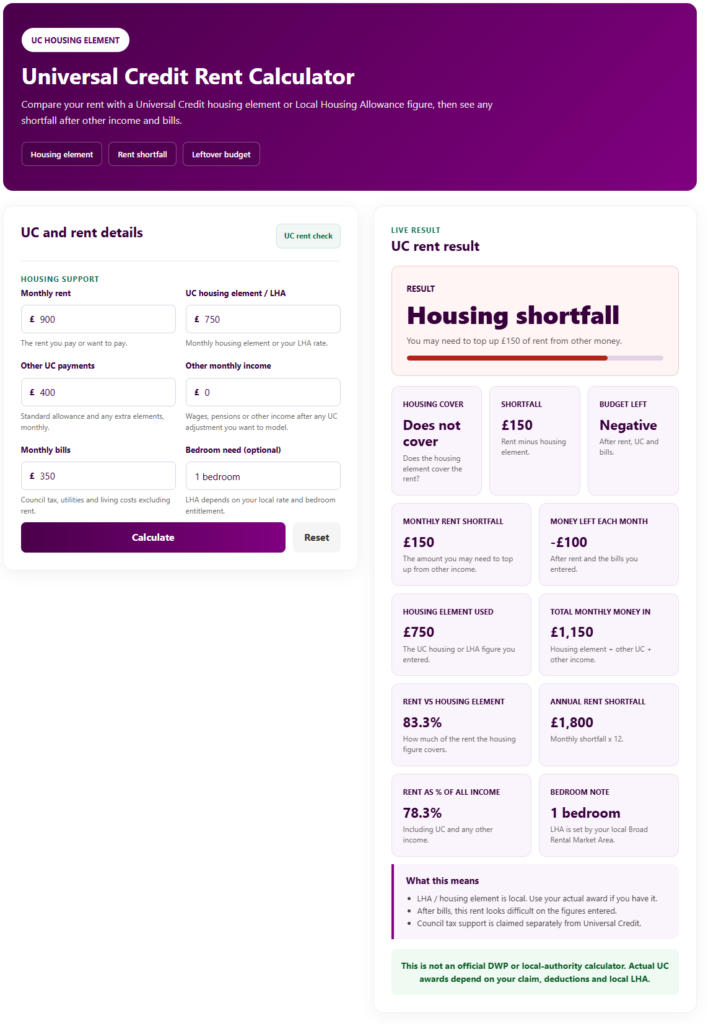
Click Here: Universal Credit Rent Calculator
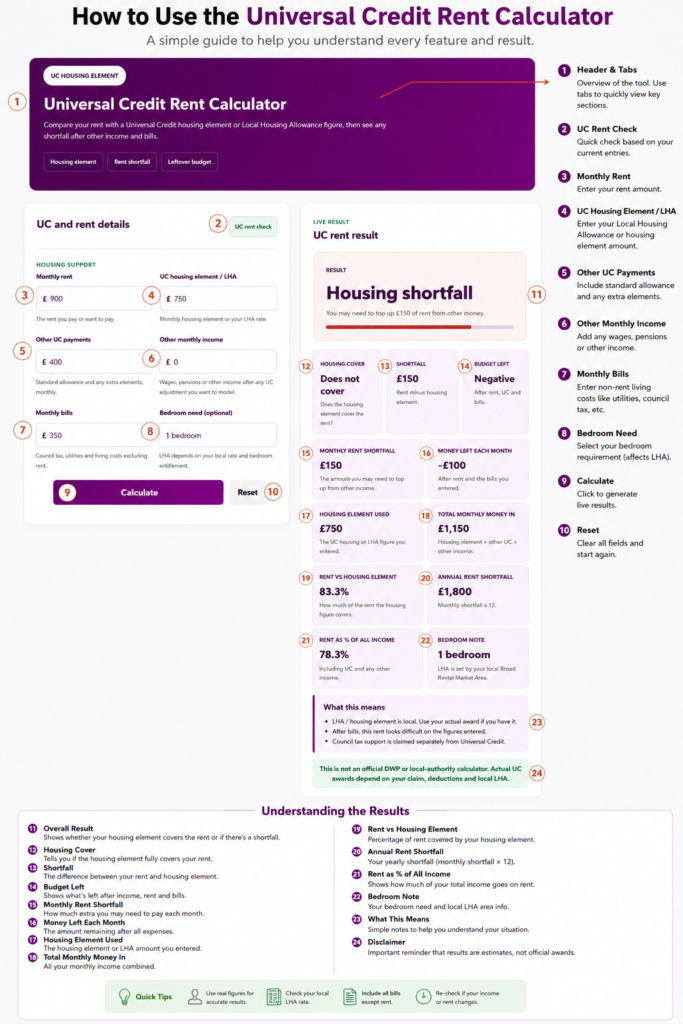
How to Use the Universal Credit Rent Calculator
How Does Universal Credit Help With Rent?
Universal Credit rent affordability is made up of different elements. The standard allowance is the basic part of your payment, and you may then receive additional amounts, including support towards eligible housing costs.
Read more:Degree Grade Calculator: 5 Best Ways to Calculate Your Final DegreeFrom April 2026, the standard monthly allowance is:
| Circumstances | Monthly Standard Allowance |
| Single, under 25 | £338.58 |
| Single, 25 or over | £424.90 |
| Couple, both under 25 | £528.34 |
| Couple, one or both 25 or over | £666.97 |
Your actual payment can be higher or lower than these figures because other elements may be included and deductions or earnings may reduce your payment.
If you rent privately, your housing support is normally based on your LHA rate. If you rent from a council or housing association, different rules generally apply, and eligible housing costs can include rent and certain service charges. The same £900 monthly rent can produce very different results depending on whether you rent privately or socially, where you live, your age, your household composition, how many bedrooms you’re entitled to, and whether your rent is above the applicable LHA rate.
What Is Local Housing Allowance?
LHA is used to determine the maximum housing support available to many people renting privately. Rates vary by geographical area and household circumstances, so there is no single “Universal Credit rent limit” for the entire UK.
| Example | Details |
|---|---|
| Person | Sarah |
| Age | 32 |
| Relationship status | Single |
| Children | No children |
| Monthly rent | £850 |
| Relevant LHA rate | £700 |
| Difference | £850 – £700 = £150 |
| Amount Sarah needs to cover herself | £150 per month |
Sarah is 32, single, and has no children. She finds a flat costing £850 per month, but the relevant LHA rate for her circumstances is £700. Her support doesn’t automatically rise to £850 just because her rent is £850 — the difference is £850 – £700 = £150, which she’d need to find from her own income.
Read more:Rent Affordability on Benefits UK – How Much Rent Can You Afford?
Universal Credit and Private Rent: The Under-35 Rule
If you are under 35, single, and have no partner or children, you will usually only be entitled to the shared accommodation rate rather than the one-bedroom LHA rate. This can make renting a self-contained flat considerably more difficult.
Example: A 28-year-old single tenant with rent of £900 and a shared accommodation LHA of £500 faces a shortfall of £900 – £500 = £400 per month — a substantial amount on a limited income.
There are exceptions: some people under 35 can qualify for the higher rate, including certain claimants of qualifying disability benefits, care leavers, and people with particular histories of homelessness.
For a single person aged 35 or over living alone, the calculation is generally more favourable, since they qualify based on the one-bedroom LHA rate. For example, David is 36, pays £800 rent, and his one-bedroom LHA rate is £750 — a shortfall of just £800 – £750 = £50.
| Situation | Typical LHA basis | Effect on a £900 rent (example) |
| Under 35, single, no children, no exemption | Shared accommodation rate | Could face a large shortfall (e.g. £400+) |
| Under 35, single, with disability/care-leaver exemption | One-bedroom rate | Shortfall similar to the 35+ case below |
| 35 or over, single, living alone | One-bedroom rate | Shortfall typically much smaller (e.g. £50–150) |
| Couple or family, any age | Rate based on household size/bedroom entitlement | Shortfall depends on local LHA vs actual rent |
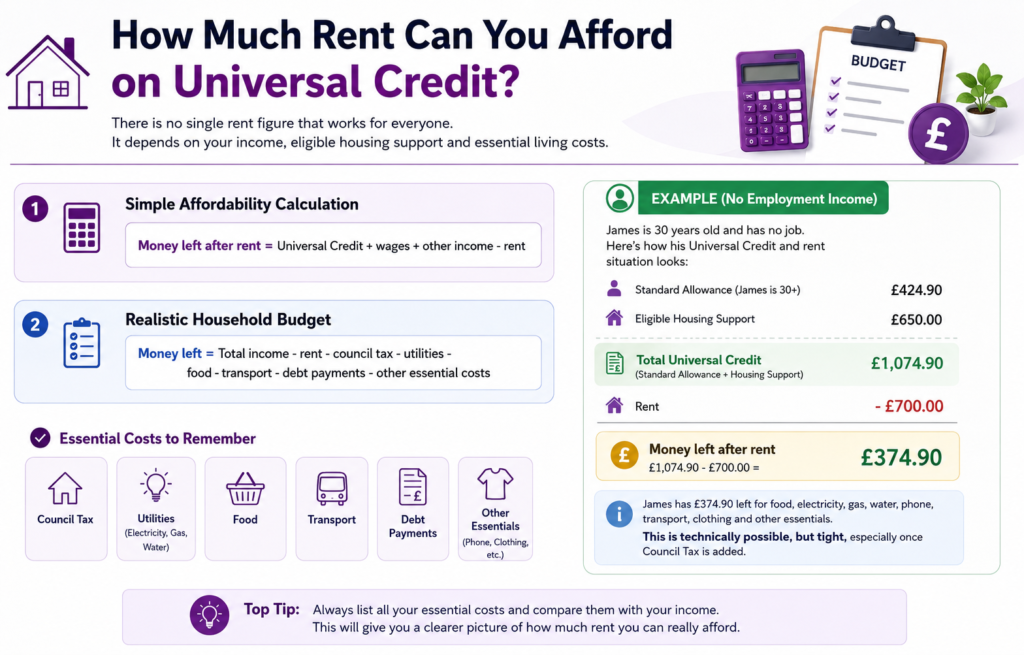
How Much Rent Can You Afford on Universal Credit?
There is no single rent figure that works for everyone. A simple affordability calculation is:
Money left after rent = Universal Credit + wages + other income – rent
But a more realistic household budget is:
Money left = Total income – rent – council tax – utilities – food – transport – debt payments – other essential costs
Example (no employment income): James is 30 with no job. His standard allowance is £424.90, and his eligible housing support is £650, giving total Universal Credit of £1,074.90. His rent is £700, so his shortfall is £50. After paying rent: £1,074.90 – £700 = £374.90 left for food, electricity, gas, water, phone, transport, clothing and other essentials — technically possible, but tight, especially once Council Tax is added.
| Example | Details |
|---|---|
| Situation | Working while claiming Universal Credit |
| Universal Credit | Working doesn’t automatically mean losing Universal Credit — it can continue while you work, though earnings reduce the payment. |
| Work allowance (2026/27) | £427 per month if you receive housing support |
| Work allowance without housing support | £710 per month if you don’t and meet the relevant conditions |
| Reduction above the allowance | Universal Credit is reduced by 55p for every £1 earned |
Take Mark: single, 30, earns £1,000 take-home, pays £900 rent, and has housing support of £650. His earnings above the work allowance are £1,000 – £427 = £573, giving an estimated UC reduction of £573 × 0.55 = £315.15. The lesson: Mark shouldn’t assume “I earn £1,000, so I can afford £900 rent” — that leaves only £100 before food, utilities, and transport. Even with Universal Credit, a £900 rent could be too high for his overall budget.
Read more:Rent Affordability for Self-Employed in the UK (2026 Guide)
A Better Way to Calculate Rent Affordability
Instead of focusing only on the maximum rent you can technically pay, use three numbers:
| Term | Explanation | Example |
|---|---|---|
| Total monthly income | Universal Credit, wages, pension income, other regular income. | — |
| Housing support | How much of your rent Universal Credit can potentially cover. | — |
| Rent shortfall | Actual rent – Housing support. | If rent is £850 and support is £700, that’s a £150 shortfall you need to find elsewhere. |
You can also work backwards using: Maximum affordable rent = Total monthly income – essential non-rent expenses – emergency buffer. For example, £1,800 – £750 – £200 = £850 estimated maximum affordable rent. This is a budgeting calculation, not a government one — it doesn’t determine your legal entitlement.
A commonly used rule of thumb is to keep housing costs around 30–35% of household income, though this isn’t an official Universal Credit rule — on a low income, housing may naturally take up a much larger share. You can check your own rent-to-income ratio with: Monthly rent ÷ Monthly household income × 100. If rent is £700 and income is £1,750, that’s 40% of income going on rent.
Before booking a viewing, calculate the real monthly cost of the property rather than looking at the advertised rent alone. Start with the rent, then add Council Tax, estimated energy bills, water, transport and any regular service charges. Next, subtract the amount of Universal Credit housing support you realistically expect to receive. This gives you a much clearer picture of what the property will actually cost you each month. For example, a property with £750 rent may initially look cheaper than one costing £800, but if the cheaper property has significantly higher energy and transport costs, the £800 property could be easier to manage overall. Doing this calculation before applying can save you from choosing a property that looks affordable on paper but puts too much pressure on your monthly budget.
What If Your Rent Is Higher Than Your Housing Support?
This is one of the most common problems for private renters. If rent is £1,000 and housing support is £750, the shortfall is £250, which normally has to come from your Universal Credit, wages or other income. The government specifically warns that the housing amount will not always cover the whole rent — this is why checking LHA before signing a tenancy is essential.
| DHP Support | Details |
|---|---|
| Main source of extra help | Discretionary Housing Payment (DHP), applied for through your local council. |
| Automatic? | No — you have to apply. |
| What you may need to provide | Explain your shortfall and show you’re already receiving the housing element. |
| Council budgets | Councils have limited annual budgets for DHPs, so payments are usually short-term and not guaranteed. |
| Under-35 shared rate | Worth trying if you need self-contained housing for health/safety reasons. |
| Bedroom tax | You may be able to apply if you’re affected by the “bedroom tax.” |
| Temporary shortfall | DHP may help if you’re facing a temporary shortfall. |
| Rent arrears/tenancy risk | Worth trying if you’re at risk of losing your tenancy due to arrears. |
| Other council support | Some councils also run separate welfare assistance, rent deposit, or homelessness prevention schemes. |
| Where to check | Check your council’s website directly. |
If you’re already behind on rent, Universal Credit can sometimes be paid directly to your landlord through an Alternative Payment Arrangement (APA/Managed Payment to Landlord). This doesn’t increase your Universal Credit — it just changes who receives it, which can help protect your tenancy while you sort out the shortfall.
Universal Credit and Council Tax
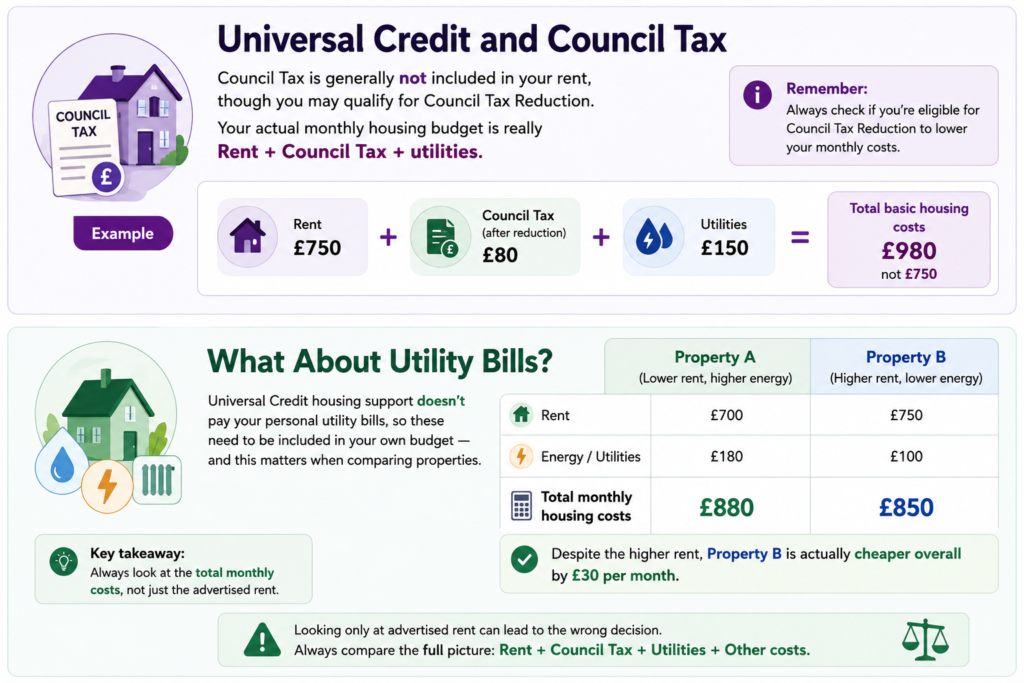
Council Tax is generally not included in your rent, though you may qualify for Council Tax Reduction. Your actual monthly housing budget is really Rent + Council Tax + utilities. For example: rent £750, Council Tax after reduction £80, utilities £150 — total basic housing costs of £980, not £750.
What About Utility Bills?
Universal Credit housing support doesn’t pay your personal utility bills, so these need to be included in your own budget — and this matters when comparing properties. Property A (rent £700, energy £180) totals £880; Property B (rent £750, energy £100) totals £850. Despite the higher rent, Property B is actually cheaper overall — looking only at advertised rent can lead to the wrong decision.
Read more:Can You Rent with Bad Credit in the UK? Complete Guide (2026)
When choosing between two properties, compare the total cost of living in each property rather than comparing rent alone. Make a simple table showing rent, expected housing support, Council Tax, energy, water, transport and other regular costs for both properties. Then calculate how much money would remain after all essential expenses. This approach can reveal differences that are easy to miss in a property listing. A home with slightly higher rent may sometimes leave you with more money each month if it has lower energy or transport costs. It also gives you a practical figure to use when deciding whether the property fits your budget.
Universal Credit and Social Housing
If you rent from a council or housing association, Universal Credit can help with eligible rent and certain service charges. But if the property has more bedrooms than your household needs, support can be reduced by 14% for one spare bedroom or 25% for two or more. For example, on eligible rent of £600, a 14% reduction is £84, leaving support of £516 — so you’d need to find the extra £84 yourself.
Other Factors That Affect Your Payment
Non-dependants: If you live with someone aged 21+ who isn’t your partner, your housing amount can be reduced — for 2026/27, the relevant contribution is £96.55 per month, though exceptions apply.
Savings: Savings of £6,000 or less don’t affect your award. Between £6,000 and £16,000, Universal Credit is reduced by £4.35 for every £250 (or part of £250) above £6,000. More than £16,000 normally means you can’t claim at all. For example, £8,000 in savings is £2,000 above the threshold — eight portions of £250 — giving a reduction of roughly £34.80 per month.
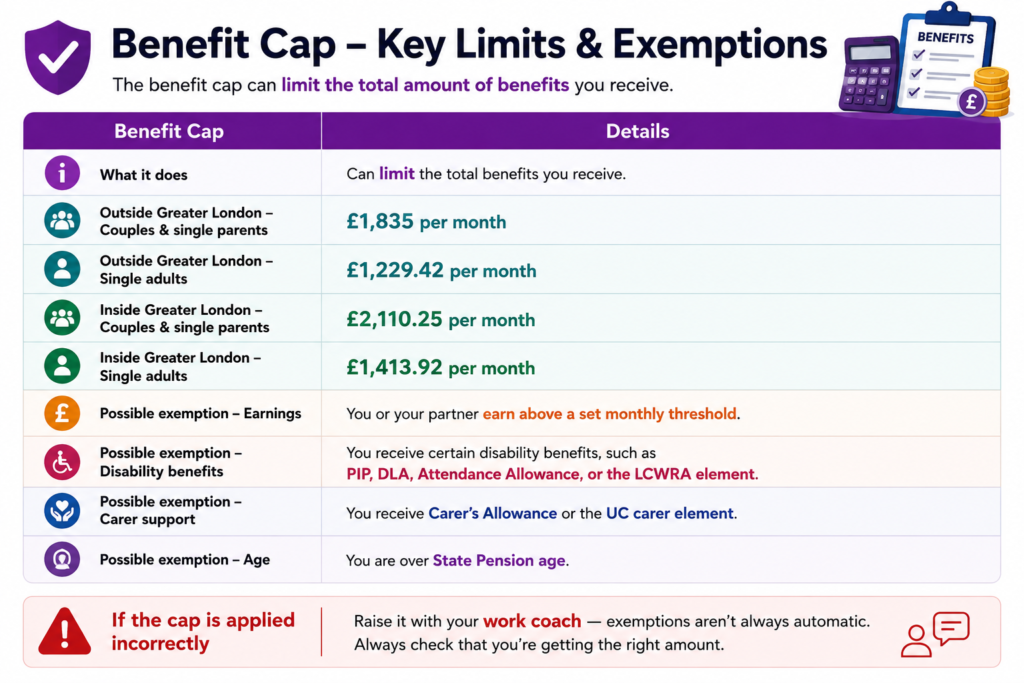
| Benefit Cap | Details |
|---|---|
| What it does | Can limit the total benefits you receive. |
| Outside Greater London – Couples & single parents | £1,835 per month |
| Outside Greater London – Single adults | £1,229.42 per month |
| Inside Greater London – Couples & single parents | £2,110.25 per month |
| Inside Greater London – Single adults | £1,413.92 per month |
| Possible exemption – Earnings | You or your partner earn above a set monthly threshold. |
| Possible exemption – Disability benefits | You receive certain disability benefits, such as PIP, DLA, Attendance Allowance, or the LCWRA element. |
| Possible exemption – Carer support | You receive Carer’s Allowance or the UC carer element. |
| Possible exemption – Age | You are over State Pension age. |
| If the cap is applied incorrectly | Raise it with your work coach — exemptions aren’t always automatic. |
How to Calculate Your Maximum Affordable Rent
Before viewing properties, run through three steps:
| Step | Item | Example |
|---|---|---|
| 1 | Add your monthly income | Universal Credit £1,100 + wages £500 = £1,600 |
| 2 | List essential non-rent expenses | Food £250 + utilities £150 + transport £100 + Council Tax £80 + phone/internet £50 + other £100 = £730 |
| 3 | Decide on a safety buffer | £150 for emergencies |
Maximum rent = £1,600 – £730 – £150 = £720. If Universal Credit only contributes £650 towards that rent, remember the remaining £70 comes from your other income.
7 Things to Check Before Renting on Universal Credit
| Check | What to Consider |
|---|---|
| LHA rate | Check your LHA rate for the property and your circumstances — don’t rely on what a landlord or friend tells you. |
| Age | Check your age — under-35s living alone may face the shared accommodation rate. |
| Rent shortfall | Calculate the rent shortfall (actual rent – expected support) and know exactly where that gap will come from. |
| Council Tax | Include Council Tax in your monthly budget. |
| Energy bills | Estimate energy bills — a cheaper property with high energy costs may not be cheaper overall. |
| Earnings | Consider your earnings — the 2026/27 work allowance is £427/month with housing support, then a 55% taper. |
| Emergency buffer | Keep an emergency buffer — a £0-margin budget leaves no room for a broken appliance or a higher bill. |
One useful step is to stress-test your budget before signing a tenancy. Calculate your monthly budget under normal circumstances, then run the same calculation with one or two realistic changes. For example, increase your estimated energy costs by £50–£100, reduce your available earnings temporarily, or include an unexpected £200 expense. If you can still pay your essential bills and rent without relying on credit or falling into arrears, your budget has more flexibility. If a small change immediately creates a shortfall, consider a lower-rent property or look for additional support before committing to the tenancy.
What If You Are Already Struggling to Pay Rent?
Don’t wait until the situation becomes an emergency. You may be able to speak to your landlord, contact your Universal Credit work Instructor, ask your council about available support, check whether your housing costs were calculated correctly, look for the lowest housing costs, consider shared housing, check for additional benefits or elements, or seek debt and budgeting advice.
Can Universal Credit Pay the Full Rent?
Sometimes, but not always. For private renters, the housing amount is limited by the relevant LHA rate and your eligible rent — if rent is £900 and LHA is £750, you get £750 and cover the remaining £150 yourself. If rent is lower than the LHA rate (e.g. rent £700, LHA £750), eligible rent is generally capped at your actual £700 rent rather than paying extra.
| Category | Details |
|---|---|
| Person | Daniel |
| Age | 38 |
| Relationship status | Single |
| Work | Part-time |
| Take-home earnings | £800 |
| Housing support | £750 |
| Rent | £800 |
| Rent shortfall | £800 – £750 = £50 |
| Total available monthly income | £1,500 |
| Council Tax | £80 |
| Utilities | £150 |
| Food | £250 |
| Transport | £80 |
| Phone/internet | £50 |
| Other | £50 |
| Total expenses | £1,460 |
| Money left | £1,500 – £1,460 = £40 |
| Overall position | Technically enough, but an extremely small safety margin. |
If he instead found a property at £700 rent, keeping everything else the same, he’d be left with £140 — showing how a £100 difference in rent can meaningfully change financial security. There’s no universal “safe rent” figure: someone on £1,500/month may be comfortable at £600 rent but struggle badly at £1,000, while someone with the same rent but £2,000 income could have a completely different experience.
Read more:Do Overtime, Bonuses, and Commission Count for Rent Affordability?
Rent Affordability Checklist
| Category | Questions to Ask |
|---|---|
| Income | How much Universal Credit do I receive? Do I have employment income? Does it change monthly? Could earnings reduce my UC? |
| Housing | What’s my rent and applicable LHA rate? Am I affected by the under-35 rule? Is this private or social housing? Are there service charges? |
| Other costs | Council Tax, energy bills, utility costs, household energy, food, transport, loan repayments, childcare or other important. |
| Safety margin | How much is remaining after important costs? Could I cover an unexpected £100–£200 bill? Would I manage if energy costs rose? Am I depending on every pound of UC to pay rent? |
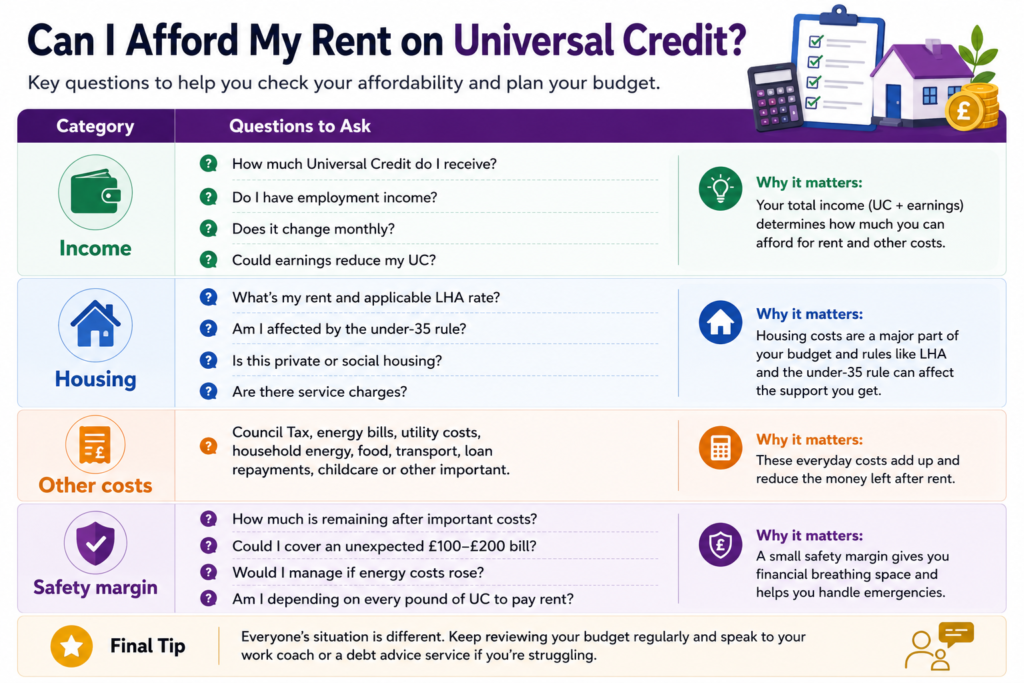
If you can’t answer these questions, you possibly shouldn’t sign the tenancy yet.
Can Universal Credit pay my entire rent?
Sometimes, but it’s not guaranteed. For private tenants, support is generally limited to the lower of your actual eligible rent and the applicable LHA rate.
Can I work and still receive Universal Credit?
Yes — earnings can reduce the payment, but you don’t lose it altogether by working.
How much can I earn before Universal Credit is reduced?
With a work allowance and housing support, the 2026/27 allowance is £427/month; above that, UC is reduced by 55p per £1 earned.
Do savings affect Universal Credit?
Yes. £6,000 or less has no effect; £6,000–£16,000 reduces your award; over £16,000 usually means you can’t claim.
Does Universal Credit include Council Tax?
No — it’s separate, though you may qualify for Council Tax Reduction depending on your local authority.
What should I do if I can’t afford my rent?
Speak to your landlord, contact your work coach, and contact your council about available support — don’t wait until arrears become severe.
What happens if my rent is higher than my LHA rate?
You’ll normally need to pay the difference yourself from your Universal Credit, wages or other income. You can also apply to your council for a Discretionary Housing Payment if you’re struggling to cover the gap.
Can someone under 35 get help with a one-bedroom flat?
Usually, a single person under 35 without a partner or children is assessed using the shared accommodation rate, but exceptions apply for certain disability benefits, care leavers, and people with a history of homelessness.
Is there a Universal Credit rent limit?
There is no single UK-wide rent limit. For private renters, the maximum support depends on the LHA rate for your specific location and household circumstances.
Will my Universal Credit go straight to my landlord?
Not usually — it’s normally paid to you, and you pay your landlord yourself. It can be redirected to your landlord through an Alternative Payment Arrangement, typically if you’re in arrears or you or your landlord request it.
Does moving to a cheaper area increase my chances of affording rent?
It can, since LHA rates vary significantly by location. But you should also weigh in changes to travel costs, job opportunities, and any support networks before deciding to move.
Can I get Universal Credit if I already live in social housing?
Yes. Eligible rent and certain service charges can be covered, though your support may be reduced if the property has more bedrooms than your household is assessed as needing (the so-called “bedroom tax”).
Does having children change how much housing support I get?
Yes. Your household size affects how many bedrooms you’re assessed as needing, which in turn affects your applicable LHA rate or any social housing bedroom reduction.
Conclusion
Yes, you can afford rent while receiving Universal Credit, but it depends on your individual circumstances rather than your Universal Credit payment alone — your age, household size, location, actual rent, LHA rate, wages, eligible UC elements, Council Tax, living costs, and whether the Benefit Cap applies all play a part.
For private renters, the key calculations are:
Rent shortfall = Actual rent – Housing support
Money left = Total income – rent – Council Tax – utilities – food – transport – other essential costs
For example, if total monthly income is £1,700 and essential costs (excluding rent) are £700, you have £1,000 to work with. A £950 rent might technically fit, but leaves only £50 spare — a £750 rent leaves £250, a much safer margin.
The goal isn’t to find the most expensive rent you can technically pay, but accommodation that leaves enough money for normal living expenses and unexpected costs. Before signing a tenancy in 2026, check your applicable LHA rate, understand how much of the rent Universal Credit may cover, calculate your rent shortfall, and build a realistic monthly budget — always confirming your circumstances against the latest official GOV.UK information.