

Rent Without Guarantor UK: Finding a rental property in the UK can be exciting, but many tenants are surprised when a landlord or letting agent asks for a guarantor. If you don’t have a family member or friend who can act as one, you may wonder whether renting is still possible.
The good news is yes—you can rent without a guarantor in the UK. While some landlords require one, many others are willing to accept alternative forms of financial security, such as paying rent in advance, providing proof of a stable income, or using a professional guarantor service.
Whether you’re a student, an international renter, self-employed, moving to the UK for work, or renting your first home, understanding your options can save you time and prevent unnecessary application rejections.
This guide explains everything you need to know about renting without a guarantor, including practical examples, affordability calculations, and proven ways to increase your chances of approval.
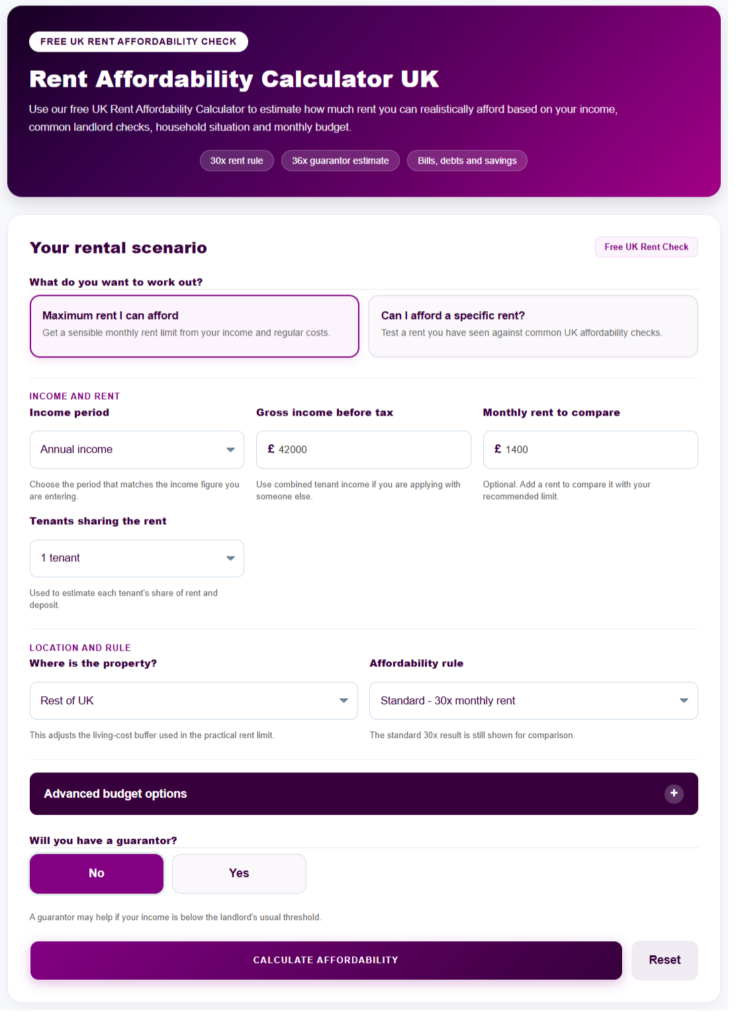
Click Here:Rent Affordability Calculator UK
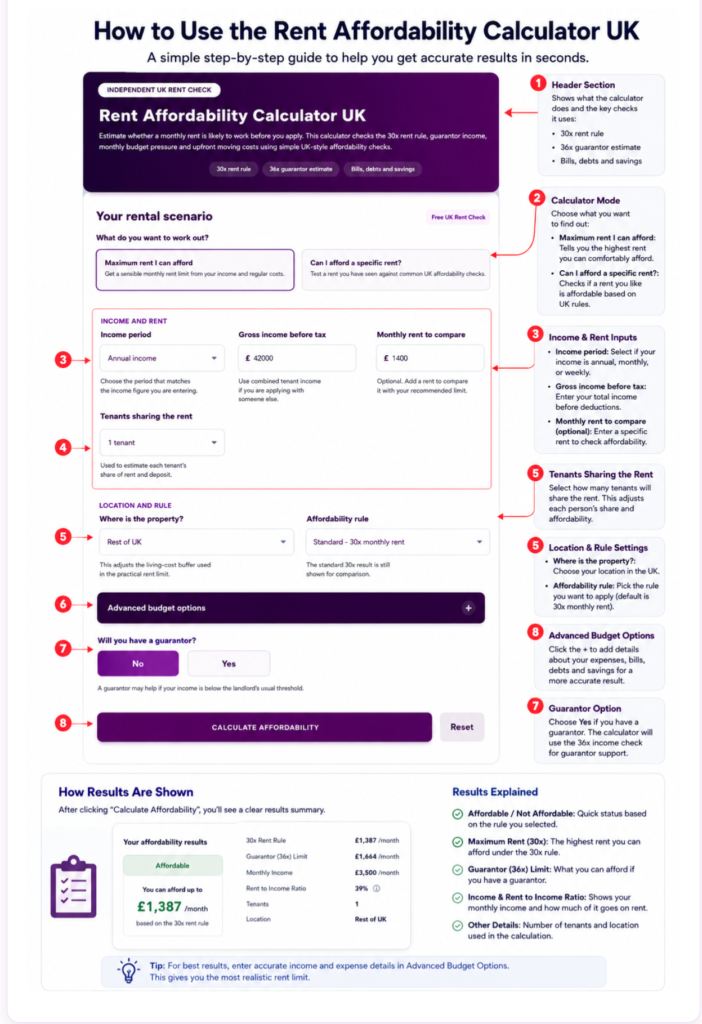
How to Use the Rent Affordability Calculator UK
What Is a Guarantor?
A guarantor is someone who agrees to pay your rent or cover any financial damage if you fail to meet your rental agreement responsibilities while trying to Rent Without Guarantor UK.
Think of a guarantor as a financial backup for the property owner.
If you stop paying rent or cause great damage to the property beyond your advance payment, the property owner can legally ask your guarantor to cover those costs
Read more: How to Calculate Your Uni Grade Using Credits and Module Weighting| Most guarantors are: | In many cases, the guarantor must: |
|---|---|
| Parents | Be over 18. |
| Close relatives | Have a good credit history. |
| Guardians | Earn enough income. |
| Trusted friends | Live in the UK (for many landlords). |
| Employers (in rare cases) | Pass reference and affordability checks. |
Why Do Landlords Ask for a Guarantor?
Property owners want to decrease financial risk.
If they believe there is a higher chance that rent payments could be missed, they may ask for additional protection.
Common Causes include:
Low Income
If your salary doesn’t meet the landlord’s affordability requirements, they may request a guarantor.
| Example | |
|---|---|
| Monthly rent | £1,200 |
| Required annual income | £1,200 × 30 = £36,000 |
| Scenario | If your salary is only £28,000, the landlord may ask for a guarantor. |
No Credit History
Many first-time renters have never taken loans or used credit cards.
Without a credit history, property owners have limited information about your financial Responsibility.
Poor Credit Score
Late payments, defaults, or County Court Judgments (CCJs) may make a property owner cautious.
International Tenant
If you’ve recently moved to the UK, you may not yet have:
- UK credit history
- UK employment records
- Previous UK landlord references
A guarantor helps reduce the landlord’s risk.
Student Tenant
Students usually don’t have a full-time income.
This is why universities and student letting agencies frequently ask for a parent or guardian to act as guarantor.
Can You Rent Without a Guarantor?
Yes.
Thousands of people rent homes in the UK every year without having a guarantor.
| Factors That Affect Your Chances of Renting Without a Guarantor |
|---|
| Your income |
| Employment status |
| Credit history |
| Rental history |
| The landlord’s policies |
| The property’s demand |
Some landlords are flexible, especially if you can demonstrate that you’re financially responsible.
Read more:Average Rent London 2026 – Borough-by-Borough Rental CostsWho Can Rent Without a Guarantor?
You may be able to rent without one if you fall into one of these Types :
| Situation | Details |
|---|---|
| Employed full-time | With a salary that clears the landlord’s affordability threshold (typically 30× the monthly rent). |
| Self-employed | Provided you can back up your income with tax returns, SA302s, or an accountant’s letter rather than payslips. |
| Retired | With a pension or investment income that’s stable and verifiable. |
| Receiving benefits | Such as Universal Credit or Housing Benefit. Some landlords and letting agents advertise as “DSS-friendly,” meaning they’ll accept tenants on benefits without insisting on a guarantor, though this varies significantly by landlord and local authority. |
| Relocating for work | Particularly with a signed employment contract and confirmed start date. |
| Able to pay rent upfront | Many property owners treat this as an acceptable substitute for guarantor security. |
| Strong references | Coming with strong references from a previous landlord or employer, especially if paired with a clean credit report. |
Understanding Rental Affordability
Most UK landlords use affordability checks before approving tenants.
A common rule is that your annual income should be 30 to 36 times the monthly rent.
Although this varies by landlord and agency, it’s one of the most widely used methods.
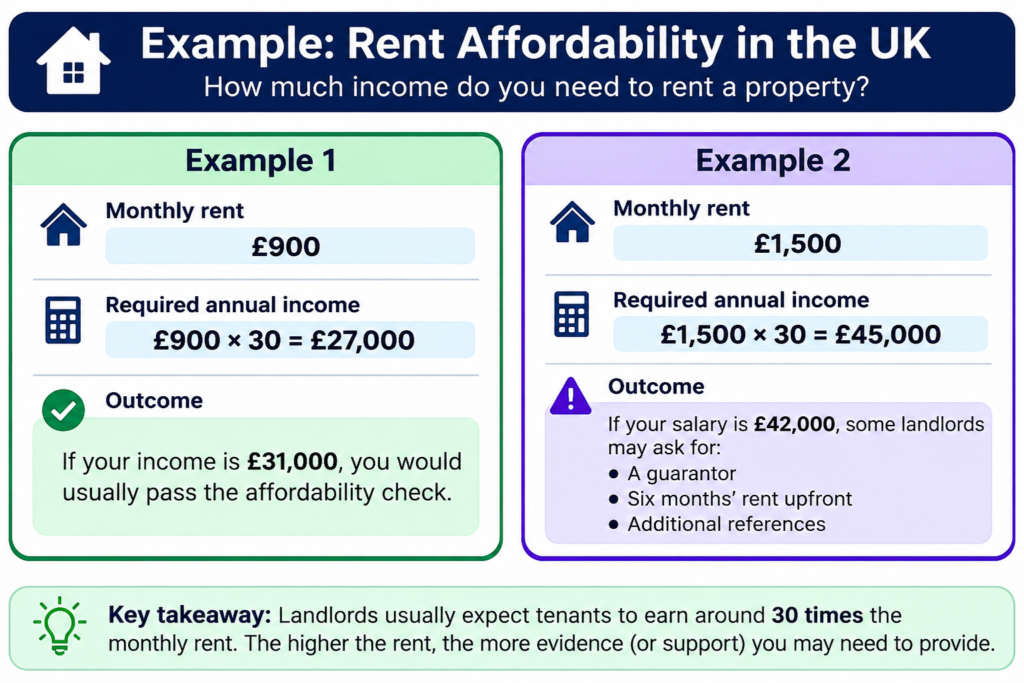
| Example 1 | |
|---|---|
| Monthly rent | £900 |
| Required annual income | £900 × 30 = £27,000 |
| Outcome | If your income is £31,000, you would usually pass the affordability check. |
| Example 2 | |
|---|---|
| Monthly rent | £1,500 |
| Required annual income | £1,500 × 30 = £45,000 |
| Outcome | If your salary is £42,000, some landlords may ask for: • A guarantor • Six months’ rent upfront • Additional references |
Example 3
Monthly rent:
£750
Annual salary:
£32,000
Calculation:
£750 × 30 = £22,500
Since your salary exceeds the requirement by £9,500, your application is likely to be stronger.
Legal Considerations to Know Before You Apply
A few legal points are worth understanding before you negotiate alternatives to a guarantor:
Deposit cap.
Under the Tenant Fees Act 2019, deposits on most assured shorthold tenancies (ASTs) with an annual rent under £50,000 are capped at five weeks’ rent.
Right to Rent checks.
All UK property owners are legally required to check a renter’s immigration status before granting a tenancy, regardless of whether a guarantor is involved. International applicants should have their passport or visa documentation ready, as this check happens independently of affordability or guarantor requirements.
Rent in advance is a “permitted payment.”
The Tenant Fees Act 2019 allows landlords to request rent in advance as an alternative to fees that are otherwise banned (like guarantor administration charges), which is part of why it’s become a common workaround for tenants without a guarantor.
Guarantor agreements are legally binding contracts.
If you do use a guarantor, they should read the agreement carefully. In most cases, their liability continues for the full length of the tenancy, including any renewal, unless the contract states otherwise.
Real-Life Example
Sarah recently moved to Manchester for a new job.
| Example | |
|---|---|
| Annual salary | £38,000 |
| Monthly rent | £1,100 |
| Required income | £1,100 × 30 = £33,000 |
Since Sarah earns more than the required amount, the landlord approved her application without asking for a guarantor.
When Are You Most Likely to Need a Guarantor?
You are more likely to need one if you:
- Have recently started a new job.
- Have no employment.
- Are a student.
- Are under 21 with no rental history.
- Have poor credit.
- Have recently declared bankruptcy.
- Have multiple missed credit payments.
- Cannot provide references.
- Are moving from another country without UK financial records.
Even in these situations, approval is still possible using alternative methods.
Benefits of Renting Without a Guarantor
| Benefit | Details |
|---|---|
| Greater independence | You remain solely responsible for your tenancy, so you’re not relying on someone else’s credit history or financial situation to secure your home—which is useful if a parent or friend has their own mortgage application pending, since being a guarantor shows up as a contingent liability on their credit file, too. |
| Faster decisions | Guarantor referencing typically adds several days to a tenancy application, since the referencing agency has to run separate credit and income checks on a second person. Skipping this step can speed up move-in, particularly useful in competitive rental markets where properties are let within days. |
| Less pressure on family or friends | A guarantor takes on legal liability for your rent—if you fall behind, they’re the ones who get chased. Renting without one avoids putting that burden on someone else. |
| More privacy | Some tenants simply prefer not to share payslips, bank statements, or personal circumstances with a parent or friend as part of the guarantor process. |
Read more:Rent Affordability Rules UK – 8 How Much Rent Can You Afford?Common Misconceptions
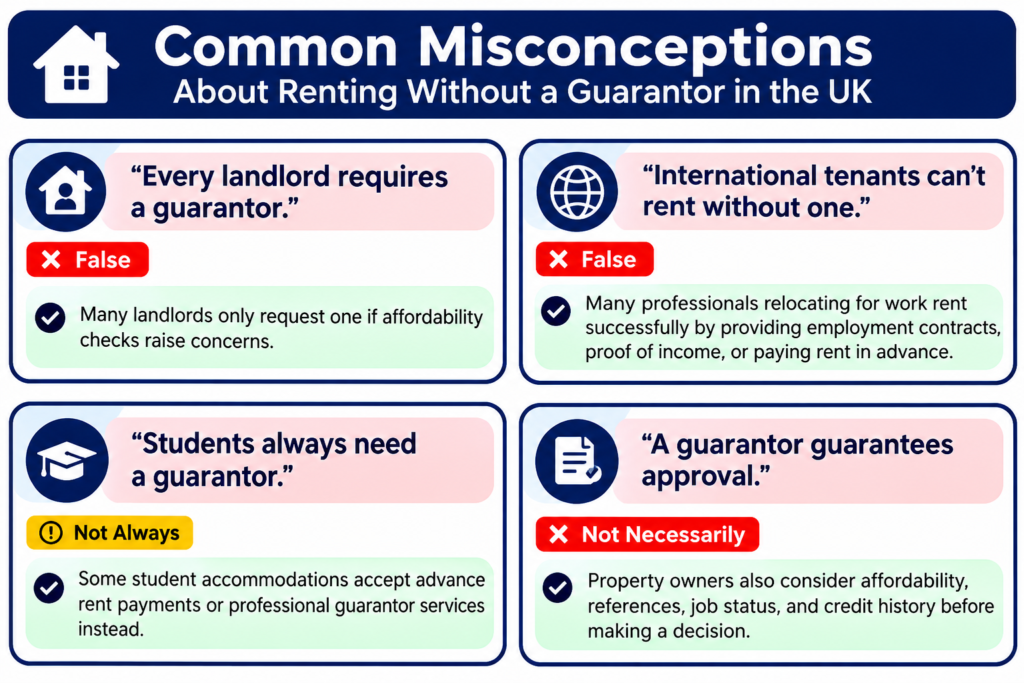
“Every landlord requires a guarantor.”
False.
Many landlords only request one if affordability checks raise concerns.
“International tenants can’t rent without one.”
False.
Many professionals relocating for work rent successfully by providing employment contracts, proof of income, or paying rent in advance.
“Students always need a guarantor.”
Not always.
Some student accommodations accept advance rent payments or professional guarantor services instead.
“A guarantor guarantees approval.”
Not necessarily.
Property owners also consider affordability, references, job status, and credit history before making a decision.
Pay Rent in Advance
One of the most common Options is paying several months’ rent upfront.
This gives property owners confidence that the rent is already covered, even if your circumstances change.
| Advance Rent Requirement | Details |
|---|---|
| 3 months’ rent in advance | Many landlords may request this. |
| 6 months’ rent in advance | A common alternative to requiring a guarantor. |
| 12 months’ rent in advance | Sometimes requested for higher-risk applications. |
The exact amount depends on your financial situation and the landlord’s policy.
Example Calculation
| Example | Amount |
|---|---|
| Monthly rent | £1,100 |
| 6 months’ rent in advance | £1,100 × 6 = £6,600 |
| Rent upfront | £6,600 |
| Tenancy deposit (if applicable) | Approximately £1,269 (based on the UK’s five-week deposit cap for many assured shorthold tenancies) |
| Total before moving in | Around £7,869 |
Although this is a high upfront cost, it can remove the need for a guarantor.
“If you go this route, ask the property owner or agent for written confirmation of how the advance payment will be protected — for instance, whether it’s held in a client account — since it isn’t covered by the same statutory deposit protection schemes as a tenancy deposit.”
Best for:
- International tenants
- Students with financial support
- Professionals relocating for work
- Self-employed tenants with savings
Provide Strong Proof of Income
If your income comfortably exceeds the affordability requirement, some landlords may not ask for a guarantor at all.
Useful documents include:
- Recent payslips
- Employment contract
- Bank statements
- P60
- Tax returns (for self-employed Candidates )
The more evidence you provide, the stronger your application becomes.
Example
| Example | Details |
|---|---|
| Monthly rent | £950 |
| Required annual income | £950 × 30 = £28,500 |
| Applicant’s salary | £40,000 |
| Income exceeds the requirement by | £11,500 |
| Outcome | This demonstrates that the rent is likely to be affordable without additional security. |
Use a Professional Guarantor Service
If you do not have a family member or friend who can act as a guarantor, you may be able to use a professional guarantor Business.
These businesses act as your guarantor in exchange for a fee, subject to their Requirements checks.
This option can be particularly useful for:
- International students
- First-time renters
- Graduates
- Young professionals
- People without UK-based relatives
Example
Monthly rent: £900
A guarantor service may charge a one-time fee or an annual fee depending on the provider and the level of cover.
While this adds to your moving costs, it may be more affordable than paying six or twelve months’ rent upfront.
“Well-known providers in this space include Housing Hand and Rent Guarantor, though acceptance varies by letting agent, so always confirm with the landlord before paying a fee.”
| Factor to Compare | Why It Matters |
|---|---|
| Fees | Compare the total cost of the guarantor service. |
| Eligibility requirements | Check whether you meet the provider’s criteria. |
| Refund policies | Understand when you can receive a refund, if applicable. |
| Landlord acceptance | Ensure your landlord accepts the guarantor service. |
| Coverage period | Confirm how long the guarantee remains valid. |
Show Excellent Credit History
A good credit report reassures landlords that you manage your finances responsibly.
Although there is no universal “minimum credit score” required to rent, landlords often look for evidence that you:
- Pay bills on time
- Have no serious defaults or CCJs
- Use credit responsibly
- Have a stable financial history
Example
| Tenant | Financial Profile |
|---|---|
| Tenant A | Stable employment, no missed payments, and a good credit history. |
| Tenant B | Several recent missed payments and outstanding debts. |
Even if both earn similar salaries, Tenant A is generally more likely to be approved without a guarantor.
Provide Strong References
References can give confidence to property owners that you are a reliable renter.
Useful references include:
Previous Landlord Reference
This may confirm that you:
- Paid rent on time
- Looked after the property
- Followed tenancy rules
- Left the property in good condition
Employer Reference
An employer can confirm:
- Your job title
- Salary
- Employment status
- Whether your role is permanent
Character Reference
Some landlords may also accept references from:
- University tutors
- Solicitors
- Accountants
- Professional mentors
Strong references help compensate for a lack of guarantor.
Improve Your Rental Application
| Section | Details |
|---|---|
| Many renters | Minimize how much a prepared application can impact a property owner’s decision. |
| Include as many required documents as possible, such as: | • Photo ID• Proof of address• Recent bank statements• Payslips• Employment contract• Previous tenancy agreement• Reference letters |
| Benefit | A complete application signals that you’re organised and serious about renting. |
Choose Properties Within Your Budget
One of the easiest ways to avoid needing a guarantor is to apply for homes that comfortably fit your income.
Example
| Example | Details |
|---|---|
| Annual salary | £33,000 |
| Using the 30× affordability guideline | £33,000 ÷ 30 = £1,100 |
| Affordable monthly rent | A monthly rent of around £1,100 or less is more likely to meet the affordability requirement. |
| If applying for a property costing £1,500 per month | The landlord may ask for:• A guarantor• Rent in advance• Additional financial evidence |
Staying within your budget increases your chances of approval.
Offer Additional Reassurance
Some landlords value open communication.
If your application has a weakness, for example, you’re starting a new job, explain your situation clearly and provide supporting Verification.
| Supporting Documents |
|---|
| A signed employment contract |
| Confirmation of your start date |
| Savings statements |
| Proof of past rental payments |
Clear communication can build trust and make a property owner more comfortable renting to you.
Original jumps quickly from a bullet list into a table. Add this one-line bridge before the table:
“Each of these alternatives suits different circumstances — the table below breaks down which option fits which type of tenant, and what trade-offs to expect.”
Read more:Rent to Income Ratio Calculator UK – 7 Easy Ways to Save MoneyHow to Approach a Landlord Without a Guarantor
If you do not have a guarantor, don’t simply submit your application and wait for the landlord to decide. A better approach is to explain your financial situation clearly before or during the application process.
For example, if you have a stable job but no UK-based guarantor, tell the letting agent that you can provide your employment contract, recent payslips, bank statements, previous landlord references, or other evidence of your ability to pay the rent.
You can also ask one simple question before paying any application or moving costs:
“I don’t have a UK-based guarantor. Would you consider my application if I provide proof of income, references, and other financial evidence?”
If the answer is yes, ask exactly which documents they would like to see. This can prevent you from spending time applying for properties where a guarantor is a strict requirement.
It is also useful to prepare a short rental application summary containing:
- Your annual salary or regular income
- Your current employment status
- Your proposed move-in date
- Your previous rental history
- Your available savings, where relevant
- The alternative security you can offer, such as rent in advance
For example, an applicant earning £42,000 per year who wants to rent a £1,100-per-month property could explain that their income is above the common 30-times affordability calculation (£33,000) and that they can provide employment and rental references.
This approach gives the landlord useful information upfront instead of leaving them to guess why you do not have a guarantor.
A Simple Application Checklist
Before contacting a landlord or letting agent, make sure you have:
- Proof of identity and Right to Rent documents where required
- Recent payslips or other income evidence
- Employment contract or employer confirmation
- Recent bank statements if requested
- Previous landlord reference, if available
- Proof of savings if you plan to offer rent in advance
- A clear explanation of why you do not have a guarantor
- Confirmation that the landlord accepts your proposed alternative
Being prepared does not guarantee approval, but it can make your application easier to assess and may help you stand out from applicants who provide incomplete information.
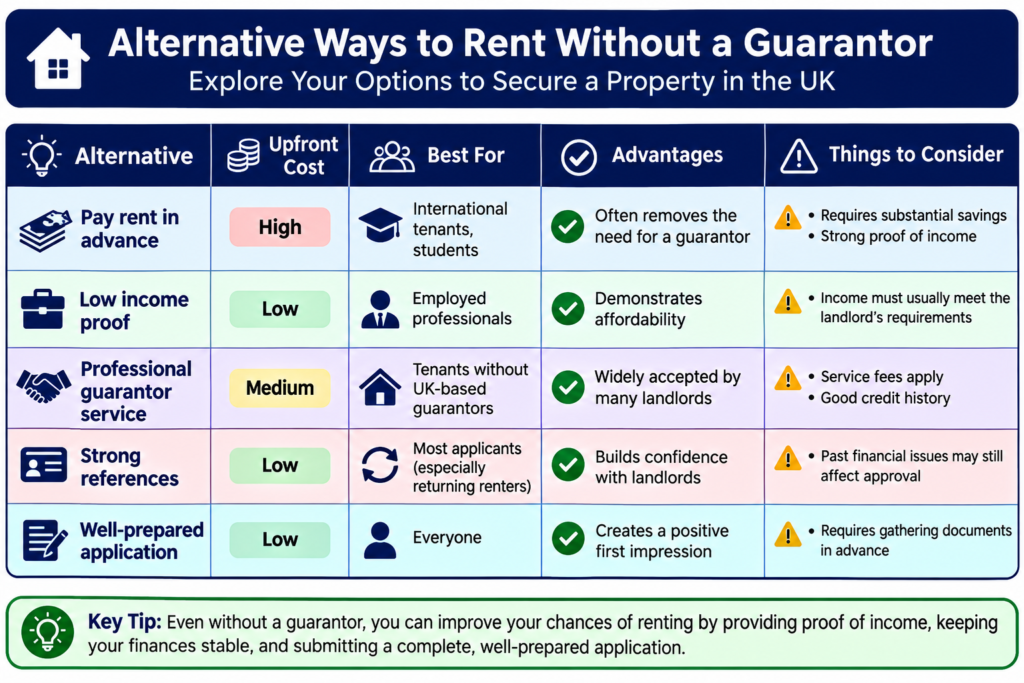
Comparing Your Options
| Alternative | Upfront Cost | Best For | Advantages | Things to Consider |
| Pay rent in advance | High | International tenants, students | Often removes the need for a guarantor | Requires substantial savings |
| Strong proof of income | Low | Employed professionals | Demonstrates affordability | Income must usually meet the landlord’s requirements |
| Professional guarantor service | Medium | Tenants without UK-based guarantors | Widely accepted by many landlords | Service fees apply |
| Good credit history | Low | Most applicants | Builds confidence with landlords | Past financial issues may still affect approval |
| Strong references | Low | Returning renters | Shows a history of reliability | First-time renters may have fewer references |
| Well-prepared application | Low | Everyone | Creates a positive first impression | Requires gathering documents in advance |
Real-Life Examples
Example 1: International Professional
| Example | Details |
|---|---|
| Applicant | Ahmed |
| Situation | Moves to Birmingham after accepting a software engineering job. |
| Annual salary | £48,000 |
| Monthly rent | £1,300 |
| UK guarantor | No UK guarantor |
| He provides | • Employment contract• Six months’ rent in advance• Passport• Bank statements |
The landlord approves his application without requiring a guarantor.
Example 2: University Student
Emily is beginning her first year at university.
She doesn’t have a UK-based guarantor.
Instead, she pays:
- One academic term’s rent in advance
Her student accommodation accepts this arrangement, allowing her to move in.
Example 3: Self-Employed Designer
James has been self-employed for four years.
Instead of payslips, he provides:
- Two years of tax returns
- Accountant’s confirmation letter
- Business bank statements
- Proof of savings
The landlord is satisfied with the evidence and agrees to the tenancy without a guarantor.
Mistakes to Avoid
Many rental applications are delayed or rejected because of avoidable mistakes.
| Try to avoid the following: |
|---|
| Applying for properties beyond your budget. |
| Hiding information from the landlord. |
| Providing incomplete documents. |
| Ignoring affordability requirements. |
| Assuming every landlord has the same rules. |
| Waiting until the last minute to prepare your paperwork. |
| Failing to check your credit report before applying. |
| Not asking the landlord whether alternatives to a guarantor are acceptable. |
A little preparation can significantly improve your chances of success.
Who Is Most Likely to Rent Without a Guarantor?
Although every landlord has different requirements, some applicants are naturally seen as lower risk.
Full-Time Employees
If you have a permanent job with a stable salary, property owners regularly feel more confident about your ability to pay rent regularly.
Example
Annual salary: £42,000
Monthly rent: £1,200
Affordability calculation:
£1,200 × 30 = £36,000
Since the applicant earns £6,000 more than the affordability requirement, they are less likely to need a guarantor.
Professionals Relocating for Work
Many people move to the UK after accepting a new job.
| Even if they don’t have a UK guarantor, landlords may accept: |
|---|
| A signed employment contract |
| Confirmation of salary |
| A relocation letter from the employer |
| Several months’ rent in advance |
This combination often provides enough reassurance.
Self-Employed Applicants
Being self-employed doesn’t naturally mean you will need a guarantor.
Property owners usually want evidence that your income is stable.
Helpful documents include:
- SA302 tax calculations
- HMRC tax overviews
- Business bank statements
- Accountant’s reference
- Recent invoices or contracts
If your income has been consistent over the last two or three years, your application can be just as strong as someone in full-time employment.
Retired Tenants
Retired applicants can also rent without a guarantor if they have reliable income from:
- A workplace pension
- A private pension
- State pension
- Investments
- Savings
Landlords are generally interested in whether your income is dependable, not whether you’re employed.
Tenants With Excellent Rental History
A positive rental record can significantly improve your chances.
| If your previous landlord confirms that you: |
|---|
| Paid rent on time |
| Looked after the property |
| Communicated well |
| Completed the tenancy without issues |
Future property owners may feel comfortable renting to you without asking for a guarantor.
Practical Tips to Increase Your Chances of Approval
Competition for rental properties can be high, mainly in major UK cities. A prepared application can make a real difference.
Apply Quickly
Attractive properties often receive multiple applications within a few days.
If you have already collected your documents, you can respond faster than other Candidates.
Keep Your Documents Organised
| Create a folder containing: |
|---|
| Passport or driving licence |
| Proof of address |
| Payslips |
| Employment contract |
| Bank statements |
| References |
| Credit report (if available) |
Having everything ready saves time and shows that you are a serious Candidate.
Be Honest About Your Situation
If you have recently changed jobs, are self-employed, or have moved to the UK, explain your situation clearly.
Property owners generally value Clarity more than Unexpected events during the reference check process.
Check Your Affordability Before Applying
Applying for properties outside your budget can lead to unnecessary rejections.
Example
Annual salary: £39,000
Using the common affordability guideline:
£39,000 ÷ 30 = £1,300
Looking for properties around £1,300 per month or less is likely to improve your chances of passing affordability checks.
Maintain Good Financial Habits
Before applying for a rental property:
- Pay bills on time.
- Avoid missed credit payments.
- Reduce unnecessary debt where possible.
- Keep enough savings for moving costs.
Strong financial habits help build confidence with landlords and referencing agencies.
Common Questions About Renting Without a Guarantor
Can I rent in the UK if I don’t have family here?
Yes.
Many International workers and students successfully rent without UK-based relatives by providing proof of earnings, paying rent in advance, or using a professional guarantor service if accepted by the property owner.
Can students rent without a guarantor?
| Can students rent without a guarantor? | Details |
|---|---|
| Yes, in some situations. | Some student accommodation providers accept: • Rent in advance • Scholarship funding • International guarantor services |
Requirements vary, so it’s important to ask before applying.
Can I use my employer instead of a guarantor?
Some landlords may accept an employer reference confirming your employment and salary. However, employers do not usually act as legal guarantors.
Does having savings help?
Yes.
Savings can reassure landlords that you have a financial cushion.
Example
Monthly rent: £900
Savings: £12,000
Even if your income is slightly below the affordability guideline, substantial savings may strengthen your application when considered alongside other factors.
Will bad credit automatically stop me renting?
Not necessarily.
Some landlords focus on your current financial situation rather than past difficulties.
| You may improve your chances by: |
|---|
| Explaining previous credit issues honestly |
| Providing proof of stable employment |
| Offering rent in advance |
| Supplying strong references |
Can I negotiate with the landlord?
Yes.
Some landlords are willing to discuss alternatives, especially if you have:
- A stable income
- Good references
- Savings
- Flexible move-in dates
- A Readiness to pay some rent in advance
Every property owner is different, so it’s worth having the conversation.
Example: Comparing Three Applicants
| Applicant | Income | Monthly Rent | Guarantor | Likely Outcome |
| Emma | £34,000 | £900 | No | Strong chance of approval because her income comfortably meets Reasonable price requirements and she has good references. |
| Daniel | £26,000 | £1,100 | No | May be asked to pay rent in advance, provide additional financial evidence, or use a guarantor service because the rent takes up a larger share of his income. |
| Sophia | £48,000 | £1,200 | No | Excellent Approval chances due to a strong salary, stable job, and a reasonable price well above the common guideline. |
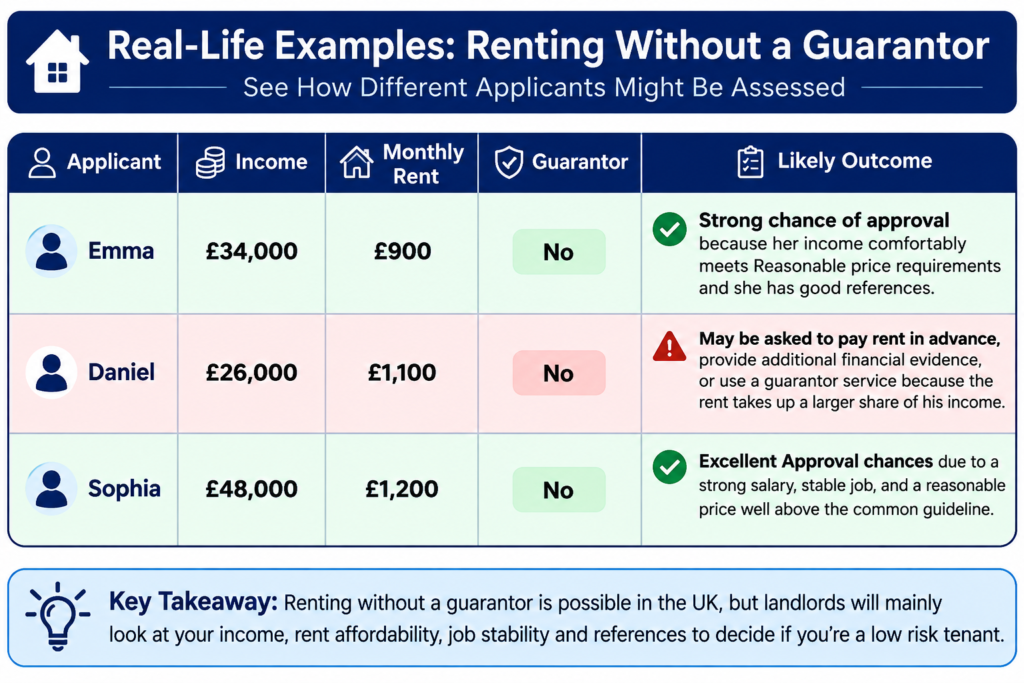
This comparison shows why earnings, Reasonable price, and supporting documents regularly matter more than simply having a guarantor.
Read more:Rent vs Buy Calculator UK – Should You Rent or Buy a Home?Can I rent without a guarantor in the UK?
Yes. Many landlords will consider applicants without a guarantor if they can demonstrate affordability, provide strong references, or offer alternatives such as paying rent in advance.
Why do landlords ask for a guarantor?
A guarantor provides additional financial security if the tenant cannot meet their rent or tenancy obligations.
Can international tenants rent without a guarantor?
Yes. International tenants may strengthen their application with an employment contract, proof of income, savings, or rent paid in advance.
Do all UK landlords require a guarantor?
No. Requirements vary between landlords and letting agents. Many only request a guarantor when affordability or referencing raises concerns.
Is paying rent in advance a good alternative?
For many tenants, yes. Paying several months’ rent upfront can reassure landlords and may remove the need for a guarantor.
Can self-employed people rent without a guarantor?
Yes. Providing tax returns, accountant references, and business bank statements can demonstrate stable income and improve the likelihood of approval.
What documents can replace a guarantor?
Landlords may accept proof of employment, recent payslips, bank statements, a strong credit report, or a reference from a previous landlord as alternatives to a guarantor.
Can students rent without a guarantor?
It’s harder, since students often lack a steady income or credit history, but some landlords accept a larger deposit, rent paid in advance, or a guarantor-replacement scheme instead.
What is a guarantor service, and how does it work?
A guarantor service is a paid third party that acts as your guarantor for a fee, usually a percentage of the annual rent, offering landlords the same financial protection without needing a friend or family member.
Does having a poor credit score mean I need a guarantor?
Not always. A poor credit score increases the chance a landlord will ask for one, but strong affordability evidence or advance rent payments can sometimes offset this.
How much rent in advance do landlords typically ask for?
This varies, but it’s common for landlords to request three to six months’ rent upfront when a guarantor isn’t provided.
Can I use a guarantor who lives outside the UK?
Some landlords accept overseas guarantors, but many require the guarantor to be a UK resident with a UK income and bank account, so it’s worth checking with the landlord or agent first.
Are guarantors required for all types of tenancies?
No. Requirements can differ between assured shorthold tenancies, student housing, and HMOs (houses in multiple occupation), with some tenancy types more likely to request one than others.
Conclusion
A guarantor can make the renting process easier for some Candidates, but it is not the only path to securing a home in the UK. By understanding Reasonable price expectations, preparing strong financial evidence, and exploring Options when necessary, you can confidently apply for properties that suit your budget and conditions.
If you’re starting your first job, moving from across the sea, studying at university, or running your own business, careful preparation is the key to renting successfully without a guarantor. A well-presented application gives property owners confidence—and that confidence can make all the difference.