
Imagine this. You’ve found a flat you love at £1,100 a month and budgeted carefully for the move. Then the letting agent emails an invoice for letting agent fees: £250 “administration”, £150 “referencing”, £120 “check-in inventory”, £200 for your guarantor. Suddenly the move costs nearly £2,000 more than planned.
If that invoice landed on your doormat before June 2019, there was very little you could do about it. Today, in England, almost every one of those charges is illegal. The Tenant Fees Act 2019 swept away the great majority of fees landlords and letting agents used to charge, capped deposits, and gave renters clear routes to get unlawful charges refunded — and the Renters’ Rights Act 2025 has now closed the last big loophole, banning rent demanded before a tenancy is even signed. This guide explains exactly what you can and cannot be charged, what to do if you’ve been overcharged, and how the rules differ across the UK.
The Quick Answer
In England, landlords and letting agents can only charge you a short list of “permitted payments”: your rent, a tenancy deposit (capped at five weeks’ rent, or six weeks if your annual rent is £50,000 or more), a holding deposit (capped at one week’s rent), limited default fees for late rent or lost keys, a capped £50 fee for tenancy changes you request, your early-termination costs, and bills such as council tax and utilities where your agreement makes you responsible for them. Everything else — admin fees, referencing, credit checks, guarantor fees, check-in and check-out fees, cleaning fees and renewal fees — is a banned “prohibited payment”. If you’ve paid one, you can get it back.
Who Do the Letting Fee Rules Apply To?
The Tenant Fees Act 2019 applies in England to most private renting arrangements, including:
- an assured shorthold tenant (the most common type of private tenancy in England)
- an assured tenant
- renting student accommodation from a private landlord
- living under a licence to occupy (for example, some lodger arrangements)
- a lodger living with a private landlord
- a property guardian
The ban also covers fees charged to your guarantor — an agent cannot sidestep the rules by billing the person guaranteeing your rent instead of you. The Act came into force for new tenancies on 1 June 2019 and has applied to all relevant tenancies since 1 June 2020, so even long-running tenancies are covered now.
A few arrangements sit outside the Act, including most social housing and long leases. For the typical private renter, though, the answer is yes — you’re protected from letting agent fees.
Which Letting Agent Fees Are Banned?
The golden rule for letting agent fees is simple: if a payment is not on the official list of permitted payments, it is banned. The Act calls these “prohibited payments”, and any clause in your tenancy agreement that requires one is not binding on you — the rest of the agreement still stands.
Here are the letting agent fees you should never be asked to pay:
| Banned payment | What it usually looks like |
|---|---|
| Administration/set-up fees | “Tenancy set-up”, “application fee”, “contract fee” or any charge for the agent’s time in creating your tenancy |
| Referencing fees | Charges for employer, landlord or personal references — even if the agent paid a third party to do them |
| Credit check fees | Any charge for checking your credit history |
| Guarantor fees | Charging you (or your guarantor) for arranging, checking or documenting a guarantor — our guarantor guide explains how guarantors normally work |
| Check-in and check-out fees | Charges for inspections when you move in or out, including the inventory |
| Professional cleaning fees | A compulsory end-of-tenancy “professional clean” fee. Your landlord can still ask you to leave the property clean, and can claim for actual damage, but cannot force you to pay for a cleaning company |
| Renewal/extension fees | Charges for renewing your tenancy or signing a new fixed term |
| Viewing fees | Being charged simply to look around a property |
| Permitted occupier fees | Fees for adding someone else to live in the property |
| End-of-tenancy fees | “Check-out administration”, “deposit release fees” or similar charges when you leave |
| Right to rent check fees | The landlord must carry out immigration checks in England, but cannot bill you for them |
Be alert to renamed letting agent fees. An agent that used to charge a “referencing fee” might now invoice you for “tenant verification services”. The name on the invoice doesn’t matter — if the payment isn’t a permitted payment, it’s banned, and agents cannot dodge the ban by asking you to pay a third party for these services either.
What Letting Agent Fees Can You Still Be Charged?
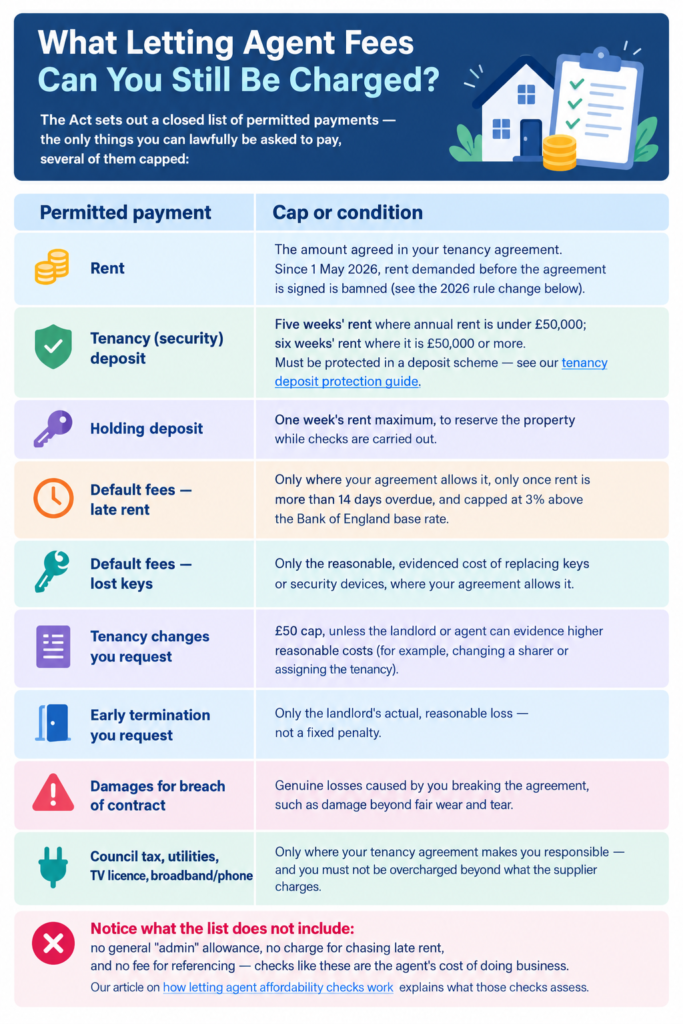
The Act sets out a closed list of permitted payments — the only things you can lawfully be asked to pay, several of them capped:
| Permitted payment | Cap or condition |
|---|---|
| Rent | The amount agreed in your tenancy agreement. Since 1 May 2026, rent demanded before the agreement is signed is banned (see the 2026 rule change below) |
| Tenancy (security) deposit | Five weeks’ rent where annual rent is under £50,000; six weeks’ rent where it is £50,000 or more. Must be protected in a deposit scheme — see our tenancy deposit protection guide |
| Holding deposit | One week’s rent maximum, to reserve the property while checks are carried out |
| Default fees — late rent | Only where your agreement allows it, only once rent is more than 14 days overdue, and capped at 3% above the Bank of England base rate |
| Default fees — lost keys | Only the reasonable, evidenced cost of replacing keys or security devices, where your agreement allows it |
| Tenancy changes you request | £50 cap, unless the landlord or agent can evidence higher reasonable costs (for example, changing a sharer or assigning the tenancy) |
| Early termination you request | Only the landlord’s actual, reasonable loss — not a fixed penalty |
| Damages for breach of contract | Genuine losses caused by you breaking the agreement, such as damage beyond fair wear and tear |
| Council tax, utilities, TV licence, broadband/phone | Only where your tenancy agreement makes you responsible — and you must not be overcharged beyond what the supplier charges |
Notice what the list does not include: no general “admin” allowance, no charge for chasing late rent, and no fee for referencing — checks like these are the agent’s cost of doing business. Our article on how letting agent affordability checks work explains what those checks assess.
Tenancy Deposit Caps: The 5-Week and 6-Week Rules
Your tenancy deposit is the biggest single payment most renters make, so the cap matters. The rule is straightforward:
| Your annual rent | Maximum tenancy deposit |
|---|---|
| Under £50,000 a year | Five weeks’ rent |
| £50,000 a year or more | Six weeks’ rent |
To work out a week’s rent from a monthly figure, use the official formula: monthly rent × 12 ÷ 52. For a £1,100-a-month flat, one week’s rent is £1,100 × 12 ÷ 52 = £253.85, and the maximum deposit is 5 × £253.85 = £1,269.23. Check your own figures with our rental deposit calculator.
Illustrative example — Marcus, London. Marcus agrees a flat at £4,500 a month — £54,000 a year, above the £50,000 threshold. One week’s rent is £4,500 × 12 ÷ 52 = £1,038.46, so his maximum lawful deposit is 6 × £1,038.46 = £6,230.77. If his agent asks for two months’ rent (£9,000), the excess £2,769.23 is a prohibited payment and must be refunded.
Remember the deposit must also be protected in a government-approved scheme within 30 days.
Holding Deposits: The 1-Week Cap and the 15-Day Rule
A holding deposit reserves the property while referencing and pre-tenancy checks happen. The key rules:
- The cap is one week’s rent — monthly × 12 ÷ 52. For a joint tenancy, the cap is one week’s total rent for the property, not one week per person.
- Both sides then have 15 days — the “deadline for agreement” — to take all reasonable steps towards signing. You can agree a different deadline in writing.
- If the tenancy goes ahead, the holding deposit must be refunded within 7 days of signing, or put towards your first rent or tenancy deposit with your consent.
- If the landlord pulls out, or the deadline passes and it wasn’t your fault, you get the full amount back.
The landlord or agent can only keep your holding deposit in four situations:
| Situation | Can they keep it? |
|---|---|
| You withdraw from the proposed tenancy | Yes |
| You gave false or misleading information that reasonably affected their decision to let to you | Yes |
| You fail a right to rent check (and they couldn’t reasonably have known you would) | Yes |
| You fail to take all reasonable steps to enter the agreement — for example, ignoring reasonable requests for information — while they did their part | Yes |
| The landlord pulls out or the 15 days pass through no fault of yours | No — full refund |
| The tenancy goes ahead | No — refunded within 7 days or applied to rent/deposit with your consent |
If they keep it, they must explain in writing within 7 days why, with evidence — miss that deadline and you’re automatically entitled to it back. Work out the maximum you can be asked for with our holding deposit calculator.
Illustrative example — Tom and Ellie, Leeds. Tom and Ellie take a two-bedroom flat at £950 a month. Their agent asks for a £219 holding deposit each. That’s wrong: one week’s rent is £950 × 12 ÷ 52 = £219.23 in total for the property. When they sign 10 days later, the £219.23 must be refunded within 7 days or — with their agreement — knocked off their first month’s rent.
Default Fees: Late Rent and Lost Keys
Default fees are the most tightly limited charges in the whole Act. Only two kinds are permitted in England, both must be written into your tenancy agreement, and both are capped:
| Default | What can be charged |
|---|---|
| Late payment of rent | Interest only, and only once the rent is more than 14 days overdue. The rate is capped at 3% above the Bank of England base rate (as an annual rate, applied per day overdue). No “admin fee” for chasing the rent |
| Lost keys or security devices | The reasonable cost of replacement only — evidenced in writing, such as a receipt. You don’t have to pay until you’ve seen the evidence |
Illustrative example — Priya, Manchester. Priya’s rent is £1,100 a month. She falls 30 days behind. Suppose the Bank of England base rate is 4% at the time, making the maximum lawful rate 7% a year. The most she can be charged is £1,100 × 7% × 30 ÷ 365 = £6.33. Her agent cannot add a £50 “late payment administration fee” on top — that would be a prohibited payment.
Note the contrast: the lawful interest on a whole month’s late rent is typically a few pounds. If you’re being charged £40 or £50 in letting agent fees for paying rent late, something is wrong.
Rent in Advance: The Big 2026 Rule Change
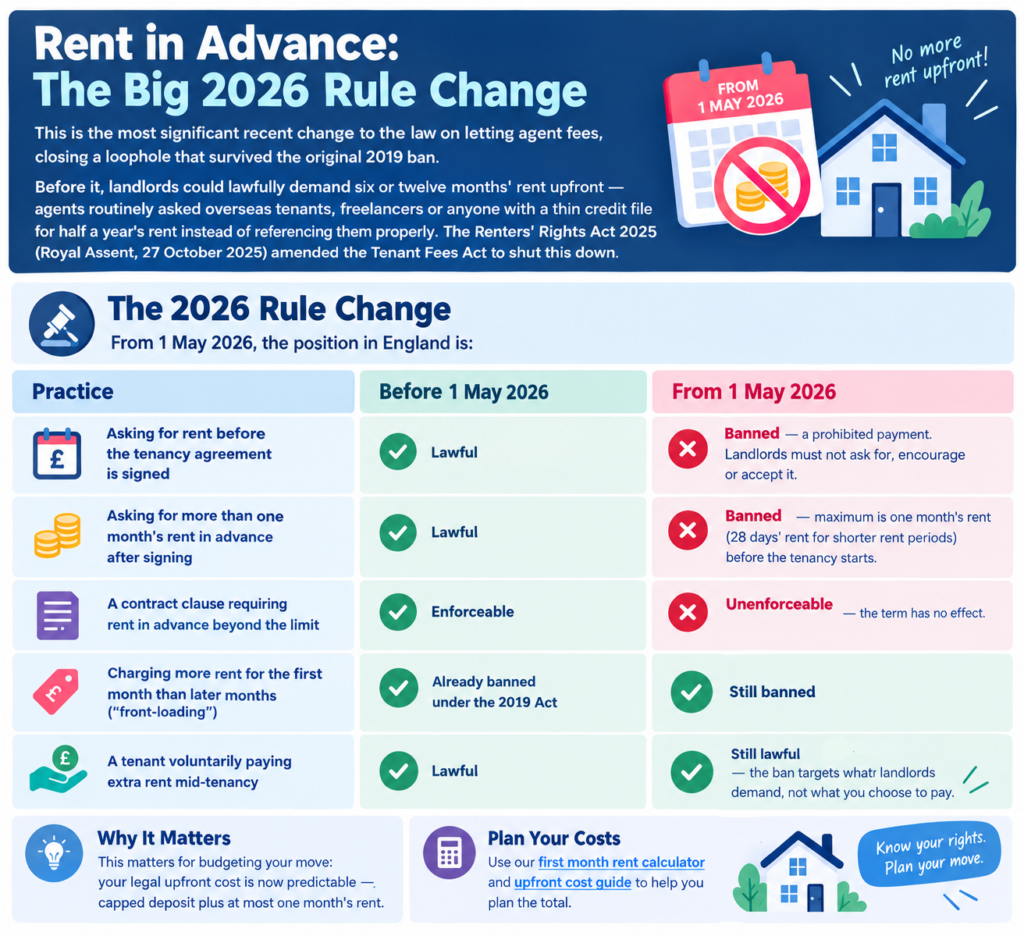
This is the most significant recent change to the law on letting agent fees, closing a loophole that survived the original 2019 ban. Before it, landlords could lawfully demand six or twelve months’ rent upfront — agents routinely asked overseas tenants, freelancers or anyone with a thin credit file for half a year’s rent instead of referencing them properly. The Renters’ Rights Act 2025 (Royal Assent, 27 October 2025) amended the Tenant Fees Act to shut this down.
From 1 May 2026, the position in England is:
| Practice | Before 1 May 2026 | From 1 May 2026 |
|---|---|---|
| Asking for rent before the tenancy agreement is signed | Lawful | Banned — a prohibited payment. Landlords must not ask for, encourage or accept it |
| Asking for more than one month’s rent in advance after signing | Lawful | Banned — maximum is one month’s rent (28 days’ rent for shorter rent periods) before the tenancy starts |
| A contract clause requiring rent in advance beyond the limit | Enforceable | Unenforceable — the term has no effect |
| Charging more rent for the first month than later months (“front-loading”) | Already banned under the 2019 Act | Still banned |
| A tenant voluntarily paying extra rent mid-tenancy | Lawful | Still lawful — the ban targets what landlords demand, not what you choose to pay |
This matters for budgeting your move: your legal upfront cost is now predictable — capped deposit plus at most one month’s rent. Our first month rent calculator and upfront cost guide can help you plan the total.
How to Check Whether Letting Agent Fees Are Legal
Before you pay any letting agent fees beyond rent and deposits, run through these checks:
- Ask for the permitted payment. Say: “Which permitted payment under the Tenant Fees Act is this?” A lawful charge must match the permitted list above. Vague answers are a red flag.
- Check the agent’s published fee list. Letting agents must prominently display a full list of their fees on their website and in each office. If the fee isn’t on it — or there is no list — that’s a warning sign.
- Check the agent’s redress scheme. Every letting agent must belong to a government-approved redress scheme (such as The Property Ombudsman or the Property Redress Scheme), offering free, independent dispute resolution. The details should be on the agent’s website.
- Ask about client money protection. Your agent should belong to a client money protection scheme, which protects money you pay them if the business goes under.
- Get everything in writing and keep receipts. Pay by bank transfer where possible. If you pay cash, get a receipt stating exactly what the payment was for.
- Do the maths on deposits. Work out one week’s rent (monthly × 12 ÷ 52) and check the deposit and holding deposit against the caps.
Charged Banned Letting Agent Fees? How to Get Your Money Back
If you’ve already paid letting agent fees that turn out to be banned, don’t write them off. The government’s own tenant guidance sets out a clear escalation path:
| Route | When to use it | What it can do |
|---|---|---|
| 1. Ask the landlord or agent directly | Always start here. Write (don’t just phone) asking for the return of the specific payment, naming it as a prohibited payment under the Tenant Fees Act 2019 | Many agents refund immediately once challenged in writing |
| 2. Complain to the redress scheme | If a letting agent charged you and won’t refund. Find their scheme on the agent’s website | Free, independent adjudication; can order an apology or compensation |
| 3. Report to trading standards | If the landlord or agent still won’t pay up. Trading standards teams sit within your local council | Can take formal enforcement action, order repayment (with interest), and fine the landlord or agent |
| 4. Apply to the First-tier Tribunal | As a last resort, or alongside the above. You apply directly — no solicitor needed | Can order the landlord or agent to repay the money. A small application fee may apply, with help available if you’re on a low income |
A few points worth knowing about banned letting agent fees:
- Keep your evidence. Invoices, emails, bank statements and notes of phone calls all count. The government’s guidance includes template letters for requesting a refund.
- Eviction protection. Under the 2019 Act, a landlord could not serve a valid section 21 “no-fault” eviction notice until banned fees were repaid. (No-fault evictions themselves were reformed by the Renters’ Rights Act 2025 — but unlawful charges must still be put right.)
- Fines bite. A first breach can mean a £5,000 penalty. Breaching again within five years is a criminal offence carrying an unlimited fine or a banning order — or a penalty of up to £30,000 instead of prosecution. The government estimated the ban would save tenants £240 million a year in England.
How the Rules Differ in Wales, Scotland and Northern Ireland
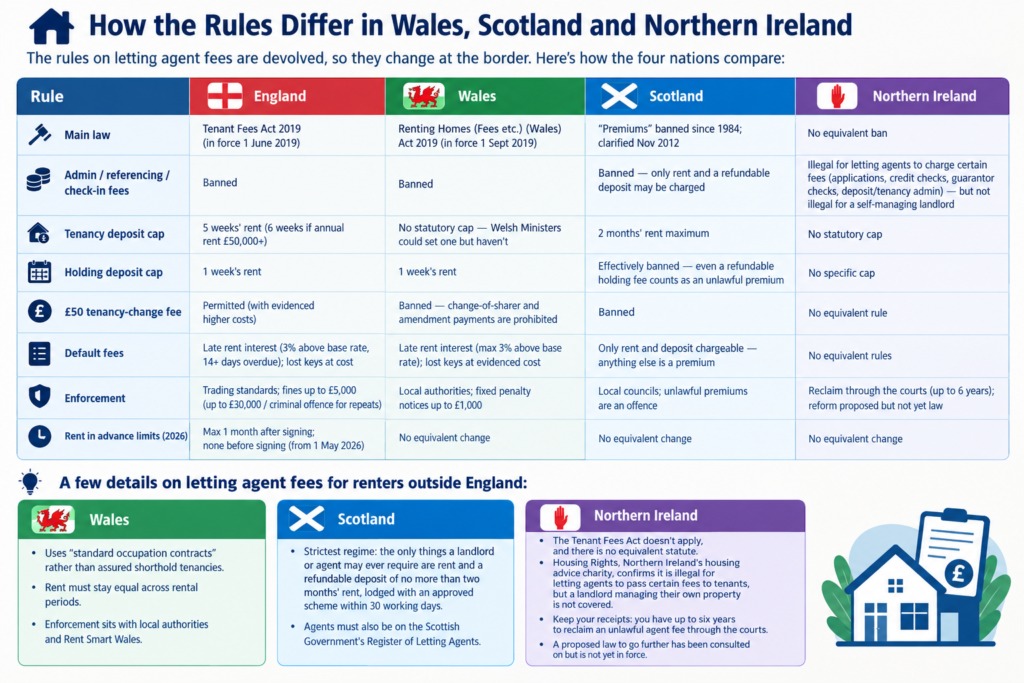
The rules on letting agent fees are devolved, so they change at the border. Here’s how the four nations compare:
| Rule | England | Wales | Scotland | Northern Ireland |
|---|---|---|---|---|
| Main law | Tenant Fees Act 2019 (in force 1 June 2019) | Renting Homes (Fees etc.) (Wales) Act 2019 (in force 1 Sept 2019) | “Premiums” banned since 1984; clarified Nov 2012 | No equivalent ban |
| Admin / referencing / check-in fees | Banned | Banned | Banned — only rent and a refundable deposit may be charged | Illegal for letting agents to charge certain fees (applications, credit checks, guarantor checks, deposit/tenancy admin) — but not illegal for a self-managing landlord |
| Tenancy deposit cap | 5 weeks’ rent (6 weeks if annual rent £50,000+) | No statutory cap — Welsh Ministers could set one but haven’t | 2 months’ rent maximum | No statutory cap |
| Holding deposit cap | 1 week’s rent | 1 week’s rent | Effectively banned — even a refundable holding fee counts as an unlawful premium | No specific cap |
| £50 tenancy-change fee | Permitted (with evidenced higher costs) | Banned — change-of-sharer and amendment payments are prohibited | Banned | No equivalent rule |
| Default fees | Late rent interest (3% above base rate, 14+ days overdue); lost keys at cost | Late rent interest (max 3% above base rate); lost keys at evidenced cost | Only rent and deposit chargeable — anything else is a premium | No equivalent rules |
| Enforcement | Trading standards; fines up to £5,000 (up to £30,000 / criminal offence for repeats) | Local authorities; fixed penalty notices up to £1,000 | Local councils; unlawful premiums are an offence | Reclaim through the courts (up to 6 years); reform proposed but not yet law |
| Rent in advance limits (2026) | Max 1 month after signing; none before signing (from 1 May 2026) | No equivalent change | No equivalent change | No equivalent change |
A few details on letting agent fees for renters outside England:
- Wales uses “standard occupation contracts” rather than assured shorthold tenancies, and rent must stay equal across rental periods. Enforcement sits with local authorities and Rent Smart Wales.
- Scotland has the strictest regime: the only things a landlord or agent may ever require are rent and a refundable deposit of no more than two months’ rent, lodged with an approved scheme within 30 working days. Agents must also be on the Scottish Government’s Register of Letting Agents.
- Northern Ireland is the outlier — the Tenant Fees Act doesn’t apply, and there is no equivalent statute. Housing Rights, Northern Ireland’s housing advice charity, confirms it is illegal for letting agents to pass certain fees to tenants, but a landlord managing their own property is not covered. Keep your receipts: you have up to six years to reclaim an unlawful agent fee through the courts. A proposed law to go further has been consulted on but is not yet in force.
“No DSS” Adverts: Can Agents Refuse Tenants on Benefits?
This isn’t one of the banned letting agent fees, but it’s a related trap to watch for while flat-hunting. For years, adverts and agents routinely declared “No DSS” — a blanket refusal to consider anyone receiving housing benefit or Universal Credit.
In July 2020, the County Court at York ruled such blanket policies unlawfully discriminatory under the Equality Act 2010: automatically rejecting benefit claimants is indirect discrimination on the grounds of sex and disability, because women and disabled people are disproportionately more likely to need help with rent. A second case, against a Birmingham agent that refused even a viewing to a disabled tenant on housing benefit, reached the same conclusion.
What this means for you: an agent or landlord cannot operate a blanket “No DSS” policy, though they can still assess affordability individually. If you’re turned away purely for being on benefits, that may be unlawful discrimination — Shelter and Citizens Advice can advise on your options.
Frequently Asked Questions
Can a letting agent charge me an administration fee?
No. Administration, set-up, application and contract fees are all prohibited payments under the Tenant Fees Act 2019 in England. The same applies in Wales and Scotland. If an agent tries to charge one, ask them to identify which permitted payment it is — they won’t be able to.
Do I have to pay for referencing or a credit check?
No. Referencing and credit checks are the landlord’s or agent’s business costs and cannot be passed to you in England, Wales or Scotland. In Northern Ireland, it is illegal for a letting agent (though not a self-managing landlord) to charge you for credit checks.
How much deposit can my landlord ask for?
In England, a maximum of five weeks’ rent where your annual rent is under £50,000, or six weeks’ rent where it’s £50,000 or more. Work out a week’s rent as your monthly rent × 12 ÷ 52. In Scotland the maximum is two months’ rent; Wales and Northern Ireland set no statutory cap.
Can my agent ask for six months’ rent upfront?
Not any more in England. From 1 May 2026, a landlord must not ask for, encourage or accept any rent before the tenancy agreement is signed, and can require no more than one month’s rent in advance after signing. Check when your tenancy was agreed — large upfront payments were lawful before that date.
What happens to my holding deposit if I change my mind about the property?
If you withdraw, the landlord or agent can keep it. But if the landlord pulls out, or the 15-day deadline passes through no fault of yours, you must get it back in full. If the tenancy goes ahead, it must be refunded within 7 days or put towards your rent or deposit with your consent.
Can I be charged for cleaning when I move out?
A compulsory professional cleaning fee is banned. Your landlord can require you to leave the property in a good, clean condition and can claim from your deposit for genuine damage or excessive mess — but cannot force you to pay a cleaning company.
Can I be charged for renewing my tenancy?
No. Renewal and extension fees are prohibited payments. Your landlord or agent cannot charge you for signing a new fixed term or for your tenancy continuing.
My tenancy started before June 2019. Am I still protected?
Yes. The Act applied to new tenancies from 1 June 2019 and to all relevant tenancies from 1 June 2020. Any prohibited payment required on or after those dates is unlawful, whenever your tenancy originally began.
How do I get a banned fee refunded?
Write to the landlord or agent asking for it back, naming it as a prohibited payment. If they refuse, complain to the agent’s redress scheme, report them to your council’s trading standards team, or apply to the First-tier Tribunal, which can order repayment. Keep all receipts, emails and bank statements as evidence.
Do the fee rules apply to my guarantor too?
Yes. The ban covers payments required from anyone acting on your behalf or guaranteeing your rent. An agent cannot charge your guarantor a guarantor fee or run the banned charges through them instead of you.
Can I be charged if I want to leave my tenancy early?
Only the landlord’s actual, reasonable costs — for example, referencing a replacement tenant or genuine lost rent — and only because you requested the early termination. A fixed early exit fee that doesn’t reflect real losses is not allowed.
Are letting agent fees different in Scotland, Wales and Northern Ireland?
Yes. Scotland bans everything except rent and a refundable deposit (max two months’ rent). Wales bans most fees under its own 2019 Act but sets no cap on the security deposit itself. Northern Ireland has no equivalent ban, though letting agents (unlike self-managing landlords) cannot charge tenants certain fees. See the comparison table above.
Final Thoughts
The ban on letting agent fees was one of the biggest wins English renters have had in a generation — and the 2026 clampdown on rent in advance closes the last major loophole. But rights only work if you use them. Before handing over a penny beyond your deposit and first month’s rent, ask: “Which permitted payment is this?” If the answer is vague or dressed up in creative invoicing, you probably don’t owe it.
Plan your move with the real numbers. Add up your capped deposit and first month’s rent with our upfront cost tools, check the bigger picture with our moving house cost guide, and browse more practical help in our rent guides. And if an agent has already charged you something that looks unlawful, don’t shrug it off — the refund routes above exist for exactly that, and the law is firmly on your side.
Further Reading
- Tenant Fees Act 2019 — GOV.UK collection of official guidance
- Letting agent and tenancy fees — Shelter England
- Citizens Advice also publishes advice on challenging letting agent fees — search “letting agent fees” on citizensadvice.org.uk for their current guidance page.