
Priya has been renting in East London for six years, and she has seen her share of landlord behaviour: a boiler ignored all winter, a deposit returned short with no explanation, and once — in a flat in Stratford — a landlord who simply could not be traced when the ceiling started to sag. So when she read about the landlord register UK scheme this October — “Landlords to pay £65 a year per property on new national register” — her first thought was not about landlords at all. It was about herself.
“Will they just put my rent up by £65 to pay for it?” she asked her friend. “And can I finally look up a landlord before I hand over a deposit?”
This guide answers exactly those questions. From 15 December 2026, the landlord register UK opens in England: a national register of landlords and rented homes — officially called the “Register your rental property” service — and every landlord in England will have to join it, property by property, at £65 a year each. It is one of the last big pieces of the Renters’ Rights Act 2025, and it matters to tenants far more than the fee suggests: it is how you will eventually check whether a landlord is legitimate, see their compliance record, and spot the rogue operators before you sign.
Quick answer: From 15 December 2026, landlords in England must register themselves and each property they let on the national “Register your rental property” service (the Private Rented Sector Database), at £65 per property per year, renewed annually. The rollout is regional — landlords get a three-month window from their region’s start date, ending with London and the South West by autumn 2027. Tenants will be able to check whether a landlord is registered; landlords who refuse face penalties of up to £7,000 (up to £40,000 for repeated breaches) and may be unable to regain possession of the property. Your landlord cannot simply add £65 to your rent mid-tenancy — any increase must follow the legal Section 13 process and reflect the market rent.
This guide reflects the position in England as of October 2026, based on the government’s 9 September 2026 announcement about the Landlord Register UK and the draft Private Rented Sector Database Regulations 2026. It is general information, not legal advice. The scheme is England-only — see the four-nation comparison below.
What Is the Landlord Register UK?
There is no single legal name tenants will see on the website — the legislation calls it the Private Rented Sector (PRS) Database, but the government brands the landlord register UK service you will actually encounter as “Register your rental property”. Think of it as Companies House for landlords: one national record of who owns and lets every private rented home in England.
The database was created under the Renters’ Rights Act 2025, the same law that abolished no-fault Section 21 evictions on 1 May 2026 and rewrote the rules on rent increases. The idea is simple. Right now, councils, tenants and even the government itself have no reliable central picture of the private rented sector. Councils spend months trying to identify who owns a problem property. Tenants sign contracts with people they cannot check. And bad landlords can simply move to the next town and start again. This is the legislation that created the Landlord Register UK.
The Landlord Register UK changes that by making registration compulsory and traceable:
- Every landlord must register themselves (one landlord entry).
- Every landlord must also register each property they let (a separate entry per home).
- Each property entry carries an annual fee of £65, renewed every year.
- Registration numbers will eventually have to appear on rental adverts, so you can check a listing before you even book a viewing.
Scotland and Wales already run their own landlord registers, and Northern Ireland has had mandatory landlord registration for years — England was the outlier. The landlord register UK closes that gap.
Why Is It Being Introduced Now?
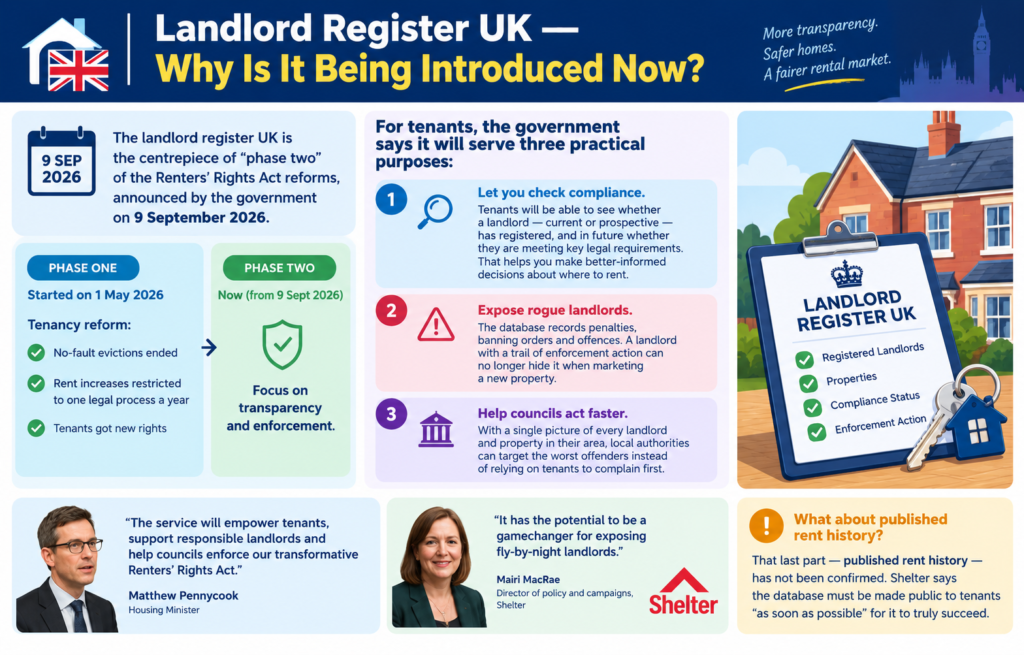
The landlord register UK is the centrepiece of “phase two” of the Renters’ Rights Act reforms, announced by the government on 9 September 2026. Phase one — which started on 1 May 2026 — covered tenancy reform: no-fault evictions ended, rent increases were restricted to one legal process a year, and tenants got new rights. Phase two is about transparency and enforcement.
For tenants, the government names three practical purposes:
- Let you check compliance. Tenants will be able to see whether a landlord — current or prospective — has registered, and in future whether they are meeting key legal requirements. That helps you make better-informed decisions about where to rent.
- Expose rogue landlords. The database records penalties, banning orders and offences. A landlord with a trail of enforcement action can no longer hide it when marketing a new property.
- Help councils act faster. With a single picture of every landlord and property in their area, local authorities can target the worst offenders instead of relying on tenants to complain first.
Housing Minister Matthew Pennycook said the service would “empower tenants, support responsible landlords and help councils enforce our transformative Renters’ Rights Act.” Shelter welcomed it — its director of policy and campaigns, Mairi MacRae, called it a potential “gamechanger” for exposing “fly-by-night” landlords, while pressing the government to publish details of previous rents charged at each property so tenants can challenge unfair increases.
That last part — published rent history — has not been confirmed; Shelter says the database must be made public to tenants “as soon as possible” for it to truly succeed.
When Does It Start? Your Regional Deadline
The landlord register UK service opens on 15 December 2026, but — crucially — your landlord does not need to register on that date unless their property is in the first region. The rollout runs region by region over roughly nine months, and the deadline follows the property’s location, not where the landlord lives. A landlord living in Kent with a flat in Birmingham follows the West Midlands timetable.
| Region | Registration opens | Deadline to register |
|---|---|---|
| West Midlands | 15 December 2026 | 14 March 2027 |
| East of England | 15 January 2027 | 14 April 2027 |
| East Midlands | 15 February 2027 | 14 May 2027 |
| South East | 15 March 2027 | 14 June 2027 |
| Yorkshire and Humber | 15 April 2027 | 14 July 2027 |
| North West | 15 May 2027 | 14 August 2027 |
| North East | 15 June 2027 | 14 September 2027 |
| London | 15 July 2027 | 14 October 2027 |
| South West | 15 August 2027 | 14 November 2027 |
When a region’s window opens, landlords there have three months to comply. Landlords with properties in several regions do not have to wait: from 15 December 2026 they can register everything at once on the landlord register UK, provided each property is done by its own regional deadline. Once a region’s window closes, councils can begin enforcement against landlords who should have registered but have not.
One more timing detail worth knowing: the requirement initially applies only to properties that are currently let or become occupied during the rollout. Empty properties do not need registering yet — but future legislation will require landlords to register unoccupied properties before they can advertise them for let.
Which Landlords Have to Register?
The short version: almost all of them in England must join the UK landlord register. The obligation covers landlords of assured tenancies — which since 1 May 2026 means every standard private tenancy, as assured shortholds automatically converted to assured periodic tenancies — and the older regulated (Rent Act 1977) tenancies.
| Who / what | Registration required? |
|---|---|
| Landlord letting on a standard assured tenancy in England | Yes — landlord entry + property entry |
| Landlord of a regulated (Rent Act 1977) tenancy | Yes |
| Joint landlords (more than one owner) | Yes — each landlord registers individually, sharing one property entry |
| Supported exempt accommodation (specialist supported housing) | No — exempt under the Supported Housing (Regulatory Oversight) Act 2023 |
| Empty property, not let | Not yet — registration required before marketing for let under future legislation |
| Letting agent managing the property | The landlord remains legally responsible — an agent cannot register on the landlord’s behalf, though agents can upload some information once the landlord has started the process |
A clarification issued on 1 October 2026 after an NRLA briefing to more than 4,000 landlords confirmed there will be no bulk registration: portfolio landlords must register and pay property by property. Registration on the Landlord Register of England and Wales is done through a government service using GOV.UK One Login, and each registration lasts 12 months — if it is not renewed, it becomes inactive. If any detail changes (or a safety certificate expires), the entry must be updated within 28 days.
Illustrative example — Josh & Ellie, Leeds. Josh and Ellie are about to sign a joint tenancy on a two-bed in Headingley at £1,100 a month. Under the new system, before handing over their holding deposit they will be able to check the register to confirm the landlord — a company this time, not a person — has a live entry for that address, and eventually see whether its gas safety and electrical certificates are current. It takes five minutes and replaces what used to be blind trust.
The £65 Fee, Explained
The headline number for the UK landlord register is simple: £65 per property, per year, renewed annually. A few clarifications that matter:
- There is no separate fee for registering yourself as a landlord — the charge is per property only.
- During the initial rollout, the fee will be pro-rated, so landlords whose regions come first do not pay more simply for being early in the timetable.
- The same flat fee applies to a one-bed flat and a six-bed HMO — it is per property, not per room or per tenancy.
- Like other costs of letting a property, landlords are generally expected to treat the fee as a deductible business expense for tax purposes — though that reduces taxable profit rather than refunding the £65.
How the cost scales for different landlords —
| Landlord | Annual registration cost |
|---|---|
| Single-property landlord (one flat) | £65 |
| Small portfolio (5 properties) | £325 |
| Mid-size portfolio (20 properties) | £1,300 |
| Large portfolio (100 properties) | £6,500 |
| Sector-wide (5 million+ dwellings in England) | ≈ £325 million+ |
That last row is not our arithmetic for fun — it is the heart of the row over the landlord register UK fee.
The £327 Million Row: Why the Fee Is So Controversial
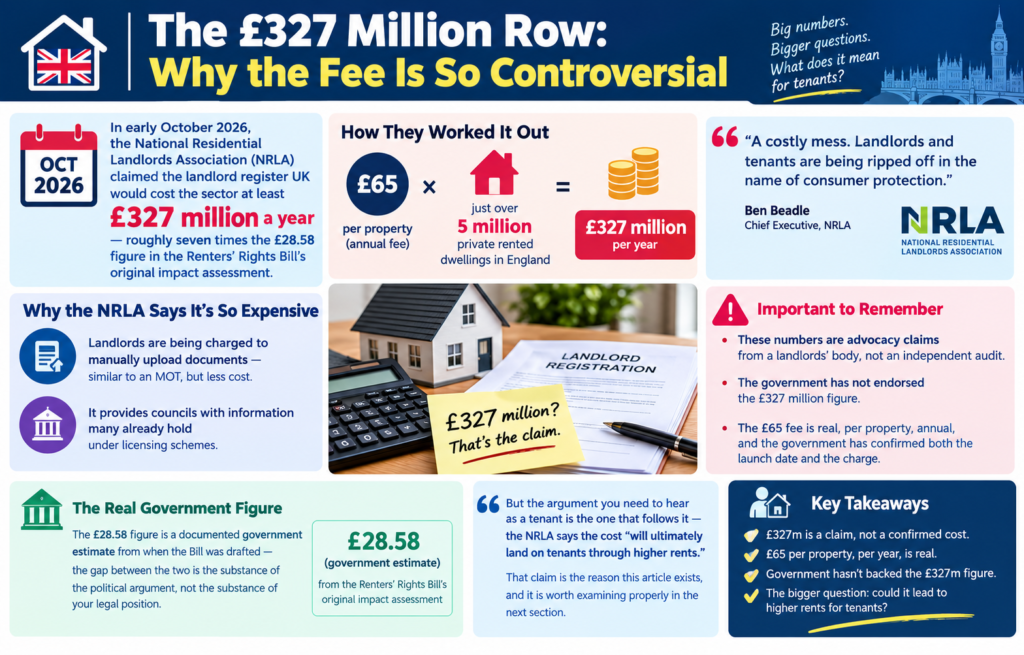
In early October 2026, the National Residential Landlords Association (NRLA) claimed the landlord register UK would cost the sector at least £327 million a year — roughly seven times the £28.58 figure in the Renters’ Rights Bill’s original impact assessment. Their maths: £65 multiplied by just over 5 million private rented dwellings in England, the official government count.
The NRLA’s chief executive, Ben Beadle, called the scheme “a costly mess” and said landlords and tenants were “being ripped off in the name of consumer protection” — arguing landlords are being charged to manually upload documents much like an MOT costs a motorist less, while providing councils with information many already hold under licensing schemes.
Treat these numbers for what they are: advocacy claims from a landlords’ body, not an independent audit. The government has not endorsed the £327 million figure. But the argument you need to hear as a tenant is the one that follows it — the NRLA says the cost “will ultimately land on tenants through higher rents.” That claim is the reason this article exists, and it is worth examining properly in the next section.
What is not in dispute: the landlord register UK £65 fee is real, it is per property, it is annual, and the government has confirmed both the launch date and the charge. The £28.58 impact-assessment figure is a documented government estimate from when the Bill was drafted — the gap between the two is the substance of the political argument, not the substance of your legal position.
What Information Goes on the Register?
This is more than a name-and-address list. Landlords will be expected to provide landlord details, property details, tenancy details and proof of compliance:
| Category | What landlords must provide |
|---|---|
| Landlord (individual) | Name, address, date of birth, contact details |
| Landlord (company) | Organisation name, legal entity type, Companies House or charity registration number, contact details of the person applying |
| The property | Address, dwelling type, number of bedrooms, whether furnished/partly furnished/unfurnished |
| The tenancy | Number of occupants, rent amount and frequency, whether rent includes utilities, HMO/selective licence details where applicable |
| Safety & compliance | Gas safety certificates, Electrical Installation Condition Reports (EICR), Energy Performance Certificate (EPC) information |
| Ongoing duty | Update the entry within 28 days of any change; renew annually or the entry goes inactive |
Landlords of older stock may find the compliance part the biggest task: documents that previously only surfaced when serving notices will now sit on the database — which means they have to exist and be current.
What Can Tenants Check on the Landlord Register UK?
This is the section tenants care about most, and it needs honest framing: the public-facing tenant view is not fully specified yet. The government has said tenants will be able to see whether their landlord — or a prospective landlord — “has signed up” on the Landlord Register UK, and that in future tenants will be able to use the service “to see if a landlord is compliant with key legal requirements.”
The exact list of information the public can access will be published at a later stage, balancing landlords’ privacy with tenants’ right to make informed choices.
| Check | Status |
|---|---|
| Is my landlord registered? | Confirmed — the core tenant-facing check |
| Is a prospective landlord registered before I sign? | Confirmed — per the government’s press release of 9 September 2026 |
| Does the property have a valid registration number on the advert? | Planned — required on adverts once the public interface launches |
| Can I see safety certificates or the compliance record? | To be confirmed — GOV.UK says a public information list will be published later |
| Can I see previous rents charged at the property? | Not confirmed — Shelter is campaigning for this; the government has not committed |
| Can I see a landlord’s penalty/banning-order history? | Expected — the database records penalties and banning orders; how much is public-facing is to be confirmed |
The practical takeaway: do not expect a full open book on day one. Expect a reliable “registered or not” check first, with more detail added as the system matures. Even that first step is powerful — a landlord who will not register is a landlord councils can fine and whose possession claims can be blocked (see below), which gives registration real teeth.
Will It Push Rents Up? The Money Question, Answered Honestly
Priya’s question is the right one, and the honest answer has three parts.
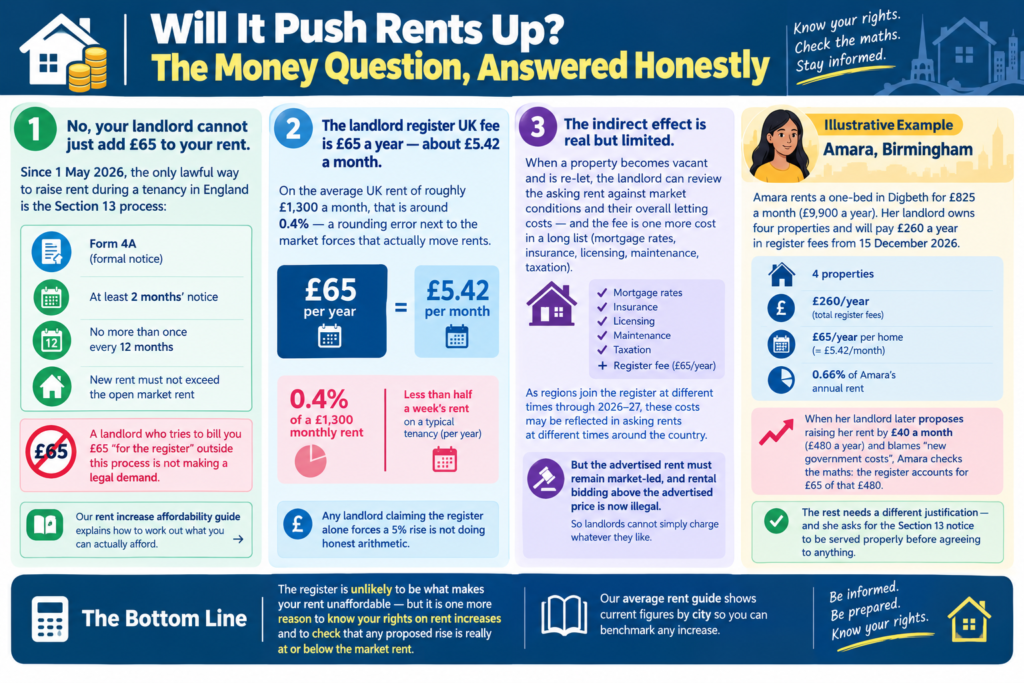
First: no, your landlord cannot just add £65 to your rent. Since 1 May 2026, the only lawful way to raise rent during a tenancy in England is the Section 13 process: a formal notice on Form 4A, at least two months’ notice, no more than once every 12 months, and the new rent must not exceed the open market rent. A landlord who tries to bill you £65 “for the register” outside that process is not making a legal demand — and our rent increase affordability guide explains how to work out what you can actually afford.
Second: the landlord register UK fee is £65 a year — about £5.42 a month. On the average UK rent of roughly £1,300 a month, that is around 0.4% — a rounding error next to the market forces that actually move rents. Worked out over a year, the fee is less than half a week’s rent on a typical tenancy. Any landlord claiming the register alone forces a 5% rise is not doing honest arithmetic.
Third: the indirect effect is real but limited. When a property becomes vacant and is re-let, the landlord can review the asking rent against market conditions and their overall letting costs — and the fee is one more cost in a long list (mortgage rates, insurance, licensing, maintenance, taxation). As regions join the register at different times through 2026–27, these costs may be reflected in asking rents at different times around the country. But the advertised rent must remain market-led, and rental bidding above the advertised price is now illegal — so landlords cannot simply charge whatever they like.
The bottom line: the register is unlikely to be what makes your rent unaffordable — but it is one more reason to know your rights on rent increases and to check that any proposed rise is really at or below the market rent. Our average rent guide shows current figures by city so you can benchmark any increase.
Illustrative example — Amara, Birmingham. Amara rents a one-bed in Digbeth for £825 a month (£9,900 a year). Her landlord owns four properties and will pay £260 a year in register fees from 15 December 2026. Spread across his four tenancies that is £65 a year — £5.42 a month — per home: 0.66% of Amara’s annual rent. When her landlord later proposes raising her rent by £40 a month (£480 a year) and blames “new government costs”, Amara checks the maths: the register accounts for £65 of that £480. The rest needs a different justification — and she asks for the Section 13 notice to be served properly before agreeing to anything.
What Happens If a Landlord Refuses to Register?
Registration on the Landlord Register in the UK is not a suggestion. Councils will enforce it, and the consequences are designed to hurt enough that compliance is the easy option:
| Consequence | Detail |
|---|---|
| Civil penalty — first breach | Up to £7,000 per breach, issued by the local council |
| Civil penalty — repeated/serious breach | Up to £40,000, plus possible rent repayment orders |
| Possession blocked | An unregistered landlord cannot obtain a possession order under most Section 8 grounds — only anti-social behaviour grounds remain available |
| Letting restrictions | Further legislation will bar unregistered landlords from marketing properties for let |
The possession point is the real lever. With Section 21 gone, every possession claim needs a legal ground — and a landlord who has not registered cannot use most of them. That means registration is effectively a precondition for getting your property back, which is why advisers treat it as non-optional.
For tenants, this is quietly useful information: if your landlord threatens eviction, one of the first questions worth asking (or having an adviser ask) is whether they are registered at all. Our tenancy deposit protection guide explains a similar dynamic with deposits — unprotected deposit, no valid possession claim.
How the Register Links to Rent Increase Challenges
The same 9 September 2026 announcement carried a second reform tenants should know about: rent-increase disputes are moving away from the First-tier Tribunal. The government says HMRC’s Valuation Office Agency (VOA) will take over responsibility for initial rent determinations — the decision on whether a proposed increase reflects the open market rent — to speed up decisions and relieve pressure on tribunals.
For now, nothing has changed on the ground: if you want to challenge a proposed increase, you still apply to the First-tier Tribunal (Property Chamber), and the new rules — tribunal cannot set rent higher than the landlord proposed, new rent starts from the rent period after the decision, not backdated — still apply. The VOA service is being developed, with the transfer date to be confirmed. Watch this space; when it lands, challenging an above-market increase should become quicker and less intimidating, which matters precisely because cost pass-through claims (like the register fee) get tested against the market rent.
Does This Apply in Scotland, Wales and Northern Ireland?
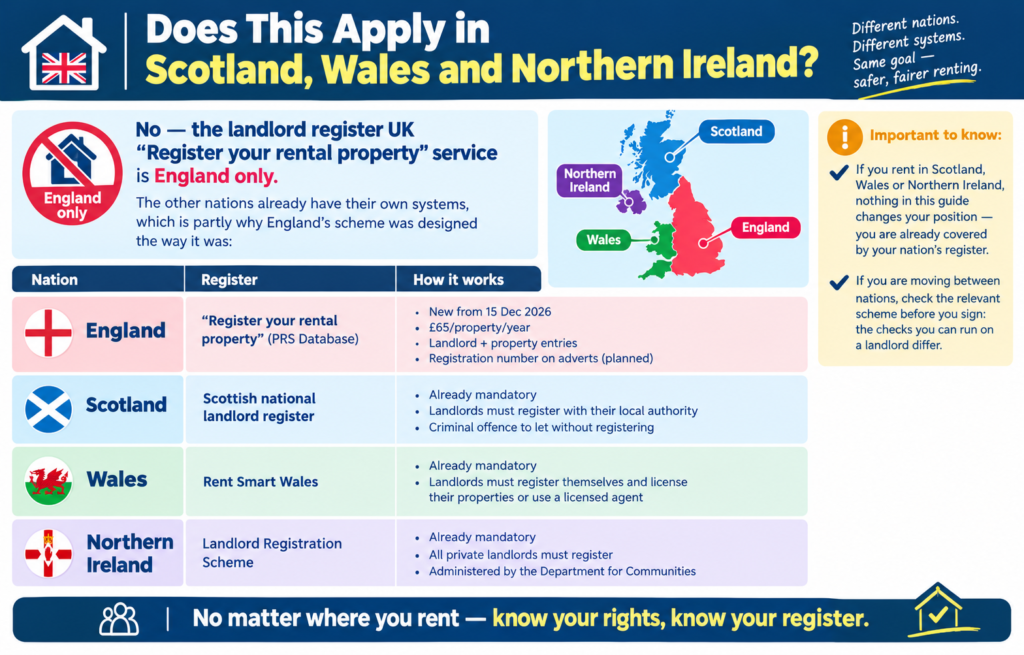
No — the landlord register UK “Register your rental property” service is England only. The other nations already have their own systems, which is partly why England’s scheme was designed the way it was:
| Nation | Register | How it works |
|---|---|---|
| England | “Register your rental property” (PRS Database) | New from 15 Dec 2026; £65/property/year; landlord + property entries; registration number on adverts (planned) |
| Scotland | Scottish national landlord register | Already mandatory — landlords must register with their local authority; criminal offence to let without registering |
| Wales | Rent Smart Wales | Already mandatory — landlords must register themselves and license their properties or use a licensed agent |
| Northern Ireland | Landlord Registration Scheme | Already mandatory — all private landlords must register; administered by the Department for Communities |
If you rent in Scotland, Wales or Northern Ireland, nothing in this guide changes your position — you are already covered by your nation’s register. If you are moving between nations, check the relevant scheme before you sign: the checks you can run on a landlord differ.
Landlord Register UK: What Tenants Should Do Now
You do not need to do anything yet — the legal duty sits on landlords, not tenants. But informed tenants get more from the Landlord Register UK. Here is a short checklist, roughly in order of when each step becomes useful:
| When | Action |
|---|---|
| Now (Oct 2026) | Learn your region’s deadline (see table above) so you know when your landlord must be registered |
| From 15 Dec 2026 | If your home is in the West Midlands, you can start asking whether your landlord has registered |
| At every region’s deadline | The register becomes a live check in that region — use it before signing any new tenancy |
| When viewing a property | Ask for the property’s registration number once numbers appear on adverts; no number on an advert in an active region is a red flag |
| If your rent is increased | Insist on the Section 13 process and benchmark the new rent against market rates — never accept “new government costs” as a justification without the paperwork |
| If your landlord threatens eviction | Ask whether they are registered — an unregistered landlord cannot use most possession grounds |
| If in doubt | Get free advice from Shelter or Citizens Advice before acting — see Further Reading |
One more practical note for movers: the upfront costs of a new tenancy (deposit, first month’s rent, holding deposit) do not change because of the register — but a registered landlord is a safer pair of hands for your money. Our rent upfront cost calculator and letting agent fees guide cover what you can legally be charged when you move.
FAQs
Is the landlord register already live?
Not yet. The “Register your rental property” service opens on 15 December 2026 in the West Midlands and rolls out region by region across England, with all landlords required to be registered by 14 November 2027 (South West deadline). Scotland, Wales and Northern Ireland already have their own mandatory registers.
Do I, as a tenant, have to register anything?
No. The legal duty sits entirely on landlords (and, for their own entries, on joint landlords individually). Tenants only benefit — through the ability to check registration and compliance — and pay nothing.
How much is the landlord register fee?
£65 per property per year, renewed annually. There is no separate fee for registering as a landlord. The fee is pro-rated during the initial rollout so early regions do not pay more. It applies per property, not per room — a six-bed HMO costs the same £65 as a one-bed flat.
Will the £65 fee make my rent go up?
Your landlord cannot add £65 to your rent outside the legal process. Rent increases during a tenancy in England must follow the Section 13 route — formal notice, two months’ warning, once a year maximum, capped at the open market rent. £65 a year is about £5.42 a month (roughly 0.4% of average rent), so it is a minor factor in rent levels compared with market forces. At re-let, asking rents may gradually reflect landlords’ overall costs, but they must stay market-led and rental bidding above the advertised price is illegal.
Can I check whether my landlord is registered?
Yes — that is the core tenant-facing feature. The government has confirmed tenants will be able to see whether their current or prospective landlord has signed up. The service is not live yet, and the full list of publicly visible information will be published later, but the “registered or not” check is confirmed.
What happens if my landlord does not register?
Councils can issue civil penalties of up to £7,000 for a first breach and up to £40,000 for repeated or serious breaches. Crucially, an unregistered landlord generally cannot get a possession order under most Section 8 grounds (only anti-social behaviour grounds remain). Future legislation will also stop unregistered landlords from advertising properties for let.
My landlord says the fee is why my rent is increasing. What should I do?
Ask for the increase to be served properly as a Section 13 notice on Form 4A — without it, the increase has no legal force. Then benchmark the proposed rent against similar local homes; our average rent guide by city can help. If it looks above market rent, you can challenge it at the First-tier Tribunal (the Valuation Office Agency will take over these decisions in future). A £65 annual fee does not justify a large monthly increase on its own.
Does the register cover HMOs and house shares?
Yes. The fee is per property regardless of how many tenants live there, so each HMO carries one £65 entry. Landlords must also declare whether HMO or selective licensing applies to the property as part of registration.
Will I be able to see my landlord’s safety certificates on the register?
Not confirmed yet. Landlords must upload gas safety, electrical safety (EICR), and EPC information, but the government has not yet published the list of information the public will be able to see. A basic “registered and compliant” indicator is expected; full document access is not guaranteed.
What if my landlord uses a letting agent — who registers?
The landlord must register personally; an agent cannot do it for them. Agents may upload certain information once the landlord has started the process. If your agent claims “we’ve handled it”, the legal responsibility — and the penalty for getting it wrong — still sits with the landlord.
Is there a rent cap or rent control coming with the register?
No. England is not introducing rent controls. The government’s stated alternative is the challenge route: if a proposed increase exceeds the open market rent, tenants can have it independently assessed (currently the First-tier Tribunal; the Valuation Office Agency in future).
Where can I get free advice about all this?
Shelter (England and Scotland) and Citizens Advice offer free, confidential housing advice — see Further Reading below. If your landlord is threatening eviction or demanding money outside the legal process, speak to an adviser before you pay or move out.
Final Thoughts
The landlord register UK is not really about £65. It is about ending the anonymity that has let bad landlords operate unchecked in England for decades. For the first time, every landlord will be on one list, every property will carry a registration, and tenants will be able to check before they commit — with councils finally able to see the whole picture and fine those who refuse to join it.
For your own finances, the message is reassuring and practical at once: the fee is small, it cannot be billed to you directly, and any rent increase still has to survive the Section 13 process and the market-rent test.
The tenants who benefit most will be the ones who use the new checks on the landlord register UK — verify registration before you sign, benchmark any increase against real market rents, and treat “new government costs” as the start of a question, not the end of one.
Before you sign your next tenancy or accept a rent rise, run the numbers: our rent-to-income ratio calculator shows whether a rent fits your budget, the rent increase affordability checker models what a rise really costs you, and the rent budget after bills planner keeps council tax, utilities and the rest in the picture. And if a move is on the cards, the council tax for renters guide covers the other bill tenants most often underestimate.
Further Reading
- Why we need a landlord register — Shelter England
- Citizens Advice publishes step-by-step guidance on renters’ rights and challenging rent increases — search “rent increase” or “private renting rights” on citizensadvice.org.uk for their current advice pages.
- England’s landlord register opens on 15 December 2026 — Higgs LLP