

Wren rents a two-bedroom flat in Leeds. The box room she uses as a home office is painted the same flat magnolia as everything else, and after two years of staring at it on video calls, she wants to Decorate Rented Property by painting one wall sage green. Her tenancy agreement says she must not “make any alteration to the property without the landlord’s prior written consent” — but is a coat of paint really an alteration? Could she just do it and paint it back later? And does the Renters’ Rights Act 2025, which changed almost everything about renting in England, change anything about the colour of her walls? If you are asking the same questions, this guide gives you the full picture for every UK nation: what the law says in England, Scotland, Wales and Northern Ireland, how to ask for permission properly, what happens to your deposit if you don’t, and the no-damage tricks that keep landlords happy — everything you need before you decorate a rented property anywhere in the UK.
Quick Answer: In England and Northern Ireland there is no statutory right to decorate — your tenancy agreement decides, and most agreements ban painting or alterations without the landlord’s written consent. In Wales, a landlord must not unreasonably refuse a written decoration request, and silence for a month can count as consent. In Scotland, new decoration rights in the Housing (Scotland) Act 2025 are not yet in force. Wherever you live, get permission in writing before you lift a paintbrush.
What Your Tenancy Agreement Actually Says About Decoration
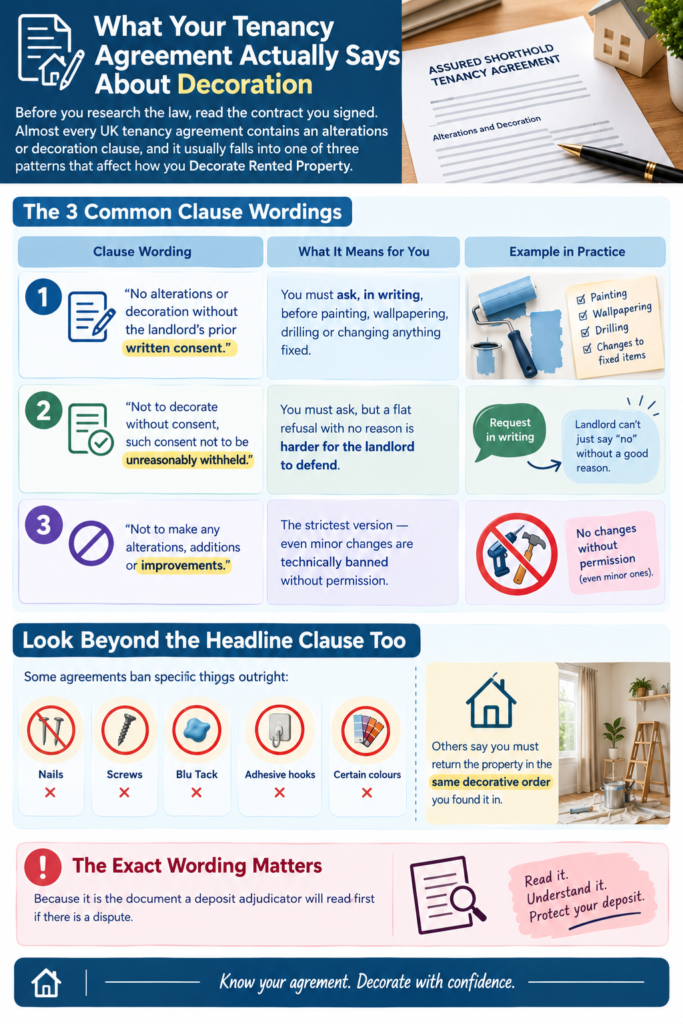
Before you research the law, read the contract you signed. Almost every UK tenancy agreement contains an alterations or decoration clause, and it usually falls into one of three patterns that affect how you Decorate Rented Property:
| Common clause wording | What it means for you |
|---|---|
| No alterations or decoration without the landlord’s prior written consent | You must ask, in writing, before painting, wallpapering, drilling or changing anything fixed |
| Not to decorate without consent, such consent not to be unreasonably withheld | You must ask, but a flat refusal with no reason is harder for the landlord to defend |
| Not to make any alterations, additions or improvements | The strictest version — even minor changes are technically banned without permission |
Look beyond the headline clause too. Some agreements ban specific things outright: nails, screws, Blu Tack, adhesive hooks, even certain colours. Others say you must return the property in the same decorative order you found it in. The exact wording matters, because it is the document a deposit adjudicator will read first if there is a dispute at the end of your tenancy. If you are unsure what your agreement means, our tenancy agreement guide explains how to read the key clauses.
Decoration vs Alteration vs Improvement: Why the Words Matter
Landlords, agents and deposit adjudicators use these three words precisely, and mixing them up is where many tenants come unstuck.
| Term | What it covers | Typical examples |
|---|---|---|
| Decoration | Cosmetic surface changes that don’t alter the structure | Painting walls, wallpapering, changing curtain fabric |
| Alteration | Changes to the property’s fixtures, fittings or layout | Putting up shelves, changing light fittings, laying flooring, drilling for a wall-mounted TV |
| Improvement | Work that adds lasting value beyond the original condition | A new bathroom suite, fitted wardrobes, rewiring |
The trap is that painting a wall — which feels like mere decoration to you — is legally treated as an alteration in most tenancy agreements. That single word is why “it’s only a coat of paint” is not a defence in a deposit dispute. And improvements carry their own warning: if you pay for an improvement yourself, there is no general right to be reimbursed for it, so an expensive redecoration is money you may never see again. Always agree costs and who pays before work starts, never after.
England: Everything Changed — Except the Walls
The Renters’ Rights Act 2025 received Royal Assent on 27 October 2025, with its first phase of reforms taking effect on 1 May 2026. It abolished Section 21 no-fault evictions, ended fixed-term assured shorthold tenancies, restricted rent increases and gave tenants a statutory right to request a pet. It is the biggest shake-up of private renting in England in a generation — and it says nothing at all about decoration.
Legal commentary on the Act has been blunt about the gap: decoration was left entirely to contract. No provision in the Act creates a right to paint, hang shelves or personalise your home, and nothing in the government’s published guidance does either. So the position in England is exactly what it was before the Act: your agreement governs, most agreements require written consent for anything permanent, and painting without that consent is a breach of contract.
There is some encouraging context. A 2025 survey by the OSB Group, widely reported in the letting industry, found that 73% of landlords welcome tenant customisation and 34% actively collaborate with tenants on decorating plans. Most landlords are not the villains of tenant folklore — but they do want to be asked, and they want the answer recorded in writing. For the full picture of what the Act did change, see our Renters’ Rights Act 2025 guide.
Worth knowing: The Tenant Fees Act 2019 bans landlords from requiring payments such as mandatory professional cleaning or redecoration fees at the end of a tenancy. A deduction from your deposit for genuine damage or unauthorised redecoration is a different matter — that is a damages claim, and it is allowed. Our fair wear and tear guide explains the boundary in detail.
Scotland: Stronger Rights Are Coming — But They Aren’t Law Yet
Scotland is the most interesting part of this story, because the law is about to change — but hasn’t yet.
The Housing (Scotland) Act 2025 received Royal Assent on 6 November 2025, after completing its final parliamentary stage on 30 September 2025. It includes a specific personalisation framework that will give private tenants greater rights to decorate their homes. The Scottish Government’s own tenant rights page describes the plan:
- Category 1 changes — minor personalisation such as putting up posters or pictures — will need no landlord consent at all.
- Category 2 changes — larger changes such as painting walls or putting up shelves — will need the landlord’s consent, but the landlord will not be able to refuse unreasonably.
- Category 2 rights will only apply once you have lived in the property for six months. You will make a written request; the landlord must respond within 30 days and may set reasonable conditions, and you will be able to challenge an unreasonable refusal at the First-tier Tribunal (Housing and Property Chamber).
But here is the crucial sentence from the Scottish Government: “A date for this change coming into force has not been set yet. Further secondary legislation is required.” The exact changes in each category will be set out in regulations after further consultation. Until those regulations are made and a commencement date is announced, the current rules apply: most Scottish private residential tenancy agreements require written permission before repainting or hanging heavy items, so ask first and get it in writing.

Wales: Your Landlord Needs a Good Reason to Say No
Wales gives tenants the strongest decoration rights currently in force anywhere in the UK, thanks to the Renting Homes (Wales) Act 2016, which took effect on 1 December 2022 and replaced tenancies with occupation contracts.
If your occupation contract says you need the landlord’s consent to decorate, a special statutory procedure applies:
- Your request must be in writing, with as much detail as you can give.
- The landlord has 14 days to ask for further information, and must give or refuse consent within one month of your request — or within one month of you supplying any extra information they asked for.
- If you don’t receive the decision in writing, consent is given by default.
- Conditions on a consent must also be given in writing, or consent is treated as unconditional.
- If the landlord refuses, you can demand written reasons within one month — and if none arrive, consent is again treated as given.
- A landlord must not refuse consent without a good reason, and must not attach unreasonable conditions. If you think the refusal is unreasonable, you can apply to the county court to decide.
As Shelter Cymru puts it: the landlord can’t refuse without a good reason, and you can ask the court to decide if you think the decision is unreasonable. Going to court is costly, so get advice first — but the right exists, which is more than tenants in England have.
One more Welsh detail: occupation contracts require you to keep the dwelling in a state of “reasonable decorative order”. Industry summaries of the Welsh Government’s Code of Practice for landlords and agents describe the usual compromise: the tenant agrees to return any decorated areas to their original state at the end of the contract. Offering that upfront is the fastest way to get a yes.
Northern Ireland: The Agreement — and One Duty — Decide
Northern Ireland has no decoration-specific statute. Your tenancy agreement governs, and the government’s own guidance for private tenants sets two clear default duties: keep the interior of the property in reasonable decorative order, and do not carry out alterations to the property without the landlord’s permission.
Note the interesting tension: you are expected to keep the place in reasonable decorative order, but you may not alter it without permission. In practice, that means touching up scuffs with matching paint is normal tenant behaviour, while choosing a new colour for a whole room is an alteration that needs written consent. Anything unclear in your statement of tenancy terms falls back on what you and your landlord agreed — so the written agreement, again, is everything.
How to Get Written Permission (and What Your Email Should Say)
A vague “can I decorate?” email gets vague answers or none at all. A specific, professional request gets yeses — landlords approve most requests to decorate a rented property when the tenant is specific, offers to restore the original condition, and puts everything in writing. Include all of the following:
| What to put in your request | Why it helps |
|---|---|
| The exact rooms and walls involved | Removes ambiguity about scope |
| Colour names or codes, with swatches or photos | Shows you have thought it through; lets the landlord picture the result |
| The paint brand and finish (e.g. matt emulsion) | Reassures on quality — cheap gloss over emulsion is a landlord’s nightmare |
| Whether you’ll DIY or hire a decorator | A professional job is easier to approve |
| Your offer to return walls to the original colour at the end | This single sentence doubles your chances |
| Proposed start date | Shows respect for inspections and schedules |
| Photos of the current condition | Protects you both at check-out |
Send it by email so there is a timestamped record, and keep the reply. A verbal “yeah, go ahead” from a letting agent is worth nothing in a deposit dispute six months later. If the landlord doesn’t reply, do not treat silence as consent — except in Wales, where the one-month default rule described above applies. Everywhere else, no answer means no.
Tip: Propose neutral, easy-to-cover colours even if your heart is set on something bold. Landlords approve warm whites, soft greys and sage greens far more readily than pillar-box red — and neutrals are cheaper to paint back, which matters at check-out.
The “Paint It Back” Rule and What Happens at Check-Out
The single most important decoration rule in UK renting is unwritten but universally applied by deposit adjudicators: if you changed it, you return it. Permission to paint is rarely permission to leave your colours behind — unless the landlord explicitly agrees in writing that the new decoration can stay.
At check-out, the adjudicator compares the property against the check-in inventory. As the Property Redress Scheme’s dispute handlers have noted, the most common décor disputes arise when the tenant either didn’t ask for permission or used a completely different colour from the one recorded at check-in. Protect yourself:
- Photograph every room before you decorate, with the date visible.
- Keep the written permission and the agreed colour names.
- Photograph the finished result.
- If you agreed to paint it back, do it before the check-out inspection — not after the landlord complains.
Our ending your tenancy guide walks through the full check-out process, and our deposit protection guide explains how disputes are decided if you can’t agree.
How Much Unauthorised Redecoration Can Cost You
Painting without permission is a breach of contract, and the financial consequences are real. Trade press puts professional repainting in London at roughly £150–£300 per room — repaint two rooms on a whim and a large slice of your deposit is gone before the argument even starts. The landlord must show the original condition and evidence actual costs, but adjudicators routinely side with landlords where redecoration was unauthorised, even when the work itself looks professional.
Two principles limit what you can be charged, and both work in your favour:
- Betterment: the landlord cannot use your deposit to leave the property in a better state than when you moved in. If the walls were already shabby, you don’t fund a showroom finish.
- Apportionment: decoration has a finite life. Deposit-dispute commentators commonly work with a decorative lifespan of around five years — this is an industry working figure, not a statute. If the paint was four years old when you arrived, an adjudicator will typically only allow the landlord a fraction of the repaint cost.
Alistair’s story shows how this works in practice.
Alistair, Manchester — the £184 lesson. Alistair painted his living room and bedroom a deep teal without asking. His deposit was £1,200. At check-out the landlord claimed £600: a decorator’s quote of £520 to repaint both rooms, plus £80 to fill and repair plaster he had damaged hanging shelves. The adjudicator’s decision:
| Claim | What the adjudicator allowed |
|---|---|
| Repaint two rooms — £520 claimed | £104 — the décor was 4 years into a ~5-year life, so only 1/5 of the cost (£520 ÷ 5) |
| Plaster repair — £80 claimed | £80 in full — tenant damage, not wear |
| £600 claimed in total | £184 allowed in total |
Alistair got £1,016 of his £1,200 back — but he still lost £184, plus the cost of the teal paint he’d bought in the first place, all for walls he didn’t get to keep. Asking first would have cost him an email.
Contrast that with Carys, who did everything right.
Carys, Cardiff — the £63 success. Carys wanted to paint her living room warm white. She emailed her landlord with the room, the exact colour code, and an offer to return it to the original magnolia at the end. The landlord never replied. Under Wales’s rules, a month of silence after a written request counts as consent — so she painted, kept the email, and repainted the original colour before check-out. Total cost: £45 for three tins of paint and £18 for rollers and dust sheets = £63. Deposit deduction for decoration: £0.
Renter-Friendly Ways to Personalise Without Touching the Paint
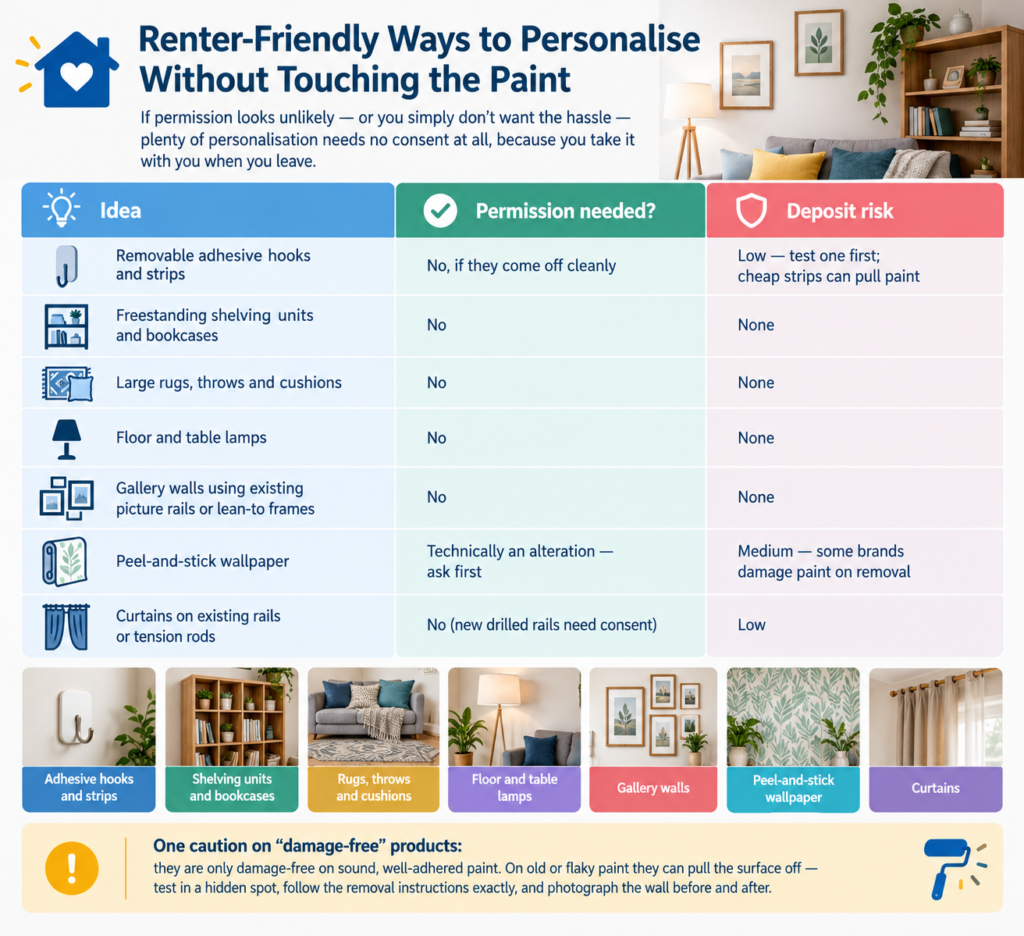
If permission looks unlikely — or you simply don’t want the hassle — plenty of personalisation needs no consent at all, because you take it with you when you leave.
| Idea | Permission needed? | Deposit risk |
|---|---|---|
| Removable adhesive hooks and strips | No, if they come off cleanly | Low — test one first; cheap strips can pull paint |
| Freestanding shelving units and bookcases | No | None |
| Large rugs, throws and cushions | No | None |
| Floor and table lamps | No | None |
| Gallery walls using existing picture rails or lean-to frames | No | None |
| Peel-and-stick wallpaper | Technically an alteration — ask first | Medium — some brands damage paint on removal |
| Curtains on existing rails or tension rods | No (new drilled rails need consent) | Low |
One caution on “damage-free” products: they are only damage-free on sound, well-adhered paint. On old or flaky paint, they can pull the surface off — test in a hidden spot, follow the removal instructions exactly, and photograph the wall before and after.
Gardens, Sheds, Satellite Dishes and Smart Doorbells
Decoration doesn’t stop at the front door. The same permission logic applies outside and to fixtures:
- Gardens: planting flowers and keeping the garden tidy is normal tenant upkeep. Digging beds, laying patios, removing trees or building raised structures counts as alteration — ask first.
- Sheds and garden rooms: almost always need written consent, and may need planning permission depending on size. In Wales, occupation-contract guidance specifically lists sheds and garden rooms as changes needing permission.
- Satellite dishes and aerials: need consent, and listed buildings or conservation areas add another layer of rules.
- Locks and smart doorbells: changing locks usually requires consent and you must give the landlord a working key. Battery video doorbells that stick rather than screw are the low-risk option, but check your agreement — some ban them.
- Wall-mounted TVs and heavy mirrors: the fixings, not the TV, are the issue. A 55-inch TV on a bracket means multiple deep holes in the wall — firmly in written-permission territory.
If repairs are what you’re actually after rather than decoration — damp patches, flaking paint caused by leaks, broken fixtures — that’s the landlord’s department, not yours. See our landlord repairs guide before you spend a penny fixing something the landlord should fix.
Frequently Asked Questions
Can I paint my rented house without asking my landlord?
In England and Northern Ireland, no — not safely. Most tenancy agreements ban decoration without written consent, and painting without it is a breach of contract that can lead to deposit deductions. In Wales, you still need to ask in writing, but your landlord must have a good reason to refuse. In Scotland, the current rules also require permission; new rights are coming but are not yet in force.
My landlord said yes verbally. Is that enough?
No. Get it in writing — an email is fine. Verbal agreements are almost impossible to prove in a deposit dispute, and memories differ about what was actually agreed, especially about whether you had to paint it back.
Can my landlord refuse to let me paint?
In England and Northern Ireland, yes — if your agreement requires consent, the landlord can refuse, and you have no statutory appeal. In Wales, a refusal must be reasonable, and you can apply to the county court if you believe it isn’t. Under Scotland’s future rules, unreasonable refusal of larger changes will be challengeable at the First-tier Tribunal.
What happens if I paint without permission?
The landlord can deduct the reasonable cost of returning the walls to their original condition from your deposit, and can claim beyond the deposit through the courts for serious cases. Adjudicators apply betterment and apportionment, so you won’t necessarily pay the full repaint cost — but unauthorised redecoration is one of the most common triggers for deposit disputes.
Do I have to paint it back to the original colour before I leave?
Almost always, unless your written permission explicitly says the new decoration can stay. “Paint it back” is the standard condition landlords attach to consent, and offering it upfront is the easiest way to get a yes.
Can the landlord charge me for paint that was already old and scruffy?
Not the full cost. Adjudicators won’t let a landlord use your deposit to fund a full redecoration of walls that were already near the end of their decorative life — deposit-dispute commentators commonly work with a lifespan of around five years. You can be charged a fair apportioned share, plus the full cost of any actual damage you caused.
Can I put up shelves or hang pictures?
Pictures on removable hooks are usually fine. Shelves, wall-mounted TVs and anything needing screws or rawlplugs count as alterations and need written permission in England, Wales and Northern Ireland, and in Scotland until the new rights commence. Under the coming Scottish rules, pictures and posters will need no consent at all.
Can I wallpaper a rented property?
Only with written permission. Wallpapering is firmly in alteration territory — it’s harder to reverse than paint, and poor removal can damage plaster. Some landlords refuse outright; if yours agrees, clarify in writing who removes it at the end.
Does the Renters’ Rights Act 2025 give me any new decoration rights?
No. The Act reformed evictions, tenancy structures, rent increases and pets, but contains no decoration or personalisation provisions. English tenants’ decoration rights are exactly what their tenancy agreements say.
When do Scotland’s new decoration rights start?
No date has been set. The Housing (Scotland) Act 2025 received Royal Assent on 6 November 2025, but the decoration provisions need secondary legislation and a commencement order first. The Scottish Government’s tenant rights page confirms the change is not yet in force — until it is, your tenancy agreement governs.
Can I decorate the garden or put up a shed?
Planting and general upkeep are normally fine, but sheds, garden rooms, patios and structural changes to the garden need the landlord’s written consent everywhere in the UK. Sheds may also need planning permission depending on their size.
My agreement bans Blu Tack, nails and Command strips. Is that enforceable?
It is part of the contract you signed, so take it seriously — adjudicators do read these clauses. That said, a blanket ban on anything touching the walls is unusually strict. If a clause seems unreasonable, get free advice from Citizens Advice or Shelter before you challenge it, and never breach it first in the hope it won’t be enforced.
Final Thoughts
Decorating a rented home comes down to one habit: ask in writing, be specific, and offer to put it back. In England and Northern Ireland that habit is your only protection, because the law gives you no decoration rights beyond your contract. In Wales the law backs you with a proper consent procedure — use it. In Scotland, genuinely tenant-friendly rights are on the way, but they are not here yet, so don’t decorate as if they were.
The maths rewards the careful. Carys spent £63 and lost nothing; Alistair skipped the email and lost £184 plus his paint money. Before you start, check what your budget actually allows with our rent affordability calculator — a tin of paint is cheap, but a deposit dispute never is. And if you’re weighing up whether the place itself is still right for you, our fair wear and tear guide and ending your tenancy guide will help you leave cleanly, with your full deposit and your reference intact.
Further Reading
- Tenant rights and protections — Scottish Government — the official page confirming Scotland’s new personalisation rights and that no commencement date has been set
- Landlord’s consent — Shelter Cymru — how the consent procedure works under Welsh occupation contracts
- Repairing your home: private tenants — nidirect — Northern Ireland’s official guidance on tenant responsibilities, including alterations and decorative order