When Chloe moved into her one-bedroom flat in Birmingham, the letting agent handed her the keys, a tenancy agreement — and an energy bill problem. The flat was on an expensive default tariff, and when she asked about switching to a cheaper deal, the agent told her the landlord had a “preferred supplier,” and she wasn’t allowed to change it. Chloe stayed put for eight months, overpaying every single month, before a friend told her the truth: if you pay the energy supplier directly, your landlord cannot stop you from switching.
Energy is one of the highest costs of renting after the rent itself. In October 2026, a typical household on a default tariff is paying £1,723 a year under Ofgem’s price cap — and many renters pay more than they need to because nobody told them their rights. This guide to energy bills when renting explains who pays for energy, your legal right to switch suppliers, what your landlord must do about energy efficiency, prepayment and smart meter rights, water bills, and the help available if you’re struggling.
Quick answer: Your tenancy agreement decides who pays — the starting point for energy bills when renting. If you pay the supplier directly, you have the legal right to choose and switch suppliers — your landlord or letting agent cannot block it, even if your agreement names a “preferred supplier”. If bills are included in your rent or your landlord is the named account holder, you cannot switch yourself but you can ask them to. Your landlord must give you a free copy of the property’s Energy Performance Certificate (minimum rating E in England and Wales), cannot charge you more for energy than they paid for it, and cannot force most prepayment meter installations on vulnerable households.
Rules differ between England, Scotland, Wales and Northern Ireland. This guide reflects the position as of October 2026 and is general information, not legal advice.
Energy Bills When Renting: Who Actually Pays?
With energy bills when renting, everything starts with your tenancy agreement. There are three common arrangements, and your rights are completely different under each one.
| Setup | How it works | Can you switch supplier? |
|---|---|---|
| You pay the supplier directly | The energy account is in your name; you choose the tariff and pay the bills | Yes — it is your legal right, and your landlord cannot block it |
| Bills included in rent | You pay one monthly figure; the landlord holds the energy account | No — but you can ask your landlord to switch to a cheaper deal |
| Landlord pays, then recharges you | The landlord is the account holder and bills you separately (common in some HMOs and sub-metered flats) | No — but the landlord cannot charge you more than they paid (see the resale rules below) |
Check your agreement before you do anything else. If you are unsure who the account holder is, look at a recent bill or ask your supplier — the name on the account is what matters, not what your landlord told you verbally.
Your Right to Switch Supplier (Even If Your Landlord Says No)
This is the right every renter should know about — and the one Chloe’s letting agent didn’t want her to know about. Ofgem’s long-standing tenant guidance on energy bills when renting is clear: where you are directly responsible for paying the energy bill, you have the right to choose your own supplier, and your landlord or letting agent should not prevent it.
Three things landlords and agents commonly get wrong:
- “Preferred supplier” clauses don’t remove your right. Your agreement may name a default supplier and must tell you about any tie-in — but if you pay the bill, you can still switch at any time. Some agreements ask you to inform the landlord after switching, or to switch back to the original supplier when you leave: check yours and follow what it says.
- Prepayment meter tenants can switch too. If you top up the meter yourself and pay the supplier directly, the same right applies.
- You can’t be charged an exit fee just for switching. There are no exit fees on standard variable tariffs. Fixed-tariff exit fees can apply if you leave early — except within the final 49 days of the contract — so check your tariff terms first.
If your landlord pays the bill (bills included in rent, or the landlord is the named account holder), you don’t have the automatic right to switch — but it costs nothing to ask. Many landlords will agree if you show them a cheaper quote.
How to Switch in Five Steps
Switching supplier — one of the best ways to cut energy bills when renting — is designed to be painless: your new supplier handles the transfer, your supply is never interrupted, and the whole thing completes within 5 working days once started.
- Check your agreement — confirm you pay the supplier directly and note any default-supplier clause or switch-back requirement.
- Find your current supplier and tariff — check a recent bill or use a postcode lookup tool.
- Compare deals — use two or three comparison sites, since no single site shows every tariff. Think about whether you want the cheapest deal, a fix for budgeting certainty, or a tariff you can leave without exit fees.
- Sign up with the new supplier — they contact your old supplier for you. You get a 14-day cooling-off period, and you can choose to switch during it or after it.
- Take a meter reading on switch day — and photograph it. Your old supplier sends a final bill within 6 weeks, and must refund any credit within 10 working days of that bill.
Worked example — Ben switches, Manchester. Ben is on his supplier’s default tariff, paying roughly the October 2026 price-cap level of £1,723 a year for typical use. He compares deals and finds a 12-month fixed tariff at an equivalent of £1,585 a year — £138 less, or about £11.50 a month. The switch takes 5 working days, his supply never drops, and his old supplier refunds his £42 credit within 10 working days of the final bill. His agreement asks him to tell the landlord after switching, so he sends a quick email. (Illustrative figures — your saving depends on your usage and the deals available.)
The October 2026 Price Cap: What You’ll Actually Pay
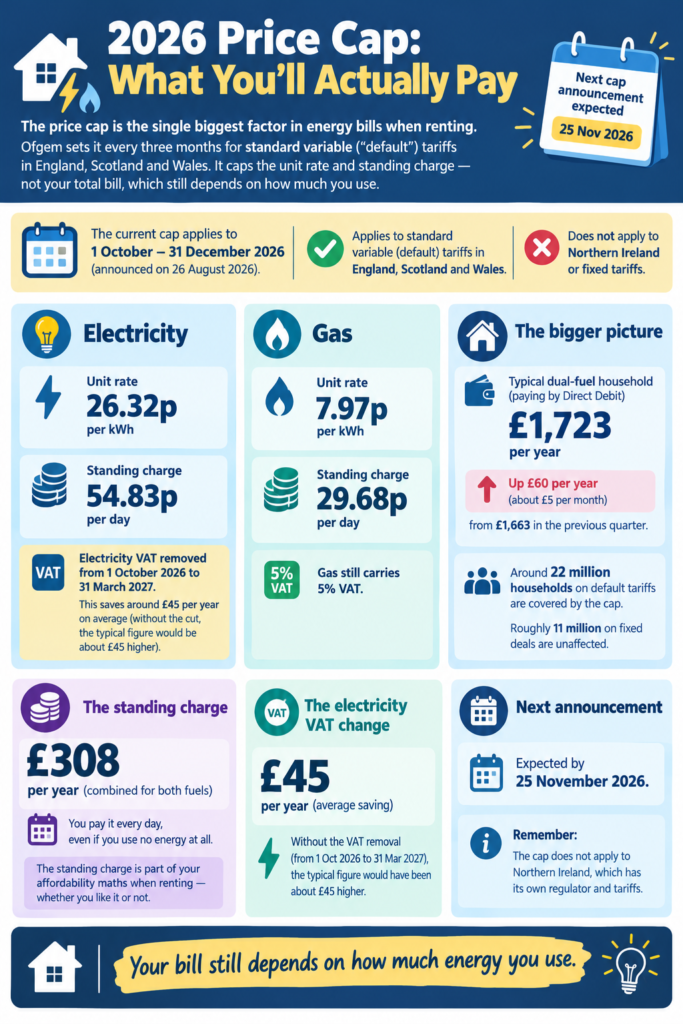
The price cap is the single biggest factor in energy bills when renting: Ofgem sets it every three months for standard variable (“default”) tariffs in England, Scotland and Wales. It caps the unit rate and standing charge — not your total bill, which still depends on how much you use. On 26 August 2026, Ofgem announced the cap for 1 October to 31 December 2026:
| Electricity | Gas | |
|---|---|---|
| Unit rate | 26.32p per kWh | 7.97p per kWh |
| Standing charge | 54.83p per day | 29.68p per day |
For a typical dual-fuel household paying by Direct Debit, that works out at £1,723 a year — about £60 a year (£5 a month) more than the previous quarter’s £1,663. Around 22 million households are on default tariffs covered by the cap; roughly 11 million on fixed deals are unaffected.
Two quirks this quarter. First, VAT has been removed from domestic electricity bills from 1 October 2026 to 31 March 2027 (gas still carries 5% VAT) — without that cut, Ofgem says the typical figure would have been about £45 higher. Second, the cap does not apply in Northern Ireland, which has its own regulator and tariffs. The next cap announcement is expected by 25 November 2026.
Remember the standing charge: you pay it every day even if you use no energy at all — around £300 a year combined for both fuels at current rates. When you budget for energy bills when renting, the standing charge is part of your affordability maths whether you like it or not.
Your Landlord’s EPC Duties: The Minimum E Rule
Before you sign, your landlord must give you a free copy of the property’s Energy Performance Certificate (EPC) — valid for 10 years, rating the home from A (best) to G (worst). You can also look up any property yourself on GOV.UK’s free energy certificate register.
Since 1 April 2020, the Minimum Energy Efficiency Standards (MEES) have required almost all privately rented homes in England and Wales to have an EPC rating of E or above — no new or renewed tenancy on an F- or G-rated property without a registered exemption. Letting a sub-standard property can bring a civil penalty of up to £5,000. There are six exemption types (including a £3,500 cost cap and cases where the tenant withholds consent), registered on the national PRS Exemptions Register.
What about EPC C by 2030? The government confirmed the policy in January 2026: a single compliance deadline of 1 October 2030 for all tenancies, with the cost cap rising to £10,000 per property and maximum penalties to £30,000. But — and this matters — it is not yet law. It needs an Act of Parliament plus a statutory instrument (expected in 2027). Until then, E remains the legal minimum.
As a tenant keeping on top of energy bills when renting, the EPC is a budgeting tool, not just paperwork: a G-rated flat will cost dramatically more to heat than a C-rated one. Always check the rating before you sign — and factor it into what you can afford using our rent budget after bills calculator.
Prepayment Meters: Your Rights
Prepayment meters loom large in energy bills when renting — pay-as-you-go for energy is common in rented homes, and these meters have a troubled history. After the forced-installation scandal, Ofgem introduced a strict Code of Practice, and the protections are real:
- Before any involuntary installation, the supplier must make at least 10 contact attempts and carry out a site welfare visit.
- Involuntary installation is banned for certain households: those needing continuous supply for health reasons (e.g. powered medical equipment), households where all occupants are 75 or over with no other support, households with children under 2, and households with severe health issues or where nobody can top up due to incapacity.
- Warrant visits must use audio or body cameras; £30 credit per meter must be applied on warrant installations; and once any debt is repaid, the supplier must reassess and move debt-free customers off prepayment if they pass credit checks.
- Only smart prepayment meters may now be installed — not old-style token or key meters.
In May 2026, British Gas agreed £70 million in compensation and debt write-offs over past forced installations — a sign of how seriously the rules are now taken. If you are struggling: tell your supplier about any vulnerabilities in writing and register for the Priority Services Register; ask for an affordable repayment plan (suppliers must help you agree one); and challenge any involuntary installation that skipped the steps above.
Smart Meters in Rented Homes
Smart meters can help you control energy bills when renting: if the energy bills are in your name, you can ask your supplier for one — suppliers must offer them to all customers, including renters, at no extra cost. Citizens Advice’s position is that a landlord cannot stop you having a meter installed or removed, though your agreement may require you to reinstall the original meter when you leave. Ofgem advises landlords not to unreasonably refuse such requests.
Two practical notes: if your bills are included in your rent, the decision sits with your landlord as the account holder. And if you are switching to a tariff that requires a smart meter, get your landlord’s written permission first to avoid a dispute at the end of the tenancy.
When Your Landlord Charges You for Energy: The Maximum Resale Price
In some HMOs, sub-metered flats and bills-recharged setups, your landlord buys the energy and sells it on to you. That makes them an energy reseller under Ofgem rules — a trap for the unwary where energy bills when renting are concerned — and the Maximum Resale Price rule applies: your landlord may not charge you more than they paid. Your bill must reflect your measured usage plus your fair share of the standing charge, plus VAT. No profit margin, no “admin fee” on top of the energy itself.
If your usage is metered, you should be charged per unit at the domestic rate plus a fair share of standing charges. If it is unmetered, the landlord must be able to show how any estimate was calculated. Charging above the resale price can be recovered through civil proceedings, plus interest.
Worked example — Aisha’s HMO overcharge, London. Aisha’s landlord charges her 40p per kWh for electricity in her HMO room, claiming “that’s the rate”. She uses about 2,400 kWh a year. What she pays: 2,400 × £0.40 = £960. The lawful maximum, measured against the October 2026 price-capped rate of 26.32p per kWh: 2,400 × £0.2632 = £631.68 (plus her fair share of the standing charge). She is being overcharged by roughly £320 a year — money she can pursue through the routes on the Citizens Advice website. Always ask to see the landlord’s own supplier bill.
Water Bills: Who Pays, and the 2026 WaterSure Reform
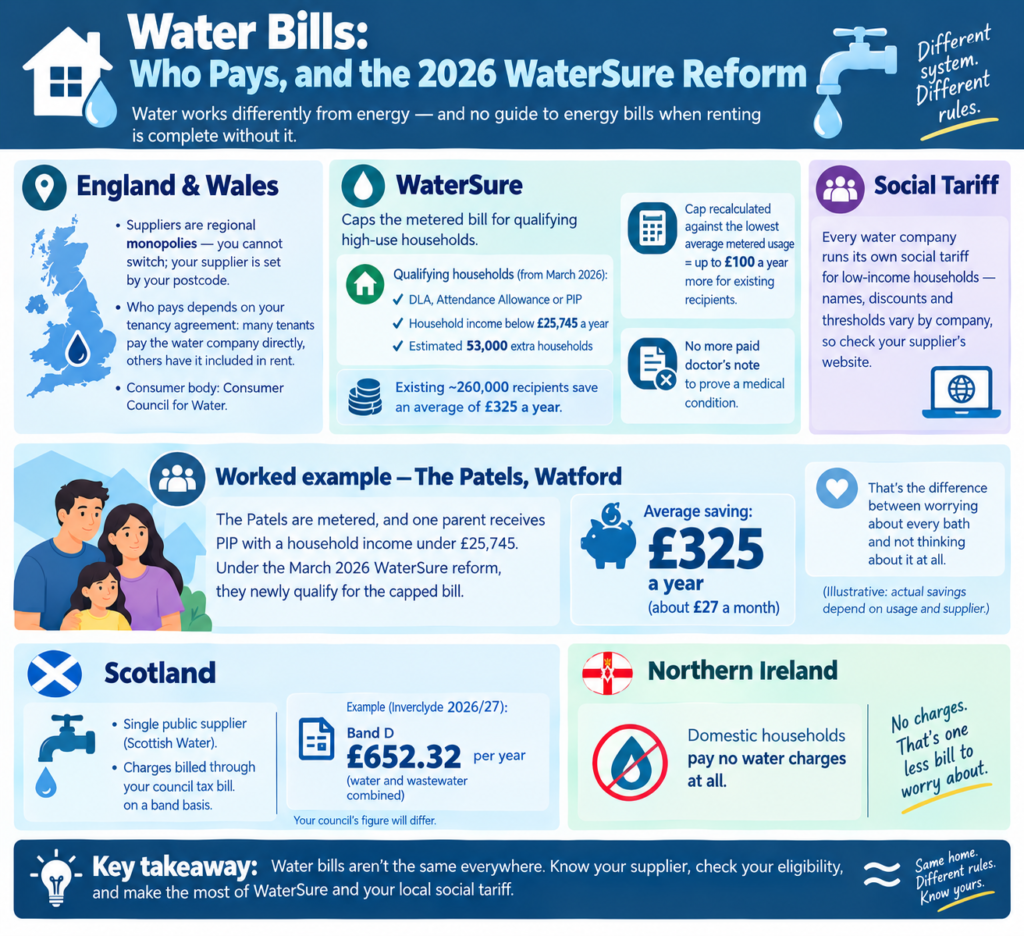
Water works differently from energy — and no guide to energy bills when renting is complete without it. In England and Wales, suppliers are regional monopolies — you cannot switch; your supplier is set by your postcode. Who pays depends on your tenancy agreement: many tenants pay the water company directly, others have it included in rent. The consumer body is the Consumer Council for Water.
WaterSure caps the metered bill for qualifying high-use households. And in March 2026, Defra announced the first major reform of the scheme since 1999: eligibility extended to households on DLA, Attendance Allowance or PIP with household income below £25,745 a year — an estimated 53,000 extra households; the existing ~260,000 recipients save an average of £325 a year; the cap is recalculated against the lowest average metered usage, worth up to £100 a year more for existing recipients; and there is no more paid doctor’s note to prove a medical condition.
Every water company also runs its own social tariff for low-income households — names, discounts and thresholds vary by company, so check your supplier’s website.
Worked example — the Patels, Watford. The Patels are metered, and one parent receives PIP with a household income under £25,745. Under the March 2026 WaterSure reform, they newly qualify for the capped bill. At the average saving of £325 a year — about £27 a month — that is the difference between worrying about every bath and not thinking about it at all. (Illustrative: actual savings depend on usage and supplier.)
Scotland is simpler: a single public supplier (Scottish Water), with charges billed through your council tax bill on a band basis — for example, Inverclyde’s 2026/27 leaflet shows Band D at £652.32 a year for water and wastewater combined (your council’s figure will differ). Northern Ireland is simpler still: domestic households pay no water charges at all.
Help With Energy Bills When Renting: What’s Available in 2026
If you are struggling with energy bills when renting, there is more help than most renters realise — but schemes change often, so check current eligibility rather than relying on old articles.
| Scheme | What you get | Who it’s for | Status |
|---|---|---|---|
| Warm Home Discount | £150 one-off credit on your electricity bill this winter | Named on the electricity bill by 23 Aug 2026 and on a qualifying means-tested benefit (UC, Pension Credit, Housing Benefit and others); automatic for most; ~6 million households expected | Winter 2026/27; not available in NI; Scotland has a different application route |
| ECO4 | Free energy-efficiency upgrades (insulation, heating) | Private renters with their landlord’s permission; homes rated EPC E–G via the benefits route | Extended to 31 Dec 2026 — eligibility doesn’t guarantee installation |
| Warm Homes: Local Grant (England) | Funded upgrades via your council | Privately rented homes, typically EPC D–G, household income ≤£36,000 or qualifying benefits/postcode | Runs to 31 Mar 2028 |
| Nest (Wales) | Free home energy improvements | Eligible Welsh households | Welsh Government added £5m for 2026–27 |
| Affordable Warmth Scheme (NI) | Heating and insulation measures | Via the NI Housing Executive; income criteria apply — check nidirect | Current (verify criteria on nidirect) |
One warning: the Great British Insulation Scheme ended on 31 March 2026. If an old article — or a cold-caller — tells you to apply for it, that information is out of date. And always start with your supplier: they must help you agree an affordable repayment plan if you fall behind, and the Priority Services Register gives extra protections if you are vulnerable.
Moving In and Out: The Meter-Reading Checklist
Energy admin at moving time is dull but valuable — a routine part of managing energy bills when renting, and it is how you avoid paying for someone else’s usage.
- Photograph every meter (gas, electricity, and water if metered) on the day you move in, with the reading clearly visible.
- Send the opening reading to your supplier when you set up the account — confirm exactly whose name is on it.
- On moving out, photograph the meters again and notify the supplier you are leaving.
- Pay the final bill — it should arrive within 6 weeks. Any credit on the account must be refunded within 10 working days of the final bill.
- Tell your landlord or agent after any switch, and check whether your agreement requires you to switch back to the original supplier at the end.
- Keep copies of everything until the final bill is settled — deposit disputes at the end of a tenancy sometimes drag energy arrears into the argument (see our tenancy deposit protection guide).
Energy Bills When Renting Across the UK at a Glance
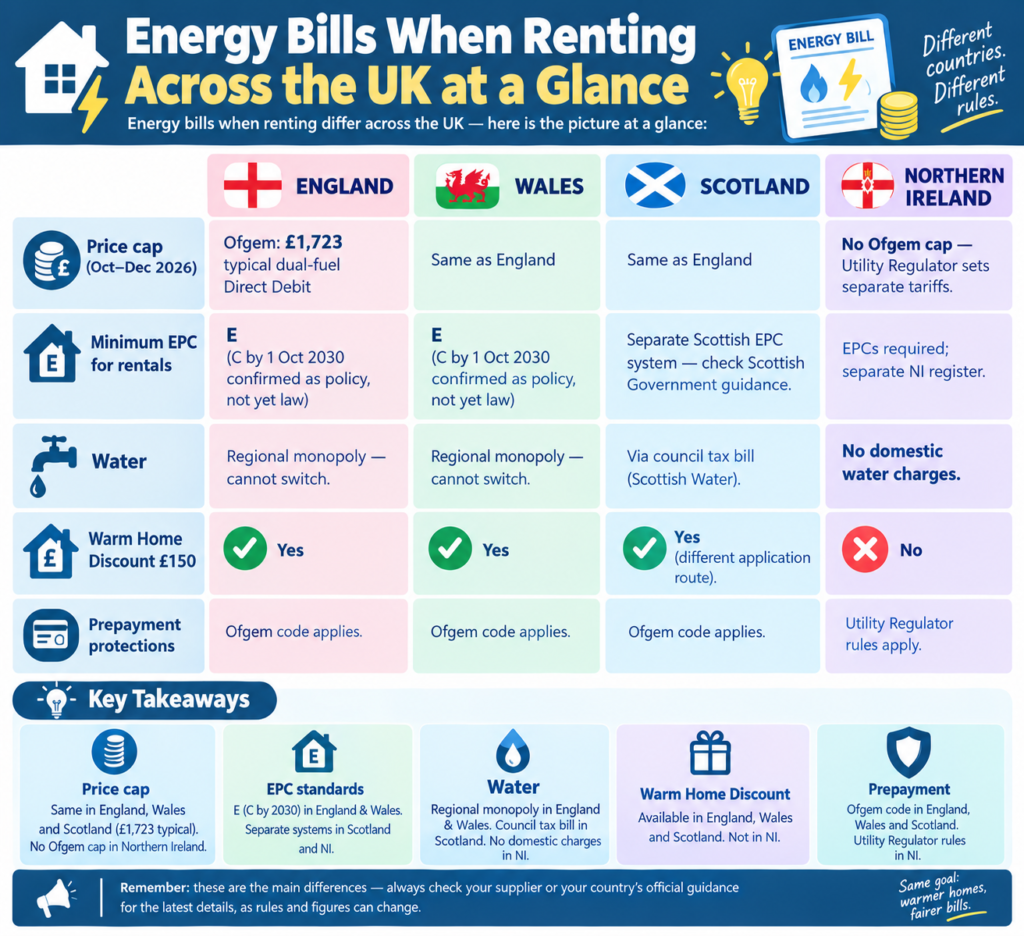
Energy bills when renting differ across the UK — here is the picture at a glance:
| England | Wales | Scotland | Northern Ireland | |
|---|---|---|---|---|
| Price cap (Oct–Dec 2026) | Ofgem: £1,723 typical dual-fuel Direct Debit | Same as England | Same as England | No Ofgem cap — Utility Regulator sets separate tariffs |
| Minimum EPC for rentals | E (C by 1 Oct 2030 confirmed as policy, not yet law) | E (C by 1 Oct 2030 confirmed as policy, not yet law) | Separate Scottish EPC system — check Scottish Government guidance | EPCs required; separate NI register |
| Water | Regional monopoly — cannot switch | Regional monopoly — cannot switch | Via council tax bill (Scottish Water) | No domestic water charges |
| Warm Home Discount £150 | Yes | Yes | Yes (different application route) | No |
| Prepayment protections | Ofgem code applies | Ofgem code applies | Ofgem code applies | Utility Regulator rules apply |
Frequently Asked Questions
Can my landlord stop me switching energy supplier?
Not if you pay the supplier directly. Ofgem’s tenant guidance says that where you are responsible for paying the energy bill, you have the right to choose your supplier and your landlord or letting agent should not prevent it. “Preferred supplier” clauses in your agreement don’t remove that right — though you may need to tell the landlord after switching, or switch back when you leave, if your agreement says so.
Do I have to switch back to the original supplier when I move out?
Check your tenancy agreement. Some agreements require you to return the account to the landlord’s preferred supplier at the end of the tenancy; others only ask to be informed of a switch. If yours is silent on the point, there is no general legal duty to switch back — but leaving the account tidy avoids deposit disputes.
What if my energy bills are included in my rent?
Then you can’t switch suppliers yourself, because the account is in your landlord’s name — but you can ask them to switch to a cheaper deal, and many will if you show them a quote. If your landlord bills you separately for energy on top of rent, the Maximum Resale Price rule means they cannot charge you more than they paid for it.
Can I get a smart meter as a tenant?
Yes, if the energy bills are in your name — ask your supplier, who must offer smart meters to all customers including renters at no extra cost. Your landlord cannot unreasonably stop the installation, but your agreement may require you to reinstall the original meter when you leave. Get written permission first if your new tariff requires a smart meter.
What EPC rating must my rented home have?
In England and Wales, almost all privately rented homes need an EPC rating of E or above — F and G-rated properties can’t be newly let without a registered exemption, and breaching the rule can mean a penalty of up to £5,000. Your landlord must give you a free copy of the EPC. The planned C-by-2030 standard is confirmed government policy but not yet law.
My landlord charges me for electricity in my HMO. Is that legal?
Charging you is legal, but overcharging isn’t. Under the Maximum Resale Price rules, a landlord who resells energy can’t charge more than they paid the supplier — your measured usage plus your fair share of the standing charge, plus VAT. Ask to see their supplier bill; if the numbers don’t add up, Citizens Advice explains how to challenge it.
Can I switch water supplier to get a cheaper deal?
No — in England and Wales, water suppliers are regional monopolies set by postcode, so there is no market to switch in. In Scotland, water is billed through your council tax. In Northern Ireland, domestic households don’t pay water charges at all. If your bill is high, check WaterSure and your supplier’s social tariff instead.
What help can I get if I can’t afford my energy bills?
If you’re struggling with energy bills when renting, start with your supplier — they must help you agree an affordable repayment plan, and you should register for the Priority Services Register if you’re vulnerable. Then check the £150 Warm Home Discount (winter 2026/27), ECO4 efficiency upgrades (needs your landlord’s permission, runs to 31 December 2026), and England’s Warm Homes: Local Grant (to March 2028). Don’t rely on the Great British Insulation Scheme — it ended in March 2026.
What happens to my energy account when I move out?
Take final meter readings (photographed) on moving day, tell your supplier you’re leaving, and pay the final bill when it arrives — it should come within 6 weeks. If the account is in credit, the supplier must refund you within 10 working days of the final bill. Keep everything until it’s settled.
Does the Ofgem price cap apply in Northern Ireland?
No. The price cap covers England, Scotland and Wales only. Northern Ireland’s energy market is regulated separately by the Utility Regulator, with its own tariffs — and around two in three homes there are heated by oil rather than gas, which isn’t price-capped at all.
Can my supplier force a prepayment meter on me?
Only by following Ofgem’s strict rules: at least 10 contact attempts, a site welfare visit, and an outright ban on involuntary installation for protected households (including under-2s, over-75s living alone without support, and people needing continuous supply for medical equipment). If a meter was forced on you without those steps, challenge it — suppliers must reassess once any debt is repaid.
Do I still pay the standing charge if I barely use any energy?
Yes, if you’re the bill-payer. The standing charge — currently 54.83p a day for electricity and 29.68p a day for gas under the October 2026 cap — applies every day regardless of usage, roughly £300 a year combined. It’s worth including in your budget even for a small flat, which our rent bills affordability calculator can help with.
Final Thoughts
Energy bills when renting are one of the few renting costs you can genuinely shrink — but only if you know the rules. Check who the account holder is, switch if it’s you, read your EPC before you sign anything, photograph your meters on moving day, and never assume your landlord’s “preferred supplier” is your only option. A single switch can save over £100 a year; a single unchecked overcharge can cost you far more.
Work out the full picture with our rent bills affordability calculator and the rent budget after bills calculator — and if you’re weighing a move to somewhere cheaper to run, check moving house costs and our council tax for renters guide first. For the fees landlords and agents can charge, see our letting agent fees guide.
Further Reading
- Ofgem — Energy price cap and standing charges explained
- Citizens Advice — Switch energy supplier or tariff
- GOV.UK — Find an energy certificate