Lena is 24 and has just moved to Leeds for her first proper job. She rents a room in Stuart’s three-bed terrace for £550 a month. The handwritten agreement calls her a “lodger” and says either side can end it with a month’s notice. Lena’s friend, who rents a whole flat, insists Lena must have the same rights as a tenant. Stuart insists she doesn’t. Both are half right — and the half they get wrong in Lodger vs Tenant UK could cost them dearly.The difference between a lodger and a tenant is one of the most misunderstood areas of UK housing law. It decides your notice period, whether your deposit must be protected, who pays the council tax, and how the taxman treats the rent. This guide explains exactly where the line falls and what rights you keep on either side of it.
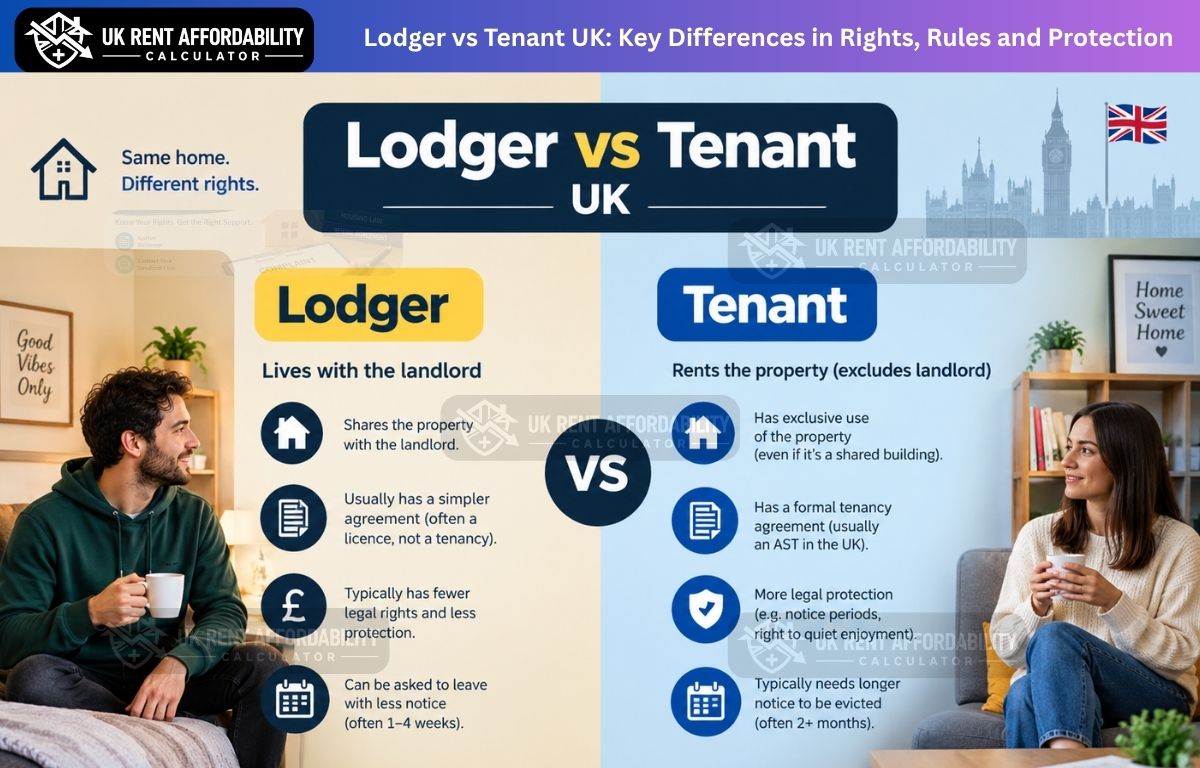
Quick Answer: A lodger rents a room in their landlord’s home while the landlord still lives there and shares the kitchen, bathroom or living room. Lodgers are “excluded occupiers”: they can be asked to leave on reasonable notice (usually one rental period) with no court order, their deposits don’t need a protection scheme, and the landlord stays liable for council tax. A tenant rents a property the landlord doesn’t live in, with exclusive possession, and gets far stronger protections — deposit protection, statutory notice periods and eviction only through the courts. The legal test looks at the reality of the arrangement, not what the agreement is called.
How Do You Tell Whether Someone Is a Lodger or a Tenant?
Two questions decide it: does the landlord live in the property as their main home? And does the landlord share living accommodation — a kitchen, bathroom or living room — with the occupier? Yes to both means Lodger vs Tenant UK; landlord living elsewhere, or a self-contained let sharing nothing, means tenant.
Crucially, the paperwork’s label doesn’t decide. An agreement headed “lodger agreement” can still create a tenancy if the facts point that way — courts look at substance, not labels, a principle settled by the most famous housing case in English legal history.
What Does “Exclusive Possession” Actually Mean?
The landmark case is Street v Mountford [1985], decided by the House of Lords. Mr Street let Mrs Mountford two rooms for £37 a week under an agreement calling itself a “licence”, terminable on 14 days’ notice. The court looked past the label: exclusive possession for a term at a rent made her a tenant.
Lord Templeman’s judgment gave the test that still applies today:
“An occupier of residential accommodation at a rent for a term is either a lodger or a tenant. The occupier is a lodger if the landlord provides attendance or services which require the landlord or his servants to exercise unrestricted access to and use of the premises. A lodger is entitled to live in the premises but cannot call the place his own.”
In plain terms: a tenant has exclusive possession — the right to keep everyone, including the landlord, out of their space. A lodger has permission to live in the room, but the landlord keeps broad access rights and sets the house rules.
There is a middle category worth knowing. If a lodger has exclusive use of their own room but shares the kitchen and bathroom, lawyers call it an excluded tenancy. If they don’t even have exclusive use of the room, it’s an excluded licence. Both are “excluded occupiers” — the practical difference for eviction is the same.
| Feature | Lodger (excluded occupier) | Tenant |
|---|---|---|
| Landlord lives in the property | Yes, as their main home | No |
| Shares kitchen/bathroom/living room | Yes | No |
| Exclusive possession of the space | No | Yes |
| Legal basis | Licence (or excluded tenancy) | Tenancy (assured periodic in England since 1 May 2026) |
| Deposit protection scheme required | No | Yes |
| Eviction needs a court order | No (if sharing living space) | Yes, always |
| Notice to end | Reasonable notice (usually one rent period) | Statutory notice periods |
| Tenant Fees Act 2019 (England) | Applies to licences, including lodger licences | Applies |
What Rights Does a Lodger Have?
Fewer than a tenant — but “fewer” does not mean “none”:
- Reasonable notice before being asked to leave — usually the length of the rental payment period (see below).
- Protection from harassment and unlawful eviction — it is a criminal offence to harass a residential occupier or evict them by force, even where no court order is required. Changing the locks while notice is still running, or using threats or violence, can be prosecuted under section 1 of the Protection from Eviction Act 1977.
- Return of the deposit — fair and prompt, minus only reasonable, itemised deductions for damage beyond fair wear and tear.
- A safe home — if the property has gas appliances, the resident landlord must arrange an annual Gas Safe check and give the lodger a copy of the certificate.
- Freedom from prohibited fees — in England, the Tenant Fees Act 2019 covers licences to occupy, including those issued by resident landlords: no referencing, admin, inventory or compulsory cleaning fees.
- Peaceful occupation — the contractual right to live in the room undisturbed under the terms agreed.
What Rights Does a Tenant Have That a Lodger Doesn’t?
The gap is significant, which is why getting the classification right matters so much:
- Deposit protection. A tenant’s deposit must be protected in a government-approved scheme within 30 days; a lodger’s need not be.
- Eviction only through the courts. A tenant cannot be evicted without a possession order. A lodger sharing living space can be asked to leave when reasonable notice expires, with no court involvement.
- Statutory notice periods. Since the Renters’ Rights Act 2025 took effect in England on 1 May 2026, tenants hold assured periodic tenancies and can only be evicted on statutory grounds through a Section 8 notice. Lodgers have no equivalent procedure.
- Security of tenure. A tenant on an assured periodic tenancy can stay indefinitely unless a legal ground for possession is proven. A lodger has no long-term security: reasonable notice ends the arrangement.
How Much Notice Must a Lodger Be Given to Leave?
There is no fixed statutory notice period for lodgers. The legal requirement is “reasonable notice” — and what counts as reasonable depends on the circumstances.
The standard guide, confirmed by GOV.UK, is that reasonable notice usually means the length of the rental payment period:
| How rent is paid | Typical reasonable notice |
|---|---|
| Weekly | One week |
| Fortnightly | Two weeks |
| Monthly | One month |
GOV.UK’s own page on renting a room in your home puts it plainly: “Reasonable notice usually means the length of the rental payment period. For example, if rent is paid monthly, you should give one month’s notice.”
A written agreement can set its own notice period, and that is what applies — one month is the most common term. If there is no agreement, or it is silent, the rent-period rule is the fallback. Shelter advises the notice should normally end on the last day of a rental period: if rent runs from the 17th to the 16th, a month’s notice should expire on the 16th.
Citizens Advice adds that what is reasonable also reflects length of residence and behaviour — a lodger of many years may be entitled to longer notice, while serious misconduct can justify less.
Worked example — notice periods: Oscar pays £150 a week in Manchester: one week’s notice applies. Lena pays £550 a month in Leeds, rent running 1st to month-end: Stuart must give a full month expiring on the last day of a rental period — notice served on 10 October expires on the 30 November.
Importantly, the same “reasonable notice” principle protects the lodger too: a lodger who wants to leave should give notice matching the rent period, rather than simply vanishing.
Can a Landlord Evict a Lodger Without Going to Court?
If the lodger is an excluded occupier — living in the landlord’s home and sharing a kitchen, bathroom or living room — then yes. Once reasonable notice has expired, the landlord can require the lodger to leave without a possession order: in practice, changing the locks while the lodger is out, provided no force is used and belongings are returned promptly.
There is a second, rarer category. If the lodger lives in the landlord’s home but does not share any living space — say, a self-contained annexe with its own kitchen and bathroom — GOV.UK says they have basic protection, and the landlord must get a court order to evict them.
Either way, the boundaries are strict:
| Situation | Court order needed? |
|---|---|
| Lodger shares kitchen/bathroom/living room with resident landlord (excluded occupier) | No — reasonable notice only |
| Lodger lives in landlord’s home but shares no living space (basic protection) | Yes |
| Tenant in a property the landlord doesn’t live in | Yes, always |
And the criminal law still applies everywhere: using force, threats or harassment to remove any residential occupier is an offence under the Protection from Eviction Act 1977, even when no court order is needed. “No court order required” never means “no rules apply”.
Do Lodger Deposits Need to Go Into a Protection Scheme?
No. This is one of the clearest differences between lodgers and tenants. A lodger’s deposit does not have to be registered with a tenancy deposit protection scheme — Shelter England confirms this directly, and the Housing Act 2004 requirement applies to assured tenancies, not lodger licences.
The landlord must still return the deposit when the lodger moves out, minus only reasonable deductions backed by evidence — cleaning or repair costs beyond fair wear and tear, supported by quotes or invoices. Good practice is to keep the deposit in a separate account, take dated photos at check-in, and provide an itemised list of deductions.
And one protection many miss: in England, the Tenant Fees Act 2019 applies to licences to occupy, including resident-landlord licences — so a lodger’s deposit is capped at five weeks’ rent, and banned fees (referencing, admin, inventory, compulsory cleaning) can’t be charged either.
Worked example — the five-week cap: Oscar’s room costs £867 a month. The maximum deposit is £867 × 12 ÷ 52 × 5 = £1,000.38, so roughly £1,000. Two months’ rent (£1,734) as a deposit would breach the Tenant Fees Act.
| Deposit rule | Lodger | Assured tenant |
|---|---|---|
| Must be protected in a scheme | No | Yes, within 30 days |
| Maximum deposit (England) | 5 weeks’ rent | 5 weeks’ rent |
| Fee ban (England) | Yes, applies | Yes, applies |
| Deductions | Must be reasonable and evidenced | Must be reasonable and evidenced |
Who Pays the Council Tax — the Lodger or the Landlord?
The resident landlord stays liable for the council tax. A lodger is not liable — the council pursues the householder, not the person renting the room. Many landlords simply factor a share of the council tax into the rent.
Two consequences follow. First, the 25% single-person discount will normally end — the property is no longer occupied by a single adult, and the council must be told. Second, a lodger who is a full-time student, an apprentice or otherwise “disregarded” for council tax purposes does not count as a second adult, so the discount can survive.
| Arrangement | Who is liable for council tax? |
|---|---|
| Lodger in resident landlord’s home | The landlord (householder) |
| Sole or joint tenant(s), whole property | The tenant(s) |
| HMO (house in multiple occupation) | The landlord |
| Permitted occupier (e.g. partner not on tenancy) | The tenant remains liable; occupier counts as an adult resident |
If you want the full breakdown of how council tax works for renters, see our council tax for renters guide.
Do Right to Rent Checks Apply to Lodgers?
Yes — in England, and this catches many resident landlords out. The Immigration Act 2014 requires checks on all adults occupying rented accommodation as their only or main home, expressly including lodgers. Check before the lodger moves in: see original documents face to face (or use the Home Office online service), take copies, and keep records.
The penalties are serious. Since 13 February 2024, the civil penalty is up to £5,000 per lodger for a first breach and up to £10,000 per lodger for repeat breaches — with no upper limit overall. Knowingly letting to someone without the right to rent can also be a criminal offence under the Immigration Act 2016. Right to Rent checks do not apply in Scotland, Wales or Northern Ireland.
Our right to rent checks guide walks through the documents you can accept and how the online checks work.
How Does the Rent a Room Scheme Work?
If you take in a lodger, the taxman gives you a generous break. The Rent a Room Scheme lets you earn up to £7,500 a year tax-free from letting furnished accommodation in your only or main home. The threshold has been £7,500 since April 2016 and applies for the 2026/27 tax year.
The key rules:
- The accommodation must be furnished and part of your main home — not a separate flat or a property you don’t live in.
- The limit covers gross receipts: rent plus anything the lodger pays for meals, cleaning, laundry or bills.
- If two people share the income, the allowance is halved to £3,750 each.
- At £7,500 or less, the exemption is automatic — no need to tell HMRC.
- Above £7,500, file a Self Assessment return and choose: Method A (tax on the amount above £7,500, no expense deductions) or Method B (opt out; tax on actual profit after expenses).
- You can’t use the scheme for rooms used as offices, or while you live abroad.
| Annual gross receipts | What happens |
|---|---|
| £7,500 or less | Tax-free automatically; no need to declare |
| More than £7,500 | File a tax return; choose Method A (tax on the excess) or Method B (tax on actual profit) |
| Shared between two people | Each gets a £3,750 allowance |
Worked example — Rent a Room tax: Oscar pays £650 a month, all-in: gross receipts of £7,800 a year, £300 over the threshold. Under Method A, Stuart pays tax on £300 — £60 at the 20% basic rate. At £550 a month (£6,600 a year), the whole amount would be tax-free automatically.
Two practical warnings. First, you don’t need to own the property — tenants can take in lodgers too — but you must have your landlord’s written permission, and check your mortgage: most residential lenders require notification before you take in a lodger. Second, tell your home insurer — failing to disclose a lodger can invalidate your policy.
What Happens to Benefits When You Take In a Lodger?
The benefit rules are surprisingly favourable — especially under Universal Credit.
Universal Credit: income from a lodger is fully disregarded — not counted as income at all, so it doesn’t reduce your UC. However, the room still counts as a spare bedroom for the housing element, so a social tenant could still face the under-occupancy charge (“bedroom tax”) on it.
Housing Benefit (legacy): less generous. Income from a sub-let has a £20-a-week disregard; for boarders it’s £20 plus half the balance. Charging up to £20 a week generally won’t affect housing benefit; above that, the income counts and benefit can go down.
If your lodger claims benefits themselves, they can usually claim housing costs — but not if they’re closely related to you, and a lodger paying rent to family members they live with can’t claim UC housing costs for it.
For more on how benefits interact with rent, see our guide to how much rent Universal Credit will pay.
What Happens If the Resident Landlord Moves Out?
This is the scenario that flips everything. The lodger arrangement depends entirely on the landlord living in the property as their main home. If the landlord moves out permanently:
- The arrangement can become a full tenancy — an assured periodic tenancy under the post-May-2026 rules in England — if the other conditions are met (notably, exclusive possession of identifiable premises). No new agreement is needed; the law reclassifies it automatically.
- Temporary absences don’t count. Holidays, hospital stays or short work trips don’t break resident-landlord status.
- If the landlord sells, the resident-landlord exception continues for 28 days after the sale, extendable to six months if the new owner gives notice within those 28 days that they intend to move in. If the new owner never moves in, the exclusion ends and the occupier can become a full tenant.
If you’re thinking of moving out as a resident landlord, get advice first — you may hand your lodger full tenancy rights without realising it.
Does the Renters’ Rights Act 2025 Change Anything for Lodgers?
The Renters’ Rights Act 2025 — the biggest shake-up of English renting law in a generation — came into force on 1 May 2026, abolishing Section 21 evictions and replacing assured shortholds with assured periodic tenancies. But it does not change genuine lodger arrangements: the Act reforms assured tenancies, and a lodger sharing the landlord’s home is a licensee, not an assured tenant — provided the home remains the landlord’s main residence and living accommodation is genuinely shared.
That said, the Act makes accurate classification more important than ever. Misclassifying a genuine tenant as a “lodger” to dodge the new eviction rules won’t survive scrutiny — the Street v Mountford test still decides. Our Renters’ Rights Act 2025 guide explains the new tenancy rules in full.
What Should a Written Lodger Agreement Include?
A written agreement is not legally required — but going without one is asking for trouble. It’s the best way to prove what was agreed. A solid lodger agreement should cover:
- Names of the landlord and the lodger, and the property address.
- The room being let and which facilities are shared.
- The rent: amount, payment day, what it includes (bills, council tax share, cleaning).
- The deposit: amount, where it’s held, and the conditions for deductions.
- The notice period for ending the arrangement (one month is standard).
- House rules: guests, smoking, pets, quiet hours, use of shared spaces.
- Access rights: when the landlord may enter the room (for example, to clean or inspect).
- Length of the arrangement: fixed term or rolling periodic.
- Signatures and date from both parties.
Remember the golden rule from Street v Mountford: the agreement’s label doesn’t decide anything. Draft it to reflect the reality — shared home, shared facilities, broad access — and live by it.
How Do the Rules Differ in Scotland, Wales and Northern Ireland?
The core concept — a live-in landlord sharing their home has an excluded occupier, not a tenant — exists across the UK, but the framework is devolved:
- Scotland: Resident landlords don’t need to register with the council; the arrangement is a common-law licence on reasonable notice. No Right to Rent checks; Scotland has its own unlawful-eviction offence.
- Wales: Under the Renting Homes (Wales) Act 2016, a lodger sharing living accommodation has no occupation contract. The Protection from Eviction Act exclusion works as in England; no Right to Rent checks.
- Northern Ireland: A lodger with a resident landlord holds a licence ended on reasonable notice; the statutory notice-to-quit periods apply to private tenancies, not lodger licences. No Right to Rent checks.
| England | Scotland | Wales | Northern Ireland | |
|---|---|---|---|---|
| Legal basis | Excluded occupier (licence or excluded tenancy) | Common-law licence | Licence; excluded from occupation contracts | Licence |
| Notice to end | Reasonable notice (usually = rent period) | Reasonable notice | Reasonable notice | Reasonable notice |
| Court order to evict? | No, if sharing living space | No, if sharing living space | No, if sharing living space | No, if sharing living space |
| Deposit protection scheme | Not required | Separate Scottish regime for tenancies | Separate Welsh regime for contracts | Separate NI regime for tenancies |
| Right to Rent checks | Yes | No | No | No |
The detail varies — if your property is outside England, take local advice before acting, especially on eviction.
Final Thoughts
The lodger–tenant divide comes down to one picture: do you share your home and your living spaces with the person paying you? If yes, you have a lodger — flexible to end, lighter on paperwork, tax-free rent up to £7,500, no deposit scheme to administer. If no, you have a tenant — and the full weight of tenancy law applies.
For landlords, the three things that cause most grief are: skipping the written agreement, forgetting Right to Rent checks, and assuming the arrangement can never become a tenancy. For lodgers: not realising reasonable notice can mean just one month, and that the deposit — unprotected by a scheme — is still your money and must come back fairly.
If you’re comparing your position with a standard tenancy, read our tenancy agreement guide and our ending your tenancy guide. And if you’re a landlord weighing up taking in a lodger, our landlord repairs guide and illegal eviction guide are worth an hour of your time.
FAQs
Am I a lodger or a tenant if my landlord lives in the flat but we never speak?
Almost certainly a lodger. The test is whether the landlord lives there as their main home and shares the kitchen, bathroom or living room with you — not how friendly you are.
Can my landlord call me a lodger to avoid giving me tenant rights?
Not if the facts say otherwise. Under Street v Mountford, courts look at the reality: exclusive possession for a term at a rent creates a tenancy, whatever the agreement is called.
How much notice does a lodger get in the UK?
Reasonable notice — usually the length of the rent period. Monthly rent means roughly a month; weekly rent roughly a week. A written agreement can set its own period.
Can a landlord change the locks on a lodger?
Once valid reasonable notice has expired, yes — provided no force is used and belongings are returned. Changing locks early, or using threats or violence, can be a criminal offence under the Protection from Eviction Act 1977.
Does a lodger’s deposit have to be protected?
No — lodger deposits don’t go into a protection scheme. But in England the Tenant Fees Act caps the deposit at five weeks’ rent, and it must be returned fairly with itemised deductions.
Who pays council tax if I take in a lodger?
You do — the resident landlord stays liable. The lodger isn’t liable, though you can reflect a share in the rent. You’ll normally lose the 25% single-person discount, so tell your council.
Do I need to do a Right to Rent check on a lodger?
In England, yes — the Immigration Act 2014 covers lodgers, with civil penalties up to £5,000 per lodger for a first breach. Checks aren’t required in Scotland, Wales or Northern Ireland.
How much can I earn tax-free from a lodger?
Up to £7,500 a year under the Rent a Room Scheme (2026/27), or £3,750 each if shared. Below the threshold it’s automatic; above it, file a tax return and choose how to be taxed.
What happens to my lodger if I move out of the property?
The arrangement can automatically become a full tenancy (an assured periodic tenancy in England) — with eviction only through the courts. Temporary absences like holidays don’t trigger this.
Does the Renters’ Rights Act 2025 apply to lodgers?
No. In force in England from 1 May 2026, it reforms assured tenancies. A genuine lodger sharing the landlord’s home is a licensee, not an assured tenant.
Can a lodger claim Universal Credit for their rent?
Yes, with a lodger agreement or rent book as evidence — unless paying rent to family members they live with. Meanwhile, the landlord’s own UC isn’t reduced by lodger income: it’s fully disregarded.
Is a written agreement required for a lodger?
No, but it’s strongly advisable. A written licence setting out rent, notice, deposit terms and house rules protects both sides if there’s a dispute.
Further Reading
- GOV.UK — Rent a room in your home: your lodger’s tenancy type
- Shelter England — Return of a lodger’s deposit
- Citizens Advice — If you’re being evicted as a lodger