
Right to Rent Checks UK: You have found the flat. The tenancy agreement is ready, and then the letting agent asks you for proof that you are allowed to live in the UK. These are the right to rent checks every landlord in England must complete: they are not optional, for them or for you. Every adult who will live in a rented home in England as their main home must be checked before the tenancy begins — whatever their nationality, including British citizens. Without acceptable proof, the landlord cannot legally let you move in.
Quick Answer: Right to rent checks are immigration checks landlords and agents in England must carry out on every adult occupier (18+) before a tenancy starts. British or Irish citizens usually prove it with a passport (even an expired one), a passport card, or a naturalisation certificate — or a combination of two other accepted documents. Everyone else typically uses the Home Office online service: generate a nine-character share code on GOV.UK (valid 90 days), give it and your date of birth to your landlord, and they check your status live. If you have no usable documents and no share code, your landlord must use the Home Office Landlord Checking Service rather than simply rejecting you.
What Exactly Are Right to Rent Checks?
Right to rent checks UK are the immigration-status checks that private landlords and letting agents in England must complete on every prospective adult tenant or lodger before the tenancy begins. Introduced under the Immigration Act 2014 (in force across England since 1 February 2016), they bar people without lawful immigration status from the private rented sector — and they apply to you even if you were born in England and have lived here all your life.
The check is the landlord’s legal responsibility — but from your side it is a practical hurdle: no proof, no keys. The landlord uses one of three accepted routes — original documents in person, your online share code, or a registered digital verification service — then records the date and keeps the evidence for the whole tenancy plus one year afterwards.
Where Do Right to Rent Checks Apply? (England Only)
This is the question that trips people up, so deal with it first: right to rent checks apply in England only. The Immigration Act 2014 gave the scheme UK-wide powers in principle, but it has never been brought into force in Wales, Scotland or Northern Ireland. If you are renting in Cardiff, Glasgow or Belfast, your landlord does not carry out a right to rent check. If you are renting in Manchester, London or Newcastle, they do.
| Rented property location | Right to rent check required? |
|---|---|
| England | Yes — every adult occupier, before the tenancy starts |
| Wales | No — scheme never commenced |
| Scotland | No — scheme never commenced |
| Northern Ireland | No — scheme never commenced |
Exemptions in England include social housing, care homes, hostels and refuges, mobile homes, university student accommodation, council-provided or job-tied accommodation, and leases of seven years or longer. For ordinary private tenancies and lodgings, though, the check is unavoidable.
Who Must Pass Right to Rent Checks?
The rule is wider than most people expect. Your landlord must check every adult aged 18 or over who will use the property as their only or main home — even if they are not named on the agreement, even without a written agreement, and even if they move in after the tenancy has started. A partner, a grown-up child, a lodger: each one needs a check.
| Situation | Check needed? |
|---|---|
| Named on the tenancy agreement | Yes |
| Living there but not named on the agreement | Yes |
| Moves in after the tenancy starts | Yes — check before they move in |
| Under 18 | No |
| Only staying temporarily and the property is not their main home | No (judged on the facts — see the “main home” test below) |
| Lodger in a live-in landlord’s home | Yes |
The “only or main home” test uses everyday indicators: they live there most of the time, keep most of their belongings there, their partner or children live with them, they are registered to vote at the address, or they are registered with a doctor there. If in doubt, landlords are told to check rather than gamble.
Callout: It is against the law for your landlord to check only the people they think might not be British. Everyone must be checked in the same way, and a landlord who singles people out because of their nationality, ethnicity or accent risks an unlawful discrimination claim. More on this below.
When Do Right to Rent Checks Have to Happen?
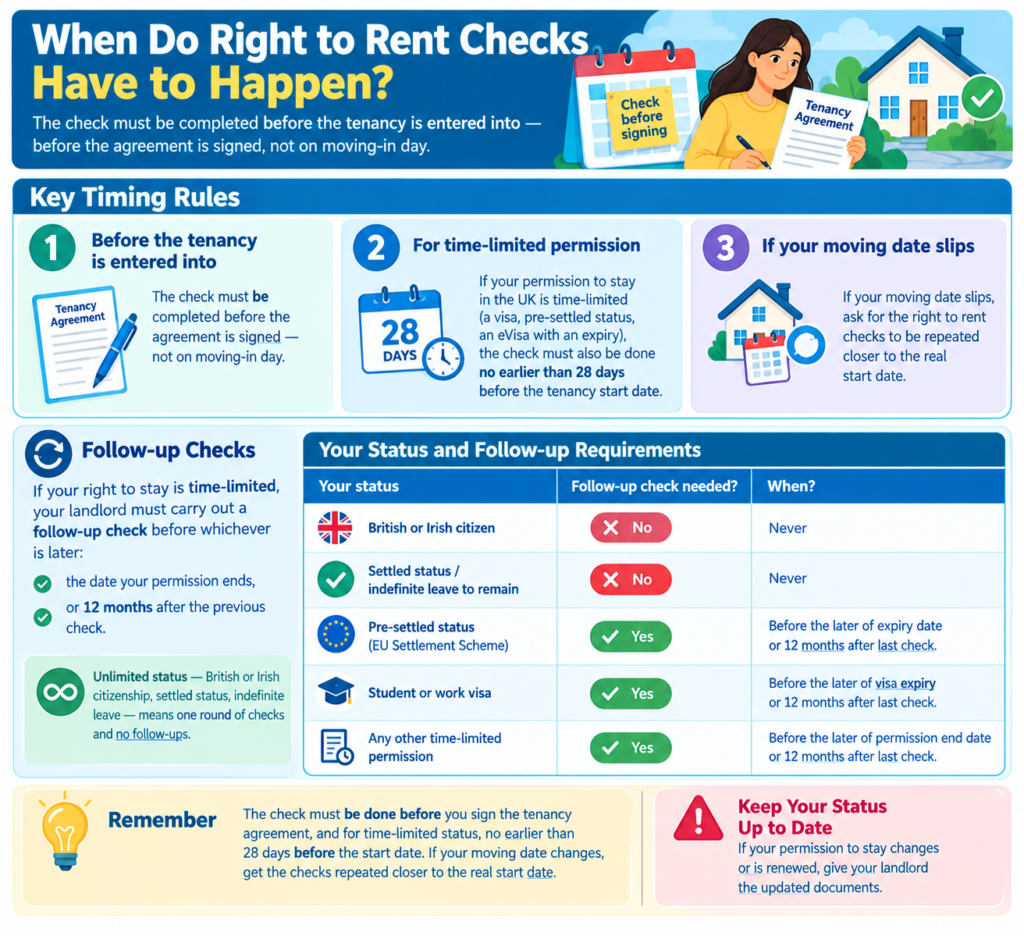
The check must be completed before the tenancy is entered into — before the agreement is signed, not on moving-in day. If your permission to stay in the UK is time-limited (a visa, pre-settled status, an eVisa with an expiry), the check must also be done no earlier than 28 days before the tenancy start date, so that it reflects your current status. If your moving date slips, ask for the right to rent checks to be repeated closer to the real start date.
If your right to stay is time-limited, your landlord must carry out a follow-up check before whichever is later: the date your permission ends, or twelve months after the previous check. Unlimited status — British or Irish citizenship, settled status, indefinite leave — means one round of right to rent checks and no follow-ups.
| Your status | Follow-up check needed? | When? |
|---|---|---|
| British or Irish citizen | No | Never |
| Settled status / indefinite leave to remain | No | Never |
| Pre-settled status (EU Settlement Scheme) | Yes | Before the later of expiry date or 12 months after last check |
| Student or work visa | Yes | Before the later of visa expiry or 12 months after last check |
| Any other time-limited permission | Yes | Before the later of permission end date or 12 months after last check |
The Three Accepted Ways to Do Right to Rent Checks
From your side, what matters is which route you will use for your right to rent checks — it decides what you need to prepare. There are three:
- A manual document check — you show the originals in person, the landlord or agent verifies they are genuine and that the photo matches you, then copies them and records the date.
- The Home Office online check — you generate a share code and give it, plus your date of birth, to the landlord, who views your live status on GOV.UK.
- A registered digital verification service (DVS) — an approved provider checks your documents, useful for British or Irish passport holders who cannot easily attend in person. From 1 October 2026, any provider used this way must be on the government’s register and specifically authorised for right to rent checks.
| Check route | Who it suits | What you provide |
|---|---|---|
| Manual document check | British/Irish citizens; anyone with original physical documents | Original documents, seen in person (or by video where permitted) |
| Online share code | eVisa holders, EU settled/pre-settled, biometric residence card/permit holders, people who used the ID Check app | Nine-character share code + date of birth |
| Registered digital verification service | British/Irish passport holders, some digital-document cases | ID via an approved provider (optional — you can insist on manual instead) |
Callout: The route is not the landlord’s free choice. If you can prove your right to rent with accepted original documents, your landlord cannot insist you use the online service instead. Conversely, if you hold an eVisa or other digital status, the check normally goes online, since physical immigration documents such as biometric residence permits are no longer acceptable for manual checks.
Right to Rent Checks for British or Irish Citizens
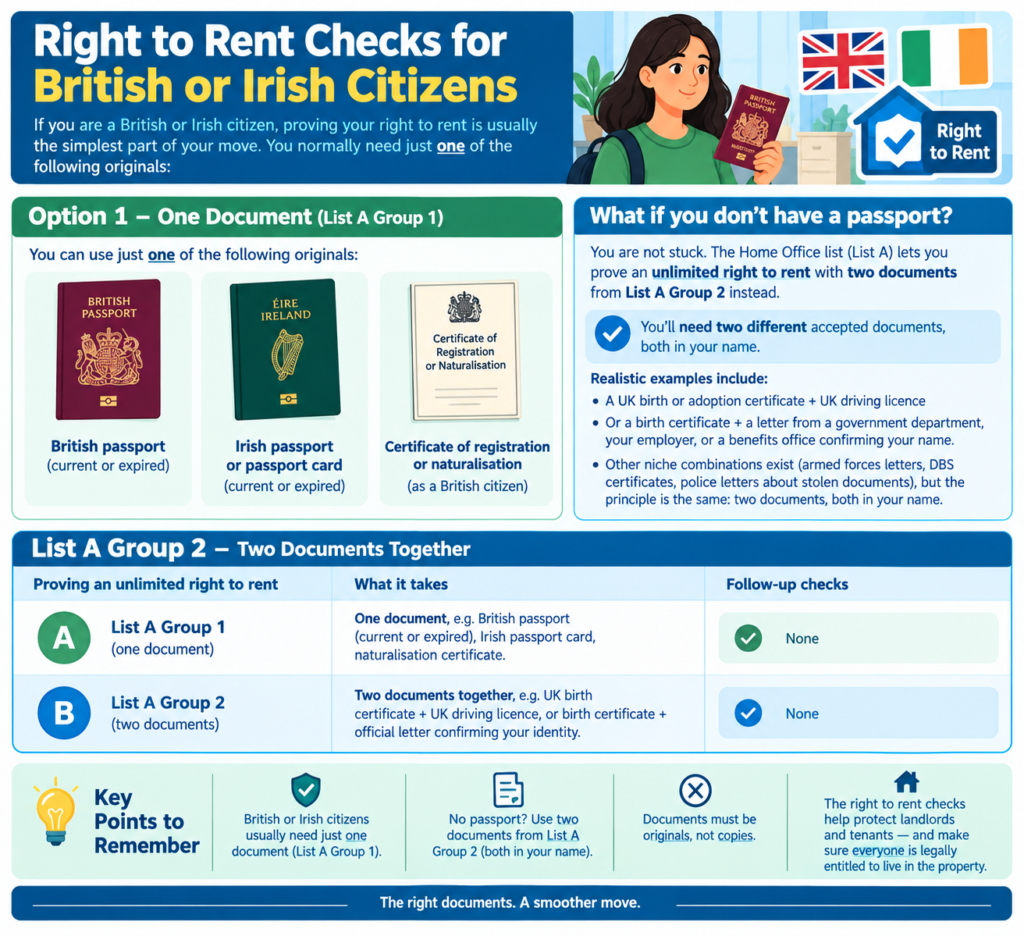
If you are a British or Irish citizen, proving your right to rent is usually the simplest part of your move. You normally need just one of the following originals:
- A British passport — current or expired (it just must not be cancelled or tampered with).
- An Irish passport or passport card — current or expired.
- A certificate of registration or naturalisation as a British citizen.
No passport? You are not stuck. The Home Office list (List A) lets you prove an unlimited right to rent with two documents from List A Group 2 instead. Realistic examples include a UK birth or adoption certificate plus a UK driving licence, or a birth certificate plus a letter from a government department, your employer, or a benefits office confirming your name. Other niche combinations exist (armed forces letters, DBS certificates, police letters about stolen documents), but the principle is the same: two different accepted documents, both in your name.
| Proving an unlimited right to rent | What it takes | Follow-up checks |
|---|---|---|
| List A Group 1 | One document, e.g. British passport (current or expired), Irish passport card, naturalisation certificate | None |
| List A Group 2 | Two documents together, e.g. UK birth certificate + UK driving licence, or birth certificate + official letter confirming your identity | None |
Worked Example: Aisha’s Paperwork Problem
Aisha, 29, is a British citizen renting a £1,150-a-month flat in Leeds and has never owned a passport. She does have her full UK birth certificate and a UK photocard driving licence — a classic List A Group 2 combination. The agent checks both in person, copies them, records the date, and Aisha’s right to rent is proved permanently: no follow-ups ever. Had she produced nothing usable, the agent would have had to use the Home Office Landlord Checking Service before turning her away (see below).
Right to Rent Checks: The Online Share Code Route
If your immigration status is digital — an eVisa, settled or pre-settled status under the EU Settlement Scheme, a biometric residence card or permit, or you applied for a visa using the “UK Immigration: ID Check” app — you will almost certainly use the Home Office online service. Physical biometric residence permits and cards can no longer be used for manual document checks, so your share code is the way in.
The code is a nine-character code beginning with the letter R (other letter codes are for other purposes, such as proving your right to work — generate the right-to-rent one). It is valid for 90 days and reusable within that window — handy if you are viewing several properties.
How to get your share code, step by step
- Go to GOV.UK and find “Prove your right to rent in England”.
- Sign in using your immigration details — passport, national ID, biometric residence card/permit, or your eVisa details, plus the email or phone number on your UKVI account.
- Verify your identity with the security code sent to your email or phone.
- Choose “prove your right to rent” and generate the code.
- Send the nine-character code and your date of birth to your landlord or agent.
The landlord enters both on the “View a tenant’s right to rent in England” service, confirms the photo and details match you, and saves a copy of the profile page with the date. A screenshot you send does not count: they must run the check themselves on the official service.
Callout: British and Irish citizens cannot generate a share code. If an agent asks you for one as a British passport holder, they have the wrong end of the stick; offer your passport instead.
Worked Example: Devansh Times His Code Badly
Devansh, 24, holds a Student visa and rents a £950-a-month room in Birmingham. He generates his share code in June while flat-hunting, but it expires after 90 days in September — before his October tenancy starts. His agent asks for a fresh one, because an expired code gives no valid result. He generates a new code two weeks before the start date (comfortably inside the 28-day window), and the check passes. Lesson: generate your code close to the tenancy start date, not months early.
What If You Cannot Provide the Documents for Right to Rent Checks?
This is where tenants get anxious, and where the system is fairer than most people assume. Three common situations, each with a defined answer:
| Your situation | What should happen |
|---|---|
| Your documents are held by the Home Office | The landlord uses the Landlord Checking Service to request a Home Office right to rent check |
| You have an outstanding immigration application or appeal | The landlord uses the Landlord Checking Service — you supply your Home Office reference number |
| The Home Office has told you that you have “permission to rent” | The landlord uses the Landlord Checking Service to confirm it |
The Landlord Checking Service answers within two working days — and if the Home Office does not respond within two working days, the landlord may treat the silence as confirmation that you have the right to rent. What your landlord must not do is simply reject you at the door. If you have no usable documents and no share code, your right to rent checks must go through this service before the landlord can say no.
One group deserves a special mention: Commonwealth citizens without standard documents. After the Windrush scandal, GOV.UK’s guidance specifically says that a Commonwealth citizen who cannot produce the usual documents might still have the right to rent — the landlord should check with the Home Office rather than assume otherwise.
What Your Landlord Cannot Do to You
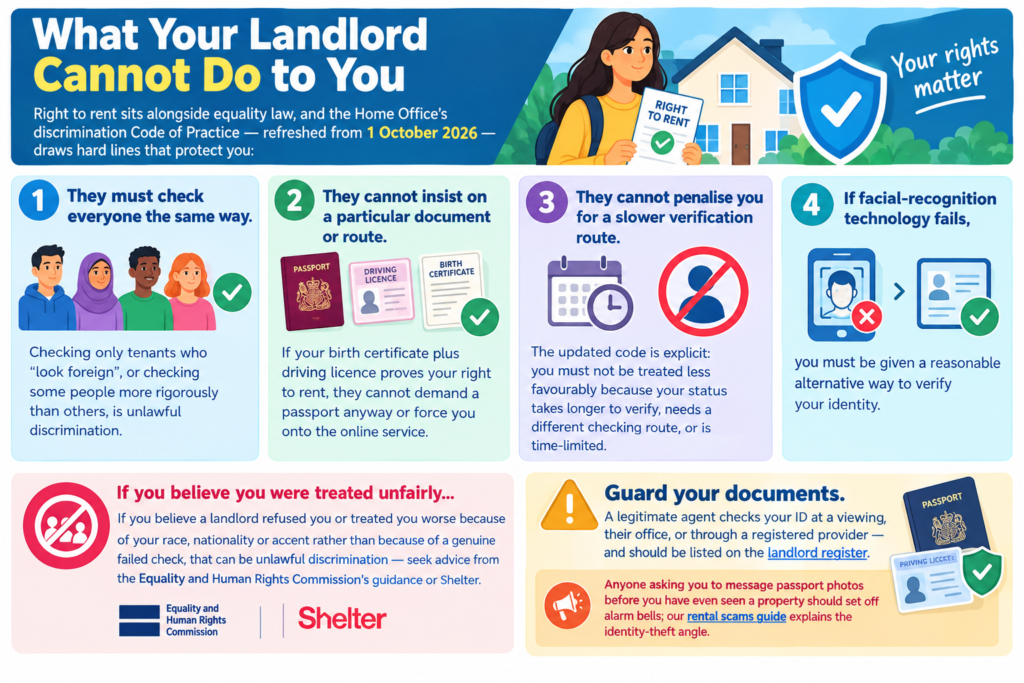
Right to rent sits alongside equality law, and the Home Office’s discrimination Code of Practice — refreshed from 1 October 2026 — draws hard lines that protect you:
- They must check everyone the same way. Checking only tenants who “look foreign”, or checking some people more rigorously than others, is unlawful discrimination.
- They cannot insist on a particular document or route. If your birth certificate plus driving licence proves your right to rent, they cannot demand a passport anyway or force you onto the online service.
- They cannot penalise you for a slower verification route. The updated code is explicit: you must not be treated less favourably because your status takes longer to verify, needs a different checking route, or is time-limited.
- If facial-recognition technology fails, you must be given a reasonable alternative way to verify your identity.
If you believe a landlord refused you or treated you worse because of your race, nationality or accent rather than because of a genuine failed check, that can be unlawful discrimination — seek advice from the Equality and Human Rights Commission’s guidance or Shelter.
Callout: Guard your documents. A legitimate agent checks your ID at a viewing, their office, or through a registered provider — and should be listed on the landlord register. Anyone asking you to message passport photos before you have even seen a property should set off alarm bells; our rental scams guide explains the identity-theft angle.
What Happens If You Fail Right to Rent Checks?
If you have no acceptable documents, no valid share code, and the Home Office Landlord Checking Service says you are not allowed to rent, the landlord cannot legally rent to you in England. They must turn you down, and if they went ahead anyway, they would risk the fines and prison terms described below.
What happens next depends on your circumstances. If your immigration application is still being decided, you may get permission to rent once it concludes — ask the Home Office or an immigration adviser; if you believe the decision is wrong, seek advice from Shelter or Citizens Advice. If a follow-up check during an existing tenancy reveals your permission to stay has ended, your landlord must report this to the Home Office — failing to do so can itself mean a fine or up to five years in prison for them. That does not mean they can change your locks: ending a tenancy still requires the proper legal process, as our ending your tenancy guide explains.
The Penalties — Why Landlords Take This So Seriously
The civil penalties were raised sharply on 13 February 2024 (via SI 2024/81), and they bite per person, per breach:
| Breach | Per lodger | Per occupier (tenant) |
|---|---|---|
| First breach | Up to £5,000 | Up to £10,000 |
| Repeat breach (within 3 years) | Up to £10,000 | Up to £20,000 |
Before February 2024, these were just £80 per lodger and £1,000 per occupier for a first breach — the largest increase since the scheme began. On top of the civil fines, the Immigration Act 2016 created a criminal offence for landlords or agents who rent to someone they know, or have reasonable cause to believe, has no right to rent: up to five years in prison and an unlimited fine on conviction.
Callout: Those per-person figures add up fast: a landlord who lets a three-bedroom house to three unchecked adult tenants faces up to £30,000 for a single first breach — which is why a reputable agent never skips right to rent checks.
A correctly completed set of right to rent checks gives the landlord a “statutory excuse” — a legal defence against the civil penalty. That is why they copy everything, date everything, and chase you for follow-up checks.
Sub-Tenants, Lodgers and Agents — Who Checks Whom?
A few edge cases that often surprise tenants:
- Taking a lodger while you rent? If you sublet a room without your landlord knowing, you become responsible for checking your sub-tenants — and you carry the penalty risk if you get it wrong. Check your tenancy agreement’s subletting rules first.
- Using a letting agent? Your landlord can ask their agent to do the checks, and should put that agreement in writing. From your perspective, nothing changes: you still provide the same proof.
- Every new adult occupier must be checked before they move in — not just the person signing the agreement.
Worked Example: Freya’s Lodger Mistake
Freya, 34, rents a two-bed in Sheffield at £1,100 a month and, without telling her landlord, takes in Declan as a lodger for £550 a month to split the bills. She never checks his documents. When the landlord discovers the arrangement, Freya is exposed too: as the person who sublet, she was responsible for Declan’s check, and a first-breach penalty of up to £5,000 per lodger could land on her. The safe move would have been a five-minute document check and a copy kept on file — and running the numbers on any sharing plan with our rent affordability rules guide.
FAQs
Do British citizens really need a right to rent check?
Yes — British and Irish citizens prove it with a British passport (current or expired), an Irish passport card, or a naturalisation certificate, or two documents from List A Group 2 such as a UK birth certificate plus a UK driving licence. No follow-up checks are ever needed for unlimited status.
Does right to rent apply in Scotland, Wales or Northern Ireland?
No — the scheme applies in England only. It has never been brought into force in Wales, Scotland or Northern Ireland, which each have their own tenancy systems.
My passport has expired. Can I still use it?
Yes. A current or expired British or Irish passport (or Irish passport card) is acceptable, as long as it has not been cancelled, damaged or tampered with — and it still proves an unlimited right to rent with no follow-up checks.
How long is a share code valid?
A right to rent share code is valid for 90 days from the day you generate it, and you can reuse it within that window. Generate a fresh code close to each new tenancy start date, and make sure it is the right-to-rent code (nine characters beginning with R), not a right-to-work code.
Can my landlord insist I use the online share code service?
No — not if you can prove it with accepted original documents. GOV.UK is explicit: the landlord cannot insist you use the online service instead. British and Irish citizens cannot get a share code at all.
What if I have no passport and no documents at all?
Your landlord should not simply reject you. They must use the Home Office Landlord Checking Service, which covers people whose documents are held by the Home Office, who have an outstanding application or appeal, or who have been granted permission to rent. You will need your Home Office reference number; the service answers within two working days, and silence after that counts as confirmation.
My partner is moving in but is not on the tenancy agreement. Do they need a check?
Yes — everyone aged 18 or over who will use the property as their only or main home must be checked before moving in, whether or not they are named on the agreement.
I am a lodger in my landlord’s own home. Does the check still apply?
Yes. Lodgers are covered, and the penalty figures even distinguish lodgers (£5,000/£10,000 per lodger) from other occupiers (£10,000/£20,000). Your live-in landlord must check you before you move in.
My visa expires halfway through my tenancy. What happens?
Your landlord must carry out a follow-up check before the later of your permission end date or twelve months after the previous check. If it shows you no longer have the right to rent, the landlord must report it to the Home Office. Keep your documents or share code up to date and talk to your landlord and an immigration adviser well before expiry.
Can a landlord refuse me because my status takes longer to verify?
Not lawfully. Landlords must check everyone the same way and must not treat you less favourably because your status needs a different checking route, takes longer to verify, or is time-limited. Refusing someone because of their nationality, ethnicity or accent rather than a genuine failed check can be unlawful discrimination.
I sub-let a room to a friend. Whose job is the check?
Yours. If you sublet without your landlord knowing, you must carry out the checks on your sub-tenants and you carry the penalty risk (up to £5,000 per lodger for a first breach).
How long does my landlord keep copies of my documents?
For the whole tenancy and one year after it ends, after which the landlord should destroy the records securely. They must follow data protection law when storing your information.
Final Thoughts
Right to rent checks feel intrusive at first, but they are a paperwork exercise with a strict timetable: know which of the three routes for right to rent checks applies to you, have your documents or share code ready before the agreement stage, keep codes fresh inside their 90-day window, and expect a follow-up if your permission to stay is time-limited. The system also protects you: no landlord may check you differently from anyone else, force you onto a particular route, or reject you without using the Home Office checking service when documents are missing. Get your proof sorted early and the check becomes the smoothest five minutes of your move; leave it late, and it can hold up everything, including the tenancy deposit protection paperwork. And remember that a rent you cannot comfortably afford is a bigger risk to your tenancy than any document check.
Further Reading
- GOV.UK: Check a tenant’s right to rent — the official guidance, document lists and the online services
- Shelter: Right to rent immigration checks — detailed legal guidance including share codes and the Landlord Checking Service
- Advicenow: Starting a tenancy and right to rent checks — plain-English tenant guide to List A and List B documents