
Felix had lived in his Birmingham flat for two years and assumed moving out would be simple: tell the landlord, hand back the keys, get his deposit back. Instead, he sent a one-line WhatsApp message — “moving out end of month, cheers” — and discovered, expensively, that it counted for nothing: ending your tenancy properly takes more than a text message. His notice wasn’t in the right form, it didn’t end on the right day, and his rent kept running for another six weeks.
Ending a tenancy in the UK in 2026 has clear rules, but they don’t forgive shortcuts—especially after the Renters’ Rights Act 2025 rewrote how tenancies end in England on 1 May 2026. This guide explains exactly how to end your tenancy properly: the notice rules that make it valid, what to do if you need to leave early, how landlords can end a tenancy now that Section 21 is gone, the check-out process that protects your deposit, final bills, and how free deposit adjudication works if you disagree about deductions. England in detail, with the key differences for Scotland, Wales and Northern Ireland.
Quick answer: In England, you end a periodic tenancy with at least 2 months’ written notice, ending on or before a rent-due day — keep paying rent until it ends. Your landlord can now only evict through the courts using reformed Section 8 grounds (no more no-fault eviction), and only a court possession order ends your right to stay. Your deposit must be returned within 10 days of you agreeing deductions, and any dispute goes to the scheme’s free adjudication service.
Rules differ between England, Scotland, Wales and Northern Ireland, and some changed in 2026. This guide reflects the position as of October 2026 and is general information, not legal advice. Whatever nation you’re in, ending your tenancy properly starts with valid written notice.
Ending Your Tenancy in England in 2026: The Rules for Tenants
Since 1 May 2026, all assured tenancies in England are periodic — rolling month to month (or week to week) with no fixed end date. The process for ending your tenancy is straightforward, but every part of the rule matters:
| Rule | Detail |
|---|---|
| Notice length | At least 2 months. Your agreement can set a shorter period, but a landlord can never demand more than 2 months. |
| Form | In writing — letter, email or text. Your landlord cannot dictate the method. |
| End date | The notice must end on a rent-due day or the day before. Get this wrong, and the notice may be invalid. |
| Rent | You keep paying rent for the whole notice period, even if you move out early. |
| Changing your mind | If you want to stay after giving notice, you need the landlord’s written agreement — otherwise the tenancy ends as planned. |
Worked example — Felix’s notice, done right: Felix pays £950 a month, rent due on the 1st. He emails his landlord on 15 October giving notice. Two months from 15 October is 15 December — and because the notice must end on or before a rent-due day, the earliest valid end date is 31 December (the day before the 1 January rent day). Felix owes rent for the whole notice period: the November and December payments, £1,900 in total, even if he moves out in November. His one-line WhatsApp — no two-month window, no end date — would have failed on every count.
Keep a copy of the notice and proof it was sent. If the landlord later claims they never received it, your sent email is your evidence. Losing that proof is one of the costliest mistakes when ending your tenancy.
Ending Your Tenancy Early: Surrender, Break Clauses and Assignment
Sometimes, when you’re ending your tenancy, you can’t wait out a notice period — a job move, a relationship breakdown, a flat that’s become unbearable. Your options:
- Surrender (early agreed end): you and the landlord agree in writing to end the tenancy early. This is the cleanest route. Get the agreement in writing, stating the exact end date and what happens to the deposit and final rent — a verbal “yeah, fine” has a habit of evaporating.
- If the landlord refuses: the tenancy continues, and rent stays due until it ends properly. Leaving anyway doesn’t end your liability — it just means you pay for an empty flat.
- Break clauses: largely obsolete in England — with no fixed terms left, there is nothing to break. They can still matter for legacy agreements, company lets and Northern Ireland tenancies, where the clause’s exact wording and service requirements are enforced strictly.
- Assignment (passing the tenancy on): only if your agreement allows it. A new tenant takes over your obligations; the landlord’s consent is usually required.
Never just hand back the keys and disappear. Without a proper ending, the tenancy — and the rent bill — continues, and an absent tenant is in a far weaker position if deposit or arrears disputes follow. If you’re struggling to pay, read our rent arrears guide before deciding anything.
When Your Landlord Wants You Out: Section 8 in Plain English
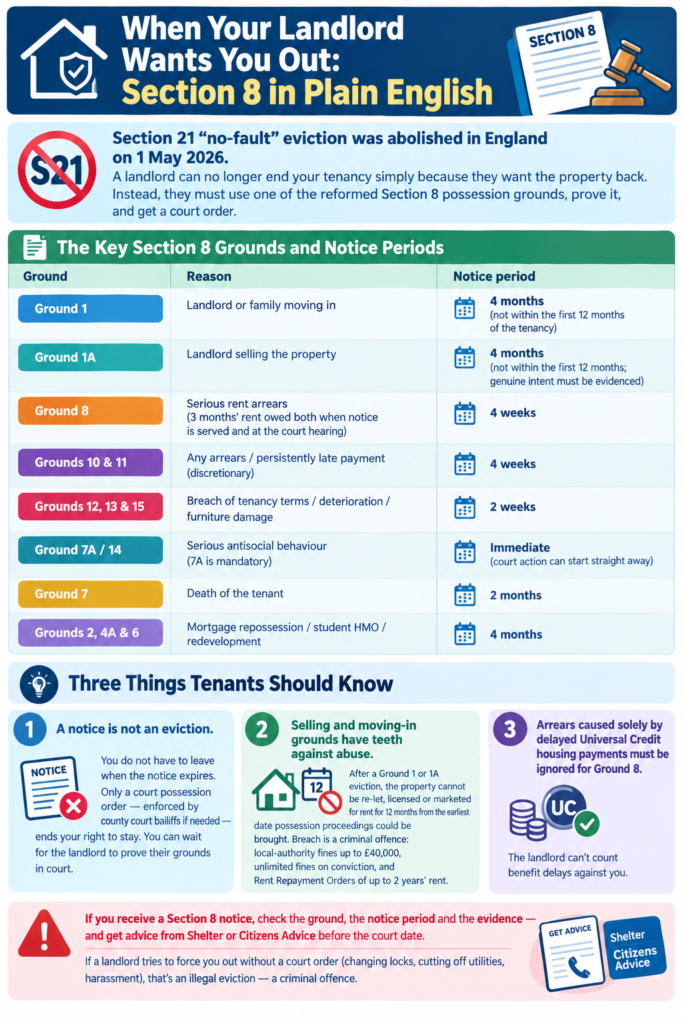
Section 21 “no-fault” eviction was abolished in England on 1 May 2026. A landlord can no longer end your tenancy simply because they want the property back. Instead, they must use one of the reformed Section 8 possession grounds, prove it, and get a court order.
The key grounds, with their notice periods:
| Ground | Reason | Notice period |
|---|---|---|
| Ground 1 | Landlord or family moving in | 4 months — not within the first 12 months of the tenancy |
| Ground 1A | Landlord selling the property | 4 months — not within the first 12 months; genuine intent must be evidenced |
| Ground 8 | Serious rent arrears (3 months’ rent owed both when notice is served and at the court hearing) | 4 weeks |
| Grounds 10 & 11 | Any arrears / persistently late payment (discretionary) | 4 weeks |
| Grounds 12, 13 & 15 | Breach of tenancy terms/deterioration/furniture damage | 2 weeks |
| Ground 7A / 14 | Serious antisocial behaviour (7A is mandatory) | Immediate — court action can start straight away |
| Ground 7 | Death of the tenant | 2 months |
| Grounds 2, 4A & 6 | Mortgage repossession / student HMO / redevelopment | 4 months |
Three things tenants should know about this system:
- A notice is not an eviction. You do not have to leave when the notice expires. Only a court possession order — enforced by county court bailiffs if needed — ends your right to stay. You can wait for the landlord to prove their grounds in court.
- Selling and moving-in grounds have teeth against abuse. After a Ground 1 or 1A eviction, the property cannot be re-let, licensed or marketed for rent for 12 months from the earliest date possession proceedings could be brought. Breach is a criminal offence: local-authority fines up to £40,000, unlimited fines on conviction, and Rent Repayment Orders of up to 2 years’ rent.
- Arrears caused solely by delayed Universal Credit housing payments must be ignored for Ground 8 — the landlord can’t count benefit delays against you.
If you receive a Section 8 notice, check the ground, the notice period and the evidence — and get advice from Shelter or Citizens Advice before the court date. If a landlord tries to force you out without a court order (changing locks, cutting off utilities, harassment), that’s an illegal eviction — a criminal offence.
Ending Your Tenancy: The Check-Out — Inventory, Cleaning and Photographs
The check-out is where deposits are won and lost. The entire process revolves around one comparison: the property’s condition now versus the check-in inventory, allowing for fair wear and tear.
Before the check-out appointment:
- Dig out your check-in inventory and read it. Note anything you flagged at the start — those are your baseline.
- Photograph everything, room by room, in daylight: walls, floors, appliances, windows, garden. Dated photos are the single most persuasive evidence in a dispute.
- Clean to the standard the agreement requires — typically the condition you found it in. You don’t have to hire professional cleaners, but oven cleaning is the most disputed item in the country, so give it real attention.
- Complete any small repairs the agreement makes your responsibility (filling picture-hook holes, replacing like-for-like light bulbs, garden tidying).
Evidence wins disputes. Adjudicators decide on documents, not memories: the signed check-in inventory, the check-out report, dated photographs from both ends of the tenancy, itemised invoices, and your rent and communication records. The burden is effectively on the landlord to justify every pound they want to keep — but only if you’ve kept your half of the paper trail.
Be present at the check-out inspection if you can, and don’t sign a check-out report you disagree with — note your objections on it or in a follow-up email the same day.
Moving-Out Day: Your Final Checklist
| Task | Detail |
|---|---|
| Meter readings | Photograph gas, electricity and water meters; send readings to each supplier with your move-out date |
| Keys | Return all sets — including window keys, shed keys and fobs — and get a receipt |
| Forwarding address | Give the landlord/agent your new address in writing (needed for deposit correspondence) |
| Belongings | Remove everything — landlords can dispose of abandoned items, usually after around 14 days |
| Security | Lock up, close windows, note the alarm code handover |
| Post | Set up a Royal Mail redirect so bills and deposit letters reach you |
| Broadband | Give notice to your provider — many need ~30 days |
| TV Licence | Update or cancel your licence and claim any refund due |
Final Bills: Council Tax, Energy and Water
Bills don’t stop because you’ve moved — they stop because you told the right people you’ve moved. It’s the least glamorous part of ending your tenancy, and the easiest to forget.
- Council tax: your liability runs until the tenancy legally ends — not until you physically leave. Tell the council your end date and new address so billing stops; otherwise reminders and collection action follow you. Moving to a new council area? Register there promptly. Our council tax for renters guide explains discounts and reductions that might apply in your final weeks.
- Energy: send final meter readings to each supplier with the move-out date and get written confirmation the account is closed or transferred. On a prepayment meter, call the supplier so you don’t inherit — or leave behind — someone else’s debt.
- Water: same process — final reading, written confirmation. In some areas, water is unmetered and billed to the property; confirm with the supplier who pays for your final days.
Keep every confirmation email. “I told them I moved” is worthless without proof if a supplier bills you for the next tenant’s usage.
Getting Your Deposit Back When Ending Your Tenancy: The 10-Day Rule
Once you and the landlord agree how much of the deposit comes back, the money must be returned within 10 days. The deposit stays protected in the scheme until then.
The process usually runs like this:
- Landlord proposes deductions (or confirms a full return) — ask for this in writing, with reasons.
- You agree or challenge. Agree only with what you genuinely accept — agreeing under pressure is hard to undo.
- Agreed amount returned within 10 days of the agreement.
- If you disagree, the disputed amount stays protected while you use the scheme’s free dispute resolution.
If your landlord becomes uncontactable, you don’t wait forever — raise a dispute directly with the scheme. And if your deposit was never protected at all, that’s a separate and serious breach: see our tenancy deposit protection guide, which explains the county-court compensation route (1–3 times the deposit).
Ending Your Tenancy: What Your Landlord Can (and Can’t) Deduct
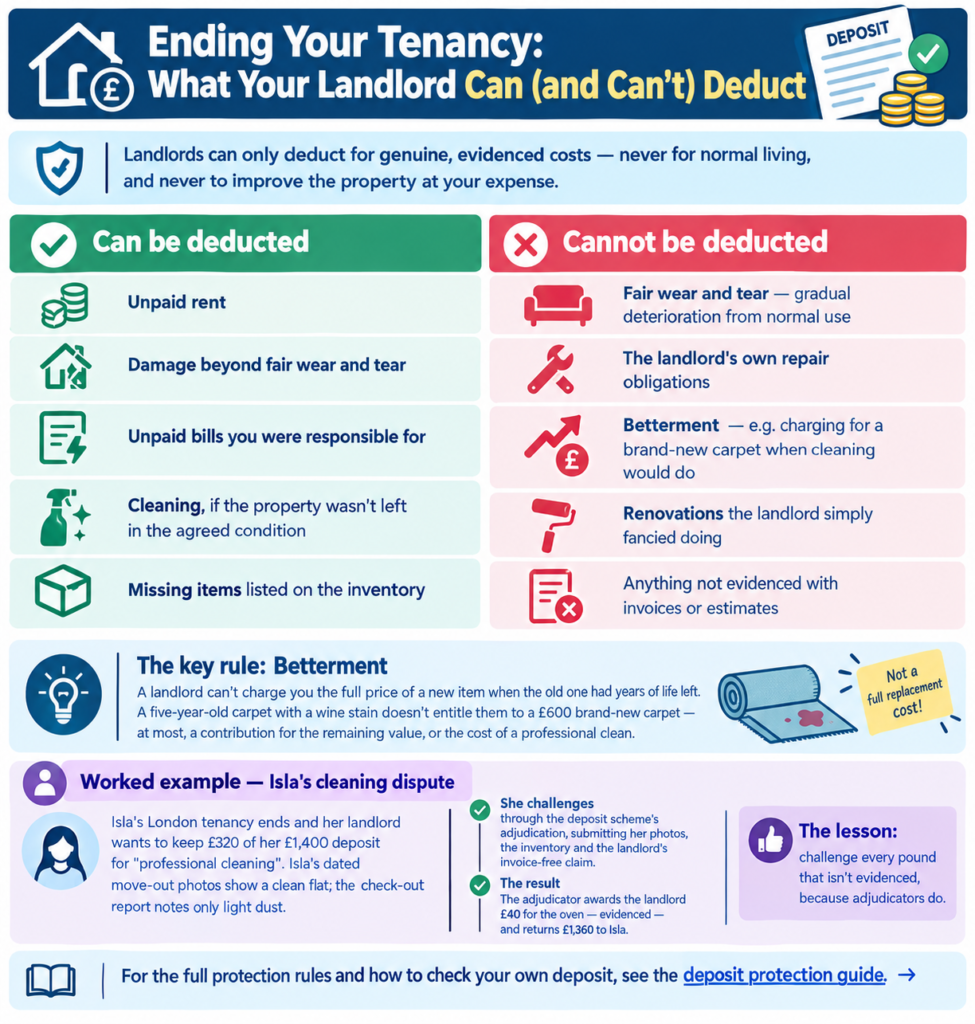
Landlords can only deduct for genuine, evidenced costs — never for normal living, and never to improve the property at your expense:
| Can be deducted | Cannot be deducted |
|---|---|
| Unpaid rent | Fair wear and tear — gradual deterioration from normal use |
| Damage beyond fair wear and tear | The landlord’s own repair obligations |
| Unpaid bills you were responsible for | Betterment — e.g. charging for a brand-new carpet when cleaning would do |
| Cleaning, if the property wasn’t left in the agreed condition | Renovations the landlord simply fancied doing |
| Missing items listed on the inventory | Anything not evidenced with invoices or estimates |
Betterment is the concept that kills most inflated claims: a landlord can’t charge you the full price of a new item when the old one had years of life left. A five-year-old carpet with a wine stain doesn’t entitle them to a £600 brand-new carpet — at most, a contribution reflecting the carpet’s remaining value, or the cost of a professional clean. Knowing this rule is one of your strongest protections when ending your tenancy.
Worked example — Isla’s cleaning dispute: Isla’s London tenancy ends and her landlord wants to keep £320 of her £1,400 deposit for “professional cleaning”. Isla’s dated move-out photos show a clean flat; the check-out report notes only light dust. She challenges through the deposit scheme’s adjudication, submitting her photos, the inventory and the landlord’s invoice-free claim. The adjudicator awards the landlord £40 for the oven — evidenced — and returns £1,360 to Isla. The lesson: challenge every pound that isn’t evidenced, because adjudicators do.
For the full protection rules and how to check your own deposit, see the deposit protection guide.
Deposit Disputes: How Free Adjudication Works
If deductions are disputed when ending your tenancy, every approved scheme (DPS, TDS, mydeposits) offers a free dispute resolution service. Either side can start it; both submit evidence; an independent adjudicator decides.
| Step | What happens |
|---|---|
| 1. Raise it | Contact the scheme holding your deposit — check your scheme’s time limits (they vary, so don’t delay) |
| 2. Evidence | Both sides submit: tenancy agreement, inventories, check-in/check-out reports, dated photos, invoices, rent records, correspondence |
| 3. Decision | The adjudicator weighs the evidence against the agreement and the law — schemes aim to decide within around 30 days of receiving everything |
| 4. Finality | The decision is final and binding — the only appeal is to the County Court |
Neither side needs a solicitor, and there’s no fee. The most common reason tenants lose isn’t a weak case — it’s weak evidence. That box of move-in photos and the signed inventory are worth more than any argument.
Joint Tenancies: Ending Your Tenancy When One Person Wants to Leave
This catches houseshares out more than almost anything else in renting:
- One joint tenant can usually end the whole joint tenancy — without the other tenants’ agreement. The tenancy ends for everyone.
- A shorter notice period needs all joint tenants to agree.
- If the tenant who gave notice then wants to stay, the landlord and all other joint tenants must agree — otherwise the tenancy still ends.
- The remaining tenants can sign a new tenancy agreement; new people can be added to it.
Worked example — Martha’s houseshare: Martha shares a four-bedroom house in Leeds with three friends on a joint tenancy at £1,600 a month. One friend gives two months’ notice and moves out. The tenancy ends for all four — the remaining three can’t simply continue on the old agreement. Their options: sign a new tenancy (possibly with a replacement housemate) or all leave. Nobody can be forced to stay, and nobody left behind owes rent on a tenancy that has legally ended.
If you’re setting up a share, think about this on day one — and budget with our joint rent affordability calculator.
Rent During Notice, Overholding and Refused Surrenders
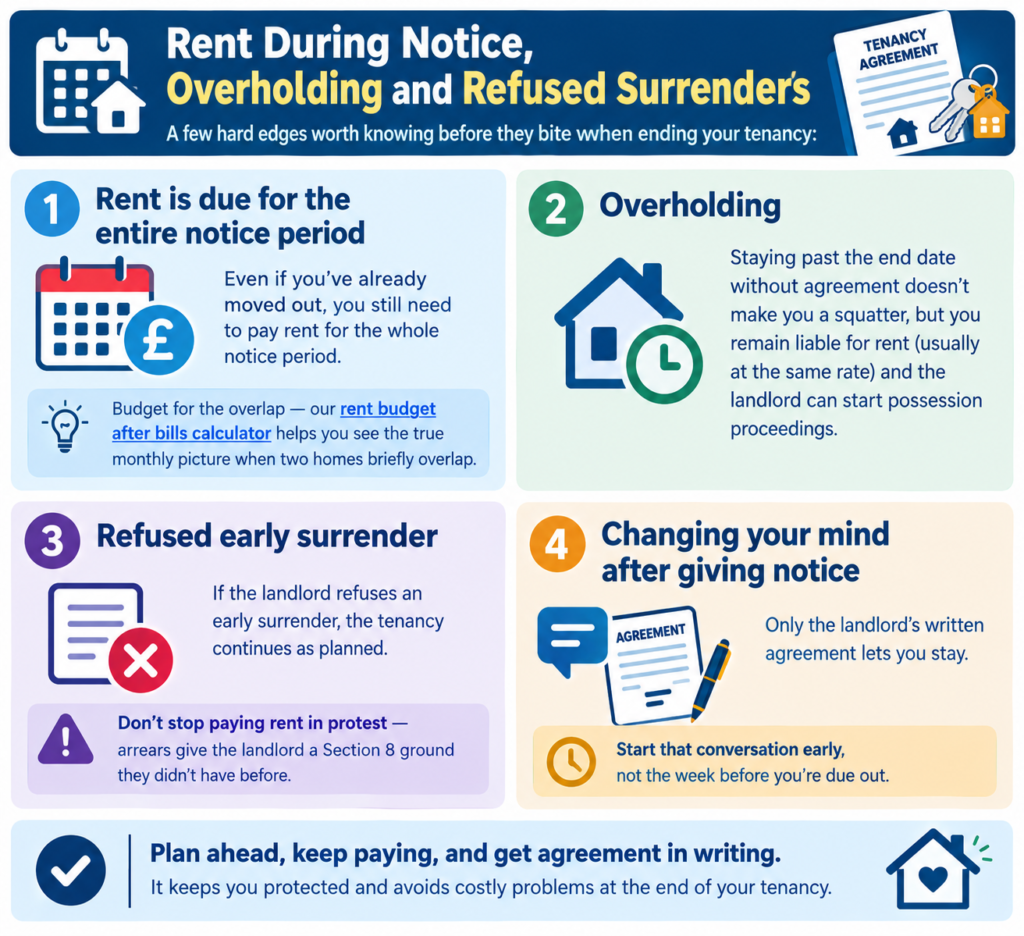
A few hard edges worth knowing before they bite when ending your tenancy:
- Rent is due for the entire notice period, even if you’ve already moved out. Budget for the overlap — our rent budget after bills calculator helps you see the true monthly picture when two homes briefly overlap.
- Overholding — staying past the end date without agreement — doesn’t make you a squatter, but you remain liable for rent (usually at the same rate) and the landlord can start possession proceedings.
- If the landlord refuses an early surrender, the tenancy continues as planned. Don’t stop paying rent in protest — arrears give the landlord a Section 8 ground they didn’t have before.
- If you change your mind after giving notice, only the landlord’s written agreement lets you stay. Start that conversation early, not the week before you’re due out.
Ending a Tenancy Across the UK at a Glance
| Notice & Deposit Rules | England | Scotland | Wales | Northern Ireland |
|---|---|---|---|---|
| Tenant notice (periodic) | 2 months, written | 28 days, written | 4+ weeks (s.168) | 4 weeks (under 10 years) |
| No-fault eviction | Abolished 1 May 2026 | Effectively abolished | 6-month no-fault notice (s.173) still exists | Still possible with notice |
| Landlord notice (typical) | 4 months (sale/move-in), 4 weeks (serious arrears), 2 weeks (breach) | 28 days (≤6 months or fault) / 84 days otherwise | 6 months, not in first 6 months | 4 weeks (≤12 months) / 8–12 weeks (longer) |
| Deposit return | 10 days after agreement | Scheme rules apply | 10 days after agreement | Scheme rules apply |
Two notes: Scotland’s joint-tenancy rule changes from 1 April 2027 (one joint tenant will be able to end a private residential tenancy for all, via a 2-month pre-notice plus 28-day final notice). Northern Ireland has proposed longer notice periods (up to 7 months) under consultation — they are not yet law; the current 4/8/12-week landlord and 4/12-week tenant periods apply.
Frequently Asked Questions
How much notice do I need to give to end my tenancy in England?
At least two months’ written notice for ending your tenancy under an assured periodic tenancy — letter, email or text, since your landlord can’t dictate the method. The notice must end on or before a rent-due day. Your agreement can allow a shorter period, but never a longer one than two months.
Can I take back my notice if I change my mind?
Only with your landlord’s written agreement. Once validly given, the notice ends the tenancy on the stated date whether you’ve found somewhere else or not. If there’s any chance you’ll want to stay, talk to your landlord before the notice expires — don’t just assume it lapses.
Do I have to keep paying rent after I’ve moved out but before the notice ends?
Yes. When ending your tenancy, rent is due for the whole notice period even if the property sits empty. The only exceptions are a written early-surrender agreement with your landlord or a shorter notice period your agreement allows. Budget for the overlap before you commit to a new place.
My landlord says I have to leave because they’re selling. What are my rights?
They must use Section 8 Ground 1A: at least 4 months’ notice, not within the first 12 months of your tenancy, with evidence of genuine intent to sell. You don’t have to leave when the notice expires — only a court possession order ends your tenancy. And the property can’t be re-let for 12 months afterwards; if it is, the landlord faces fines up to £40,000.
Can my landlord evict me without a reason in 2026?
Not in England — Section 21 no-fault eviction was abolished on 1 May 2026. In Scotland it’s effectively abolished too. Wales still allows a 6-month no-fault notice, and Northern Ireland still permits no-fault eviction with the statutory notice periods. Anywhere else, a landlord who changes the locks or cuts off utilities without a court order is carrying out an illegal eviction.
How long does my landlord have to return my deposit?
Within 10 days of you both agreeing how much comes back. If you disagree about deductions, the disputed amount stays protected in the scheme while you use its free dispute resolution service. If the landlord goes quiet, raise the dispute with the scheme directly — don’t wait indefinitely.
What counts as fair wear and tear?
Gradual deterioration from normal living: flattened carpet where people walk, faded paint after years, minor scuffs. It doesn’t cover damage: cigarette burns, crayon on walls, pet-chewed woodwork, or filth that needs more than normal cleaning. Adjudicators also reject “betterment” — charging you for a brand-new replacement when the old item had life left in it.
My landlord wants £400 for cleaning. How do I challenge it?
Ask for the claim in writing with evidence — an invoice or estimate. Compare it against your dated move-out photos and the check-out report. If the property was left in the agreed condition, challenge the deduction through your deposit scheme’s free adjudication, submitting your photos, the inventory and all correspondence. Unevidenced claims rarely survive.
One of my housemates gave notice. Do I have to leave too?
In a joint tenancy in England, usually yes — one joint tenant’s valid notice ends the tenancy for everyone. You can’t continue on the old agreement alone. Your options are to sign a new tenancy (with or without a replacement housemate) or move out. Talk to your landlord early about a new agreement.
What happens if I just leave without giving proper notice?
The tenancy continues and rent keeps accruing until it ends properly — leaving without ending your tenancy properly doesn’t end your liability. You also lose leverage in any deposit dispute and may owe the landlord’s re-letting costs. If you’re leaving because of serious problems with the property, get advice first: you may have options (repairs enforcement, environmental health) that don’t involve abandoning your legal position.
Who pays the council tax and energy bills after I move out?
You remain liable until the tenancy legally ends, not just until you hand back the keys. Notify the council and each supplier of your end date, send final meter readings with photographic proof, and get written confirmation each account is closed. Keep those confirmations — they’re your defence against bills for the next tenant’s usage.
My deposit was never protected. Can I still get it back?
Yes — and you may be owed more. In England and Wales your landlord had 30 days to protect it in an approved scheme. If they didn’t, you can apply to the county court for the deposit’s return plus compensation of 1–3 times the deposit, even after you’ve moved out (up to 6 years later). Our tenancy deposit protection guide explains the process step by step.
Final Thoughts
Ending your tenancy well is mostly about paperwork done in the right order: valid written notice ending on the right day, rent paid through the notice period, a documented check-out, final readings and closed accounts, and a deposit claim backed by evidence. The 2026 rules are firmly on the tenant’s side — no no-fault eviction in England, free deposit adjudication, and strict limits on what landlords can deduct — but every one of those protections works best when you’ve kept your own records straight from day one.
Planning the financial side of the move? Our rent affordability calculator checks what your income supports at the new place, the moving house cost guide budgets the full move, and the rent budget after bills calculator makes sure the new rent still works once bills are included. And if you’re at the start of the journey rather than the end, read our companion guide on what to check before signing a tenancy agreement first.
Further Reading
- GOV.UK — How to end your assured periodic tenancy — the official tenant notice rules for England.
- Shelter England — Eviction advice — free guidance on Section 8 notices and your rights in court.
- Citizens Advice — Ending your tenancy — practical help with notice, check-out and deposits.