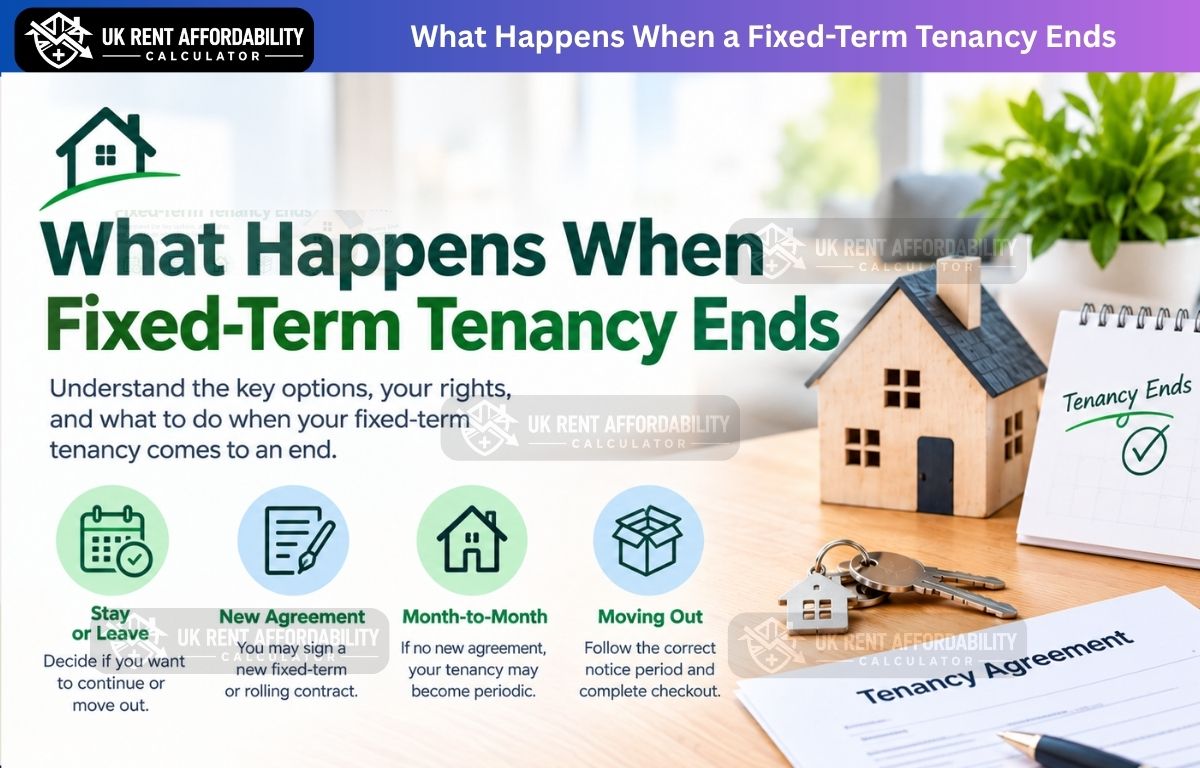
What happens when a fixed-term tenancy ends is rarely as simple as an agent’s ultimatum suggests. When Dorothea signed her tenancy agreement in December 2025, it said “fixed term: 12 months”. Two months before that December 2026 date arrived, her letting agent emailed an ultimatum: sign a new twelve-month fixed term — with a £75 rent rise baked in — or move out when the term ends. Dorothea liked the flat and did not want to move, but she did not want to be locked in for another year either. She assumed the agent’s “sign or leave” framing was simply how renting worked.
It is not. In England, fixed-term assured tenancies no longer exist — every qualifying tenancy became a rolling periodic tenancy on 1 May 2026, and a landlord cannot make you leave, or make you renew, just because a date in an old agreement has passed. This guide explains exactly what happens when fixed term tenancy ends in the UK in 2026: what continues automatically, what your landlord can and cannot do, the renewal question, deposits, rent, joint tenancies, and how Scotland, Wales and Northern Ireland differ.
Quick answer: When a fixed term ends and you stay on, your tenancy continues automatically on the same terms as a rolling periodic tenancy — nothing needs signing. In England, the Renters’ Rights Act 2025 abolished fixed-term assured tenancies from 1 May 2026: existing fixed terms converted to periodic tenancies automatically, and new fixed terms cannot be created. Your landlord cannot force you out at expiry (they need a legal ground and a court order) and cannot force you to renew. Renewal fees are banned, your deposit stays protected, and rent can only be increased through the statutory process.
Rules differ between England, Scotland, Wales and Northern Ireland, and some changed in 2026. This guide reflects the position as of October 2026 and is general information, not legal advice. If you want to end your tenancy yourself rather than understand expiry, our ending your tenancy guide covers the notice mechanics step by step.
What a Fixed Term Actually Is
A fixed term is simply a tenancy with a set start and end date written into the agreement — most commonly six or twelve months. During the fixed term, both sides are locked in: you owe the rent for the whole term, and the landlord cannot end the tenancy early without a legal ground and (usually) a break clause. Understanding that lock-in is the starting point for understanding what happens when fixed term tenancy ends.
Fixed terms were the standard shape of private renting in England for nearly forty years. That is why so many agreements, templates and old advice articles still talk about them — and why the 2026 changes catch so many people out. What follows explains both the classic position (which still governs tenancies that ended before 1 May 2026, and still applies in Northern Ireland) and the new one. Knowing this background makes it easier to understand what happens when fixed term tenancy ends today.
What Happens When Fixed Term Tenancy Ends: The Rolling Tenancy
If your fixed term ends, you stay in the property, and nobody signs anything new, the law does the work for you: the tenancy continues automatically on the same terms. In England this is the statutory periodic tenancy under section 5 of the Housing Act 1988 — it rolls from rent period to rent period (usually month to month), with every term of the old agreement carrying over: the rent, the repair obligations, the notice rules, all of it.
| Scenario at expiry | What happens |
|---|---|
| You stay, nothing is signed | Tenancy continues automatically as a periodic tenancy on identical terms |
| You and the landlord sign a renewal | A brand-new fixed term begins (only possible where fixed terms still exist) |
| You give proper notice and leave | The tenancy ends on the notice expiry date |
| You and the landlord agree to end it | The tenancy ends by mutual agreement (“surrender”) — get it in writing |
The critical point: doing nothing is a valid choice. There is no legal requirement to sign a renewal for your right to stay to continue. Landlords and agents sometimes imply otherwise — the next two sections explain why they cannot enforce that implication.
The Big 2026 Change: England’s Fixed Terms Are Already Over
On 1 May 2026, the Renters’ Rights Act 2025 abolished fixed-term assured tenancies in England. Every qualifying tenancy — including any fixed term still running — became an assured periodic tenancy automatically. Any end date written in your agreement no longer has legal effect, and you did not need to sign anything for the change to happen.
For new tenancies, the position is blunt: a landlord cannot create a fixed-term assured tenancy at all. If an agreement purports to grant one, the fixed-term wording has no legal effect — the tenancy takes effect as a periodic tenancy anyway. GOV.UK’s tenant guidance confirms that a landlord who tries to create an assured periodic tenancy with an end date can be reported to the council and fined.
A few tenancy types sit outside the new regime for what happens when fixed term tenancy ends, and can still have fixed terms:
| Still outside the 2026 fixed-term abolition | Why |
|---|---|
| Company lets (the tenant is a company, not a person) | Not assured tenancies — common-law rules apply |
| Annual rent above £100,000 | Outside the assured-tenancy regime entirely |
| Annual rent below £250 (£1,000 in London) | Outside the regime |
| Long leases over 21 years | Different legal category |
| Lodgers with a resident landlord | Excluded occupiers, not tenants |
| Purpose-built student accommodation (under the National Code) | Specifically exempted |
| Tenancies with a valid Section 21 or Section 8 notice served before 1 May 2026, where court proceedings were started in time | Conversion delayed until proceedings conclude |
If none of those apply to you — and for the typical private renter, none do — then in England you have not had a fixed term since 1 May 2026, whatever your paperwork says. That is the short answer to what happens when fixed term tenancy ends in England.
What Happens When Fixed Term Tenancy Ends: Can Your Landlord Make You Leave?
No. This is the single most important thing to understand about fixed-term expiry: the end of the fixed term is not, by itself, a reason you have to leave.
During a fixed term, and in any periodic tenancy that follows it, your landlord can only end your tenancy by proving a statutory ground for possession and getting a court order. In England that means the reformed Section 8 grounds — serious rent arrears, the landlord genuinely selling or moving in, breach of the agreement, antisocial behaviour — each with its own notice period and evidence requirements. A notice is not an eviction: only a court possession order ends your right to stay.
What this means in practice for what happens when fixed term tenancy ends:
- An agent’s “your tenancy ends on 12 December, please vacate” letter has no legal force on its own.
- A landlord who changes the locks, cuts off utilities or harasses you out is committing an illegal eviction — a criminal offence.
- If you receive a Section 8 notice, check the ground, the notice period and the evidence — and get advice from Shelter or Citizens Advice before any court date. Our section 8 eviction guide explains each ground.
Illustrative example — Dorothea, Manchester: Dorothea’s agent insists she must sign a new twelve-month fixed term or leave in December. Dorothea knows the position: her old fixed term converted to a periodic tenancy on 1 May 2026, so there is no fixed term left to “renew”, and the agent cannot end her tenancy without a Section 8 ground and a court order. She replies in writing declining the renewal and confirming she will continue on a periodic basis. The agent backs down — there was never any legal basis for the ultimatum.
Can Your Landlord Make You Renew?
No — for exactly the same reason. Renewal is always optional for the tenant. Your landlord can offer a new agreement, but cannot require you to sign one as the price of staying. If you decline, the existing tenancy simply continues periodically on its current terms.
Be wary of pressure tactics dressed up as administration: “we need a new agreement for our files”, “the system requires a renewal”, or a rent rise presented as conditional on signing. None of these creates a legal obligation to renew. A rent increase, if the landlord wants one, must go through the statutory Section 13 process whether you renew or not — it cannot be smuggled in as a renewal condition. Pressure does not change what happens when fixed term tenancy ends in law.
Renewal: The Honest Pros and Cons
Just because you do not have to renew does not mean you should never consider it. Where fixed terms still exist (Northern Ireland, company lets, Wales’s fixed-term standard contracts), or where a landlord offers a fresh agreement, what happens when fixed term tenancy ends is worth weighing properly:
| Renewing: the pros | Renewing: the cons |
|---|---|
| Rent certainty — the rent is fixed for the new term (subject to any agreed review) | You are locked in — you owe rent for the whole term even if your circumstances change |
| Security of tenure for the term’s length | Less flexibility — leaving early needs a break clause or the landlord’s agreement |
| A clean paperwork reset — deposit re-protected, terms updated, everyone clear | New terms may be worse — read every clause; some landlords use renewals to slip in new restrictions |
| Relationship signal — can reassure a nervous landlord | Negotiating leverage is limited — you are negotiating from inside the property, not as a free agent |
In England’s periodic system, the main reason tenants historically renewed — fear of a no-fault eviction at expiry — no longer exists. That shifts the calculation: for most English renters now, the flexibility of the rolling tenancy outweighs what a renewal offers, unless the landlord is offering something concrete in return, such as a genuinely fixed rent for a year. For most tenants, then, what happens when fixed term tenancy ends is far less disruptive than it used to be.
No Renewal Fees — Ever
If anyone asks you to pay for renewing, continuing or extending your tenancy in England, the answer is simple: it is banned. Renewal and extension fees are prohibited payments under the Tenant Fees Act 2019 — Shelter England lists “renewing your tenancy when your fixed term contract ends” explicitly among the banned charges.
| Charge presented as | Legal position in England |
|---|---|
| “Renewal administration fee” | Banned — any amount |
| “Tenancy extension fee” | Banned |
| “Fee to continue on a rolling basis” | Banned — continuing a periodic tenancy costs nothing |
| “New agreement drafting fee” | Banned |
| Up to £50 for a change you requested (e.g. adding a housemate) | Permitted — but this is for changes, not renewals |
Illustrative example — Dorothea’s £150: Alongside the renewal ultimatum, Dorothea’s agent invoices a £150 “renewal administration fee”. Dorothea recognises it as a prohibited payment and writes back refusing to pay, naming the Tenant Fees Act 2019. The agent withdraws the invoice the same day. Had she already paid it, she could have recovered it through the First-tier Tribunal. Our letting agent fees guide lists every banned charge and the refund routes.
Note the boundary: a fee for a change you request — such as swapping a housemate mid-tenancy — is permitted up to £50 (unless higher reasonable costs are evidenced). A fee for the tenancy merely continuing is not. Do not let an agent blur the two.
What Happens When Fixed Term Tenancy Ends for Your Deposit
Your deposit does not need drama at expiry — but it does need the right handling. What happens when fixed term tenancy ends for your deposit depends on what happens next:
| Situation at expiry | What happens to the deposit |
|---|---|
| Tenancy continues periodically on the same terms | The existing protection continues — no re-protection needed. (The Housing Act 2004 treats the protection and prescribed information as carried over where the deposit stays in the same scheme.) |
| You sign a brand-new agreement (new fixed term or new periodic) with material changes | The deposit must be re-protected within 30 days and fresh prescribed information served — it is legally a new tenancy. Best practice: re-serve the prescribed information even for a simple continuation. |
| Tenants change (one leaves, one joins) | Re-protection in the new tenants’ names is required. |
| You leave and the tenancy ends | The deposit must be returned within 10 days of you agreeing deductions; disputes go to the scheme’s free adjudication. |
The trap to avoid: assuming a renewal is “just paperwork” while the deposit quietly becomes non-compliant. If your landlord offers a new agreement, ask in writing: “Will the deposit be re-protected and will I receive fresh prescribed information?” A landlord who cannot answer that clearly is a landlord to worry about. For the full rules, see our tenancy deposit protection guide.
Your Rent Terms Carry Over — and How Increases Work Now
When the tenancy continues periodically, the rent stays exactly as it was. Your landlord cannot use expiry as an excuse to bump the rent by email, by a “renewal offer”, or by a clause in the old agreement. In England, since 1 May 2026, there is exactly one lawful way to raise the rent on an assured periodic tenancy:
| Rule | Detail |
|---|---|
| The only route | Section 13 notice on Form 4A — rent review clauses in agreements no longer work |
| Notice | At least 2 months, in writing |
| Frequency | Maximum once every 52 weeks; never in the first 52 weeks of a tenancy |
| The ceiling | Must not exceed the open market rent |
| Challenge | Apply to the First-tier Tribunal before the start date — £47 fee, help available; the tribunal cannot set a rent higher than proposed |
Illustrative example — Florrie, Bristol: Florrie’s agreement showed a fixed term ending in August 2026. Her tenancy had already become periodic the previous May, and it continued at £975 a month. In October her landlord serves a valid Form 4A proposing £1,050. Florrie gathers adverts for similar two-bedroom flats at £990–£1,010 and refers the increase to the tribunal before the start date, continuing to pay £975 meanwhile. The tribunal sets the market rent at £1,000 — saving her £50 a month (£600 a year) against the proposal, with no risk of it going higher. Our challenge a rent increase guide walks through the notice line by line.
The Written Statement Your Landlord Must Give You
The 2026 reforms added a paperwork duty that matters for what happens when fixed term tenancy ends. In England:
- New tenancies from 1 May 2026: the landlord must give you prescribed written information about the key terms — parties, property, rent, deposit, notice rights — before the agreement is signed.
- Existing tenancies with written terms: landlords had to give tenants the government’s official Information Sheet by 31 May 2026.
- Existing tenancies with no written terms at all: the landlord must provide a written statement of the key terms (deadline reported as 31 May 2026 in GOV.UK-based guidance).
Failing to provide the required documents can expose landlords to civil penalties of up to £7,000 per breach. As a tenant, treat missing paperwork as a warning sign — and know that the absence of a written statement does not weaken your tenancy; the statutory rights apply regardless. Our tenancy agreement guide lists everything the statement should contain.
Joint Tenancies at Expiry: One Person’s Notice Ends It for Everyone
Shared rentals add a twist at expiry. In England, the rule for a periodic joint tenancy is stark: any one joint tenant can give written notice that ends the entire tenancy for everyone — no one else’s permission needed (the rule from Hammersmith and Fulham v Monk, expressly preserved by the 2026 reforms). The remaining tenants have no automatic right to stay; they must negotiate a brand-new agreement with the landlord.
During a fixed term, the position is different: one tenant’s notice does not end a fixed term. Ending it early needs all joint tenants to agree (a surrender), or a break clause exercised exactly as written.
| Situation | What happens |
|---|---|
| Periodic joint tenancy, one tenant gives valid notice | The whole tenancy ends for everyone on the notice expiry date |
| Fixed term still running, one tenant wants out | They cannot end it alone — all tenants (and usually the landlord) must agree |
| Tenancy ends and the stayers want to remain | They need a new agreement — possibly with a replacement housemate, new rent, and re-protected deposit |
| One tenant simply stops paying but does not give notice | Everyone remains jointly and severally liable for the full rent |
Illustrative example — Nelson, Leeds: Nelson shares a three-bedroom house with two friends on a tenancy that became periodic in May 2026. One friend gives two months’ written notice and moves out. The tenancy ends for all three of them on the expiry date — Nelson and the remaining friend cannot simply carry on. The landlord offers them a new agreement with a replacement housemate, re-protects the £1,800 deposit in the new names, and charges nothing for the changeover (any “new tenancy fee” would be banned). Nelson learns the lesson every sharer should know: talk to your housemates before anyone gives notice. Our joint tenancy guide covers the full mechanics.
What Happens When Fixed Term Tenancy Ends if You Want to Leave
Sometimes expiry is your exit cue, not your landlord’s. What happens when fixed term tenancy ends and you want to leave depends on the notice rules for where you are:
| Nation | Tenant’s notice to leave |
|---|---|
| England (assured periodic tenancy) | At least 2 months’ written notice, ending on or before a rent-due day; keep paying rent through the notice period |
| Scotland (private residential tenancy) | At least 28 days’ written notice |
| Wales (standard contract) | Usually 4 weeks’ written notice for a periodic standard contract |
| Northern Ireland (fixed term ending) | You are free to leave at the end of the fixed term without giving notice to quit; for periodic tenancies, 4 weeks’ notice if the tenancy has lasted under 10 years, 12 weeks’ if over 10 years |
Three practical points for England. First, time your notice so it expires on the right day — get the date wrong and you can owe extra rent. Second, keep paying rent for the whole notice period even if you move out early. Third, put it in writing (email counts) and keep proof of sending. The mechanics are covered in full in our ending your tenancy guide.
Scotland, Wales and Northern Ireland
What happens when fixed term tenancy ends also depends on your nation: the 1 May 2026 abolition of fixed terms is England-only. Elsewhere:
| England | Scotland | Wales | Northern Ireland | |
|---|---|---|---|---|
| Fixed terms in 2026 | Abolished for assured tenancies | Already abolished — private residential tenancies have been open-ended since December 2017 | Still exist — fixed-term standard contracts are normal | Still exist — fixed terms remain standard |
| What happens at expiry | Tenancy is already periodic; nothing changes | No expiry — the tenancy has no end date | Continues as a periodic standard contract on the same terms | Becomes a periodic tenancy, or a new agreement is signed |
| Landlord ending the tenancy | Section 8 grounds + court order | Tribunal order on statutory grounds | Restricted no-fault routes; contract-holder protections | Notice to quit: 4 weeks (< 1 year), 8 weeks (1–10 years), 12 weeks (> 10 years) |
| Tenant leaving | 2 months’ notice | 28 days’ notice | 4 weeks’ notice (periodic) | Free to leave at fixed-term end; 4 or 12 weeks’ notice for periodic |
| Renewal fees | Banned | Only rent + refundable deposit may be charged | Banned under Welsh fees legislation | No equivalent ban — keep receipts |
| Written terms duty | Written statement before new tenancies | Written tenancy agreement required | Written statement of the occupation contract required | Tenancy information notice within 28 days of start |
Two notes on the devolved nations. In Wales, when a fixed-term standard contract becomes periodic, the landlord must give you a further written statement of the contract — if yours never arrives, ask for it in writing. In Scotland, because there have been no fixed terms since December 2017, any “fixed term” wording in a Scottish agreement is simply wrong — your tenancy is open-ended regardless.
Frequently Asked Questions
What happens automatically when my fixed-term tenancy ends?
If you stay and sign nothing, the tenancy continues automatically as a rolling periodic tenancy on exactly the same terms — rent, obligations, everything. In England this happens under section 5 of the Housing Act 1988; the same principle applies in Wales and Northern Ireland.
Do fixed-term tenancies still exist in England in 2026?
Not for assured tenancies. The Renters’ Rights Act 2025 abolished them from 1 May 2026 — existing fixed terms converted to periodic tenancies automatically, and new ones cannot be created. Exceptions include company lets, tenancies with annual rent above £100,000, and lodger arrangements.
Can my landlord evict me when the fixed term ends?
No. The end of a fixed term is not a ground for eviction. In England your landlord must prove a Section 8 ground and obtain a court possession order. Only the court — not a letter, not the expiry date — ends your right to stay.
Do I have to sign a renewal to stay in the property?
No. Renewal is always optional. If you decline, your tenancy continues periodically on its current terms. A landlord cannot make signing a new agreement a condition of staying.
Can my landlord charge me a renewal fee?
Not in England — renewal and extension fees are prohibited payments under the Tenant Fees Act 2019, and any clause requiring one is unenforceable. The same applies in Wales and Scotland; Northern Ireland has no equivalent ban.
What happens to my deposit when the fixed term ends?
If the tenancy continues periodically on the same terms, the existing deposit protection continues — nothing needs doing. If you sign a brand-new agreement with material changes, the deposit must be re-protected within 30 days and fresh prescribed information served.
Can my landlord increase the rent when the fixed term ends?
Not automatically. In England the rent carries over unchanged, and any increase must go through the Section 13 process: at least two months’ notice on Form 4A, no more than once every 52 weeks, capped at the open market rent — which you can challenge at the First-tier Tribunal.
One of my housemates gave notice. Does our joint tenancy end?
In England, yes — for a periodic joint tenancy, one tenant’s valid notice ends the whole tenancy for everyone. Those who want to stay must agree a new tenancy with the landlord. During a fixed term, one tenant cannot end it alone.
How much notice do I need to give to leave at expiry?
In England, at least two months’ written notice for an assured periodic tenancy, ending on or before a rent-due day. Scotland requires 28 days; Wales usually four weeks for a periodic standard contract; in Northern Ireland you can leave at the end of a fixed term without giving notice.
My agreement still says “fixed term of 12 months”. Is it valid?
In England, for a new assured tenancy, the fixed-term wording has no legal effect — the tenancy is periodic from the start. For tenancies that began before 1 May 2026, the fixed term converted to a periodic tenancy on that date. In Wales and Northern Ireland, fixed terms remain valid.
What is the written statement my landlord must give me?
In England, landlords must give new tenants prescribed written information about the key tenancy terms before the agreement is signed; existing tenants should have received the government’s Information Sheet by 31 May 2026. Missing paperwork can lead to fines of up to £7,000 — but your statutory rights apply whether or not you received it.
Where can I get advice if my landlord is pressuring me at expiry?
Shelter England and Citizens Advice both publish free guidance on fixed-term expiry and renewal pressure. If the landlord’s behaviour amounts to harassment or an illegal eviction attempt, contact your council — and see our how to complain about your landlord guide for the escalation routes.
Final Thoughts
The end of a fixed term used to be the moment landlords held all the cards: renew on their terms, accept a rent hike, or face a no-fault eviction. In England in 2026, that power dynamic has inverted — your tenancy continues automatically, your landlord needs a court order to end it, renewal is your choice, fees for renewing are banned, and rent rises must survive a statutory process you can challenge. So if you are asking what happens when fixed term tenancy ends, the honest answer in 2026 is: far less than landlords once wanted you to fear.
The practical rule is simple: never let an expiry date panic you into signing something. Read any renewal offer carefully, check every fee against the banned list, and remember that doing nothing is a legally valid option that keeps every right you already have.
Before you make any move, check the numbers still work. Our rent affordability calculator shows what you can genuinely sustain, and see all calculators for the full toolkit.
Further reading on fixed-term tenancy expiry: GOV.UK: assured periodic tenancies, Shelter England: assured shorthold tenancies, and Citizens Advice: ending your tenancy.