
When Nadia opened the letter from her letting agent, the first line made her stomach drop: her rent was going up from £950 to £1,120 a month — a £170 rise she had not budgeted for, arriving with barely two months’ warning. Her first instinct was that she had no choice but to pay it or move out — but tenants can challenge rent increase notices, and this guide shows exactly how.
She was wrong on both counts. In England, the rules on rent increases were rewritten on 1 May 2026, and they now give tenants more protection than ever before: landlords must follow one strict legal process, give at least two months’ notice, and can only raise the rent once a year — and if you think the new rent is too high, you can challenge it at an independent tribunal that cannot leave you paying more than the landlord asked for. This guide explains exactly how rent increases work in 2026, how to check whether yours is legal, and how to challenge it step by step.
Quick answer: In England, since 1 May 2026 a landlord can only increase your rent with a Section 13 notice on Form 4A, giving at least two months’ notice, no more than once every 12 months, and the new rent must not exceed the open market rent. Rent review clauses in tenancy agreements no longer work. If you think the increase is too high, apply to the First-tier Tribunal before the start date in the notice — it costs £47 (help available if you cannot afford it), you keep paying your old rent until the decision, and the tribunal cannot set a rent higher than the landlord proposed.
Rent increase law differs between England, Scotland, Wales and Northern Ireland. This guide reflects the position as of October 2026 and is general information, not legal advice. For each nation, we explain who can challenge rent increase decisions, how the local rules differ, and what deadlines apply.
Can Your Landlord Just Put the Rent Up?
Not anymore — at least, not in England. Before 1 May 2026, many landlords raised the rent however they liked: a quick email, a clause buried in the tenancy agreement providing for an automatic annual uplift, or a “take it or leave it” conversation at renewal time. The Renters’ Rights Act 2025 swept that away.
The golden rule now is simple: for an assured periodic tenancy in England, the only lawful way to increase the rent is the Section 13 process. Anything else — a verbal demand, an email, a rent review clause in your agreement — has no legal force, and you are not obliged to pay it. Your tenancy agreement cannot override this: any clause that purports to raise the rent outside the statutory process is unenforceable.
One important exception to understand: your landlord and you can still agree a rent change between yourselves at any time — for example, agreeing a lower rent, or accepting a smaller increase than the one in a Section 13 notice. What the landlord cannot do is impose an increase unilaterally without the proper notice.
The New Section 13 Rules From 1 May 2026
Section 13 of the Housing Act 1988 has existed for decades, but the Renters’ Rights Act rewrote it. Here is what changed: Each one affects how you challenge rent increase notices and how the tribunal decides cases.
| Rule | Before 1 May 2026 | From 1 May 2026 |
|---|---|---|
| The only lawful route | Section 13 notice or a rent review clause in the agreement | Section 13 notice only — rent review clauses are void |
| The form | Form 4 | Form 4A (new prescribed form for private tenancies) |
| Minimum notice | One month (for monthly tenancies) | Two months, whatever the rent frequency |
| How often | Once every 12 months (52 weeks) | Once every 12 months — and never in the first 52 weeks of the tenancy |
| The amount | Had to be arguably reasonable | Must not exceed the open market rent |
| Challenging at tribunal | Tribunal could set rent higher than proposed | Tribunal cannot set rent higher than the landlord’s proposal |
| When the new rent starts | From the date in the notice | From the rent period after the tribunal’s decision — not backdated |
Because assured shorthold tenancies were abolished on the same date and all assured tenancies are now periodic, every private assured tenancy in England is covered. If your landlord served a valid notice before 1 May 2026 on the old form, that increase still stands — the new rules apply to notices served on or after that date. This is also why the rules on how to challenge rent increase notices changed at the same time.
What a Valid Section 13 Notice Must Contain
A Section 13 notice is a legal document, and it fails if any of the formalities are wrong. Before you even think about the amount, check the paperwork against this list: Running these checks is the first step in how to challenge rent increase proposals — most fail here, not at the tribunal.
| Requirement | What to check |
|---|---|
| Correct form | It must be on Form 4A — “Landlord’s notice proposing a new rent for assured tenancies in the private rented sector”. A letter, email or the old Form 4 is not enough |
| Two months’ notice | Count from the day you receive it, not the day it was sent. Less than two months = invalid |
| Correct start date | The new rent must start at the beginning of a rent period (e.g. the 1st of the month if that is when your rent period starts) |
| Your correct details | Your name and the property address must be right |
| Signed by the landlord | Or by someone properly authorised to act for them |
| Timing | Not within 52 weeks of the last increase taking effect, and not in the first 52 weeks of the tenancy |
If any of these are wrong, the notice is invalid, and the increase has no legal effect — you owe only your current rent until a fresh, valid notice is served with a new two-month period. In other words, you may not even need to challenge rent increase figures — the notice does the work for you.
Is Your Rent Increase Legal? Run These Checks
Work through these in order the moment a proposed increase lands: Each check takes a minute, and any one of them can give you solid grounds to challenge rent increase proposals.
- Is it on Form 4A? If it arrived as a text, email or letter, it is not a valid Section 13 notice — the increase is unenforceable.
- Did you get two full months? Check the date you received it against the proposed start date.
- Has it been at least 12 months? Look at when your last increase took effect — the new one cannot take effect sooner than 52 weeks later.
- Is it above market rent? Look up what similar homes near you are advertised for — our average rent guide shows current figures by city. If the proposed rent is clearly above the going rate, you have grounds to challenge.
- Is it really an increase? Sometimes what looks like a rent rise is actually something else — for example, bills previously included being separated out. Check what the notice actually proposes.
Illustrative example — Nadia, Birmingham. Nadia’s agent proposes £1,120 from £950 with a letter headed “rent review” — not Form 4A. She writes back pointing out the notice is invalid, and the agent re-serves a proper Form 4A proposing £1,090 with two months’ notice. Nadia then gathers adverts for similar two-bedroom flats nearby at £1,000–£1,050, and negotiates the increase down to £1,040 — saving £80 a month (£960 a year) compared with the original demand, without ever going near a tribunal.

How to Challenge Rent Increase Notices at the Tribunal
If the notice is valid but the amount is above the market rent, you can refer it to the First-tier Tribunal (Property Chamber). This is the formal challenge route, and since 1 May 2026 it is deliberately low-risk for tenants. Here is the process:
| Stage | Timing | What happens |
|---|---|---|
| Notice received | Day 0 | Landlord serves a valid Form 4A proposing the new rent |
| You apply | Before the start date in the notice | Apply to the tribunal — miss the date and the increase takes effect automatically |
| Landlord notified | Week 1 | The tribunal sends your landlord a copy of your application |
| Evidence | Weeks 2–4 | Both sides submit evidence: comparable local rents, photos, property details |
| Inspection/hearing | Weeks 4–10 | The tribunal may inspect the property; many cases are decided on paper |
| Decision | Weeks 8–16 | The tribunal sets the market rent in a written decision |
You apply using the tribunal’s application form (the GOV.UK guidance calls it the open market rent determination application; the paper form is MR1). The form asks for details of the property — rooms, facilities, furniture, condition — so the tribunal can compare it fairly with other homes. Getting this evidence right is the single most important part of how to challenge rent increase proposals successfully.
Two deadlines matter above all: apply before the start date in the notice, and keep paying your current rent until the decision. The government has confirmed you do not have to pay the higher rent while the tribunal case is ongoing.
Challenge Rent Increase Notices: What the Tribunal Can and Can’t Decide
The tribunal’s job is to work out the open market rent — what your home would reasonably fetch if it were newly let today on the same terms. It looks at comparable properties, the condition of your home, and any improvements you have made yourself (which count in your favour). Here is what it can do:
| Power | Detail |
|---|---|
| Confirm the landlord’s rent | If the proposed rent matches the market, the increase stands |
| Reduce the rent | If the market rent is lower — even below what you currently pay |
| Set rent higher than proposed | Not allowed since 1 May 2026 — challenging can no longer backfire |
| Backdate the increase | Not allowed — the new rent starts from the rent period after the decision |
| Delay for hardship | Can postpone the start by up to two months if the normal date would cause you undue hardship |
The “cannot set it higher” rule is the single biggest reason to use the tribunal if your case is arguable: the worst outcome is that the landlord’s figure stands, and even then the increase is delayed for months while the case runs. For most tenants, that safety net alone is reason enough to challenge rent increase notices instead of simply paying up.
Illustrative example — Oliver, London. Oliver’s landlord proposes raising his one-bedroom flat from £2,000 to £2,250. Similar flats in his postcode are advertised at £2,050–£2,100, so Oliver applies to the tribunal (£47 fee) before the start date and keeps paying £2,000. Three months later the tribunal sets the market rent at £2,100 — saving Oliver £150 a month (£1,800 a year) against the proposal, and the increase was never backdated.
What It Costs and How Long It Takes
Challenging is designed to be accessible, but go in with your eyes open: The process to challenge rent increase decisions is deliberately low-cost and low-risk since the 2026 reforms.
- The fee is £47, set by the tribunal’s fees order. If you cannot afford it, Help with Fees remission is available — check GOV.UK before you apply.
- There is no hearing fee, and you do not pay the landlord’s costs even if you lose.
- Keep paying your old rent throughout. Do not stop paying rent altogether — arrears are a separate problem that can lead to eviction proceedings.
- Expect 2–4 months for a decision. Because the increase cannot be backdated, every month of the process is a month at your old rent.
- You don’t need a solicitor. Most tenants represent themselves; the tribunal is less formal than a court.
One caution from the landlord side of the debate: because there is now so little downside to challenging, tribunals are seeing more applications and backlogs are growing — apply promptly and make sure your evidence (comparable adverts, photos of disrepair) is organised. The fact that it is now so cheap and safe to challenge rent increase decisions is exactly why landlord groups lobbied against the change.
Try Talking First: How to Negotiate With Your Landlord
The tribunal is your backstop, not your first move. Many landlords would rather agree a smaller increase than spend months in a tribunal process — use that: Landlords know tenants can now challenge rent increase notices at almost no risk, which makes them keener to settle.
- Respond in writing, politely but promptly. Silence can be read as acceptance.
- Bring evidence, not emotion. Three or four adverts for similar local properties at lower rents beat a page of complaints.
- Point to your record. Reliable payment history and a well-kept property are worth real money to a landlord — replacing a tenant costs far more than a modest increase.
- Propose a figure, not just a refusal. “£1,040 works for me based on these comparables” gives the landlord something to say yes to.
- Get any agreement in writing. A landlord can agree a lower rent than the notice proposes — make sure the agreed figure and date are confirmed by email or letter.
If negotiation fails, you still have the tribunal route as long as you apply before the start date in the notice. You can challenge rent increase proposals right up to that deadline, so do not let stalled talks make you miss it.

What If You Can’t Afford the New Rent?
Sometimes the increase is technically lawful and at market rent — but you still cannot pay it. You have options, and doing nothing is the worst of them: In that situation, you cannot challenge rent increase decisions on price, but the options below can still help.
- Check your benefits. If you get Universal Credit, report the rent increase in your journal — but be aware your housing element is capped at the Local Housing Allowance rate for your area, so it may not rise to cover the full increase. Ask the council about Discretionary Housing Payments for a top-up.
- Talk to the council early. If you are at risk of falling behind, the council’s housing team can advise before arrears build up.
- Use the affordability maths. Work out what the new rent means as a share of your income with our rent-to-income calculator and our main affordability calculator — if the new rent pushes you past 35–40% of take-home pay, that is strong evidence for negotiation or for deciding to move.
- Start looking early. With two months’ notice plus a potential tribunal delay, you have a window to find somewhere cheaper without a panicked move. Our rent budget after bills tool helps you set a realistic target.
Never simply stop paying the rent in protest — that creates arrears, which are a separate legal ground for eviction. Withholding rent is never the right way to challenge rent increase demands — it weakens your position.
Challenging Your Starting Rent: The 6-Month Rule
The Renters’ Rights Act created a second, separate challenge route many tenants miss: if your tenancy began less than six months ago and you believe the starting rent was above the open market level, you can ask the First-tier Tribunal to review it — even without any Section 13 notice.
This matters most where the initial rent was inflated: a tenant who accepted an overpriced rent in a tight market, or who suspects the advertised rent was set above what the property would achieve openly. The tribunal determines the market rent, and the same protections apply — it cannot set a figure above what you are already paying. If you have just moved in and the rent feels wrong compared with similar homes, check the six-month window before it closes. Think of it as a one-off chance to challenge rent increase levels from day one and have the tribunal set a fair rent instead.
Rent Increase Rules Across the UK: Scotland, Wales and Northern Ireland
Rent increase law is devolved — England’s Section 13 system stops at the border — and so does the English route to challenge rent increase notices at the First-tier Tribunal.
| Rule | England | Scotland | Wales | Northern Ireland |
|---|---|---|---|---|
| Main system | Section 13, Housing Act 1988 (Form 4A) | Private residential tenancy rent increase notice | Renting Homes (Wales) Act 2016, s.123 | Private Tenancies Act (NI) 2022 |
| Minimum notice | 2 months | 3 months | 2 months | 3 months (written) |
| How often | Once every 12 months | Once every 12 months | Once every 12 months (first increase any time) | Once every 12 months |
| Challenge route | First-tier Tribunal (before start date) | Rent Service Scotland — apply within 21 days of the notice | Seek advice — no direct tribunal equivalent confirmed | No formal tribunal route — negotiation/mediation |
| Challenge cost | £47 (Help with Fees available) | Free via rent officer | n/a | n/a |
| Market rent cap | Yes — tribunal sets open market rent | Yes — rent officer sets market rent | No statutory market-rent test | No statutory market-rent test |
A few notes for renters outside England on where you can challenge rent increase decisions:
- Scotland: your landlord must use the official rent increase notice form, and you must respond via Part 3 of the notice — tick that you do not accept the increase, send it back, and apply to Rent Service Scotland within 21 days. A government rent officer then sets the rent based on the market rate for similar homes.
- Wales: the landlord gives at least two months’ notice under the standard occupation contract; after the first increase, each subsequent one must be at least a year after the last took effect. If you think an increase is unfair, get advice from Shelter Cymru or Citizens Advice promptly.
- Northern Ireland: since April 2025 the landlord must give at least three months’ written notice in the prescribed form, and increases are limited to once a year. There is no tribunal that sets market rents — but the housing mediation service can help resolve disputes, so do not simply accept an increase you cannot afford.
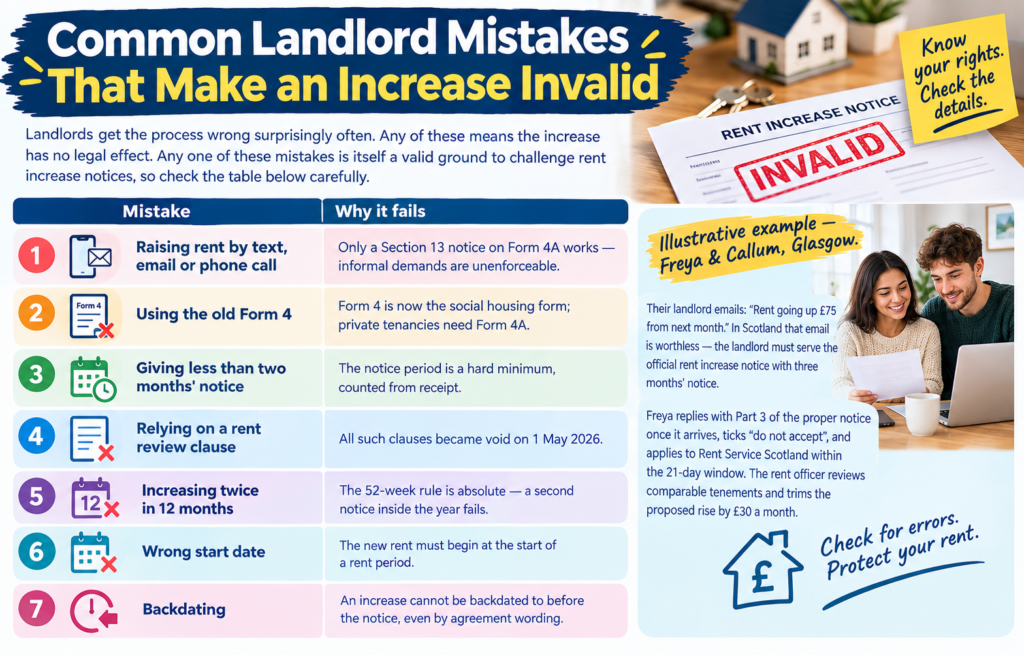
Common Landlord Mistakes That Make an Increase Invalid
Landlords get the process wrong surprisingly often. Any of these means the increase has no legal effect: Any one of these mistakes is itself a valid ground to challenge rent increase notices, so check the table below carefully.
| Mistake | Why it fails |
|---|---|
| Raising rent by text, email or phone call | Only a Section 13 notice on Form 4A works — informal demands are unenforceable |
| Using the old Form 4 | Form 4 is now the social housing form; private tenancies need Form 4A |
| Giving less than two months’ notice | The notice period is a hard minimum, counted from receipt |
| Relying on a rent review clause | All such clauses became void on 1 May 2026 |
| Increasing twice in 12 months | The 52-week rule is absolute — a second notice inside the year fails |
| Wrong start date | The new rent must begin at the start of a rent period |
| Backdating | An increase cannot be backdated to before the notice, even by agreement wording |
Illustrative example — Freya & Callum, Glasgow. Their landlord emails: “Rent going up £75 from next month.” In Scotland that email is worthless — the landlord must serve the official rent increase notice with three months’ notice. Freya replies with Part 3 of the proper notice once it arrives, ticks “do not accept”, and applies to Rent Service Scotland within the 21-day window. The rent officer reviews comparable tenements and trims the proposed rise by £30 a month.
Frequently Asked Questions on How to Challenge Rent Increase Notices
Can my landlord increase my rent whenever they want?
No. In England, a landlord can only increase the rent of an assured periodic tenancy with a Section 13 notice on Form 4A, giving at least two months’ notice, no more than once every 12 months. Any other method — a phone call, email, or a rent review clause — is legally ineffective.
What is a Section 13 notice?
It is the statutory notice under section 13 of the Housing Act 1988 that a landlord must use to propose a rent increase. Since 1 May 2026, it must be on the prescribed Form 4A, give at least two months’ notice, and the increase cannot take effect sooner than 52 weeks after the last one.
How do I challenge a rent increase?
Apply to the First-tier Tribunal (Property Chamber) before the start date stated in the Section 13 notice. The tribunal will determine the open market rent based on comparable properties and evidence from both sides. It costs £47, with Help with Fees available, and you keep paying your old rent until the decision.
Can the tribunal increase my rent above what the landlord asked?
No — not for notices served since 1 May 2026. The tribunal can confirm the landlord’s figure or reduce it to the market rent, but it cannot set a higher rent. This makes challenging much less risky than it used to be.
Do I have to pay the higher rent while waiting for the tribunal?
No. Keep paying your current rent until the tribunal decides. The government has confirmed you do not have to pay the increased amount during the case, and the new rent cannot be backdated — it starts from the rent period after the decision.
What if my landlord never served a proper notice?
Then there is no lawful increase, and you owe only your current rent. Tell the landlord in writing that you do not accept the increase because no valid Section 13 notice was served, and keep a copy. They must start again with a proper Form 4A and a fresh two-month notice period.
Can I challenge the rent I agreed to when I moved in?
Yes, if your tenancy began less than six months ago and you believe the starting rent was above the open market level, the Renters’ Rights Act gives you a separate route to ask the First-tier Tribunal to review it — no Section 13 notice needed.
How much notice must my landlord give for a rent increase?
In England, at least two months on a Section 13 notice. In Scotland, it is three months on the official notice form; in Wales two months; in Northern Ireland, three months in writing. The rules differ, so check the section for your nation above.
How often can my landlord increase the rent?
In England, Scotland, Wales and Northern Ireland alike, rent can only be increased once every 12 months. In England it also cannot be increased at all during the first 52 weeks of the tenancy.
What if I can’t afford the increase even though it’s lawful?
Negotiate with evidence of comparable rents, check whether Universal Credit or Discretionary Housing Payments can help, and use our affordability calculators to see what you can genuinely sustain. Never just stop paying — arrears are a separate ground for eviction.
Are rent review clauses in tenancy agreements still valid?
No. From 1 May 2026, any clause in an assured tenancy agreement that provides for rent increases is unenforceable in England. The Section 13 process is the only lawful route. (If you signed before that date, old clauses may still have applied to increases made before 1 May 2026.)
Where can I get free help with a rent increase dispute?
Shelter England’s rent increases advice pages, Citizens Advice, and your local council’s housing team all give free guidance. For tribunal applications, the GOV.UK open market rent determination guidance explains the forms and the process.
Final Thoughts
The 2026 rule changes tilted the balance on rent increases firmly toward tenants: one lawful process, two months’ notice, once a year, market rent only — and a tribunal challenge that can no longer backfire. But rights only work if you use them. When a rent rise lands, check the notice first, the amount second: an invalid notice means no increase at all, and an above-market figure means the tribunal can bring it down.
And keep the bigger picture in view. A rent increase changes what you can afford, so re-run the numbers with our rent increase affordability checker, see how the new rent sits against your income with our rent-to-income calculator, and browse more practical help in our rent guides. An informed tenant is a landlord’s least favourite surprise — in the best possible way.