
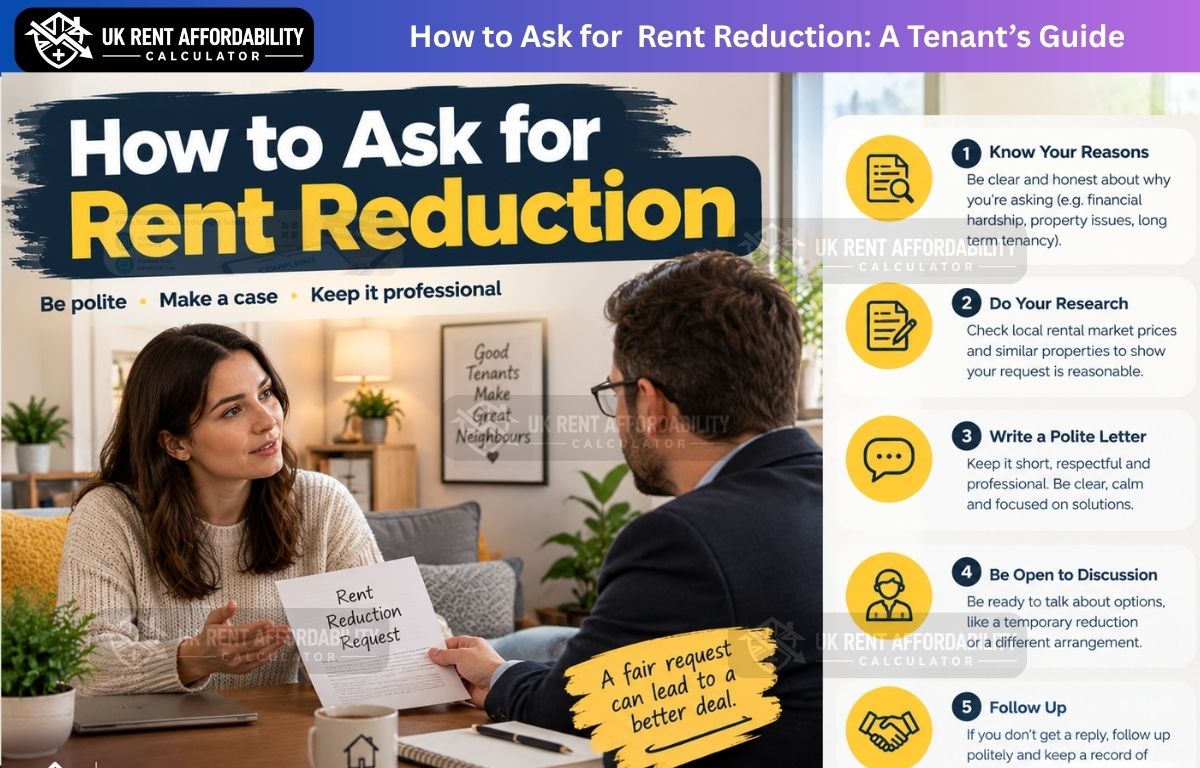
Louise has lived in her two-bedroom flat in Leeds for eighteen months. When she moved in, £1,200 a month felt fair — the market was hot and she needed somewhere fast. This spring, out of curiosity, she looked at the listings on her own street: similar two-beds were now going for £1,100–£1,150. Her pay rise hadn’t materialised, her energy bills had crept up, and the flat’s ancient boiler was costing her a fortune to run. She started wondering How to Ask for Rent Reduction.
Louise didn’t want to move. She liked the flat, liked the area, and dreaded the cost and chaos of relocating. So she asked herself the question this guide answers: how do you ask for a rent reduction in the UK when you’re already living in the property — mid-tenancy, with months or years of history behind you?
This guide is strictly about mid-tenancy rent reductions: asking your current landlord to lower the rent on the home you already occupy. (If you haven’t signed yet, our negotiate rent guide covers getting a lower figure before you commit — the tactics overlap, but the timing changes everything.)
Quick answer: There is no legal right to a rent reduction in the UK — it is a negotiation, and the decision is your landlord’s. But landlords agree more often than tenants expect, because a small cut is usually cheaper than an empty property. Your strongest approach: gather 3–5 comparable local listings showing your rent is above the market, write a polite specific request (a figure, not a vague plea), explain your reasoning briefly, offer something in return — and get any agreement in writing. Never stop paying rent to force the issue.
Rules differ between England, Scotland, Wales and Northern Ireland, and several changed in 2026. This guide reflects the position as of October 2026 and is general information, not legal advice.
The Starting Truth: There Is No Right to a Reduction
Get this clear first, because everything else flows from it. In the UK, you do not have a legal right to pay less rent mid-tenancy. Your tenancy agreement sets the rent, and — unlike rent increases, which must follow a strict legal process — a rent reduction is purely a matter of agreement between you and your landlord. This is an important point to understand when learning How to Ask for Rent Reduction.
That sounds discouraging. It shouldn’t be. It means the conversation is a commercial negotiation, not a legal battle — and in a negotiation, the side with the better maths and the calmer tone usually wins. Landlords are running a business. An occupied property paying slightly less rent beats an empty property paying nothing, every single time. Your job is to make that maths visible to them.
There are two narrow exceptions worth knowing:
- The first-six-months tribunal route (England). If you signed within the last six months and your rent is well above the local market rate, you can ask the First-tier Tribunal to set the initial rent. The tribunal compares it with the open market rent for similar local homes and can reduce it — though never above what you agreed. This is a challenge to the starting rent, not a mid-tenancy reduction, and the six-month deadline is strict.
- Disrepair compensation. If serious disrepair has reduced the value of living in the property, you may have a claim for compensation — which is different from a rent reduction, and usually pursued through the council or the courts rather than a polite letter. See our landlord repairs guide if this is your situation.
For everyone else, the route is negotiation. Here is how to do it properly.
Step 1: Find Out Whether Your Rent Is Actually Above the Market
Never ask for a reduction armed only with a feeling that the rent “seems high”. Landlords respond to evidence, not hunches. Before you write a word, build a small dossier:
| Source | What to record |
|---|---|
| Rightmove / Zoopla listings | Asking rent, bedroom count, postcode, days listed, condition — aim for 3–5 comparables at a lower figure |
| ONS rental price index | National and regional averages to sanity-check your figures — the September 2026 index put the average UK private rent at £1,400 a month, £1,459 in England |
| Local letting agents | Ask what similar flats nearby actually let for, not just what is advertised |
| Your own property’s condition | Dated notes on wear, outdated fittings, parking, transport links — anything that justifies a lower figure than the headline comparables |
Louise’s dossier looked like this: three two-bed listings on neighbouring streets at £1,100, £1,125 and £1,150 (hers: £1,200), all within a ten-minute walk; her flat’s boiler was 15 years old and the bathroom hadn’t been updated in a decade. “Similar two-beds on this street are listed at £1,100–£1,150” is an argument. “I feel it’s too much” is not.
One caution: make sure you are comparing like with like. A flat with bills included, a parking space or a recent refurbishment is not comparable to yours without one. A landlord who spots a sloppy comparison will dismiss the whole case.
Step 2: Understand the Landlord’s Maths — Why a Cut Beats a Void
Here is the argument that does most of the work for you. An empty property costs a landlord money every day: lost rent that never comes back, plus re-advertising, referencing and cleaning costs. A modest reduction that keeps a reliable tenant almost always beats holding out for full price and risking a void.
| Monthly rent | Cost of 2 weeks sitting empty | Cost of 4 weeks sitting empty |
|---|---|---|
| £900 | £415 | £831 |
| £1,200 | £554 | £1,108 |
| £1,350 | £623 | £1,246 |
| £1,500 | £692 | £1,385 |
(Calculated as monthly rent × 12 ÷ 52 × number of empty weeks.)
Read that table as a landlord would. At £1,200 a month, a single empty month costs £1,108 — nearly the entire saving from refusing a £100-a-month reduction for a whole year (£1,200). Add re-letting costs on top, and the landlord who turns down your request is gambling more than the discount costs them.
Illustrative example — Donna, Bristol. Donna pays £1,350 a month. Comparable two-beds nearby are letting at £1,250–£1,275, and she asks her landlord to reduce her rent to £1,250 — a £100 monthly cut, £1,200 over the year. Her landlord hesitates. Donna’s email lays out the maths: four empty weeks would cost the landlord £1,350 × 12 ÷ 52 × 4 = £1,246.15 in lost rent alone, before a penny of re-advertising or referencing. The £1,200 annual concession is cheaper than one empty month. The landlord agrees — a year of guaranteed £1,250 beats a gamble on £1,350.
This is also why timing matters. Landlords are most receptive when the market is soft — typically the winter months, when fewer people are moving — and when a property nearby has sat empty for weeks. If your street has “To Let” boards gathering dust, say so.
Tactic 1: The Market-Evidence Approach
This is your primary tactic: a calm, documented case that your rent is above what the market now supports.
- Lead with the comparables. “Similar two-beds on [street/area] are currently listed at £1,100–£1,150. I am paying £1,200.” Include the listing details — bedroom count, postcode, how long each has been listed. Screenshots with dates are better than descriptions.
- Name a specific figure. “I would like to discuss reducing my rent to £1,125” gives the landlord something to say yes to. A vague “could you reduce my rent please?” invites a vague no. Aim slightly below what you would genuinely accept, so there is room to meet in the middle — the realistic negotiating zone is roughly 5–10% below your current rent.
- Explain briefly, not emotionally. One or two sentences on why: the comparables, plus any condition issues. A page of complaints makes landlords defensive; three lines of evidence make them think.
- Point to your record. Reliable payment history and a well-kept property are worth real money. If you have never missed a payment and the flat is in good shape, say so — replacing you means referencing, void risk and an unknown quantity.
Keep the tone collaborative throughout. “I would rather stay than move, and I think £1,125 reflects the local market” lands far better than “reduce it or I’m leaving.” Ultimatums make landlords defensive; a landlord who feels respected is a landlord who says yes.
Tactic 2: The Hardship Letter
Sometimes the market hasn’t moved — but your circumstances have. A pay cut, reduced hours, a relationship breakdown, an illness, a benefit payment delayed: landlords are human, and a frank, specific hardship letter works more often than tenants expect. Shelter’s own guidance suggests exactly this: tell your landlord about problems such as losing your job, higher energy costs or Universal Credit delays, and ask about paying a lower rent for a short time.
What to include:
- What has changed, in one or two sentences. “My warehouse shifts were cut from five days to three in September; my take-home pay has fallen by £400 a month.”
- What you can pay, as a specific figure and timeframe. “I can manage £850 a month for the next six months, returning to £950 in April” beats “I can’t afford the rent.”
- Evidence you are serious. A simple monthly budget showing income and outgoings — rent, council tax, energy, food, transport — proves this is maths, not mood. Our rent arrears guide explains how to build one.
- What happens next. “If my hours are restored I will return to the full rent” gives the landlord a horizon. A temporary reduction is a much easier yes than a permanent one.
Illustrative example — Paul, Liverpool. Paul’s overtime was cut and his £950 rent stopped fitting his budget. He wrote to his landlord with a one-page budget and proposed £850 a month for six months, reverting to £950 afterwards — a total concession of £600. The alternative, he noted politely, was that he would have to give notice and move somewhere cheaper. The landlord agreed: £600 of temporary reduction against the £877 cost of just four empty weeks (£950 × 12 ÷ 52 × 4) plus re-letting costs. Paul kept his home; the landlord kept a paying tenant.
One warning: be honest. A landlord who discovers the “hardship” was invented will never trust you again — and trust is the currency this whole negotiation runs on.
Tactic 3: Offer Something in Return
Negotiation is a two-way street. If you are asking for less, consider what you can give that costs you little but matters to the landlord:
| What you offer | Why the landlord cares |
|---|---|
| Your genuine intention to stay | Avoids re-letting costs and void risk for years — back it with your track record (“three years in my last flat”) |
| A track record of reliability | Clean references, on-time payments, a well-kept property — certainty is what landlords buy |
| Minor maintenance you take on | Garden upkeep, small redecoration, keeping on top of minor repairs (check your agreement first) |
| Flexibility on access and inspections | Makes managing the property easier, especially for distant landlords |
| Paying rent a few days early each month | Improves the landlord’s cash flow at zero cost to you |
One thing you cannot offer in England: a fixed-term lock-in. Since 1 May 2026, all new private tenancies are assured periodic (rolling) tenancies — fixed terms are no longer permitted, and you can leave with two months’ notice. So don’t promise to “sign for two years” — it has no legal meaning. Offer instead your genuine intention to stay, backed by evidence. (In Scotland, Wales and Northern Ireland, where fixed terms still exist, a longer commitment can still be a real bargaining chip.)
Tactic 4: The LHA / Universal Credit Angle
If you claim Universal Credit, there is a specific, powerful argument available. Your UC housing element is capped at the Local Housing Allowance (LHA) rate for your area and bedroom entitlement — it is the lower of your rent or your LHA rate. And LHA rates are frozen for 2026/27 at their April 2024 levels, while market rents have kept rising. If your rent sits above your LHA rate, you are filling the gap from the rest of your income every month.
Asking the landlord to reduce the rent to your LHA rate is a concrete, verifiable proposal: it eliminates your shortfall entirely, and the figure comes from the government’s own tables, not from haggling.
Illustrative example — Claire, Cardiff. Claire rents a two-bedroom flat at £900 a month. Her household’s bedroom entitlement gives her Cardiff’s two-bedroom LHA rate: £189.86 a week, which is £189.86 × 52 ÷ 12 = £822.73 a month. Every month, Claire finds £77.27 from the rest of her UC award — £927.24 a year. She writes to her landlord proposing a reduction to £822.73, enclosing the LHA table for her postcode. The landlord can verify the figure in minutes, and the ask is framed not as “I want cheaper rent” but as “bring the rent in line with the government’s assessed local rate.” Our Universal Credit rent guide explains how to check your exact LHA rate.
Two notes: check your rate before you write — LHA depends on your exact postcode and bedroom entitlement, not your town. And if the gap is large, also ask your council about the Crisis and Resilience Fund Housing Payment (England), which can bridge shortfalls while you negotiate.
How to Ask: Putting the Request in Writing
Start in writing — an email or letter creates a record and gives you time to choose your words. (You can offer to talk it through afterwards, but the paper trail matters.) Shelter’s guidance makes the same point: get proof of what you agree, in writing.
Your request should include:
| Element | What to write |
|---|---|
| The exact figure | “I would like to discuss reducing my rent from £1,200 to £1,125 a month” — never a vague range |
| Your evidence | Two or three comparables with sources, briefly stated |
| Your reliability | Payment history, how long you have lived there, condition of the property |
| Your reason | Market evidence, changed circumstances, or the LHA gap — one or two sentences |
| What you offer | Intention to stay, flexibility, maintenance — something concrete |
| A timeframe | “Could you let me know by [date]?” — two to three working days keeps things moving |
| Tone | Warm, specific, collaborative — you enjoy living there and want to stay |
Example opening: “Dear [name], I hope you’re well. I’ve really enjoyed living at [address] for the past eighteen months and I’d like to stay long term. I’ve been looking at the local market, and similar two-beds nearby are currently listed at £1,100–£1,150 while I’m paying £1,200. I’d like to discuss reducing my rent to £1,125 a month. I’ve never missed a payment, the flat is in good order, and I’m hoping to stay for several more years. Would you be open to discussing this? Kind regards, [name].”
Get Any Agreement in Writing — Non-Negotiable
Whatever you agree — a lower figure, a temporary reduction, a freeze — get it confirmed in writing before you change what you pay. A confirming email from the landlord or agent is usually enough for a simple reduction. Verbal promises are difficult to rely on later, and a landlord who “agrees” on the phone may genuinely misremember the figure.
| The agreement must state | Why |
|---|---|
| The new rent figure | Exact monthly amount, no ambiguity |
| The start date | Which rent payment the new figure applies from |
| The duration | Permanent, or temporary with a review/end date |
| What happens afterwards | If temporary: does it revert to the old rent, or get reviewed? |
| Any conditions | Anything you offered in return, written down |
If the landlord agrees in writing to a permanent lower rent, that is your new rent amount — keep the email with your tenancy paperwork. If a new tenancy agreement is issued, read the rent clause carefully before signing and check the figure matches what was agreed.
If the Landlord Says No: The Fallback Menu
A refusal is not always the end of the discussion. Landlords who won’t cut the rent will often agree to something else — and the alternatives can be worth nearly as much:
| Fallback | What to ask |
|---|---|
| A rent freeze | No increase for the next 12 months, in writing — valuable in itself when rents are rising |
| A phased increase | If an increase is coming, ask for it in stages rather than all at once |
| Improvements instead of a cut | A new boiler, redecoration, better insulation, white goods — one-off costs for the landlord, lasting value for you |
| Bills folded in | Council tax, water or broadband included or capped within the rent |
| Revisit in six months | “If the market softens, can we talk again in six months?” — keeps the door open |
| A shorter commitment to the current rent | Agree the current rent for now, with a written review date |
And if the underlying problem is affordability rather than the market, act on that directly: check whether you are claiming everything you are entitled to (Universal Credit, Council Tax Reduction), ask your council about the Crisis and Resilience Fund Housing Payment, and get free debt advice from StepChange, National Debtline or Citizens Advice before arrears build up. Our rent arrears guide walks through the full toolkit.
If the Landlord Counters With a Rent Increase
Sometimes asking for a reduction prompts the opposite: the landlord responds by proposing an increase. Don’t panic — and don’t accept it on the spot. In England, a rent increase is only lawful through the Section 13 process: a formal notice on Form 4A, at least two months’ notice, no more than once every 12 months, and the new rent must not exceed the open market rent. A text, email or phone call proposing a higher rent has no legal force.
Your response:
- Ask for the formal notice. “Please serve a Section 13 notice if you’d like to propose an increase.” Many informal demands evaporate at this point.
- Check the notice when it arrives — correct form, two full months, at least 12 months since the last increase, and a figure at or below market rent.
- Negotiate the figure. Respond in writing with your comparables and propose a smaller increase — or a freeze. Landlords know you can challenge, which makes them keener to settle.
- Challenge at the tribunal if needed. Apply to the First-tier Tribunal before the start date in the notice (£47 fee, help available). The tribunal sets the market rent — and since 1 May 2026 it cannot set a figure higher than the landlord proposed, so challenging can no longer backfire.
Our challenge rent increase guide covers the whole process, including the exact checks that invalidate most bad notices.
Rent Increases and Reductions Across the UK
The negotiation tactics in this guide work everywhere, but the legal backdrop for rent increases — the thing your landlord might do instead — differs by nation:
| England | Wales | Scotland | Northern Ireland | |
|---|---|---|---|---|
| Increase route | Section 13 notice (Form 4A) only | Notice of Variation of Rent | Prescribed rent-increase notice | Written notice (3 months) |
| Notice required | 2 months | 2 months | 3 months | 3 months |
| Frequency | Once every 12 months; never in the first 52 weeks | Once a year | Once every 12 months | Once every 12 months (since 1 April 2025) |
| Challenge | First-tier Tribunal — cannot set rent above the proposal | Rent Assessment Committee | Rent Service Scotland rent officer — binding adjudication | Limited challenge routes; get advice |
| Reduction | By agreement (this guide) | By agreement | By agreement | By agreement |
Scotland’s challenge route is the strongest of the four: a rent officer’s adjudication is binding, and you currently have 21 days from the notice to refer (extending to 30 days for notices given from 1 April 2027). Scotland’s Housing (Scotland) Act 2025 has also put a rent-control framework in place from 1 April 2026 — no areas are designated yet, but the direction of travel is clear.
What Never to Do
Two mistakes turn a negotiation into a crisis:
- Never stop paying rent to force a reduction. There is no legal right to withhold rent in the UK — not even when your landlord is in the wrong. Stopping payment creates arrears, and in England arrears of three months or more can trigger a mandatory eviction order under Ground 8. Our can I withhold rent guide explains why this backfires and what to do instead.
- Never agree a reduction verbally and act on it. Paying the lower figure without written confirmation leaves you technically in arrears for the difference — and arrears are arrears, whatever the handshake was.
And one more: don’t threaten to leave unless you mean it. An empty threat discovered is worse than no threat at all — but a genuine, polite statement that you will have to move if the numbers don’t work is simply honest. If you do decide to leave, our guide to ending a tenancy early shows how to do it without overpaying.
Frequently Asked Questions
Can I ask my landlord to reduce my rent?
Yes — you can ask at any time. There is no legal right to a reduction, but landlords agree more often than tenants expect, especially when you present market evidence and a specific figure. Put the request in writing, keep it polite and specific, and get any agreement confirmed in writing.
How much of a reduction should I ask for?
The realistic negotiating zone is roughly 5–10% below your current rent. Ask for slightly less than you would accept, so there is room to meet in the middle. Base the figure on comparable local listings, not on what you wish the rent was.
What if my landlord refuses to lower the rent?
Ask for the fallback menu: a 12-month rent freeze in writing, a phased increase instead of a jump, property improvements, bills folded into the rent, or an agreement to revisit in six months. If affordability is the real issue, check your benefit entitlement and ask your council about the Crisis and Resilience Fund Housing Payment.
Should I ask in writing or in person?
Start in writing — an email creates a dated record and lets you choose your words carefully. You can offer to discuss it afterwards. Whatever is agreed must be confirmed in writing before you change what you pay.
Can my landlord increase the rent because I asked for a reduction?
Your landlord can propose an increase, but in England it is only lawful through the Section 13 process: Form 4A, two months’ notice, once every 12 months, at or below market rent. An informal demand by text or phone call has no legal force. You can also challenge a formal increase at the First-tier Tribunal.
Does asking for a reduction put my tenancy at risk?
Asking politely does not give your landlord any legal ground against you. In England, no-fault eviction was abolished in 2026 — your landlord can only end the tenancy by proving a Section 8 ground. That said, keep the tone collaborative: a landlord who feels respected is more likely to say yes, and less likely to become difficult.
What if my rent is above my Local Housing Allowance rate?
Propose reducing the rent to your LHA rate, and enclose the rate table for your postcode. It is a concrete, verifiable figure from the government’s own tables — framed as aligning the rent with the assessed local rate rather than haggling. Check your exact rate first: it depends on your postcode and bedroom entitlement, and LHA rates are frozen for 2026/27.
Can I get a rent reduction in Scotland, Wales or Northern Ireland?
Yes — the negotiation tactics in this guide work in all four nations, because a reduction is a matter of agreement everywhere. The surrounding rules differ: Scotland gives you the strongest challenge route against increases (binding rent-officer adjudication), Wales requires 2 months’ notice for increases, and Northern Ireland requires 3 months’ written notice with increases limited to once a year.
Is there a template letter for asking for a rent reduction?
There is no official template, but the structure in this guide covers what matters: the exact figure, two or three comparables with sources, your reliability and payment history, your reason in one or two sentences, something you offer in return, and a response date. Shelter and Citizens Advice both advise putting the request in writing and keeping a record of everything agreed.
What if I’m already behind on rent?
Don’t ask for a reduction and ignore the arrears — deal with the arrears first. Tell your landlord in writing, work out exactly what you owe, and treat rent as a priority debt. A repayment plan agreed now strengthens any later conversation about the rent level. Our rent arrears guide walks through the steps, including Universal Credit advances and Breathing Space.
Can the tribunal lower my rent mid-tenancy?
In England, the First-tier Tribunal route for challenging rent applies to increases (Section 13) and to the initial rent within the first six months of the tenancy — not to an ongoing mid-tenancy reduction you simply want. A mid-tenancy reduction is a negotiation. In Scotland, you can refer a proposed increase to a rent officer for binding adjudication.
My landlord agreed verbally but won’t put it in writing — what now?
Do not change what you pay yet. Send a polite follow-up email summarising what was agreed (“Just confirming we agreed £1,125 a month from 1 December…”) and ask them to confirm by reply. If they won’t confirm, you have no agreement — keep paying the contractual rent while you continue the conversation.
Final Thoughts
Asking for a rent reduction feels like an imposition. It isn’t — it’s a business conversation, and landlords have it from the other side regularly. The tenants who succeed are not the boldest or the neediest; they are the best prepared. Three comparables, one specific figure, a calm email, and the landlord’s own void-cost maths laid out politely: that combination wins reductions every week across the UK.
Remember the two rules that protect you while you negotiate: never stop paying rent to force the issue — arrears hand your landlord the weapon you are trying to take away — and never act on a verbal agreement — get the figure, the date and the duration in writing first.
Before you write the email, make sure the numbers work for your budget. Our negotiate rent guide covers the pre-signing tactics this guide builds on, the Universal Credit rent guide shows how to check your LHA rate, and the challenge rent increase guide is your backstop if the landlord responds with an increase instead. Ask well, ask in writing — and stay put on your own terms.
Further Reading
- Can you negotiate rent with a landlord? — Shelter England — Shelter’s guidance on asking for lower rent, including what to do if you cannot afford your rent.
- Private renting: your rights — GOV.UK — the official overview, including the rent disputes section and how to challenge your rent.
- Citizens Advice also publishes advice on negotiating with your landlord and dealing with rent increases — search “rent increases” on citizensadvice.org.uk for their current guidance page.