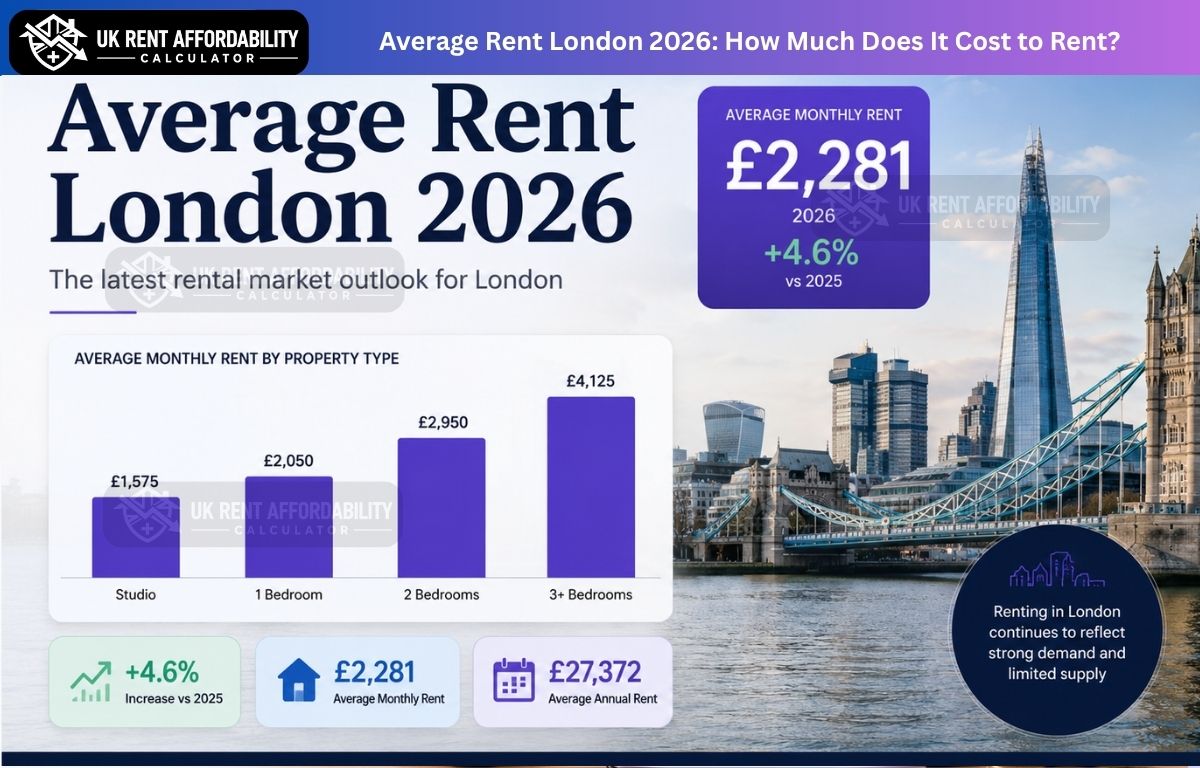
Average Rent London 2026: London rent has crossed a new threshold in 2026, and the gap between boroughs has never mattered more. A one-bedroom apartment in Bexley might run you £1,400 a month; the same-size flat in Kensington & Chelsea can top £3,200.
That’s not a rounding error; it’s over £21,000 a year, enough to cover a postgraduate degree or a house deposit elsewhere in the UK.
This guide is built from current borough-level rental listings and market reporting (see Sources & Methodology below), not just headline citywide averages.
It breaks down what you’ll actually pay once transport, council tax, and lifestyle costs are added because the “cheap” borough on paper often isn’t the cheap borough in practice.
Sources & Methodology
Rent figures in this guide reflect one-bedroom property averages compiled from active listings and market trend reports across Greater London as of mid-2026, cross-checked against typical ranges reported by major UK property portals and letting agencies. Figures are indicative averages, not guaranteed prices — exact rent depends on the specific street, building age, and furnishing. Where possible, compare any figure here against live listings for your target borough before budgeting, since local markets can shift month to month.
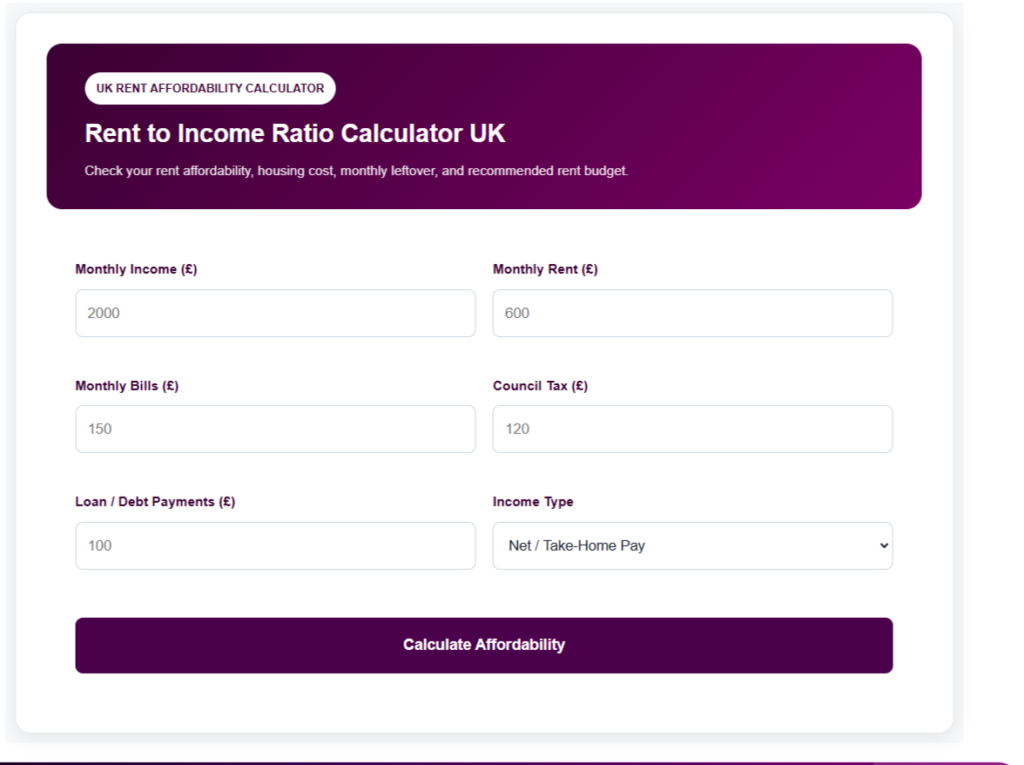
Clich Here:Rent to Income Ratio Calculator UK
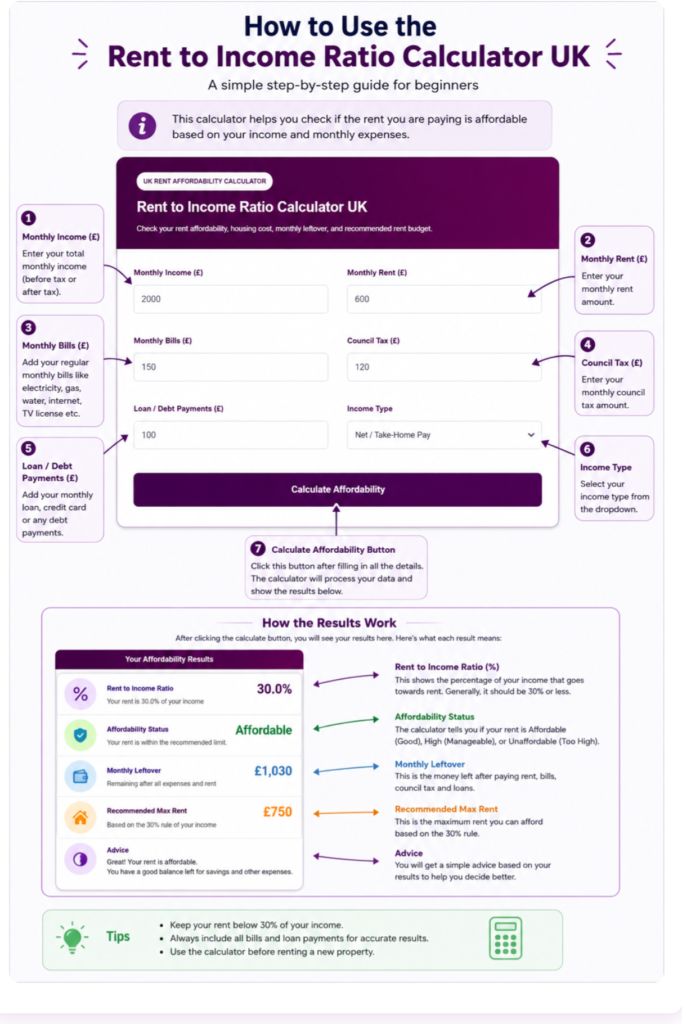
How to Use the Rent to Income Ratio Calculator UK
Why London Rent Continues to Rise in 2026
Unlike many UK cities, average rent in London in 2026 is determined by several powerful factors working together.
The demand remains very high because thousands of degree holders, international students, professionals, and overseas workers continue to move into the capital every month.
At the same time, housing supply has worked hard to keep pace.
Even though new developments continue across Greater London, available rental properties are regularly booked within days, influencing the Average Rent London 2026 across different boroughs.
Landlords also face:
- Higher mortgage costs
- Increased maintenance expenses
- Insurance increases
- Service charges
- Compliance with updated rental regulations
Many of these additional costs are eventually reflected in the Average Rent London 2026 and monthly rental prices
Read more: What Happens If You Miss a University Exam? Complete Student Guide.What Is the Average Rent in London in 2026?
Across Greater London, lower monthly rents generally fall into these ranges:
| Property Type | Average Monthly Rent |
| Studio Apartment | £1,450–£1,750 |
| 1 Bedroom Flat | £1,750–£2,150 |
| 2 Bedroom Flat | £2,200–£2,900 |
| 3 Bedroom House/Flat | £2,900–£4,000+ |
| Family House | £3,800–£6,000+ |
But these citywide averages don’t tell the full story.
A renter selecting Howling, on the other hand, over Kensington could save over £15,000 per year on rent alone.
That difference is enough to buy a car, create an emergency fund, or cover university tuition.
London Is Really 32 Different Rental Markets
Many first-time renters think London has one average rent.
In reality, every borough operates almost like its own housing market.
Factors affecting prices include:
- Transport connections
- Underground accessibility
- Crime levels
- School ratings
- Employment opportunities
- Shopping centres
- Green spaces
- New developments
- International demand
That’s why neighbouring boroughs can have rental differences exceeding 40%.
Borough-by-Borough Average Rent (2026)
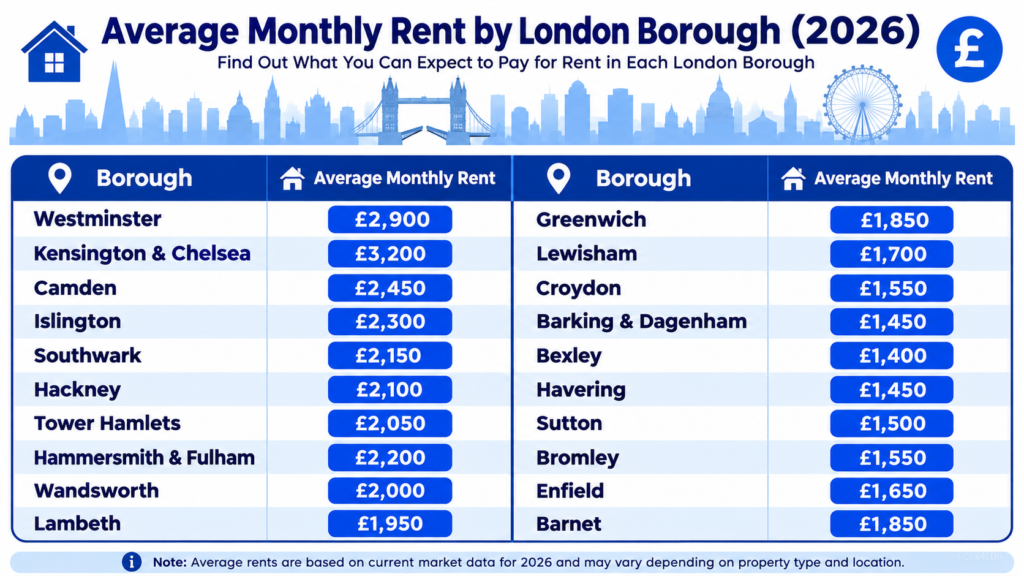
The following numbers represent average monthly rents for a one-bedroom property.
| Borough | Average Monthly Rent |
| Westminster | £2,900 |
| Kensington & Chelsea | £3,200 |
| Camden | £2,450 |
| Islington | £2,300 |
| Southwark | £2,150 |
| Hackney | £2,100 |
| Tower Hamlets | £2,050 |
| Hammersmith & Fulham | £2,200 |
| Wandsworth | £2,000 |
| Lambeth | £1,950 |
| Greenwich | £1,850 |
| Lewisham | £1,700 |
| Croydon | £1,550 |
| Barking & Dagenham | £1,450 |
| Bexley | £1,400 |
| Havering | £1,450 |
| Sutton | £1,500 |
| Bromley | £1,550 |
| Enfield | £1,650 |
| Barnet | £1,850 |
These averages vary depending on:
- Furnished vs unfurnished
- Property age
- Exact location
- Distance to Underground stations
- Building amenities
The Hidden Truth Behind Borough Prices
Many renters immediately choose the cheapest borough.
But cheaper rent doesn’t always mean lower living costs.
Consider this comparison.
Example A
Apartment in Westminster
Monthly Rent: £2,700
Walking distance to work.
Transport Cost:
£80/month
Example B
Apartment in Barking
Monthly Rent:
£1,450
Daily commute:
75 minutes each way
Monthly Transport:
£260
Extra coffee, meals, and travel expenses:
Approximately £180
Total monthly additional costs:
£440
Real housing cost becomes:
£1,890/month
Suddenly, the lower property is not saving as much money as expected.
This is one of the biggest mistakes new renters make.
Real-Life Example 1 – Sarah, Marketing Executive
Here’s how the numbers played out for one renter navigating exactly this trade-off.
Sarah accepted a marketing role in Canary Wharf.
Initial salary: £46,000 per year
She had two choices.
| Category | Option 1 — Rent Near Work | Option 2 — Move to Zone 5 |
|---|---|---|
| Apartment Rent | £2,050/month | £1,500/month |
| Travel Time | 15 minutes | 90 minutes daily |
| Monthly Transport | £95 | £280 |
| Extra Food & Coffee | — | £170 |
| Lost Freelance Time | — | Around 30 hours every month |
| Total Monthly Cost (excluding lost time) | £2,145 | £1,950 |
Sarah eventually realised her “cheaper” apartment actually reduced both her savings and quality of life. She moved closer to work after six months and ended up spending less overall.
Real-Life Example 2 – University Student
Ahmed moved to London from Manchester for his Master’s degree.
Instead of renting an entire studio, he chose a shared house in Lewisham.
His monthly costs looked like this:
Rent:
£820
Utilities:
£95
Internet:
Included
Transport:
£130
Groceries:
£240
Total:
£1,285/month
If he had rented a private studio in Central London, his monthly housing expenses alone would have exceeded £2,000.
Sharing accommodation saved him nearly £9,000 in one year.
Read more: Average Rent UK 2026 – Latest Rental Prices by City (Complete Guide)The Salary Needed to Rent Comfortably
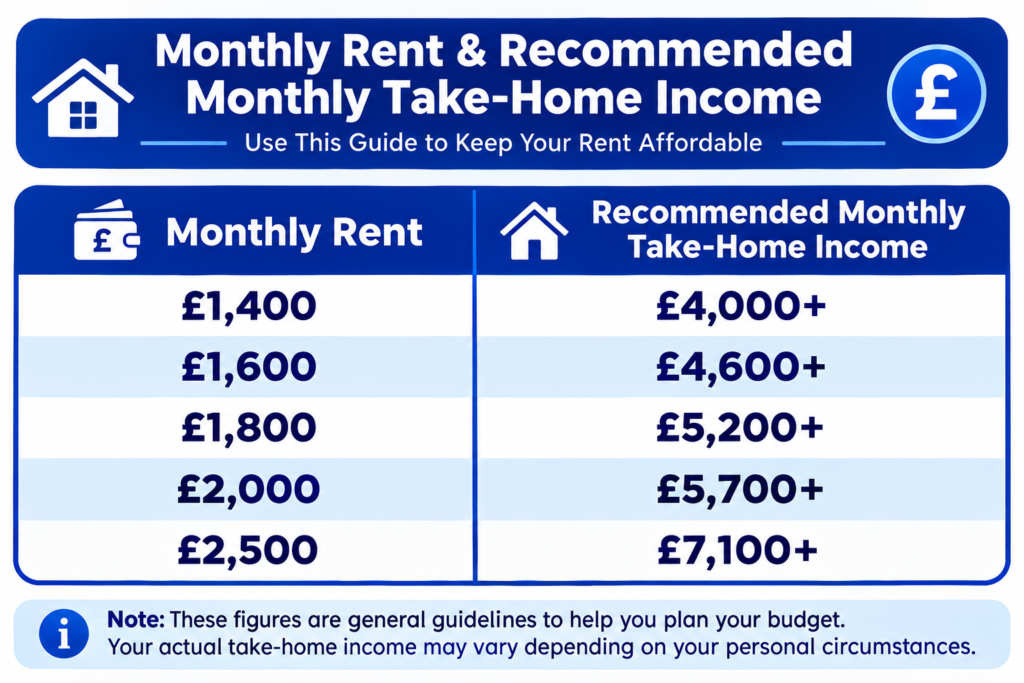
Financial advisers often recommend spending no more than 30–35% of your take-home income on rent.
Let’s compare.
| Monthly Rent | Recommended Monthly Take-Home Income |
| £1,400 | £4,000+ |
| £1,600 | £4,600+ |
| £1,800 | £5,200+ |
| £2,000 | £5,700+ |
| £2,500 | £7,100+ |
Absolutely, many London renters exceed these percentages because wages have not increased at the same pace as rental prices.
However, staying below the 35% Limit provides more Adaptability for bills, emergencies, and savings.
Can I Actually Afford This Rent? A Quick Practical Test
A rental property can look affordable when you compare the rent with your salary, but your real budget depends on everything you pay after receiving your monthly income.
Before choosing a property, use this simple calculation:
Monthly Take-Home Income − Rent − Essential Bills − Transport − Food − Debt Payments = Money Left
For example, suppose your monthly take-home income is £3,500 and the property costs £1,400 per month.
Monthly Cost Amount Take-Home Income £3,500 Rent £1,400 Council Tax £150 Utilities £180 Internet £35 Transport £200 Groceries £350 Debt Payments £200 Money Left £985 In this example, £985 remains after the main monthly expenses. That money can cover savings, clothing, entertainment, emergencies and other personal costs.
Now test the budget under pressure. Add another £150–£200 for unexpected increases in energy, transport or other expenses. If your remaining money becomes very small, the property may be affordable on paper but uncomfortable in real life.
A useful final question is:
“Could I still comfortably pay this rent if one of my regular expenses increased next month?”
If the answer is no, consider a property with lower rent, shared accommodation, a different borough, or a location that reduces your commuting costs.
This approach gives you a more realistic picture than looking at rent alone and can help you avoid committing to a tenancy that puts too much pressure on your monthly budget.
A Unique Way to Compare Boroughs: The “Rent Efficiency Score”
Most rental guides simply rank boroughs by price. That doesn’t tell you which area offers the best overall value.
Instead, imagine a simple Rent Efficiency Score based on four practical factors:
- Monthly rent
- Average commute time to Central London
- Access to transport
- Local Services (shops, parks, healthcare)
For example:
| Borough | Avg. Rent | Commute | Value Score (10) |
| Greenwich | £1,850 | 25 min | 9.2 |
| Wandsworth | £2,000 | 22 min | 9.0 |
| Lewisham | £1,700 | 30 min | 8.8 |
| Barking | £1,450 | 38 min | 8.4 |
| Westminster | £2,900 | 8 min | 7.9 |
This is not an official metric—it’s a practical way to think about value rather than price alone. A borough with slightly higher rent may provide shorter commutes, better transport, and more Comfort, making it a smarter long-term choice.
Inner London vs Outer London – Which Offers Better Value?
One of the biggest decisions renters face is whether to live closer to Central London or further out.
At first glance, Outer London appears to be the Clear choice because monthly rent is usually lower. However, once Daily travel costs and time are included, the answer isn’t always so simple.
| Factor | Inner London | Outer London |
| Average 1-Bed Rent | £2,250 | £1,600 |
| Monthly Transport | £80–£150 | £180–£320 |
| Average Commute | 20–30 mins | 45–90 mins |
| Entertainment | Higher | Moderate |
| Green Spaces | Moderate | Excellent |
| Parking | Limited | Easier |
| Family Homes | Less Common | More Available |
For someone working in Central London five days a week, paying an extra £250–£350 in rent could actually reduce total monthly cost if it cuts Daily travel costs and time greatly.
London’s Most Expensive Boroughs in 2026
These Towns remain the premium locations for renters.
Kensington & Chelsea
Lower 1-bedroom rent:
£3,200/month
Why so expensive?
- Luxury apartments
- International demand
- Excellent schools
- Hyde Park nearby
- High-end shopping
- Strong property values
Typical renters include:
- Executives
- Diplomats
- International professionals
- Wealthy overseas students
| Area | Average Rent | Why People Choose It |
|---|---|---|
| Westminster | £2,900/month | Living in Westminster means you’re close to:• Government offices• Financial institutions• West End• Tourist attractions• Major transport hubs. Many professionals happily pay higher rent because they save nearly two hours of Daily travel every day. |
| Camden | £2,450/month | Popular because of:• Universities• Nightlife• Markets• Underground connections• Young professionals |
Camden offers one of London’s strongest rental markets due to constant demand.
Best Value Boroughs in 2026
Costly does not always mean better.
These boroughs provide an excellent balance between affordability and convenience.
Greenwich
Average rent:
£1,850
Why renters love it:
- DLR
- Elizabeth Line access (nearby connections)
- River Thames
- Parks
- Historic attractions
- Growing business districts
Many finance workers choose Greenwich instead of Canary Wharf because they save several hundred pounds each month.
Wandsworth
Lower rent:
£2,000
Benefits:
- Low council tax compared with many boroughs
- Fast rail connections
- Family-friendly areas
- Good schools
- Large green spaces
Although rent is slightly above the lower end, overall monthly living costs are often lower than planned.
Lewisham
Lower rent:
£1,700
Ideal for:
- Graduates
- Young professionals
- Couples
- First-time renters
The Town continues improving through regeneration projects while remaining one of South London’s better-value areas.
Cheapest Boroughs for Rent in 2026
If your priority is affordability, these boroughs deserve attention.
| Borough | Average 1-Bed Rent |
| Bexley | £1,400 |
| Barking & Dagenham | £1,450 |
| Havering | £1,450 |
| Croydon | £1,550 |
| Sutton | £1,500 |
Lower rent often means:
- Longer journeys
- Fewer Tube stations
- More suburban lifestyle
- Larger homes
- Better parking
For families working remotely, these areas can provide significantly better value.
Real-Life Example – A Couple Relocating to London
A real relocation decision shows how this plays out at scale.
Meet James and Emma. Combined annual salary: £82,000
They initially wanted a flat in Camden.
After reviewing their finances, they rented in Greenwich instead.
Monthly savings: £670 | Annual savings: £8,040
That saving was enough to fund a holiday, increase investments, and build an emergency fund—all without dramatically affecting their quality of life.
| Category | Camden (Monthly) | Greenwich (Monthly) |
| Rent | £2,500 | £1,850 |
| Utilities | £210 | £200 |
| Internet | £35 | — |
| Council Tax | £180 | £165 |
| Transport | £220 | £260 |
| Groceries | £500 | £500 |
| Entertainment | £350 | £350 |
| Total Monthly Spending | £3,995 | £3,325 |
| Savings | Amount |
| Monthly Savings | £670 |
| Annual Savings | £8,040 |
Read more: Rent Affordability Calculator Birmingham 2026 – Check Your Rental BudgetHidden Rental Costs Most Tenants Forget
Rent is only one part of the total cost of living.
Many first-time renters underestimate the following expenses.
Council Tax
Depending on the borough and property band, this can range from approximately £100 to over £250 per month.
Utilities
Electricity
Gas
Water
Average combined cost:
£150–£250/month
This can rise during winter or in poorly insulated properties.
Internet
Broadband typically costs:
£25–£45/month
Premium fibre packages can cost more.
Contents Insurance
Usually:
£10–£25/month
A small expense that can save thousands if belongings are stolen or damaged.
Moving Costs
Typical one-time costs include:
- Removal van
- Packing supplies
- Cleaning
- New furniture
- Utility setup
Many renters spend £800–£2,000 before even settling into their new home.
The 12-Month Cost Difference Most People Never Calculate
Imagine two renters.
| Category | Person A | Person B |
|---|---|---|
| Monthly Rent | £1,550 | £1,900 |
| Commute | £280/month | Walking to work |
| Transport | — | £40/month |
| Daily Coffee | £6 | £1/day |
| Working Days | 22/month | — |
| Annual Commuting | £3,360 | — |
| Annual Transport | — | £480 |
| Annual Coffee | £1,584 | £264 |
| Annual Rent | £18,600 | £22,800 |
| Total | £23,544 | £23,544 |
Despite paying £350 more in monthly rent, Person B spends almost the same over the year once commuting and daily habits are factored in. They also gain hundreds of extra hours of personal time.
Lesson: Always calculate your total living cost, not just your rent.
The “Commute Cost Multiplier” (A Practical Planning Method)
Here’s another way to compare properties before signing a tenancy.
Use this simple formula:
True Monthly Housing Cost = Rent + Transport + Average Workday Expenses
| Category | Example 1 | Example 2 |
|---|---|---|
| Rent | £1,650 | £1,900 |
| Transport | £220 | £80 |
| Lunches / Packed Lunches | £120 (Lunches bought because of commute) | £20 (Packed lunches) |
| Occasional Taxis | £60 | No taxis |
| True Monthly Cost | £2,050 | £2,000 |
The second property looks more costly on paper, but it actually costs less overall and provides a shorter commute.
Best Boroughs by Lifestyle
For Young Professionals
- Camden
- Hackney
- Islington
- Southwark
- Wandsworth
These areas provide excellent transport links, Social life, and access to major employment hubs.
For Families
- Sutton
- Bromley
- Barnet
- Richmond
- Bexley
They generally offer larger homes, parks, and reputable schools.
For Students
- Lewisham
- Greenwich
- Stratford (Newham)
- Camden (shared housing)
- Hammersmith
Shared accommodation in these boroughs can make studying in London much more affordable.
A Smarter Way to Budget: The 50-30-20 Rule for London Renters
A helpful Financial planning framework is:
- 50% of your take-home pay for important costs (rent, bills, food)
- 30% for lifestyle (travel, having a meal, hobbies)
- 20% for savings or loan repayment
Because London rents are high, many renters may need to adjust these percentages temporarily. Even now, the goal should be to avoid letting housing consume so much income that you can not save or handle unplanned costs.
Borough Spotlight: North London
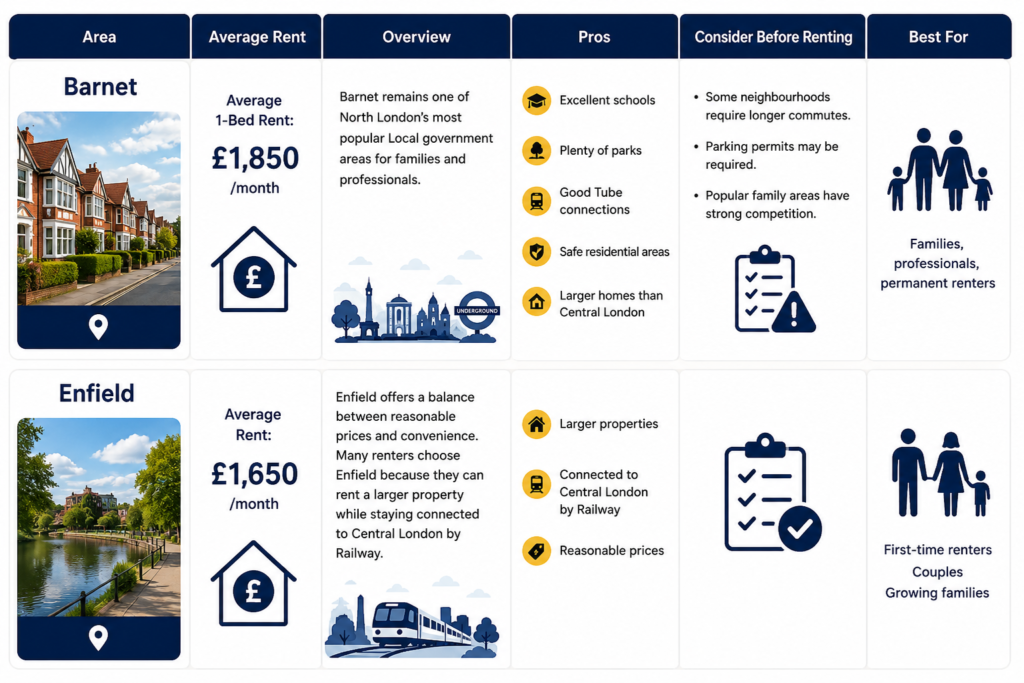
| Area | Average Rent | Overview | Pros | Consider Before Renting | Best For |
|---|---|---|---|---|---|
| Barnet | Average 1-Bed Rent: £1,850/month | Barnet remains one of North London’s most popular Local government areas for families and professionals. | • Excellent schools• Plenty of parks• Good Tube connections• Safe residential areas• Larger homes than Central London | • Some neighbourhoods require longer commutes.• Parking permits may be required.• Popular family areas have strong competition. | Families, professionals, permanent renters |
| Enfield | Average Rent: £1,650/month | Enfield offers a balance between reasonable prices and convenience. Many renters choose Enfield because they can rent a larger property while staying connected to Central London by Railway. | • Larger properties• Connected to Central London by Railway• Reasonable prices | — | First-time renters, couples, growing families |
Borough Spotlight: East London
Tower Hamlets
Average Rent: £2,050/month
Tower Hamlets’ small communities continue to attract finance and technology professionals due to their closeness to Canary Wharf.
Advantages include:
- Excellent transport
- Modern apartment developments
- Riverside living
- Strong job market
The trade-off is higher competition and premium rents near major stations.
Hackney
Average Rent: £2,100/month
Hackney has transformed over the last decade.
Today it’s known for:
- Creative industries
- Cafés
- Independent businesses
- Co-working spaces
- Energetic night scene
Although prices have increased, many young professionals even now see Hackney as good value because of its lifestyle benefits.
Borough Spotlight: South London
Croydon
Average Rent: £1,550/month
Croydon provides some of London’s best rental value.
Benefits include:
- Fast trains to Central London
- Modern apartment developments
- Shopping centres
- More spacious properties
Many renters moving from Central London are surprised by how much extra living space they can manage here.
Bromley
Average Rent: £1,550/month
Bromley is ideal for families seeking:
- Quiet neighbourhoods
- Parks
- Separate and semi-detached homes
- Good schools
Although commuting takes longer, many households accept the trade-off for a better quality of life.
Read more:Rent Affordability Calculator Manchester – Calculate Affordable Rent (2026 Guide)Borough Spotlight: West London
Hammersmith & Fulham
Average Rent: £2,200/month
This Local government area remains highly desirable because it combines transport, employment opportunities, and entertainment.
Popular among:
- Healthcare professionals
- Media workers
- Young couples
- International tenants
Borough Spotlight: Southeast London
Greenwich
Greenwich deserves special attention because it offers one of London’s strongest balances between cost and convenience.
Average rent:
£1,850
Why demand continues growing:
- River transport
- DLR connections
- Historic attractions
- Parks
- New developments
For many professionals, Greenwich provides almost everything Central London offers at a significantly lower price.
How London Rents Have Changed
Rental prices haven’t increased equally across every borough.
Approximate changes over recent years:
| Year | Average London Rent |
| 2022 | £1,700 |
| 2023 | £1,820 |
| 2024 | £1,950 |
| 2025 | £2,050 |
| 2026 | £2,150 |
That’s an increase of roughly 26% over four years.
For someone renting continuously since 2022, this could mean paying around £450 more every month, or £5,400 extra each year, if they moved with the market instead of renewing at a lower rate.
Why Some Boroughs Rise Faster Than Others
Several factors influence rental growth:
New Transport Links
Areas improving from improved rail or Tube connections often become more attractive, increasing rental demand.
Regeneration Projects
New shopping centres, offices, and Housing developments can transform an area and drive rents up.
Employment Growth
When jobs increase, demand for nearby housing usually follows.
Limited Housing Supply
If demand overtakes available rental homes, prices naturally increase.
Real-Life Example: Paying More to Save More
One City worker’s spending told a similar story.
Michael works in the City of London.
| Category | Option A | Option B |
| Rent | £1,600 | £2,050 |
| Commute | 80 min/day | Walking distance to work |
| Transport | £260/month | £35/month |
| Breakfast/Coffee | £180/month (on commute) | Breakfast at home |
| Taxis | £90/month (occasional) | Almost zero |
| Total Monthly Cost | £2,130 | £2,085 |
Although his rent is £450 higher, his overall monthly spending is actually lower, while he gains over 50 hours of free time each month.
The “Time Value of Rent” (A Unique Perspective)
Most people compare properties using only money.
But time also has value.
Imagine your hourly wage is £25.
If a lower property adds 2 hours of commuting each working day, that’s roughly:
2 hours × 22 working days = 44 hours per month
44 hours × £25 = £1,100 worth of time
Even if you don’t earn that extra income directly, those hours could be used for:
- Freelancing
- Studying
- Rest
- Exercise
- Family time
- Building a business
A property with higher rent may actually provide a better overall return if it gives you back valuable time.
Common Rental Mistakes That Cost Thousands
| Mistake | Details |
|---|---|
| Mistake 1: Focusing Only on Rent | Always include:• Utilities• Council Tax• Transport• Internet• Food• Parking• Insurance. The cheapest advertised rent isn’t always the cheapest lifestyle. |
| Mistake 2: Ignoring Energy Efficiency | Two identical flats can have very different energy costs. A poorly protected property might cost £70–£120 more each month in heating during winter. When viewing a property, ask about insulation, double glazing, and the Energy Performance Certificate (EPC). |
| Mistake 3: Choosing an Area Without Visiting | Photos rarely show:• Noise levels• Traffic• Local shops• Safety• Evening atmosphereVisit at different times of the day if possible before signing a tenancy. |
| Mistake 4: Forgetting One-Time Costs | Moving often involves:• Security deposit• First month’s rent• Removal services• Furniture• Cleaning• Utility setupFinancial planning for these upfront expenses can prevent financial stress. |
What to Check During a London Rental Viewing
Don’t judge a rental property only by its size, decoration or location. A 15-minute viewing can reveal costs and problems that may affect your budget for the entire tenancy.
Before leaving the property, check these practical points:
- Heating: Ask what type of heating the property uses and whether previous tenants can provide an idea of typical winter bills.
- Windows: Check for drafts, condensation or damaged seals.
- Water pressure: Turn on taps and check the shower if possible.
- Mobile signal: Check your phone in different rooms.
- Internet: Ask which broadband providers serve the property and whether fibre is available.
- Noise: Listen carefully with the windows closed and open. Nearby roads, railway lines, pubs and construction sites can make a major difference.
- Transport: Check the real walking time to the station rather than relying only on the advertised distance.
- Parking: If you need a car, confirm whether parking is included and whether permits or additional charges apply.
- Storage: Check wardrobes, cupboards and available space for everyday belongings.
- Bills: Ask which bills are included in the rent and which ones you will pay separately.
Take notes during every viewing. If you are comparing several properties, use the same checklist for each one. This makes it much easier to compare the real cost and practical value instead of choosing the property that simply looks nicest.
Negotiating Rent: Tips That Can Work
While not every property owner will reduce the rent, you may improve your chances by:
- Showing stable job and income.
- Providing a longer tenancy if it suits your plans.
- Being flexible on the move-in date.
- Highlighting a strong rental history and references.
- Comparing similar local listings to support your application.
Showings are often more successful in markets with higher vacancy or when a property has been listed for several weeks.
Which London Borough Is Best for Your Salary?
Instead of searching only by postcode, start with your annual income.
| Income Range | Recommended Areas / Options | Details |
|---|---|---|
| If You Earn £30,000–£40,000 | Barking & Dagenham, Bexley, Croydon, Havering. Shared accommodation in Greenwich or Lewisham | Living alone in Central London may stretch your budget.These areas can help keep rent manageable while maintaining reasonable transport links. |
| If You Earn £40,000–£60,000 | Greenwich, Wandsworth, Lewisham, Barnet, Enfield, Southwark (depending on property type) | You have more flexibility. Many professionals in this earning bracket choose a one-bedroom apartment or share a larger property to balance lifestyle and savings. |
| If You Earn £60,000–£90,000 | Camden, Islington, Hammersmith, Hackney, Tower Small villages, Wandsworth | You can comfortably consider these Local government areas.They provide shorter Travels, vibrant social scenes, and strong travel links. |
| If You Earn Over £100,000 | WestminsterKensington & ChelseaChelseaNotting HillFulhamSt John’s Wood | Higher-income renters often prefer convenience over cost.These locations offer premium amenities, but even high earners should evaluate total living costs before committing. |
Read more:Income Required to Rent Calculator UK – Find the Salary You Need (2026 Guide)Real-Life Family Budget Example
For a family of four, the same logic applies — but with bigger numbers.
Meet David and Sophie. Two children. Combined annual salary: £92,000
They were deciding between Camden and Barnet.
| Category | Option A – Camden | Option B – Barnet |
| Rent | £2,750 | £2,050 |
| Council Tax | £190 | £165 |
| Utilities | £240 | £220 |
| Transport | £180 | £240 |
| Parking | £120 | Free |
| Total Monthly Cost | £3,480 | £2,675 |
| Comparison | Amount |
| Monthly Difference | £805 |
| Annual Savings | £9,660 |
They used those savings to build an emergency fund, start Junior ISA contributions for both children, and take one family holiday each year.
Rent vs Commute: A Different Way to Compare
Instead of asking:
“Which borough is cheapest?”
Ask:
“Which borough gives me the best value for every pound I spend?”
Here’s a practical comparison.
| Borough | Rent | Commute | |
| Westminster | High | Excellent | |
| Camden | High | Excellent | |
| Greenwich | Medium | Very Good | |
| Wandsworth | Medium | Excellent | |
| Lewisham | Lower | Good | |
| Croydon | Lower | Moderate | |
| Barking | Lowest | Moderate |
The borough with the lowest rent isn’t always the one with the highest value.
Future Rental Predictions for 2027
While no forecast is promised, several trends are likely to shape London’s rental market beyond 2026.
Demand Is Expected to Stay Strong
London remains a global centre for money, technology, education, and Cultural industries. Continued demand is likely to keep pressure on rental prices.
Well-Connected Outer Boroughs May Grow Faster
Areas with improving travel and regeneration projects could become more attractive to renters looking for better value.
Energy-Efficient Homes May Become More Desirable
Properties with better protection and lower running costs may command greater demand as renters look beyond headline rent.
Flexible Working Will Continue to Influence Choices
Many renters now accept longer travel if they only travel to the office a few days a week, increasing interest in suburban areas with larger homes.
A Practical “Moving Budget”
Many renters prepare only for monthly rent, but the first month is usually the most expensive.
Example for a £1,850/month property:
| Expense | Cost |
| First Month’s Rent | £1,850 |
| Security Deposit (5 weeks approx.) | £2,130 |
| Removal Costs | £450 |
| Initial Groceries | £180 |
| Household Items | £350 |
| Broadband Setup | £40 |
| Miscellaneous | £250 |
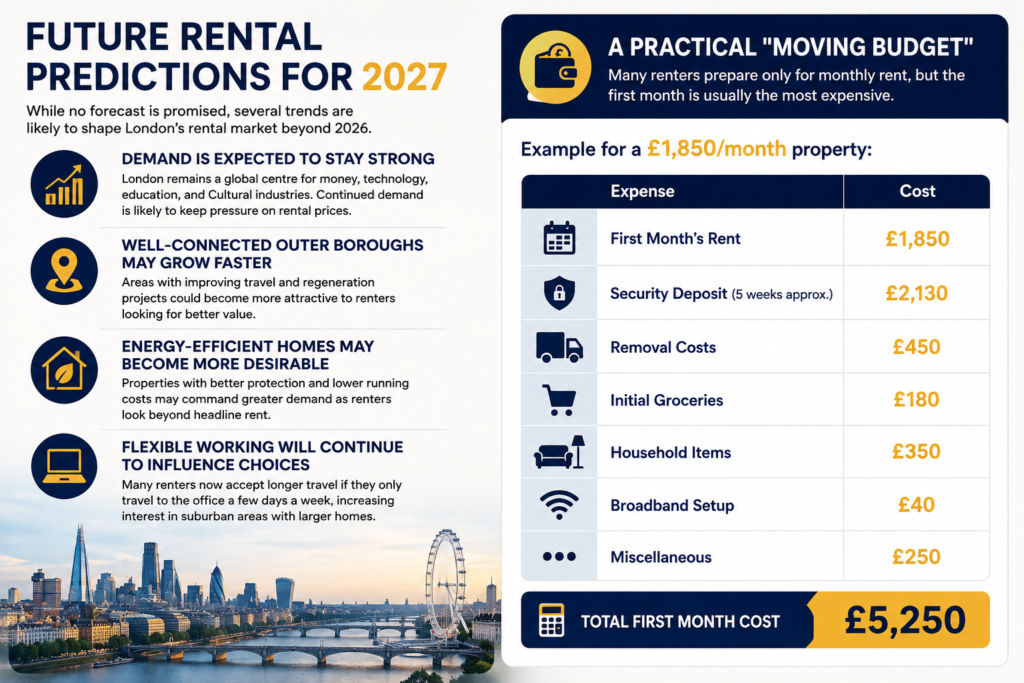
Estimated Upfront Budget: £5,250
Planning for these costs in advance can make moving much less stressful.
The 24-Hour London Rent Test Before You Sign a Tenancy
Finding a flat that looks affordable on paper is only the first step. Before signing a tenancy, give yourself 24 hours to test whether the property actually fits your budget and daily routine.
Start by writing down the property’s full monthly cost, not just the advertised rent. Add council tax, utilities, internet, transport, parking, insurance, and any regular work-related expenses.
For example, if the rent is £1,700 but your other monthly costs add another £500, your real monthly housing and living commitment is closer to £2,200.
Next, check what would happen if one of your regular costs increased. Try adding £100–£150 to your monthly budget for higher energy bills, transport costs or unexpected expenses. If this immediately makes the budget difficult, the property may be too expensive even though you can technically afford the advertised rent.
Use This Simple Test
Step 1: Write down your monthly take-home income.
Step 2: Subtract rent and essential housing costs.
Step 3: Subtract food, transport, debt payments and other regular expenses.
Step 4: Leave an amount for savings and unexpected costs.
Step 5: Ask yourself: “Could I still manage this property if my monthly expenses increased by £150?”
If the answer is no, consider a cheaper property, a different borough, shared accommodation, or a shorter commute that reduces your daily spending.
This simple test can prevent a common mistake: choosing a property because you can afford it today, rather than choosing one that you can comfortably afford throughout the tenancy.
What is the average rent in London in 2026?
Average monthly rent for a one-bedroom property is generally around £2,150, although prices vary widely by borough, property type, and exact location.
Which borough has the cheapest rent?
Bexley, Barking & Dagenham, Havering, Sutton, and Croydon are typically among the more affordable boroughs for one-bedroom rentals.
Which borough is the most expensive?
Kensington & Chelsea remains one of the highest-priced boroughs, followed by Westminster and parts of Camden.
Is it cheaper to live outside Central London?
Often yes, but remember to include commuting costs, travel time, and other daily expenses before deciding.
How much income do I need to rent in London?
A common budgeting guideline is to keep rent within 30–35% of your monthly take-home income, although many London renters spend a higher proportion because of market conditions.
Should I rent a studio or a one-bedroom flat?
A studio can reduce monthly costs, while a one-bedroom offers more privacy and flexibility. The right choice depends on your budget, lifestyle, and space requirements.
Is renting in London worth it compared to buying?
For most new arrivals, renting is the only realistic short-term option given deposit requirements and mortgage affordability tests. Renting also offers flexibility if your job, studies, or family situation could change within a few years — a real advantage in a city where career moves are frequent.
How much notice do landlords need to give before increasing rent?
This depends on your tenancy agreement type. Fixed-term tenancies generally can’t have rent increased mid-term unless a review clause is included; periodic tenancies typically require at least one month’s written notice. Always check the specific clauses in your contract rather than relying on general assumptions.
Do I need a guarantor to rent in London?
Many landlords and letting agents ask for a UK-based guarantor if you’re a student, new to the UK, or don’t yet have a high income or credit history. Some agencies offer guarantor insurance schemes as an alternative if you don’t have someone who can act as one.
What’s the difference between renting through an agency and renting privately?
Agencies typically charge referencing and admin fees but offer more legal protection, standardised contracts, and faster dispute resolution. Private landlords may offer more flexibility on price or move-in dates but come with more variability in how professionally the tenancy is managed.
Conclusion
If you are a student, a young professional, a growing family, or moving for work, understanding Average Rent London 2026 – Borough-by-Borough Rental Costs is the first step towards making a smart housing decision.
Use the local government area below as a starting point, calculate your true monthly living cost, and remember that the most reasonable property isn’t always the best value.
A well-informed choice today can save you thousands of pounds over the course of a rental agreement while improving your daily quality of life. That’s the real goal of successful renting in London.