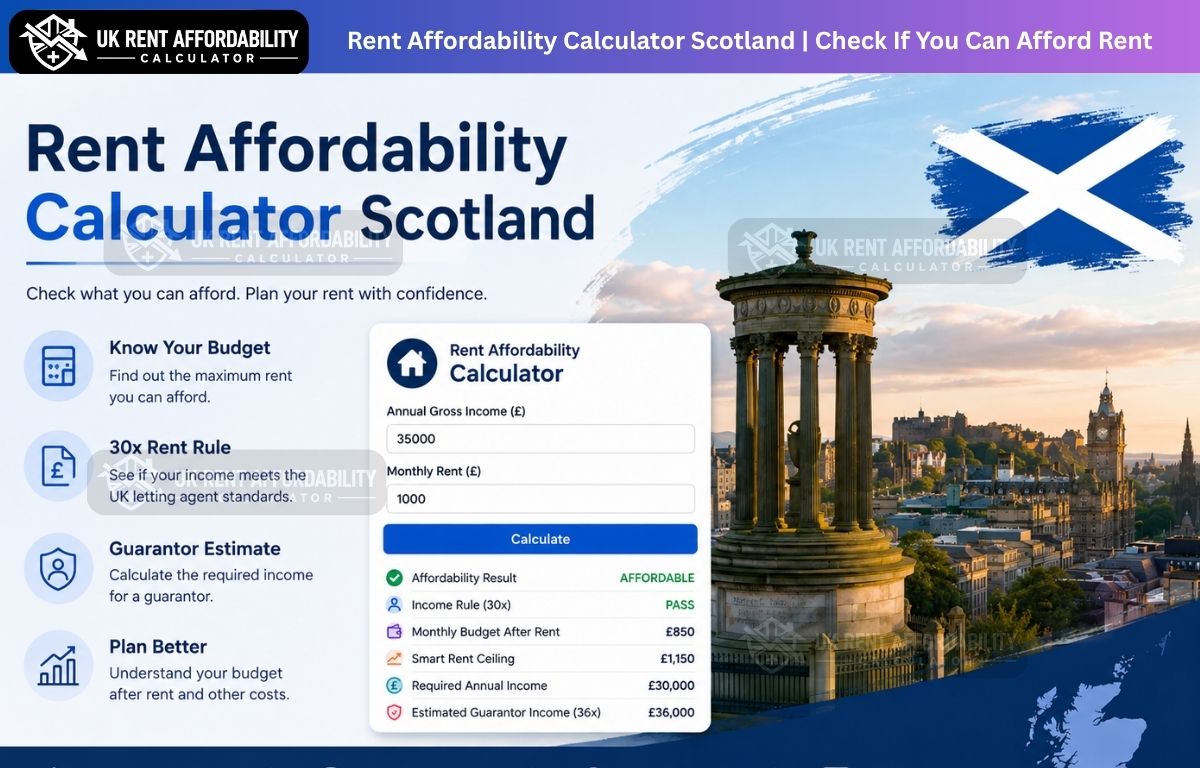
Rent Affordability Calculator Scotland – Think you have finally found the perfect flat in Edinburgh, a modern apartment in Glasgow, or a peaceful home in Aberdeen? The photos look amazing, the location is ideal, and you are already picturing yourself living there.
Then the property owner asks one simple question:
“Can you actually afford this rent?”
This is the moment many people realise that liking a property and qualifying for it are two completely different things.
Every year, thousands of tenants across Scotland apply for homes that end up outside their real budget. Some applications are turned down because the applicant doesn’t meet a landlord’s income requirements. Others are approved, but the tenant later struggles to keep up with rent, bills, and everyday costs once they’ve signed a Private Residential Tenancy (PRT), the standard tenancy agreement used across Scotland since December 2017.
That’s exactly why a Rent Affordability Calculator Scotland is so useful.
Rent affordability is not the same as being able to make the first month’s payment. A property may technically fit your income but still leave you with very little room for ordinary life. For example, a £900 rent might look reasonable on paper, but if your total monthly housing and living costs reach £2,000 and your take-home income is only £2,300, the remaining £300 has to cover everything from unexpected repairs to social activities and savings. Looking at the full monthly picture gives you a much more realistic idea of whether a property is genuinely affordable.
Instead of guessing what you can manage, this calculator helps you work out a practical monthly cost based on your income and financial situation. If you’re renting for the first time, moving to another city, moving for work, or searching for a larger family home, knowing your financial plan before you start house hunting can save you time, money, and stress.
Click Here:Rent Affordability Calculator UK
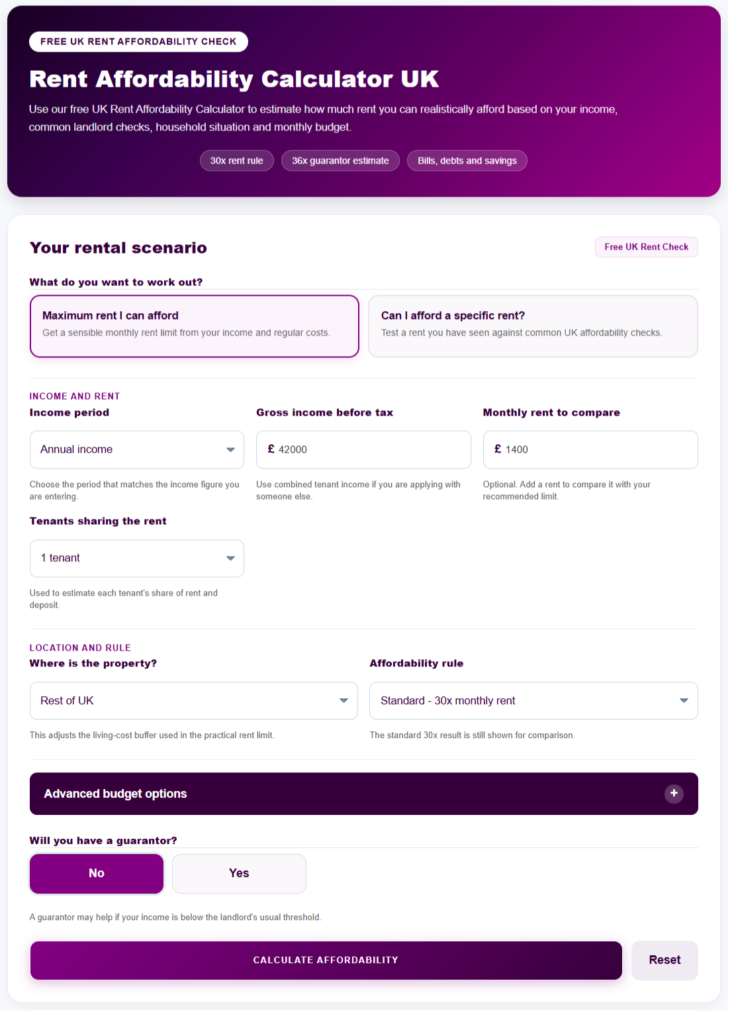
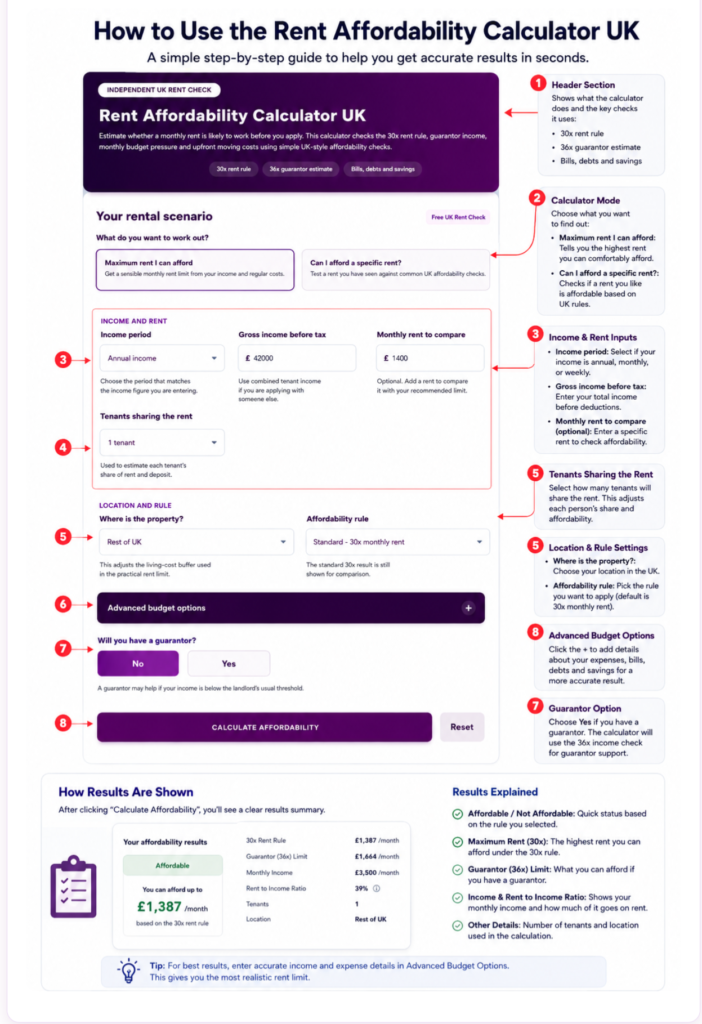
How to Use the Rent Affordability Calculator UK
What Is a Rent Affordability Calculator?
A Rent Affordability Calculator Scotland is a simple financial tool that estimates how much rent you can comfortably pay every month based on your income.
Rather than focusing only on whether you can pay the rent, it looks at whether you’ll still have enough money left for:
| Monthly Living Expenses Considered |
|---|
| Food and groceries |
| Council Tax |
| Gas and electricity |
| Internet |
| Mobile phone |
| Transport |
| Insurance |
| Savings |
| Emergency expenses |
| Entertainment |
| Unexpected bills |
The goal isn’t just to rent a home.
The goal is to live comfortably after paying your rent.
The result should be treated as a planning guide rather than a guaranteed rent limit. If the calculator shows that you could potentially afford £1,200 per month, that does not mean you should automatically search for properties at £1,200. Your safer target may be lower if your income is variable, you have upcoming expenses, or you want to save regularly. A useful approach is to identify both a maximum figure and a comfortable target, then focus your property search around the comfortable figure.
Read more:What Is a Passing Grade at University? Best UK Students Guide (2026)Why Is Rent Affordability So Important in Scotland?
Scotland has experienced significant changes in rental prices over the past few years, making a Rent Affordability Calculator Scotland increasingly useful for tenants.
The way tenancies work here also differs from the rest of the UK. Since December 2017, most private tenancies in Scotland have used the Private Residential Tenancy (PRT), which gives tenants an open-ended agreement rather than a fixed 6- or 12-month contract. The Scottish Government can also designate rent pressure zones in specific council areas to help limit rent increases, though these don’t apply everywhere.
| Major Scottish Cities Where Rent Affordability Matters |
|---|
| Edinburgh |
| Glasgow |
| Dundee |
| Aberdeen |
| Inverness |
Any deposit you pay must also be protected by law, within 30 working days, in one of Scotland’s three approved tenancy deposit schemes: SafeDeposits Scotland, Letting Protection Service Scotland, or mydeposits Scotland.
have all seen growing demand for rental properties.
As rents increase, financial planning becomes even more important.
Many people make the mistake of choosing a property based only on looks or location.
At a later time, they discover they have very little money left each month after paying rent.
| Potential Financial Challenges |
|---|
| Living paycheck to paycheck |
| Missing savings goals |
| Relying on credit cards |
| Financial stress |
| Difficulty covering unexpected expenses |
Using a rent affordability calculator helps you avoid these problems before you sign a tenancy agreement.
How Does a Rent Affordability Calculator Work?
Although different websites use slightly different formulas, most affordability calculators consider factors such as:
Your annual salary
or
Your monthly income
Then they estimate:
- Maximum affordable monthly rent
- Recommended rent
- Remaining disposable income
| Some Advanced Calculators Also Include |
|---|
| Existing loans |
| Credit commitments |
| Childcare costs |
| Student loan repayments |
| Council Tax |
| Utility bills |
| Number of tenants |
| Household income |
The more accurate the information you provide, the more realistic your results will be.
The Biggest Mistake First-Time Renters Make
Many first-time renters ask themselves:
“Can I pay £1,200 every month?”
But that’s, in fact, the wrong question.
The better question is:
“After paying £1,200 rent, can I continue to comfortably pay for everything else?”
This small difference changes everything.
Because affordability isn’t about surviving.
It’s about living comfortably.
Read more:What Salary Do You Need to Rent in the UK? Salary Guide 2026A Simple Example
Let’s imagine Ahmed has just accepted a new job in Glasgow.
His salary is:
£36,000 per year
His monthly take-home pay is about:
£2,350
He finds a beautiful apartment costing:
£1,300 per month
At first glance, it seems affordable.
But then his monthly expenses look like this.
| Expense | Monthly Cost |
| Rent | £1,300 |
| Council Tax | £160 |
| Electricity & Gas | £170 |
| Internet | £35 |
| Mobile | £30 |
| Food | £320 |
| Transport | £140 |
| Entertainment | £180 |
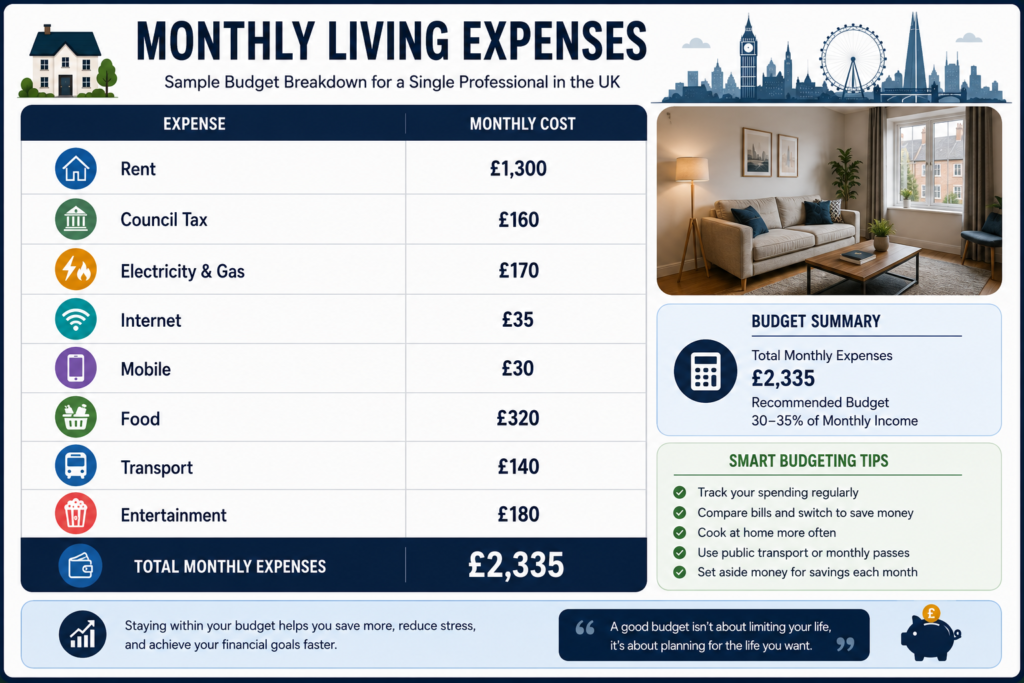
Total Expenses
£2,335
His monthly income:
£2,350
Money left over:
Only £15
Technically, he can pay the rent.
Realistically?
Not comfortably.
One unexpected car repair or medical expense could put him into debt.
This is exactly why affordability calculations matter.
A Better Decision
Instead, Ahmed chooses another apartment costing:
£950 per month
Now his budget looks like this.
| Expense | Monthly Cost |
| Rent | £950 |
| Council Tax | £160 |
| Utilities | £170 |
| Internet | £35 |
| Mobile | £30 |
| Food | £320 |
| Transport | £140 |
| Entertainment | £180 |
Total monthly expenses:
£1,985
Monthly income:
£2,350
Money remaining:
£365
| Now Ahmed Can |
|---|
| Build savings |
| Handle emergencies |
| Take holidays |
| Invest |
| Avoid debt |
The second apartment may not have been his dream home, but it gives him something even more valuable:
Financial peace of mind.
The 30% Rule (A Helpful Starting Point)
One of the most common budgeting guidelines suggests spending around 30% of your gross monthly income on rent.
While it’s not a legal requirement, it provides a useful starting point for many renters.
| Example | Value |
|---|---|
| Annual Salary | £40,000 |
| Monthly Gross Income | £3,333 |
| 30% of £3,333 | ≈ £1,000 per month |
That means a monthly rent of around £1,000 is generally considered affordable before taking other financial commitments into account. A Rent Affordability Calculator Scotland can help you estimate whether this budget is realistic based on your own income and expenses.
But this rule isn’t perfect for everyone. If you have loans, childcare costs, or other major expenses, your reasonable rent may be lower. On the other hand, if you have very few monthly commitments, you may comfortably afford a little more.
Another Popular Rule Used by Landlords
Many Scottish landlords and letting agents use an affordability ratio rather than the 30% rule.
A common benchmark is:
Annual income should be around 30 times the monthly rent.
| Example | Value |
|---|---|
| Monthly Rent | £900 |
| Required Annual Income | £900 × 30 |
| Result | £27,000 per year |
If your salary is close to or above this amount, you are more likely to meet the affordability criteria used during tenant referencing.
Keep in mind that individual landlords and referencing companies may apply different income multiples or consider additional factors such as credit history, employment type, or guarantors.
Why Guessing Can Cost You Thousands
Choosing a property that’s too expensive can have long-term Results :
- Less money for savings
- Increased financial stress
- Difficulty handling emergencies
- Higher reliance on borrowing
- Reduced flexibility if your situation changes
Spending just a little time calculating what you can truly manage before you start viewing properties can help you avoid these issues and make a more confident decision.
Read more:Ultimate 30x Rent Rule UK Guide – What It Means and How Letting Agents Calculate AffordabilityHow to Calculate Rent Affordability in Scotland
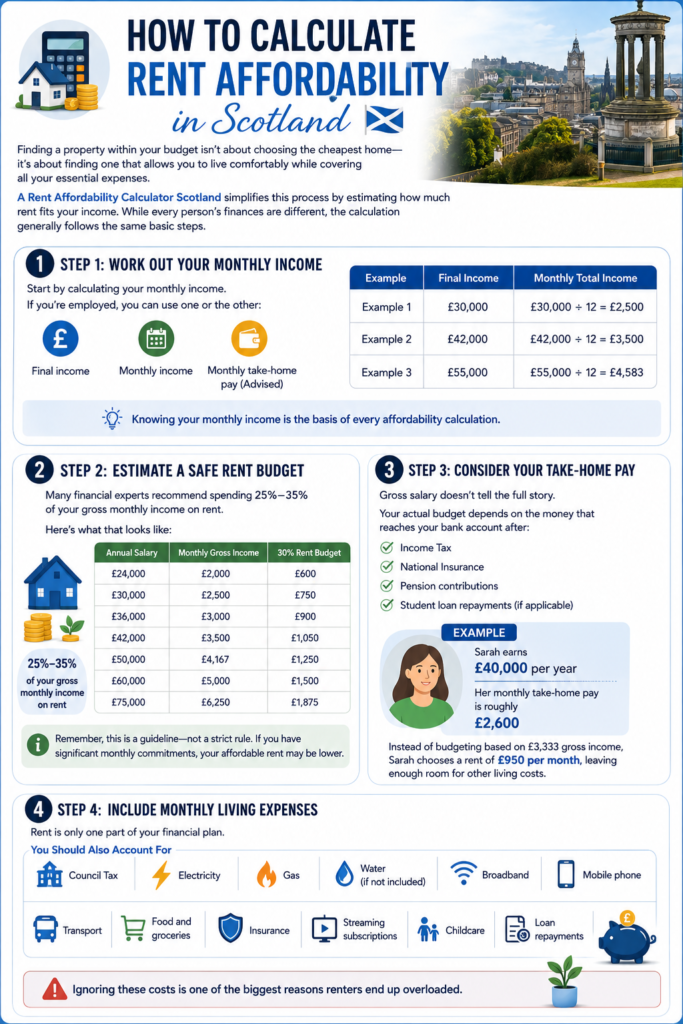
Finding a property within your budget isn’t about choosing the cheapest home—it’s about finding one that allows you to live comfortably while covering all your essential expenses.
A Rent Affordability Calculator Scotland simplifies this process by estimating how much rent fits your income. While every person’s finances are different, the calculation generally follows the same basic steps.
Step 1: Work Out Your Monthly Income
Start by calculating your monthly income.
If you’re employed, you can use one or the other :
- Final income
- Monthly income
- Monthly take-home pay (Advised)
| Example | Final Income | Monthly Total Income |
|---|---|---|
| Example 1 | £30,000 | £30,000 ÷ 12 = £2,500 |
| Example 2 | £42,000 | £42,000 ÷ 12 = £3,500 |
| Example 3 | £55,000 | £55,000 ÷ 12 = £4,583 |
Knowing your monthly income is the Basis of every affordability calculation.
Step 2: Estimate a Safe Rent Budget
Many financial experts recommend spending 25%–35% of your gross monthly income on rent.
Here’s what that looks like:
| Annual Salary | Monthly Gross Income | 30% Rent Budget |
| £24,000 | £2,000 | £600 |
| £30,000 | £2,500 | £750 |
| £36,000 | £3,000 | £900 |
| £42,000 | £3,500 | £1,050 |
| £50,000 | £4,167 | £1,250 |
| £60,000 | £5,000 | £1,500 |
| £75,000 | £6,250 | £1,875 |
Remember, this is a guideline—not a strict rule. If you have significant monthly commitments, your affordable rent may be lower.
Step 3: Consider Your Take-Home Pay
Gross salary doesn’t tell the full story.
Your actual budget depends on the money that reaches your bank account after:
- Income Tax
- National Insurance
- Pension contributions
- Student loan repayments (if applicable)
| Example | Value |
|---|---|
| Sarah earns | £40,000 per year |
| Her monthly take-home pay is roughly | £2,600 |
Instead of budgeting based on £3,333 gross income, Sarah chooses a rent of £950 per month, leaving enough room for other living costs.
Step 4: Include Monthly Living Expenses
Rent is only one part of your financial plan.
| You Should Also Account For |
|---|
| Council Tax |
| Electricity |
| Gas |
| Water (if not included) |
| Broadband |
| Mobile phone |
| Transport |
| Food and groceries |
| Insurance |
| Streaming subscriptions |
| Childcare |
| Loan repayments |
| Savings |
Ignoring these costs is one of the biggest reasons renters end up Overloaded.
Real-Life Example 1 – Single Professional
Emma has recently moved to Edinburgh for work.
Annual Salary:
£34,000
Monthly Take-Home Pay:
£2,250
Monthly expenses (excluding rent):
| Expense | Cost |
| Council Tax | £155 |
| Utilities | £170 |
| Internet | £35 |
| Mobile | £30 |
| Groceries | £300 |
| Transport | £120 |
| Entertainment | £150 |
| Savings | £200 |
Total non-rent expenses:
£1,160
Available for rent:
£2,250 − £1,160 = £1,090
Emma decides to rent a flat for £900 per month, leaving a financial cushion for unexpected costs.
Real-Life Example 2 – A Couple Renting Together
James and Sophie both work full-time.
Combined annual income:
£68,000
Combined monthly take-home pay:
£4,350
Monthly household expenses:
| Expense | Cost |
| Council Tax | £180 |
| Utilities | £220 |
| Internet | £40 |
| Food | £550 |
| Transport | £300 |
| Insurance | £90 |
| Entertainment | £250 |
| Savings | £500 |
Total non-rent expenses:
£2,130
Remaining budget:
£4,350 − £2,130 = £2,220
Although they could afford a rent above £2,000, they chose a home costing £1,450 per month, allowing them to save more each month and prepare for future goals like buying a house.
Read more:How Much Rent Can I Charge in the UK? Proven Rent Pricing Guide for Landlords 2026Real-Life Example 3 – “The Ahmed family” with “The Khan family”
The Ahmed family lives in Glasgow.
Combined annual income:
£52,000
Monthly take-home pay:
£3,450
Monthly expenses:
| Expense | Cost |
| Childcare | £500 |
| Food | £600 |
| Council Tax | £180 |
| Utilities | £220 |
| Internet | £40 |
| Car & Fuel | £350 |
| Insurance | £120 |
| Savings | £250 |
Total non-rent expenses:
£2,260
Remaining income:
£3,450 − £2,260
= £1,190
Rather than stretching to the limit, they choose a rental property costing £1,050 per month, leaving room for school expenses, birthdays, holidays, and unexpected bills.
Example 4 – University Student
Liam studies in Dundee.
Monthly income:
- Part-time job: £850
- Student funding: £650
Total monthly income:
£1,500
Monthly expenses:
| Expense | Cost |
| Food | £250 |
| Transport | £70 |
| Mobile | £20 |
| Internet | £20 |
| Books & Supplies | £60 |
| Entertainment | £100 |
Total expenses (excluding rent):
£520
Available for rent:
£1,500 − £520 = £980
Liam chooses shared accommodation costing £650 per month, keeping over £300 available for emergencies and savings.
Why Landlords Check Rent Affordability
When you apply for a rental property, landlords want confidence that the cost will be paid regularly.
| They May Check |
|---|
| Employment status |
| Annual income |
| Payslips |
| Bank statements |
| Credit history |
| Existing debts |
| Previous landlord references |
| Surety (if required) |
Meeting affordability Requirements improves your chances of having your application approved.
If You Receive Benefits: Local Housing Allowance
If part of your rent is covered by the housing element of Universal Credit, your support is capped by the Local Housing Allowance (LHA) rate for your council area and household size — not by your actual rent. Before applying for a property, it’s worth checking the current LHA rate where you’re looking, since any gap between that rate and the real rent is something you’d need to cover from your own income.
When comparing two rental properties, don’t compare the rent alone. Look at the estimated total monthly cost of living in each property. One home might have a lower rent but higher heating costs, longer commuting expenses or additional parking costs. Another property could have slightly higher rent but lower travel and household costs.
A simple comparison can include rent, Council Tax, energy, internet, transport and any other regular property-related costs. This gives you a more realistic figure: the approximate amount the property will actually take from your monthly budget. It can sometimes change which property appears to be the cheaper option.
For example, a flat costing £850 in rent may seem cheaper than one costing £950, but if the cheaper property adds £150 in monthly travel and energy costs, the £950 property could actually be the more affordable choice overall.
Common Rent Affordability Mistakes
Many renters make avoidable budgeting errors. Here are some of the most common:
Choosing the Maximum You Can Afford
Just because you qualify for a property doesn’t mean it’s the best financial decision.
Forgetting Utility Costs
A property with lower rent but very high heating costs could end up being more expensive overall.
Ignoring Council Tax
Council Tax can add a great monthly expense, depending on the property’s valuation band and local Council.
Not Building an Emergency Fund
Unexpected costs—such as car repairs or replacing household items—can quickly become stressful if every pound is already assigned to rent and bills.
Overlooking Lifestyle Costs
Gym memberships, subscriptions, dining out, and hobbies all affect your monthly financial plan and should be included in your calculations.
Expert Tips to Improve Your Rent Affordability
Finding a reasonable property isn’t only about earning a higher salary. Smart financial planning can greatly improve how comfortably you live after paying rent.
Here are practical Methods that many successful renters follow.
Set a Realistic Budget Before House Hunting
One of the biggest mistakes people make is searching for properties first and checking reasonable cost later.
| Instead |
|---|
| Calculate your monthly income. |
| List all your fixed expenses. |
| Decide on a comfortable rent limit. |
| Search only within that budget. |
This Method saves time and helps you avoid disappointment.
Build an Emergency Fund
Life is Unexpected.
| You May Face |
|---|
| Unexpected medical expenses |
| Car repairs |
| Job changes |
| Household appliance replacements |
| Family emergencies |
Aim to save three to six months of essential living expenses over time. Even a small monthly Support can make a big difference.
Don’t Forget Hidden Moving Costs
Many renters focus only on monthly rent, but moving into a new home regularly involves additional expenses, such as:
| Upfront Moving Costs |
|---|
| Security deposit |
| First month’s rent |
| Moving services |
| Furniture |
| Kitchen essentials |
| Cleaning supplies |
| Broadband setup |
| Parking approvals (where applicable) |
Planning for these costs helps avoid financial surprises.
Share Housing if It Fits Your Lifestyle
If you’re comfortable sharing a home, renting with a trusted friend or housemate can reduce costs such as:
- Rent
- Service bills
- Broadband
- Council Tax
Shared Housing can make living in higher-demand areas more reasonable.
Review Your Monthly Spending
Small Regular expenses can add up over a year.
| Examples Include |
|---|
| Streaming subscriptions |
| Unused gym memberships |
| Frequent takeaway meals |
| Impulse online shopping |
Reducing unnecessary spending may free up money for savings or improve your overall financial Adaptability.

Read more:Rent Affordability Calculator London – How Much Rent Can You Afford in London?How to Increase Your Chances of Getting Approved by a Landlord
Landlords and letting brokers often receive multiple applications for the same property.
You can strengthen your application by:
- Providing proof of stable income
- Keeping a good credit history
- Preparing recent payslips and bank statements
- Having references from previous landlords if available
- Providing a surety if requested
- Replying quickly to requests for documents
Being prepared can make the application process smoother.
Should You Rent at the Maximum You Can Afford?
Many people ask:
“If the property owner approves me, should I take the property?”
Not necessarily.
Approval means you meet the landlord’s criteria—it doesn’t guarantee the rent is the best choice for your long-term finances.
| A Slightly Cheaper Property May Allow You To |
|---|
| Save for a deposit on a future home |
| Create an urgent savings |
| Enjoy Vacations and free-time activities |
| Handle unexpected costs more comfortably |
Affordability is about financial stability, not just qualification.
Rent Affordability Checklist
Before signing a tenancy agreement, take a final look at your budget.
Monthly income covers rent comfortably.
Council Tax has been included.
Utility bills have been estimated.
Food and transport costs are budgeted.
Savings remain after paying bills.
Emergency expenses can be managed.
Existing debts are affordable.
You are not relying on credit cards for everyday living.
If you can tick each point, you’re in a stronger position to rent confidently.
What is a Rent Affordability Calculator?
A Rent Affordability Calculator estimates how much monthly rent you can comfortably afford based on your income and regular financial commitments.
How much of my income should go towards rent?
Many budgeting guides suggest spending around 25% to 35% of your gross monthly income on rent. However, the right amount depends on your personal circumstances, existing commitments, and financial goals.
Do landlords in Scotland check affordability?
Yes. Most landlords and letting agents in Scotland — who must be registered with their local council — review your income, employment status, references, and sometimes credit history before approving a tenancy. Many use an income multiple (often around 30 times the monthly rent) as a benchmark, and may ask for a guarantor if your income falls short.
What tenancy will I sign if I rent in Scotland?
Almost all private tenants in Scotland sign a Private Residential Tenancy (PRT). Unlike older-style contracts, a PRT has no fixed end date, which gives tenants more long-term security as long as rent is paid and tenancy terms are met.
Is my deposit protected by law?
Yes. Landlords in Scotland must place your deposit in an approved tenancy deposit scheme within 30 working days of receiving it, and must give you specific information about where it’s held. This protects your deposit and sets out the process for disputes when you move out.
Does the calculator use gross or net income?
Some calculators use gross income, while others work with take-home (net) income. Using your actual monthly take-home pay often provides a more realistic picture of your budget.
Should I include utility bills in my calculations?
Absolutely. Rent is only one part of your monthly housing costs. Utilities, Council Tax, internet, transport, groceries, and insurance should all be considered.
Can I rent if I have a low income?
Yes, provided the rent fits your overall budget, and you meet the landlord’s affordability requirements. In some cases, a guarantor may be requested.
What happens if I spend too much on rent?
Paying more than you can comfortably afford may leave less money for essentials, savings, or unexpected expenses, increasing financial pressure over time.
Does living with a partner improve affordability?
In many cases, yes. Combining household income can make it easier to cover rent and other shared living costs.
Is shared accommodation a good option?
For many people, sharing a property can reduce monthly expenses and make living in higher-demand locations more affordable.
Before committing to a rental property, try a simple stress test. Calculate your normal monthly budget, then imagine that one regular cost increases or an unexpected expense appears. For example, consider what would happen if your energy bill increased, your car needed repairs, or your working hours temporarily dropped.
If your budget immediately becomes difficult to manage, your planned rent may be too close to your financial limit. A comfortable rental budget should leave some breathing room rather than using every available pound. You do not need to predict every future expense, but having some flexi
Final Thoughts
Selecting a rental property is one of the biggest financial decisions many people make each year. At the same time, it’s natural to be looking forward to a stylish apartment or a great location; the most important question is if the property truly matches your financial plan.
A Rent Affordability Calculator Scotland gives you a clearer picture of what you can practically afford before you start viewing homes. By reviewing your income together with everyday costs such as Council Tax, Basic services, groceries, transport, and savings, you can make decisions that support your long-term financial Health.
Remember, the goal isn’t simply to rent a home. It’s to choose a home where you can pay your bills with confidence, enjoy your lifestyle, prepare for unplanned costs, and continue working in the direction of your future aims without unneeded financial pressure.
The most important property isn’t always the lowest one; it’s the one that allows you to live comfortably today while still structuring a protected tomorrow.
This guide is reviewed regularly to reflect current Scottish rental agreement law, advance payment protection rules, and typical UK living costs, so you’re financial planning against up-to-date figures rather than outdated averages.
Key Takeaways
- Calculate your rent budget before searching for properties.
- Include all regular household expenses, not just rent.
- Keep some money available for savings and urgent situations.
- Don’t feel pressured to pay the Highest amount you qualify for.
- Review your financial plan every time your income or costs change.
- Use a rent reasonable cost calculator as a planning tool, not just a qualification check.
Making informed decisions today can help you enjoy a more stable and financially confident renting experience across Scotland.