
Rental scams UK renters are falling for right now look like this: Leah had been flat-hunting in Manchester for three weeks when she found it: a bright two-bedroom flat at £850 a month — nearly £300 below anything else she had seen. The “landlord” replied within minutes, said he was working abroad, and asked her to transfer a £1,200 deposit by bank transfer before a viewing because “three other people want it”. Leah paid. The listing vanished that evening; the flat belonged to someone else entirely, and the money was gone.
Leah’s story is fictional, but the scam is not. Rental scams UK victims report follow the same playbook thousands of times a year, targeting people at their most pressured: desperate to secure a home. This guide shows you how the scams work, the red flags, how to verify landlords and agents, what a legitimate process looks like, and what to do if you’ve already paid.
Quick Answer: Rental scams usually involve fake or hijacked listings for properties that don’t exist, aren’t for rent, or belong to someone else. Never pay before viewing in person, never pay by bank transfer to someone unverified, and always check the landlord or agent independently. Scammed? Contact your bank immediately and report to Report Fraud on 0300 123 2040. In England, a legitimate holding deposit can never exceed one week’s rent.
How do rental scams actually work?
A rental scam is advance-fee fraud applied to housing — and rental scams UK renters encounter follow the same structure: a criminal poses as a landlord or letting agent, advertises a property they have no right to let, and persuades you to hand over a deposit, “holding fee” or first month’s rent before you realise the property isn’t theirs.
The money is the whole point: a scammer has no property at all. Once your payment clears, the listing disappears, phone numbers go dead, and the money — usually sent by bank transfer — is moved on within hours. Rental scams UK renters face thrive on high demand, low supply and urgency: when there are twenty applicants for every rental home, renters feel they must act fast, and acting fast is exactly what scammers want. Action Fraud data obtained via Freedom of Information requests shows 4,092 rental fraud reports in England, Wales and the Crown Dependencies in 2025/26, with losses of £12.84 million — up 20% in three years. Fewer scams, but each one costlier.
Rental scams UK: 7 scam types every renter should know
Most rental scams UK renters report follow one of these patterns — learn them and you’ll recognise the script immediately.
| Scam type | How it works |
|---|---|
| Phantom rental | The property doesn’t exist or was never for rent. Stolen photos and a made-up address pull you in; you’re asked to pay before viewing. |
| Hijacked advert | A genuine listing is copied word-for-word, but the contact details are swapped for the scammer’s. You think you’re dealing with a real agent. |
| “Landlord abroad” advance fee | The “landlord” claims to be working overseas and can’t show you the property. They ask for a deposit by bank transfer to “secure” it before your viewing. |
| Viewing-fee scam | You’re asked to pay a fee just to view the property, or to “prove you can afford it” before a viewing is arranged. |
| Cloned letting-agent website | A fake website mimics a real agency — similar name, copied branding, slightly different web address — and collects deposits through it. |
| Phishing links | A link sent by text, email or social media takes you to a convincing fake portal to “apply” or “pay your deposit”, harvesting your card details. |
| Deposit-before-viewing demand | Any demand for a deposit, holding fee or first month’s rent before you have seen the property and signed an agreement. |
Trading Standards describe phantom rentals and hijacked adverts as the most common rental scams UK renters report. Action Fraud specifically warns that students are targeted ahead of each academic year with below-market rooms and upfront deposit demands.
Rental scams UK: red flags in a rental listing
No single red flag proves a listing is fake, but in rental scams UK renters report, the scammers almost always show several at once:
| Red flag | What to do instead |
|---|---|
| Rent far below market rate for the area | Compare with similar properties on Rightmove and Zoopla; a big discount is bait |
| No viewing offered, or excuses why you can’t view | Insist on viewing with the agent or landlord present before paying anything |
| Pressure to pay quickly — “someone else will take it” | Walk away; legitimate landlords want referencing and checks first, not speed |
| Payment demanded by bank transfer, crypto or gift cards | Pay by traceable means only, after a viewing and a signed agreement |
| Landlord refuses to show ID or proof of ownership | Ask for photo ID and proof they own or manage the property |
| Contact only via social media, free email or messaging apps | Verify the agent’s real website, landline and office address independently |
| No written tenancy agreement offered | Never hand over money without a written agreement you have read |
| No tenant screening or referencing at all | Be suspicious — real landlords check you before asking for money |
| Spelling errors, stock photos, vague descriptions | Reverse-image-search the photos (see below) |
Callout: Citizens Advice’s golden rule applies to renting: if it seems too good to be true, it probably is. A city-centre two-bedroom at half the going rate isn’t a bargain — it’s the hook.
What does a legitimate rental process look like in the UK?
Knowing what “normal” looks like is your best defence: rental scams UK fraudsters survive by rushing you past steps a genuine landlord or agent would never skip.
| A legitimate process | A scam version |
|---|---|
| Viewing offered before any money changes hands | Payment demanded before you’ve seen inside |
| Referencing, credit and Right to Rent checks on you | No checks at all — they just want your money |
| Holding deposit of at most one week’s rent (England & Wales) | “Reservation fee” of hundreds or thousands, or several weeks’ rent upfront |
| Written tenancy agreement you can read before signing | Verbal promises or a vague email attachment |
| Tenancy deposit protected in a government-approved scheme | No mention of deposit protection at all |
| Safety certificates (gas, electrical) available on request | Excuses, or documents that look cobbled together |
| Agent displays redress scheme membership and fees | No company details, no address, no scheme logo |
In England, the Tenant Fees Act 2019 bans almost all tenant fees: only rent, a refundable tenancy deposit (capped at five weeks’ rent), a holding deposit capped at one week’s rent, and a few permitted charges can be asked for. Wales has an equivalent one-week holding deposit cap. Any demand above these caps isn’t just suspicious — it’s unlawful. See our letting agent fees guide.
Once you pay a tenancy deposit to a genuine landlord, it must be protected in a government-approved scheme — see our tenancy deposit protection guide for what that paperwork looks like. If your “landlord” has never heard of deposit protection, that tells you everything.
How do I check a landlord really owns the property?
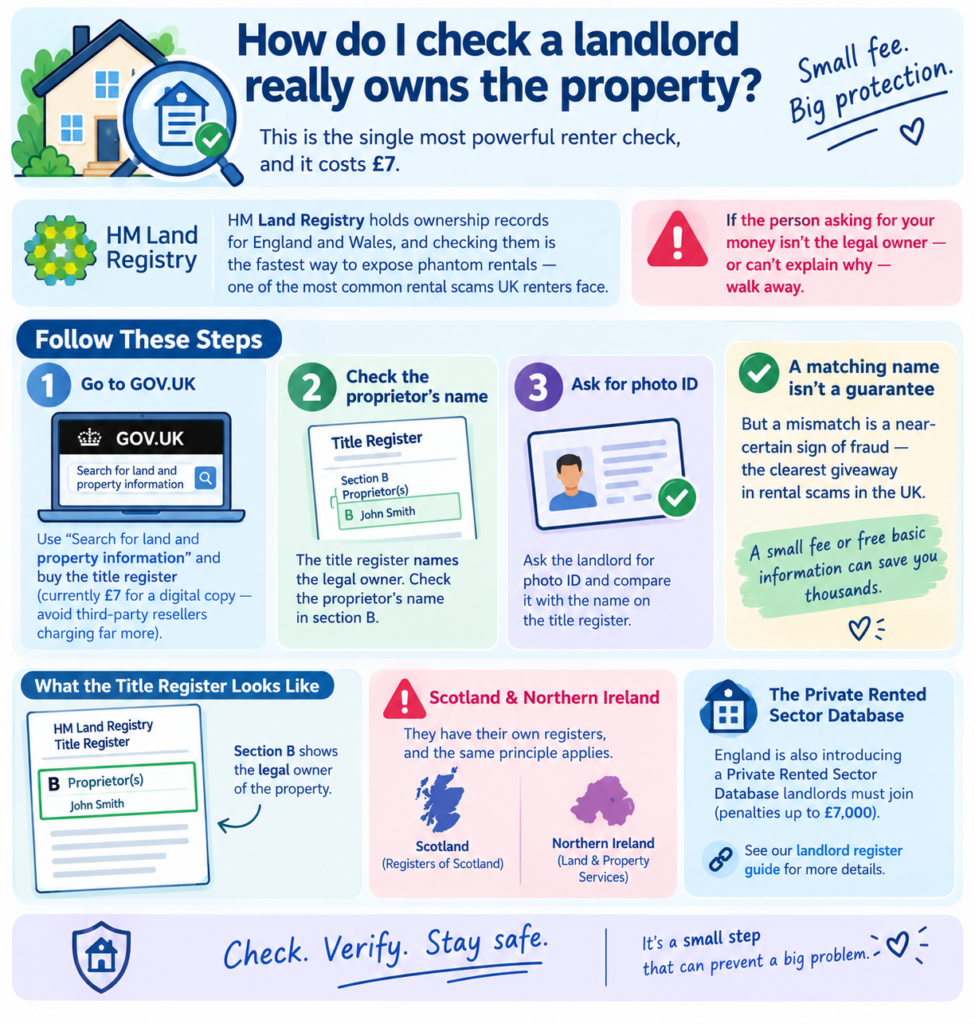
This is the single most powerful renter check, and it costs £7. HM Land Registry holds ownership records for England and Wales, and checking them is the fastest way to expose phantom rentals — one of the most common rental scams UK renters face. If the person asking for your money isn’t the legal owner — or can’t explain why — walk away.
The title register names the legal owner. If it doesn’t match the person asking for your money, stop immediately:
- On GOV.UK, use “Search for land and property information” and buy the title register (currently £7 for a digital copy — avoid third-party resellers charging far more).
- Check the proprietor’s name in section B.
- Ask the landlord for photo ID and compare.
A matching name isn’t a guarantee, but a mismatch is a near-certain sign of fraud — the clearest giveaway in rental scams in the UK. A small fee or free basic information can save you thousands. It’s the single best £7 a renter can spend.
Scotland and Northern Ireland have their own registers, and the same principle applies. England is also introducing a Private Rented Sector Database landlords must join (penalties up to £7,000) — see our landlord register guide.
How do I check a letting agent is legitimate?
Fake agents are behind some of the fastest-growing rental scams UK renters report — cloned websites and hijacked adverts mimicking genuine agencies. Checking an agent’s credentials takes minutes and defeats most of these frauds outright.
| Check | How to do it |
|---|---|
| Redress scheme membership | Every letting agent in England must by law belong to The Property Ombudsman or the Property Redress Scheme. Search both schemes’ member registers directly. |
| Companies House | Search the company name at Companies House (free) to confirm it exists, is active, and the details match. |
| Client Money Protection | Agents handling client money must belong to an approved CMP scheme and display the certificate. Ask to see it. |
| Real contact details | Find the agency’s landline and office address from its own website or Google Maps — not from the advert — and call it. |
| Reviews and history | Check independent reviews and how long the business has traded; be wary of brand-new entities with no footprint. |
An agent missing from both redress registers is a serious warning sign — membership has been legally required since 2014. This is one of the easiest checks that exposes rental scams UK fraudsters pose as agents. You can also call Citizens Advice’s consumer helpline on 0808 223 1133 for guidance.
Callout: Never verify an agent using contact details from the advert itself. Scammers running hijacked adverts expect you to call “their” number. Look the agency up independently and call the number on its real website.
Should I ever pay money before viewing?
No. This is the clearest line in the whole guide: do not pay any money until you — or someone you trust — has viewed the property in person with the agent or landlord.
Action Fraud, the police and Trading Standards all give the same advice. If you need to secure accommodation from overseas, ask your employer, university, or a friend or relative in the UK to view the property on your behalf and confirm it exists and is available. Scammers rely on distance; a trusted person on the ground defeats the entire con.
The one legitimate pre-tenancy payment in England and Wales is a holding deposit of no more than one week’s rent — but even that should only be paid after a viewing, to a verified landlord or agent, with a written agreement. Anyone asking for more is breaking the law.
Also reverse-image-search the listing’s photos: if the same images appear on other listings or sale adverts in different cities, the listing is almost certainly stolen.
Rental scams UK: which payment methods do scammers use?
How you’re asked to pay is one of the strongest signals of rental scams UK fraud: scammers want methods that are fast, irreversible and hard to trace. Any request for payment by bank transfer to an individual, cryptocurrency, gift cards or cash is a major red flag — and the reason is simple: once the money is gone, it’s almost impossible to get back.
| Payment method | How safe it is |
|---|---|
| Bank transfer to an individual’s account | Risky — but APP fraud reimbursement rules (below) may help you recover it |
| Cryptocurrency or gift cards | Effectively unrecoverable — never pay rent this way, no exceptions |
| Cash in hand, no receipt | Untraceable — never do this |
| Credit card (over £100) | Strong protection — Section 75 makes the card company jointly liable |
| Debit card | Some protection — ask your bank about chargeback |
| Direct debit / standing order to a verified agent | Normal for rent payments once a genuine tenancy is set up |
If a “landlord” insists on bank transfer and refuses card payment, ask yourself why a legitimate business would refuse the payment method that protects you.
Callout: Paying by credit card is one of the simplest protections: under Section 75 of the Consumer Credit Act 1974, your card provider is jointly liable with the supplier for purchases over £100 and up to £30,000 — even if you only paid a deposit on the card. Debit card instead? Ask your bank about chargeback.
Who do scammers target most — and why?
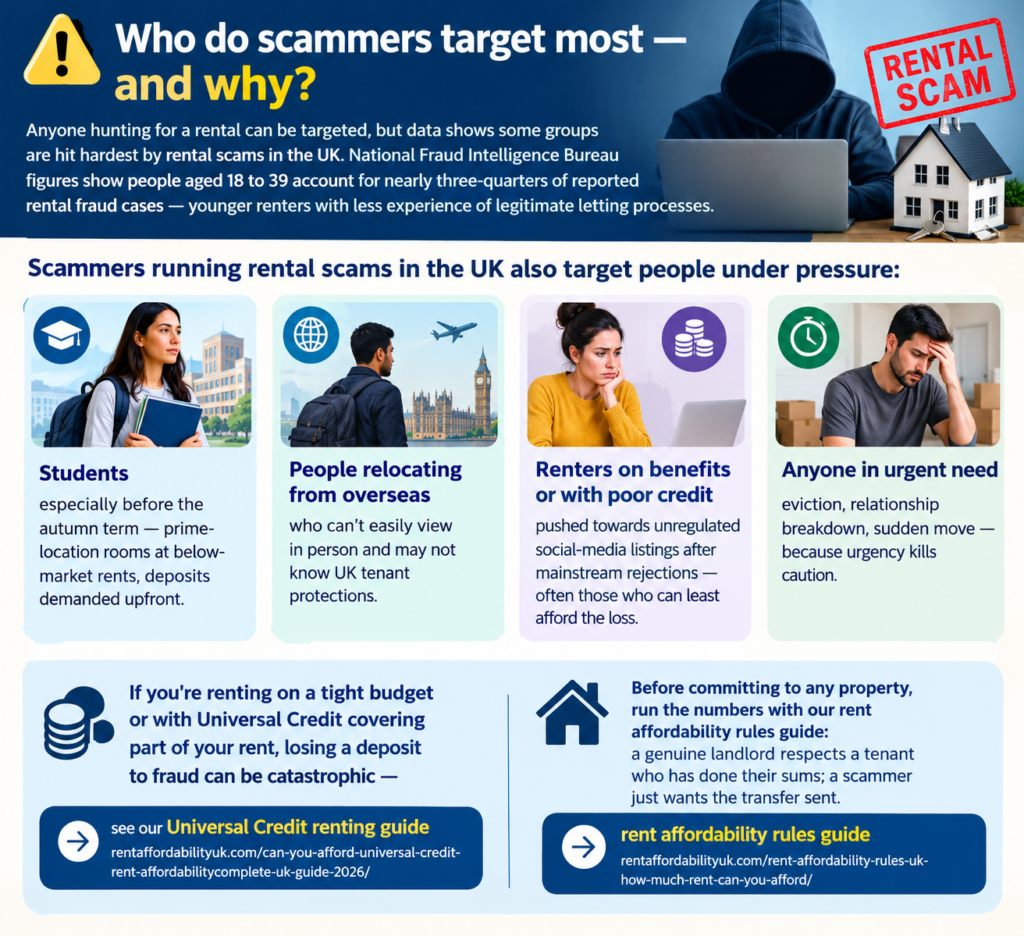
Anyone hunting for a rental can be targeted, but data shows some groups are hit hardest by rental scams in the UK. National Fraud Intelligence Bureau figures show people aged 18 to 39 account for nearly three-quarters of reported rental fraud cases — younger renters with less experience of legitimate letting processes.
Scammers running rental scams in the UK also target people under pressure:
- Students, especially before the autumn term — prime-location rooms at below-market rents, deposits demanded upfront.
- People relocating from overseas, who can’t easily view in person and may not know UK tenant protections.
- Renters on benefits or with poor credit, pushed towards unregulated social-media listings after mainstream rejections — often those who can least afford the loss.
- Anyone in urgent need — eviction, relationship breakdown, sudden move — because urgency kills caution.
If you’re renting on a tight budget or with Universal Credit covering part of your rent, losing a deposit to fraud can be catastrophic — see our Universal Credit renting guide for budgeting a move safely. Before committing to any property, run the numbers with our rent affordability rules guide: a genuine landlord respects a tenant who has done their sums; a scammer just wants the transfer sent.
Worked example: Kwame’s £1,725 deposit that vanished
The figures below are fictional and illustrative.
Kwame, 24, needed a Leeds flat within a fortnight for a new job. On Facebook Marketplace he found a one-bedroom at £650 a month — about £150 below similar listings. The “landlord” said she had moved to Spain, couldn’t arrange a viewing, but would email a tenancy agreement if Kwame transferred a £650 deposit plus £1,075 first month’s rent to “secure” it.
Red flags missed: no viewing, below-market rent, landlord abroad, pressure (“two other people viewing tomorrow”), bank transfer to a personal account, and a generic tenancy agreement with no deposit protection details.
Kwame transferred £1,725. The listing vanished the next morning, and the number was disconnected. He reported it to Report Fraud (0300 123 2040) and his bank the same day. Under the Payment Systems Regulator’s mandatory APP fraud reimbursement rules (in force since October 2024), banks must reimburse most Faster Payments fraud victims up to £85,000, usually within five business days. Kwame’s claim succeeded — but it took weeks of stress, and he nearly missed his start date.
Worked example: how Sofia recovered £2,400 with Section 75
The figures below are fictional and illustrative.
Sofia, 31, answered a Gumtree advert for a two-bedroom flat in Bristol. The “agency” had a professional website — a clone of a real Bristol agency with one letter changed in the web address. Sofia paid £2,400 (deposit plus first month’s rent) by credit card via a payment link the “agent” sent.
At the viewing, the real agency had never heard of her. But her payment method saved her: because the total exceeded £100, she made a Section 75 claim under the Consumer Credit Act 1974, and her card provider — jointly liable with the supplier — refunded the full £2,400.
Two lessons: check website addresses character by character and find an agency’s real site independently, never via advert links. And where you have the choice, pay deposits by credit card — it gives you a legal safety net; bank transfers and cash don’t. (Debit card users: ask your bank about chargeback.)
What should I do if I spot a scam listing?
If something smells wrong but you haven’t paid, act fast — reporting the rental scam listing quickly protects the next person.
- Stop all contact. Don’t confront the scammer or send money “to test” them.
- Screenshot everything — the advert, photos, messages, numbers and payment details — before they disappear.
- Report the listing to the platform (Rightmove, Zoopla, OpenRent, Facebook Marketplace, Gumtree) so it’s taken down.
- Report to Report Fraud at reportfraud.police.uk or 0300 123 2040, even with no loss. Near-miss intelligence helps police map scam networks.
- Warn others — your university accommodation office or local group admins.
If the scammer has your personal details, tell your bank, consider CIFAS protective registration, and watch your credit file.
I’ve already paid a scammer — what do I do right now?
Time matters enormously — the faster you act after rental scams UK fraud, the better your chances. Work through these steps in order:
| How you paid | Your recovery route |
|---|---|
| Bank transfer | Call your bank now (dial 159) and ask about APP fraud reimbursement: up to £85,000, usually within 5 working days, if reported within 13 months. |
| Credit card (over £100) | Make a Section 75 claim — your card provider is jointly liable. |
| Debit card | Ask your bank about chargeback. |
| Cash, crypto, gift cards | Recovery is very unlikely — but still report it; your report helps stop the scammer. |
Then, whatever the payment method:
- Call your bank on 159 or the number on your bank card (never a number from the scammer). Ask them to recall or freeze the payment.
- Report to Report Fraud (reportfraud.police.uk or 0300 123 2040) and keep the crime reference number — your bank may ask for it. In Scotland, call Police Scotland on 101.
- Threatened in person? Call 999. Otherwise use 101 for non-emergencies.
- Contact Citizens Advice on 0808 223 1133 for guidance and to pass intelligence to Trading Standards.
- Keep all evidence: adverts, messages, emails, bank statements, and the crime reference number.
Be honest with your bank. A claim can only be refused in narrow circumstances such as gross negligence — being tricked by a convincing scam does not, on its own, count as negligence.
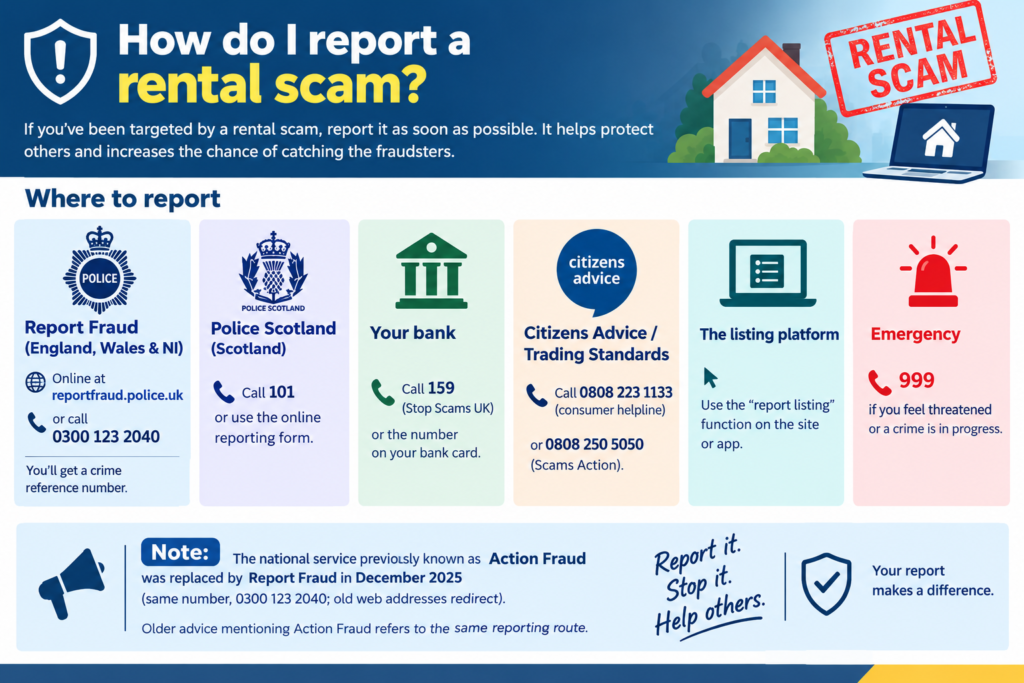
How do I report a rental scam?
| Where to report | How |
|---|---|
| Report Fraud (England, Wales & NI) | Online at reportfraud.police.uk or call 0300 123 2040 — you’ll get a crime reference number |
| Police Scotland (Scotland) | Call 101 or use the online reporting form |
| Your bank | Call 159 (Stop Scams UK) or the number on your bank card |
| Citizens Advice / Trading Standards | Call 0808 223 1133 (consumer helpline) or 0808 250 5050 (Scams Action) |
| The listing platform | Use the “report listing” function on the site or app |
| Emergency | 999 if you feel threatened or a crime is in progress |
Note: the national service previously known as Action Fraud was replaced by Report Fraud in December 2025 (same number, 0300 123 2040; old web addresses redirect). Older advice mentioning Action Fraud refers to the same reporting route.
Frequently Asked Questions
-
What is the most common rental scam in the UK?
Phantom rentals (the property doesn’t exist or isn’t for rent) and hijacked adverts (a genuine listing copied with the scammer’s contact details swapped in). Both end with you paying a deposit for a property the criminal has no right to let.
-
How can I tell if a rental listing is fake?
Look for red flags together: below-market rent, no viewing offered, pressure to pay quickly, bank transfer or crypto demanded, no written agreement, contact only via social media. Reverse-image-search the photos and check the address on Google Maps.
-
Should I ever pay a deposit before viewing a rental property?
No. Never pay until you — or someone you trust — has viewed the property in person. A legitimate holding deposit in England and Wales is capped at one week’s rent and should only be paid after a viewing, with a written agreement.
-
How do I check if a landlord really owns the property?
Buy the title register via GOV.UK (currently £7 digital) and check the named owner matches the person asking for your money. Ask for photo ID too — a mismatch is a near-certain sign of fraud.
-
How do I check a letting agent is legitimate?
Search the member registers of The Property Ombudsman and the Property Redress Scheme — every letting agent in England must belong to one by law. Check the company on Companies House and call the agency on a number you find independently, not one from the advert.
-
What payment methods are safe for paying a rental deposit?
Credit card payments over £100 carry Section 75 protection; debit cards may be recoverable via chargeback. Never pay an unverified individual by bank transfer, and never pay by cash, cryptocurrency or gift cards.
-
I’ve paid a scammer by bank transfer — can I get my money back?
Possibly. Call your bank immediately (dial 159) and ask about reimbursement under the Payment Systems Regulator’s APP fraud rules (in force since October 2024): most victims are reimbursed up to £85,000, usually within five business days, if reported within 13 months. Also report to Report Fraud on 0300 123 2040.
-
What is Report Fraud, and is it the same as Action Fraud?
Report Fraud is the UK’s national fraud reporting service, run by the City of London Police — it replaced Action Fraud in December 2025. The number is unchanged (0300 123 2040) and old Action Fraud addresses redirect to reportfraud.police.uk. In Scotland, report to Police Scotland on 101.
-
How much does the average rental scam victim lose?
Around £1,400 per victim, according to Trading Standards citing Action Fraud data. Total losses hit £12.84 million in 2025/26 across England, Wales and the Crown Dependencies — up 20% in three years.
-
Are students more at risk from rental scams?
Yes — students are targeted ahead of each academic year with below-market rooms and upfront deposit demands. People aged 18 to 39 account for around three-quarters of reported rental fraud cases.
-
Can a landlord ask for more than one week’s rent as a holding deposit?
In England and Wales, no — the cap is one week’s rent and any excess is unlawful. In Scotland, holding deposits are banned entirely. Anyone demanding more is breaking the law or running a scam.
-
What should I do if I spot a fake listing but haven’t paid?
Stop contact, screenshot everything, report the listing to the platform, and report to Report Fraud (reportfraud.police.uk or 0300 123 2040). If the scammer has your personal documents, tell your bank and monitor your credit file.
Final Thoughts: keep your money — and your move — safe
Rental scams UK exploit urgency, not stupidity — intelligent people lose money every week because pressure made them skip a check. Your defence is a short routine: compare the rent to the market, insist on an in-person viewing, verify the landlord or agent independently, never pay before a signed agreement, and use a payment method that protects you.
Budget for a genuine move — protected tenancy deposit, first month’s rent, moving expenses — with our rent affordability rules guide, so a “bargain” that skips normal costs rings alarm bells. And if you’re weighing renting against buying, our rent vs buy calculator guide compares the true costs. Share it with anyone flat-hunting — especially students and newcomers to a city.
Further Reading
- Report Fraud — report a fraud or cybercrime — the UK’s national fraud reporting service (replaced Action Fraud in December 2025), online reporting and 0300 123 2040.
- GOV.UK: Report Fraud — new service from City of London Police — official announcement explaining the service and how to report.
- Citizens Advice: check if something might be a scam — interactive tool and guidance on recognising and reporting scams.