

Tamsin, who rents a two-bedroom flat in Leeds, had been woken five nights running by thumping bass from the flat above — 11.40 pm to past 1 am. She starts a 7 am shift at a GP surgery. By the second week she was dozing at her desk and dreading going home. She had asked the neighbour to turn it down twice; both times she got an eye-roll and a “mate, it’s Friday”. She was sure the law was on her side — she just had no idea which door to knock on first.
If that sounds familiar, this guide is for you: what the law calls a noise problem, what your council can do, what your landlord can and cannot do, when the police get involved, and how to take your neighbour to court if every other route stalls.
Quick Answer: Your main ally against noisy neighbours is your local council, not your landlord and not the police. Councils have a legal duty to investigate noise that could be a statutory nuisance under the Environmental Protection Act 1990, and they can serve an abatement notice ordering the noise to stop — fines up to £5,000 for homes (£20,000 for businesses) if it is ignored. Between 11pm and 7am they can also issue warning notices for night-time noise that doesn’t even need to reach nuisance level, with on-the-spot penalties up to £110. If the council won’t or can’t act, you can complain directly to a magistrates’ court yourself under section 82 of the same Act — no solicitor required.
What Does the Law Mean by “Statutory Nuisance”?
Noise counts as a statutory nuisance when it unreasonably and substantially interferes with the use or enjoyment of your home, or when it injures your health or is likely to — the legal test the council applies under the Environmental Protection Act 1990.
Notice what the test is not: it isn’t about decibel readings on a gadget you bought online. It’s about impact. Bass thumping through your ceiling until 2 am, a dog barking for hours every day, power tools at midnight — strong candidates. A baby crying, footsteps on a staircase, one lively New Year’s Eve party — not. Ordinary sounds of daily life seldom qualify.
It applies at any hour of the day or night. Councils can’t use these powers for traffic or aircraft noise, political demonstrations, or armed-forces premises — if your problem is a main road, you need a different route entirely.
Key rule: The council has a duty to investigate any complaint about possible statutory nuisance — it’s not optional. Once officers are satisfied a nuisance exists or is likely, they must serve an abatement notice. That duty applies to renters exactly as to homeowners.
What Can the Council Actually Do?
Knowing the council is your main route is one thing; knowing how the machinery works is another:
- You report to the council’s environmental health team (sometimes the “noise team”). Keep a reference number.
- They investigate. An officer may visit, listen, measure, and talk to your neighbour. They often try an informal warning first — the law lets them delay formal action for up to 7 days while the noise-maker gets a chance to sort it out.
- Abatement notice. If satisfied the noise is a statutory nuisance, they serve a formal notice on the person responsible (or the owner/occupier if that person can’t be found), stating exactly what must stop and by when.
- Enforcement. Breaching the notice without a reasonable excuse is a criminal offence. The council can prosecute, enter premises to stop the nuisance, and seize noise-making equipment.
The penalties are deliberately stiff:
| Premises type | Maximum fine for breaching an abatement notice |
|---|---|
| Domestic premises (homes) and private vehicles | £5,000, plus up to £500 more for every day the offence continues after conviction |
| Industrial, trade or business premises | £20,000 |
Key rule: Keep everything the council gives you — reference numbers, officer names, visit dates. If your case reaches court, this paper trail is your strongest evidence.
Night-Time Noise: The Extra Rules Between 11 pm and 7 am
Under the Noise Act 1996, the hours between 11 pm and 7 am are “night hours”, and councils can serve warning notices for excessive noise during this window even when it isn’t (yet) a statutory nuisance.
The notice states the noise exceeds the permitted level (measured from inside your home) and gives a short compliance window — at least 10 minutes, ending by 7 am. Ignoring it is an offence:
| Response | Detail |
|---|---|
| Fixed Penalty Notice (FPN) | Up to £110 for homes, up to £500 for licensed premises — payable within 14 days instead of going to court |
| Prosecution | Fine up to £1,000 for homes; unlimited for licensed premises |
| Equipment seizure | Officers can remove noise-making equipment such as loudspeakers |
The “permitted level” isn’t zero — it scales with background noise — and councils measure from inside your home.
Kieran, who rents a one-bed flat in Manchester above a ground-floor tenant with a powerful speaker system, called the council at 11.50 pm when the music had been running since 9pm. An officer measured the noise from Kieran’s living room and served a warning notice — the music stopped within the hour. When it restarted the following weekend, the neighbour got a £110 Fixed Penalty Notice, and the noise stopped completely after that.
Key rule: Renters get exactly the same council protection as owner-occupiers — you pay council tax and you get the same rights. (Check your council tax liability when renting if you’re unsure.)
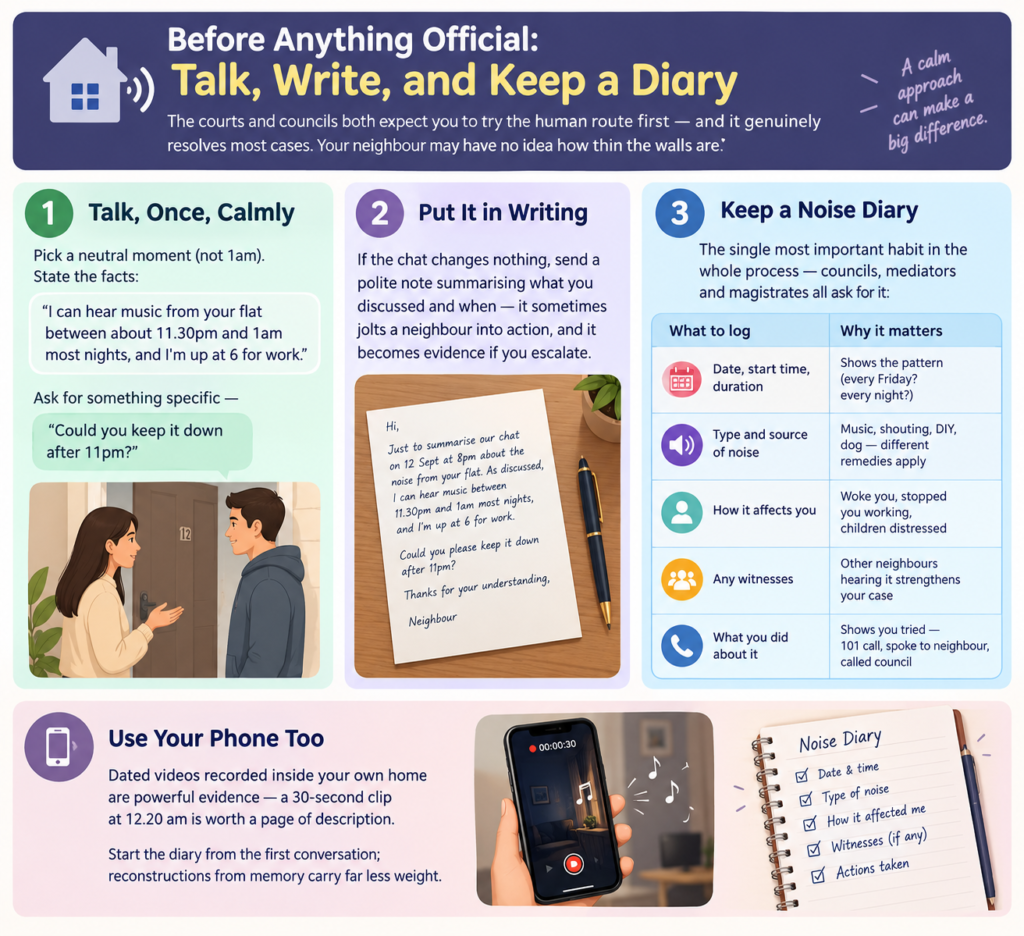
Before Anything Official: Talk, Write, and Keep a Diary
The courts and councils both expect you to try the human route first — and it genuinely resolves most cases. Your neighbour may have no idea how thin the walls are.
Step one: talk, once, calmly. Pick a neutral moment (not 1am). State the facts: “I can hear music from your flat between about 11.30pm and 1am most nights, and I’m up at 6 for work.” Ask for something specific — “Could you keep it down after 11pm?”
Step two: put it in writing. If the chat changes nothing, send a polite note summarising what you discussed and when — it sometimes jolts a neighbour into action, and it becomes evidence if you escalate.
Step three: keep a noise diary. The single most important habit in the whole process — councils, mediators and magistrates all ask for it:
| What to log | Why it matters |
|---|---|
| Date, start time, duration | Shows the pattern (every Friday? every night?) |
| Type and source of noise | Music, shouting, DIY, dog — different remedies apply |
| How it affects you | Woke you, stopped you working, children distressed |
| Any witnesses | Other neighbours hearing it strengthens your case |
| What you did about it | Shows you tried — 101 call, spoke to neighbour, called council |
Use your phone too: dated videos recorded inside your own home are powerful evidence — a 30-second clip at 12.20 am is worth a page of description. Start the diary from the first conversation; reconstructions from memory carry far less weight.
What Your Own Landlord Can and Cannot Do
This is where tenants most often get the wrong end of the stick. Your tenancy agreement gives you the right to quiet enjoyment — but that right is about your landlord, not your neighbour. It means your landlord must not disturb you: no unannounced entries, no harassment, no cutting off services. (If your landlord is the one barging in, read our guide on whether your landlord can enter without permission.)
What quiet enjoyment does not mean is that your landlord is your noise enforcer. A landlord has no general duty to police the neighbours, even if everyone involved rents from the same landlord:
| Your landlord CAN do | Your landlord does NOT have to do |
|---|---|
| Deal with noise caused by their contractors, agents or staff | Intervene where the noisy neighbour has no relationship with them |
| Act against their own tenant breaching a nuisance clause (see below) | Guarantee a silent home or evict someone on your say-so |
| Maintain sound insulation where disrepair is the issue | Soundproof a sound flat because you can hear footsteps |
That said, check your tenancy agreement for a nuisance clause — most have one. If your landlord’s own tenant (in the flat next door, say) is the noisy one, the landlord can enforce that clause, and ultimately seek eviction on anti-social behaviour grounds. More on that next.
Key rule: Never withhold rent over noisy neighbours. It’s not a legal remedy — it breaches your tenancy and puts you in the wrong (see whether you can withhold rent). Complain up, not down: the council is your lever.
If the Noisy Neighbour Is Also a Tenant
When the noise-maker rents — from a private landlord, a letting agent, a housing association or the council — you gain an extra lever: their landlord. Nearly every tenancy agreement contains a clause requiring the tenant not to cause nuisance or annoyance to neighbours, and persistent night-time noise is a textbook breach.
Write to the neighbour’s landlord or managing agent with a clear summary and dates, copies of your diary entries, your council complaint reference if you have one, and a request that they enforce the tenancy agreement.
Landlords who ignore a documented, ongoing nuisance can face action themselves — in Scotland, councils can serve an antisocial behaviour notice on the landlord requiring them to deal with it. In England and Wales, the ultimate sanction is eviction: persistent noise can support a Section 8 claim on Ground 7A (serious ASB), Ground 14 (nuisance/annoyance) or Ground 12 (breach of a tenancy obligation). A written paper trail makes it very hard for a landlord to claim they knew nothing. If a letting agent is stonewalling you, our guide on how to complain about a letting agent covers the formal route.
Key rule: You can’t force your neighbour’s landlord to act — but councils and courts can, and both take a documented complaint history seriously. Your diary is doing double duty here.
Mediation: The Option Most People Skip
Between the friendly chat and the formal complaint sits mediation: an independent, impartial third party who helps you and your neighbour reach an agreement. It sounds soft, but it resolves a surprising number of disputes that would otherwise drag on for months.
Mediation is voluntary — your neighbour must agree — and it suits misunderstandings more than malice: clashing sleep schedules, a new baby versus a night-shift worker. Some councils offer free mediation; independent services may charge, so check fees first. The Civil Mediation Council lists accredited services.
The strategic point renters miss: mediation strengthens every later step. Being able to say “I tried mediation and they refused to attend” looks far better in court than “I went straight to legal action.”
When Noise Becomes Harassment — and When to Call the Police
There is a line where noise stops being an environmental problem and becomes something more serious: harassment. If the noise is targeted at you — deliberately timed to distress you, combined with threats, abusive messages, banging on your walls or door — you may be dealing with harassment under the Protection from Harassment Act 1997 (England and Wales), which covers a “course of conduct” (at least two occasions) the person knows or ought to know amounts to harassment.
Harassment is both a criminal matter (report it to the police) and a civil one: you can apply to the County Court for an injunction restraining the behaviour, and claim damages for anxiety or financial loss. This route is heavier, slower and costlier than the council route — reserve it for genuinely targeted behaviour, not a neighbour who is simply loud and oblivious.
On the practical side: noise is primarily a council matter — but use 101 (non-emergency) when you want persistent noise logged, especially outside council hours, or when there’s low-level intimidation. Use 999 only if you feel threatened or someone is being violent. Always keep the incident number: police logs, like council references, feed into the evidence trail.
Key rule: Don’t call 999 “to get them to come faster” for pure noise. A logged 101 call builds the same evidence trail without misusing emergency resources.
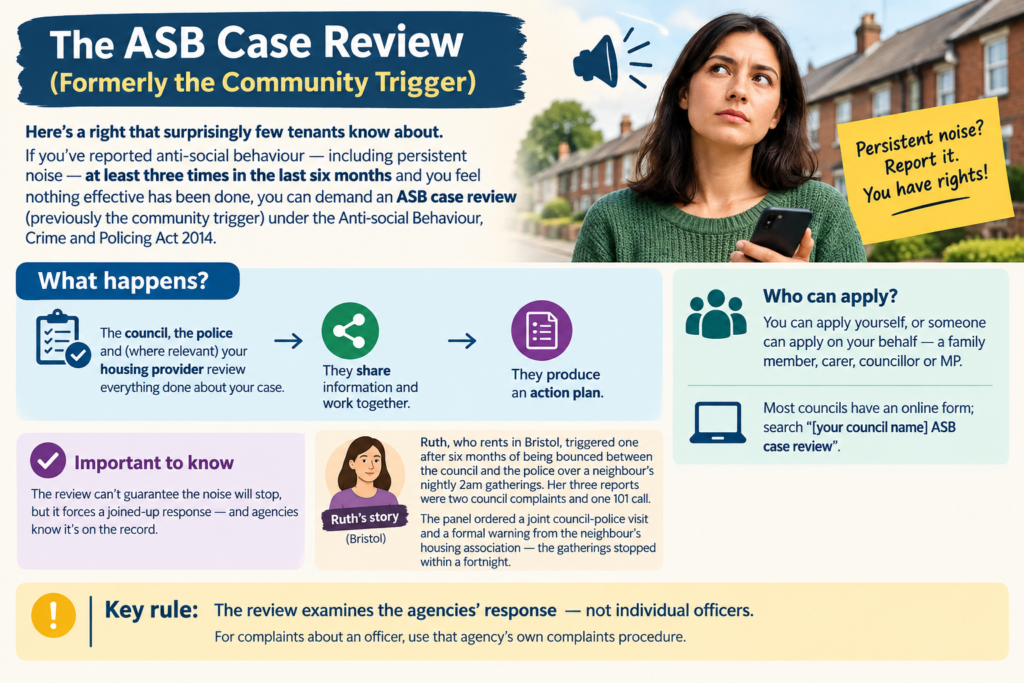
The ASB Case Review (Formerly the Community Trigger)
Here’s a right that surprisingly few tenants know about. If you’ve reported anti-social behaviour — including persistent noise — at least three times in the last six months and you feel nothing effective has been done, you can demand an ASB case review (previously the community trigger) under the Anti-social Behaviour, Crime and Policing Act 2014.
What happens: the council, the police and (where relevant) your housing provider review everything done about your case, share information, and produce an action plan. You can apply yourself, or someone can apply on your behalf — a family member, carer, councillor or MP. Most councils have an online form; search “[your council name] ASB case review”. The review can’t guarantee the noise will stop, but it forces a joined-up response — and agencies know it’s on the record.
Ruth, who rents in Bristol, triggered one after six months of being bounced between the council and the police over a neighbour’s nightly 2am gatherings. Her three reports were two council complaints and one 101 call. The panel ordered a joint council-police visit and a formal warning from the neighbour’s housing association — the gatherings stopped within a fortnight.
Key rule: The review examines the agencies’ response — not individual officers. For complaints about an officer, use that agency’s own complaints procedure.
Taking Your Neighbour to Court Yourself: Section 82
If the council decides the noise isn’t a statutory nuisance — or simply won’t act — you have a backstop. Section 82 of the Environmental Protection Act 1990 lets any person “aggrieved by” a statutory nuisance complain directly to the magistrates’ court, with no solicitor required:
| Step | What to do |
|---|---|
| 1. Build your evidence | Noise diary, dated videos, witness details, council reference showing you tried the official route |
| 2. Give 3 days’ written notice | Write to the noise-maker saying you intend to complain to the Magistrates’ Court. Keep a dated copy — hand-deliver or send by recorded delivery |
| 3. Contact the court | Tell the clerk you want to complain under section 82. They’ll explain the procedure and check you have an arguable case |
| 4. Summons | If satisfied, the court issues a summons, which you deliver to the noise-maker |
| 5. Hearing | You present your case yourself (a solicitor is optional) — stay factual |
| 6. Order | If the magistrates agree, they order the nuisance abated, can prohibit recurrence, and can fine the defendant up to £5,000 |
On costs: win, and the court will normally order the other side to pay your reasonable expenses. Lose, and you bear your own costs — plus the neighbour can claim theirs against you. That risk is why evidence and the three-day notice (which often resolves things on its own) matter so much. Section 82 is your backstop, not your opening move: courts expect to see that you tried the council route first, and the council’s own records become part of your evidence.
Tamsin, our Leeds renter from the intro, went this route herself after the council closed her case: roughly £120 out of pocket (printing, postage, one £60 advice session) versus a £1,800–£2,400 solicitor quote. She won — the noise was ordered abated, and she recovered her £120.
Scotland, Wales and Northern Ireland: What’s Different
Noise law isn’t identical across the UK:
| Nation | Framework | Key differences |
|---|---|---|
| England & Wales | Environmental Protection Act 1990 + Noise Act 1996 | As described in this guide: statutory nuisance, abatement notices, 11 pm–7 am warning notices |
| Scotland | Antisocial Behaviour etc. (Scotland) Act 2004 + EPA 1990 | Councils investigate noise and can issue warning notices during locally set “noise control periods”; councils can also serve an antisocial behaviour notice on the noisy tenant’s landlord requiring them to act. Report to the council, or to the police on 101 |
| Northern Ireland | Clean Neighbourhoods and Environment Act (NI) 2011 | District councils handle complaints and can serve abatement notices; the Noise Act 1996’s night-noise warning regime does not apply in NI in the same form — don’t assume 11pm–7am rules transfer |
For Wales, the same rules apply as in England (including the ASB case review). For Scotland and NI, start with your council’s own noise page — and an honest flag: published guidance on the fine detail of NI night-noise enforcement is thin, so check with your district council.
Renter-Friendly Ways to Make the Noise Bearable
While the formal wheels turn, you still have to sleep. These tenancy-safe measures don’t alter the property (so no deposit disputes later):
| Fix | Typical cost | What it does |
|---|---|---|
| Heavy or thermal-lined curtains | £40–£80 per window | Dampens airborne noise and helps sleep |
| Door draught seals + door sweep | £15–£35 | Closes the biggest sound gap in most flats — the front door |
| Removable acoustic foam panels | £25–£60 a pack | Reduces echo and takes the edge off bass in your bedroom |
| White noise machine or app + earplugs | £20–£40 | Masks intermittent noise; earplugs for the worst nights |
| Bookshelf or wardrobe against the shared wall | £0 (use what you own) | Mass blocks sound — the oldest trick in the book |
Ruth’s Bristol bedroom backed onto the neighbour’s living room. Her spend: draught seals £22, acoustic panels £45, white-noise machine £28 — £95 in total. It didn’t eliminate the bass, but it took it from “wakes me up” to “sleepable with the machine on”, buying the six weeks she needed for the ASB case review to work — versus £800–£1,500 to break her tenancy early (deposit deductions, double rent, moving costs).
Key rule: Avoid anything that damages the property — drilling, heavy adhesive, ripping up flooring. Deposit deductions can dwarf the noise problem. Removable and freestanding only.
When Moving Out Is the Right Answer
Sometimes the honest advice is that the flat is the problem, not just the neighbour. If you’ve exhausted the council route, the diary is three months long, and your sleep and health are suffering — moving may be the rational, self-protecting choice, not a defeat.
Before you go, know your exit options. In a fixed term, you usually need your landlord’s agreement or a break clause — our guide on how to end a tenancy early covers the options and costs. On a periodic tenancy, you can usually leave with proper notice — see ending your tenancy. Before signing anywhere new, run the numbers with our rent affordability rules guide and the rent-to-income ratio calculator — moving somewhere cheaper but just as noisy solves nothing.
One last tip: when viewing a new flat, visit at different times — including late evening — before you commit.
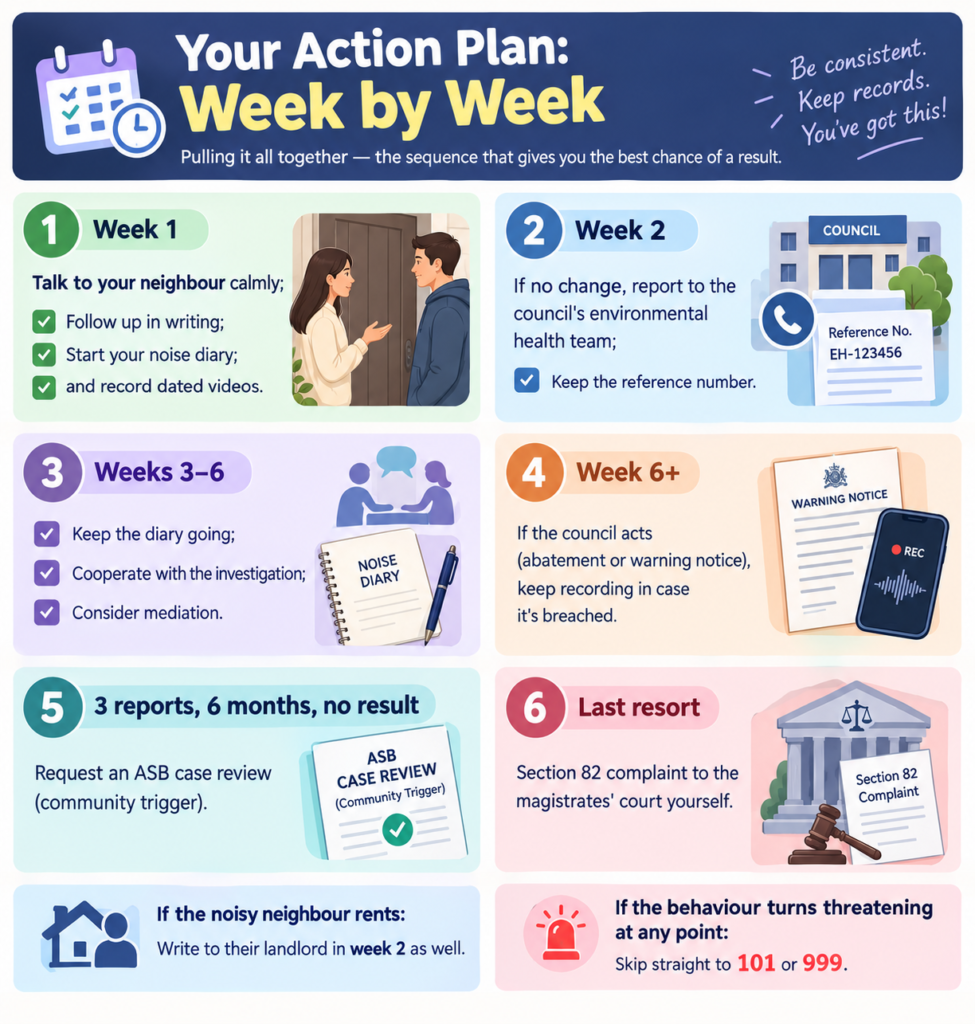
Your Action Plan: Week by Week
Pulling it all together — the sequence that gives you the best chance of a result:
| Week | Action |
|---|---|
| Week 1 | Talk to your neighbour calmly; follow up in writing; start your noise diary and dated videos |
| Week 2 | If no change, report to the council’s environmental health team; keep the reference number |
| Weeks 3–6 | Keep the diary going; cooperate with the investigation; consider mediation |
| Week 6+ | If the council acts (abatement or warning notice), keep recording in case it’s breached |
| 3 reports, 6 months, no result | Request an ASB case review (community trigger) |
| Last resort | Section 82 complaint to the magistrates’ court yourself |
If the noisy neighbour rents, write to their landlord in week 2 as well. If the behaviour turns threatening at any point, skip straight to 101 or 999.
Frequently Asked Questions
Can I call the council about noise during the day, or only at night?
Any time — statutory nuisance law applies around the clock. The 11 pm–7 am rules are an additional faster route, not the only one, and not a licence to be loud until 11 pm either.
My landlord says noise disputes are “nothing to do with me”. Is that true?
Mostly. But if the noisy person is your landlord’s own tenant breaching a nuisance clause, the landlord can and should enforce it — put your request in writing.
Will the council tell my neighbour I complained?
Councils usually keep complainants’ details confidential during the investigation, but if the case goes to court you may need to give evidence. Ask the officer about confidentiality at the start.
How long does a council noise investigation take?
Weeks to months, depending on resources and whether officers can witness the noise. A diary with a clear pattern (“every Friday 11 pm–1 am”) helps officers time visits and speeds things up.
Can I be fined for making a noise complaint that goes nowhere?
No — there’s no penalty for a genuine complaint that doesn’t result in action. The risk only arises if you take someone to court yourself under section 82 and lose; then you may have to pay the other side’s costs.
What if my neighbour retaliates after I complain?
Keep recording everything and report retaliation to the council and the police (101, or 999 if you feel unsafe). Deliberate retaliation can cross into harassment under the Protection from Harassment Act 1997.
I’m in Scotland — is the process the same?
Broadly similar, but Scotland has its own framework: councils work under the Antisocial Behaviour etc. (Scotland) Act 2004 with locally set noise control periods and warning notices, and you can report antisocial noise to the police on 101.
Can noise affect my tenancy reference or deposit?
Complaining doesn’t affect your deposit. But DIY soundproofing that damages the property (drilling, strong adhesives, removing fixtures) can lead to deductions — stick to removable, freestanding fixes.
Should I get a solicitor for a section 82 court complaint?
It’s not required — councils describe the procedure as simple enough to do yourself, and many tenants do. Consider advice (Citizens Advice is free) if the neighbour has hired a solicitor, because losing can mean paying their costs.
What counts as anti-social behaviour versus just noise?
Noise becomes ASB when it’s persistent, deliberate or causes harassment, alarm or distress — late-night parties every weekend, targeted banging, shouting abuse. Everyday living sounds rarely qualify.
Can my neighbour’s landlord evict them for noise?
Ultimately, yes. Persistent serious noise can support eviction on anti-social behaviour grounds (Ground 7A for serious ASB, Ground 14 for nuisance, or Ground 12 for breaching the tenancy). Landlords usually try warnings first — eviction is the last resort.
Final Thoughts
Noisy neighbours are one of the most common reasons tenants consider moving — and one of the most solvable problems, if you work the system in the right order. Talk first, write everything down, then let the council do what the law requires it to do. The abatement notice, the night-noise warning, the ASB case review and the section 82 backstop are all real, tested tools; they just need evidence to bite — and your diary is the teeth.
If the situation does push you towards moving, make the money side boring and predictable: check what rent you can truly afford with our rent affordability rules guide and run your budget through the rent-to-income ratio calculator before you sign anything.