
Tom moved into a two-bedroom flat in Manchester six weeks ago. The boiler rattles, he has never seen a gas safety certificate, and his letting agent just shrugged: “The previous tenant never asked.” Tom pays £1,150 a month with no idea whether his home is legally safe — or what paperwork his landlord owes him. His story shows why landlord safety certificates matter to every renter.
This guide to landlord safety certificates answers both. UK landlords must provide specific safety certificates — annual gas checks, five-yearly electrical inspections, energy performance certificates, and working smoke and carbon monoxide alarms — and the duties and penalties differ between England, Scotland, Wales and Northern Ireland. Each nation’s rules are kept clearly separate below.
Quick Answer: In England your landlord must: arrange an annual gas safety check by a Gas Safe registered engineer and give you the record within 28 days (before move-in for new tenants); inspect the fixed electrical installation at least every five years and share the report within 28 days; provide a valid EPC free of charge; and fit smoke alarms on every storey plus CO alarms in rooms with a fixed combustion appliance (excluding gas cookers). Scotland, Wales and Northern Ireland add their own requirements — including interlinked and heat alarms — explained below.
Landlord safety certificates: which documents must your landlord actually give you?
The term “safety certificate” covers several landlord safety certificates from different laws. The table summarises England; later sections detail each document and the other nations’ differences.
| Certificate or record | How often | When you must receive it |
|---|---|---|
| Gas safety record (often called a CP12) | Every 12 months | Within 28 days of the check; before move-in for new tenants |
| Electrical Installation Condition Report (EICR) | At least every 5 years | Within 28 days of the inspection; before move-in for new tenants |
| Energy Performance Certificate (EPC) | Valid for 10 years | Free of charge, at the earliest opportunity |
| Smoke and CO alarms | Kept in working order | In place when you move in; repaired once the landlord is told of a fault |
Keep these with your tenancy agreement in one folder, physical or digital. If a dispute ever arises, showing exactly what you were and weren’t given puts you in a far stronger position.
Gas safety certificates: the annual check your landlord cannot skip
Gas safety is the most serious landlord duty because breach is a criminal offence. Under the Gas Safety (Installation and Use) Regulations 1998 (UK-wide), your landlord must: maintain gas fittings and flues safely; arrange a check of every gas appliance and flue every 12 months by a Gas Safe registered engineer; give you the record within 28 days (or before you move in); and keep records for at least two years. It covers landlord-provided appliances — boiler, fire, hob — plus pipework and flues. Your own appliances aren’t covered, though their connecting pipework is the landlord’s responsibility.
| Deadline | The rule |
|---|---|
| Every 12 months | Gas Safe registered engineer checks each gas appliance and flue |
| Within 28 days of the check | Existing tenants receive a copy of the record |
| Before move-in day | New tenants receive a copy before occupying |
| At least 2 years | Landlord keeps records of every check |
Breaching these duties is a criminal offence. The Health and Safety Executive (HSE) prosecutes in England, Scotland and Wales; Northern Ireland has its own regulator, HSENI. Courts can impose unlimited fines and imprisonment — up to six months in the magistrates’ court or two years in the Crown Court. (Older trade-press articles quote £6,000 per appliance, but current government-backed guidance treats fines as unlimited.)
Smell gas or suspect carbon monoxide? Call the National Gas Emergency Service on 0800 111 999 (free, 24 hours). Open windows, don’t touch electrical switches, and don’t wait for your landlord. For non-urgent concerns about a landlord dodging gas checks, the HSE Gas Safety Advice Line is 0800 300 363.
Electrical safety (EICR): the five-year rule in England
The EICR is one of the key landlord safety certificates. Under the 2020 Electrical Safety Standards regulations (England), every private rented home’s fixed installation — wiring, sockets, consumer unit — must be inspected at least every five years by a qualified person (sooner if the report says so). Your landlord must share the report within 28 days, supply the council a copy if asked, and complete remedial work within 28 days (or sooner if specified), confirming completion to you in writing.
The maximum civil penalty per breach was raised from £30,000 to £40,000 by 2025 amendment regulations (SI 2025/1043), confirmed on legislation.gov.uk — separate from the Renters’ Rights Act’s own £40,000 regime for serious offences.
| Breach | Enforcer | Maximum penalty |
|---|---|---|
| No valid EICR, or report not shared within 28 days | Local authority | £40,000 per breach |
| Remedial work not completed on time | Local authority | £40,000 per breach |
| Inspection done by an unqualified person | Local authority | £40,000 per breach |
These landlord safety certificates regulations cover England only — Scotland, Wales and Northern Ireland reach similar outcomes through their own standards, covered below.
Energy Performance Certificates: more than a coloured chart
The EPC is one of the landlord safety certificates you should receive without asking. An EPC rates your home’s energy efficiency from A to G and estimates likely bills. Valid 10 years, it must reach you free of charge at the earliest opportunity — when the property is marketed, certainly before you sign. Never received one? Check the public EPC register and ask for a copy.
Under Minimum Energy Efficiency Standards, landlords in England or Wales generally cannot let a property rated F or G — the minimum is band E — without a registered exemption. Trading Standards enforces this (penalties up to £5,000 per breach).
The government confirmed in January 2026 that the minimum will rise to the equivalent of EPC band C from 1 October 2030. Note the status carefully: confirmed policy, not yet law — the enacting statutory instrument is planned for 2027, and band E remains the legal minimum until then. Reported figures for a proposed cost cap on improvements conflict, so treat any specific number with caution.
Why the EPC matters to your wallet: two identical-looking flats can have very different ratings — and very different heating bills. Check the EPC before committing. Our guide to energy bills when renting explains how to read the numbers.
Smoke and carbon monoxide alarms: England’s rules
Under the Smoke and Carbon Monoxide Alarm (England) Regulations (amended 2022), landlords must fit at least one smoke alarm on every storey with living accommodation, a carbon monoxide alarm in any living-accommodation room with a fixed combustion appliance (boiler, fire, stove — excluding gas cookers), and repair or replace alarms once told they’re faulty.
Councils enforce the rules: a landlord in breach gets a remedial notice with 28 days to comply, and continued failure brings a civil penalty of up to £5,000, with the council able to do the work itself. On move-in day, press every alarm’s test button while the agent is still there — a missing or dead alarm on day one is never acceptable.
Scotland: the Repairing Standard sets a higher bar
Scotland’s Repairing Standard (Housing (Scotland) Act 2006) must be met before the tenancy starts and throughout it. Before move-in your landlord should give you these landlord safety certificates: the gas safety certificate, the EICR (plus PAT records for provided appliances — inspections at least every five years), a valid EPC, and the smoke and heat alarm expiry dates.
On alarms, Scotland goes well beyond England: mains-powered, interlinked smoke and heat alarms — typically smoke alarms in the living room and hallways/landings plus a heat alarm in the kitchen — and a carbon monoxide detector wherever there’s a carbon-fuelled appliance or flue. Battery-only alarms aren’t compliant; units must be mains-powered or sealed tamper-proof long-life batteries, and the smoke and heat alarms must be interlinked so they all sound together.
If your landlord won’t comply, the First-tier Tribunal for Scotland (Housing and Property Chamber) can order the work done, and serious failures can lead the council to review the landlord’s place on the landlord register.
Wales: fit for human habitation — or no rent is due
Under the Renting Homes (Wales) Act 2016 and 2022 fitness regulations, Welsh landlords must provide these landlord safety certificates from day one: mains-powered interlinked smoke alarms on every storey; a CO alarm in every room with a gas, oil or solid-fuel appliance; an electrical inspection at least every five years (report to you within 7 days of the occupation date); and a gas safety certificate before you move in, with each annual record supplied within 28 days.
The Welsh sting is enforcement: you don’t have to pay rent for any period the property is unfit for human habitation because these safety measures are missing — and a non-compliant landlord risks Rent Smart Wales revoking their licence. That’s powerful leverage, but take advice before withholding any rent and put everything in writing.
Northern Ireland: smoke, heat and CO alarms since 2024
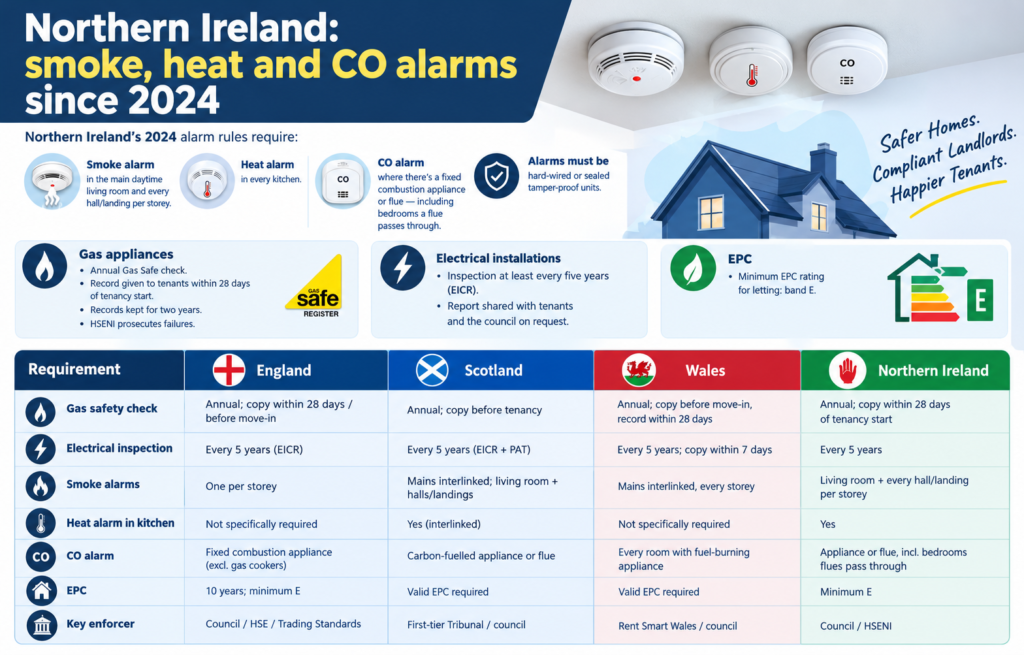
Northern Ireland’s 2024 alarm rules require: a smoke alarm in the main daytime living room and every hall/landing per storey; a heat alarm in every kitchen; a CO alarm wherever there’s a fixed combustion appliance or flue — including bedrooms a flue passes through. Alarms must be hard-wired or sealed tamper-proof units.
Gas appliances need an annual Gas Safe check with the record given to tenants within 28 days of the tenancy start (records kept two years; HSENI prosecutes failures). Electrical installations need inspection at least every five years, with the report shared with tenants and the council on request. Minimum EPC rating for letting: band E.
| Requirement | England | Scotland | Wales | Northern Ireland |
|---|---|---|---|---|
| Gas safety check | Annual; copy within 28 days / before move-in | Annual; copy before tenancy | Annual; copy before move-in, record within 28 days | Annual; copy within 28 days of tenancy start |
| Electrical inspection | Every 5 years (EICR) | Every 5 years (EICR + PAT) | Every 5 years; copy within 7 days | Every 5 years |
| Smoke alarms | One per storey | Mains interlinked; living room + halls/landings | Mains interlinked, every storey | Living room + every hall/landing per storey |
| Heat alarm in kitchen | Not specifically required | Yes (interlinked) | Not specifically required | Yes |
| CO alarm | Fixed combustion appliance (excl. gas cookers) | Carbon-fuelled appliance or flue | Every room with fuel-burning appliance | Appliance or flue, incl. bedrooms flues pass through |
| EPC | 10 years; minimum E | Valid EPC required | Valid EPC required | Minimum E |
| Key enforcer | Council / HSE / Trading Standards | First-tier Tribunal / council | Rent Smart Wales / council | Council / HSENI |
Worked example: Priya’s 28-day gas safety countdown (London)
Priya rents a one-bedroom London flat for £1,750 a month, with a landlord-provided gas boiler and hob. This is how the gas safety timeline applied to her:
- 3 March 2026 — a Gas Safe registered engineer completes the annual check.
- 31 March 2026 — the legal deadline: Priya must have her copy within 28 days of the check.
- 2 April 2026 — nothing has arrived, so Priya emails landlord and agent requesting the record, keeping a copy.
- 16 April 2026 — still nothing. Priya contacts the council’s environmental health team and notes the HSE Gas Safety Advice Line (0800 300 363).
The maths: Priya’s rent is £1,750 × 12 = £21,000 a year; a typical gas safety check costs £60–£90 (2026 industry guides; varies by region). Skipping a £75 check and risking a criminal prosecution with an unlimited fine is the landlord’s gamble — and the bill is always theirs, never the tenant’s.
Worked example: the £85 fee Priya should never have paid
At sign-up, Priya’s agent added an £85 “safety inspection admin fee” to her move-in invoice. This is banned. Under the Tenant Fees Act 2019, English landlords and agents may only charge payments on an express permitted list — rent, deposits, certain default fees and utilities-type payments. Safety checks are the landlord’s legal duty and cost; passing these landlord safety certificates on to tenants is a prohibited payment.
Priya paid under protest, kept the receipt, and wrote within a week identifying the charge as prohibited and demanding it back. The agent refunded it; had they refused, Trading Standards enforces the fees ban. Memorise this: any fee tied to your landlord’s safety duties is unlawful. Our letting agent fees guide lists exactly what agents can and cannot charge.
Worked example: Callum’s move-in day in Glasgow
Callum took a two-bedroom Glasgow flat at £950 a month, moving in 15 May 2026. Under the Repairing Standard, his landlord owed him these landlord safety certificates before day one: the gas safety certificate, the EICR (plus PAT records for the provided washing machine and fridge), a valid EPC, and the smoke/heat alarm expiry dates.
What happened instead:
- 15 May 2026 — keys handed over, no documents. One standalone battery smoke alarm in the hall, nothing interlinked, no kitchen heat alarm.
- 1 June 2026 — after verbal chases failed, Callum writes listing everything missing, keeping a copy.
- 15 June 2026 — no response; Callum sends a follow-up allowing 14 more days.
- 1 July 2026 — 47 days in with nothing provided, Callum applies to the First-tier Tribunal (Housing and Property Chamber), which can order compliance.
The numbers: Callum’s rent is £950 × 12 = £11,400 a year; his tribunal application costs nothing, while the landlord faces a binding enforcement order plus a possible registration review. Typical landlord safety certificates compliance costs — roughly £99–£180 for an EICR, £69–£90 for an EPC — are trivial against a year’s rent, and never the tenant’s bill.
These landlord safety certificates are the landlord’s bill, everywhere in the UK. No nation lets landlords pass gas, electrical, EPC or alarm costs to tenants. Being asked to pay is a red flag about the landlord — not a legitimate charge.
| What it is | Typical figure |
|---|---|
| Annual gas safety check | £60–£90 (industry guides; varies by region) |
| EICR (every 5 years) | £99–£180 |
| EPC (every 10 years) | £69–£90 |
| EICR breach penalty (England) | Up to £40,000 per breach |
| Alarm breach penalty (England) | Up to £5,000 |
| Gas safety breach (UK-wide) | Unlimited fine and/or imprisonment |
What did the Renters’ Rights Act 2025 change about landlord safety certificates?
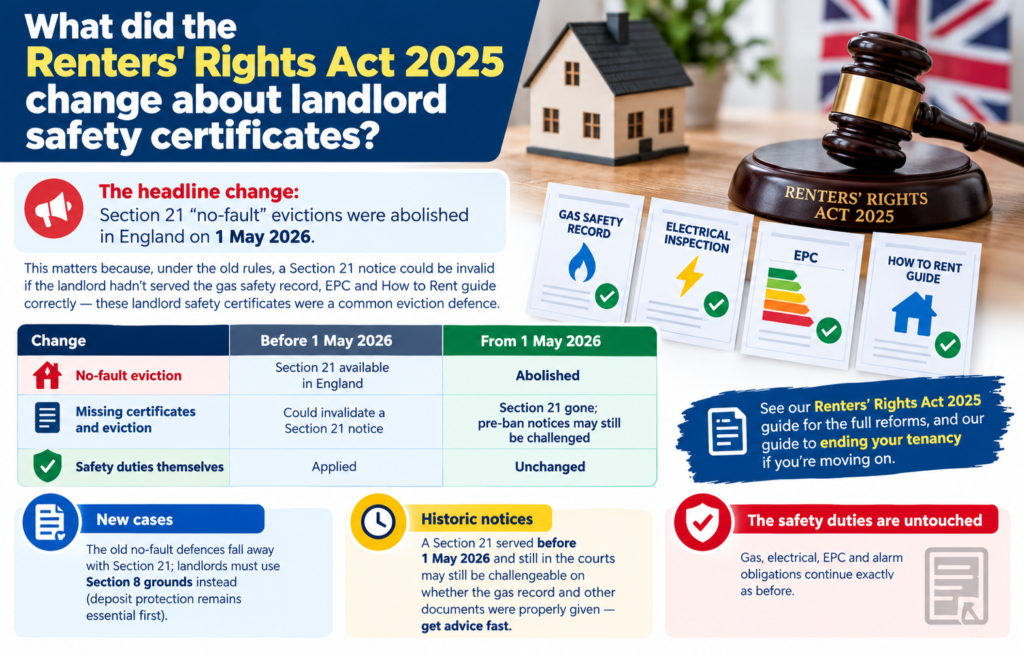
The headline change: Section 21 “no-fault” evictions were abolished in England on 1 May 2026. This matters because, under the old rules, a Section 21 notice could be invalid if the landlord hadn’t served the gas safety record, EPC and How to Rent guide correctly — these landlord safety certificates were a common eviction defence.
What this means now:
| Change | Before 1 May 2026 | From 1 May 2026 |
|---|---|---|
| No-fault eviction | Section 21 available in England | Abolished |
| Missing certificates and eviction | Could invalidate a Section 21 notice | Section 21 gone; pre-ban notices may still be challenged |
| Safety duties themselves | Applied | Unchanged |
- New cases: the old no-fault defences fall away with Section 21; landlords must use Section 8 grounds instead (deposit protection remains essential first — see our deposit protection guide).
- Historic notices: a Section 21 served before 1 May 2026 and still in the courts may still be challengeable on whether the gas record and other documents were properly given — get advice fast.
- The safety duties are untouched. Gas, electrical, EPC and alarm obligations continue exactly as above.
See our Renters’ Rights Act 2025 guide for the full reforms, and our guide to ending your tenancy if you’re moving on.
What to do if your landlord hasn’t given you the certificates
Work through these steps in order to get the landlord safety certificates you’re owed.
| Step | Action | Why it works |
|---|---|---|
| 1. Ask in writing | Email landlord/agent listing what’s missing; keep a copy | Creates a paper trail; many comply immediately |
| 2. Set a deadline | Allow 14 days for documents or arranged checks | Shows reasonableness if it escalates |
| 3. Contact the council | Environmental health / housing standards; Trading Standards for EPC and fee issues | Councils can serve remedial notices and fine up to £5,000 (alarms) or £40,000 (electrical) |
| 4. Gas: contact HSE | Gas Safety Advice Line 0800 300 363 (HSENI in NI) | Gas breaches are criminal matters enforced by HSE |
| 5. Scotland: use the tribunal | First-tier Tribunal (Housing and Property Chamber) | Can order the landlord to meet the Repairing Standard |
| 6. Wales: know your leverage | Property may be unfit — rent isn’t due for unfit periods | The fitness standard has real financial teeth; take advice first |
Don’t withhold rent as a protest (outside Wales’s specific rule, taken with advice) — arrears give your landlord grounds against you. And allow access for checks; you must let the engineer in.
Note the split between safety and repairs: a broken boiler needing fixing is a repair issue (see our landlord repairs guide); the annual check proving it’s safe is certification. Both are the landlord’s job, but they use different enforcement routes.
Legionella: the “certificate” that doesn’t exist
You may see agents or tradespeople selling a “legionella certificate”. No such certificate exists in law and the HSE doesn’t recognise one. Landlords do have a general duty to assess and control legionella risk in the water system — but for a typical home with a normal domestic hot-and-cold setup, the HSE says risk is usually low and a competent landlord can assess it themselves, with no professional consultant or lab test legally required.
Your landlord should have considered the system (flushing before you moved in, dealing with long-unused outlets), but you can’t demand a certificate that doesn’t exist. Helpful habits: run taps and showers a couple of minutes after they’ve sat unused (e.g. post-holiday), and leave the boiler’s hot-water temperature settings alone — they control bacteria as well as scalds.
Your move-in day checklist
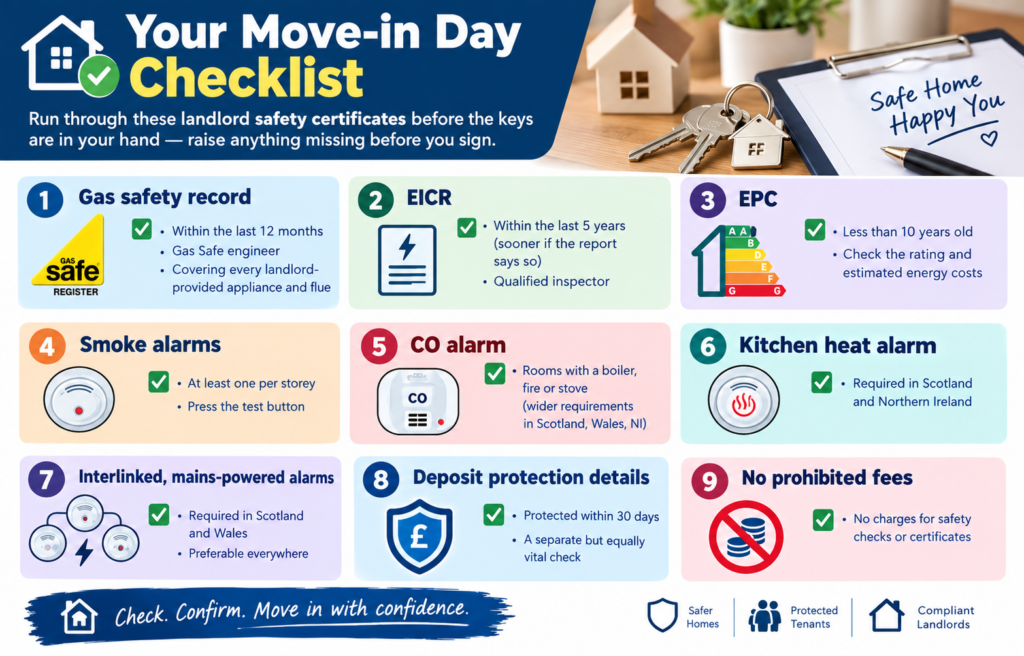
Run through these landlord safety certificates before the keys are in your hand — raise anything missing before you sign.
- Gas safety record — within the last 12 months, Gas Safe engineer, covering every landlord-provided appliance and flue
- EICR — within the last 5 years (sooner if the report says so), qualified inspector
- EPC — less than 10 years old; check the rating and estimated energy costs
- Smoke alarms — at least one per storey; press the test button
- CO alarm — rooms with a boiler, fire or stove (wider requirements in Scotland, Wales, NI)
- Kitchen heat alarm — required in Scotland and Northern Ireland
- Interlinked, mains-powered alarms — required in Scotland and Wales; preferable everywhere
- Deposit protection details — protected within 30 days; a separate but equally vital check
- No prohibited fees — no charges for safety checks or certificates
FAQs
What safety certificates must a landlord give tenants in the UK?
England: an annual gas safety record (within 28 days, or before move-in for new tenants), an EICR at least every 5 years (shared within 28 days), a valid EPC given free, and smoke alarms per storey plus CO alarms where required. Scotland, Wales and NI add stricter alarm and inspection rules — see above.
How often does a landlord need a gas safety check?
Every 12 months, for every landlord-provided gas appliance and flue, by a Gas Safe registered engineer. Records are kept two years; your copy must arrive within 28 days of the check or before you move in.
My landlord hasn’t given me a gas safety certificate. What should I do?
Ask in writing and keep a copy. If nothing arrives within two weeks, report it to the council’s environmental health team — and for gas, call the HSE Gas Safety Advice Line on 0800 300 363 (HSENI in NI). Breaches are a criminal offence.
How often is an EICR required in a rented property?
In England, at least every five years — sooner if the report says so. Your landlord must share the report within 28 days and complete remedial work within 28 days (or sooner if specified). Councils can fine up to £40,000 per breach.
Can my landlord charge me for a gas safety check or EICR?
No. The Tenant Fees Act 2019 bans charges outside the permitted payments list, and safety checks are the landlord’s duty and expense. Charged a “safety inspection fee”? Demand it back in writing; report the agent or landlord to Trading Standards if refused.
Does my landlord have to give me an EPC?
Yes — a valid EPC (under 10 years old), free, at the earliest opportunity, normally when the property is marketed. F or G rated homes generally can’t be let without a registered exemption, and you can look any EPC up on the public register.
Where should smoke and carbon monoxide alarms be in a rental?
England: smoke alarm per storey, CO alarm in rooms with a fixed combustion appliance (excl. gas cookers). Scotland: mains-powered interlinked smoke/heat alarms + CO detection. Wales: mains-powered interlinked smoke alarms per storey + CO alarms by fuel-burning appliances. NI: as England, plus a kitchen heat alarm.
What is the penalty for a landlord with no EICR?
In England, the local authority can impose up to £40,000 per breach — raised from £30,000 by 2025 amendment regulations. The council can also arrange required remedial work and recover the cost from the landlord.
Do the Renters’ Rights Act 2025 changes affect safety certificates?
The duties are unchanged. But eviction law changed on 1 May 2026: Section 21 was abolished in England, so old “invalid Section 21” defences no longer apply to new cases. Pre-1-May notices may still be challenged on historic compliance — get advice.
Is there a legionella certificate landlords must provide?
No — no legal “legionella certificate” exists and the HSE doesn’t recognise one. Landlords must assess and control legionella risk in the water system, but for typical domestic properties that’s usually a simple assessment the landlord can do themselves.
What are the landlord’s safety duties in Scotland?
Under the Repairing Standard: a gas safety certificate, an EICR at least every 5 years (plus PAT for provided appliances), a valid EPC, and mains-powered interlinked smoke and heat alarms with CO detection — all before the tenancy starts. The First-tier Tribunal (Housing and Property Chamber) can enforce compliance.
Can I withhold rent if my landlord won’t do safety checks?
Generally no — arrears give your landlord grounds against you. The exception is Wales, where rent isn’t due for periods the property is unfit for human habitation due to missing safety measures — but take advice before relying on it. Everywhere else, use the written-request-to-council route.
Final Thoughts
Landlord safety certificates reveal your landlord’s standards: one who hands over the gas record, EICR and EPC unprompted almost certainly maintains the boiler and fixes faults fast. One who shrugs, stalls or bills you for the paperwork is telling you everything — act early, in writing, and use the enforcement routes above.
Before your next tenancy: run the numbers on a rent affordability calculator so the home fits your budget, and confirm the landlord safety certificates above so it’s legally safe. The rent must be affordable and the home must be safe — this site helps you check both.
Further Reading
GOV.UK guidance on the Smoke and Carbon Monoxide Alarm (Amendment) Regulations 2022 — the official explanation of landlord alarm duties and the £5,000 penalty
The Electrical Safety Standards amendment regulations 2025 (SI 2025/1043) on legislation.gov.uk — confirming the penalty rise to £40,000 per breach
Rent Smart Wales landlord course handbook — the Welsh Government source for fitness-for-habitation safety duties