Can you sublet rented home legally? Reece has an enviable problem: a four-month secondment in Manchester, accommodation paid for — but eleven months left on his Leeds tenancy. His plan? Sublet the flat while he’s away and let the subtenant’s rent cover his own. It sounds tidy — until you learn that English law now builds a no-subletting rule into almost every private tenancy, and breaking it can end with a court-ordered possession claim.
Reece’s situation is common — spare rooms after break-ups, long trips abroad, a friend who needs a roof — but subletting is one of the most misunderstood areas of UK renting law. If you’re wondering whether you can sublet a rented home or just a spare room, this guide explains what it means, when it’s allowed, how to ask properly, the Airbnb rules, and the money side: benefits, tax and council tax.
This guide is general information, not legal advice. Subletting rules differ across the UK nations and between tenancy types, so get proper advice from Citizens Advice or Shelter if your situation is complicated.
Quick Answer: In England, almost every private tenancy now carries an implied term (Housing Act 1988, section 15) that you must not sublet or share possession of any part of your home without your landlord’s consent. Where consent rests only on that implied term, your landlord can refuse for any reason — “not unreasonably withheld” only applies if your agreement expressly says so. Always ask in writing, get consent in writing, and never sublet on the strength of a verbal “yes”.
What does it mean to sublet a rented home? Subletting explained
Before you sublet a rented home, it helps to know the vocabulary. Lawyers and letting agents use several overlapping terms, and it matters which one applies to you:
| Arrangement | What it means |
|---|---|
| Subletting the whole home | You move out and grant someone else exclusive possession of the entire property — e.g. Reece lets his whole Leeds flat to a subtenant while he’s in Manchester |
| Subletting part of the home | You stay, but give someone exclusive possession of a defined part, such as a lockable spare bedroom |
| Taking in a lodger | You stay, and someone shares the home with you — but they have no exclusive possession of any part (you can enter their room, e.g. to clean) |
| Airbnb / short-stay hosting | You let the home or a room for short paid stays via a platform |
This test decides whether you sublet a rented home or merely take in a lodger. The dividing line between a subtenant and a lodger is the exclusive-possession test: does the other person have exclusive use of a part of the property you can’t enter without their permission? Courts look at the reality, not the label — and both usually still need your landlord’s permission.
Can you sublet a rented home in England? The legal position
Since the Renters’ Rights Act 2025 took effect (Royal Assent 27 October 2025, with the main tenancy reforms in force from 1 May 2026), almost every private tenancy in England is now an assured periodic tenancy. And section 15 of the Housing Act 1988 builds an implied term into every one of them:
It is an implied term of every assured periodic tenancy that the tenant shall not, without the landlord’s consent — (a) assign the tenancy, or (b) sub-let or part with possession of the whole or any part of the dwelling.
In plain terms: the default position in England is “no subletting without permission” — and that permission is the landlord’s to give or withhold. So the short answer to “can you sublet rented home rooms or a whole flat in England” is: only with your landlord’s consent.
Two narrow exceptions: an express provision about subletting in the tenancy or a side agreement, or a premium paid on grant. A deposit counts as a premium only above one-sixth of the annual rent — roughly two months’ rent — so with deposits capped at five or six weeks’ rent, this rarely helps.
Still in a fixed term? The agreement alone governs: no prohibition means you may sublet; an absolute prohibition stands; a qualified one means consent can’t be unreasonably refused. But once the tenancy becomes periodic, the section 15 implied term switches on — unless express wording displaces it. In other words, you can usually sublet a rented home during a fixed term only if the agreement allows it.
What your tenancy agreement might say — and why the wording matters
Dig out your tenancy agreement (our guide to reading your tenancy agreement explains where to find key clauses) and look for the words sublet, assign, part with possession or share possession. What you find decides which legal regime you’re in:
| What the agreement says | What the law then says |
|---|---|
| Absolute prohibition (“you must not sublet”) | The ban stands. Subletting is a breach of contract. |
| Qualified prohibition (“you must not sublet without consent, which will not be unreasonably withheld”) | Consent cannot be refused without a good reason, and a refusal must follow a proper procedure (see below). |
| Silent on subletting (during the fixed term) | The agreement alone governs — subletting is not prohibited. |
| Silent on subletting (periodic tenancy) | The section 15 implied term applies: you need consent, and the landlord can refuse for any reason. |
The last row is the trap: most tenants assume their landlord “can’t unreasonably refuse”, but that’s only true where the agreement expressly says so. Where consent rests on the bare implied term, section 15(2) of the Housing Act 1988 excludes the “not unreasonably withheld” rules — your landlord can refuse for any reason, with no need to justify it.
How to ask your landlord for consent (do it in writing)
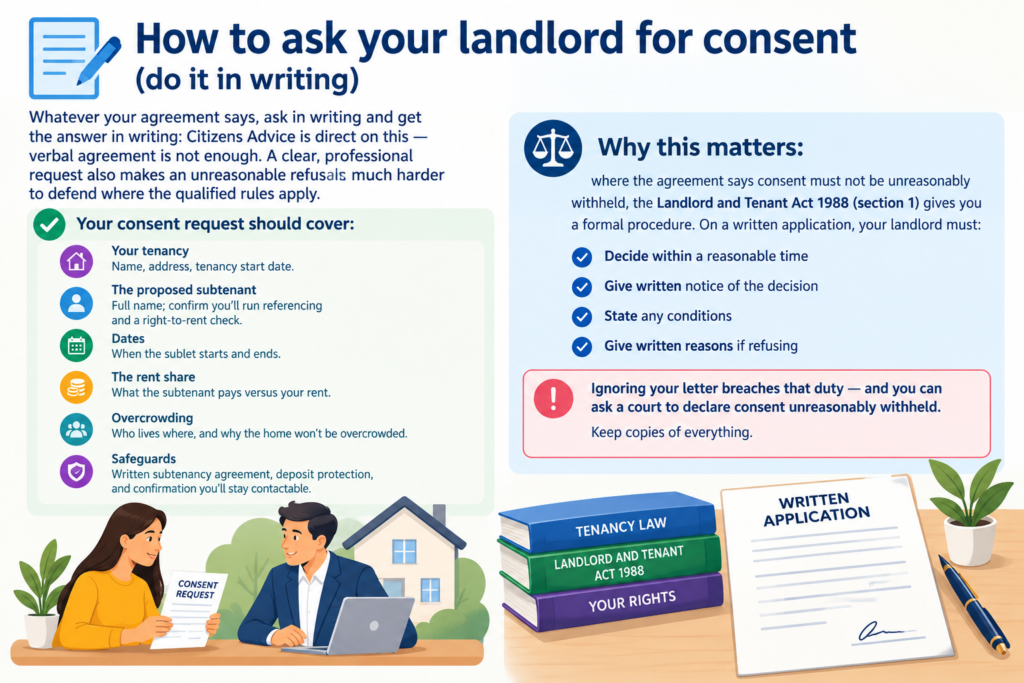
Whatever your agreement says, ask in writing and get the answer in writing: Citizens Advice is direct on this — verbal agreement is not enough. A clear, professional request also makes an unreasonable refusal much harder to defend where the qualified rules apply.
If you want to sublet a rented home, your consent request should cover:
- Your tenancy — name, address, tenancy start date
- The proposed subtenant — full name; confirm you’ll run referencing and a right-to-rent check
- Dates — when the sublet starts and ends
- The rent share — what the subtenant pays versus your rent
- Overcrowding — who lives where, and why the home won’t be overcrowded
- Safeguards — written subtenancy agreement, deposit protection, and confirmation you’ll stay contactable
Why this matters: where the agreement says consent must not be unreasonably withheld, the Landlord and Tenant Act 1988 (section 1) gives you a formal procedure. On a written application, your landlord must decide within a reasonable time, give written notice of the decision, state any conditions, and give written reasons if refusing. Ignoring your letter breaches that duty — and you can ask a court to declare consent unreasonably withheld. Keep copies of everything.
When can your landlord say no?
Whether your landlord can refuse when you sublet a rented home depends on your position:
| Your legal position | Can the landlord refuse? |
|---|---|
| Agreement expressly says consent must not be unreasonably withheld | Only with a genuine reason — overcrowding is Citizens Advice’s classic example: if the arrangement breaches the statutory standards, the landlord can reasonably refuse. |
| Consent rests on the section 15 implied term | For any reason — or no reason. The landlord does not have to explain themselves. |
What counts as overcrowding? The Housing Act 1985 sets two tests: the room standard (two people aged 10+ of opposite sexes, not living as a couple, must not share a sleeping room) and the space standard (permitted occupants by room count and floor area). If your proposal breaches either, a refusal is on solid ground.
What conditions can a landlord attach to consent?
Where the qualified rules apply, consent may come subject to reasonable conditions — an unreasonable condition doesn’t satisfy the legal duty. Typically reasonable: referencing and a right-to-rent check on the subtenant, a written subtenancy agreement, confirmation the deposit will be protected, and evidence insurance remains valid. Ignore these expectations and your plan to sublet a rented home can stall before it starts.
One honest caveat: whether a landlord can demand a higher deposit as the price of consent is legally uncertain. The Tenant Fees Act 2019 caps deposits at five or six weeks’ rent, but it isn’t confirmed whether a landlord can take an extra deposit as a consent condition. Don’t agree to pay extra for consent without legal advice — and the Act’s banned-payments rules apply in England only. Whatever the condition, never sublet a rented home without written consent in place.
What happens if you sublet a rented home without permission?
To sublet a rented home without required consent is a breach of contract — in the private sector the landlord’s route is eviction, not prosecution. (Social housing is different and far more serious — see the box below.)
In England, breaching any tenancy obligation other than paying rent triggers Ground 12 of the Housing Act 1988 — a discretionary possession ground on two weeks’ notice, unchanged by the Renters’ Rights Act. “Discretionary” means the court decides whether eviction is reasonable.
Second danger: an assured tenancy only exists while you occupy the home as your only or principal home. Move out entirely and sublet the whole property, and you can lose assured status altogether — freeing the landlord from the statutory possession grounds. (The harsher section 15A rule, making that loss irreversible, applies only to social-housing landlords.)
Your subtenant is caught in the crossfire too. A subtenancy is a derivative interest: the subtenant can stay only while your (mesne) tenancy continues, even if the sublet was unauthorised. The head landlord must end your tenancy through the courts to remove them — changing the locks or forcing them out without a court order is an illegal eviction under the Protection from Eviction Act 1977. (Assured tenancies can’t be forfeited: possession always needs a Section 8 court order.)
Warning — social housing is a different world: the Prevention of Social Housing Fraud Act 2013 makes it a criminal offence for a social tenant to sublet the whole home in breach and stop living there. A knowing breach carries an unlimited fine; a dishonest one up to two years’ imprisonment and/or an unlimited fine, plus Unlawful Profit Orders to repay the profit. Councils actively prosecute.
Airbnb and short stays: does the same rule apply?
Yes — listing your rented home or part of it on Airbnb counts as subletting or parting with possession and needs the same consent. Around one in eight tenants has sublet, roughly half without permission, and the gap between monthly rent and nightly rates is a powerful temptation. But the risks stack up fast:
| Risk | The rule |
|---|---|
| Consent | Short stays are subletting — your tenancy’s consent rules apply exactly as above |
| London planning law | In Greater London, the Deregulation Act 2015 allows temporary sleeping accommodation for up to 90 nights per calendar year without planning permission; beyond that is a material change of use. The cap is per property, across all platforms, and only works if you remain liable for council tax. Hosted room lets (you live there) aren’t caught. |
| Insurance | Standard insurance is priced for long-term tenants, not paying guests. Hosting on Airbnb — even for a single weekend — can leave damage, theft or injury uncovered, or get your policy cancelled. Airbnb’s AirCover is not a substitute for proper insurance. Tell your insurer before you host. |
| HMO rules | Extra occupants can tip a property into an HMO: 3+ people in 2+ households sharing facilities is an HMO; 5+ people in 2+ households needs a mandatory licence. Running a licensable HMO without one is a criminal offence. |
| Lease and mortgage | Many flat leases require the property to be used as a private residence — short lets can breach the lease — and residential mortgages commonly require lender consent. Check both before you list. |
Worked example — Tess, Clapham: Tess lists her whole one-bed flat on Airbnb during five months of travelling, hosting guests for roughly 150 nights — well over London’s 90-night annual cap. Even with her landlord’s consent, nights 91–150 need planning permission the flat doesn’t have. Her consent was never in writing, and she never told her insurer — two more holes that could each sink her.
Does subletting affect your benefits when you sublet a rented home?
Whether your money changes when you sublet a rented home differs completely between benefit types:
| Money issue | What the rules say |
|---|---|
| Universal Credit | Rent from a subtenant is not treated as income for UC — whatever you charge, your UC is unaffected. |
| Housing Benefit | Subtenant income can affect HB: only £4 a week is disregarded (plus £10.55 if payments include heating) — the rest counts as income. If you claim HB, ask the council for a better-off calculation first. |
| Income tax — the £1,000 allowance | The first £1,000 of property income per tax year is tax-free. Between £1,000 and £2,500 gross, contact HMRC; above £2,500 after expenses (or £10,000 before), file a Self Assessment return. Above £1,000, deduct either the £1,000 allowance or actual expenses — not both. |
| Income tax — Rent-a-Room | Up to £7,500 a year tax-free for letting furnished accommodation in your main home (halved to £3,750 if shared). Tenants qualify too, with the landlord’s permission. Automatic at £7,500 or less; above that, you’re taxed on the excess with no expense deductions, or you can opt out and declare profit normally. Covers lodgers and room lets while you live there — not letting the whole property while you live elsewhere. |
| Council tax — 25% discount | The single-person discount needs you to be the only adult (18+) living there as your main home. A subtenant who isn’t disregarded ends the discount — two or more non-disregarded adults means none at all. Tell the council about household changes; penalties apply for not reporting. See our council tax guide for renters. |
| Contents insurance | Renting out a room can raise your premium, and you must tell your insurer — a claim could otherwise be refused. See our renters’ contents insurance guide. |
Worked example — Saskia, Bristol: Saskia sublets her spare room for £650 a month while she stays in the flat. Here’s what that means financially:
- Universal Credit: the £650 is ignored entirely — her UC stays the same.
- Housing Benefit (if she claimed it): £650 × 12 ÷ 52 = £150 a week; only £4 is disregarded, so ~£146 a week counts as income — her HB could fall sharply. She should get a better-off calculation from the council first.
- Income tax: £650 × 12 = £7,800 a year. She lives there, the room is furnished and her landlord consents, so Rent-a-Room applies: the first £7,500 is tax-free; she only deals with tax on the remaining £300 (or opts out and deducts expenses instead).
- Council tax: she loses her 25% single-person discount, because she is no longer the only adult in the home.
One spare room, four separate money consequences when you sublet rented home — all predictable if you check first.
Worked example — Imran, Sheffield: Imran takes in a subtenant for one term at £500 a month (£6,000 a year), lives in the flat himself, and has his landlord’s written consent. £6,000 sits below the £7,500 Rent-a-Room threshold, so it’s tax-free and he doesn’t need to tell HMRC; his UC is unaffected. He still tells the council (losing his 25% discount) and his insurer, protects the £500 deposit within 30 days, and issues a written statement of terms — because even a friendly arrangement is a legal landlordship.
You become a landlord: your legal duties to your subtenant
The moment you sublet a rented home, you are the landlord of that subtenancy — with landlord duties to match. This catches tenants out more than anything else:
| Your duty to your subtenant | The rule |
|---|---|
| Right-to-rent checks | The immediate landlord must check immigration status — that’s you, even if your own landlord knows. Check every adult before move-in and keep copies. Penalties since February 2024: £10,000 per occupier for a first breach, £20,000 per repeat breach; knowingly letting to someone without the right to rent means an unlimited fine and/or up to 5 years in prison. England only. See our right-to-rent guide. |
| Deposit protection | Any deposit you take must be protected in an authorised scheme within 30 days, with prescribed information given to the subtenant. Fail, and the subtenant can claim 1–3 times the deposit — and you’re barred from most possession routes until it’s fixed. (The RRA carried these duties into the new assured-tenancy regime.) See our deposit protection guide. |
| Written statement of terms | Before the subtenancy starts, you must give the subtenant a Written Statement of Terms — civil penalty up to £7,000 (starting point £4,000; up to £40,000 for a continuing breach). |
| Deposit caps | The Tenant Fees Act caps bind you too: max 5 weeks’ rent as a deposit (6 weeks at £50,000+ annual rent), max 1 week’s rent as a holding deposit. Banned fees are banned for you as well. (This is the straightforward legal reading of the Act’s general wording; no case has tested enforcement against tenant-sublandlords specifically.) |
| Safety duties | Gas safety, electrical checks and the rest apply to the sublet just as they do to your own tenancy. |
If your tenancy ends, what happens to your subtenant?
If you sublet a rented home, your subtenant’s rights depend on yours. Your subtenant’s right to stay is derivative: it ends when your tenancy ends — by notice, agreement or possession order. That’s why unauthorised subtenants are so exposed, and why head landlords must still go through the courts.
If your own tenancy is ending, tell your subtenant early — and if your decision to sublet a rented home without permission caused the eviction, you may be liable for their losses.
How the rules differ in Scotland, Wales and Northern Ireland
Everything above covers whether you can sublet a rented home in England. The other nations do it differently:
| Nation | The subletting rule |
|---|---|
| Scotland — private (PRT) | A statutory term bans subletting (whole or part), taking lodgers, assigning or sharing possession without the landlord’s written agreement. Breach can mean eviction via Ground 10 (not occupying as your only/principal home — mandatory) or Ground 11 (breach of the agreement — discretionary) at the First-tier Tribunal. (References to “Ground 12” are wrong — that’s rent arrears in Scotland.) |
| Scotland — secure (council) | Written application with details including any payment; refusal only if not unreasonable; the landlord must reply in writing within one month with reasons, and silence counts as consent. |
| Wales | Subletting is “suboccupation” (Renting Homes (Wales) Act 2016, ss.59–68). No right to sublet without the landlord’s agreement — usually an additional contract term. You become landlord of your sub-holder; your landlord becomes the head landlord. |
| Northern Ireland — private | No statutory subletting provision — the agreement governs, and in practice agreements almost always require written permission. |
| Northern Ireland — regulated tenancies | The Rent (NI) Order 1978 gives a mandatory possession ground where the tenant has, without consent, assigned or sublet the whole dwelling. |
| Northern Ireland — secure | An absolute right to take lodgers; subletting part needs written consent, not to be unreasonably withheld, with written reasons for refusal — and no conditions may be attached. |
Right-to-rent checks and the Tenant Fees Act are England-only — they don’t apply in the other nations. Wherever you sublet a rented home, check the local rules first.
Your subletting consent checklist
Before you sublet a rented home and anyone moves in, run through this list:
- Read your agreement — find the subletting clause; note whether consent “must not be unreasonably withheld” or the ban is absolute.
- Ask in writing — cover your tenancy details, the subtenant’s details, dates, the rent share, and why the home won’t be overcrowded.
- Wait for written consent — read any conditions carefully. Never rely on a verbal “yes”.
- Check the conditions are reasonable — don’t agree to higher deposits or fees as a consent condition without legal advice (see the caveat above).
- Right-to-rent check every adult subtenant before move-in; keep copies.
- Sign a written subtenancy agreement — plus the Written Statement of Terms the RRA requires before the subtenancy starts.
- Protect any deposit in an authorised scheme within 30 days, and give the prescribed information.
- Tell your insurer and confirm the policy covers subletting; check HMO thresholds before adding occupants.
- Tell the council about the new household (council tax, benefits); tell HMRC if sublet income tops £1,000 in the tax year.
- Take an inventory with photos on move-in day — standard landlord practice, and it protects you if deductions are disputed.
- Airbnb or short stays: consent still required, London’s 90-night cap applies, and watch the insurance gap. (A national short-let registration scheme has been discussed but isn’t confirmed — re-check current rules before hosting.)
Frequently Asked Questions
Can I sublet my rented flat without telling my landlord?
Not if your tenancy requires consent — and in England, the implied term in every assured periodic tenancy does. Subletting without required consent is a breach of contract, and your landlord can start possession proceedings on Ground 12 (two weeks’ notice). Always ask first, in writing.
Can my landlord refuse my subletting request for no reason?
It depends on your agreement. If it says consent must “not be unreasonably withheld”, the landlord needs a genuine reason (overcrowding is the classic one). But where consent rests only on the section 15 implied term, the landlord can refuse for any reason and doesn’t have to explain.
How long does my landlord have to reply to my request?
Where the qualified “not unreasonably withheld” rules apply, the landlord must decide within a reasonable time and give written reasons if refusing. There’s no fixed deadline in the legislation, but ignoring a written request breaches the duty. Keep copies of everything you send.
Can I take in a lodger instead of a subtenant?
Possibly, but it isn’t a loophole: lodgers still need your landlord’s permission under most private tenancies. The upside is Rent-a-Room relief — up to £7,500 a year tax-free — if your landlord agrees.
Does subletting affect my Universal Credit?
No. Rent from a subtenant is not treated as income for Universal Credit, so your UC won’t change. But the same income can reduce Housing Benefit (only £4 a week is disregarded) and is taxable above the property allowance thresholds — so check which benefits you actually claim.
Do I have to pay tax on money from a subtenant?
Possibly. The first £1,000 of property income per tax year is tax-free under the property allowance. If you live in the home and let a furnished room with your landlord’s permission, Rent-a-Room gives you up to £7,500 a year tax-free instead. Above those thresholds, you may need to contact HMRC or file a Self Assessment return.
Can I put my rented flat on Airbnb while I’m away?
Only with your landlord’s consent — short stays count as subletting. In Greater London there’s also a 90-night annual planning cap per property, standard insurance often won’t cover paying guests, and adding occupants can trigger HMO rules. Sort consent, insurance and the 90-night rule before you list.
I’ve already sublet without permission — what should I do?
Get advice quickly (Citizens Advice or Shelter), and don’t ignore it. Your landlord can seek possession on Ground 12, and if you’ve moved out entirely you may have lost your tenancy’s assured status. Asking for retrospective consent — and fixing any deposit-protection or right-to-rent failures — is better than waiting to be discovered.
Does my subtenant have any rights if I get evicted?
Your subtenant’s right to stay is derivative — it ends when your tenancy ends, even if the sublet was unauthorised. But the head landlord must still end your tenancy through the courts; forcing the subtenant out without a court order (changing locks, for example) is an illegal eviction.
Do I really have to protect my subtenant’s deposit?
Yes. Whoever receives the deposit must protect it in an authorised scheme within 30 days and give the prescribed information — and that “whoever” is you. Fail, and your subtenant can claim one to three times the deposit, barring you from most possession routes until it’s fixed.
Can my landlord charge me a fee or a higher deposit to allow subletting?
Be very careful here. The Tenant Fees Act 2019 caps deposits at five or six weeks’ rent and bans most fees — but whether a landlord can demand a higher deposit as a condition of consent isn’t confirmed. Don’t agree to pay extra without legal advice.
What’s the difference between the rules in England, Scotland, Wales and Northern Ireland?
England runs on the section 15 implied term (consent required, refusal can be for any reason unless the agreement says otherwise). Scotland’s private tenancies need the landlord’s written agreement; Wales calls it “suboccupation” and makes you your sub-holder’s landlord; Northern Ireland private tenancies are governed by the agreement alone. See the comparison table above for the details.
Final Thoughts
Subletting isn’t forbidden — but in England it is permission-based: you cannot sublet a rented home without your landlord’s consent, and the permission sits with your landlord. Get consent in writing, understand the implied term lets your landlord refuse for any reason unless your agreement says otherwise, and remember that the moment someone pays you rent, you pick up full landlord duties: right-to-rent checks, deposit protection, a written statement of terms, deposit caps. The money side is kinder than expected — UC ignores sublet rent, Rent-a-Room shelters up to £7,500 a year of room income — but Housing Benefit, council tax and insurance all need a check.
Before committing, run the numbers: our income-required-to-rent calculator shows what salary your rent demands, the rent-to-income ratio calculator checks your budget is healthy, and the Universal Credit affordability guide covers the benefits picture. Thinking longer term? The rent-vs-buy calculator puts both options side by side. Sublet smart, stay legal, and keep everything in writing.
Further Reading
- Check if you can sublet your home — Citizens Advice — the authoritative tenant-facing explainer on consent, whole-vs-part, and benefit impacts
- Subletting from another tenant — Shelter — your rights if you are the subtenant, including what happens when the head tenancy ends
- Tenant Fees Act 2019: guidance for tenants — GOV.UK — the official word on deposit caps and banned payments