
Failed a Rent Affordability Check: Reviewed for accuracy against current UK government and Shelter guidance. Last updated: August 2026.
You’ve found the flat you want.
The location is right, the rent looks manageable, and you have a regular income coming in every month. You send over your payslips, employment details, and the other documents the letting agent asks for.
Then comes the message you were hoping not to receive:
“Unluckily, you have not approved the affordability Review .”
It can be a horrible feeling.
Especially when you know you can pay the rent.
You might start wondering whether there is something wrong with your income, your credit history, or your application. You may even think, “If I can manage £1,000 a month, why is Somebody else informing me I can’t?”
The important thing to understand is that a rent affordability check is not a complete picture of your financial life. It is an assessment based on particular criteria used by a landlord, letting agent, or referencing provider.
So failing one check does not automatically mean you cannot rent a home.
Sometimes you simply missed a particular income threshold. Sometimes part of your income was not counted. Sometimes your employment situation made verification difficult. And in some cases, the problem may not have been affordability at all.
The good news is that once you know what went wrong, you can often work out what to do next.
Quick answer: Failing a rent affordability check usually means your income didn’t meet the landlord’s chosen multiple of the rent — commonly around 30 times the monthly rent — not that you have bad credit or can’t rent at all. Ask the agent exactly which part of referencing you failed, then look at a guarantor, additional income evidence, or a lower rent band.
Visit now:Rent Affordability Calculator UK
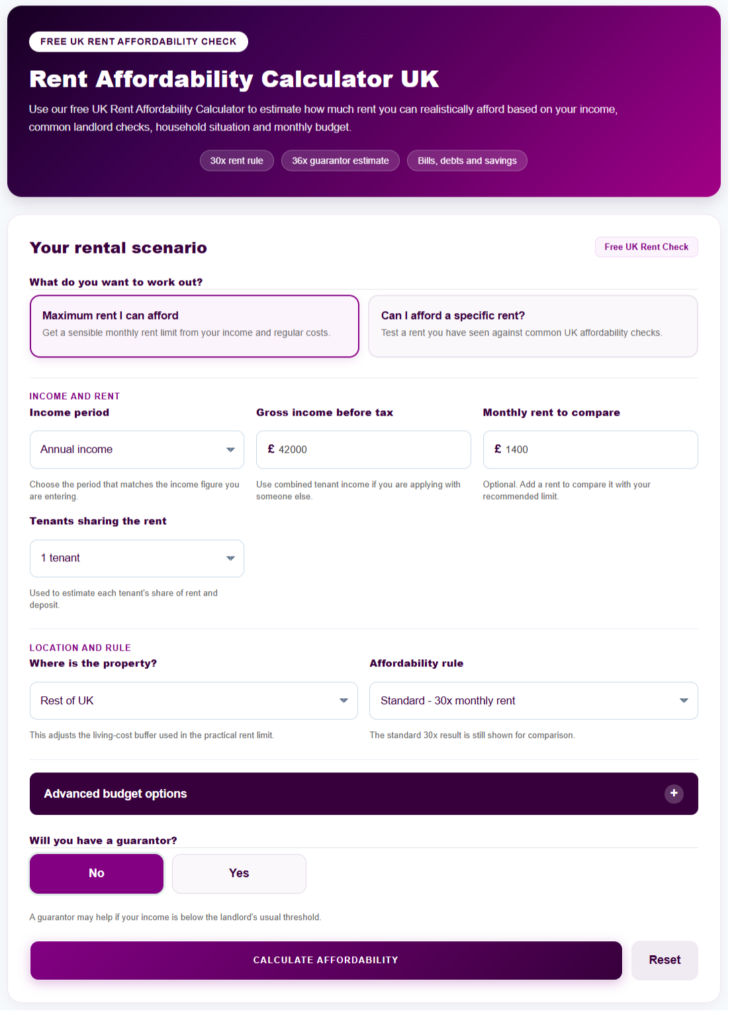
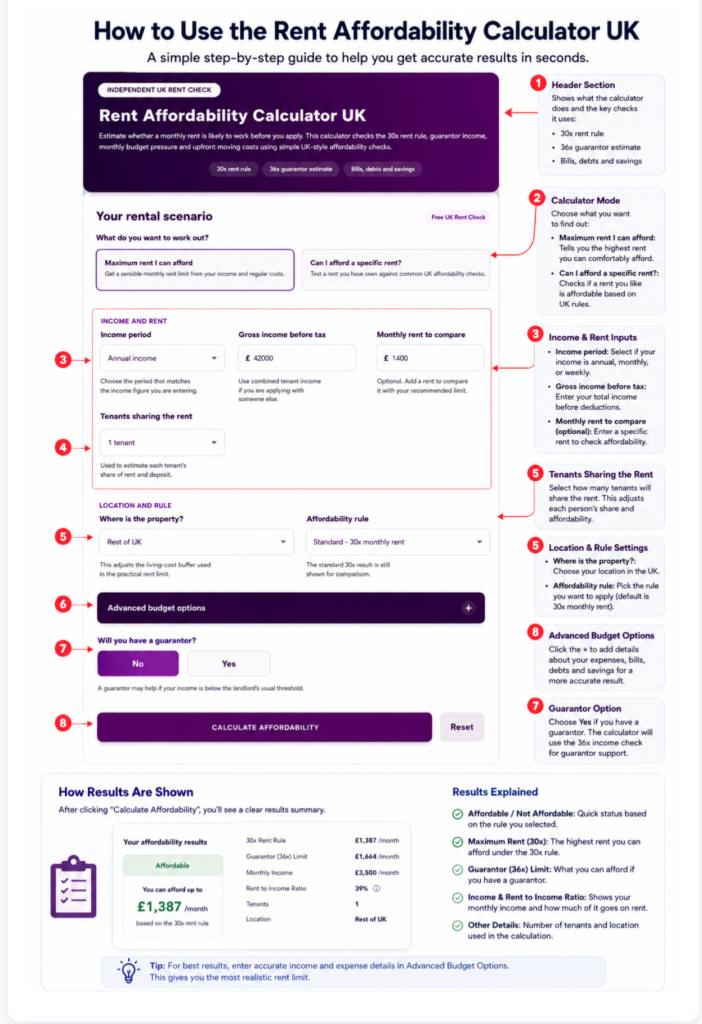
How to Use the Rent Affordability Calculator UK
What Does It Actually Mean to Fail a Rent Affordability Check?
Before you start worrying about your next application, it helps to understand what the failed rent affordability check is trying to establish.
A landlord wants reasonable confidence that you will be able to keep paying the rent throughout the tenancy. A referencing provider may therefore compare your income with the rent and look at other information supplied during the referencing process.
There isn’t one universal affordability formula that every landlord in the UK has to use. Different landlords and referencing companies can have different requirements.
One commonly used approach is to compare annual income with a multiple of the monthly rent.
Read more:First Class Degree Calculator – How Close Are You to a First?| Monthly Rent | Calculation | Annual Income Requirement |
|---|---|---|
| £1,000 | £1,000 × 12 | £12,000 annual rent |
| £1,000 | £1,000 × 30 | £30,000 required income |
| £1,000 | £28,000 income | Falls short |
| £1,000 | £30,000 income | Meets the calculation |
But that doesn’t necessarily mean the person earning £28,000 is incapable of paying £1,000 rent. It simply means they haven’t met that particular referencing Requirement.
That Difference is easy to miss, but it is one of the most important things to understand when an affordability check goes wrong.
Why Do Landlords Use Affordability Checks?
Think about the situation from the landlord’s side.
If a property is rented for £1,200 a month, the landlord isn’t only interested in whether you can make the first payment.
They want to know whether you are likely to remain able to pay that amount month after month.
That’s why an affordability assessment may look at income and employment rather than simply asking how much money you have available today.
A person could have £10,000 in their bank account but no regular income.
Another person could have very little savings but a stable £45,000 salary.
The two situations tell a landlord very different things about ongoing rent payments.
Referencing is therefore designed to create a consistent way of assessing applicants.
The problem is that real people’s finances are rarely as simple as a single salary figure.
You might earn commission.
You might work overtime.
You might be self-employed.
You might have recently changed jobs.
You might receive benefits alongside employment income.
You might have moved to the UK recently.
And that is where affordability checks can become more complicated.
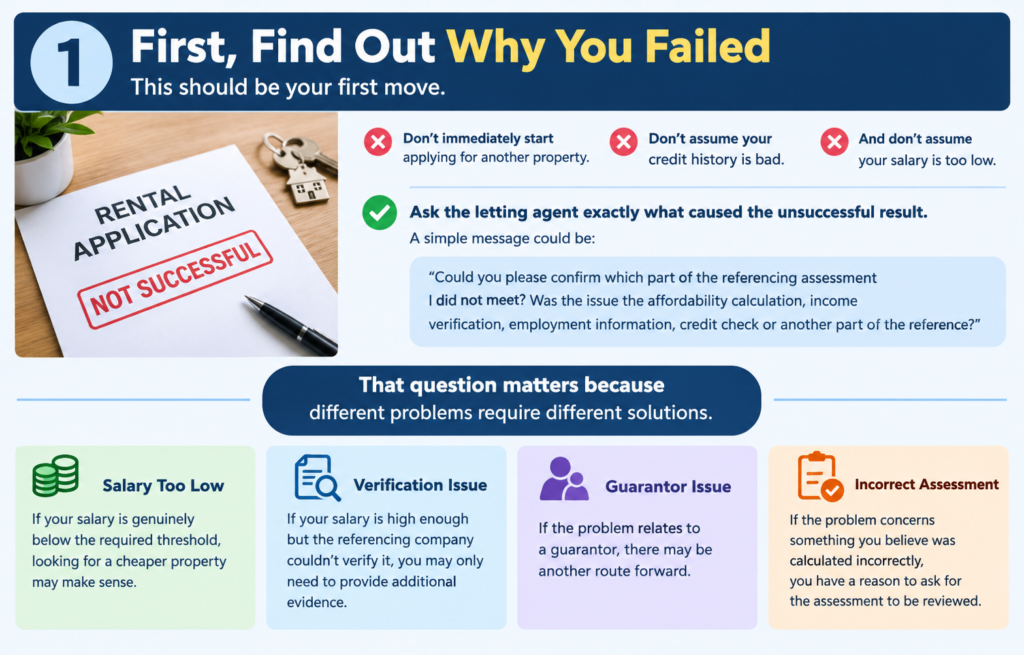
First, Find Out Why You Failed
This should be your first move.
Don’t immediately start applying for another property.
Don’t assume your credit history is bad.
And don’t assume your salary is too low.
Ask the letting agent exactly what caused the unsuccessful result.
A simple message could be:
“Could you please confirm which part of the referencing assessment I did not meet? Was the issue the affordability calculation, income verification, employment information, credit check or another part of the reference?”
That question matters because different problems require different solutions.
If your salary is genuinely below the required threshold, looking for a cheaper property may make sense.
If your salary is high enough but the referencing company couldn’t verify it, you may only need to provide additional evidence.
If the issue relates to a guarantor, there may be another route forward.
And if the problem concerns something you believe was calculated incorrectly, you have a reason to ask for the assessment to be reviewed.
Turn the Failed Result Into a Checklist
Before you make another application, write down the exact reason for the failed check. This prevents you from making the same mistake twice.
For example, if the problem was income, note the income figure the referencing provider used and the income they expected. If the problem was verification, list the documents that were missing or could not be confirmed. If the issue was your credit history, ask what type of information caused concern. If you were applying jointly, confirm whether both incomes were assessed together.
You can then use this simple checklist:
- Income: What annual income did they use?
- Rent: What monthly rent did they assess?
- Affordability rule: What income multiple or calculation was used?
- Income evidence: Was every relevant source of income included?
- Employment: Was my current job successfully verified?
- Credit: Was there a separate credit-related issue?
- References: Was a previous landlord reference required?
- Documents: Was anything missing or unclear?
- Guarantor: Would the landlord accept one?
Getting these answers turns a vague “failed” result into a specific problem that you can actually address.
Let’s Look at the Numbers
| Scenario | Calculation | Result |
|---|---|---|
| Annual salary | — | £35,000 |
| Gross monthly income | £35,000 ÷ 12 | £2,916.67 |
| Rent | — | £1,100/month |
| Income requirement | £1,100 × 30 | £33,000 |
| Difference | £35,000 − £33,000 | £2,000 above requirement |
| Result | — | Meet the income threshold |
| New rent | — | £1,200/month |
| New income requirement | £1,200 × 30 | £36,000 |
| Difference | £36,000 − £35,000 | £1,000 below requirement |
| Result | — | Below the illustrative requirement |
Nothing changed about your job.
Nothing changed about your salary.
The only thing that changed was the cost.
And suddenly the outcome can be different.
This is why a renter who passes one property can fail another property only a few minutes later.
Calculate Your Rent-to-Income Ratio Before You Apply
One useful way to check a property before applying is to calculate your rent-to-income ratio.
The basic calculation is:
Rent-to-Income Ratio = Monthly Rent ÷ Monthly Gross Income × 100
For example, if you earn £3,000 gross per month and the rent is £1,000:
£1,000 ÷ £3,000 × 100 = 33.3%
This does not tell you whether a landlord will approve your application, because referencing providers may use different affordability methods. However, it gives you a quick way to compare properties before you spend time gathering documents or paying a holding deposit.
You can also repeat the calculation using your take-home pay. This gives you a second view: one figure helps you understand the type of affordability test a landlord might use, while the other helps you understand how much of your actual monthly income the rent would consume.
Using both calculations can help you spot a property that technically passes an affordability test but would leave your personal budget under pressure.
Illustrative income needed at a 30× monthly rent multiple
| Monthly rent | Annual rent | Illustrative income required (30×) |
| £800 | £9,600 | £24,000 |
| £950 | £11,400 | £28,500 |
| £1,000 | £12,000 | £30,000 |
| £1,100 | £13,200 | £33,000 |
| £1,200 | £14,400 | £36,000 |
| £1,350 | £16,200 | £40,500 |
| £1,500 | £18,000 | £45,000 |
This is an illustrative example only. Actual income multiples vary by landlord and referencing provider — some use 30×, others use different multiples or affordability models entirely.
Read more:What Income Counts for Rent Affordability Checks in the UK?A £50 Increase in Rent Can Make a Bigger Difference Than You Think
Here’s another example.
| Scenario | Calculation | Result |
|---|---|---|
| Annual salary | — | £30,000 |
| Property rent | — | £1,000/month |
| Income requirement | £1,000 × 30 | £30,000 |
| Result | — | Meet the threshold |
| New property rent | — | £1,050/month |
| New income requirement | £1,050 × 30 | £31,500 |
| Difference | £31,500 − £30,000 | £1,500 below requirement |
Suddenly, the illustrative income requirement is £1,500 higher than your salary.
That £50 monthly difference could therefore change the referencing result.
And if you actually choose the £1,050 property, that extra £50 also costs you:
£50 × 12 = £600 a year.
So a small-looking difference in monthly rent can matter both to the referencing calculation and to your real household budget.
Passing the Check Doesn’t Automatically Mean the Rent Is Comfortable
This is where you need to differentiate between two different questions.
Question one: Can I pass the landlord’s affordability test?
Question two: Can I comfortably live with this rent?
They aren’t necessarily the same.
Imagine you take home £2,500 a month.
Your rent is £1,000.
Then you have:
- Council tax: £150
- Gas and electricity: £160
- Transport: £200
- Food: £300
- Phone and internet: £60
- Insurance: £70
- Other essential costs: £180
| Expense | Monthly Amount |
|---|---|
| Rent | £1,000 |
| Council tax | £150 |
| Gas and electricity | £160 |
| Food | £200 |
| Transport | £300 |
| Internet | £60 |
| Phone | £70 |
| Other spending | £180 |
| Total spending | £2,120 |
| Monthly income | £2,500 |
| Remaining amount | £380 |
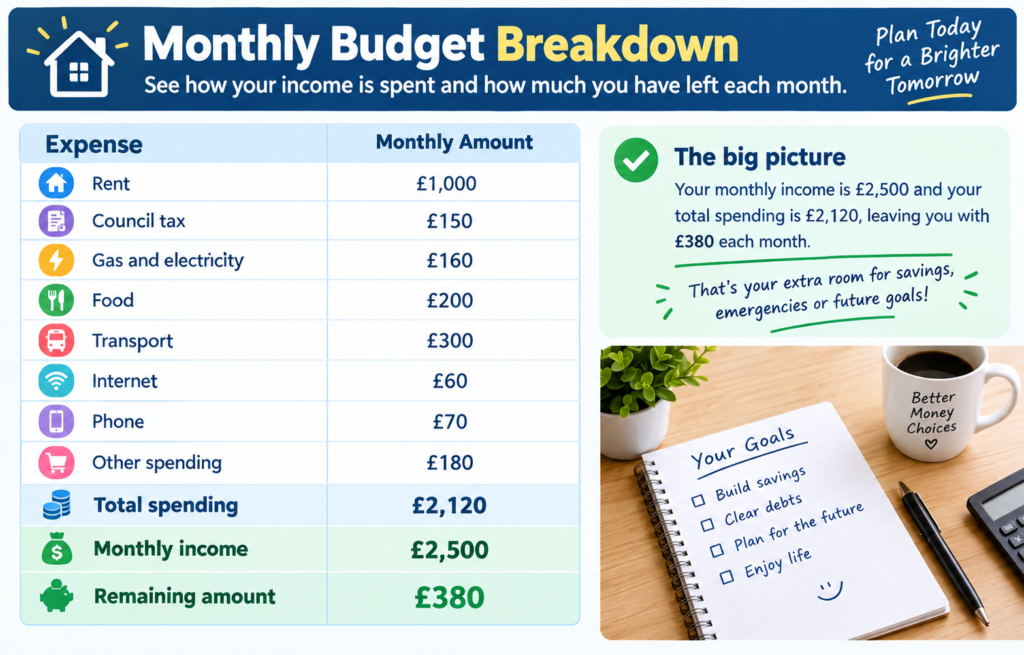
You may have passed the affordability assessment.
But you only have £380 left for everything else.
That could include clothing, entertainment, emergencies, savings, unexpected bills, and anything else that appears during the month.
This is why you shouldn’t make your target:
“I want the most expensive property I can technically pass.”
A much better question is:
“What cost leaves me enough room to live without frequently being serious about the next payment?”
What If Your Income Is Just Below the Requirement?
This is one of the most common situations.
| Item | Calculation | Amount |
|---|---|---|
| Annual salary | — | £32,000 |
| Monthly rent | — | £1,100 |
| Illustrative income requirement | £1,100 × 30 | £33,000 |
| Difference | £33,000 − £32,000 | £1,000 below requirement |
You’re £1,000 below the example threshold.
That doesn’t necessarily mean the application is hopeless.
Ask the agent whether the landlord would consider an alternative arrangement.
Depending on the landlord’s policy, possibilities could include:
- A guarantor
- Additional acceptable income evidence
- A different property
- A lower monthly rent
- Another arrangement offered by the landlord
Don’t assume that an alternative will be accepted.
Instead, ask.
A useful question is:
“My earnings are slightly below the affordability limit. Does the landlord accept a guarantor, or is there another way to support the application?”
That’s far more productive than simply accepting the rejection without asking why.
Could a Guarantor Help?
In some cases, yes.
A guarantor is someone who agrees to meet certain financial obligations under the tenancy if the tenant fails to do so, depending on the terms of the guarantee.
Some landlords also accept guarantor insurance schemes as an alternative to a personal guarantor — it’s worth asking the agent whether this is an option.
Shelter explains that a guarantor may be an option for someone who does not pass an income, credit or reference check.
But having someone willing to act as your guarantor doesn’t automatically guarantee acceptance.
The landlord or referencing provider may have its own requirements.
For example, they may want a guarantor with sufficient income and an acceptable financial history.
So before asking your parents, relative, or friend to provide lots of paperwork, ask the agent:
“What are your guarantor requirements?”
That way, you know whether the person you have in mind is likely to meet them.
Example: How a Guarantor Could Change the Situation
| Item | Calculation | Amount |
|---|---|---|
| Annual salary | — | £27,000 |
| Monthly rent | — | £1,000 |
| Illustrative income requirement | £1,000 × 30 | £30,000 |
| Difference | £30,000 − £27,000 | £3,000 below threshold |
You ask the letting agent whether a guarantor is accepted.
They say yes.
You then find out that the guarantor needs to meet specific income and reference requirements.
If your proposed guarantor satisfies those requirements, the landlord may be willing to proceed.
Notice the important part here:
You didn’t manipulate your income.
You didn’t hide anything.
You simply found out whether the landlord had another legitimate way of assessing the risk.
What If You’re Self-Employed?
Being self-employed doesn’t mean you can’t rent.
It can, however, make the paperwork different.
An employed person might have straightforward monthly payslips showing their salary.
An independent worker may have earnings that change during the year.
| Item | Amount |
|---|---|
| Business sales | £65,000 |
| Personal income | Not automatically £65,000 |
Sales are not necessarily the same as your personal income.
After business expenses and other relevant calculations, the income figure used for referencing may be very different.
This is why self-employed renters may be asked for additional financial evidence, such as tax documents, accounts or other proof of income.
An accountant’s reference or SA302 tax calculation is also commonly accepted as proof of income for self-employed applicants.
If you’re self-employed, don’t wait until the referencing company asks for everything one document at a time.
Arrange the Related paperwork in advance.
It can make the process much Easier.
Read more:Do Overtime, Bonuses, and Commission Count for Rent Affordability?What If Your Salary Includes Overtime or Commission?
This is another area where people can get Unsure.
| Income Component | Annual Amount |
|---|---|
| Basic salary | £28,000 |
| Regular overtime | £5,000 |
| Commission | £4,000 |
| Potential annual income | £37,000 |
But the important question is:
Which parts of that £37,000 does the referencing provider accept?
Some income may be treated differently depending on how reliable or regular it is and according to the provider’s criteria.
So if you fail despite apparently having enough income, ask:
“Could you confirm which parts of my earnings were included in the affordability calculation?”
That question can reveal a lot.
What If You’re Applying With a Partner or Housemates?
Many renters apply as a couple or as a group of sharers, and the article so far only talks about a single applicant’s income. This matters because referencing providers don’t all treat joint applications the same way.
Some landlords and referencing companies will assess joint applicants on combined household income against the rent. Others review each tenant individually against their share of the rent, or against the full rent regardless of how many people are named on the rental agreement. This is worth checking before you assume two moderate incomes will simply add up the way you expect.
| Item | Calculation | Amount |
|---|---|---|
| Applicant 1 income | — | £24,000 |
| Applicant 2 income | — | £22,000 |
| Combined income | £24,000 + £22,000 | £46,000 |
| Monthly rent | — | £1,400 |
| Illustrative income requirement | £1,400 × 30 | £42,000 |
| Amount above requirement | £46,000 − £42,000 | £4,000 |
Combined, they comfortably clear the illustrative threshold. But if the referencing provider instead assesses each applicant against the full rent, neither person would pass on their own. So if a joint application fails, ask specifically:
“Is affordability assessed on our combined income, or does each of us need to individually meet the threshold?”
That single question can completely change what your next move should be — whether that’s adding a guarantor for the weaker earner, or simply asking the agent to confirm how the household was assessed.

Starting a New Job Can Also Cause Problems
Imagine you’ve accepted a new job paying £45,000 a year.
On paper, your income looks excellent.
But you started the job only two weeks ago.
You may not yet have a long series of payslips.
The referencing company may therefore need other evidence to verify your employment and salary.
That could include your employment contract or confirmation from your employer, depending on what the agent and referencing provider accept.
The mistake would be to think:
“I have no payslips, so I must be unable to rent.”
That’s not necessarily true.
Your problem may simply be that your current income needs to be demonstrated in another way.
Tell the letting agent about the new job before the application reaches the referencing stage.
What If You Receive Benefits?
Receiving benefits should not automatically put you at a disadvantage.
Current government guidance for England says landlords cannot discourage or prevent someone from renting because they receive benefits, and benefit income must be included when affordability is assessed.
| Income Source | Annual Amount |
|---|---|
| Employment income | £22,000 |
| Benefit income | £8,000 |
| Total relevant income | £30,000 |
If an affordability calculation requires £30,000 and the eligible benefit income has been properly included, the position can look very different from an assessment that only considers the salary.
This applies whether your benefit income comes from Universal Credit, Housing Benefit, or another award.
So if you receive benefits and think they were ignored, ask the agent how your income was calculated.
You don’t need to be Hostile.
Simply ask for the calculation.
What If the Problem Is Your Credit History?
Affordability and credit checks are not identical.
You could have enough income but still encounter a problem during referencing because of information in your credit history.
For example, the assessment may identify public information such as a CCJ, IVA or bankruptcy.
Shelter explains that landlords and agents can carry out credit checks with permission and that these are generally soft searches that don’t affect your credit score.
A soft search shows the agent or referencing provider a snapshot of your credit information — things like CCJs, IVAs, bankruptcy, or missed payments on public record — without leaving a mark that other lenders can see, and without affecting your credit score the way a mortgage or credit card application would. This is different from a “hard” credit check, which is why most tenancy referencing doesn’t damage your ability to get a mortgage or loan later.
If you’re not sure which type of check was run, ask the agent directly rather than supposing the worst. It’s a reasonable question, and a Legal referencing provider should be able to tell you.
If your application fails, ask whether the issue was actually affordability or whether something else came up during referencing.
This distinction matters.
If the problem is credit history, you may need a different solution than someone whose income simply doesn’t meet the rent threshold.
Don’t Assume Every Failed Check Means Your Credit Is Bad
This is worth repeating because people often jump to the worst conclusion.
You receive:
“Your application has not passed referencing.”
Your brain immediately goes:
“My credit must be terrible.”
Not necessarily.
| Possible Issue |
|---|
| Salary below the required threshold |
| Missing payslips |
| Unable to verify employment |
| Self-employed income requiring more evidence |
| Variable income |
| Credit information |
| Rental reference |
| Right-to-rent documentation |
| Another part of the referencing process |
So don’t diagnose the problem yourself.
Ask.
What About Your Holding Deposit?
This is where things can become especially stressful.
You may have paid a holding deposit because you wanted to secure the property while referencing took place.
Then the application fails.
What happens to that money?
The answer depends on the circumstances.
Shelter states that where a tenant provided accurate information, a holding deposit should generally be returned if the landlord decides not to proceed, including certain situations where the tenant does not pass a credit or income check.
So don’t automatically assume:
“I failed referencing, therefore I’ve lost my holding deposit.”
Ask the agent why they believe the deposit can or cannot be retained.
Keep copies of everything.
| Documentation |
|---|
| Payment confirmation |
| Emails |
| Application forms |
| Referencing messages |
| Property details |
| Messages from the letting agent |
If there is a disagreement later, having the paperwork can make a huge difference.

What If the Agent Says “No Benefits”?
If you’re in England and an agent tells you that they won’t rent to you because you receive benefits, don’t simply assume that’s allowed.
Government guidance specifically addresses rental discrimination involving benefits. It states that landlords cannot refuse to rent simply because someone receives benefits, and benefit income should be included in affordability assessments.
Ask the agent to explain the actual affordability criteria.
Sometimes what sounds like:
“We don’t accept benefits.”
may need to be distinguished from a legitimate assessment of whether the applicant’s overall income meets the property’s affordability criteria.
The exact circumstances matter.
Read more:How Much Savings Should You Have Before Renting in the UK? (2026 Guide)Don’t Forget the Right-to-Rent Check
It’s also worth ruling out a completely different explanation. Even when your income, credit, and references are fine, there’s a separate check that has nothing to do with affordability at all.
A right-to-rent check is separate from affordability.
This matters particularly if you’re applying to rent in England.
| Factor | Status |
|---|---|
| Income | Enough income |
| References | Excellent references |
| Credit | Good credit |
and still need to complete the required right-to-rent process.
GOV.UK explains that landlords must check the right to rent of adult tenants who will use the property as their main home in England.
So if someone tells you that you “failed referencing”, don’t be afraid to ask which check failed.
It might not have been the affordability assessment at all.
Here’s a Better Way to Calculate Your Own Rent Limit
| Item | Calculation | Result |
|---|---|---|
| Annual salary | — | £36,000 |
| Monthly gross income | £36,000 ÷ 12 | £3,000 |
| Property rent | — | £1,200/month |
| Rent as % of gross income | £1,200 ÷ £3,000 × 100 | 40% |
| Lower property rent | — | £1,000/month |
| Rent as % of gross income | £1,000 ÷ £3,000 × 100 | 33.3% |
| Monthly rent difference | £1,200 − £1,000 | £200 |
| Annual rent difference | £200 × 12 | £2,400 |
So the £1,000 property leaves £2,400 more of your gross income available over the year than the £1,200 property, before considering any differences in bills or other costs.
This is why your personal calculation should happen before you start viewing properties.
Don’t wait for a referencing company to tell you what you can afford.
Build Your Budget Around Take-Home Pay
Gross salary is useful for understanding referencing.
But your personal budget should normally be built around the money that actually reaches your account.
Suppose your gross salary is £36,000.
Your actual take-home pay will be lower after applicable tax, National Insurance and other deductions.
So don’t look at £3,000 gross monthly income and think:
“I have £3,000 available.”
You don’t.
The amount you can actually spend is your net income.
| Regular Commitment |
|---|
| Rent |
| Council tax |
| Energy |
| Water |
| Internet |
| Food |
| Transport |
| Insurance |
| Debt repayments |
| Childcare |
| Other regular commitments |
Only after doing that can you see whether the property fits comfortably into your life.
A Simple Example of a Healthy Rental Decision
Imagine your monthly take-home pay is £2,600.
You find two properties.
| Item | Property A | Property B |
|---|---|---|
| Rent | £1,150 | £950 |
| Other essential costs | £1,000 | £1,000 |
| Total essential spending | £2,150 | £1,950 |
| Remaining | £450 | £650 |
| Extra remaining each month with Property B | — | £200 |
| Extra remaining over a year | — | £2,400 |
The cheaper property may not be as exciting.
Perhaps the kitchen isn’t quite as nice.
Maybe the bedroom is slightly smaller.
But £2,400 of additional annual breathing room can be worth far more than a nicer kitchen when an unexpected bill arrives.
What Should You Do Before Applying Again?
The best thing you can do is turn your failed application into information.
Find out:
What income figure did they use?
What rent figure did they assess?
What affordability multiplier did they use?
Were all relevant income sources included?
Was the issue affordability or another part of referencing?
Would they accept a guarantor?
What documents would strengthen another application?
Once you have these answers, your next application becomes much more strategic.
You stop applying randomly.
You know what type of property is realistic.
Create Your Own “Pre-Application” Check
Before paying a holding deposit, do a rough calculation.
| Item | Property A | Property B |
|---|---|---|
| Annual income | £34,000 | £34,000 |
| Monthly rent | £1,050 | £1,150 |
| Illustrative 30× requirement | £1,050 × 30 | £1,150 × 30 |
| Required income | £31,500 | £34,500 |
| Difference | £34,000 − £31,500 = £2,500 above | £34,500 − £34,000 = £500 below |
| Result | Looks comfortable under this calculation | Below the illustrative requirement |
Now you’re:
£500 below the illustrative requirement.
If your finances haven’t changed, you can already see that the second property may be more difficult to reference.
That five-minute calculation can save you from wasting time on applications that were unlikely to work.
What Documents Should You Have Ready?
If you’re actively looking for somewhere to rent, having your documents organised can make the process much less stressful.
Depending on your circumstances and what the agent requests, you may need things such as:
| Applicant Type | Documents / Evidence |
|---|---|
| For employed applicants | Recent payslips |
| Employment contract | |
| Employer details | |
| Bank statements where requested | |
| For self-employed applicants | Relevant tax documents |
| Accounts | |
| Proof of income | |
| Business financial information where required | |
| For people receiving benefits | Relevant benefit statements or evidence |
| For previous renters | Previous landlord or letting-agent reference |
| For guarantors | Evidence required by the landlord or referencing provider |
The exact documents vary.
Some referencing providers and letting agents publish their own online affordability calculator — using it before you apply can save you from an avoidable rejection.
Don’t send sensitive financial information to random people simply because they claim to be an agent. Make sure you’re dealing with a legitimate landlord, letting agent or referencing provider, and understand why each document is being requested.
One Mistake You Should Never Make
Don’t alter your financial information to pass the check.
If you earn £29,000, don’t write £35,000.
If your commission isn’t guaranteed, don’t present it as guaranteed.
If you’re self-employed, don’t turn business turnover into personal salary just because the number looks better.
A failed application can be frustrating.
But Incorrect information can create much bigger problems.
If you don’t meet the criteria, look for a Legal alternative.
Nothing is embarrassing about needing a cheaper property or a guarantor.
Read more:Rent Affordability Calculator Glasgow – Find Out How Much Rent You Can Afford What If You Keep Failing Affordability Checks?
If you’ve applied for several properties and repeatedly failed, stop for a moment.
Don’t just keep submitting applications.
Look for the pattern.
If every property is around £1,200 and your income is £30,000, the problem may simply be that your target rent is too high for the referencing criteria you’re encountering.
If you reduce your target to £950 or £1,000, the situation may look very different.
| Monthly Rent | 30× Calculation | Illustrative Annual Income Requirement |
|---|---|---|
| £1,200 | £1,200 × 30 | £36,000 |
| £1,000 | £1,000 × 30 | £30,000 |
| Difference | — | £6,000 |
Sometimes the solution isn’t fixing your application.
It’s changing the price range of the properties you’re applying for.
Don’t Let a Failed Check Make You Desperate
This is perhaps the most practical advice in the entire article.
When you’ve already lost one property, it is easy to become desperate about the next one.
You may think:
“I’ll do anything to get this flat.”
That’s exactly when people make poor decisions.
They agree to rent they can’t comfortably afford.
They pay suspicious fees.
They send personal documents to unverified people.
They exaggerate their income.
They borrow money simply to make an application look stronger.
Don’t.
A home should give you stability, not put you into financial panic from the first month.
If a property only works when everything goes perfectly, it probably doesn’t really work.

What a Failed Rent Check Can Actually Teach You
There is a strange upside to failing an affordability assessment.
It forces you to look closely at your money.
You may discover that the property you wanted was consuming too much of your income.
You may realise that your variable income isn’t as predictable as you thought.
You may discover that a £100 reduction in rent gives you much more breathing room than expected.
Or you may find that the issue wasn’t your finances at all—it was simply missing documentation.
In that sense, a failed check isn’t always a dead end.
Sometimes it is a warning sign.
And sometimes it is simply a paperwork problem wearing the mask of a financial problem.
Can I rent a property after failing an affordability check?
Yes. Failing one affordability assessment does not automatically prevent you from renting another property. Different landlords and referencing providers may use different criteria.
What should I ask after failing?
Ask exactly which part of the referencing process you did not meet and whether the issue was income, income verification, credit information, references, documentation, or another requirement.
What is the 30× rent calculation?
It is a commonly used illustrative method where the monthly rent is multiplied by 30 to estimate the annual income requirement. For example, £1,000 monthly rent × 30 = £30,000 annual income. It is not a universal UK legal requirement.
Can a guarantor help if my salary is too low?
Potentially, if the landlord accepts guarantors and your guarantor meets the required criteria.
Can self-employed people pass affordability checks?
Yes. Self-employed applicants may simply need to provide different evidence to demonstrate their income.
Can overtime and commission count?
It depends on the landlord or referencing provider’s criteria and how the income is assessed. Ask which parts of your income were included.
What if I have recently started a job?
You may need additional evidence of your salary and employment, such as an employment contract or employer confirmation, depending on the referencing requirements.
Can benefits be included in affordability?
In England, government guidance says benefit income must be included when affordability is assessed, and landlords cannot refuse to rent simply because someone receives benefits.
Does failing referencing mean I have bad credit?
No. An unsuccessful reference can happen for many reasons, including affordability, missing information, or employment verification. Ask the agent what specifically caused the result.
Can I lose my holding deposit if I fail referencing?
Not automatically. The circumstances matter. Shelter states that where accurate information was provided, a holding deposit should generally be returned in circumstances where the landlord decides not to proceed, including certain failed referencing situations.
Failed Your Rent Affordability Check? Do These 6 Things Next
If you’ve just received an unsuccessful referencing result, don’t immediately start another application. Take a short pause and work through these steps.
1. Ask for the specific reason.
Find out whether the issue was affordability, income verification, credit information, references, documentation or another part of the process.2. Ask what income was included.
Check whether salary, overtime, commission, benefits or other relevant income was counted according to the provider’s criteria.3. Ask what rent and affordability calculation were used.
You need to know the numbers before deciding whether the property was actually outside your range.4. Ask about legitimate alternatives.
Depending on the landlord’s policy, this could include a guarantor, additional evidence or another acceptable arrangement.5. Recalculate your own budget.
Use your take-home pay and include regular household expenses rather than looking only at gross salary.6. Change your search range if necessary.
If several properties are failing for the same affordability reason, lowering the maximum rent you search for may be more practical than repeatedly submitting applications that are unlikely to meet the same criteria.The goal is not simply to get another “passed” result. The goal is to understand what went wrong and make the next application with better information.
Conclusion
Failing a rent affordability check can make you feel as though the door has been slammed shut.
Usually, it hasn’t.
The first thing to do is find out why you failed.
If your income is too low for the rent, look at a cheaper property or ask whether a guarantor is accepted.
If your income wasn’t fully recognised, find out why and provide the appropriate evidence.
If you’re self-employed, prepare your financial documents.
If you’re starting a new job, provide proof of employment and salary.
If you receive benefits, make sure eligible income has been considered correctly.
If the issue is credit-related, ask what specifically caused the concern.
And if the problem is simply that the rent would leave you with very little money every month, take that seriously.
A successful affordability check is not the finish line.
You still have to live in the property after the paperwork is signed.
The best rental decision is therefore not:
“What is the most expensive home I can get approved for?”
It is:
“What home can I afford while still having enough money left to live, save and deal with life’s surprises?”
If you’ve just failed a rent affordability check, don’t see the result as a judgment on your financial situation.
Treat it as a signal.
Find the number that caused the problem.
Understand the criteria.
Work out your real budget.
Ask about legitimate alternatives.
Then make your next application with a much clearer idea of what is actually realistic.
Because getting approved for a tenancy is important—but being able to comfortably afford the home once you have the keys is even more important.