
Wondering how to end a tenancy early UK? You’re not alone. Elena, 29, rents a one-bedroom flat in Leeds on a 12-month fixed-term contract with a six-month break clause. A new job in Manchester means she must move in eight weeks — but her letting agent says the break clause “doesn’t exist anymore”, while her landlord insists she owes rent until next spring. Since 1 May 2026, England’s renting rules have changed, and leaving a tenancy early has changed with them.
Quick answer: In England fixed terms effectively ended on 1 May 2026: most private tenancies are now rolling periodic tenancies, old break clauses no longer have legal effect, and you can leave at any time with at least 2 months’ written notice — but the tenancy must end on the last day of a rent period, which can stretch the wait beyond two months. Scotland, Wales and Northern Ireland still use fixed terms, so break clauses and negotiated surrender still matter there. Never just walk out: rent stays due until the tenancy is properly ended, and unpaid rent can be chased through the county court.
Can I simply walk out of my tenancy?
No — and this is the single most expensive misunderstanding in renting. Moving your belongings out, handing the keys back, or posting them through the landlord’s letterbox does not end your tenancy by itself. Until the tenancy is ended properly — through valid notice, surrender, or a court order — you can remain liable for rent, and in some circumstances council tax, utility charges and damage costs too. That’s why so many tenants researching how to end a tenancy early UK end up paying rent for months after moving out.
Posting the keys through the letterbox is legally only an offer to surrender, which the landlord must accept. If they do not, the rent keeps accruing — whether you are in England’s new periodic system or on a fixed term anywhere in the UK.
The safe rule: you have not left until you have a written end date — a valid notice, a signed surrender, or a court order — and you keep paying rent until that date.
What changed in England in May 2026?
On 1 May 2026, the first phase of the Renters’ Rights Act 2025 took effect in England. Most existing assured shorthold tenancies automatically converted into periodic assured tenancies, and new private tenancies are now granted as periodic (rolling, with no fixed end date). Fixed-term, break-clause and rent-review clauses, and rent periods longer than one month, were invalidated on conversion. Understanding this change is the starting point for how to end a tenancy early UK in England today.
For tenants, the practical result is a complete change of frame: you no longer need a break clause in England — you need to get the notice mechanics right. Any old break clause in your agreement has ceased to have legal effect in the private sector. Section 21 “no-fault” eviction was abolished at the same time — read our Section 8 eviction notice guide for how landlords seek possession now, and our Renters’ Rights Act 2025 guide for the full background.
A few English private tenants can still be on a fixed term: those with a valid Section 21 or Section 8 notice served before 1 May 2026, where the landlord started court proceedings by the notice expiry date or 31 July 2026 (whichever was earlier). If that is you, your fixed term continues until the proceedings conclude — and your old break clause may still matter. If that’s you, read your agreement carefully before deciding how to end a tenancy early UK. Everyone else is on the new periodic rules below.
How to end a tenancy early UK: serving a valid notice in England
Under the new rules, you can end your periodic assured tenancy at any time with at least 2 months’ written notice. This is how to end a tenancy early UK in England under the post-May-2026 rules. The requirements are specific:
| Requirement | The rule |
|---|---|
| Length | At least 2 months — the maximum a landlord can require is 2 months |
| Form | Must be in writing: letter, email or text all count |
| End date | Must fall on a rent-due day or the day before — in other words, the end of a rent period |
| Method | Your landlord cannot dictate how you give notice |
| Shorter notice | Only with your landlord’s written agreement, or a shorter period already in your agreement |
Two things tenants often miss: rent keeps being paid during the notice period — you cannot move out early and stop paying unless your landlord agrees — and if you change your mind after giving notice, you can only stay on with your landlord’s written agreement. This catches out many tenants learning how to end a tenancy early UK for the first time.
The end date must align with a rent period, so 2 months is a minimum — serve at the wrong point in the month and the wait stretches. Always double-check the period alignment when you’re planning how to end a tenancy early UK.
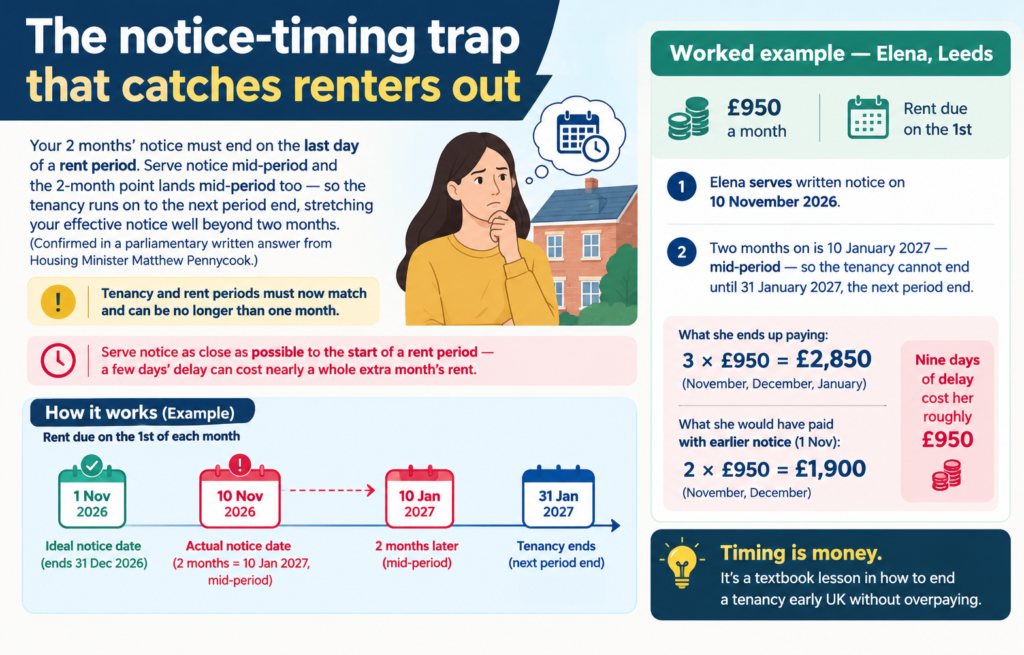
The notice-timing trap that catches renters out
Your 2 months’ notice must end on the last day of a rent period. Serve notice mid-period and the 2-month point lands mid-period too — so the tenancy runs on to the next period end, stretching your effective notice well beyond two months. (Confirmed in a parliamentary written answer from Housing Minister Matthew Pennycook.) Tenancy and rent periods must now match and can be no longer than one month.
Serve notice as close as possible to the start of a rent period — a few days’ delay can cost nearly a whole extra month’s rent.
Worked example — Elena, Leeds: £950 a month, rent due on the 1st. She serves written notice on 10 November 2026; two months on is 10 January 2027 — mid-period — so the tenancy cannot end until 31 January 2027, the next period end. She pays rent for November, December, January: 3 × £950 = £2,850, versus 2 × £950 = £1,900 had she served notice on 1 November. Nine days of delay cost her roughly £950 — timing is money. It’s a textbook lesson in how to end a tenancy early UK without overpaying.
Break clauses: where they still matter
In England’s private sector, break clauses are history for new and converted tenancies. Elsewhere in the UK, where fixed terms still exist, they still matter for anyone working out how to end a tenancy early UK:
- Scotland (older tenancies): assured and short assured tenancies granted before December 2017 can still have fixed terms. Ending during the fixed term needs a break clause in your agreement — otherwise negotiate and get any agreement in writing. If the agreement says nothing about notice, the usual position is 28 days (fixed term under 4 months) or 40 days (over 4 months), with the last day of notice matching the last day of the fixed term. These tenancies auto-renew without notice, so serve in time — Shelter Scotland advises adding 2 days for delivery.
- Scotland (private residential tenancies): the standard PRT has no fixed term and no break clause concept — you simply give 28 days’ written notice at any time (or a different period agreed in writing; the landlord can waive your notice only in writing).
- Wales: fixed-term standard occupation contracts can only be ended early with a contract-holder’s break clause, exercised with at least 4 weeks’ notice. Landlord break clauses are tightly restricted: only in fixed terms of 2 years or more, with 6 months’ notice, and never within the first 18 months. Stay past the end of a fixed term, and the contract becomes a periodic standard contract, endable with 4 weeks’ notice.
- Northern Ireland: a fixed-term tenancy ends as agreed — there is no unilateral right to end it early. You need a break clause, the landlord’s agreement (surrender), or a negotiated exit — Housing Rights NI offers a mediation service. For periodic tenancies, a tenant’s written notice to quit must be at least 4 weeks (tenancy up to 10 years) or 12 weeks (over 10 years), expiring at the end of a rental period.
Proposed — not yet law: draft Northern Ireland regulations would introduce longer notice bands, but they have not commenced. Check nidirect or Housing Rights NI for the current position.
Surrender: how to end a tenancy early UK by agreement
Surrender is the voluntary agreement between you and your landlord that the tenancy has ended — the cleanest route when valid notice alone will not get you out in time, and it can end a fixed-term or periodic tenancy. In many cases, it’s the simplest answer to how to end a tenancy early UK cleanly. There are two kinds:
| Express surrender | Implied surrender | |
|---|---|---|
| What it is | A formal written agreement, executed as a deed | Ending inferred from both sides’ unequivocal actions |
| Requirements | Both sides sign, both signatures witnessed; the document states it is a deed and the tenancy ends with immediate effect | Acts inconsistent with the tenancy continuing — e.g. you hand the keys back intending to end it and the landlord accepts them and agrees it is over |
Do not draft a deed of surrender from an internet template without advice — a defective deed may not end the tenancy. Whatever form the surrender takes, get this in writing: the date the tenancy ends and the last day rent is payable. Getting the paperwork right is essential whenever you’re working out how to end a tenancy early UK by agreement.
On a fixed term (and legacy English fixed terms), all joint tenants must agree to a surrender — if any tenant or the landlord disagrees, the tenancy continues. In England’s new periodic system, by contrast, one joint tenant can usually end the joint tenancy for everyone without the others’ agreement, though a shorter notice period needs the landlord and all other joint tenants to agree in writing.
How to end a tenancy early UK by negotiating with your landlord
Government guidance says it is good practice for landlords and agents to agree to reasonable early-termination requests — so if you’re working out how to end a tenancy early UK, asking is the expected first move, not a favour:
- Put it in writing. Any earlier end date or shorter notice must be agreed in writing to be binding.
- Propose a concrete date, not “as soon as possible”. Landlords respond better to certainty.
- Offer the standard compromise: the landlord re-markets the property immediately and your rent liability ends when a replacement tenant’s tenancy starts. You may be asked to cover reasonable re-letting costs — but only within the legal caps explained below.
- Get written confirmation of the agreed end date and last rent day before you stop paying anything.
- In Wales, if you give notice to leave and change their mind before the move-out date, you can stay as long as the landlord has not objected in writing.
Never stop paying rent based on a verbal promise. If the agreement is not in writing, it is very hard to prove — and the rent liability continues.
Early-exit routes at a glance:
| Route | When it works | Typical cost |
|---|---|---|
| 2 months’ written notice (England) | Any periodic assured tenancy | Rent during the notice period |
| Break clause | Scotland, Wales or NI fixed term where your agreement has one | Rent until the break date |
| Surrender | Any tenancy, if your landlord agrees | Negotiated — often re-letting costs within the legal caps |
| Replacement tenant | Landlord approves the new tenant | Rent until the new tenancy starts, plus ≤£50 variation charge (England) |
| Assignment or novation | Landlord consents and the paperwork is done properly | ≤£50 or evidenced reasonable costs (England) |
What your landlord can legally charge you
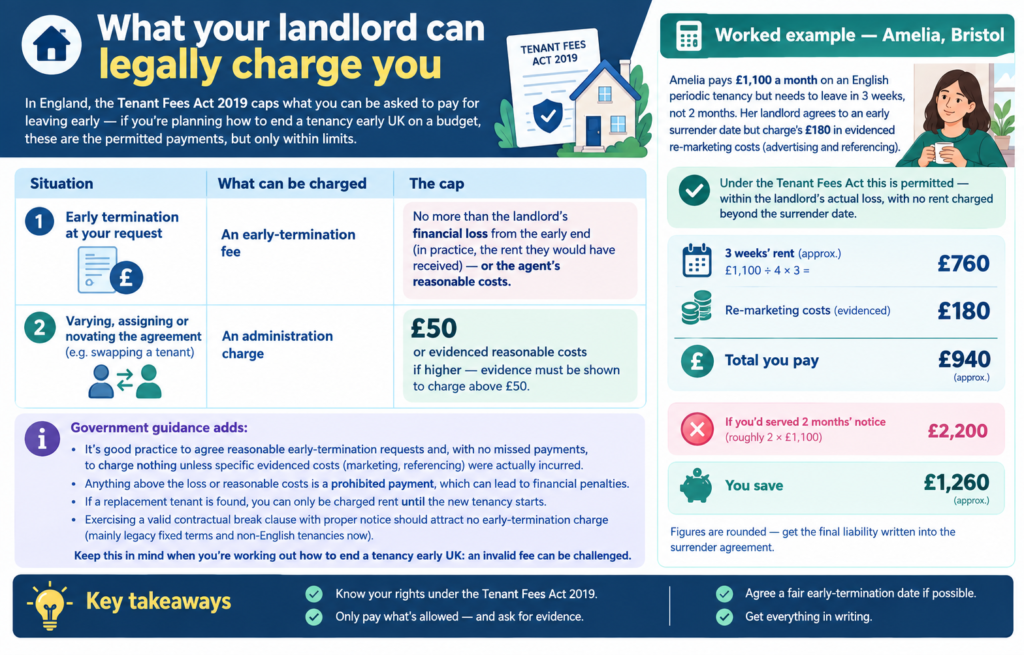
In England, the Tenant Fees Act 2019 caps what you can be asked to pay for leaving early — if you’re planning how to end a tenancy early UK on a budget, these are the permitted payments, but only within limits:
| Situation | What can be charged | The cap |
|---|---|---|
| Early termination at your request | An early-termination fee | No more than the landlord’s financial loss from the early end (in practice, the rent they would have received) — or the agent’s reasonable costs |
| Varying, assigning or novating the agreement (e.g. swapping a tenant) | An administration charge | £50, or evidenced reasonable costs if higher — evidence must be shown to charge above £50 |
Government guidance adds: it is good practice to agree reasonable early-termination requests and, with no missed payments, to charge nothing unless specific evidenced costs (marketing, referencing) were actually incurred. Anything above the loss or reasonable costs is a prohibited payment, which can lead to financial penalties. If a replacement tenant is found, you can only be charged rent until the new tenancy starts — and exercising a valid contractual break clause with proper notice should attract no early-termination charge (mainly legacy fixed terms and non-English tenancies now). Keep this in mind when you’re working out how to end a tenancy early UK: an invalid fee can be challenged.
Worked example — Amelia, Bristol. Amelia pays £1,100 a month on an English periodic tenancy but needs to leave in 3 weeks, not 2 months. Her landlord agrees to an early surrender date but charges £180 in evidenced re-marketing costs (advertising and referencing). Under the Tenant Fees Act, this is permitted — within the landlord’s actual loss, with no rent charged beyond the surrender date. Amelia pays roughly 3 weeks’ rent (about £760) plus the £180 — around £940 in total — instead of roughly £2,200 for a full two-month notice period, saving about £1,260 (figures rounded — get the final liability written into the surrender agreement).
Finding a replacement tenant yourself
If your landlord will not simply release you, offering a ready-made replacement tenant is your strongest card. The official guidance expects landlords and agents to consider reasonable requests to change the agreement rather than refusing unreasonably — with charges capped at £50 or evidenced reasonable costs, as above. In practice, a strong replacement proposal is one of the fastest ways to resolve how to end a tenancy early UK with a clean, agreed end date.
Make your proposal easy to say yes to when you’re arranging how to end a tenancy early UK:
- Find someone credible for similar terms and share their details early so referencing can start.
- Put in writing that you will keep paying rent at the agreed intervals until the new tenancy starts.
- Agree in writing the exact date your liability ends — the day the replacement’s tenancy begins.
Be aware that advertising the room yourself while you are still the tenant sits close to subletting territory. Read our guide to subletting your rented home before you list anything, so you do not accidentally breach your agreement.
Assignment and novation: handing the tenancy to someone else
Assignment means transferring your tenancy to a new tenant; novation replaces the agreement with a new one between the landlord and the incoming tenant. Both need the landlord’s consent, even if your agreement forbids assignment — and both should be documented formally (typically a licence to assign plus a deed of assignment), with guarantors kept informed. Either way, formal paperwork is non-negotiable when you’re arranging how to end a tenancy early UK this way.
This route suits cases where someone else wants to take the tenancy over wholesale — a friend taking your room, for example — which can be a practical solution for how to end a tenancy early UK. Assigning or subletting without the landlord’s consent can breach the tenancy, so do not treat a handshake handover as an assignment. Take advice rather than drafting it yourself; the £50 cap on variation and novation charges (England) applies here too.
What happens if you just walk out
Walk out without a proper plan for how to end a tenancy early UK and this is what keeps running:
| What continues | Why it matters |
|---|---|
| Rent liability | You owe rent until the tenancy is legally ended — weeks or months of it |
| Other bills | You may remain liable for council tax and utilities depending on the circumstances — check with your council |
| Court action for arrears | The landlord can pursue unpaid rent as a debt through the county court, including online via Money Claims Online (MCOL) |
| Credit file damage | A County Court Judgment (CCJ) appears on your credit file, making credit and mortgages harder to get — the common warning is around six years of impact |
| Guarantor pursuit | You and/or your guarantor can be pursued; a CCJ can be issued against either, including for arrears built up while the tenancy continued |
| Enforcement | If a judgment is not paid, enforcement options include attachment of earnings and warrants of control |
| Your deposit | Never treat the deposit as your last month’s rent without written agreement — it covers damage, cleaning and arrears, and withholding rent leaves you liable for any shortfall |
If one joint tenant leaves without the tenancy being formally ended or varied, the landlord can normally hold all tenants and their guarantors liable for arrears until it is properly ended. If rent has already fallen behind, read our rent arrears guide before the situation hardens into a court claim.
Your deposit must stay protected for the whole tenancy — including your notice period — and you can still challenge deductions at the end. See our tenancy deposit protection guide for the check-out steps that get deposits back.
If your home is unsafe or you are fleeing domestic abuse
An unsafe home is a different situation, with dedicated support routes. You do not have to give up your tenancy straight away: you can apply to court for an occupation order to have the abusive partner removed, so you can stay safely.
Other routes, in outline:
- Sanctuary schemes run by councils and specialist services can arrange security upgrades — reinforced doors, locks, police-linked alarms, even a safe room. The perpetrator must not live there; if they are a joint tenant, an occupation order or tenancy transfer may be needed first, and landlord permission is required for structural changes.
- Councils must help people facing homelessness because of domestic abuse: approach the council for emergency or temporary accommodation and housing advice. Refuge accommodation is available through specialist services, and Universal Credit or Housing Benefit can usually cover rent on both emergency housing and the home you left if you hope to return.
Contact, in confidence: Refuge’s National Domestic Abuse Helpline, Women’s Aid (directory of local services), Rights of Women, Citizens Advice, your local council’s housing options team, or the police in an emergency.
England, Scotland, Wales and Northern Ireland compared
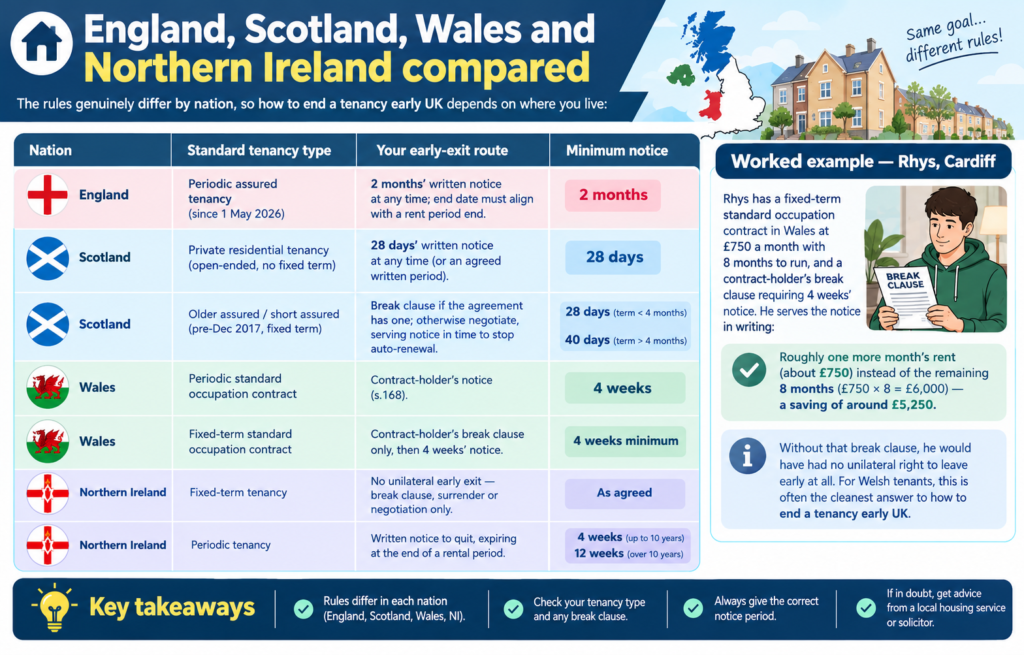
The rules genuinely differ by nation, so how to end a tenancy early UK depends on where you live:
| Nation | Standard tenancy type | Your early-exit route | Minimum notice |
|---|---|---|---|
| England | Periodic assured tenancy (since 1 May 2026) | 2 months’ written notice at any time; end date must align with a rent period end | 2 months |
| Scotland | Private residential tenancy (open-ended, no fixed term) | 28 days’ written notice at any time (or an agreed written period) | 28 days |
| Scotland | Older assured / short assured (pre-Dec 2017, fixed term) | Break clause if the agreement has one; otherwise negotiate, serving notice in time to stop auto-renewal | 28 days (term under 4 months) / 40 days (term over 4 months) |
| Wales | Periodic standard occupation contract | Contract-holder’s notice (s.168) | 4 weeks |
| Wales | Fixed-term standard occupation contract | Contract-holder’s break clause only, then 4 weeks’ notice | 4 weeks minimum |
| Northern Ireland | Fixed-term tenancy | No unilateral early exit — break clause, surrender or negotiation only | As agreed |
| Northern Ireland | Periodic tenancy | Written notice to quit, expiring at the end of a rental period | 4 weeks (tenancy up to 10 years) / 12 weeks (over 10 years) |
Worked example — Rhys, Cardiff. Rhys has a fixed-term standard occupation contract in Wales at £750 a month with 8 months to run, and a contract-holder’s break clause requiring 4 weeks’ notice. He serves the notice in writing: roughly one more month’s rent (about £750) instead of the remaining 8 months (£750 × 8 = £6,000) — a saving of around £5,250. Without that break clause, he would have had no unilateral right to leave early at all. For Welsh tenants, this is often the cleanest answer to how to end a tenancy early UK.
Frequently Asked Questions
Can I end my tenancy early in England without a break clause?
Yes. Since 1 May 2026, most English private tenancies are periodic, and old break clauses no longer have legal effect. You can end the tenancy at any time with at least 2 months’ written notice, as long as the end date falls on the last day of a rent period.
How much notice do I need to give to end a tenancy early in the UK?
2 months’ written notice in England, 28 days in Scotland for a private residential tenancy (28 or 40 days for older assured tenancies), 4 weeks in Wales, and 4 or 12 weeks in Northern Ireland by tenancy length. In England, the end date must fall on the last day of a rent period — if your 2 months expire mid-period, the tenancy runs to the next period end. Fixed terms in Scotland, Wales and Northern Ireland generally need a break clause or the landlord’s agreement.
My agreement still has a break clause — does it work?
In England’s private sector, no — break clauses ceased to have legal effect when tenancies converted to periodic on 1 May 2026 (the narrow exception is legacy fixed terms preserved by pre-1 May possession proceedings). In Scotland, Wales and Northern Ireland, they still operate, so check your agreement.
Can my landlord charge me for leaving early?
In England, only within Tenant Fees Act caps: an early-termination fee cannot exceed the landlord’s financial loss (in practice, the rent they would have received), and variation, assignment or novation charges are capped at £50 unless evidenced higher reasonable costs are shown. With no arrears, official guidance says good practice is to charge nothing without evidenced costs.
What if my landlord refuses to let me leave early?
In England, you do not need their permission — valid 2 months’ notice ends the tenancy regardless. In Scotland, Wales and Northern Ireland fixed terms, you generally need a break clause or the landlord’s agreement, so negotiate in writing, propose a replacement tenant, and in Northern Ireland consider Housing Rights’ mediation service.
Can one joint tenant end the tenancy for everyone?
In England’s periodic system, one joint tenant can usually end the joint tenancy for all of them. On a fixed term, all joint tenants must agree to a surrender or break-clause exercise. In Scotland, a new process from 1 April 2027 will let one joint tenant end a private residential tenancy via a 2-month pre-notice plus a 28-day final notice.
What happens if I just move out without telling my landlord?
The tenancy continues and so does your rent liability — returning the keys is only an offer of surrender, which the landlord must accept. Unpaid rent can be pursued through the county court (including Money Claims Online), a resulting CCJ damages your credit file for around six years, and your guarantor can be chased too.
Can I use my deposit as the last month’s rent?
Not unless your landlord agrees in writing. The deposit is held against damage, cleaning, missing items and arrears — not as a rent substitute. Withholding rent means the landlord may claim arrears from the deposit while you remain liable for any shortfall, and the deposit must stay protected for the whole tenancy including your notice period.
Do I have to keep paying rent during the notice period?
Yes — until the tenancy legally ends. You can only move out early without paying the rest if your landlord agrees, and any such agreement must be in writing.
Can I change my mind after giving notice?
In England, only with your landlord’s written agreement. In Wales, a contract-holder can change their mind before the move-out date as long as the landlord has not objected in writing.
Final Thoughts
Ending a tenancy early is usually a paperwork problem, not a legal trap. In England, the post-May-2026 system is simpler: forget break clauses, serve 2 months’ written notice, and mind the period-end alignment so the timing trap does not add a month to your bill. Three rules keep you safe: get everything in writing, keep paying rent until the legal end date, and never walk out hoping the problem disappears — it follows you as a debt. For the full end-of-tenancy process once your exit date is set, see our guide to ending your tenancy. And before you sign your next agreement, run the numbers with our rent affordability rules guide so your next move is one you can comfortably afford.
Further Reading
- GOV.UK: If your tenant wants to leave — the official statement of England’s 2-month notice rules
- Shelter England: assured shorthold tenancies with private landlords — detailed tenant advice including surrender and joint tenancies
- Shelter Scotland: how to end your tenancy — Scotland-specific notice rules and tenancy types