
Bethan is 34, a lone parent in Cardiff with two children — a daughter aged 12 and a son aged 7. She has found a three-bedroom house at £875 a month, but has no idea How Much Rent Will Universal Credit Pay whether the number of bedrooms matters, or what happens if the rent goes up next year.
If you are in Bethan’s position, this guide is for you. It explains how the housing element of Universal Credit is calculated in 2026/27: the Local Housing Allowance (LHA) rates that cap what private renters get, the bedroom entitlement rules, and the deductions that can shrink the final payment — with the maths shown line by line.
Quick answer: For private renters, Universal Credit’s housing element is normally the lower of your eligible rent or the Local Housing Allowance rate for your area and bedroom entitlement. LHA rates are frozen for 2026/27 at the levels introduced in April 2024 (the 30th percentile of local rents). If your rent is above your LHA rate, you must cover the gap yourself — UC will not bridge it automatically.
Rules differ between England, Scotland, Wales and Northern Ireland, and some changed in 2026. This guide reflects the position as of October 2026 and is general information, not legal advice or a personal benefits calculation.
What Is the Universal Credit Housing Element?
Universal Credit is paid as one monthly amount made up of several “elements”: a standard allowance, plus extra amounts for children, disability, carers, childcare — and housing costs. The housing costs element is the part that helps with rent. It is not a separate payment; it sits inside your single UC award.
For most private tenants, the housing element is calculated from your eligible rent, capped by your Local Housing Allowance (LHA) rate. For council and housing association tenants, different rules apply — your actual eligible rent is used, with reductions only for spare bedrooms (covered later).
Three things decide your starting figure: your eligible rent, your bedroom entitlement (how many bedrooms your household is judged to need), and your LHA rate (the maximum for that bedroom size in your area). The housing element is then the lower of the two. Everything after that — earnings, the benefit cap, other adults in the home — reduces your overall UC payment, not the housing element in isolation.
The Core Rule: Lower of Eligible Rent or LHA Rate
Your housing element is normally the lower of your eligible monthly rent and the LHA rate for your bedroom entitlement and area. Rent of £950 with an LHA rate of £775? The calculation starts at £775. Rent of £700 with the same rate? It starts at £700.
The government is explicit that LHA “is not intended to cover all rents in all areas” — it is a ceiling, not a guarantee. Government data suggests that of the roughly 1.7 million private-rented households receiving housing-cost support, about 53% face a gap between their support and their rent. Never assume UC will rise because your landlord raises the rent — once rent passes your LHA ceiling, the gap simply grows. Check your rate before you agree to a tenancy.
If you are already behind on rent, our rent arrears guide explains what to do step by step — and the section below on managed payments explains when UC can be paid directly to your landlord.
What Counts as “Eligible Rent”?
UC does not simply take the headline rent from your tenancy agreement. It works from your eligible rent: your contractual rent minus anything the rules say UC cannot cover, plus certain service charges it can.
| Covered | Not covered |
|---|---|
| Your contractual rent | Personal utilities (gas, electricity, water) |
| Service charges that are a condition of the tenancy (communal cleaning, gardens, lifts) | Meals, personal laundry services |
| Essential shared facilities (communal rubbish collection, essential appliances) | Leisure facilities, housing management charges, charges for rented items |
The exact boundary between eligible and ineligible service charges is decided case by case by DWP — if a chunk of your monthly payment is labelled “service charge”, check which parts count before you budget.
Rent quoted weekly or four-weekly? UC is assessed monthly, so DWP converts: weekly rent × 52 ÷ 12, four-weekly rent × 13 ÷ 12. £180 a week becomes £180 × 52 ÷ 12 = £780 a month.
LHA Rates in 2026/27: Frozen — and Why That Matters
LHA rates were restored to the 30th percentile of local market rents in April 2024 — then frozen twice: for 2025/26 and again for 2026/27. The 2026/27 rates (1 April 2026 to 31 March 2027) are the same ones that took effect on 1 April 2024, based on rents surveyed between October 2022 and September 2023.
The freeze is the story of 2026/27. Market rents have kept rising since 2023, but the LHA ceiling has not moved. Every rent increase your landlord applies widens the gap UC leaves you to fill.
The same freeze applies in Northern Ireland, where every 2026 LHA rate was set at its 31 January 2024 level.
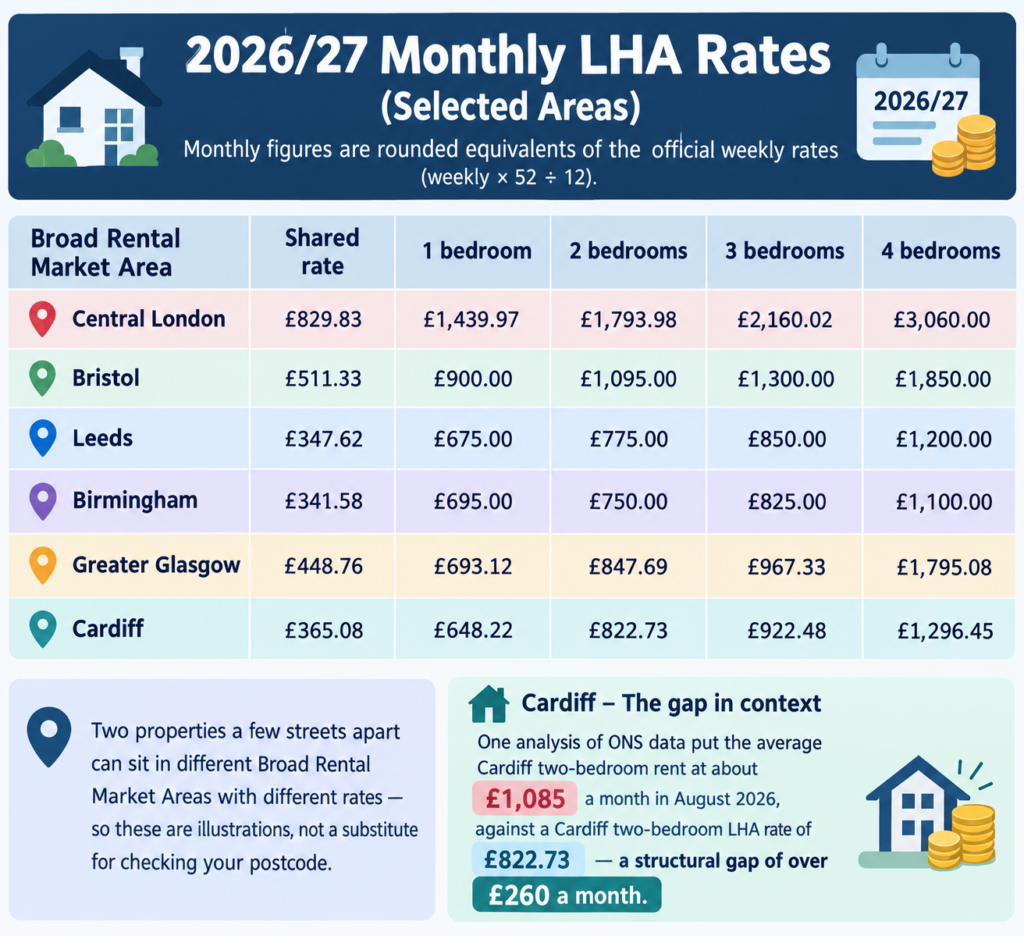
Example 2026/27 monthly LHA rates (selected areas)
Monthly figures are rounded equivalents of the official weekly rates (weekly × 52 ÷ 12):
| Broad Rental Market Area | Shared rate | 1 bedroom | 2 bedrooms | 3 bedrooms | 4 bedrooms |
|---|---|---|---|---|---|
| Central London | £829.83 | £1,439.97 | £1,793.98 | £2,160.02 | £3,060.00 |
| Bristol | £511.33 | £900.00 | £1,095.00 | £1,300.00 | £1,850.00 |
| Leeds | £347.62 | £675.00 | £775.00 | £850.00 | £1,200.00 |
| Birmingham | £341.58 | £695.00 | £750.00 | £825.00 | £1,100.00 |
| Greater Glasgow | £448.76 | £693.12 | £847.69 | £967.33 | £1,795.08 |
| Cardiff | £365.08 | £648.22 | £822.73 | £922.48 | £1,296.45 |
Two properties a few streets apart can sit in different Broad Rental Market Areas with different rates — so these are illustrations, not a substitute for checking your postcode.
To put the freeze in context: one analysis of ONS data put the average Cardiff two-bedroom rent at about £1,085 a month in August 2026, against a Cardiff two-bedroom LHA rate of £822.73 — a structural gap of over £260 a month.
How to Check Your Exact LHA Rate
LHA rates are set for each Broad Rental Market Area (BRMA) — the area you could reasonably be expected to live in. Your rate depends on the property’s exact postcode, not the town — two streets apart can mean two different rates.
| Where | How to check |
|---|---|
| England | The Valuation Office Agency’s LHA Direct postcode checker (lha-direct.voa.gov.uk), or your council’s housing benefit pages |
| Wales | Your council’s website (most publish full BRMA tables) |
| Scotland | The Scottish Government’s published 2026–27 LHA tables, or your council |
| Northern Ireland | The Northern Ireland Housing Executive’s website |
Check this before you pay a holding deposit — the cheapest five minutes of the whole move.
Bedroom Entitlement: How Many Bedrooms Will UC Count?
For private renters, the LHA rate you get depends on how many bedrooms your household is judged to need — not on how many bedrooms the property actually has. The rules:
| Who | Bedrooms allowed |
|---|---|
| You (and your partner, if you have one) | 1 bedroom |
| Any other adult aged 16 or over (who isn’t your partner, tenant or lodger) | 1 bedroom each |
| Two children of the same sex, both under 16 | Share 1 bedroom |
| Two children under 10, regardless of sex | Share 1 bedroom |
| Any other child | 1 bedroom each |
Key points people get wrong:
- Aged 10 is the cut-off for mixed-sex sharing. Two children under 10 share whatever their sex; once a child turns 10, mixed-sex children get separate bedrooms.
- The maximum LHA rate is the four-bedroom rate, however large your household.
- An extra bedroom may apply for a disability that prevents sharing (with a qualifying disability benefit such as PIP daily living or middle/high-rate DLA care), a non-resident overnight carer, or a foster carer active in the last 12 months.
Single and 35 or over, living alone? You are normally entitled to the one-bedroom LHA rate — but only if the property is self-contained (your own bedroom plus exclusive use of a bathroom, toilet and kitchen, or of at least two rooms). In shared accommodation, the shared rate can still apply.
Worked Example: Bethan in Cardiff — Counting Bedrooms, Applying the Cap
Back to Bethan: 34, lone parent in Cardiff, daughter 12, son 7, looking at a three-bedroom house at £875 a month.
Step 1 — bedroom entitlement. Bethan gets one bedroom. Her daughter is 12 and her son is 7 — different sexes, and the daughter is over 10, so they need one bedroom each. Entitlement: 3 bedrooms.
Step 2 — LHA rate. Cardiff’s 2026/27 three-bedroom rate is £212.88 a week = £212.88 × 52 ÷ 12 = £922.48 a month.
Step 3 — the lower-of rule. Rent £875; LHA rate £922.48. The lower figure wins:
| Monthly Housing Cost & LHA Comparison | Amount |
|---|---|
| Monthly rent | £875.00 |
| 3-bedroom LHA rate (Cardiff) | £922.48 |
| Housing element (before other adjustments) | £875.00 |
| Monthly gap Bethan must find | £0 |
Because her rent sits below her LHA ceiling, the housing element covers the full rent at this stage. Had the house cost £1,000, the element would have been capped at £922.48 — a £77.52 monthly gap.
Step 4 — earnings. Bethan takes home £1,200 a month. As a parent getting housing support, her 2026/27 work allowance is £427 — earnings above it reduce UC by 55p per £1:
£1,200 − £427 = £773 → £773 × 0.55 = £425.15 deducted from her total UC award.
The taper reduces her overall payment — which is why the LHA figure is never “what lands in your account”.
The Under-35 Shared Accommodation Rate
If you are single, under 35, with no partner or dependent children, UC normally limits you to the shared accommodation rate — the amount for a room in a shared house — even if you rent a self-contained one-bedroom flat. This is the single biggest shock in the system for young private renters.
Turning 35 is a cliff edge in reverse: from your 35th birthday, a single person living alone is normally assessed at the one-bedroom rate instead. The difference can be hundreds of pounds a month.
There are important exemptions. You can get the one-bedroom rate instead if you:
- are a care leaver under 25 (extended from 22 in 2021)
- have experienced domestic abuse since age 16 (since October 2022; you’ll need a supporting letter from a professional)
- have lived in a homeless hostel or refuge for 3+ months since age 16
- are a former prisoner aged 25–34 under MAPPA, a modern slavery survivor, or receive qualifying disability benefits without needing overnight care
If any of these might apply, raise it with your work coach or an adviser — don’t assume the shared rate is your fate.
Worked Example: Aoife in Glasgow — The Shared-Rate Gap
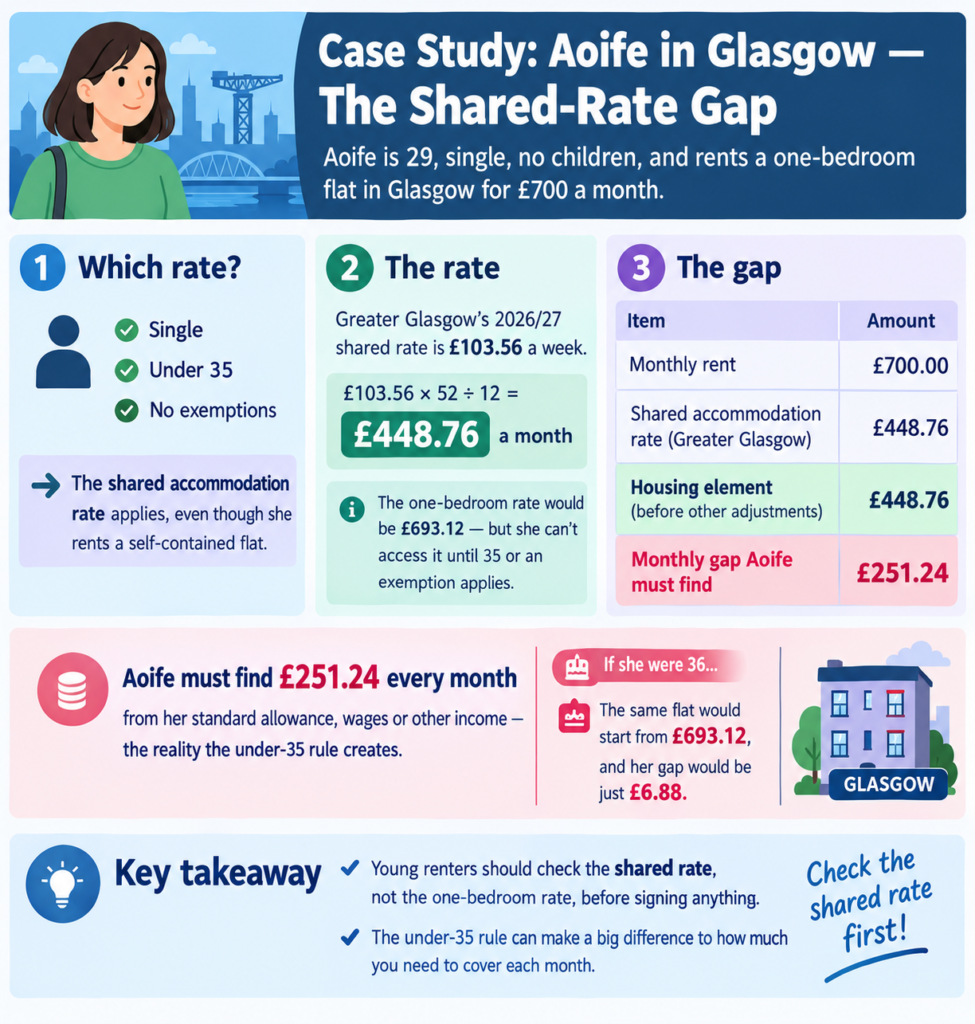
Aoife is 29, single, no children, and rents a one-bedroom flat in Glasgow for £700 a month.
Step 1 — which rate? Single, under 35, no exemptions: the shared accommodation rate applies, even though she rents a self-contained flat.
Step 2 — the rate. Greater Glasgow’s 2026/27 shared rate is £103.56 a week = £103.56 × 52 ÷ 12 = £448.76 a month. (The one-bedroom rate would be £693.12 — but she can’t access it until 35 or an exemption applies.)
Step 3 — the gap:
| Housing Cost Breakdown | Amount |
|---|---|
| Monthly rent | £700.00 |
| Shared accommodation rate (Greater Glasgow) | £448.76 |
| Housing element (before other adjustments) | £448.76 |
| Monthly gap Aoife must find | £251.24 |
Aoife must find £251.24 every month from her standard allowance, wages or other income — the reality the under-35 rule creates. If she were 36, the same flat would start from £693.12, and her gap would be just £6.88. This is why young renters should check the shared rate, not the one-bedroom rate, before signing anything.
Worked Example: Kofi in Leeds — When Rent Exceeds the LHA Rate
Kofi is 38, a single father in Leeds with a son aged 7 and a daughter aged 5, renting a two-bedroom flat at £950 a month.
Step 1 — bedroom entitlement. Kofi gets one bedroom. Both children are under 10, so they share one bedroom regardless of sex. Entitlement: 2 bedrooms.
Step 2 — LHA rate. Leeds’ 2026/27 two-bedroom rate is £775 a month.
Step 3 — the gap:
| Monthly Housing Costs | Amount |
|---|---|
| Monthly rent | £950.00 |
| 2-bedroom LHA rate (Leeds) | £775.00 |
| Housing element (before other adjustments) | £775.00 |
| Monthly gap Kofi must find | £175.00 |
Two notes for Kofi. Since 6 April 2026, the two-child limit has been removed — UC now pays the child element (£303.94 a month) for every eligible child, applied automatically. That lifts his total UC but leaves the £775 housing cap untouched. And if his earnings push his total UC near the benefit cap, even the £775 can be cut in practice — see below.
Before signing, a check with the income required to rent calculator would have shown whether £950 was realistic on his household income.
Why the LHA Figure Isn’t Your Final Payment
The housing element calculation gives a starting figure. Your actual UC payment can be lower because UC is one household award. The main reducers:
Earnings — the 55p taper. With a work allowance (you’re responsible for a child, or have limited capability for work), the first £427 a month is ignored when you get housing support (£710 without). Above that, UC falls 55p per £1 earned. No work allowance? The taper starts from the first pound.
The benefit cap. This limits total household benefits and can bite hard on larger families in expensive areas. 2026/27 monthly caps (unchanged from 2025/26):
| Household | Greater London | Outside London |
|---|---|---|
| Couple, or lone parent with children | £2,110.25 | £1,835.00 |
| Single adult, no children | £1,413.92 | £1,229.42 |
Exemptions include earning above DWP’s monthly threshold or receiving qualifying disability or carer’s benefits. The cap is deducted from your UC, which can push effective housing help below the LHA figure.
Another adult living with you. If an adult 21+ who isn’t your partner lives with you, £96.55 a month (2026/27) can be deducted per non-dependant. Exemptions include disability benefits in the household, or the other adult being under 21, responsible for a child under 5, or receiving Carer’s Allowance or Pension Credit.
Savings. Up to £6,000 ignored; £6,000–£16,000 reduces UC by £4.35 a month per £250 above £6,000; over £16,000 usually means no UC at all.
The five-week wait. A new claim takes around five weeks for the first payment. Advances are available but are loans repaid from future payments — talk to your landlord early.
The golden rule: the LHA rate tells you the maximum housing cost UC will recognise. Your earnings, savings, household make-up and the benefit cap decide what you actually receive. Budget on the second figure, not the first.
What If Your Rent Goes Up? (It Lands on You)
Report any rent change to UC through your journal straight away, with evidence. If the new rent is still below your LHA rate, your housing element can rise to match it. If your rent was already at or above the LHA ceiling, nothing changes — with LHA frozen until at least April 2027, every rent rise lands entirely on you.
When a Section 13 rent-increase notice arrives, read our challenging a rent increase guide before you accept it — and our negotiating rent guide if you are still at the offer stage.
Social Housing, Joint Tenancies and Who Gets the Money
Council and housing association tenants do not use LHA: your housing element is based on your actual eligible rent — but the under-occupancy charge cuts it by 14% for one spare bedroom or 25% for two or more. On £600 eligible rent, one spare bedroom costs you £84 a month.
If your joint tenant moves out, you remain jointly and severally liable for the whole rent, and UC regulations allow the full rent to be considered — even though DWP staff sometimes initially suggest only 50%. Ask for the decision to be looked at again and get advice.
Who receives the money? Normally you do, as part of your UC payment. But DWP can arrange a Managed Payment to Landlord where appropriate — a landlord can request it once arrears reach two months’ rent. You normally get seven days to object.
Scotland — Scottish Choices. UC claimants in Scotland can choose twice-monthly payments and direct payment of the housing element to their landlord.
Help If Your Housing Element Doesn’t Cover the Rent
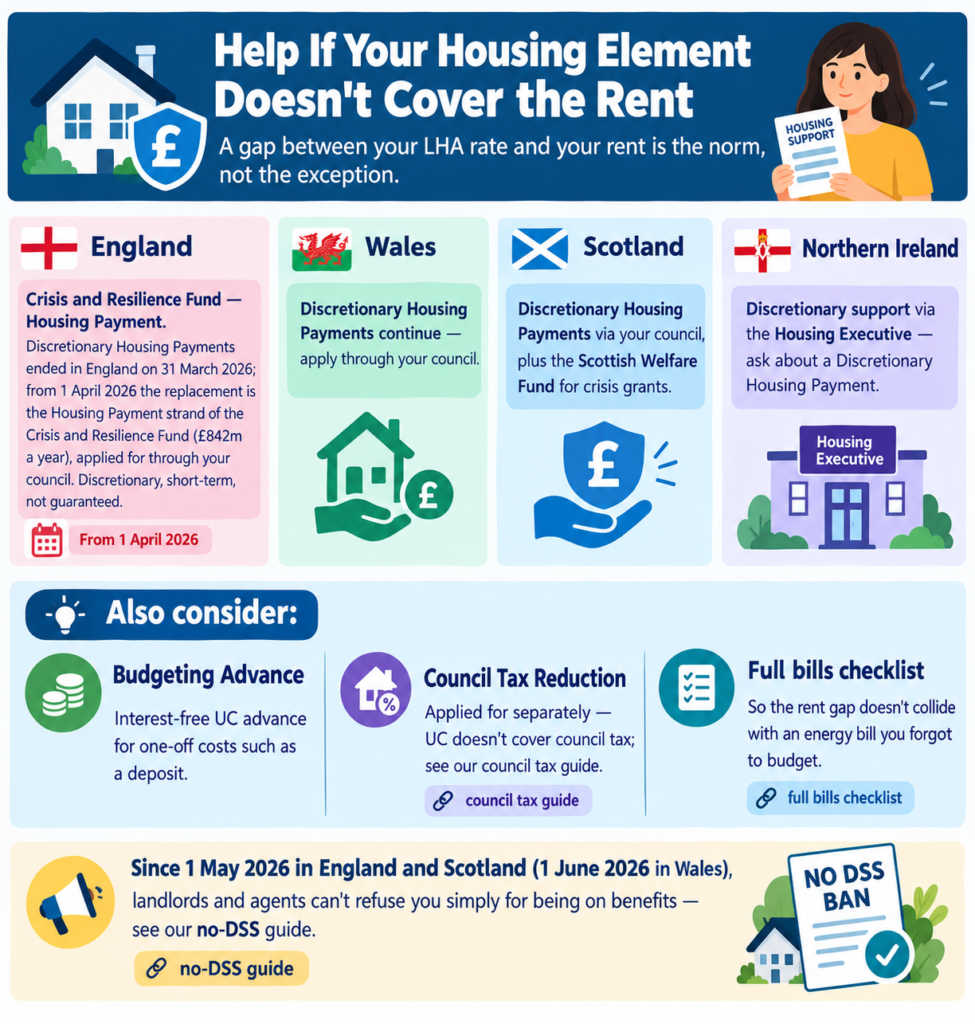
A gap between your LHA rate and your rent is the norm, not the exception:
| Nation | Shortfall help |
|---|---|
| England | Crisis and Resilience Fund — Housing Payment. Discretionary Housing Payments ended in England on 31 March 2026; from 1 April 2026 the replacement is the Housing Payment strand of the Crisis and Resilience Fund (£842m a year), applied for through your council. Discretionary, short-term, not guaranteed. |
| Wales | Discretionary Housing Payments continue — apply through your council. |
| Scotland | Discretionary Housing Payments via your council, plus the Scottish Welfare Fund for crisis grants. |
| Northern Ireland | Discretionary support via the Housing Executive — ask about a Discretionary Housing Payment. |
Also consider: a Budgeting Advance (interest-free UC advance for one-off costs such as a deposit), Council Tax Reduction (applied for separately — UC doesn’t cover council tax; see our council tax guide), and the full bills checklist so the rent gap doesn’t collide with an energy bill you forgot to budget.
Since 1 May 2026 in England and Scotland (1 June 2026 in Wales), landlords and agents can’t refuse you simply for being on benefits — see our no-DSS guide.
The Four Nations at a Glance
| Housing Support Comparison | England | Scotland | Wales | Northern Ireland |
|---|---|---|---|---|
| LHA 2026/27 | Frozen at April 2024 levels | Frozen at April 2024 levels | Frozen at April 2024 levels | Frozen at Jan 2024 levels |
| Where to check rates | VOA LHA Direct/council | Scottish Government tables / council | Council BRMA tables | NI Housing Executive |
| UC payment options | Monthly, to you (managed payment possible) | Scottish Choices: twice-monthly, direct to landlord | Monthly, to you (managed payment possible) | Monthly, to you (managed payment possible) |
| Shortfall help | CRF Housing Payment | Council DHP | Council DHP | Housing Executive discretionary help |
| Social housing | Under-occupancy 14%/25% | Under-occupancy 14%/25% (mitigation payments available) | Under-occupancy 14%/25% | Under-occupancy 14%/25% (mitigation payments available) |
Frequently Asked Questions
How much rent will Universal Credit pay for a private tenant in 2026/27?
Normally, the lower of your eligible rent and the Local Housing Allowance rate for your bedroom entitlement and area. LHA rates are frozen at April 2024 levels for 2026/27 — if your rent exceeds your rate, you cover the difference yourself.
Will Universal Credit pay my full rent?
Sometimes, but not automatically. If your rent is at or below your LHA rate and no other deductions apply, the housing element can cover it in full. Earnings, the benefit cap, non-dependant deductions and savings can all reduce the final payment.
How do I find my Local Housing Allowance rate?
Use the Valuation Office Agency’s LHA Direct postcode checker for England, your council’s website for Wales, the Scottish Government’s published tables for Scotland, or the Northern Ireland Housing Executive’s website.
What is the shared accommodation rate and who does it apply to?
The LHA rate for a room in shared accommodation — it normally applies to single claimants under 35 with no partner or children, even in a self-contained flat. Exemptions include care leavers under 25, domestic abuse survivors and some disabled claimants.
How many bedrooms will Universal Credit count for my family?
One for you (and your partner), one for each other adult 16+, one shared bedroom for two same-sex children under 16, one shared bedroom for two children under 10, and one each for any other child. The maximum rate is the four-bedroom LHA rate.
Does Universal Credit cover service charges?
Some — if they are a condition of your tenancy, like cleaning communal areas. Personal charges such as meals, personal laundry and your own utilities are not covered.
What happens to my housing element if my landlord raises the rent?
Report the change through your UC journal. If the new rent is still below your LHA rate, your housing element can rise. If your rent is already at or above the ceiling, your award doesn’t change — the extra falls entirely on you.
Can Universal Credit be paid directly to my landlord?
Usually the housing element is paid to you as part of your UC. DWP can arrange a Managed Payment to Landlord — for example, once arrears reach two months’ rent. In Scotland, you can also choose direct payment.
What is the housing costs contribution (non-dependant deduction)?
If an adult 21+ who isn’t your partner lives with you, £96.55 a month (2026/27) can be deducted per non-dependant. Exemptions apply, including where disability benefits are involved.
Does the benefit cap affect the housing element?
The cap limits your total benefits and is deducted from your UC — so a capped household can end up with less than the LHA-based figure. 2026/27 monthly caps: £2,110.25 / £1,413.92 in London, £1,835 / £1,229.42 outside London.
What replaced Discretionary Housing Payments in England?
From 1 April 2026, the Housing Payment strand of the Crisis and Resilience Fund — applied for through your council. DHPs continue in Wales and Scotland, with equivalent help in Northern Ireland via the Housing Executive.
I have three children — does the two-child limit still apply?
No — it was removed on 6 April 2026. UC now pays the child element (£303.94 a month) for every eligible child, automatically. This lifts your total UC but doesn’t change your LHA-capped housing element.
Final Thoughts
Bethan, Kofi and Aoife all asked the same question and got three different answers — because the answer is never one number. It is a chain: your eligible rent, your bedroom entitlement, your area’s frozen LHA rate, then the deductions that shape your final award.
For 2026/27: check your LHA rate before you commit (the ceiling won’t move to meet your rent), count your bedrooms correctly (the under-10 rule and the under-35 shared rate are where surprises hide), and budget on the final payment, not the LHA figure.
Run the numbers through the rent-to-income ratio calculator and the income required to rent calculator before you sign — and if you can’t honestly bridge the gap between your LHA rate and the asking rent, keep looking. The cheapest tenancy is the one you can sustain.