
Savings before renting UK is a major financial Responsibility. If you are renting your first apartment, moving to a new city, starting university, or simply looking for a better home, having enough savings before you move can make the Complete process much easier.
The monthly rent is usually the biggest Cost, but it is not the only one you need to consider. Before moving in, you may need money for a rental agreement deposit, holding deposit, first month’s rent, moving costs, furniture, utility bills, council tax, and other everyday costs.
So, how much savings should you have before renting in the UK in 2026?
As a practical starting point, many renters should aim to have sufficient money to cover their upfront rental costs plus at least 2 to 3 months of essential living expenses. If your income is Unclear, you are self-employed, moving to a costly city, or renting for the first time, having a larger emergency fund can provide much more financial safety.
This guide explains exactly what you should budget for, how much savings you may need, and how to calculate your own target before renting.
Visit Here:Rent Affordability Calculator UK
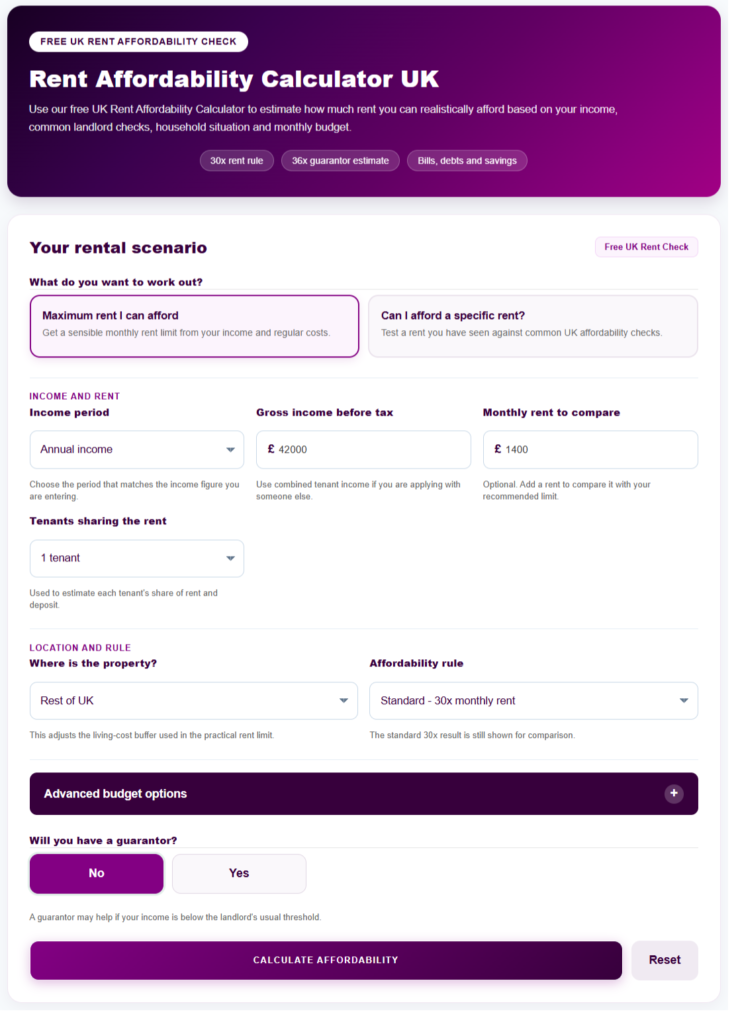
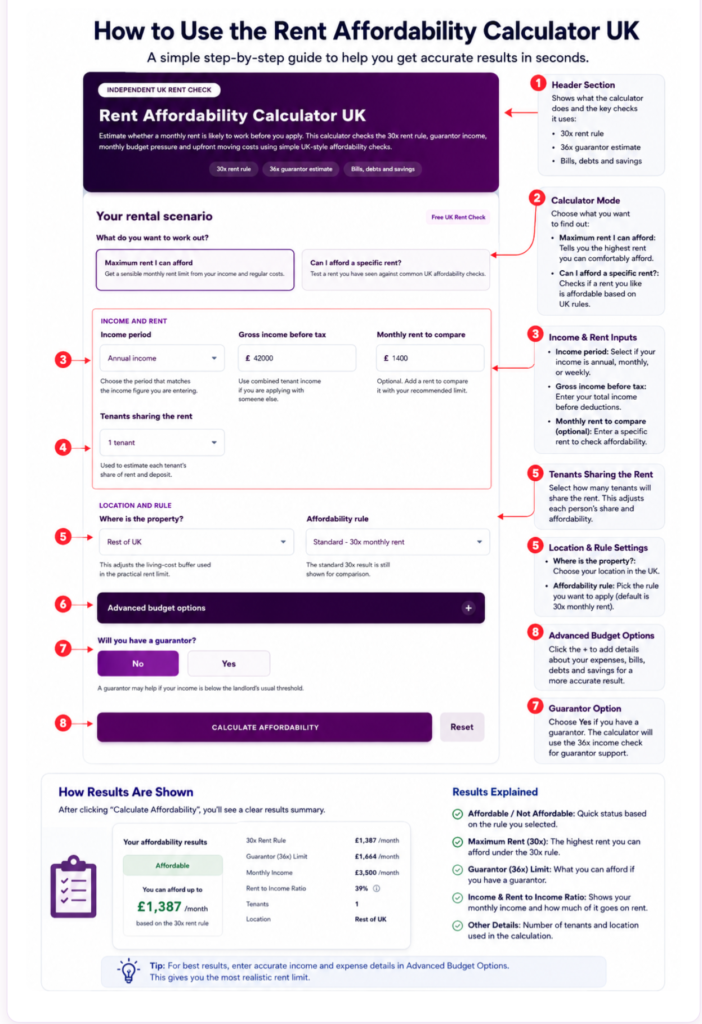
How to Use the Rent Affordability Calculator UK
How Much Money Should You Have Saved Before Renting?
There is no single savings number that works for every renter because the amount depends on your costs, location, earnings, lifestyle, and moving costs.
However, when considering savings before renting in the UK, a useful target is:
Upfront rental costs + moving costs + 2–3 months of essential expenses + emergency buffer
For example, suppose you are renting a property for £1,200 per month.
| Initial Cost | Amount |
|---|---|
| First month’s rent | £1,200 |
| Tenancy deposit | Potentially around £1,385 |
| Moving costs | £300 |
| Basic household items | £400 |
| Emergency savings | £2,000–£3,000 |
That could put your initial savings target somewhere around £5,285–£6,285, depending on your circumstances.
This is only an example. A person renting a room in a shared house may need considerably less, while someone renting a £2,000-per-month property in London could need substantially more.
The important point is that rent alone should not determine your savings target.
Read more:University Grade Conversion Calculator – Percentage, GPA and Degree ClassThe Main Costs You Need to Save For
Before signing a tenancy, it helps to break your savings target into separate categories.
The main costs are:
- Tenancy deposit
- First month’s rent
- Holding deposit
- Moving expenses
- Furniture and household essentials
- Council tax
- Utility bills
- Emergency savings
Let’s look at each one.
1. Tenancy Deposit
The tenancy deposit is one of the highest upfront costs when renting.
In England, for most properties with annual rent below £50,000, a landlord can generally require a refundable tenancy deposit of up to five weeks’ rent. For properties with annual rent between £50,000 and £100,000, the maximum can be six weeks’ rent.
| Monthly Rent | Annual Rent | 5 Weeks’ Rent (Tenancy Deposit) |
|---|---|---|
| £1,000 | £12,000 | £1,153.85 |
| £1,500 | £18,000 | £1,730.77 |
That means the deposit alone could require more than £1,700.
Important point
A tenancy deposit is normally refundable at the end of the tenancy, subject to legitimate deductions. It is therefore different from an ordinary expense.
However, you still need to have the money available when you move in.
In England, where a tenancy deposit is taken, the landlord must protect it in a government-approved tenancy deposit protection scheme.
2. First Month’s Rent
You will normally need to budget for your initial rent payment.
Since May 2026, new rules in England restrict landlords from requiring or accepting rent before the tenancy agreement has been signed. Once the agreement has been signed, a landlord can generally require up to one month’s rent in advance before the tenancy begins.
| Monthly Rent | Suggested Budget |
|---|---|
| £700 | around £700 |
| £900 | around £900 |
| £1,200 | around £1,200 |
| £1,500 | around £1,500 |
| £2,000 | around £2,000 |
This is one reason why your savings target should be based on your actual expected rent rather than an arbitrary number.
3. Holding Deposit
A holding deposit may be required while the landlord or letting agent carries out pre-tenancy checks.
In England, the maximum holding deposit is generally one week’s rent.
For example, with monthly rent of £1,200:
£1,200 × 12 ÷ 52 ≈ £276.92
So a holding deposit could be approximately £277.
The holding deposit is not necessarily an additional permanent cost. If you go ahead with the tenancy, it can, with your agreement, be put towards the tenancy deposit or first month’s rent.
This is important when calculating how much cash you actually need.
4. Moving Costs
Moving home can cost more than expected.
You might need to pay for:
- Van hire
- Professional movers
- Fuel
- Packing materials
- Boxes
- Storage
- Travel
- Cleaning
- Replacement household items
If you are moving locally and have friends or family who can help, your moving costs may be relatively low.
If you are moving across the country, the cost could be greatly higher.
A reasonable starting budget might be £200–£500, but your actual amount depends on how much you own and how far you are moving.
Read more: Rent Affordability Calculator Bristol – Check Your Rental Budget in 20265. Furniture and Household Essentials
A property may look ready to move into, but you can regularly spend a surprising amount on everyday important items.
Depending on the house, you may require household essentials.
The Difference between “Ready-to-live-in ” and “Without furniture ” is bigger than most first-time renters believe:
| Move-in type | What’s usually included | Typical setup cost |
| Furnished | Beds, sofa, wardrobes, sometimes white goods | £150–£400 (linens, kitchenware, small items) |
| Part-furnished | White goods only, no soft furnishings | £500–£1,000 |
| Unfurnished | Empty rooms, sometimes no flooring or light fittings | £1,200–£3,000+ |
If you’re moving into an unfurnished flat, don’t try to buy everything in week one. Prioritise a bed, basic kitchen kit, and lighting — then build the rest out over your first two or three pay cheques. This also protects your emergency fund from being quietly absorbed into homeware spending.
6. Council Tax
If you rent an entire property rather than simply renting a room, council tax may be one of your regular monthly expenses.
The amount depends on:
- Your local authority
- The property’s council tax band
- Your circumstances
- Whether you qualify for a discount or an exemption
Before renting, find out how much council tax you are likely to pay.
Do not simply look at the advertised rent and assume that is your total housing cost.
For example:
Rent = £1,100
But your actual monthly housing budget might look more like:
| Expense | Monthly Cost |
|---|---|
| Rent | £1,100 |
| Council tax | £150 |
| Gas/electricity | £120 |
| Water | £35 |
| Internet | £30 |
Total:
£1,435 per month
That difference is important.
7. Utility Bills
Utilities can significantly increase the cost of renting. Depending on the property and tenancy arrangement, you may need to budget for gas, electricity, water, broadband, a TV licence where applicable, mobile phone, and other household services.
Some rental properties include certain bills, especially rooms in shared accommodation. Always check exactly what is included before calculating affordability, because a property that appears cheaper may not actually be cheaper once bills are added.
As a rough guide for a single-use property, a one-bedroom flat in 2026:
| Bill | Typical monthly cost |
| Gas & electricity | £90–£160 |
| Water | £30–£45 |
| Broadband | £25–£35 |
| TV licence (if needed) | ~£14.50 |
| Mobile phone | £15–£30 |
| Total | £175–£285 |
Two flats advertised at the same rent can have very different real costs once you factor this in — always ask the landlord or agent for the property’s average bills, or check the EPC rating, before signing.
8. Emergency Savings
This is one of the most important parts of your rental budget.
Your savings should not disappear immediately after you move in.
Imagine you have £5,000 saved and your initial rental costs are £4,700.
You may technically be able to move in, but you would have only £300 left.
That is a risky position.
What happens if:
- Is your salary delayed?
- Are your hours reduced?
- You need an unexpected repair?
- Your travel costs increase?
- You have an urgent personal expense?
This is why an emergency fund matters.
A useful target is to keep at least two to three months of essential expenses available after paying your initial moving costs.
If your essential monthly expenses are £1,500, a two-month emergency fund would be:
£1,500 × 2 = £3,000
A three-month fund would be:
£1,500 × 3 = £4,500
You may want an even larger buffer if your income is irregular.
Create a Move-In Cashflow Plan
Instead of calculating only the total amount you need, write down when each payment will actually be due. This can prevent a situation where you have enough money overall but not enough available at the right moment.
For example, your rental timeline might look like this:
- Before signing: possible holding deposit and application-related costs
- After signing: agreed initial rent payment and tenancy deposit
- Moving week: van, transport, cleaning and other moving expenses
- First month: council tax, utilities, food, transport and household purchases
- Following months: regular rent and household bills
This matters because your bank balance can change quickly during a move. A renter with £6,000 available may feel comfortable until several large payments are due within the same week.
A simple spreadsheet or notes app can help you record the payment, amount, due date and whether it is refundable. Once everything is listed, you can see the highest amount of cash you will need at any one time.
This is a more practical way to prepare than simply saying, “I have £6,000 saved.”
How Much Savings Do You Need Based on Your Rent?
One of the easiest ways to estimate your savings target is to start with your monthly rent.
Here are some examples.
| Monthly Rent | Approx. 5-Week Deposit | First Month’s Rent | Example Moving Budget | Suggested Starting Target* |
| £700 | £808 | £700 | £300 | £3,500–£4,500 |
| £900 | £1,038 | £900 | £300 | £4,500–£5,500 |
| £1,000 | £1,154 | £1,000 | £300 | £4,800–£6,000 |
| £1,200 | £1,385 | £1,200 | £400 | £5,500–£7,000 |
| £1,500 | £1,731 | £1,500 | £500 | £6,500–£8,500 |
| £2,000 | £2,308 | £2,000 | £500 | £8,000–£10,500 |
*These are planning examples, not legal requirements or universal minimums. Your actual target depends on bills, earnings, furniture, location and emergency savings.
The table shows why two people renting different properties can have completely different savings requirements.
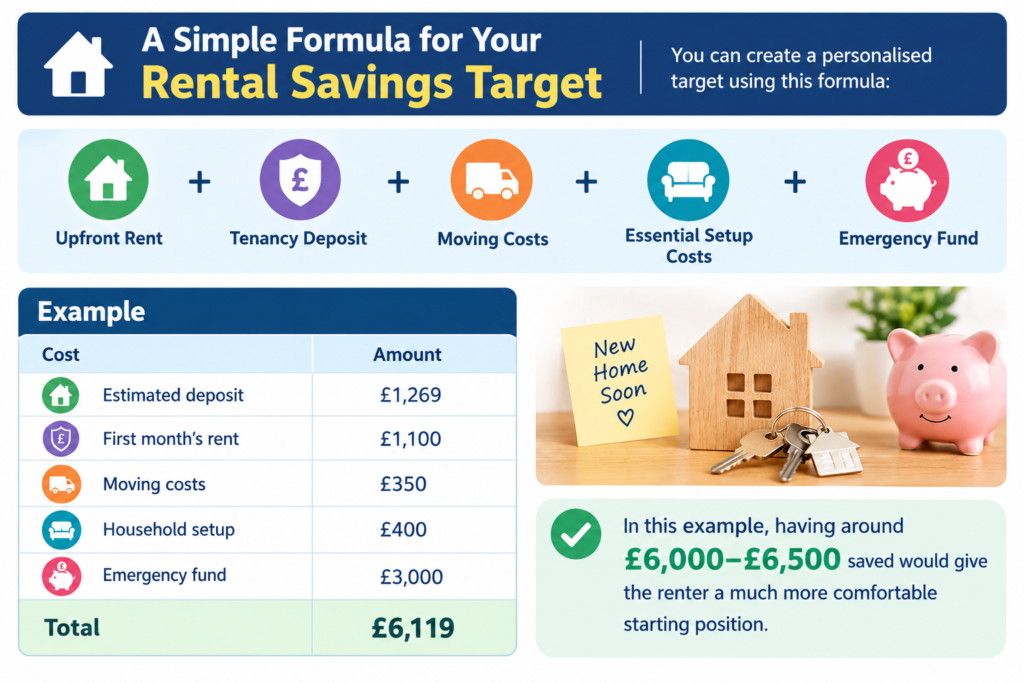
A Simple Formula for Your Rental Savings Target
You can create a personalised target using this formula:
Savings Target = Upfront Rent + Tenancy Deposit + Moving Costs + Essential Setup Costs + Emergency Fund
For example:
| Cost | Amount |
|---|---|
| Estimated deposit | £1,269 |
| First month’s rent | £1,100 |
| Moving costs | £350 |
| Household setup | £400 |
| Emergency fund | £3,000 |
| Total | £6,119 |
In this example, having around £6,000–£6,500 saved would give the renter a much more comfortable starting position.
Read more:Rent Affordability Calculator Scotland – Check How Much Rent You Can Afford Before
Is £5,000 Enough Savings to Rent in the UK?
It can be, but it depends heavily on your rent and circumstances.
For someone renting a room for £600–£700 per month, £5,000 could provide a reasonable starting cushion.
For someone renting a £1,500-per-month flat, £5,000 may be much tighter.
For example:
| Cost | Amount |
|---|---|
| Rent | £1,500 |
| Deposit | ≈ £1,731 |
| First month’s rent | £1,500 |
| Moving costs | £400 |
| Basic setup | £300 |
| Total initial costs | ≈ £3,931 |
| Remaining savings | £1,069 |
An emergency fund of only £1,069 may not be enough for someone with significant monthly expenses.
So the question should not simply be:
“Do I have £5,000?”
Instead ask:
“How much will I have left after moving in?”
That is a much better measure of financial readiness.
Is £10,000 Enough to Rent in the UK?
For many renters, £10,000 can provide a much stronger financial cushion.
Suppose you rent a property for £1,200 per month.
Your approximate initial costs might be:
| Initial Cost | Amount |
|---|---|
| Deposit | £1,385 |
| First month’s rent | £1,200 |
| Moving | £400 |
| Household setup | £500 |
Total initial costs:
£3,485
If you start with £10,000:
£10,000 − £3,485 = £6,515 remaining
That gives you considerably more flexibility.
However, £10,000 is not automatically enough for every renter.
Someone living in a high-cost area with £2,000 monthly rent and high living expenses may need more.
What If You Have No Savings?
Renting without savings can be extremely difficult because landlords and letting agents may expect you to demonstrate that you can afford the tenancy. You may also need money for the deposit and initial rent.
If your savings are limited, consider reducing your initial costs rather than choosing a property that uses almost all your money.
For example, someone with only £800 saved and no guarantor would struggle to rent a £900-per-month flat (deposit alone would likely exceed £1,000). The same person could realistically afford a £450-per-month room in a shared house, where the deposit might be closer to £520, and bills are often included.
Possible approaches include:
| Tip | Description |
|---|---|
| Rent a room instead of an entire property | A room in a shared house can have much lower upfront costs than renting an entire flat. |
| Choose a cheaper location | Rent can vary significantly between cities and even between neighbourhoods. |
| Buy household items gradually | You don’t need to furnish your entire home on the first day. |
| Continue saving before moving | Waiting a few additional months can sometimes make a significant difference. |
| Build an emergency fund first | Avoid putting every pound you have into the initial move. |
| Ask about a guarantor arrangement | Some landlords will accept a guarantor in place of a larger upfront payment. |
How Much Emergency Savings Should Renters Have?
There is no legally required emergency savings for private renters. However, from a personal budgeting perspective, it’s one of the most valuable forms of financial protection you can build before moving — see the worked examples in the Emergency Savings section above for how this scales with rent.
As a quick reference by income bracket:
| Essential monthly expenses | 2-month buffer | 3-month buffer |
| £1,200 | £2,400 | £3,600 |
| £1,700 | £3,400 | £5,100 |
| £2,200 | £4,400 | £6,600 |
If your income is unpredictable — freelance work, zero-hours contracts, seasonal roles — lean toward the higher end, or even a 4–6 month buffer, since you won’t have the same warning if income drops.
Should You Have 3 Months’ Rent Saved?
Having three months of rent saved can be useful, but it should not be confused with having three months of total living expenses.
For example:
Monthly rent = £1,000
Three months’ rent = £3,000.
But your actual monthly essential expenses might be:
| Monthly Expense | Amount |
|---|---|
| Rent | £1,000 |
| Council tax | £150 |
| Utilities | £150 |
| Food | £300 |
| Transport | £150 |
| Other essentials | £100 |
Total = £1,850
Three months of essential expenses:
£1,850 × 3 = £5,550
So three months of rent is only one part of the emergency-fund calculation.
Read more:What Salary Do You Need to Rent in the UK? Salary Guide 2026How Much Should a First-Time Renter Save?
First-time renters often need a larger initial budget because they may not already own furniture, kitchen equipment, or household essentials — costs that renters moving between properties have usually already paid for once.
A first-time renter should plan for four separate categories, with a worked example for someone renting a £900/month flat:
| Category | What it covers | Example amount |
| Move-in money | Deposit + first month’s rent | £2,038 |
| Moving costs | Transport, boxes, cleaning | £300 |
| Home setup | Basic furniture and household items | £700 |
| Emergency fund | Untouched buffer for 2–3 months’ essentials | £3,000–£4,500 |
| Total target | £6,000–£7,500 |
A first-time renter who plans these categories separately — rather than lumping everything into “savings” — is far less likely to underestimate the real cost of moving, and far less likely to arrive with a deposit but no cushion left over.
Savings Needed for Renting in London
London can require a significantly larger budget because rental costs can be high.
| Cost | Calculation / Amount |
|---|---|
| Rent per month | £1,800 |
| Five-week deposit | £1,800 × 12 ÷ 52 × 5 ≈ £2,077 |
| First month’s rent | £1,800 |
| Moving and setup | £700 |
| Initial costs | ≈ £4,577 |
| Emergency buffer | £4,000 |
| Total savings target | £8,500–£9,000 |
Again, this is an example rather than a universal London requirement.
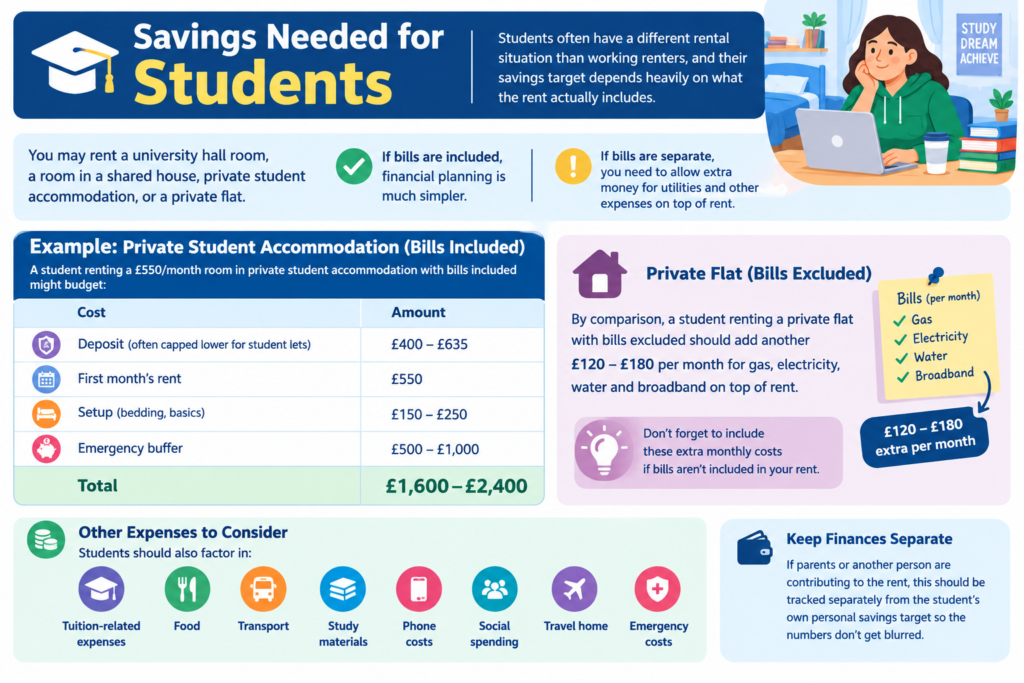
Savings Needed for Students
Students often have a different rental situation than working renters, and their savings target depends heavily on what the rent actually includes.
You may rent a university hall room, a room in a shared house, private student accommodation, or a private flat. If bills are included, financial planning is much simpler. If bills are separate, you need to allow extra money for utilities and other expenses on top of rent.
For example, a student renting a £550/month room in private student accommodation with bills included might budget:
| Cost | Amount |
| Deposit (often capped lower for student lets) | £400–£635 |
| First month’s rent | £550 |
| Setup (bedding, basics) | £150–£250 |
| Emergency buffer | £500–£1,000 |
| Total | £1,600–£2,400 |
By comparison, a student renting a private flat with bills excluded should add another £120–£180 per month for gas, electricity, water, and broadband on top of rent.
Students should also factor in tuition-related expenses, food, transport, study materials, phone costs, social spending, travel home, and emergency costs. If parents or another person are contributing to the rent, this should be tracked separately from the student’s own personal savings target so the numbers don’t get blurred.
Do You Need More Savings If You Are Self-Employed?
yes.
Self-employed renters may face additional challenges because income can vary from month to month.
A stable salary can make monthly financial planning relatively Simple.
Self-employed income may be more Unexpected.
If your income changes greatly throughout the year, a larger emergency fund can reduce financial pressure.
For example, in place of keeping only two months of essential expenses, you may decide that three to six months provides a more comfortable safety buffer.
The right amount depends on your business, income history, and personal requirements.
What About Renters With a Guarantor?
Having a guarantor does not necessarily mean you can rent without savings. A guarantor may help with the landlord’s affordability or risk assessment — and under the Renters’ Rights Act rules that came into force on 1 May 2026, landlords can no longer ask for large rent-in-advance payments, so a guarantor has become a more common alternative for renters without a strong credit history or UK income record.
But even with a guarantor in place, you’ll still typically need money for:
| Cost | Explanation |
|---|---|
| Deposit | Guarantors don’t remove the need for a deposit |
| Initial rent | Still payable once the tenancy agreement is signed |
| Moving costs | — |
| Household expenses | — |
| Emergency savings | A guarantor covers the landlord’s risk, not yours |
So a guarantor can help with the application process and may open up properties that would otherwise be out of reach, but it doesn’t replace the need for a realistic personal savings target.
Don’t Spend All Your Savings on the Move
One of the biggest mistakes new renters make is treating every pound of savings as available for moving.
Imagine you have £6,000.
Your move-in costs are £5,700.
Technically, you can afford to move.
But after moving, only £300 remains.
That is not a comfortable financial position.
A better approach is to set a minimum amount that you refuse to spend.
For example:
Total savings: £8,000
Maximum moving budget: £5,000
Emergency reserve: £3,000
This gives you a clear financial boundary.
How to Build Your Rental Savings Fund
If you are not ready to rent yet, start by calculating your target.
Suppose you want to save £6,000 over 12 months.
£6,000 ÷ 12 = £500 per month
If you can save £500 each month, you could reach your target in one year.
If you need £6,000 but can only save £300 per month:
£6,000 ÷ £300 = 20 months
You can then decide whether to:
- Reduce your target
- Increase your monthly savings
- Delay moving
- Find cheaper accommodation
- Increase your income
Breaking the goal into monthly amounts makes it much easier to manage.
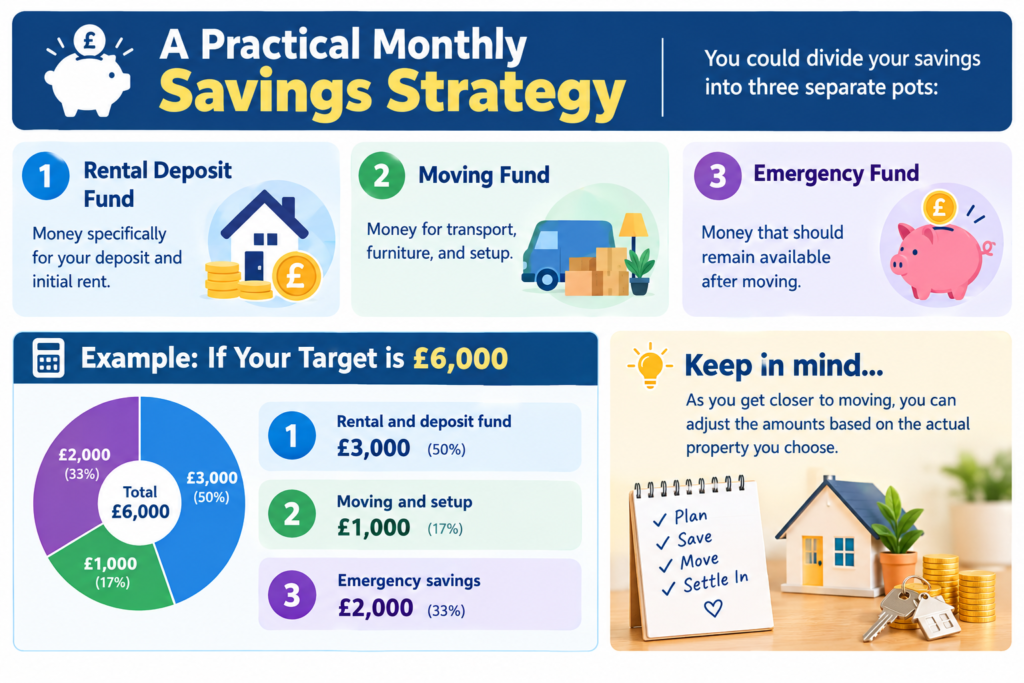
A Practical Monthly Savings Strategy
You could divide your savings into three separate pots:
Rental deposit fund
Money specifically for your deposit and initial rent.
Moving fund
Money for transport, furniture, and setup.
Emergency fund
Money that should remain available after moving.
For example, if your target is £6,000:
£3,000 — rental and deposit fund
£1,000 — moving and setup
£2,000 — emergency savings
As you get closer to moving, you can adjust the amounts based on the actual property you choose.
How Rent Affordability Affects Your Savings
Savings are important, but your ongoing income is even more important.
A large savings account cannot permanently compensate for rent that is too expensive for your monthly income.
For example, suppose you have £10,000 saved, but your monthly housing costs are significantly higher than your income.
Eventually, your savings will decrease.
This is why you should consider both:
Upfront affordability
and
Monthly affordability
before signing a tenancy.
Your goal should be to find a property that you can continue to afford after your savings are no longer being used.
Use a Rent Affordability Calculator Before You Move
A rent affordability calculator can help you estimate how much rent may fit within your income and budget.
Instead of asking:
“What is the most costly property I can technically afford?”
ask:
“What rent can I comfortably manage while still saving money every month?”
This is a much healthier approach to rental budgeting.
For example, if your take-home income is £2,800 per month, you might compare different rental Situations and see how much remains after rent, bills, food, transport, and other important expenses.
A calculator can give you a starting point, but you should always consider your actual Conditions.
The Difference Between Being Able to Rent and Being Ready to Rent
These two things are not the same.
You may be able to pay the deposit and first month’s rent.
But are you financially ready?
Being ready means you can:
- Pay your rent every month
- Cover your regular bills
- Handle unexpected expenses
- Maintain some savings
- Afford food and transport
- Avoid relying on credit for basic expenses
- Continue saving after moving
That final point is particularly important.
A healthy rental budget should leave room for future savings.
2026 England Rental Rules You Should Know
The rental market has changed in 2026, particularly in England.
From 1 May 2026, important changes under the Renters’ Rights Act came into effect. These include changes to private tenancies, rent in advance and other aspects of renting.
One important change concerns rent in advance.
For new private tenancies covered by the rules, landlords cannot ask for, encourage or accept rent before the tenancy agreement has been signed. Once the agreement is signed, they can generally require up to one month’s rent in advance before the tenancy starts.
This is important for renters who are calculating how much cash they need before moving.
However, remember that England, Scotland, Wales and Northern Ireland have different rental rules. If you are renting outside England, check the rules that apply to your nation before making financial assumptions.
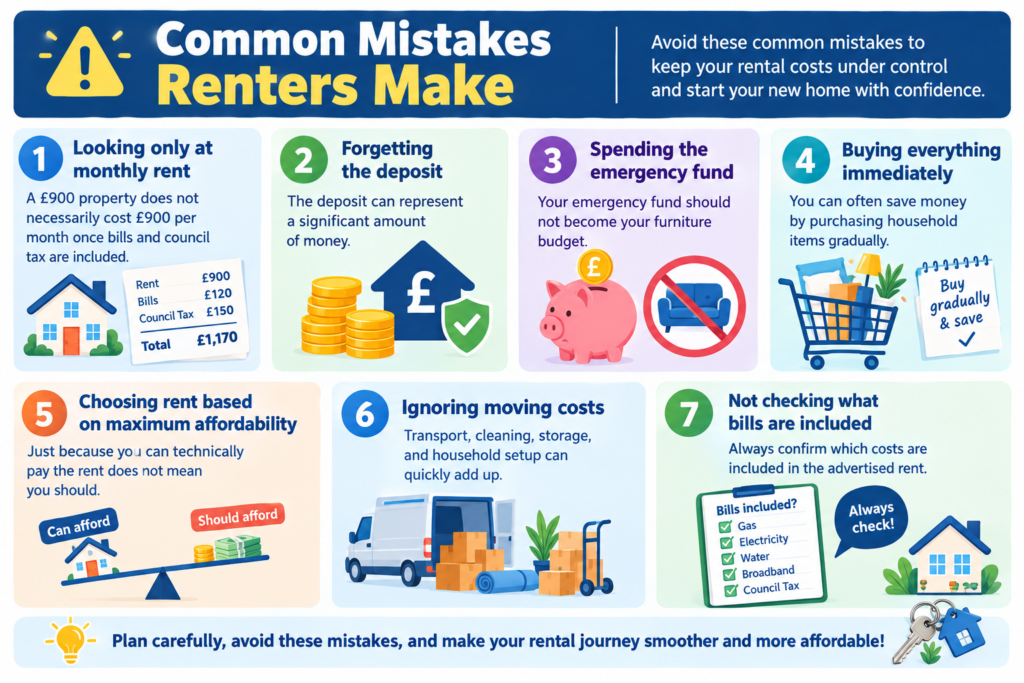
Read more: How Do Letting Agents Check Affordability in the UK? (2026 Guide)Common Mistakes Renters Make
Mistake 1: Looking only at monthly rent
A £900 property does not necessarily cost £900 per month once bills and council tax are included.
Mistake 2: Forgetting the deposit
The deposit can represent a significant amount of money.
Mistake 3: Spending the emergency fund
Your emergency fund should not become your furniture budget.
Mistake 4: Buying everything immediately
You can often save money by purchasing household items gradually.
Mistake 5: Choosing rent based on maximum affordability
Just because you can technically pay the rent does not mean you should.
Mistake 6: Ignoring moving costs
Transport, cleaning, storage, and household setup can quickly add up.
Mistake 7: Not checking what bills are included
Always confirm which costs are included in the advertised rent.
A Simple Pre-Renting Savings Checklist
Before applying for a rental property
| Category | Question |
|---|---|
| Upfront costs | Do I have enough for the tenancy deposit? |
| Do I have the first month’s rent available? | |
| Do I understand whether a holding deposit is required? | |
| Monthly costs | Can I afford the rent every month? |
| Have I calculated council tax? | |
| Have I estimated utility bills? | |
| Have I included food and transport? | |
| Moving costs | Do I have money for moving? |
| Do I need furniture? | |
| Do I need household equipment? | |
| Emergency fund | Will I still have savings after moving? |
| Could I handle an unexpected expense? | |
| Could I manage if my income temporarily decreased? | |
| Final consideration | If you cannot answer these questions confidently, it may be important to build your savings before moving. |
How much should I save before renting in the UK?
There is no universal amount. A practical target is enough to cover your upfront rental costs, moving expenses, household setup, and at least two to three months of essential expenses.
Is £5,000 enough to rent?
It can be enough for some renters, particularly those renting cheaper accommodation, but it may be insufficient for higher rents or expensive locations.
Is £10,000 enough before renting?
For many renters, £10,000 can provide a strong starting cushion. However, your actual requirement depends on rent, deposit, bills, moving costs, and emergency savings.
How much is a typical tenancy deposit?
In England, for most properties with annual rent below £50,000, the maximum tenancy deposit is generally five weeks’ rent. Higher-rent properties can have a six-week maximum under the applicable rules.
How much is a holding deposit?
In England, a holding deposit can generally be no more than one week’s rent.
Should I have three months’ rent saved?
It can be helpful, but it is better to think in terms of three months of essential expenses rather than rent alone.
What if I have a guarantor?
A guarantor may help with the rental application, but you should still budget for your deposit, rent, moving expenses and emergency savings.
Can a landlord ask for six months’ rent upfront?
No. Since 1 May 2026, under the Renters’ Rights Act, landlords and agents in England cannot require, encourage, or accept rent in advance before the tenancy agreement is signed, and can generally only require up to one month’s rent in advance once it is signed. Older practices of asking for large lump sums upfront are no longer enforceable for new tenancies.
Should I rent if I have no emergency fund?
It may be possible, but it leaves you financially vulnerable. If possible, build at least a basic emergency reserve before moving.
Final Thoughts
There is no magic number that tells every UK renter exactly how much money they need before renting.
For one person, £4,000 may be enough.
For another, £8,000 may be more appropriate.
For someone moving to a costly city or renting a high-cost property, the required savings could be significantly higher.
The most useful Method is to calculate your own target instead of copying someone Another person’s number.
Start with:
Deposit + first month’s rent + moving costs + household setup + emergency fund
Then check whether your monthly income can comfortably cover:
Rent + council tax + utilities + food + transport + other essential expenses
Most importantly, do not use all your savings just to get the keys.
The goal is not simply to afford the move.
The goal is to move into your new home without putting yourself under unnecessary financial pressure.
If you can pay your upfront costs, maintain an emergency savings account and regularly have enough monthly income to cover your regular expenses, you will be in a much stronger position as a renter.
For a personalised calculation, calculate your expected rent, deposit and monthly living costs before applying. A rent affordability calculator can also help you understand how your income compares with your intended rental financial plan.
The best time to prepare for renting is before you find the property, not after you have already fallen in love with it.