
Salary Needed to Rent UK is an important factor to understand before starting your rental journey.
Renting a home in the UK has become more Challenging than ever. If you’re moving into your first apartment, moving for work, or upgrading to a larger property, one question always comes up:
“What salary do you need to rent in the UK?”
The answer isn’t the same for everyone. It depends on several factors, including where you want to live, the monthly rent, if you’re renting alone or with someone else, and the reasonable price rules used by the property owner or letting agent.
Many people believe that if they can pay the first month’s rent and deposit, they’ll automatically be approved. In reality, most landlords and letting agents carry out an affordability assessment to make sure your income is high enough to cover the rent throughout your tenancy.
For example, if you earn £30,000 per year, you may comfortably afford a property renting for £1,000 per month in one city, but struggle to qualify for a similar property in another location where affordability requirements are stricter.
This guide explains exactly how much salary you typically need to rent in the UK in 2026. You’ll learn the most common reasonable price formulas, see real-life calculations, compare salary requirements for different rent levels, and discover practical Advice to improve your chances of getting approved.
If you’re an employee, self-employed, a student, or planning to rent with a partner, this guide will help you make informed decisions before sending your rental application.
Figures in this guide are based on commonly used UK letting agent reasonable price formulas (the 30×, 36×, and 2.5× rent rules) and average city rent levels reported by major rental indices such as the HomeLet Rental Index and ONS private rent data. Individual landlords and referencing agencies may apply different limits, so always confirm the specific reasonable price policy with your letting agent before applying.
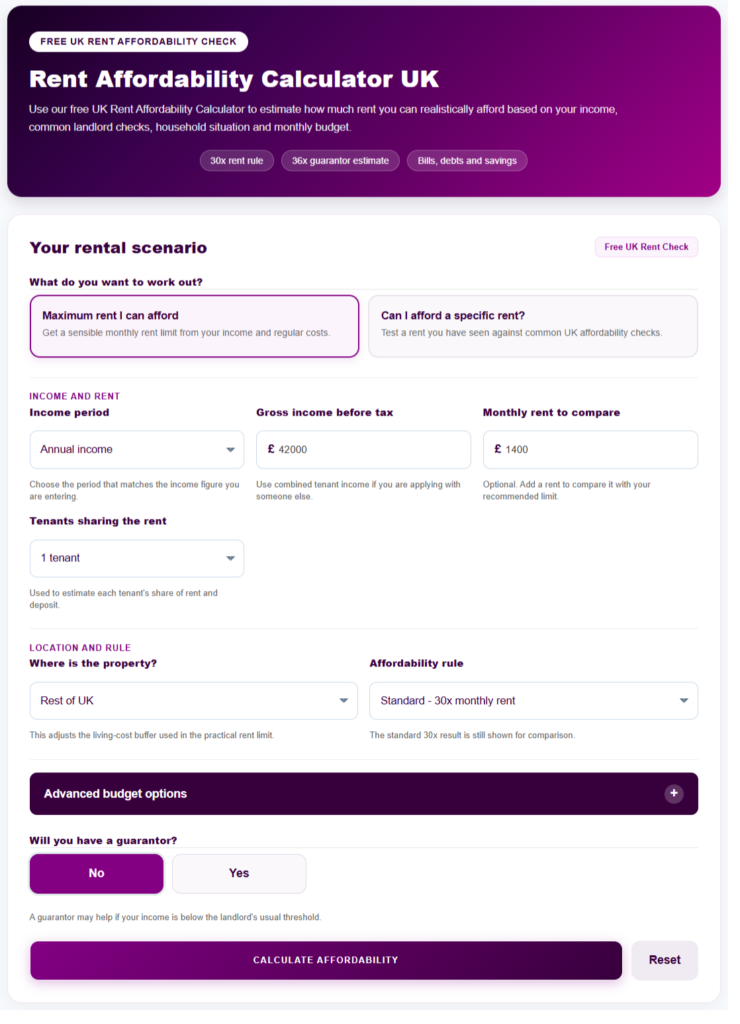
Click Here:Rent Affordability Calculator UK
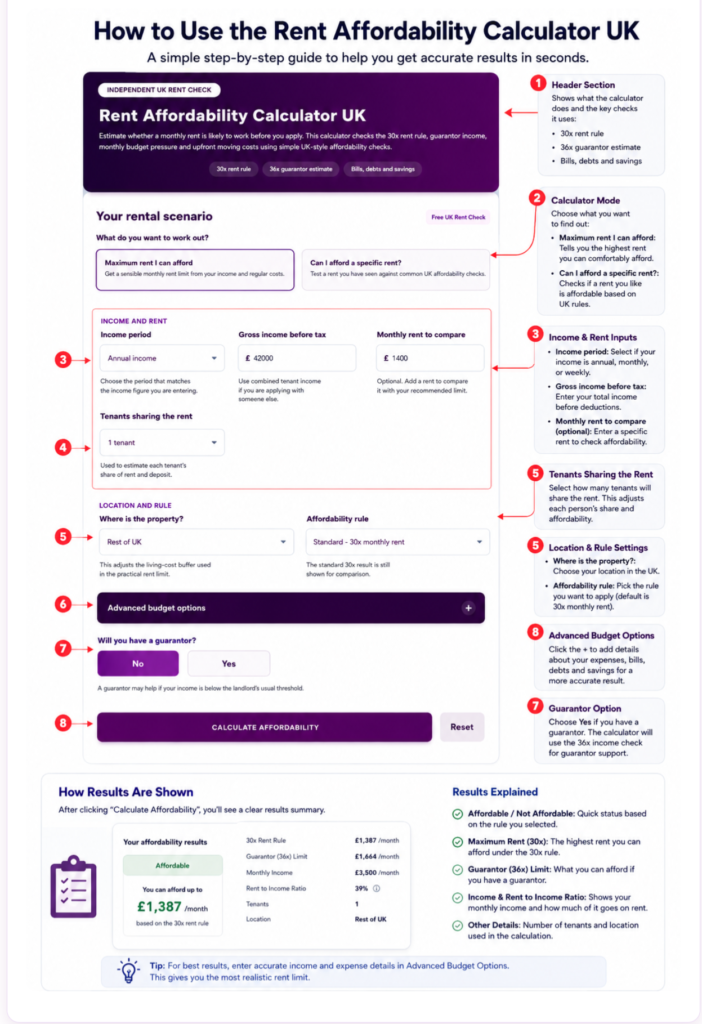
How to Use the Rent Affordability Calculator UK
Why Does Your Salary Matter When Renting?
When a property owner rents out a property, they want confidence that the renter can pay the rent regularly every month.
Rather than relying on promises, they compare your income with the monthly rent to determine whether the property is reasonable for you. This is one of the main reasons why understanding the Salary Needed to Rent UK is so important before you start searching for a home.
This process benefits both parties:
| For Landlords | For Tenants |
|---|---|
| Reduces the risk of missed rent payments. | Prevents taking on rent that’s difficult to manage. |
| Helps select financially stable renters. | Motivates better financial planning. |
| Protects their investment. | Reduces the risk of falling into late rent payments. |
| Increases the Chance of a long-term rental agreement. |
Think of your salary as evidence that you can comfortably manage the rent alongside everyday costs such as utility bills, food, transport, protection, and other financial requirements.
Read more:How to Calculate Your Uni Grade Using Credits and Module WeightingHow Do Letting Agents Calculate the Salary You Need?
Most UK letting agents use an affordability calculation rather than choosing a salary figure at random.
| The three most common methods are: |
|---|
| 30× Monthly Rent Rule |
| 36× Monthly Rent Rule |
| 2.5× Annual Rent Rule |
Though each formula looks different, they all Purpose to answer the same question:
Can this tenant comfortably afford the monthly rent?
We can look at each method in more detail.
The 30× Monthly Rent Rule
The 30× rule is one of the most widely used affordability checks in the UK.
Formula
Required Annual Salary = Monthly Rent × 30
Example 1
| Calculation | Amount |
|---|---|
| Monthly Rent | £800 |
| Calculation | £800 × 30 |
| Required Annual Salary | £24,000 |
A tenant earning £24,000 or more per year would usually meet the affordability requirement.
Example 2
| Calculation | Amount |
|---|---|
| Monthly Rent | £1,100 |
| Calculation | £1,100 × 30 |
| Required Annual Salary | £33,000 |
A salary of approximately £33,000 per year would normally satisfy this requirement.
Example 3
Monthly Rent:
£1,500
Calculation:
£1,500 × 30 = £45,000
To rent this property, many letting agents would expect the applicant to earn at least £45,000 annually before tax.
The 36× Monthly Rent Rule
Some premium landlords and referencing companies apply a stricter affordability check.
Instead of multiplying the monthly rent by 30, they multiply it by 36.
Formula
Required Salary = Monthly Rent × 36
Example
| Calculation | Amount |
|---|---|
| Monthly Rent | £1,200 |
| Calculation | £1,200 × 36 |
| Required Annual Salary | £43,200 |
Under this rule, an applicant earning £40,000 may not qualify, even though they might have passed under the 30× rule.
The 2.5× Annual Rent Rule
Some letting agents first calculate the property’s annual rent and then compare it to your annual income.
Formula
Required Annual Salary = Annual Rent × 2.5
Example
| Calculation | Amount |
|---|---|
| Monthly Rent | £950 |
| Annual Rent | £950 × 12 = £11,400 |
| Salary Requirement | £11,400 × 2.5 |
| Required Annual Salary | £28,500 |
Although the formula differs slightly, the result is often similar to the 30× rule.
Read more: How Do Letting Agents Check Affordability in the UK? (2026 Guide)Salary Needed for Different Monthly Rent Amounts
The table below provides an estimate of the annual salary commonly required using the 30× monthly rent rule.
| Monthly Rent | Approximate Salary Required |
| £600 | £18,000 |
| £700 | £21,000 |
| £800 | £24,000 |
| £900 | £27,000 |
| £1,000 | £30,000 |
| £1,100 | £33,000 |
| £1,200 | £36,000 |
| £1,300 | £39,000 |
| £1,400 | £42,000 |
| £1,500 | £45,000 |
| £1,800 | £54,000 |
| £2,000 | £60,000 |
Remember: These are general estimates. Some landlords or referencing companies may use different affordability ratios or consider additional factors.
Real-Life Example: Renting on a £30,000 Salary
James has recently accepted a new job in Nottingham with an annual salary of £30,000.
He finds a one-bedroom apartment with a monthly rent of £950.
| Calculation Details | Amount |
|---|---|
| Step 1: Calculate the Required Salary | £950 × 30 = £28,500 |
| Step 2: Compare the Figures | |
| James earns | £30,000 |
| Required Salary | £28,500 |
Because his salary exceeds the affordability requirement, he passes the income assessment and moves on to the referencing stage.
Real-Life Example: Salary Below the Requirement
Aisha earns £26,000 per year and wants to rent a flat costing £1,000 per month.
The letting agent uses the 30× rule.
| Calculation Details | Amount |
|---|---|
| Required Salary Calculation | £1,000 × 30 = £30,000 |
| Required Salary | £30,000 |
| Actual Salary | £26,000 |
| Shortfall | £4,000 |
Although Aisha has an excellent rental history, the landlord asks her to either provide a guarantor or apply with a joint tenant because her income falls below the required threshold.
Can Couples Combine Their Salaries?
Yes. In most cases, letting agents combine the incomes of joint applicants when assessing affordability.
This is one of the easiest ways to qualify for a property that may be unaffordable on a single income.
Example
| Income & Affordability Details | Amount |
|---|---|
| Daniel’s Salary | £25,000 |
| Emma’s Salary | £22,000 |
| Combined Income | £47,000 |
| Monthly Rent | £1,400 |
| Required Salary | £1,400 × 30 = £42,000 |
Since their combined income is higher than the required amount, they successfully meet the affordability criteria.
Does Gross or Net Salary Matter?
One of the most common questions renters ask is whether affordability checks are based on gross salary (before tax) or net salary (after tax).
In the majority of cases, UK letting agents use your gross annual salary because it’s a standard figure that can be easily verified through:
- Employment contracts
- Payslips
- Employer references
However, some independent landlords may also look at your monthly take-home pay to ensure you have enough disposable income after covering taxes and other regular expenses.
What Other Income Can Be Included?
Your basic salary isn’t always the only income considered during an affordability assessment.
| Depending on the landlord and referencing company, the following may also count: |
|---|
| Regular overtime payments |
| Performance bonuses |
| Commission earnings |
| Self-employed profits |
| Pension income |
| Freelance income |
| Investment income |
| Certain government benefits, where accepted |
The most important requirement is that the income is regular, reliable, and supported by evidence such as payslips, bank statements, tax returns, or accountant references.
Why Salary Alone Isn’t Everything
Although meeting the salary requirement is essential, it’s only one part of the tenant referencing process. Letting agents typically run a full affordability check alongside the income test, which usually looks at:
- Employment status — permanent, fixed-term, probationary, or self-employed contracts are weighted differently.
- Length of service — under six months in a role can trigger requests for extra evidence, even if income is sufficient.
- Credit history — checked via referencing agencies such as HomeLet, Rightmove Referencing, or Goodlord, who also flag existing CCJs or defaults.
- Previous landlord references — late payments or disputes can outweigh a strong salary.
- Bank statements — used to confirm the salary is real and to check for signs of financial stress (overdraft use, existing loan repayments, gambling transactions).
- Existing financial commitments — car finance, student loans, and credit card balances all reduce disposable income even if gross salary looks healthy.
- Right to Rent documentation — a legal requirement in England regardless of income level.
Salary Requirement vs Your Real Monthly Budget
Meeting the landlord’s salary requirement does not always mean that a property is comfortable for your personal budget. The 30× or 36× calculation is mainly an affordability screening method, while your own budget should also account for tax, council tax, energy bills, food, transport, debt repayments and savings. For example, someone who qualifies for £1,200 monthly rent may still find that amount difficult if their regular expenses leave very little money at the end of each month. Before applying, calculate your expected take-home income and subtract your essential monthly costs. The amount left after these expenses gives you a more realistic idea of whether the rent is manageable.
Salary Needed to Rent in Different UK Cities
The salary you need doesn’t just depend on the letting agent’s reasonable price formula—it also depends on where you choose to live. Rental prices vary greatly across the UK.
The table below uses average monthly rents and the common 30× affordability rule. These figures are calculated and can vary depending on the property type and exact location.
| City | Average Monthly Rent | Estimated Salary Needed |
| London | £2,000 | £60,000 |
| Manchester | £1,250 | £37,500 |
| Birmingham | £1,100 | £33,000 |
| Leeds | £1,050 | £31,500 |
| Liverpool | £950 | £28,500 |
| Glasgow | £950 | £28,500 |
| Bristol | £1,400 | £42,000 |
| Edinburgh | £1,350 | £40,500 |
| Nottingham | £900 | £27,000 |
| Sheffield | £850 | £25,500 |
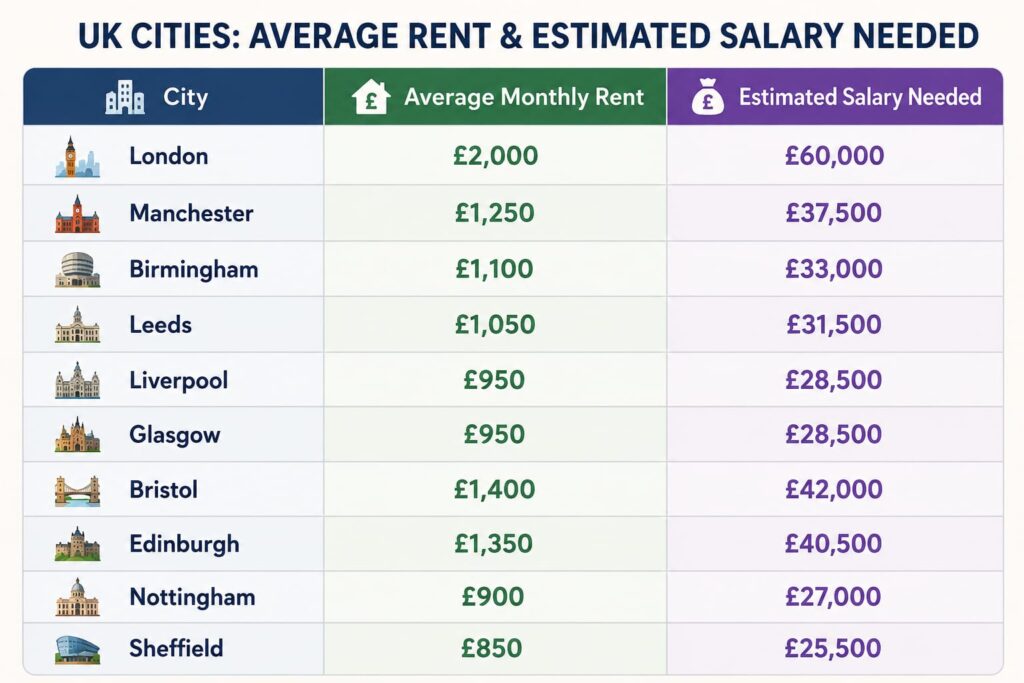
These figures are intended as a guide. Premium properties in city centres may require significantly higher salaries.
What Different Salaries Typically Afford
| Annual Salary | Max Affordable Rent (30× rule) | Typical Property Access (outside central London) |
| £25,000 | £833/month | Studio or room in a shared house; small 1-bed in lower-cost cities |
| £30,000 | £1,000/month | 1-bed flat in most regional cities |
| £35,000 | £1,166/month | 1-bed flat or small 2-bed in mid-cost cities |
| £40,000 | £1,333/month | 2-bed flat or house in most regional cities |
| £50,000 | £1,666/month | 2–3 bed house or premium apartment in most cities outside London |
Worked example: Rebecca earns £40,000 and applies for a flat at £1,250/month. Required salary under the 30× rule is £37,500, so her income comfortably clears the bar — this is the kind of margin that lets an application move straight to referencing without extra conditions.
As a rule of thumb, aim for at least 10–15% headroom above the minimum required salary — it makes approval smoother and gives you a buffer if rents or bills increase mid-tenancy.
Don’t Budget for Rent Alone
When working out how much rent you can afford, avoid using your entire housing budget for the rent itself. A rental property can create several additional monthly costs that are easy to overlook when comparing listings. Depending on the property, you may need to budget for council tax, gas and electricity, water, broadband, mobile phone costs, transport and contents insurance. Some homes may also have parking charges or other regular costs. Before deciding on a maximum rent, make a simple list of these expenses and leave some money available for emergencies and savings. This can prevent a property that looks affordable on paper from becoming difficult to manage after you move in.
Monthly Budget Example
Passing an affordability check doesn’t necessarily mean you’ll have plenty of money left each month.
Let’s look at a realistic monthly budget.
Example
| Financial Details | Amount |
|---|---|
| Annual Salary | £36,000 |
| Approximate Monthly Take-home Pay | £2,400 |
| Monthly Rent | £1,000 |
| Utilities | £180 |
| Internet & Mobile | £55 |
| Council Tax | £170 |
| Food & Groceries | £320 |
| Transport | £180 |
| Entertainment | £180 |
| Savings | £200 |
| Total Expenses | £2,285 |
| Remaining Balance | Approximately £115 |
This example shows why landlords don’t simply check whether you can pay the rent—they want to ensure you can continue paying it while managing your other living costs.
Renting as a Couple
Applying jointly can significantly improve affordability because most letting agents combine both applicants’ incomes.
Example
Anna earns:
£24,000
James earns:
£27,000
Combined income:
£51,000
Monthly rent:
£1,450
Required salary:
£1,450 × 30 = £43,500
Since their combined income is above the requirement, they comfortably qualify.
Read more:Can You Rent Without a Guarantor in the UK? Complete Guide (2026)Renting as a Self-Employed Applicant
Self-employed applicants are reviewed differently because they don’t usually receive regular payslips.
Instead, letting agents often request:
- SA302 tax calculations
- Tax Year Overview
- Accountant’s reference
- Business accounts
- Personal and business bank statements
Real-Life Example
Hassan runs his own web design business.
| Income & Affordability Details | Amount |
|---|---|
| Average Annual Profit | £48,000 |
| Monthly Rent | £1,350 |
| Required Salary Calculation | £1,350 × 30 |
| Required Annual Salary | £40,500 |
Hassan provides two years of tax returns and accountant-certified accounts, demonstrating stable income. His application is approved.
Renting as a Student
Students often have little or no employment income.
In these situations, landlords may ask for:
- A UK-based guarantor
- Student finance evidence
- Scholarship documents
- Rent paid several months in advance
- Proof of parental financial support
Example
Lucy is studying at university in Leeds.
She doesn’t work full-time, but her parents agree to act as guarantors.
The landlord reviews the guarantors’ income instead of Lucy’s salary and approves the tenancy.
Renting on Universal Credit or Housing Benefit
Tenants receiving Universal Credit’s housing element or Housing Benefit are sometimes treated differently under affordability checks, and policies vary widely between landlords and letting agents.
| What tends to happen in practice: |
|---|
| Some letting agents will only count benefit income if the Local Housing Allowance rate covers the full rent. |
| Many private landlords ask for a guarantor even when benefit income technically meets the 30× threshold, since LHA rates are reviewed periodically and can change. |
| It is illegal for landlords and agents in England to operate blanket “No DSS” policies that reject applicants solely because they receive benefits. |
| Applicants can strengthen their case with a UK-based guarantor, a personal reference, or several months’ rent paid upfront. |
Example: Priya receives Universal Credit with a housing element of £900 per month and applies for a flat renting at £850. Her benefit income covers the rent, but the landlord still requests a guarantor because her benefit award is reviewed every six months. With her sister acting as guarantor, the tenancy is approved.
What If Your Salary Isn’t High Enough?
If your income doesn’t meet the affordability requirement, don’t review; you’ll automatically be rejected.
Many landlords are prepared to consider alternative arrangements.
These include:
1. Using a Guarantor
A guarantor agrees to cover the rent if you’re unable to pay.
2. Paying Rent in Advance
Some landlords accept:
- Three months’ rent
- Six months’ rent
- Twelve months’ rent
This reduces their financial risk.
3. Applying with a Joint Tenant
Combining incomes often makes affordability much easier.
4. Choosing a Lower-Rent Property
Reducing your monthly rent by even £100–£200 can make a significant difference to the required salary.
| Option | How It Works | Best For |
| Guarantor | A third party (often a parent) agrees to cover rent if you can’t; they must pass their own credit and income checks. | Students, new employees, first-time renters |
| Rent in advance | Paying 3, 6, or 12 months upfront reduces landlord risk. | Self-employed applicants, those with irregular income |
| Joint tenant | Combining income with a partner or friend raises the effective household income. | Couples, sharers |
| Lower-rent property | Reducing target rent by £100–£200/month lowers the required salary threshold. | Anyone close to the affordability line |
Common Salary Mistakes Renters Make
Many applicants, without meaning to, reduce their chances of approval by making avoidable mistakes.
Some of the most common Involve :
- Applying for properties beyond their affordability.
- Forgetting that affordability is based on gross annual salary, not take-home pay.
- Assuming bonuses or overtime will automatically be included.
- Providing incomplete financial documents.
- Changing jobs shortly before applying without informing the letting agent.
- Ignoring existing debts and financial commitments.
Planning and understanding the affordability requirements can help avoid these issues.
Quick Salary-to-Rent Reference Table
| Annual Salary | Approximate Maximum Monthly Rent (30× Rule) |
| £20,000 | £666 |
| £25,000 | £833 |
| £30,000 | £1,000 |
| £35,000 | £1,166 |
| £40,000 | £1,333 |
| £45,000 | £1,500 |
| £50,000 | £1,666 |
| £60,000 | £2,000 |
| £70,000 | £2,333 |
| £80,000 | £2,666 |
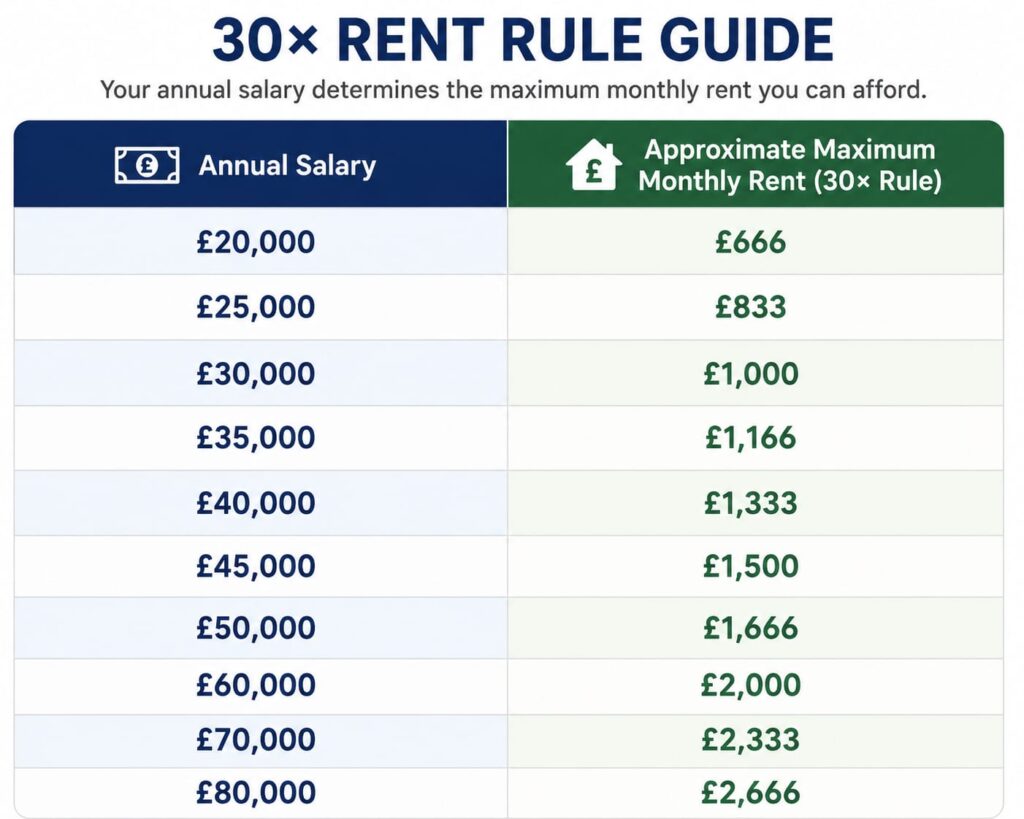
This table provides a quick estimate to help you understand what rent level may suit your income before you begin searching for a property.
Expert Tips to Improve Your Chances of Renting
Confirming the income requirement is important, but it is not the only factor property owners and letting agents consider. A prepared application can make a great difference, especially if there are multiple candidates for the same property.
1. Calculate Your Affordability Before Viewing Properties
Many people spend time viewing homes they are unlikely to qualify for.
Before arranging a viewing, use this simple calculation:
Maximum Monthly Rent = Annual Salary ÷ 30
Example
Annual salary:
£42,000
Maximum affordable monthly rent:
£42,000 ÷ 30 = £1,400
By setting your budget in advance, you can focus on properties that match both your finances and the letting agent’s affordability criteria.
2. Save More Than Just the Deposit
Many first-time renters only budget for the tenancy deposit, but there are several upfront costs to consider.
| You may need money for: |
|---|
| First month’s rent |
| Security deposit |
| Moving costs |
| Furniture (if the property is unfurnished) |
| Utility setup |
| Broadband installation |
| Local Tax (where applicable) |
Having extra savings shows financial Balance and helps you manage unplanned expenses after moving in.
3. Keep Your Employment Stable
Changing jobs shortly before applying doesn’t instantly prevent you from renting, but some property owners prefer candidates with a stable job history.
If you’ve recently started a new role, you can improve your application by providing:
- A signed job contract
- A confirmation letter from your employer
- A recent salary slip (if available)
This reassures the landlord that your income is secure.
4. Organise Your Financial Documents
Planning your paperwork before applying can speed up the reference check process and leave a positive impression.
| Create a folder containing: |
|---|
| Passport or driving licence |
| Three months of payslips |
| Three months of bank statements |
| Employment contract |
| Proof of address |
| Previous landlord reference |
| Proof of savings |
Candidates who respond quickly often have an advantage in challenging rental markets.
5. Don’t Ignore Your Credit History
Although affordability checks focus on income, many landlords also review your credit history.
A good credit record suggests that you manage your financial commitments responsibly.
If possible:
- Pay bills on time.
- Reduce outstanding debts.
- Avoid missing loan or credit card payments.
- Check your credit report for errors before applying.
6. Consider a Joint Application
If your income alone is slightly below the affordability requirement, applying with a partner or trusted friend may help.
Most letting agents combine the incomes of joint applicants.
Example
| Income & Affordability Details | Amount |
|---|---|
| Emma’s Salary | £24,000 |
| Ryan’s Salary | £21,000 |
| Combined Salary | £45,000 |
| Monthly Rent | £1,300 |
| Required Salary | £1,300 × 30 = £39,000 |
Together, they comfortably meet the affordability requirement.
Real-Life Scenario: Choosing a More Affordable Property
Mark earns £31,000 per year and wants to rent a flat costing £1,200 per month.
The letting agent uses the 30× affordability rule.
Required salary:
£1,200 × 30 = £36,000
Mark doesn’t qualify on his own.
Instead of applying and risking rejection, he chooses another apartment costing £1,000 per month.
New salary requirement:
£1,000 × 30 = £30,000
His salary now is greater than the requirement, and his application is approved without needing a guarantor.
This simple decision saves time, avoids unneeded credit checks, and improves his chances of securing a property.
Real-Life Scenario: Renting After a Promotion
Sophie previously earned £28,000 and struggled to qualify for the properties she wanted.
After receiving a promotion, her salary increased to £38,000.
She applied for a property renting at £1,200 per month.
Required salary:
£1,200 × 30 = £36,000
Because her new income was greater than the affordability limit, the referencing process was straightforward, and she secured the rental agreement.
This highlights how even a modest salary increase can greatly expand your rental options.
Read more: £40,000 Salary Rent UK: How Much Rent Can You AffordCommon Myths About Rental Salary Requirements
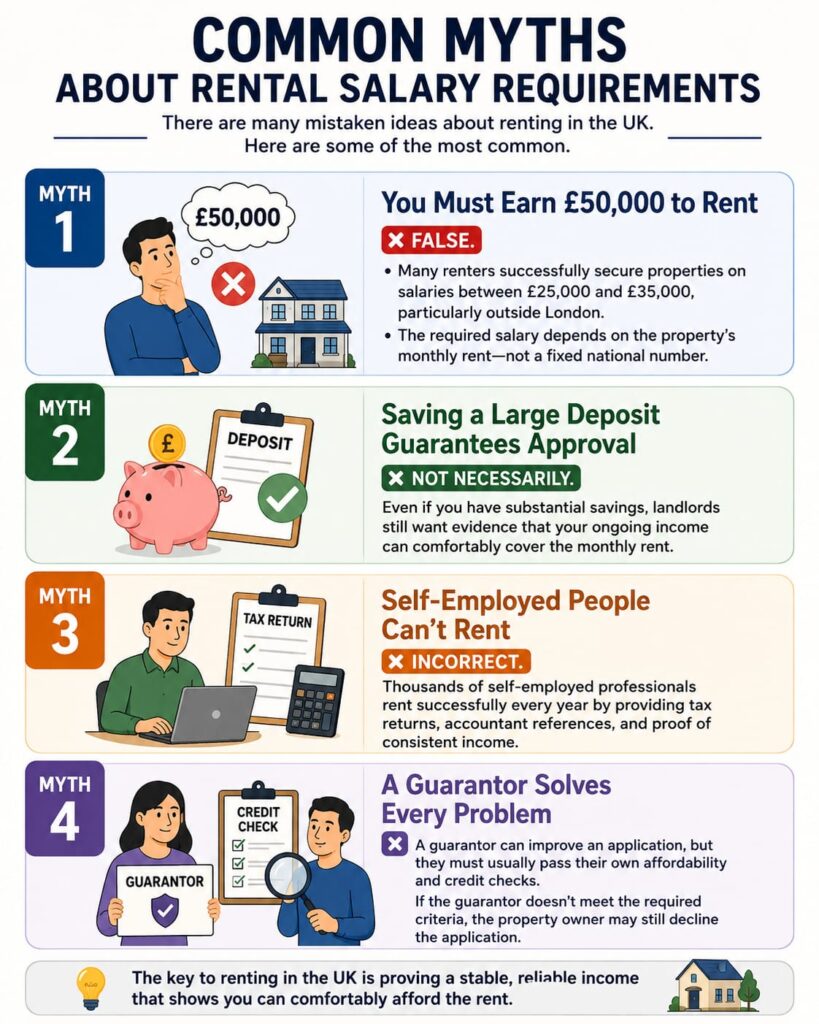
There are many Mistaken ideas about renting in the UK. In this place are some of the most common.
Myth 1: You Must Earn £50,000 to Rent
False.
Many renters successfully secure properties on salaries between £25,000 and £35,000, particularly outside London.
The required salary depends on the property’s monthly rent—not a fixed national number.
Myth 2: Saving a Large Deposit Guarantees Approval
Not necessarily.
Even if you have substantial savings, landlords still want evidence that your ongoing income can comfortably cover the monthly rent.
Myth 3: Self-Employed People Can’t Rent
Incorrect.
Thousands of self-employed professionals rent successfully every year by providing tax returns, accountant references, and proof of consistent income.
Myth 4: A Guarantor Solves Every Problem
A guarantor can improve an application, but they must usually pass their own affordability and credit checks.
If the guarantor doesn’t meet the required criteria, the property owner may still decline the application.
What salary do I need to rent in the UK?
A common guideline is that your annual salary should be at least 30 times the monthly rent. For example, renting a property at £1,000 per month typically requires an annual income of around £30,000.
Can I rent on a £25,000 salary?
Yes. Using the 30× affordability rule, a salary of £25,000 generally supports rent of around £830 per month, although this depends on the landlord’s affordability policy and the local rental market.
Is affordability based on gross or net salary?
Most letting agents use your gross annual salary (before tax) because it provides a consistent and verifiable measure of income.
Can bonuses and overtime be included?
Yes, if they are regular and supported by evidence such as payslips or employer references, many letting agents will include them in their affordability assessment.
Can I combine my salary with my partner’s?
Yes. Joint applicants are usually assessed based on their combined gross annual income, making it easier to qualify for higher-rent properties
What if I don’t earn enough?
If your salary is below the affordability requirement, you may still be able to rent by:
Providing a guarantor.
Paying several months’ rent in advance.
Applying jointly with another tenant.
Choosing a property with a lower monthly rent.
Do letting agents verify my salary?
Yes. Most letting agents verify your income using payslips, bank statements, employment references, and, for self-employed applicants, tax documents or accountant references.
What is a rent-to-income ratio and how is it different from the 30× rule?
A rent-to-income ratio expresses affordability as a percentage — commonly, rent shouldn’t exceed 30–35% of gross monthly income. This is mathematically similar to the 30× annual salary rule and is often used interchangeably by referencing companies.
Do letting agents use an online affordability calculator?
Many letting agents and referencing companies (such as Goodlord or HomeLet) use automated affordability calculators that apply the 30× or 2.5× rules instantly once you submit your salary and the monthly rent, rather than a manual review.
A Simple Way to Decide If a Rent Is Affordable
Before committing to a rental property, look at the decision from two angles. First, check whether your income meets the landlord’s affordability requirement. Second, check whether the rent leaves enough money for your normal living costs, savings and unexpected expenses. If you pass the first test but fail the second, the property may still be too expensive for you. A slightly cheaper home can sometimes provide much more financial flexibility during the tenancy. Taking a few minutes to calculate both figures before applying can help you choose a property that is not only possible to rent, but practical to live in month after month.
Final Thoughts
Learning what salary you need to rent in the UK is one of the best ways to prepare for a successful rental application. While affordability calculations may seem Rigid, they are designed to ensure that renters can comfortably manage their rent together with everyday living expenses.
Before applying for a property, calculate if your salary meets the likely affordability requirement, arrange your documents, and be practical about your financial plan. If your income falls A little below the required limit, remember that Options such as a guarantor, a joint application, or paying rent in advance may even help you secure a rental agreement.
The most successful candidates aren’t always those with the highest salaries; they’re the ones who understand the process, provide Correct information, and show that they can consistently meet their rental requirements.