

Student Rent Affordability UK: Moving away for university is exciting, but working out how to pay for everything can be a different story. Rent is usually one of the biggest expenses a student has to deal with, and it is easy to underestimate how quickly accommodation can take up a large part of a student budget.
For some students, rent is covered partly by a Maintenance Loan. Others rely on parents, savings or a part-time job. Many use a Mixture of all of these. The amount available can also vary considerably depending on where a student lives. Renting a room in a shared house in a smaller university city can cost far less than renting a room in London.
So, how much rent can a student actually afford in the UK?
There is no single number that works for everyone. A better way to answer the question is to look at the student’s total monthly income, regular living costs, and the amount left after those costs have been paid.
This guide explains how to work out an affordable student rent budget, with simple examples and calculations that you can use before choosing accommodation.
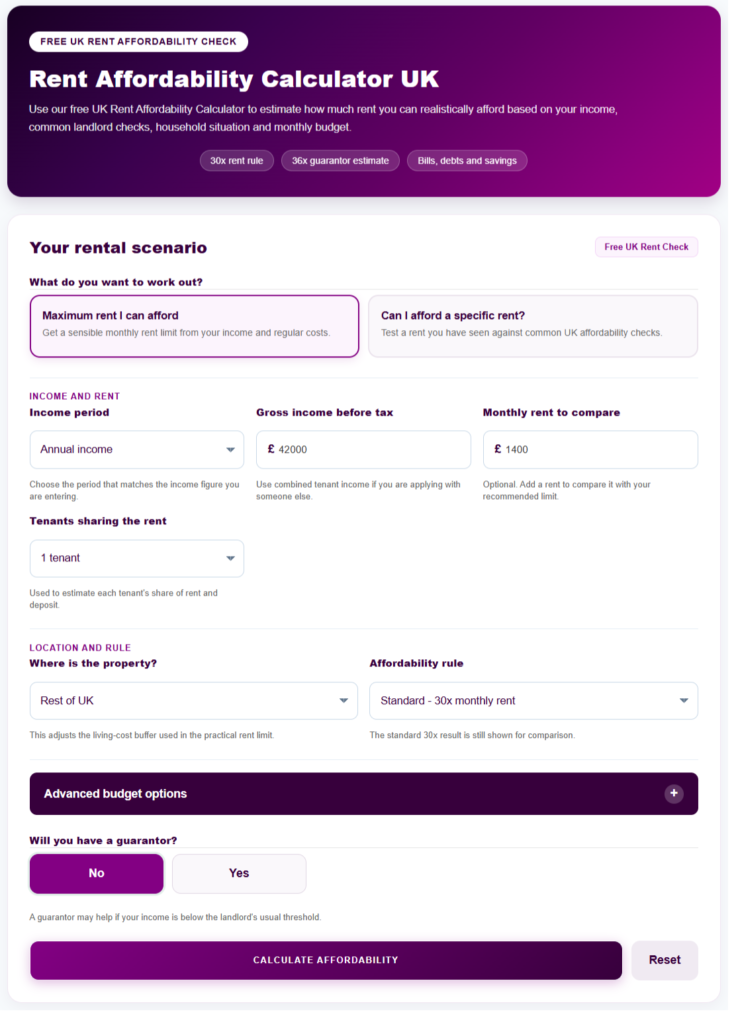
Click Here:Rent Affordability Calculator UK
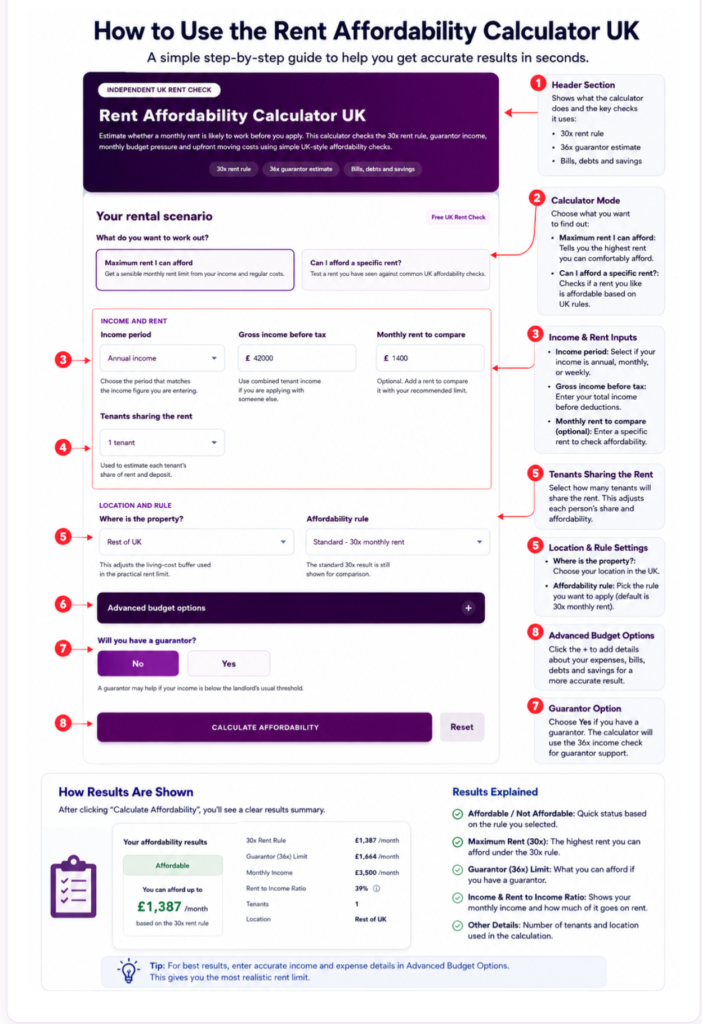
How to Use the Rent Affordability Calculator UK
What Is Student Rent Affordability?
Student Rent Affordability UK means being able to pay for accommodation without leaving yourself short of money for other essential expenses.
It is tempting to look at a room advertised for £600 a month and simply ask whether you can find £600 to pay the landlord. But that is only part of the picture.
You regularly need money for food, transport, your phone, course-related costs, social activities, and unexpected costs.
For example, assume a student has £1,300 available each month.
Their regular expenses might look like this:
| Expense | Amount |
|---|---|
| Rent | £600 |
| Food | £220 |
| Transport | £70 |
| Phone | £30 |
| Course expenses | £40 |
| Personal expenses | £100 |
| Emergency funds | £75 |
That leaves:
£1,300 − £600 − £220 − £70 − £30 − £40 − £100 − £75 = £165
In this example, the £600 rent may be manageable because there is still some money left after the main expenses.
Now imagine the same student chooses a property costing £800 a month.
The calculation becomes:
£1,300 − £800 − £220 − £70 − £30 − £40 − £100 − £75 = −£35
The student would be £35 short every month.
That is why the cheapest-looking or most attractive property is not necessarily the right choice. The important thing is whether the entire budget works.
Read more:Semester Grade Calculator UK: Calculate Your Semester AverageHow Much Should a Student Spend on Rent?
There is no official UK rule saying that students must spend a particular percentage of their income on rent.
You may come across the 30% housing rule, which suggests keeping housing costs below 30% of income. This can be a useful budgeting reference, but it does not always work well for students.
Students often have lower and less predictable incomes than full-time workers. At the same time, rents in university towns and cities can be relatively high.
For that reason, it can be more useful to think in terms of a range.
| Monthly Rent as % of Available Funds | General Budgeting Guide |
|---|---|
| Under 30% | Relatively comfortable for many students |
| 30%–40% | Often manageable |
| 40%–50% | Requires closer budgeting |
| 50%–60% | Can put considerable pressure on the rest of the budget |
| Over 60% | Usually leaves very little flexibility |
These are not official affordability thresholds. They are simply useful figures for comparing different accommodation options.
For students, the amount of money left after paying rent may tell you more than the percentage itself.
A Simple Formula for Student Rent Affordability
You can work out a realistic rent budget with a simple calculation:
Maximum Comfortable Rent = Monthly Available Money − Essential Expenses − Emergency Buffer
| Calculation | Amount |
|---|---|
| Monthly available money | £1,400 |
| Other essential expenses | £550 |
| Emergency buffer | £100 |
| Affordable rent amount | £750 |
The student could potentially spend up to £750 on rent, but it would still be sensible to look for something cheaper if possible.
For example, choosing accommodation at £650 would leave another £100 of flexibility each month.
Over a year, that difference could be:
£100 × 12 = £1,200
That is a useful amount of money for a student who may face unexpected travel, household, or course-related costs.
What Counts as Student Income?
Before working out your rent budget, you need a realistic idea of how much money you actually have available.
For many students, money comes from several places rather than one monthly salary.
| Possible Source of Money | |
|---|---|
| Student Maintenance Loan | |
| Part-time employment | |
| Financial support from parents | |
| Savings | |
| Scholarships | |
| Bursaries | |
| Grants or other support | |
| Other regular income |
The important word here is reliable.
If you normally earn £400 a month from a part-time job but your hours can drop during exams, it may be risky to base your entire rent budget on receiving £400 every month.
A safer approach is to work out your essential budget using income that you can reasonably expect to receive.
You can then treat additional earnings as extra financial support rather than money that is already committed to rent.
Read more: How Much Rent Can Couples Afford in the UK? (2026 Guide)
Example: Calculating Rent from a Student Budget
Let’s say James is studying at a university outside London.
He expects to have:
- Maintenance Loan money: £800 per month
- Part-time job: £350 per month
- Family support: £100 per month
His total monthly funds are:
£800 + £350 + £100 = £1,250
Now he estimates his other monthly costs:
| Expense | Monthly amount |
| Food | £210 |
| Transport | £65 |
| Phone | £30 |
| Course materials | £35 |
| Personal expenses | £90 |
| Emergency savings | £75 |
| Total | £505 |
The amount left is:
£1,250 − £505 = £745
So £745 is the theoretical maximum available for rent.
However, James does not necessarily need to spend all £745.
If he finds a room for £600 including bills, his calculation becomes:
£1,250 − £600 − £505 = £145
He would have £145 left each month.
That gives him considerably more breathing room than choosing a £745 room.
Why the 30% Rule Does Not Always Work for Students
The 30% rule is easy to understand, but student finances are unusual.
Suppose a student has £1,200 available each month.
| Calculation | Amount |
|---|---|
| Monthly available money | £1,200 |
| 30% of £1,200 | £360 |
A £360 monthly rent would be excellent from a budgeting perspective. However, depending on the city and type of accommodation, finding a suitable room at that price may not be realistic.
Now imagine another student has £2,000 available each month because they receive substantial family support and earn a good amount from work.
| Calculation | Amount |
|---|---|
| Monthly available money | £2,000 |
| 30% of £2,000 | £600 |
If that student pays £750 in rent, they are spending 37.5% of their available money on accommodation, but they may still have a comfortable overall budget.
This illustrates why rent percentage should be treated as a guide rather than a strict rule.
The better question is:
After paying costs, can I comfortably manage everything else I need?

Rent Affordability for Students Living in London
London deserves separate consideration because accommodation and transport costs can be considerably higher than in many other parts of the UK.
A student living in London may need to budget for:
- Higher rent
- Transport
- Food
- Bills
- Course expenses
- Personal spending
Suppose Sarah has:
| Income Source | Monthly Amount |
|---|---|
| Student finance | £1,100 |
| Part-time income | £500 |
| Family contribution | £200 |
Total:
£1,100 + £500 + £200 = £1,800
Her non-rent expenses are:
| Expense | Monthly Amount |
|---|---|
| Food | £250 |
| Transport | £120 |
| Phone | £35 |
| Course expenses | £40 |
| Personal spending | £100 |
| Emergency savings | £100 |
Total:
£645
Money left for housing:
£1,800 − £645 = £1,155
Sarah could theoretically afford up to £1,155 in rent, but choosing accommodation around £900–£1,000 could give her more flexibility.
For example, at £950 rent:
£1,800 − £950 − £645 = £205
She would still have £205 available after her planned expenses.
This is much healthier than using almost all of her available money on rent.
Rent Affordability Outside London
Students outside London may find more options at lower prices, although costs vary considerably between cities.
Suppose a student has £1,250 available each month and their essential non-rent costs are £500.
They have:
£1,250 − £500 = £750
available for accommodation.
They compare three properties:
| Property | Rent | Bills | Total Housing Cost | Money Remaining |
|---|---|---|---|---|
| Property A | £500 | £100 | £600 | £150 |
| Property B | £600 | Included | £600 | £150 |
| Property C | £700 | £100 | £800 | −£50 |
Property C does not fit the student’s financial plan.
Interestingly, Property A and Property B cost the same overall, even though their advertised rents are different.
This is why students should compare the total monthly housing cost.
Don’t Forget About Bills
One of the easiest mistakes is to compare rents without checking what is included.
A room costing £550 may sound cheaper than one costing £650, but if the first room has several additional bills, the difference may disappear.
For example:
| Room | Rent | Electricity & Heating | Water | Internet | Bills | Total Monthly Cost |
|---|---|---|---|---|---|---|
| Room 1 | £550 | £65 | £20 | £15 | £100 | £650 |
| Room 2 | £630 | — | — | — | Included | £630 |
The second property costs only £20 more in this example.
It may also be easier to plan financially because the student knows the housing cost in advance.
Before signing a rental agreement, check exactly which payments are included and if there are any limits or additional Expenses.
Read more: Can You Rent with Bad Credit in the UK? Complete Guide (2026)
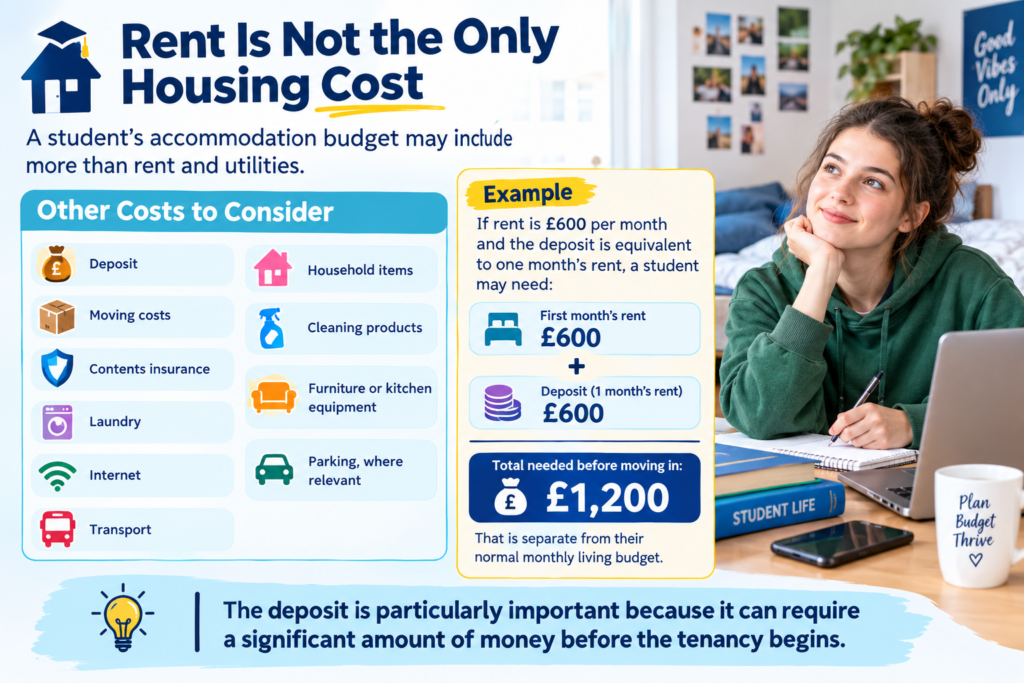
Rent Is Not the Only Housing Cost
A student’s accommodation budget may include more than rent and utilities.
| Other Cost | |
|---|---|
| Deposit | |
| Moving costs | |
| Contents insurance | |
| Laundry | |
| Internet | |
| Transport | |
| Household items | |
| Cleaning products | |
| Furniture or kitchen equipment | |
| Parking, where relevant |
The deposit is particularly important because it can require a significant amount of money before the tenancy begins.
For example, if rent is £600 per month and the deposit is equivalent to one month’s rent, a student may need £1,200 just for the first month’s rent and deposit.
That is separate from their normal monthly living budget.
Think About the Full Length of the Tenancy
Students sometimes calculate affordability based only on the months they are attending lectures.
This can cause problems.
A tenancy might run for 12 months even if the academic year is shorter.
For example, suppose a student has £9,600 available for living costs.
| Calculation | Amount |
|---|---|
| Total available amount | £9,600 |
| Number of months | 8 |
| Monthly amount | £1,200 |
That may make their budget look quite comfortable.
But if the money needs to cover 12 months:
£9,600 ÷ 12 = £800
That is a very different situation.
If rent is £700 per month, the student would have only:
£800 − £700 = £100
left for everything else.
Before agreeing to a property, students should check the exact tenancy dates and work out how they will cover rent during the summer or other periods when their income may change.
Shared Accommodation Can Make Rent More Affordable
Sharing a house or flat is one of the ways students can reduce individual accommodation costs.
Suppose four students rent a house for £2,200 per month.
| Calculation | Amount |
|---|---|
| Total rent | £2,200 |
| Number of students | 4 |
| Rent per student | £550 |
| Monthly household bills | £360 |
| Bills per student | £90 |
| Total housing cost per student | £640 |
This may be more affordable than renting a private studio.
However, students should check the tenancy agreement carefully. In some arrangements, tenants may have shared responsibility for rent and other obligations.
It is also worth considering whether everyone in the household is likely to pay their share on time.
Is Living Further Away from University Cheaper?
Not always.
A property further from campus may have a lower rent, but students should include the cost of travelling to university.
Imagine two rooms:
| Room | Rent | Transport | Total |
|---|---|---|---|
| Room A | £650 | £20 | £670 |
| Room B | £550 | £120 | £670 |
Both cost the same overall.
There is also a time factor. A cheaper property that requires a long commute every day may not be worth the saving for some students.
When comparing properties, look at:
Rent + Bills + Transport
rather than rent alone.
Should Students Work Part-Time to Pay Higher Rent?
A part-time job can clearly help with living costs, but it is worth being careful about how that earning is used.
The amount of work can change during the year. Students may also work A smaller number of hours during exams or university holidays.
For example, a student might normally earn £450 a month but only earn £200 during a particularly busy period.
If their rent is based on the assumption that they will always earn £450, they could quickly run into trouble.
A safer approach is to avoid making rent so high that it depends entirely on variable employment income.
For example:
| Income Source | Monthly Amount |
|---|---|
| Monthly guaranteed funds | £900 |
| Average part-time earnings | £400 |
Instead of assuming the student always has £1,300, they could make sure their essential commitments are manageable with the £900 guaranteed amount.
The extra earnings can then help with food, savings, travel, and other flexible costs.
What If Parents Are Helping With Rent?
Family support can make a significant difference to student affordability.
| Calculation | Amount |
|---|---|
| Monthly parent contribution | £150 |
| Number of months | 12 |
| Total annual contribution | £1,800 |
That can make a considerable difference to the student’s annual housing budget.
However, students should be clear about whether the contribution is guaranteed for the full tenancy.
If a student signs a contract expecting £200 per month from their family but that support later becomes unavailable, the rent still has to be paid.
It is better to build a budget around support that is genuinely available and reliable.
Read more: Failed a Rent Affordability Check? Here’s What to Do Next
How Much Should Students Keep for Emergencies?
There is no universal emergency-fund amount for students, because financial circumstances differ.
Even setting aside a Moderate amount can help.
| Monthly Savings | Number of Months | Total Savings |
|---|---|---|
| £50 | 12 | £600 |
| £75 | 12 | £900 |
That money could be useful if a laptop needs repairing, travel becomes more expensive, work hours fall, or an unexpected bill appears.
If money is very tight, students should not feel that they need to save a large amount immediately. The main idea is to leave some room in the budget rather than spending every pound on rent and regular expenses.
A Full Student Rent Affordability Example
Let’s put everything together.
Imagine Alex has:
- Maintenance Loan funds: £850
- Part-time work: £300
- Family support: £100
Total monthly funds:
£850 + £300 + £100 = £1,250
Alex’s monthly non-rent budget is:
| Expense | Cost |
| Food | £200 |
| Transport | £70 |
| Phone | £30 |
| Course costs | £35 |
| Personal expenses | £90 |
| Emergency fund | £75 |
| Total | £500 |
Money available for rent:
£1,250 − £500 = £750
Alex finds a room advertised at £650.
Bills are expected to be £80.
Total housing cost:
£650 + £80 = £730
Now calculate the remaining money:
£1,250 − £730 − £500 = £20
Although Alex can technically pay the rent, only £20 remains.
That would be a very tight budget.
Now imagine Alex finds another room for £550 with bills included.
The calculation becomes:
£1,250 − £550 − £500 = £200
That leaves £200 each month.
The second property is therefore much safer financially, even though the first room may initially have seemed affordable.
This is a good example of why maximum affordability is not the same as comfortable affordability.

What Should Students Do If They Cannot Find Affordable Rent?
Sometimes the numbers simply do not work.
If suitable Rental property is consistently above the student’s budget, there are several possibilities worth taking into account.
Look at different areas
A nearby neighbourhood may have lower rents while still providing reasonable access to the university.
Consider sharing
Sharing can reduce both rent and household bills.
Compare university accommodation
University-managed accommodation may sometimes provide different pricing structures or include bills.
Look for bills-inclusive options
This can make monthly budgeting easier.
Review transport costs
A slightly cheaper room may not be cheaper overall if transport is expensive.
Check available financial support
Students should check whether they qualify for scholarships, Student funding, university hardship support, or other Support.
Review part-time work carefully
Additional income can help, but students should avoid taking on more work than they can practically manage alongside their Program.
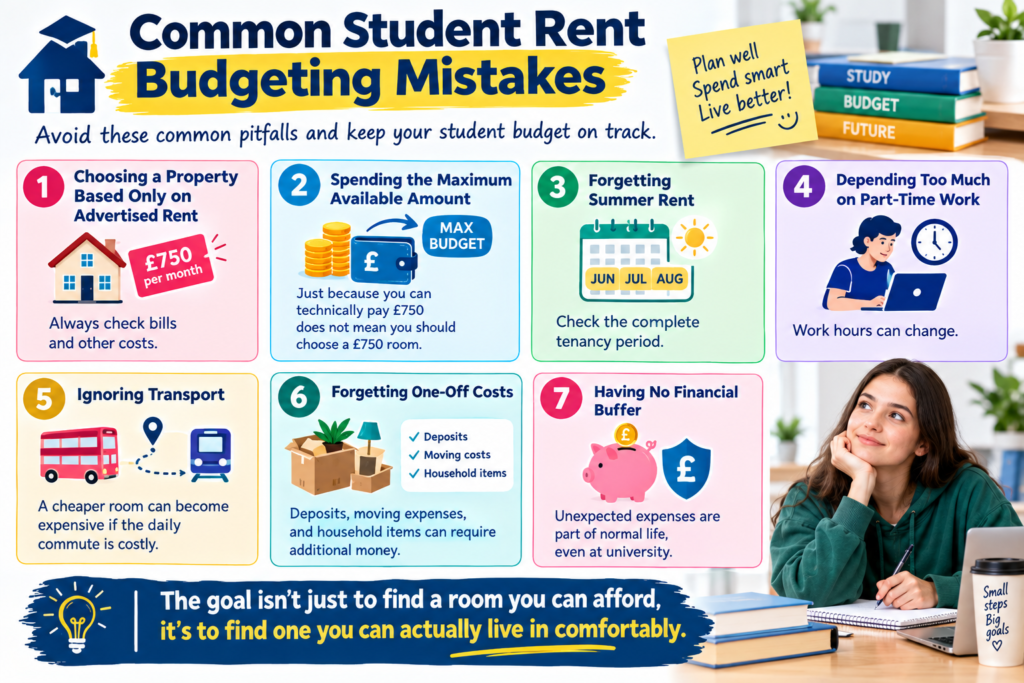
Common Student Rent Budgeting Mistakes
| Common Mistake | What to Consider |
|---|---|
| Choosing a Property Based Only on Advertised Rent | Always check bills and other costs. |
| Spending the Maximum Available Amount | Just because you can technically pay £750 does not mean you should choose a £750 room. |
| Forgetting Summer Rent | Check the complete tenancy period. |
| Depending Too Much on Part-Time Work | Work hours can change. |
| Ignoring Transport | A cheaper room can become expensive if the daily commute is costly. |
| Forgetting One-Off Costs | Deposits, moving expenses, and household items can require additional money. |
| Having No Financial Buffer | Unexpected expenses are part of normal life, even at university. |
How to Find a Comfortable Student Rent Budget
A useful way to approach the decision is to calculate three figures.
Figure 1: Maximum Rent
This is what your budget technically allows.
Available money − essential expenses = maximum possible rent
Figure 2: Comfortable Rent
This is lower than the maximum and leaves some flexibility.
Figure 3: Preferred Rent
This is the amount you would ideally like to pay while still having money for savings, social activities and unexpected costs.
For example:
- Maximum possible rent: £750
- Comfortable rent: £650
- Preferred rent: £600
This gives the student a realistic target rather than one fixed number.
Try a Student Rent Stress Test Before Signing a Tenancy
A rent budget can look affordable on paper but become difficult when your circumstances change. Before choosing a property, it is useful to test your budget against a less comfortable month. Start with the rent you are considering and then imagine that your part-time income falls by £150, your monthly bills increase by £50, or you have an unexpected £100 expense. Recalculate the amount left after these changes.
For example, suppose you have £1,400 available each month, your essential non-rent costs are £500, and you are considering rent of £650. Under normal circumstances, you would have £250 left:
£1,400 − £500 − £650 = £250
Now test the same budget with £150 less income and £50 higher expenses:
£1,250 − £550 − £650 = £50
The rent has not changed, but the amount of financial breathing room has dropped from £250 to just £50. This does not automatically mean the property is unaffordable, but it shows how dependent the budget is on everything going exactly as planned.
This simple test can help students compare properties more realistically. If a small change in income or expenses leaves you with almost nothing, consider looking for a lower-cost room, a bills-included option, or shared accommodation. The aim is not to predict every possible problem, but to make sure your rent budget can cope with an ordinary difficult month rather than only a perfect one.
Read more: What Income Counts for Rent Affordability Checks in the UK?
How much rent can a student afford in the UK?
There is no fixed amount that every student can afford. A student should calculate their total monthly income, subtract essential living costs, and keep some money aside for unexpected expenses. The amount left can be used to set a realistic rent budget.
What percentage of a student’s income should go towards rent?
A useful starting point is around 30% to 40% of available monthly funds. However, students may need to spend more depending on where they live and how much financial support they receive. The most important thing is to make sure enough money remains for food, transport, bills, and other essential costs.
Is 50% of income on rent too much for a student?
Spending 50% of available income on rent can make a student’s budget quite tight. It may be manageable if the student has low living costs or additional financial support, but they should carefully calculate what remains after rent and bills.
How do I calculate affordable rent as a student?
Use this simple formula:
Affordable Rent = Monthly Available Funds − Essential Expenses − Emergency Buffer
For example, if you have £1,300 per month and your other expenses total £500, with £100 reserved for emergencies, your comfortable rent budget would be:
£1,300 − £500 − £100 = £700
Does a Maintenance Loan cover student rent?
A Maintenance Loan is designed to help eligible students with living costs, which can include accommodation, food and travel. It is not intended to cover rent alone, so students need to budget for their other expenses as well.
Can I afford student accommodation without a part-time job?
It depends on your Maintenance Loan, family support, savings, and living costs. If your available funds cover rent and essential expenses without employment income, you may not need a part-time job. If your budget has a shortfall, additional income may be necessary.
Is student accommodation cheaper than renting a private house?
Not necessarily. University halls, purpose-built student accommodation and private shared houses can all have different prices. Students should compare the total cost, including bills, transport and other housing expenses, rather than looking at rent alone.
Is bills-included student accommodation worth it?
Bills-included accommodation can make budgeting easier because your monthly housing cost is more predictable. However, students should compare the total price with properties where bills are paid separately to make sure they are getting good value.
How much should a student budget for rent in London?
London rents vary considerably depending on the area and type of accommodation. Instead of using one fixed figure, students should calculate their personal budget based on their available income, rent, bills, transport and other expenses.
Can students afford £700 rent per month?
Some students can afford £700 per month, while others cannot. For example, a student with £1,400 available each month and £500 of essential non-rent expenses may be able to manage £700 rent. A student with only £1,000 available may find the same rent difficult.
Conclusion
There is no universal rent figure that every UK student can afford.
A student with substantial family support may comfortably afford a higher rent, while someone relying mainly on student finance may need to look for a much cheaper room.
The best way to work out your own figure is to start with the money you can realistically expect to receive and then subtract everything you need to pay for.
The basic calculation is:
Monthly Available Funds − Essential Expenses − Emergency Buffer = Comfortable Rent Budget
For example:
£1,300 − £500 − £100 = £700
In this case, £700 might be the upper end of a comfortable budget. Finding accommodation for £600 or £650 would give the student more flexibility.
Remember that rent should not be considered in isolation. Always look at:
Rent + Bills + Transport + Other Housing Costs
A room that costs £550 is not necessarily cheaper than one costing £600 if the first property has significantly higher bills and transport costs.
Most importantly, don’t build a student budget that only works in a perfect month. If your plan depends on working maximum hours every week, receiving every expected contribution from family and having no unexpected expenses, the rent may be too high.
A slightly cheaper property can provide much more financial breathing room throughout the year.
Quick Student Rent Affordability Calculation
If you want a simple Starting stage, use:
Comfortable Student Rent = Total Monthly Funds − Essential Monthly Expenses − Emergency Buffer
For example:
£1,400 − £550 − £100 = £750
The student could potentially afford up to £750, but searching around £600–£700 would provide a safer margin.
The right cost is finally the amount you can continue paying month after month, while regularly being able to afford food, payments, study costs, and everyday life.
That is what makes rental property genuinely reasonable.