
Self-employed rent affordability can be Clear when you have a regular monthly salary. For self-employed people, freelancers, contractors and business owners, however, proving affordability can sometimes feel more Complex.
The good news is that being self-employed does not automatically make you less Qualified to rent a property. The main challenge is usually proving that your income is genuine, reliable, and sufficient to cover the rent.
In 2026, landlords and letting agents may look at your declared income, business accounts, tax documents, bank statements, credit history and overall financial position when assessing your application. Your affordability is generally about more than simply asking, “How much do you earn each month?”
This guide explains rent affordability for self-employed people in the UK, how landlords may assess your income, what documents you may need, how to calculate an affordable rent, and what you can do if your income changes from month to month.
Quick answer: A sensible starting point is to keep your rent around 30% to 35% of your reliable monthly income, although actual affordability depends on your household expenses, debts, taxes, savings and the landlord or letting agent’s affordability criteria.
“This guide takes on HMRC’s published Personal Assessment and Making Tax Digital Advice, along with common referencing practices reported by UK letting brokers. It’s intended as general information, not financial or legal advice — for a decision specific to your situation, speak to an accountant or a letting agent directly.”
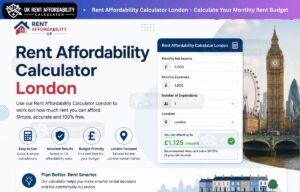
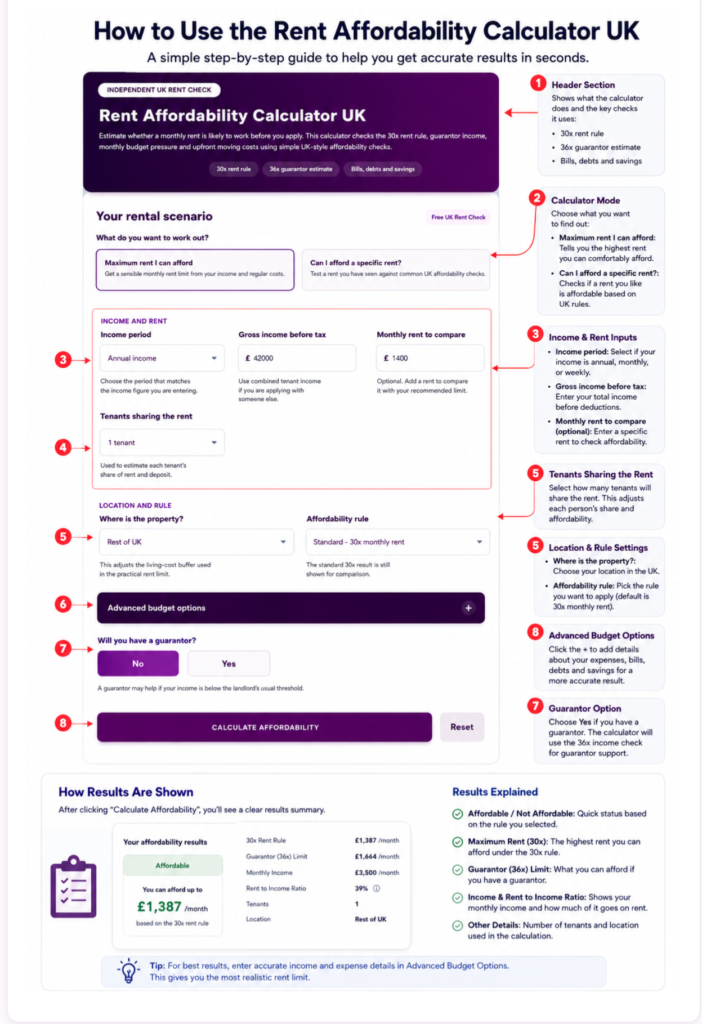
Visit Here:Rent Affordability Calculator UK
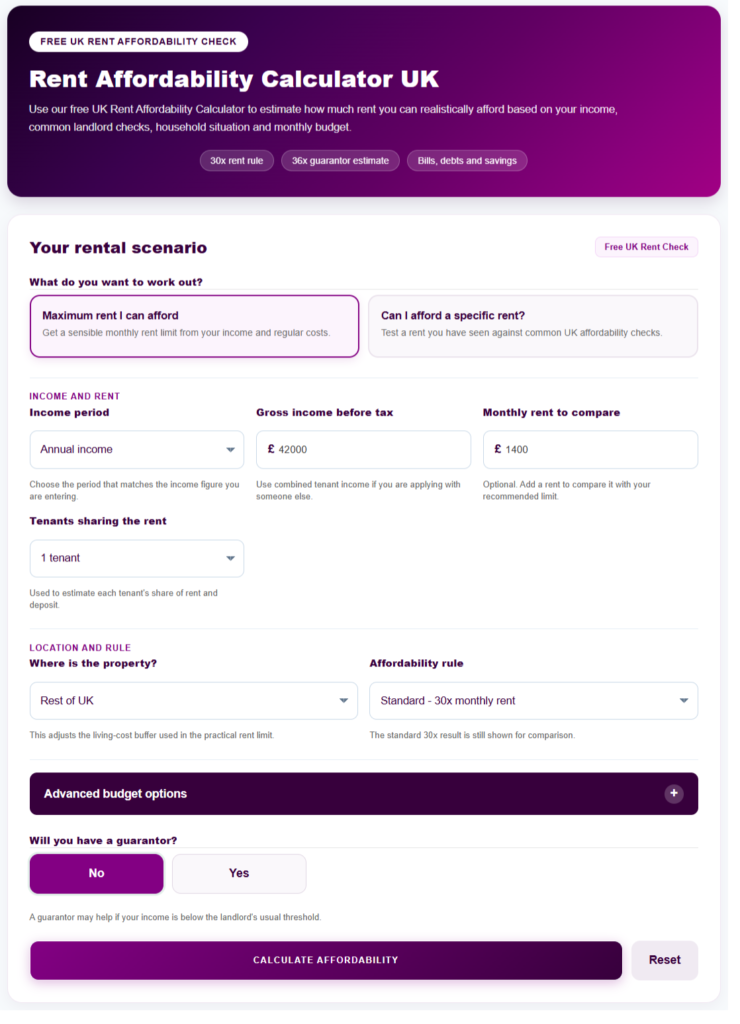
How to Use the Rent Affordability Calculator UK
What Is Rent Affordability for Self-Employed People?
Rent affordability is an assessment of whether you can comfortably pay the rent while still managing your other financial commitments.
For an employed tenant, affordability may be based on a straightforward annual salary. For example, someone earning £36,000 a year has a relatively easy income figure to verify.
For a self-employed person, the situation can be different.
Your business might generate £60,000 in sales, but that does not necessarily mean you personally earn £60,000. You may have business expenses, tax liabilities and other costs that reduce your actual income.
This is why landlords and referencing companies may focus on declared taxable income or business profit rather than turnover alone.
HMRC treats profits from self-employment as taxable income, and self-employed people may need to report their income through Self Assessment.
The important distinction is:
Turnover ≠ profit ≠ personal disposable income.
For example:
| Item | Amount |
|---|---|
| Business turnover | £70,000 |
| Business expenses | £25,000 |
| Approximate business profit | £45,000 |
| Personal tax and other commitments | Additional deductions |
A landlord may therefore assess the £45,000 profit figure rather than simply looking at the £70,000 turnover.
Read more: How to Predict Your Final Degree Classification Before Results DayIs It Harder for Self-Employed People to Rent in the UK?
It can be slightly more complicated, but it is not necessarily harder.
The biggest difference is proof of income.
| An employee may provide | Purpose |
|---|---|
| Recent payslips | Shows regular income |
| Employment contract | Confirms employment and salary |
| Bank statements | Helps verify income payments |
| Employer information | Confirms employment details |
A self-employed applicant may need to provide:
- SA302 or tax calculation
- Tax Year Overview
- Self Assessment records
- Business accounts
- Bank statements
- Accountant’s reference
- Proof of ongoing contracts
- Evidence of savings
HMRC confirms that an SA302 shows your income on which tax is due, allowances and the tax calculated for the relevant tax year.
You can obtain an SA302 for recent tax years after submitting your Self Assessment return. HMRC also provides Tax Year Overviews, which can be used as evidence of income in situations where proof is required.
So, the issue is usually not that you are self-employed. It is that your income requires more evidence and interpretation.
How Do Landlords Calculate Rent Affordability for Self-Employed Tenants?
There is no single affordability formula used by every landlord or letting agent.
Different referencing companies and landlords can have different requirements.
However, one common approach is to compare your annual income with the annual rent.
| Calculation | Amount |
|---|---|
| Monthly rent | £1,200 |
| Annual rent | £1,200 × 12 = £14,400 |
| Income requirement (30-times-rent rule) | £14,400 × 2.5 = £36,000 |
The applicant would therefore need around £36,000 of qualifying annual income.
Another way of communicating the same idea is:
Maximum monthly rent = annual qualifying income ÷ 30
So if your qualifying income is £45,000:
£45,000 ÷ 30 = £1,500
That gives an indicative maximum rent of £1,500 per month under a 30-times-rent affordability test.
However, this should not be treated as a universal UK legal requirement. It is an affordability method that some landlords, agents or referencing providers may use.
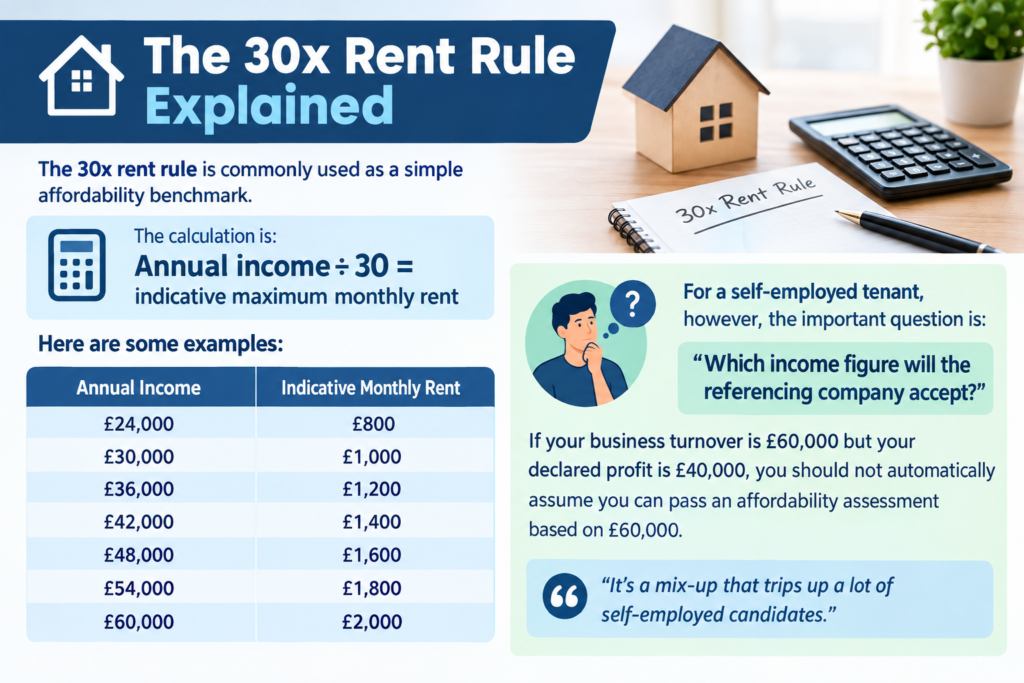
The 30x Rent Rule Explained
The 30x rent rule is commonly used as a simple affordability benchmark.
The calculation is:
Annual income ÷ 30 = indicative maximum monthly rent
Here are some examples:
| Annual Income | Indicative Monthly Rent |
| £24,000 | £800 |
| £30,000 | £1,000 |
| £36,000 | £1,200 |
| £42,000 | £1,400 |
| £48,000 | £1,600 |
| £54,000 | £1,800 |
| £60,000 | £2,000 |
For a self-employed tenant, however, the important question is:
Which income figure will the referencing company accept?
If your business turnover is £60,000 but your declared profit is £40,000, you should not automatically assume you can pass an affordability assessment based on £60,000.
“It’s a mix-up that trips up a lot of self-employed candidates.”
Read more: Student Rent Affordability UK – How Much Can Students Afford?
A More Realistic Way to Calculate Your Rent Affordability
Passing a referencing test and actually being able to afford a property are two different things.
Imagine you earn £4,000 per month on average.
A 30% rent calculation would be:
£4,000 × 30% = £1,200
A 35% calculation would be:
£4,000 × 35% = £1,400
That means an affordable target might be somewhere around £1,200–£1,400, depending on your other expenses.
But consider what happens if you also pay:
| Expense | Monthly Amount |
|---|---|
| Business-related costs | £400 |
| Personal debt | £300 |
| Transport | £250 |
| Insurance | £200 |
| Food and household expenses | £300 |
| Tax savings | £500 |
Suddenly, a £1,400 rent may feel much less comfortable.
“As a result, it’s worth calculating affordability from Dependable income after tax and regular costs, rather than the best month of the year.”
What Income Counts for a Self-Employed Renter?
“The income figure a landlord uses can vary a surprising amount depending on how you’re structured.”
Self-employed income can come from different sources, including:
- Sole trader profits
- Freelance work
- Contracting
- Consultancy
- Online businesses
- Professional services
- Partnerships
- Company director income
- Dividends
The way your income is assessed can vary depending on your business structure and the landlord’s referencing policy.
Sole Traders
If you operate as a sole trader, your business income and expenses are reported through Self Assessment.
For affordability purposes, the relevant figure may be based on your declared business profit rather than total sales.
| Item | Amount |
|---|---|
| Turnover | £80,000 |
| Allowable business expenses | £30,000 |
| Profit | £50,000 |
Your affordability assessment may therefore be based around the £50,000 figure, depending on the referencing company’s criteria.
Limited Company Directors
“This distinction catches a lot of directors out.”
| Income Type |
|---|
| Salary |
| Dividends |
| Benefits |
| Other income |
Some referencing providers may consider salary and dividends, while others may apply their own rules.
This is why limited company directors should ask the letting agent exactly what income they will accept before paying application or referencing costs.
Sole Trader vs. Freelancer vs. Limited Company Director: How Affordability Differs
The same £50,000 of business activity can be assessed very differently depending on how you’re structured:
| Business structure | Figure a landlord is likely to assess | Example |
| Sole trader | Declared profit after expenses | £80,000 turnover, £30,000 expenses → assessed on £50,000 |
| Freelancer/contractor | Average income over a set period, often smoothed across months | £3,500–£4,500 monthly swings → assessed on the average, e.g. £3,783 |
| Limited company director | Salary plus dividends, not company turnover or retained profit | £120,000 company turnover, but £18,000 salary + £20,000 dividends → assessed on £38,000 |
The practical takeaway: don’t assume your business’s total revenue is the number a referencing provider will use. Ask directly which figure they apply before you commit time or application fees.
What Documents Do Self-Employed Tenants Need?
Having these ready before you view a property — rather than scrambling once you’ve found one can shave days off the referencing process.
| Document | Why it’s requested | Where to get it |
| SA302 tax calculation | Shows income HMRC has assessed you as earning | Downloaded from your HMRC online account after filing Self Assessment |
| Tax Year Overview | Confirms your SA302 matches HMRC’s records | HMRC online account or by post |
| Business accounts | Shows the financial position behind the tax figures | Your accountant, or self-prepared if unaudited |
| Bank statements (3–6 months) | Demonstrates regular income landing and available funds | Your bank’s app or online portal |
| Accountant’s reference | Adds third-party verification of trading history | Request directly from your accountant |
| Signed contracts or ongoing work | Evidence of future, not just past, income | Client agreements, purchase orders, retainer letters |
| Proof of savings | Reassurance during quieter income months | Savings account statements |
SA302 Tax Calculation
The SA302 is an important document because it summarises the income and tax calculation from your Self Assessment.
HMRC states that you can obtain tax calculations for the last four years after submitting your Self Assessment returns.
Tax Year Overview
A Tax Year Overview can help verify that your tax information corresponds with your HMRC records.
Business Accounts
Some landlords or referencing providers may request accounts prepared by an accountant.
These can help demonstrate your business’s financial position.
Bank Statements
Bank statements can demonstrate regular income and help show that you have enough money available to meet your rent and other commitments.
Accountant’s Reference
If you work with an accountant, a reference confirming your trading history and income can strengthen your application.
Contracts or Future Work
If you are a freelancer or contractor, evidence of ongoing contracts can help demonstrate future income.
Proof of Savings
Savings can be particularly useful if your income fluctuates.
They do not necessarily replace income requirements, but they can provide additional reassurance.
Read more:Rent Affordability Calculator Leeds – Calculate Your Rental Budget (2026)
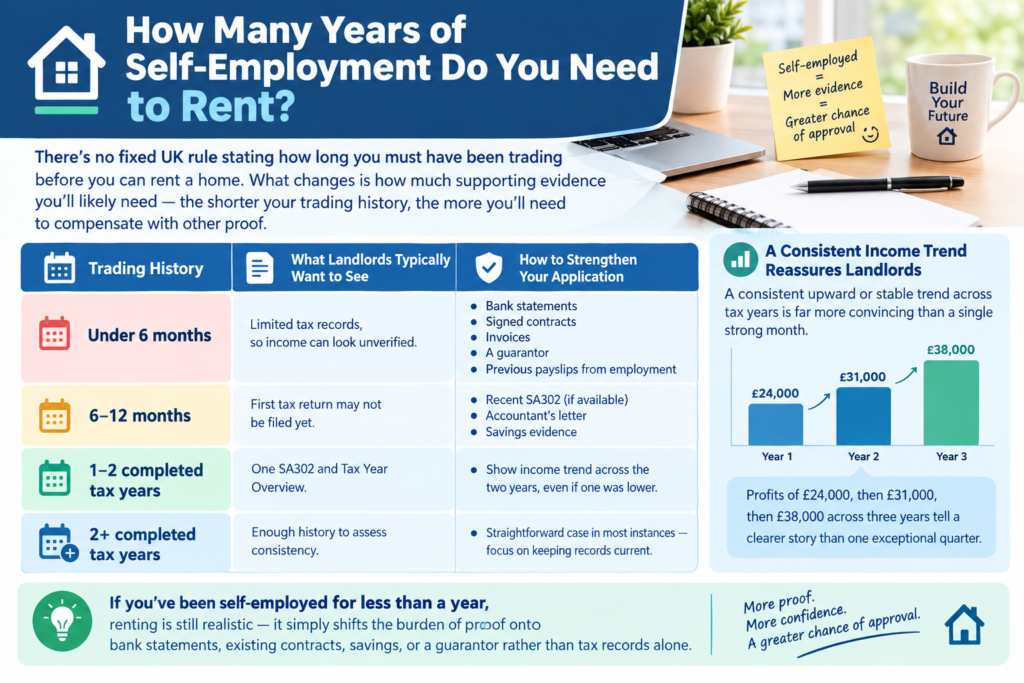
How Many Years of Self-Employment Do You Need to Rent?
There’s no fixed UK rule stating how long you must have been trading before you can rent a home. What changes is how much supporting evidence you’ll likely need — the shorter your trading history, the more you’ll need to compensate with other proof.
| Tradinghistory | What landlords typically want to see | How to strengthen your application |
| Under 6 months | Limited tax records, so income can look unverified | Bank statements, signed contracts, invoices, a guarantor, or previous payslips from employment |
| 6–12months | First tax return may not be filed yet | Recent SA302 (if available), accountant’s letter, savings evidence |
| 1–2 completed tax years | One SA302 and Tax Year Overview | Show income trend across the two years, even if one was lower |
| 2+ completed tax years | Enough history to assess consistency | Straightforward case in most instances — focus on keeping records current |
A consistent upward or stable trend across tax years reassures a landlord far more than a single strong month. For example, profits of £24,000, then £31,000, then £38,000 across three years tell a clearer story than one exceptional quarter.
If you’ve been self-employed for less than a year, renting is still realistic — it simply shifts the burden of proof onto bank statements, existing contracts, savings, or a guarantor rather than tax records alone.
What If Your Self-Employed Income Changes Every Month?
“Freelancers and business owners run into this often.”
One month you might earn £5,000.
The next month you might earn £2,000.
Then you could have a £7,000 month because of a large project.
Looking at one month alone can make your finances appear unstable even when your annual income is healthy.
A better approach is to calculate your average reliable income.
For example:
| Month | Income |
| January | £3,500 |
| February | £4,000 |
| March | £2,800 |
| April | £4,500 |
| May | £3,700 |
| June | £4,200 |
Total:
£22,700
Average:
£22,700 ÷ 6 = £3,783 per month
Instead of planning rent around £4,500 per month, you could use approximately £3,783 as a more conservative starting point.
This protects you against months when your business is quieter.
Build a Rent Buffer Before You Move
One practical step that is often overlooked is creating a rent buffer before signing a tenancy.
If your income changes from month to month, don’t base your housing budget on the amount you expect to earn in a particularly busy month. Instead, look at the months when your income was lower and ask whether you could still cover the rent, bills and essential expenses.
For example, suppose your average monthly income is £4,000, but your income has previously fallen to £2,700 during quieter periods. A property with £1,500 monthly rent may appear affordable based on your average income, but it could become difficult during a slow month.
A useful approach is to keep enough accessible savings to cover several months of essential expenses. This does not need to be presented as a formal affordability rule. It is simply a way of protecting yourself against gaps between contracts, late client payments or seasonal changes in your work.
Before moving, calculate:
Monthly rent + essential household bills + minimum debt payments + essential living costs
Then compare this figure with the amount you have available during a typical low-income month.
This gives you a much clearer picture of whether the property is sustainable rather than simply whether you can afford the first month’s rent.
For self-employed renters, financial breathing room can be just as important as passing the referencing check.
How Much Rent Can a Self-Employed Person Afford?
There is no universal amount because affordability depends on your income, location, and lifestyle.
A useful starting point is to keep rent around 30% to 35% of reliable monthly income.
For example:
| Monthly Income | 30% | 35% | Indicative Comfortable Rent Range |
|---|---|---|---|
| £2,500 | £750 | £875 | £750–£875 |
| £3,000 | £900 | £1,050 | £900–£1,050 |
| £4,000 | £1,200 | £1,400 | £1,200–£1,400 |
| £5,000 | £1,500 | £1,750 | £1,500–£1,750 |
These are budgeting guidelines, not official affordability limits.
Don’t Forget Tax When Calculating Rent Affordability
This is one of the biggest mistakes self-employed renters can make.
If you receive £5,000 in business income during a month, that does not necessarily mean you have £5,000 available to spend.
| Financial Commitment |
|---|
| Income Tax |
| National Insurance |
| Self Assessment payments |
| Business expenses |
| VAT, if applicable |
| Pension contributions |
| Other financial commitments |
HMRC requires eligible self-employed people to report taxable profits through Self Assessment, and the tax treatment depends on their circumstances.
So when working out how much rent you can afford, always think about money available after business costs and tax provisions, not just money entering your bank account.
What About Self-Employed People With High Turnover but Low Profit?
This is a particularly serious situation.
| Item | Amount |
|---|---|
| Business turnover | £100,000 |
| Taxable profit after business expenses | £35,000 |
A landlord may not consider you a £100,000-income tenant.
From an affordability perspective, the £35,000 profit may be much more relevant.
| Calculation | Amount |
|---|---|
| Taxable profit | £35,000 |
| 30× approach | £35,000 ÷ 30 |
| Approximate monthly rent | £1,167 |
That does not mean you can only rent a £1,167 property.
It simply demonstrates why turnover and profit should never be confused.
If your business has significant legitimate expenses, make sure your application explains your financial position clearly.
Can Savings Help a Self-Employed Tenant?
Yes, savings can strengthen an application, although whether they are accepted as part of affordability depends on the landlord or referencing provider.
Imagine your income is slightly below the standard affordability requirement, but you have £20,000 in accessible savings.
That demonstrates financial resilience.
| Savings Can Help With |
|---|
| Deposit |
| First month’s rent |
| Moving costs |
| Furniture |
| Emergency expenses |
| Periods of lower business income |
However, don’t use all your savings simply to secure a property.
A self-employed person should ideally maintain an emergency fund because income can be less predictable than a standard salary.
Can a Guarantor Help If You Don’t Meet the Affordability Requirement?
A Financial supporter can sometimes help when a renter does not meet the property owner’s affordability Requirements.
A guarantor usually agrees to cover certain financial Responsibilities if the renter fails to meet them.
However, guarantor requirements vary.
| Guarantor Requirement |
|---|
| Have sufficient income |
| Pass affordability checks |
| Have a suitable credit history |
| Be UK-based in some cases |
| Provide their own documentation |
If you think you may not pass affordability checks, ask the letting agent whether a guarantor is accepted before submitting your application.
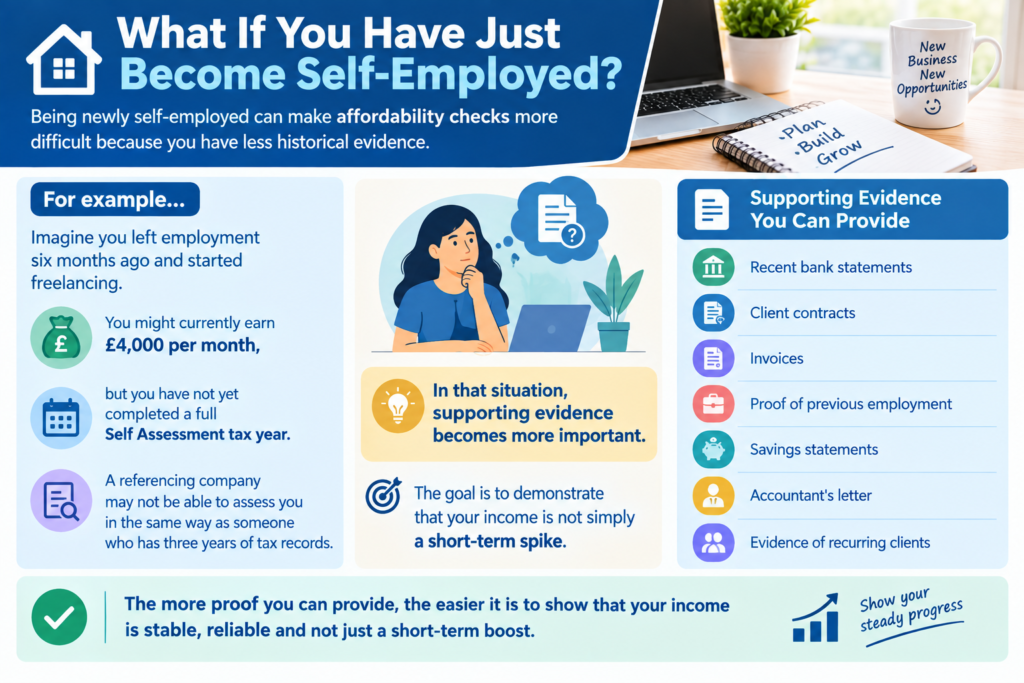
What If You Have Just Become Self-Employed?
Being newly self-employed can make affordability checks more difficult because you have less historical evidence.
For example, imagine you left employment six months ago and started freelancing.
You might currently earn £4,000 per month, but you have not yet completed a full Self Assessment tax year.
A referencing company may not be able to assess you in the same way as someone who has three years of tax records.
In that situation, supporting evidence becomes more important.
| Document / Evidence |
|---|
| Recent bank statements |
| Client contracts |
| Invoices |
| Proof of previous employment |
| Savings statements |
| Accountant’s letter |
| Evidence of recurring clients |
The goal is to demonstrate that your income is not simply a short-term spike.
Read more:Rent Affordability Calculator Glasgow – Find Out How Much Rent You Can Afford
How to Improve Your Chances of Passing a Rental Affordability Check
If you’re self-employed and planning to rent in 2026, preparation can make a significant difference.
| Section | Content |
|---|---|
| Organise Your Tax Documents | Have your SA302 and Tax Year Overview ready.Do not wait until the landlord asks for them.HMRC provides guidance on obtaining these documents through your Self Assessment records. |
| Keep Business and Personal Finances Organised | Separate business and personal transactions where possible. Clear records make it easier to demonstrate your actual financial position. |
| Build an Emergency Fund | Self-employed income can fluctuate.Having several months of essential expenses saved can make a major difference. |
| Avoid Taking on Unnecessary Debt | Existing credit commitments may affect how much rent you can comfortably afford. |
| Be Honest About Your Income | Never inflate your income to pass a referencing check. Landlords and referencing providers may verify the information you provide. |
| Speak to the Agent Before Applying | Ask: “I’m self-employed. Which income documents and affordability criteria do you use?”That one question can save a lot of time. |
Ask These Questions Before Paying for Referencing
If you are self-employed, it can be worth asking the letting agent about their affordability criteria before you submit an application.
This is especially useful if your circumstances are unusual, such as having only recently become self-employed, operating through a limited company, receiving most of your income through dividends, or having significant fluctuations in monthly earnings.
You can keep the conversation simple. Ask:
“I’m self-employed. Which income documents do you accept, and how do you calculate affordability for self-employed applicants?”
You can also ask whether they require one or more years of accounts, whether dividends are included, whether savings can be considered as supporting evidence, and whether a guarantor is accepted if the standard affordability calculation is not met.
Getting these answers early can save time and avoid preparing an application that does not match the property’s referencing requirements.
It is also useful to keep copies of the documents you are likely to need in one secure folder. For example, you could keep your latest tax documents, bank statements, accounts, identification and relevant contracts together so they are ready when a property becomes available.
Rental properties can move quickly, so being organised can make the application process much less stressful.
Rent Affordability Example for a Self-Employed Freelancer
We can take a practical example.
Sarah is a Self-employed designer.
Her average monthly business income is:
£4,200
After business expenses and tax provisions, she estimates that around:
£3,200
is reliably available for personal living costs.
She finds a property costing:
£1,200 per month
Her rent-to-income ratio based on gross average income is:
£1,200 ÷ £4,200 × 100 = 28.6%
On that basis, the rent looks reasonable.
| Expense / Commitment |
|---|
| Council Tax |
| Energy bills |
| Internet |
| Transport |
| Food |
| Insurance |
| Debt repayments |
| Savings |
| Pension |
| Irregular business expenses |
If she has great monthly commitments, she may decide that a £1,000 property provides a safer financial Reserve.
This is the key difference between passing an affordability test and being normally comfortable with the rent.
Rent Affordability for Limited Company Directors
Limited company directors should be especially careful when calculating affordability.
Your company may have substantial revenue, but your personal income might consist of a relatively small salary plus dividends.
For example:
| Item | Amount |
|---|---|
| Company turnover | £120,000 |
| Director salary | £18,000 |
| Dividends | £20,000 |
Your personal income could therefore look very different from your company’s turnover.
Different landlords and referencing companies may treat salary, dividends and retained company profits differently.
If you are a company director, ask the referencing provider whether they accept:
- Salary
- Dividends
- Company profits
- Retained profits
- Accountant’s references
This can avoid unpleasant surprises later in the rental process.
Does Credit Score Affect Rent Affordability?
Affordability and credit history are related but different.
A tenant may have enough income to afford the rent but still encounter problems because of their credit history.
Similarly, someone with excellent credit may not pass an affordability test if their income is too low.
A landlord or referencing provider may look at several factors together:
Income + affordability + credit history + rental history + documentation
So don’t focus entirely on your credit score.
Instead, prepare your entire application.
What If You Fail the Affordability Check?
Failing an affordability assessment does not always mean you cannot rent the property.
Depending on the landlord and referencing provider, possible alternatives may include:
- Providing a guarantor
- Offering additional rent in advance where appropriate
- Demonstrating substantial savings
- Providing stronger income evidence
- Applying with a partner
- Choosing a lower-rent property
- Finding a landlord with more flexible criteria
The important thing is to realise why you failed.
If your income was insufficient, lowering the rent may solve the problem.
If documentation was missing, providing the correct documents could solve it.
If your income is new or inconsistent, stronger evidence may help.
Find Out Exactly Why the Affordability Check Failed
If a referencing assessment does not pass, don’t immediately assume that you cannot afford to rent.
First, find out what caused the problem.
There is a significant difference between failing because your qualifying income was below the required level and failing because the referencing provider could not verify your income.
For example, a freelancer might have enough income but only have six months of trading history. Another applicant might have several years of accounts but a qualifying income that falls below the property’s affordability threshold.
The solution may be different in each situation.
If the issue is insufficient qualifying income, a lower monthly rent or an accepted guarantor could potentially help. If the issue is missing documentation, providing the correct tax records, bank statements or accounts may resolve the problem. If the issue is recent self-employment, evidence of ongoing contracts and previous employment income may provide additional context, depending on the referencing criteria.
Ask the letting agent or referencing provider what information caused the assessment to fail and whether additional evidence can be considered.
This is more useful than simply applying for another property without understanding what went wrong.
Making Tax Digital and Self-Employed Renters in 2026
Another important 2026 development for self-employed people is the expansion of Making Tax Digital for Income Tax.
From 6 April 2026, sole traders and landlords with qualifying income above £50,000 from self-employment and property may need to use Making Tax Digital for Income Tax. HMRC says qualifying income is based on total income before expenses, or turnover, from self-employment and property.
The Release is being introduced in stages, with More limits applying in later years.
For renters, the key Main point is simple:
Keep exact financial records.
Good digital records can make it easier to understand your income, prepare tax information, and demonstrate your financial position when required.
Read more:What Salary Do You Need to Rent in the UK? Salary Guide 2026
Self-Employed Rent Affordability Checklist
Before applying for a rental property, make sure you have:
- Your latest SA302 or tax calculation
- Tax Year Overview
- Recent bank statements
- Business accounts if available
- Accountant details or reference if applicable
- Evidence of current contracts
- Proof of savings
- Details of existing financial commitments
- Identification documents
- Right-to-rent evidence where required
For properties in England, tenants must also prove their right to rent. GOV.UK explains that the process depends on nationality and immigration status.
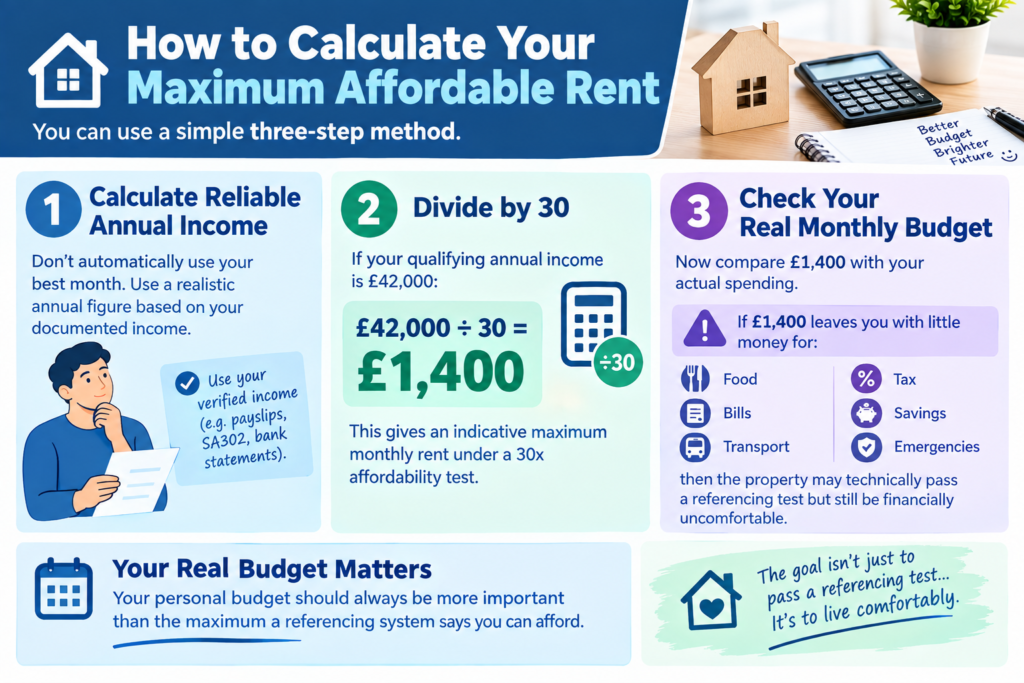
How to Calculate Your Maximum Affordable Rent
You can use a simple three-step method.
Step 1: Calculate Reliable Annual Income
Don’t automatically use your best month.
Use a realistic annual figure based on your documented income.
Step 2: Divide by 30
If your qualifying annual income is £42,000:
£42,000 ÷ 30 = £1,400
This gives an indicative maximum monthly rent under a 30x affordability test.
Step 3: Check Your Real Monthly Budget
Now compare £1,400 with your actual spending.
If £1,400 leaves you with little money for:
- Food
- Bills
- Transport
- Tax
- Savings
- Emergencies
then the property may technically pass a referencing test but still be financially uncomfortable.
Your personal budget should always be more important than the maximum a referencing system says you can afford.
Can self-employed people rent in the UK?
Yes. Self-employed people can rent homes in the UK. The main difference is that they may need to provide additional evidence of income because they do not have standard employment payslips.
What proof of income do self-employed tenants need?
Common evidence includes an SA302, Tax Year Overview, bank statements, business accounts and accountant references. Exact requirements vary by landlord and referencing provider.
Is there a 30x rent rule in the UK?
Some landlords and referencing providers use an income-to-rent calculation equivalent to annual income being around 30 times the monthly rent. It is not a universal legal requirement.
Can I rent if I have only been self-employed for one year?
Yes, potentially. However, you may need additional evidence such as bank statements, contracts, savings or a guarantor because you have a shorter trading history.
Do landlords look at turnover or profit?
It depends on the referencing policy and business structure. For many self-employed applicants, documented profit is more relevant than gross turnover because turnover does not show what you actually earn after business expenses.
Can savings help me pass affordability?
Potentially. Some landlords may consider savings as supporting evidence, but policies vary. Savings should not automatically be assumed to replace an income requirement.
Can a guarantor help?
Yes, where the landlord accepts guarantors. The guarantor may need to pass their own affordability and credit checks.
Can I rent a property if my self-employed income is irregular?
Yes. Irregular income does not automatically prevent you from renting. A landlord or referencing provider may look at your income over a longer period rather than judging you on a single month. Bank statements, tax calculations, business accounts, and ongoing contracts can help demonstrate that your overall income is sufficient.
Do landlords accept freelance income as proof of affordability?
Yes, freelance income can generally be considered, but you may need to provide additional evidence. Depending on the landlord’s requirements, this could include Self Assessment records, SA302 documents, bank statements, invoices, contracts, and an accountant’s reference.
Can I use my average income to calculate affordable rent?
Yes. Using average income can be a sensible approach when your earnings fluctuate. Add your reliable income over several months or a full year and calculate the average. This gives you a more realistic figure than using your highest-earning month.
Can I rent a property if my income is below the landlord’s affordability requirement?
Possibly. Some landlords may consider alternatives such as a guarantor, additional financial evidence, or other arrangements. However, acceptance is entirely dependent on the landlord’s or letting agent’s criteria.
Last reviewed: August 2026. Figures and thresholds referenced are correct as of this date; HMRC thresholds for Making Tax Digital are being introduced in phases, so check GOV.UK for the latest position before relying on them.
Set Your Own Rent Limit Before You Start Viewing Properties
One of the most practical things you can do is decide your personal maximum rent before you begin property searches.
Without a limit, it is easy to start with a realistic budget and gradually increase it after seeing properties with better locations, larger rooms or additional features.
For example, you may initially decide that £1,200 is comfortable. After viewing several properties, you might start considering £1,350 or £1,450 because the difference seems relatively small.
However, an extra £200 per month means another £2,400 per year before considering any related increases in bills or other housing costs.
Instead, calculate three figures:
Comfortable rent: the amount you can pay without putting pressure on your normal budget.
Maximum practical rent: the highest amount you could manage while still maintaining savings and covering your regular commitments.
Referencing maximum: the highest rent you may qualify for under the landlord or referencing provider’s affordability calculation.
These three numbers do not have to be the same.
For example:
Rent measure Monthly amount Comfortable budget £1,100 Maximum practical budget £1,300 Referencing maximum £1,500 In this example, qualifying for £1,500 does not mean that £1,500 is necessarily the right personal budget.
Setting your own limit before viewing properties can help you focus on homes that fit your actual finances rather than simply the maximum amount a referencing system may allow.
Final Thoughts: Rent Affordability for Self-Employed People in 2026
Being self-employed should not stop you from finding a good rental home in the UK.
The real challenge is making your income easy to understand.
Unlike a salaried employee with a predictable payslip, your financial picture may include business turnover, expenses, profits, tax, dividends, contracts and irregular monthly income.
That is why preparation matters.
Start with a realistic income figure. Work out your average monthly earnings, consider your tax obligations and regular expenses, and then decide what rent leaves you with enough financial breathing room.
As a general budgeting guide, keeping rent around 30% to 35% of reliable monthly income can be a useful starting point. A 30x annual income calculation can also help you estimate which properties may meet common affordability tests.
But don’t chase the most expensive property you can technically qualify for.
If you are self-employed, financial flexibility is valuable. One quiet month should not put your tenancy at risk.
The strongest rental application is not necessarily the person with the highest turnover. It is the applicant who can clearly demonstrate stable income, organised finances, reliable documentation, and the ability to pay rent consistently.
So before you start viewing properties, calculate your own rent affordability first.
Know your numbers, prepare your documents, and choose a rent that you can comfortably maintain—not just one that you can barely pass an affordability check for.
In 2026, with changes such as the continued rollout of Making Tax Digital, keeping accurate financial records is becoming even more important for many self-employed people.