
Last updated: August 2026. This guide has been checked against current Local Housing Allowance rates, Universal Credit housing cost rules, and Benefit Cap figures for 2026/27, as published on GOV.UK. It’s written for general budgeting guidance — for a personalised assessment of your entitlement, use an independent benefits calculator such as Turn2us, Entitledto or Policy in Practice, or speak to a benefits adviser or your local council’s housing options team.
Rent Affordability on Benefits UK: Finding a suitable home can be difficult when your main income comes from benefits. Rent is usually the highest monthly cost, and choosing a property that is too costly can quickly lead to rent arrears, debt, and financial stress.
If you receive Universal Credit, Housing Benefit, or other benefits, the amount of rent you can realistically manage depends on more than your monthly benefit payment. Your household size, location, age, income, Local Housing Allowance (LHA), Council Tax, utility bills and other essential expenses can all affect your real rental budget.
There is also an important difference between how much rent a landlord charges and how much housing support you may receive. Your benefit may not cover the entire rent, particularly if the property’s rent is above the applicable Local Housing Allowance rate.
This guide explains how to work out rent affordability on benefits in the UK, with simple calculations, examples, and tables to help you decide what rent level is financially realistic.
Quick answer: There is no single rent amount that everyone receiving benefits can afford. A sensible rent budget should be based on your actual income, housing support, essential expenses, and the gap between your rent and any benefit contribution.
Click Here:Rent Affordability Calculator UK
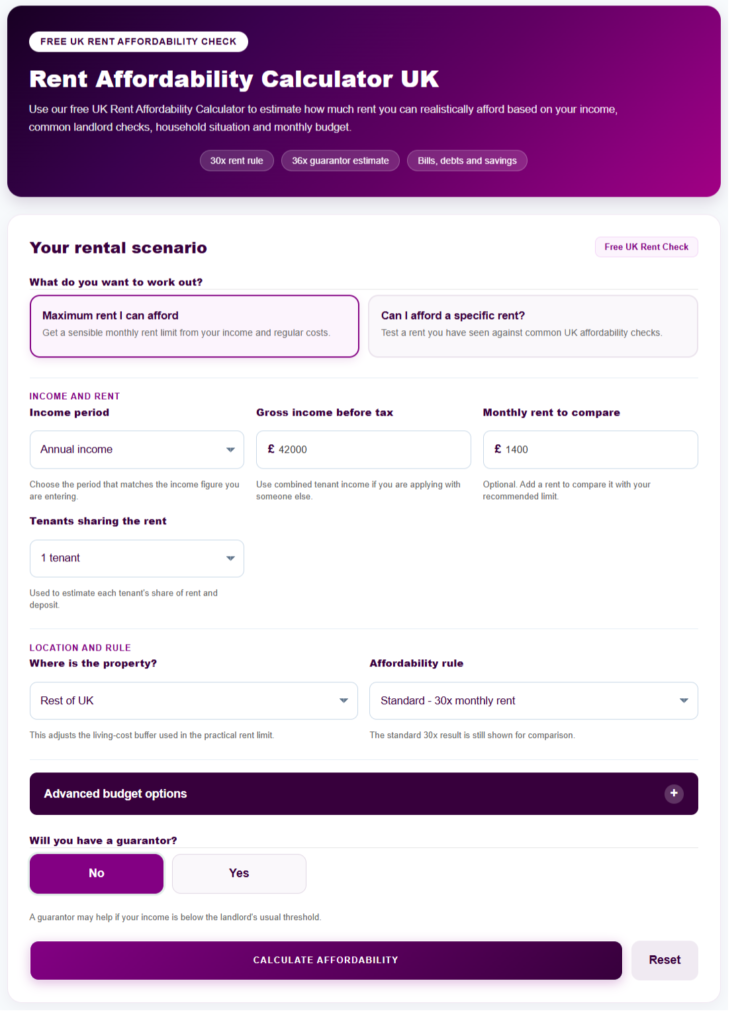
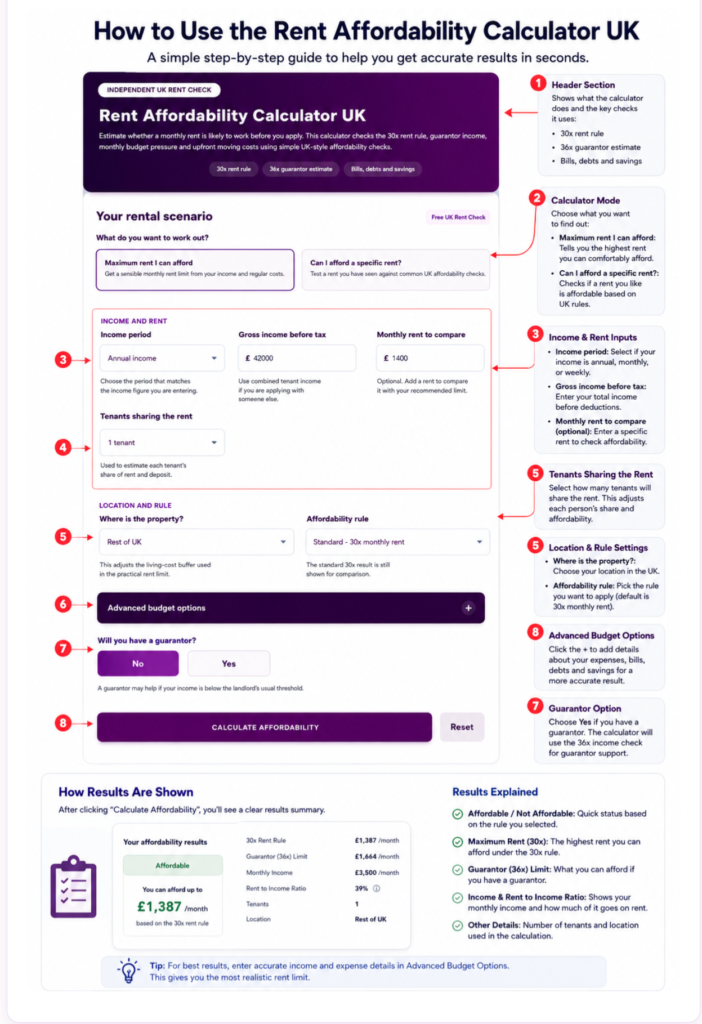
How to Use the Rent Affordability Calculator UK
What Does Rent Affordability on Benefits Mean?
Rent affordability on benefits UK means identifying whether you can comfortably pay your monthly rent while regularly having enough money for important living costs.
For someone receiving benefits, the calculation can be slightly more Complex than for someone earning a regular salary.
Read more:First Class Honours Explained: 7 Amazing Requirements, Marks & TipsFor example, imagine you receive:
| Item | Amount |
|---|---|
| Universal Credit | £1,250 per month |
| Housing support included | £700 |
| Other income | £200 |
| Monthly rent | £850 |
At first glance, the £850 rent may appear manageable because you receive £1,450 in total income.
However, if only £700 of your housing costs are covered, you may need to find:
£850 − £700 = £150
from your remaining income every month.
That £150 rent shortfall needs to be considered alongside food, electricity, gas, transport, Council Tax, phone bills and other expenses.
For this reason, simply asking, “How much rent can I afford on benefits?” does not always create the correct answer.
How Much Rent Can You Afford on Benefits?
There is no universal percentage that says a person on benefits can spend exactly a certain amount of their income on rent.
A commonly used budgeting approach is to try to keep housing costs around 30% to 35% of household income, but this should only be treated as a budgeting guide rather than a government rule.
For people receiving benefits, the more useful calculation is:
Affordable Rent = Housing Support + Amount You Can Safely Contribute From Remaining Income
For example:
| Monthly housing support | Safe personal contribution | Approx. affordable rent |
| £500 | £100 | £600 |
| £600 | £150 | £750 |
| £700 | £150 | £850 |
| £800 | £200 | £1,000 |
| £900 | £200 | £1,100 |
These figures are examples only. Your own affordable rent could be significantly different depending on your household income and expenses.
Universal Credit and Rent
Universal Credit can include an additional amount to help with housing costs.
| This can help pay |
|---|
| Rent to a private landlord |
| Rent to a council |
| Rent to a housing association |
| Some eligible service charges |
The amount you receive depends on your circumstances and the type of accommodation you live in.
For private renters, your housing support may be restricted by the Local Housing Allowance (LHA) rules.
This is one of the most important things to check before deciding how much rent you can afford.
What Is Local Housing Allowance?
Local Housing Allowance, commonly called LHA, is used to determine housing support for many private renters receiving benefits.
| Your LHA rate depends mainly on |
|---|
| Where you live |
| Your household size |
| The number of bedrooms you are entitled to |
| Your circumstances |
For private renters, Housing Benefit normally uses the lower of the actual rent and the applicable LHA rate when determining eligible rent. Similar LHA limits apply to Universal Credit housing costs for many private tenants.
The government has published Universal Credit LHA rates for April 2026 to March 2027 for England, Scotland and Wales.
The important point is this:
A landlord can charge £1,000 per month, but that does not automatically mean your benefits will cover £1,000.
If your applicable housing support is £750, you could potentially have to pay the remaining £250 yourself.
Read more:Rent Affordability for Self-Employed in the UK (2026 Guide)
Example: Rent Higher Than LHA
Suppose Sarah receives Universal Credit and lives in an area where her applicable LHA rate is:
£750 per month
She finds a private property advertised at:
£900 per month
Her potential rent shortfall is:
£900 − £750 = £150
So Sarah needs to find an additional £150 every month from her other income or Universal Credit.
Sarah’s calculation
| Item | Monthly amount |
| Rent | £900 |
| Housing support/LHA used in example | £750 |
| Rent shortfall | £150 |
| Sarah’s contribution | £150 |
If Sarah can comfortably afford that £150 after paying her essential expenses, the property may be manageable.
If she has only £100 available after essential spending, the property would create a £50 monthly budget deficit.
That may not look like a large amount, but:
£50 × 12 months = £600 per year
A small monthly shortfall can therefore become a significant financial problem.
2026/27 Local Housing Allowance Example
The LHA rates vary considerably between locations.
For example, the published 2026/27 England data shows different monthly rates across Broad Rental Market Areas and bedroom categories. In Leeds, the listed monthly figures range from £347.62 for the shared accommodation rate to £1,200 for the four-bedroom rate. In Central London, the figures are considerably higher, reaching £3,060 for the four-bedroom category.
This demonstrates why there is no single UK-wide answer to the question:
“How much rent can I afford on benefits?”
Location can make a major difference.
Example LHA figures
| Area | Shared accommodation | 1 bedroom | 2 bedrooms | 3 bedrooms | 4 bedrooms |
| Leeds | £347.62 | £675 | £775 | £850 | £1,200 |
| Nottingham | £380 | £550 | £650 | £750 | £970 |
| Bristol | £511.33 | £900 | £1,095 | £1,300 | £1,850 |
| Central London | £829.83 | £1,439.97 | £1,793.98 | £2,160.02 | £3,060 |
These are examples from the published 2026/27 England LHA data. Your actual entitlement depends on your circumstances and the relevant LHA area and bedroom category.
Can You Afford Rent If Your Benefits Do Not Cover It?
Yes, potentially.
You are not necessarily limited to properties where the rent exactly matches your housing support.
You can contribute the difference yourself if your overall budget allows it.
For example:
| Item | Amount |
|---|---|
| Rent | £900 |
| Housing support | £750 |
| Shortfall | £150 |
| Other monthly income available | £500 |
If your essential non-rent expenses are £300, you have:
£500 − £300 = £200
available.
The £150 rent shortfall could therefore be affordable, leaving:
£200 − £150 = £50
However, this would be a relatively tight budget.
A better property might be one costing £800:
£800 − £750 = £50 shortfall
That would leave an additional £100 compared with the £900 property.
This illustrates an important principle:
The cheapest property is not automatically the best option, but a property with a smaller rent shortfall can make your monthly budget much safer.
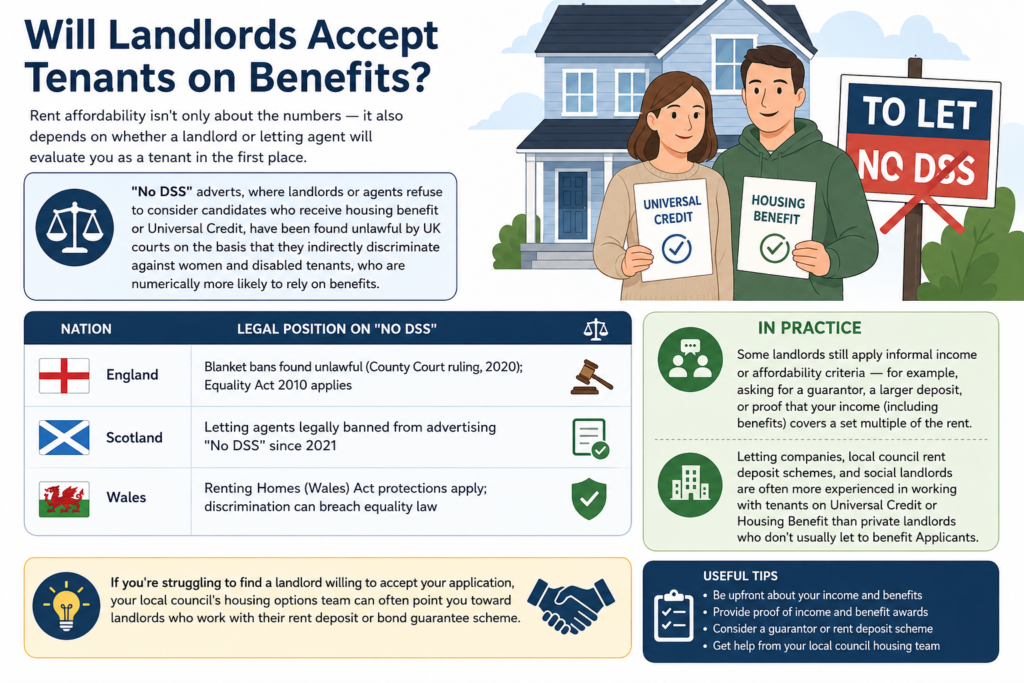
Will Landlords Accept Tenants on Benefits?
Rent affordability isn’t only about the numbers — it also depends on whether a landlord or letting agent will evaluate you as a tenant in the first place.
“No DSS” adverts, where landlords or agents refuse to consider candidates who receive housing benefit or Universal Credit, have been found unlawful by UK courts on the basis that they indirectly discriminate against women and disabled tenants, who are numerically more likely to rely on benefits.
| Nation | Legal position on “No DSS” |
| England | Blanket bans found unlawful (County Court ruling, 2020); Equality Act 2010 applies |
| Scotland | Letting agents legally banned from advertising “No DSS” since 2021 |
| Wales | Renting Homes (Wales) Act protections apply; discrimination can breach equality law |
In practice, some landlords still apply informal income or affordability criteria — for example, asking for a guarantor, a larger deposit, or proof that your income (including benefits) covers a set multiple of the rent. Letting companies, local council rent deposit schemes, and social landlords are often more experienced in working with tenants on Universal Credit or Housing Benefit than private landlords who don’t usually let to benefit Applicants.
If you’re struggling to find a landlord willing to accept your application, your local council’s housing options team can often point you toward landlords who work with their rent deposit or bond guarantee scheme.
Rent Affordability Calculation for Benefits
A useful personal calculation is:
Add your reliable monthly income
| Include |
|---|
| Universal Credit |
| Housing support |
| Earnings |
| Pension income |
| Eligible benefits |
| Regular maintenance or other reliable income |
Do not rely on irregular or uncertain income when setting your rent budget.
Identify housing support
Find out how much of your housing costs may be covered.
For private renting, check your applicable LHA rate.
Calculate the rent shortfall
Use:
Rent Shortfall = Monthly Rent − Housing Support
If the result is zero or negative, your rent may be fully covered by the housing support amount used in your calculation.
If the result is positive, you need to pay the difference yourself.
Calculate essential expenses
| Essential Spending |
|---|
| Food |
| Gas |
| Electricity |
| Water |
| Council Tax |
| Transport |
| Internet |
| Mobile phone |
| Insurance |
| Childcare |
| Debt repayments |
| Medical expenses |
| School costs |
| Other essential spending |
Check what’s left
Use:
Money Left = Total Reliable Income − Rent − Essential Expenses
If very little remains, the property may be too expensive even if you technically can pay the rent.
Rent Affordability Example 1: Single Person
Let’s say James is 29 and lives alone.
His monthly income is:
| Item | Amount |
|---|---|
| Universal Credit and other income | £1,100 |
| Housing support included in his overall calculation | £600 |
He finds a property costing £700 per month.
His rent shortfall is:
£700 − £600 = £100
His other monthly essential costs are:
| Expense | Monthly cost |
| Rent shortfall | £100 |
| Food | £220 |
| Gas/electricity | £120 |
| Council Tax after any reduction | £80 |
| Transport | £100 |
| Phone/internet | £40 |
| Other essentials | £100 |
| Total essential spending | £760 |
If his total available income is £1,100:
£1,100 − £760 = £340
He has approximately £340 left.
This could provide some flexibility for savings, unexpected expenses, and discretionary spending.
However, James must also check whether his housing support is actually available at the level assumed and whether his age and living arrangement affect the applicable LHA category.
Read more:Student Rent Affordability UK – How Much Can Students Afford?
Rent Affordability Example 2: Family With Children
Families need to look beyond rent because childcare, food and transport can consume a significant portion of the household budget.
Suppose a family has:
Total monthly income: £2,200
Housing support:
£1,000
Monthly rent:
£1,150
Rent shortfall:
£1,150 − £1,000 = £150
Other essential costs:
| Expense | Amount |
| Rent shortfall | £150 |
| Food | £500 |
| Energy | £180 |
| Council Tax | £120 |
| Transport | £180 |
| Child-related costs | £200 |
| Phone/internet | £60 |
| Other essentials | £150 |
| Total | £1,540 |
| Item | Amount |
|---|---|
| Total income | £2,200 |
| Total expenses | £1,540 |
| Money remaining | £660 |
| New rent | £1,400 |
| Housing support | £1,000 |
| New shortfall | £400 |
| Additional monthly reduction | £250 |
| Additional annual reduction | £3,000 |
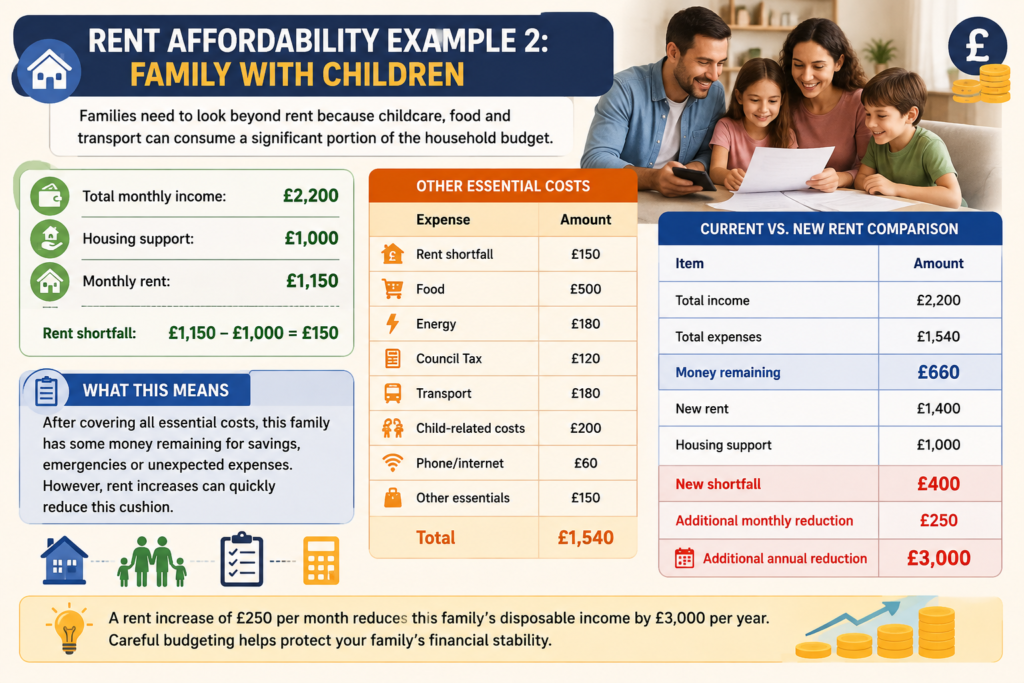
So even a £250 difference in monthly rent can have a major effect on household finances.
What About Housing Benefit?
Housing Benefit Continuing exists, but most new claims for help with rent now go through Universal Credit instead, subject to individual circumstances and exemptions. You may still be able to claim Housing Benefit directly if you already receive the Severe Disability Premium, or if you live in temporary housing or certain types of supported or sheltered housing.
| Housing Benefit for Private Tenants | Explanation |
|---|---|
| Qualified rent | Generally capped at the lower of your actual rent and applicable LHA rate |
| Actual rent | The amount you actually pay your landlord |
| LHA rate | The maximum eligible rent used for the calculation |
| Income and savings | May reduce the Housing Benefit amount further |
For council or social housing tenants, the calculation is different. There’s no LHA cap — instead, your eligible rent is based on your actual rent charge, though certain service charges may or may not count, and heating or water charges are usually excluded. If your property is considered too large for your household under the “bedroom tax” (Removal of the Spare Room Subsidy), your Housing Benefit can be reduced by 14% for one extra bedroom or 25% for two or more.
Example: Tom rents a two-bedroom council flat but lives alone, so it’s assessed as having one spare bedroom. His rent is £600 a month, but his Housing Benefit is reduced by 14% — a shortfall of £84 a month he needs to cover himself, on top of any other shortfall from income-based reductions.
Because these rules differ so much from the private-rent calculation, don’t apply the LHA examples in this guide directly to a council or housing association tenancy — check your eligible rent with your landlord or local council instead.
Benefit Cap and Rent Affordability
Another factor that can affect your overall budget is the Benefit Cap.
The Benefit Cap limits the total amount of certain benefits a household can receive.
For 2026/27, the monthly cap is:
| Household | Outside Greater London | Greater London |
| Single adult without children | £1,229.42 | £1,413.92 |
| Couple or single parent with qualifying child | £1,835.00 | £2,110.25 |
The corresponding weekly amounts are £283.71 and £326.29 for single adults, and £423.46 and £486.98 for couples/single parents, depending on location.
The Benefit Cap does not affect everyone because there are exemptions and different circumstances can apply.
However, if you are affected by the cap, you need to be particularly careful when calculating your maximum affordable rent.
What If Your Rent Is Higher Than Your Universal Credit Housing Amount?
This is one of the most common situations for private renters.
Suppose:
| Item | Amount |
|---|---|
| Monthly rent | £1,000 |
| Housing amount | £750 |
| Shortfall | £250 |
You may need to pay the £250 difference from your other income.
If you have £600 available after essential expenses, the property may be possible.
But if you have only £150 available, the property is not realistically affordable.
A safer calculation
Instead of asking:
“Can I pay £1,000 rent?”
ask:
“Can I pay £250 every month toward the rent without sacrificing food, energy, transport, Council Tax or emergency savings?”
That is a much more useful affordability question.
Don’t Forget Council Tax
Rent is not your only housing cost.
Council Tax can make a significant difference to your monthly budget.
Some people receiving benefits may qualify for Council Tax Reduction, depending on their circumstances and local scheme.
For example:
| Housing cost | Monthly amount |
| Rent | £850 |
| Rent shortfall | £100 |
| Council Tax | £90 |
| Energy | £120 |
| Water | £35 |
| Total housing-related costs | £345 |
Looking only at the £850 rent would underestimate the true cost of living in the property.
Your affordability calculation should therefore consider the entire housing package.
How Much Should You Have Left After Paying Rent?
There is no government rule saying exactly how much money must remain after rent.
However, a sensible personal budget should leave room for:
| Essential Costs |
|---|
| Food |
| Energy |
| Council Tax |
| Transport |
| Household items |
| Clothing |
| Phone and internet |
| Unexpected expenses |
| Emergency savings |
| Other essential costs |
A property that leaves you with £20 or £30 at the end of every month is risky.
One unexpected £100 expense could immediately put you into debt.
A stronger budget gives you some breathing room.
A Simple Rent Affordability Formula
You can use this formula:
Maximum Rent = Housing Support + Safe Rent Contribution
Where:
Safe Rent Contribution = Total Monthly Income − Essential Non-Rent Expenses − Emergency/Savings Allowance
Example
| Item | Amount |
|---|---|
| Monthly income | £1,500 |
| Essential non-rent expenses | £650 |
| Savings/emergency allowance | £100 |
| Safe rent contribution | £750 |
| Housing support | £600 |
| Maximum affordable rent | £1,350 |
However, this is only a mathematical maximum.
A £1,350 property would leave the household with almost no flexibility if the housing support were £600 and the remaining £750 contribution represented the entire available rent budget.
In practice, you may want to target a lower figure.
Read more:How Much Rent Can Couples Afford in the UK? (2026 Guide)
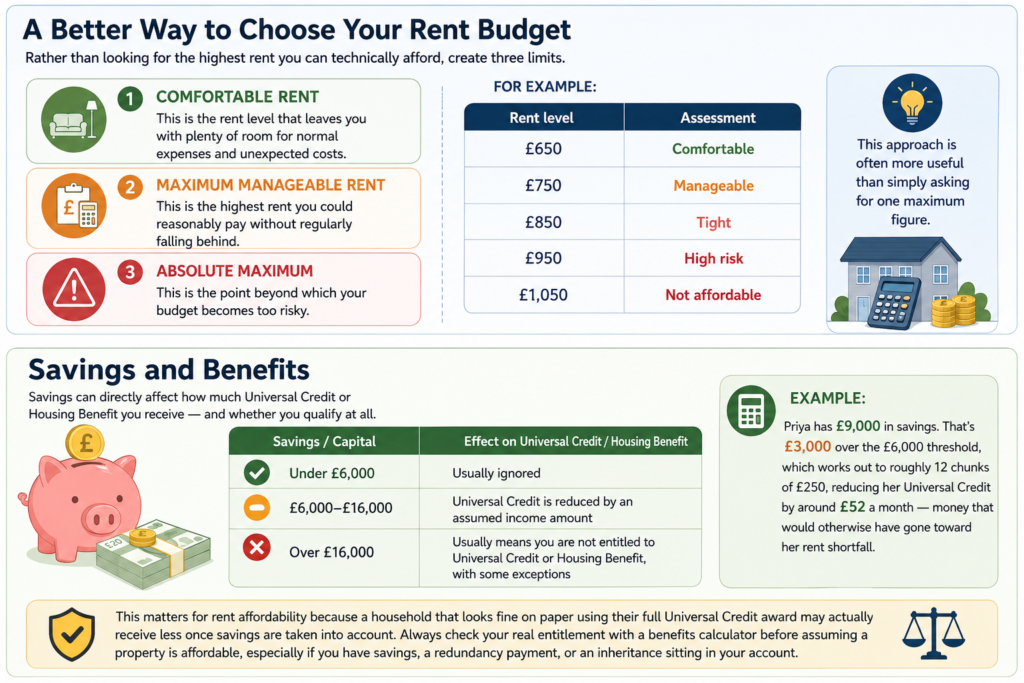
A Better Way to Choose Your Rent Budget
Rather than looking for the highest rent you can technically afford, create three limits.
1. Comfortable rent
This is the rent level that leaves you with plenty of room for normal expenses and unexpected costs.
2. Maximum manageable rent
This is the highest rent you could reasonably pay without regularly falling behind.
3. Absolute maximum
This is the point beyond which your budget becomes too risky.
For example:
| Rent level | Assessment |
| £650 | Comfortable |
| £750 | Manageable |
| £850 | Tight |
| £950 | High risk |
| £1,050 | Not affordable |
This approach is often more useful than simply asking for one maximum figure.
Compare Properties by Total Monthly Cost, Not Just Advertised Rent
When comparing two rental properties, do not automatically choose the one with the lower advertised rent. Calculate the expected monthly cost of each property before making a decision. Include the rent you must pay yourself, Council Tax, energy, transport and any other regular housing-related costs. A property that costs £50 more in rent could sometimes have lower overall running costs, while a cheaper property could become more expensive if it requires significantly higher heating or transport spending. Creating a simple comparison for each property gives you a clearer picture of what the tenancy will actually cost your household every month.
Savings and Benefits
Savings can directly affect how much Universal Credit or Housing Benefit you receive — and whether you qualify at all.
| Savings / Capital | Effect on Universal Credit / Housing Benefit |
|---|---|
| Under £6,000 | Usually ignored |
| £6,000–£16,000 | Universal Credit is reduced by an assumed income amount |
| Over £16,000 | Usually means you are not entitled to Universal Credit or Housing Benefit, with some exceptions |
Example: Priya has £9,000 in savings. That’s £3,000 over the £6,000 threshold, which works out to roughly 12 chunks of £250, reducing her Universal Credit by around £52 a month — money that would otherwise have gone toward her rent shortfall.
This matters for rent affordability because a household that looks fine on paper using their full Universal Credit award may actually receive less once savings are taken into account. Always check your real entitlement with a benefits calculator before assuming a property is affordable, especially if you have savings, a redundancy payment, or an inheritance sitting in your account.
How to Find a More Affordable Rental Property
If your preferred property is too expensive, you do not necessarily need to stop looking.
Consider changing one factor at a time.
| Tip | Details |
|---|---|
| Move slightly outside the most expensive area | Rent can vary significantly between neighbouring locations. A property only a few miles away may cost substantially less. |
| Consider shared accommodation | This can be particularly important for younger single renters who may be subject to the Shared Accommodation Rate. |
| Look at different bedroom sizes | If you do not need an additional bedroom, choosing a smaller property may reduce both rent and utility costs. |
| Compare total housing costs | A property with £50 higher rent might still be cheaper overall if it has better energy efficiency, lower Council Tax, lower transport costs, included services, or lower heating requirements. |
| Negotiate where appropriate | Some landlords may be willing to consider reasonable offers, particularly when a property has been available for a while. |
What If You Are Already Struggling With Rent?
If your housing support does not cover your full rent and you are struggling to make up the difference, do not simply wait until arrears build up.
Contact:
- Your local council
- Your Universal Credit work coach
- A benefits adviser
- Your landlord
- A recognised debt or housing advice organisation
Depending on your circumstances and location, additional local help may be available.
The government says that if Universal Credit housing support does not cover all your rent, you may be able to seek additional help from your local council. In England, this can include support through the Crisis and Resilience Fund, while different arrangements apply in Scotland and Wales.
Use a Benefits Calculator Before Renting
Before signing a tenancy agreement, use a benefits calculator to estimate how your circumstances affect your benefits.
The UK government lists independent calculators including:
| Resource |
|---|
| Entitledto |
| Turn2us |
| Policy in Practice |
These calculators can calculate benefits and show how changes such as starting work, changing hours, having a child or moving in with a partner may affect your rights.
You should have accurate information about:
| Factors |
|---|
| Income |
| Savings |
| Existing benefits |
| Rent |
| Council Tax |
| Childcare costs |
| Partner’s income |
| Household members |
The more accurate your information, the more useful the estimate will be.
Rent Affordability Table Based on Monthly Income
The following table is a general budgeting illustration, not a benefits entitlement table.
| Total monthly household income | 30% rent guide | 35% rent guide | 40% rent guide |
| £900 | £270 | £315 | £360 |
| £1,000 | £300 | £350 | £400 |
| £1,200 | £360 | £420 | £480 |
| £1,400 | £420 | £490 | £560 |
| £1,600 | £480 | £560 | £640 |
| £1,800 | £540 | £630 | £720 |
| £2,000 | £600 | £700 | £800 |
| £2,500 | £750 | £875 | £1,000 |
These percentages are useful as a starting point, but they should not be treated as an official UK benefits affordability rule.
Someone with high childcare and transport costs may need a much lower rent.
Someone with very low expenses and substantial savings may have more flexibility.
Why the 30% Rule Does Not Always Work for Benefits
The 30% rule is popular because it is simple.
But consider two households earning £1,500 per month.
Household A
| Item | Amount |
|---|---|
| Rent | £450 |
| Childcare | £0 |
| Transport | £50 |
| Debt | £0 |
Household B
| Item | Amount |
|---|---|
| Rent | £450 |
| Childcare | £400 |
| Transport | £180 |
| Debt | £150 |
Both spend 30% of income on rent.
But their financial situations are completely different.
This is why people receiving benefits should focus on residual income — how much money remains after all essential expenses — rather than relying exclusively on a rent-to-income percentage.
The Most Important Number: Your Rent Shortfall
For people on benefits, one of the most useful numbers to calculate is the rent shortfall.
Formula
Rent Shortfall = Actual Rent − Housing Support
For example:
£950 − £700 = £250
That £250 is the amount you need to find from your remaining income.
Now compare different properties:
| Property | Rent | Housing support | Your shortfall |
| A | £750 | £700 | £50 |
| B | £800 | £700 | £100 |
| C | £900 | £700 | £200 |
| D | £1,000 | £700 | £300 |
| E | £1,100 | £700 | £400 |
Property E requires £400 every month from your other income.
That is:
£400 × 12 = £4,800 per year
So a property that is only £350 more expensive per month could cost you £4,200 more per year in rent shortfall.
A Practical Way to Test a Rent Shortfall
Before applying for a property, test the rent shortfall against your real monthly budget rather than looking at the figure on its own. Write down the amount you would need to pay yourself each month and then check whether that amount would still be available after food, energy, Council Tax, transport, childcare, debt payments and other essential costs. It is also useful to multiply the shortfall by 12 to understand the yearly commitment. For example, a £175 monthly shortfall may look manageable at first, but it represents £2,100 over a full year. Doing this calculation before viewing or applying for a property can help you avoid choosing a home that looks affordable on paper but becomes difficult to maintain over time.
Read more:What Income Counts for Rent Affordability Checks in the UK?
How much rent can I afford on Universal Credit?
There is no single amount. Your affordable rent depends on your housing support, LHA rate, household circumstances, income and essential expenses.
A property may be affordable even if the rent exceeds your housing support if you can safely cover the difference with other income.
Does Universal Credit pay all of my rent?
Not necessarily.
Universal Credit can include an amount toward housing costs, but the amount may not cover your full rent. For private renters, LHA rules can limit the housing amount.
What happens if my rent is higher than my LHA?
You may have to pay the difference yourself.
For example:
Rent = £900
LHA/housing support = £700
Shortfall = £200
You would need to find the £200 from other available income unless additional support is available.
Can I rent a property that costs more than my benefits?
Potentially, yes.
The key question is whether you can sustainably pay the difference after covering your essential expenses.
However, a landlord may also carry out their own affordability or referencing checks.
Can I afford rent on benefits if I have no job?
Possibly, depending on your benefit entitlement, housing support and household circumstances.
The important thing is to calculate your total reliable income and compare it with your complete monthly budget.
Does age affect how much rent I can afford?
Age can affect housing support rules.
For example, a single private renter under 35 who lives alone may normally be subject to the Shared Accommodation Rate, subject to exceptions.
Does where I live affect my rent affordability?
Yes.
LHA rates vary by Broad Rental Market Area, so the amount of housing support available can differ significantly between locations. The government publishes different LHA rates for different areas
Can I get extra help if my benefits do not cover my rent?
You may be able to get additional help from your local council depending on your circumstances and where you live.
The available schemes differ between England, Scotland and Wales.
Can I be evicted if I fall behind on rent because of a shortfall?
Yes, potentially. Falling behind on rent because your benefits don’t cover the full amount is treated the same as any other rent arrears, and persistent arrears can lead to eviction proceedings. Contact your landlord, local council or a debt/housing advice organisation as soon as you notice a shortfall building up, rather than waiting until arrears become serious.
Can a landlord refuse to rent to me because I’m on benefits?
Blanket “No DSS” refusals have been ruled unlawful in England, and are banned outright for letting agents in Scotland. Landlords can still assess affordability more broadly (for example, asking for a guarantor), but refusing an applicant purely because their income includes benefits can amount to unlawful discrimination.
A Quick Check Before You Apply for a Rental
Before applying for a property, take five minutes to check the numbers one more time. Start with your reliable monthly income and confirm the housing support you expect to receive. Subtract the actual rent, then add the rent shortfall, Council Tax, utilities, food, transport and other essential expenses to your budget. Finally, check what would remain if an unexpected bill appeared during the month. If the remaining amount is already very small before any unexpected expense occurs, the property may leave too little room in your budget. Making this check before submitting an application can help you focus on properties that are more realistic for your circumstances.
Final Thoughts: How Much Rent Should You Pay on Benefits?
The right rent budget is not necessarily the highest rent you can technically pay.
A better approach is to choose a property that leaves you with enough money for normal living expenses, unexpected costs, and some financial breathing room.
Before renting, calculate:
1. Your total reliable monthly income
2. Your housing support
3. Your LHA rate, if applicable
4. Your rent shortfall
5. Council Tax and utility costs
6. Food and transport
7. Childcare and other essential expenses
8. A realistic emergency or savings allowance
Then ask:
“After paying this rent, will I regularly have enough money to live comfortably and deal with an unexpected cost?”
If so, the property may be reasonable.
If the answer is no, it is usually better to look for a cheaper property, consider shared housing, explore a different area, or examine whether additional support is available.
For 2026/27, official LHA rates and benefit rates provide useful starting points, but your personal circumstances determine what you may actually receive. The government recommends using an independent benefits calculator with accurate information about your income, savings, benefits, rent and household expenses.
The goal should not simply be to find the maximum rent you can pay. The goal is to find a rent you can afford month after month without putting your household finances under unnecessary pressure.
Remember Your Numbers
The formula in this guide doesn’t change — housing support plus a safe contribution from your own income, minus an emergency buffer. What changes is your situation. Revisit the calculation whenever your rent, income, household size, or benefit entitlement changes, and always check your actual Universal Credit or Housing Benefit position separately, since LHA rates and personal circumstances can shift from year to year.