Renting an HMO UK – Your Rights, Licensing Rules & What to Check (2026 Guide)
When Amara, 23, found a room in a five-bedroom shared house in Manchester for £520 a month, bills included, she thought she had found the perfect deal for her first graduate job. She signed the agreement, paid a £600 deposit, and moved in the same week. It was only six months later — when a ceiling leak went unrepaired for weeks, the fire alarm batteries ran flat, and a friend asked whether the house even had an HMO licence — that she realised she knew almost nothing about her rights as an HMO Tenant or the HMO Tenant Rights that could protect her.
She is not alone. Houses in multiple occupation (HMOs) come with an extra layer of legal protection that most single-let tenants never need: rules on licensing, minimum room sizes, fire safety, management standards and council tax that exist specifically because several unrelated households live under one roof.
This guide explains what every UK HMO tenant needs to know in 2026: what counts as an HMO, how to tell whether yours is one, the three kinds of licensing and how to check your home is licensed, room sizes and overcrowding rules, fire safety and management duties, who pays the council tax, deposits in shared houses, housemate problems, and your remedies — including rent repayment orders — if the HMO was never licensed.
Quick answer: In England and Wales, a house is an HMO if three or more people from more than one household live there and share a kitchen, bathroom or toilet. An HMO needs a mandatory licence from the council if five or more people from two or more households live there (in England, whatever the number of storeys; in Wales, only if it has three or more storeys). Smaller HMOs may still need a licence under your council’s additional or selective licensing schemes. Your landlord has extra legal duties on fire safety, room sizes, repairs and management — and if the HMO should have been licensed but was not, you can apply to a tribunal for a rent repayment order of up to 24 months’ rent for offences committed on or after 1 May 2026.
Rules differ between England, Scotland, Wales and Northern Ireland, and several changed in 2026. This guide reflects the position as of October 2026 and is general information, not legal advice.
What Counts as an HMO — and What Doesn’t?
In England and Wales, the legal definition comes from section 254 of the Housing Act 2004. Your home is an HMO if all of the following are true:
- Three or more people live there as their main residence (children count);
- they form more than one household — not all one family, couple or single person;
- they share a basic amenity — a toilet, bathroom/shower or cooking facilities — or the accommodation lacks one;
- rent is paid by at least one occupier (or their employer pays it for them).
The law also catches some converted blocks of flats (so-called “section 257 HMOs”, converted before the 1991 building regulations). In practice, the classic case is what most people picture: several unrelated people renting rooms in one house and sharing the kitchen and bathrooms. Five unrelated friends are five households; a couple plus an unrelated friend are two — both are HMOs covered by HMO Tenant Rights.
What is not an HMO matters just as much:
- A single household (a couple, a family, one person living alone) is never an HMO, whatever the size of the house.
- Purpose-built student accommodation and university-owned halls are generally excluded.
- A lodger living in the landlord’s own home — not an HMO.
- A flat in a purpose-built block of three or more self-contained flats is excluded from mandatory licensing in England, even if five or more unrelated people share one flat (additional or selective schemes may still apply).
How to Tell If Your Home Is an HMO
Answer yes to all four and you almost certainly live in an HMO:
- Do at least three people live here? Count everyone who lives there as their main home, including children.
- Do they come from more than one household? Three friends are three households; a couple plus a friend are two; a family is one.
- Do they share a kitchen, bathroom or toilet?
- Does anyone pay rent?
If unsure, ask your council’s housing department. Being an HMO does not automatically mean a licence is needed, but the management rules apply to your landlord either way.
Which HMOs Need a Licence?
Licensing is where many tenants get caught out, because the thresholds changed and differ between nations. There are three schemes, and they stack.
Mandatory licensing is set by national law and applies everywhere in England and Wales — no council designation needed.
| England | Wales | |
|---|---|---|
| People | 5 or more occupiers | 5 or more occupiers |
| Households | 2 or more | 2 or more |
| Storeys | Any number (since 1 October 2018) | 3 or more (old rule still applies) |
| Shared or lacking amenities | Yes | Yes |
The key change: until 1 October 2018, England only required a licence for HMOs of three or more storeys. The 2018 order removed the storey requirement, bringing an estimated 177,000 more properties into licensing. In Wales the three-storey test was never removed — a two-storey house with five sharers does not need a mandatory licence in Wales (though it might need an additional one).
A licence lasts up to five years, your landlord needs a separate licence for each HMO they run, and the council must be satisfied the manager is a “fit and proper person” before granting one. Licence conditions can cover room sizes, fire precautions and safety certificates.
Being an HMO is not the same as needing a licence. Every HMO is covered by the management regulations (below), even if no licence is required. Licensing is an extra layer on top.
Additional and Selective Licensing: The Hidden Layer
Even if your home is too small for mandatory licensing, your council may run one or both of these schemes:
| Scheme | What it covers | Example |
|---|---|---|
| Mandatory | 5+ people, 2+ households — national law | Everywhere in England and Wales |
| Additional | Smaller HMOs (typically 3–4 people) in designated areas | Thurrock borough-wide since September 2025; Hackney borough-wide since May 2026; Reading since March 2026 |
| Selective | All privately rented homes in a designated area — not just HMOs | Parts of Leeds since February 2026; seven Havering wards since March 2026; parts of Islington |
Additional licensing typically catches three- and four-person shares that fall below the mandatory threshold. Selective licensing is broader still: it covers every private rental in the area, including ordinary single-family lets. Schemes last up to five years and change over time — and since late 2024, councils no longer need central government sign-off for additional schemes, so new ones are appearing faster.
The practical point for you: you cannot assume no licence is needed just because there are only three or four of you. Check your council’s website — it is the authority.
How to Check Your HMO Is Licensed
Do this in your first weeks — it takes a few minutes:
- Search your council’s HMO licence register. Most councils publish a searchable public register of licensed HMOs. Search by address.
- Check for additional or selective schemes. On the same council page, look for designations covering your street — a 3-person share can need an additional licence, and any rental in a selective area needs one.
- Ask your landlord or agent whether the property is licensed and to see the licence. A professional landlord will show you without hesitation; evasiveness is a warning sign.
- Contact the council’s housing team if the register is unclear — they will confirm the position for the address.
From 15 December 2026, England’s new Private Rented Sector Database (the “Register your rental property” service) opens region by region, starting in the West Midlands. Landlords must register themselves and each property and confirm their safety certificates and HMO licence position — giving you another way to check your landlord is compliant.
Minimum Room Sizes and Overcrowding Rules
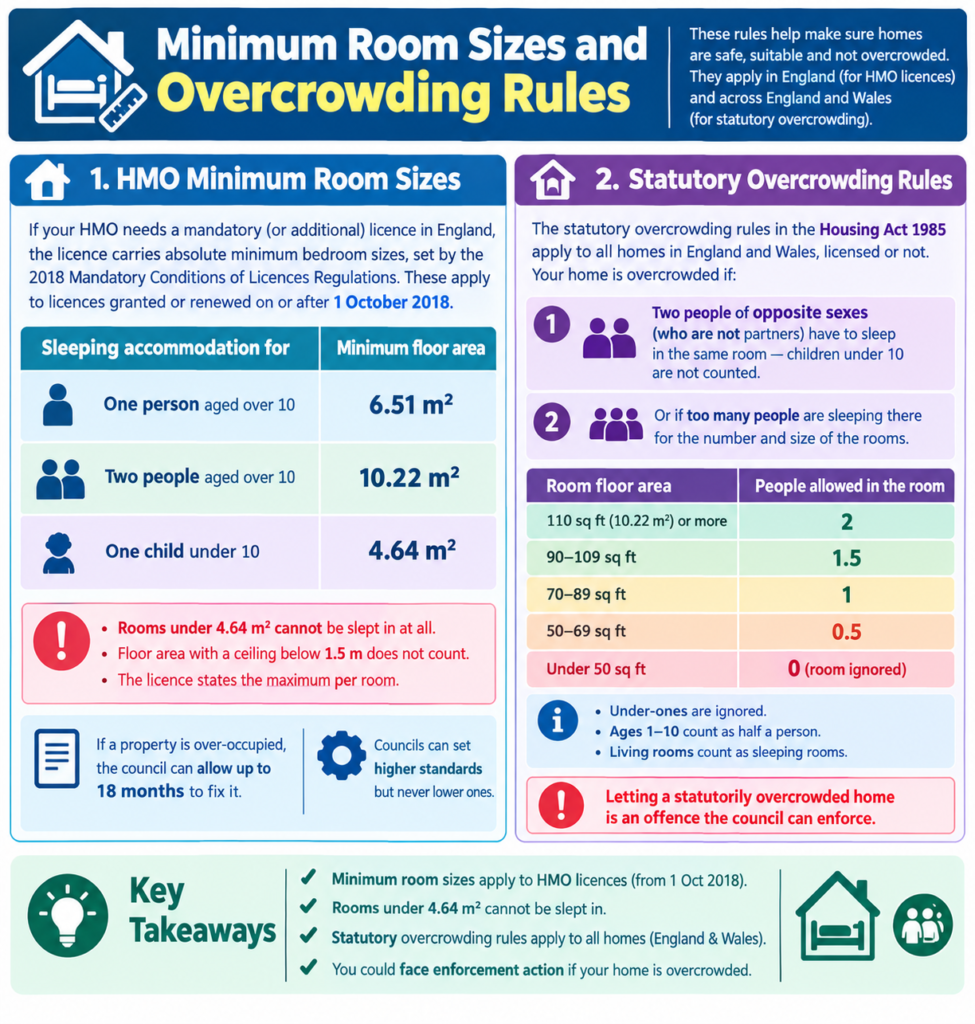
If your HMO needs a mandatory (or additional) licence in England, the licence carries absolute minimum bedroom sizes, set by the 2018 Mandatory Conditions of Licences Regulations. These apply to licences granted or renewed on or after 1 October 2018:
| Sleeping accommodation for | Minimum floor area |
|---|---|
| One person aged over 10 | 6.51 m² |
| Two people aged over 10 | 10.22 m² |
| One child under 10 | 4.64 m² |
Rooms under 4.64 m² cannot be slept in at all, and floor area with a ceiling below 1.5 m does not count. The licence states the maximum per room; if a property is over-occupied, the council can allow up to 18 months to fix it. Councils can set higher standards but never lower ones.
Separately, the statutory overcrowding rules in the Housing Act 1985 apply to all homes in England and Wales, licensed or not. Your home is overcrowded if two people of opposite sexes (who are not partners) have to sleep in the same room — children under 10 are not counted — or if too many people are sleeping there for the number and size of the rooms:
| Room floor area | People allowed in the room |
|---|---|
| 110 sq ft (10.22 m²) or more | 2 |
| 90–109 sq ft | 1.5 |
| 70–89 sq ft | 1 |
| 50–69 sq ft | 0.5 |
| Under 50 sq ft | 0 (room ignored) |
Under-ones are ignored, ages 1–10 count as half a person, and living rooms count as sleeping rooms. Letting a statutorily overcrowded home is an offence the council can enforce.
Fire Safety and Management Duties: What Your Landlord Must Do
Shared houses carry stricter duties than single lets, because unrelated people share the same escape routes.
Fire safety (England): under the 2022 Smoke and Carbon Monoxide Alarm Regulations, your landlord must ensure at least one smoke alarm on each storey with living accommodation, and a carbon monoxide alarm in any room used as living accommodation containing a fixed combustion appliance (boilers, wood burners — gas cookers excluded). Alarms must work at the start of each tenancy, and the landlord must repair or replace them once you report a fault. In licensed HMOs, expect more: interlinked smoke and heat detection, fire doors, protected escape routes, emergency lighting and extinguishers where appropriate. Furniture your landlord provides must meet fire-safety regulations.
The Management of Houses in Multiple Occupation (England) Regulations 2006 apply to every HMO, licensed or not. The person managing the property must:
| Duty | What it means in practice |
|---|---|
| Contact details | Display their name, address and phone number prominently in the property |
| Fire safety | Keep escape routes clear; maintain alarms and firefighting equipment; take reasonable steps to protect you from injury |
| Water and drainage | Keep the water supply and drainage working |
| Gas and electricity | Annual gas safety check by a Gas Safe engineer; electrical installation inspected at least every 5 years; no unreasonable cut-offs |
| Common parts and waste | Halls, stairs, landings, handrails, lighting, shared facilities and bin provision in good, clean, safe repair |
| Living accommodation | Each letting’s structure, fixtures, fittings and appliances in good repair; each unit clean at the start of your occupation |
Breaching these regulations is a criminal offence, and the council can enforce them directly — you do not need to go to court. Our guide to landlord repairs explains how to report problems step by step.
Your duties: do not hinder the manager, allow reasonable access for safety work, dispose of refuse properly, and follow fire-safety instructions.
Your landlord needs 24 hours’ written notice before entering your room for inspections or non-urgent repairs, and must come at a reasonable time — living in an HMO does not give them a free pass to walk in. Only a genuine emergency overrides this.
Who Pays Council Tax in an HMO?
This is the money question most HMO tenants get wrong — and it is good news for many of them. Under the Council Tax (Liability for Owners) Regulations 1992, the landlord is liable where tenants occupy only part of the property:
| Your arrangement | Who pays council tax |
|---|---|
| You rent a room on your own separate tenancy; housemates have their own agreements | Your landlord pays — even if you have a lock on your door |
| Everyone signed one joint tenancy for the whole house | You and your housemates pay (usually split between you) |
| All occupants are full-time students | Nobody — the property is exempt |
Since December 2023, most HMOs in England have a single council tax bill — one bill, and in a room-by-room HMO it is your landlord’s.
Two wrinkles: some landlords pass the cost on through “bills-included” rent — lawful, but check the maths. And if your agreement says you are responsible while everyone is on separate room-only agreements, the legal liability may still sit with your landlord — ask the council’s council tax team.
Worked example — Goran, Leeds. Goran rents one room for £550 a month on his own room-only agreement; his three housemates have theirs. The council tax bill is his landlord’s responsibility — if one arrives in Goran’s name, he should contact the council’s council tax team with a copy of his agreement. On a single joint tenancy for the whole house, the four friends would have been jointly liable instead.
Our council tax guide for renters explains discounts, exemptions and how to challenge a bill. (Scotland and Northern Ireland handle HMO council tax differently — check with your local council.)
Your Deposit in an HMO
The deposit rules apply in full to HMO tenants. Your landlord must protect your deposit in a government-approved scheme within 30 days of receiving it and give you the written “prescribed information” in the same 30 days — room-only or joint. Fail, and you can claim one to three times the deposit through the county court.
In England the cap works on your tenancy’s rent — where room-only tenants benefit:
Worked example — Zofia, Birmingham. Zofia pays £650 a month for her room: weekly rent is (£650 × 12) ÷ 52 = £150, so the maximum deposit is 5 × £150 = £750. When her agent demanded £900 (six weeks), Zofia knew £150 of it was above the legal cap and had to be refunded.
One HMO-specific point: on a joint tenancy there is usually one shared deposit, so one housemate’s damage can come out of the shared pot (you recover from the housemate, not the landlord). On room-only agreements, your deposit answers only for your room. Read our full tenancy deposit protection guide to check your deposit in a few minutes.
| England | Wales | Scotland | Northern Ireland | |
|---|---|---|---|---|
| Protect within | 30 days | 30 days | 30 working days | 28 days |
| Deposit cap | 5/6 weeks’ rent | No statutory cap | 2 months’ rent | 1 month’s rent |
Rent and Bills in an HMO
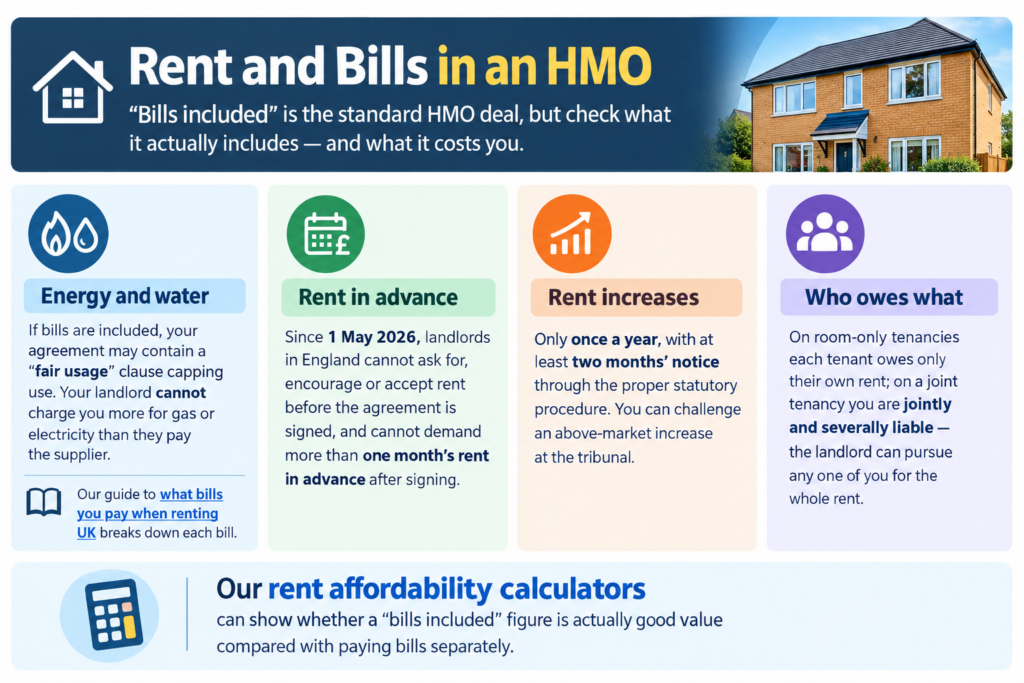
“Bills included” is the standard HMO deal, but check what it actually includes — and what it costs you.
- Energy and water: if bills are included, your agreement may contain a “fair usage” clause capping use. Your landlord cannot charge you more for gas or electricity than they pay the supplier. Our guide to what bills you pay when renting breaks down each bill.
- Rent in advance: since 1 May 2026, landlords in England cannot ask for, encourage or accept rent before the agreement is signed, and cannot demand more than one month’s rent in advance after signing.
- Rent increases: only once a year, with at least two months’ notice through the proper statutory procedure. You can challenge an above-market increase at the tribunal.
- Who owes what: on room-only tenancies each tenant owes only their own rent; on a joint tenancy you are jointly and severally liable — the landlord can pursue any one of you for the whole rent.
Our rent affordability calculators can show whether a “bills included” figure is actually good value compared with paying bills separately.
Dealing With Housemate Problems
Your landlord is not your mediator. Noise, mess, guests who never leave and chores nobody does are, in the first instance, between you and your housemates — talk to them early, agree house rules in writing, and keep a record. If noise becomes persistent, our noisy neighbours guide covers the escalation steps.
Two legal points matter especially in HMOs:
- On a joint tenancy, one person’s notice ends it for everyone. Under the Renters’ Rights Act, a notice to quit given by only one (or some) of the joint tenants is valid and ends the whole tenancy after the two-month notice period. If a housemate gets a job in another city and serves notice, everyone is out in two months — not just them.
- On separate room-only tenancies, a housemate leaving changes nothing for you — but the landlord may move a stranger into the empty room, so check what your agreement allows.
For threats, violence or persistent serious nuisance, tell your landlord in writing: they have strengthened eviction grounds, but on a joint tenancy they can act against the whole household. Our joint tenancy guide explains shared liability in full.
Unlicensed HMO? Your Remedies
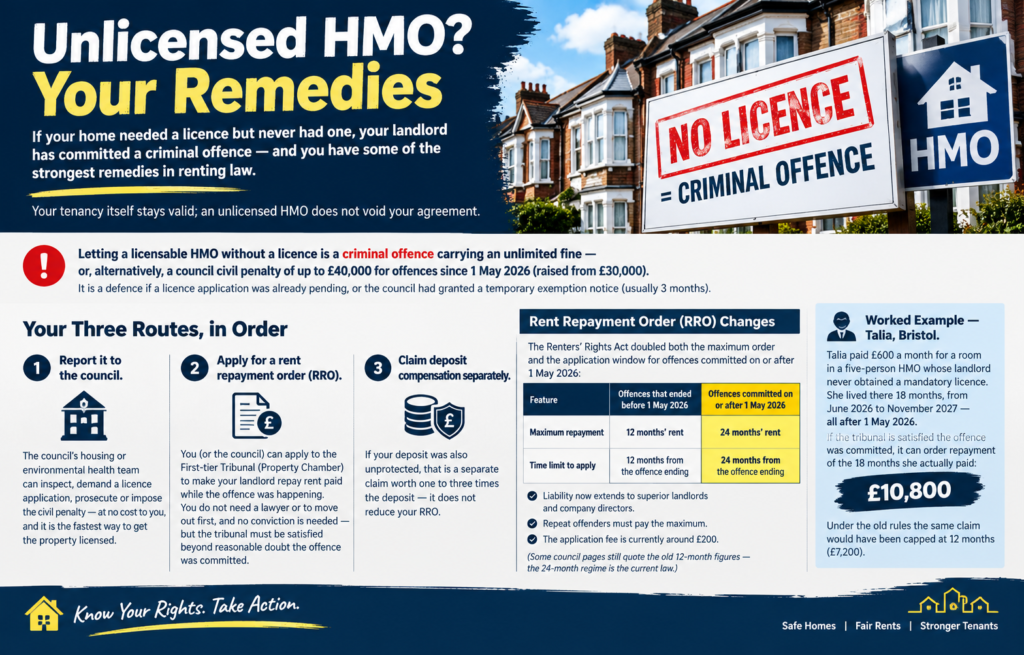
If your home needed a licence but never had one, your landlord has committed a criminal offence — and you have some of the strongest remedies in renting law. Your tenancy itself stays valid; an unlicensed HMO does not void your agreement.
Letting a licensable HMO without a licence is a criminal offence carrying an unlimited fine — or, alternatively, a council civil penalty of up to £40,000 for offences since 1 May 2026 (raised from £30,000). It is a defence if a licence application was already pending, or the council had granted a temporary exemption notice (usually 3 months).
Your three routes, in order:
1. Report it to the council. The council’s housing or environmental health team can inspect, demand a licence application, prosecute or impose the civil penalty — at no cost to you, and it is the fastest way to get the property licensed.
2. Apply for a rent repayment order (RRO). You (or the council) can apply to the First-tier Tribunal (Property Chamber) to make your landlord repay rent paid while the offence was happening. You do not need a lawyer or to move out first, and no conviction is needed — but the tribunal must be satisfied beyond reasonable doubt the offence was committed.
The Renters’ Rights Act doubled both the maximum order and the application window for offences committed on or after 1 May 2026:
| Offences that ended before 1 May 2026 | Offences committed on or after 1 May 2026 | |
|---|---|---|
| Maximum repayment | 12 months’ rent | 24 months’ rent |
| Time limit to apply | 12 months from the offence ending | 24 months from the offence ending |
Liability now extends to superior landlords and company directors, and repeat offenders must pay the maximum. The application fee is currently around £200. (Some council pages still quote the old 12-month figures — the 24-month regime is the current law.)
Worked example — Talia, Bristol. Talia paid £600 a month for a room in a five-person HMO whose landlord never obtained a mandatory licence. She lived there 18 months, from June 2026 to November 2027 — all after 1 May 2026. If the tribunal is satisfied the offence was committed, it can order repayment of the 18 months she actually paid: £10,800. Under the old rules the same claim would have been capped at 12 months (£7,200).
3. Claim deposit compensation separately. If your deposit was also unprotected, that is a separate claim worth one to three times the deposit — it does not reduce your RRO.
Notice Periods and Eviction Rules After the Renters’ Rights Act
- Section 21 “no-fault” eviction is abolished. Your landlord must use a Section 8 ground and prove it — our Section 8 eviction guide explains each ground.
- You can leave with two months’ notice. Assured periodic tenancies (which replaced fixed-term assured shortholds on 1 May 2026) can be ended by the tenant at any point with two months’ written notice — email or text counts — ending on the last day of a rent period.
- Landlord notice periods are longer. For most Section 8 grounds, landlords must give at least two months’ notice — four months for the selling and moving-in grounds, which cannot be used in the first 12 months of a tenancy.
- Student HMOs: most student tenancies converted to assured periodic tenancies as well; landlords can use the dedicated student ground (Ground 4A) to regain possession, while purpose-built student accommodation is exempt from the Act.
For the full picture of how the 2025 Act changed renting, read our Renters’ Rights Act 2025 guide.
HMOs Across the UK at a Glance
| England | Wales | Scotland | Northern Ireland | |
|---|---|---|---|---|
| HMO definition | 3+ people, 2+ households sharing facilities | 3+ people, 2+ households sharing facilities | 3+ people from 3+ families | 3+ people, more than 2 households |
| Mandatory licence threshold | 5+ people, 2+ households, any storeys | 5+ people, 2+ households, 3+ storeys | 3+ unrelated people — always | All HMOs — always |
| Licensed by | Local council | Local council (+ Rent Smart Wales registration) | Local council | Local council (Belfast CC administers for all 11) |
| Since | 2006; storey rule removed 2018 | 2006 | 2000 | April 2019 |
| Unlicensed penalty | Unlimited fine or civil penalty up to £40,000 | Unlimited fine or civil penalty | Criminal offence, fine up to £50,000 | Offence under the HMO Act (NI) 2016 |
| Tenancy type | Assured periodic (since 1 May 2026) | Standard occupation contract | Private residential tenancy | Private tenancy |
| Deposit deadline | 30 days | 30 days | 30 working days | 28 days |
In Wales, every landlord must also register with Rent Smart Wales, and self-managing landlords need a Rent Smart Wales licence (or a licensed agent) — letting or managing without one is a criminal offence that blocks no-fault possession notices. Welsh tenants hold occupation contracts, with a written statement due within 14 days.
Your Moving-In Checklist for an HMO
Before you pay anything beyond a holding deposit, work through this list — it takes an hour and can save you thousands:
- Check the council’s HMO register for the address — is it licensed, and for how many people?
- Check for additional or selective licensing covering your street, even if there are only three or four of you.
- Measure your room — a single room in a licensed HMO must be at least 6.51 m².
- Test the alarms — every smoke alarm, plus a carbon monoxide alarm near the boiler.
- Check the escape routes — clear halls, stairs and front door? Fire doors on kitchens and bedrooms?
- Read your agreement — room-only (your rent, your deposit, your liability) or joint tenancy (shared everything)? Is the named landlord the person you are paying?
- Check the deposit paperwork — which scheme, and did you get the prescribed information within 30 days?
- Ask who pays the council tax — with separate room agreements, the landlord should be paying. Get it in writing.
- Note the manager’s contact details — the regulations require them to be displayed in the property.
- Photograph everything — date-stamped photos of your room and shared areas on day one are your best evidence in any deposit dispute.
Frequently Asked Questions
Do deposits in HMOs have to be protected like normal tenancies?
Yes. If you have an assured tenancy in England or Wales — whether room-only or joint — your deposit must be protected in a government-approved scheme within 30 days of the landlord receiving it, with the prescribed information in writing in the same period.
Can my landlord enter my room without notice in an HMO?
No — an HMO gives your landlord no extra right of entry. They must give at least 24 hours’ written notice and visit at a reasonable time, except in a genuine emergency such as a fire or flood. Regular unannounced entries can amount to harassment, which is an offence.
Three couples share a house — is that an HMO?
Yes. Three couples are three households, so it is an HMO. With six people living there, it would also need a mandatory licence in England.
My room is smaller than 6.51 square metres — what can I do?
In a licensed HMO in England, a single-occupancy bedroom must be at least 6.51 m² — the council can enforce this, allowing the landlord up to 18 months to fix over-occupation. Contact your council’s HMO or environmental health team, who can measure the room and take action.
Who is responsible for cleaning the shared kitchen and hallways?
Day-to-day cleaning is generally down to the tenants — agree a rota. But your landlord must keep the common parts in good, clean repair and safe working order and provide enough bins. A neglected shared house the landlord never attends to is a management failure you can report.
My housemate stopped paying rent — am I liable?
On a joint tenancy, yes — you are jointly and severally liable, so the landlord can pursue you for the missing rent. On separate room-only tenancies, no — each tenant owes only their own rent.
How do I report an unlicensed HMO?
Contact your council’s housing or environmental health team — most have an online form. Give the address and why you believe it needs a licence; the council can inspect, require an application, prosecute, or impose a civil penalty of up to £40,000.
Does the Renters’ Rights Act apply to HMO tenants?
Yes. HMO tenants in England have the same protections as other private renters: no Section 21, assured periodic tenancies, two months’ notice to leave, rent rises once a year, and rent repayment orders of up to 24 months’ rent for offences since 1 May 2026.
Can my landlord evict me from an HMO for complaining?
No — retaliatory eviction is restricted; your landlord must prove a valid Section 8 ground in court. If a notice follows your complaint to the council, get advice from Shelter or Citizens Advice immediately and tell the court the full history.
Do students in shared houses get different HMO rules?
Mostly no — students in ordinary shared houses have the same HMO rights as anyone else. Two exceptions: university-owned accommodation is generally excluded from the HMO definition, and landlords of student HMOs can use a dedicated possession ground (Ground 4A). Purpose-built student accommodation is exempt from the Renters’ Rights Act.
Final Thoughts
Renting an HMO can be one of the most affordable ways to live in the UK’s expensive cities — but only if you know which rules protect you. The three checks that matter most take less than an hour: confirm the property is licensed on your council’s register, measure your room against the 6.51 m² minimum, and verify your deposit is protected within 30 days.
If something is wrong — an unlicensed house, a cupboard-sized room, dead alarm batteries — you are not powerless: your council can enforce the rules at no cost to you, and rent repayment orders now run to 24 months’ rent for offences since 1 May 2026.
Before you sign your next shared-house agreement, make sure the numbers work too: our rent affordability calculators show what you can genuinely afford each month, and the bills guides help you judge whether “bills included” is really a bargain. An affordable room is only affordable if the full monthly cost fits your budget — check before you commit, not after.
Further Reading
- House in multiple occupation licence — GOV.UK — the official licence finder: what counts as an HMO, when a licence is needed, and how to apply through your council.
- Houses in multiple occupation (HMO) — Shelter England — Shelter’s tenant-focused guide to HMO definitions, licensing and your landlord’s responsibilities.