

Nadia rents a two-bedroom flat in Birmingham. One Tuesday she comes home to find her landlord’s coat in the hallway — he had let himself in with the spare key to “check the boiler”. No message, no knock, no warning. She asks the question thousands of UK renters type into Google every month: can my landlord enter without permission?
Quick answer: No — not in any normal situation. Your landlord needs your permission to enter your home, even if they kept a spare key. For inspections and repairs they must give you at least 24 hours’ written notice at a reasonable time of day, and notice on its own is not enough: you still have to agree. The only exception is a genuine emergency, such as a gas leak or a fire.
Rules differ between England, Scotland, Wales and Northern Ireland, and this guide covers all four. It is general information, not legal advice. If your situation is urgent or frightening, contact Shelter, Citizens Advice or a solicitor. Wherever you are in the UK, the starting question is the same — ‘can my landlord enter without permission’ — and the answer begins with your rights as a tenant.
Can my landlord enter without permission? Your legal rights explained
Your landlord’s entry rights are very limited, and you hold most of the cards. When you sign a tenancy agreement and move in, the law gives you exclusive possession — the home is yours to occupy, and your landlord has given up the right to walk in whenever they like.
Every residential tenancy in England and Wales also carries an implied promise of quiet enjoyment: you are entitled to live in peace and privacy, without unnecessary interference from your landlord. A landlord who repeatedly lets themselves in without asking is breaking that promise. That promise is the legal backbone behind the question ‘can my landlord enter without permission’: your peace and privacy come first.
In practice:
- Your landlord cannot drop in unannounced “just to check things”.
- A spare key is not permission to use it.
- A tenancy clause claiming entry “at any time” cannot override quiet enjoyment.
- Sensible access rules in your tenancy agreement still apply — but they cannot weaken these legal basics.
What is the 24-hour rule for landlord entry?
In England and Wales, Section 11 of the Landlord and Tenant Act 1985 gives your landlord a right to enter to view the property’s condition — but only on at least 24 hours’ written notice, at a reasonable time of day. The Housing Act 1988 adds an implied term in assured tenancies that you must allow access for repairs your landlord is entitled to carry out.
A valid access request should include:
| Element | What the rule requires |
|---|---|
| Notice period | At least 24 hours, counted from when you receive it |
| Written form | Text, email or letter — something you can keep a copy of |
| Reason for the visit | Inspection, repair, safety check — a clear purpose |
| Date and time | A specific appointment, not “sometime next week” |
| Timing | A reasonable time of day — not early morning or late evening |
Notice is a request, not a right. Even a perfect 24 hours’ written notice does not force you to open the door — your landlord must still get your agreement. If the time does not suit you, suggest an alternative, and a reasonable landlord will accept.
Shelter’s advice is plain: your landlord should not enter without telling you they are coming and asking whether it is okay. The same limits bind letting agents and contractors — anyone your landlord sends. It is advice worth following, because ‘can my landlord enter without permission’ is a question best settled before anyone knocks.
Can my landlord enter without permission? When the answer is yes
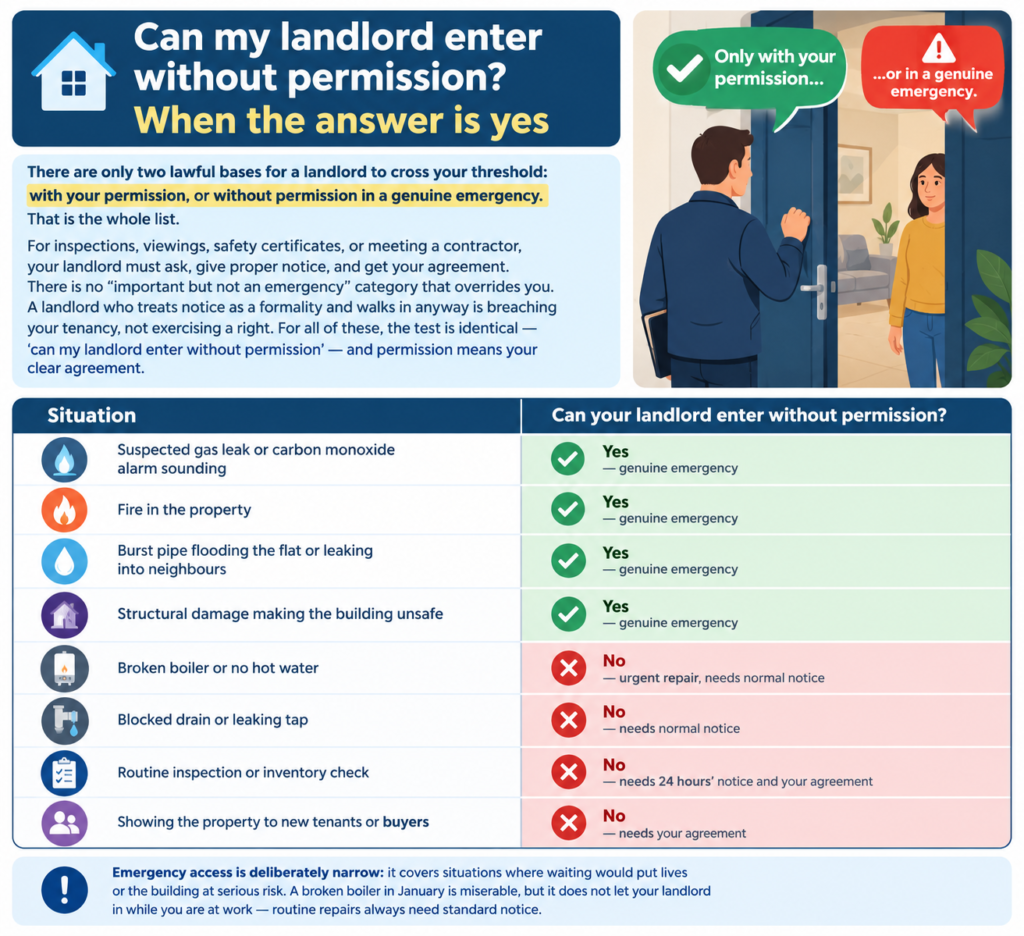
There are only two lawful bases for a landlord to cross your threshold: with your permission, or without permission in a genuine emergency. That is the whole list.
For inspections, viewings, safety certificates, or meeting a contractor, your landlord must ask, give proper notice, and get your agreement. There is no “important but not an emergency” category that overrides you. A landlord who treats notice as a formality and walks in anyway is breaching your tenancy, not exercising a right. For all of these, the test is identical — ‘can my landlord enter without permission’ — and permission means your clear agreement.
Emergency access is deliberately narrow: it covers situations where waiting would put lives or the building at serious risk. A broken boiler in January is miserable, but it does not let your landlord in while you are at work — routine repairs always need standard notice. However miserable the situation feels, ‘can my landlord enter without permission’ still gets a narrow answer: only when waiting would risk lives or the building.
| Situation | Can your landlord enter without permission? |
|---|---|
| Suspected gas leak or carbon monoxide alarm sounding | Yes — genuine emergency |
| Fire in the property | Yes — genuine emergency |
| Burst pipe flooding the flat or leaking into neighbours | Yes — genuine emergency |
| Structural damage making the building unsafe | Yes — genuine emergency |
| Broken boiler or no hot water | No — urgent repair, needs normal notice |
| Blocked drain or leaking tap | No — needs normal notice |
| Routine inspection or inventory check | No — needs 24 hours’ notice and your agreement |
| Showing the property to new tenants or buyers | No — needs your agreement |
Can my landlord enter without permission after giving 24 hours’ notice?
Yes. Your tenancy gives you exclusive possession, so you have the final say over who enters your home. You can refuse a visit even when the notice was perfect, and your landlord cannot physically force their way in over your objection. That final say is the whole point of asking ‘can my landlord enter without permission’: the permission is yours to give — or to withhold.
That said, refusing is not always wise, and whether your refusal is reasonable matters:
- Reasonable refusal — you are ill, you work nights, or it is the fourth inspection this month. Suggest an alternative time in writing.
- Refusing safety checks — your landlord has strict legal duties around annual gas safety checks and five-yearly electrical checks (see our guide to landlord safety certificates). Blocking these puts everyone at risk and weakens your position in any dispute. Always try to agree a time instead.
- What your landlord can do — they cannot force entry, but they can go to court for an injunction ordering you to allow access. In Northern Ireland, the County Court can make an entry order specifically for this. These routes are slow and expensive, which is why most disputes end with a sensible appointment being agreed.
One point is worth knowing: in a reported County Court decision from November 2025, a judge refused a landlord’s application for permission to force entry to carry out a gas safety check, ruling that no court has the power to authorise a landlord to force their way into a tenant’s home. The landlord’s remedies were contempt or possession proceedings — not a spare key and a shoulder. Even the courts, then, answer ‘can my landlord enter without permission’ with a no — forced entry is simply not on the table.
How often can your landlord inspect your property?
There is no statutory limit on inspection requests, but visits must stay proportionate to a genuine need. Industry guidance treats a routine inspection every three to six months as a reasonable baseline — more frequent than that, without a specific reason each time, starts to look excessive.
| Pattern of visits | How it is likely to be treated |
|---|---|
| One inspection every 3–6 months, with proper notice | Normal and reasonable |
| Monthly inspections with a clear reason (e.g. monitoring a leak) | Acceptable if the reason is genuine |
| Monthly or more frequent inspections “just to check” | Excessive — risks being treated as harassment |
| Unannounced visits, especially evenings or weekends | Harassment, even if each visit is brief |
| Visits combined with threats, demands or intimidation | Harassment and potentially a criminal offence |
If inspections feel relentless, write to your landlord or agent setting out what you consider reasonable, and keep copies. A paper trail showing a pattern of excessive visits is exactly what councils and courts look for. Keep asking the key question — ‘can my landlord enter without permission’ — and make sure your written record shows the answer was always no.
What access must you allow for gas safety checks, electrical checks and repairs?
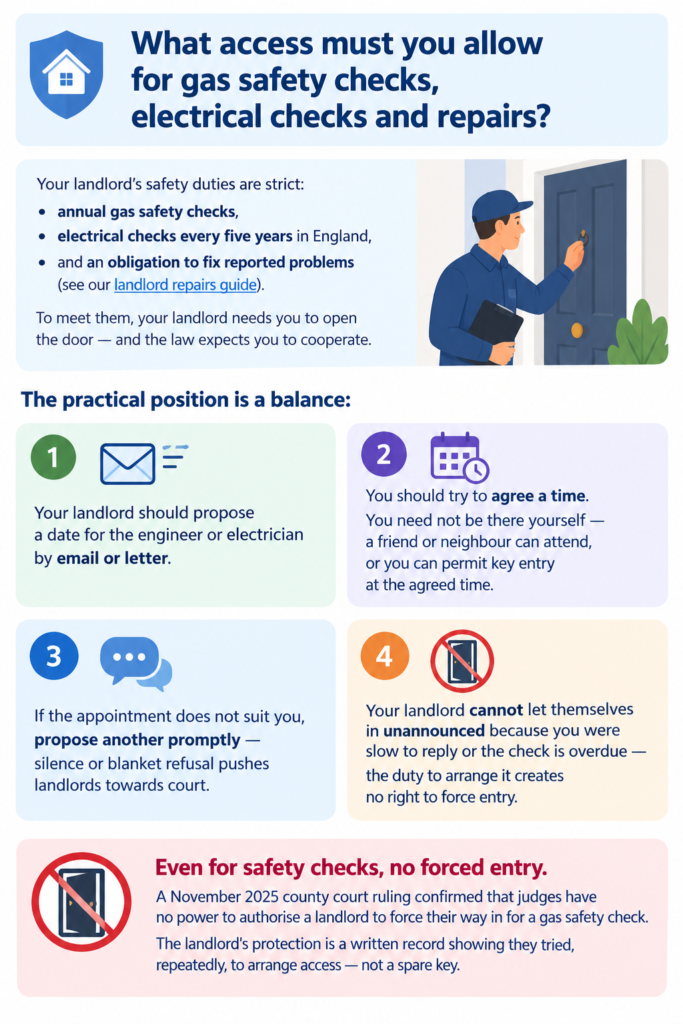
Your landlord’s safety duties are strict: annual gas safety checks, electrical checks every five years in England, and an obligation to fix reported problems (see our landlord repairs guide). To meet them, your landlord needs you to open the door — and the law expects you to cooperate.
The practical position is a balance:
- Your landlord should propose a date for the engineer or electrician by email or letter.
- You should try to agree a time. You need not be there yourself — a friend or neighbour can attend, or you can permit key entry at the agreed time.
- If the appointment does not suit you, propose another promptly — silence or blanket refusal pushes landlords towards court.
- Your landlord cannot let themselves in unannounced because you were slow to reply or the check is overdue — the duty to arrange it creates no right to force entry.
Even for safety checks, no forced entry. A November 2025 county court ruling confirmed that judges have no power to authorise a landlord to force their way in for a gas safety check. The landlord’s protection is a written record showing they tried, repeatedly, to arrange access — not a spare key.
End-of-tenancy viewings: do you have to let viewers in?
This is one of the most common flashpoints. Your landlord or agent may want to show the property to prospective tenants in the final weeks. The rules:
- Check your tenancy agreement first. You only have to agree to viewings if your agreement says so. Without such a clause, you can refuse — though cooperating can help with references and your deposit return.
- Notice and timing still apply. Viewings need reasonable notice at reasonable times. A demand for daily open-house evenings is not enforceable.
- Refusing without good reason carries a risk. It can lead to a damages claim for financial loss — for example, rent lost while the property sat empty. But unreasonable access demands are not enforceable, and a court would weigh whether your refusal was reasonable.
Agree to a limited number of viewings at times that suit you, confirm them in writing, and ask for 24 hours’ notice of each one. Our ending your tenancy guide covers the final weeks in more detail.
Can your landlord send agents, contractors or strangers instead?
Yes — your landlord can send someone else, such as a letting agent, a plumber or an electrician. But the substitute has no more rights than the landlord:
- The same notice and permission rules apply to everyone your landlord sends.
- You are entitled to know who is coming and why. Ask to see identification if you are unsure.
- You can refuse an unknown visitor who turns up without an appointment, even if they claim the landlord sent them. A genuine contractor will happily rebook.
- If your agent manages the property, agree a simple rule in writing: no visits without an email confirming the date, time, purpose and the visitor’s name. One message prevents most disputes.
Can you change the locks — and can your landlord change them on you?
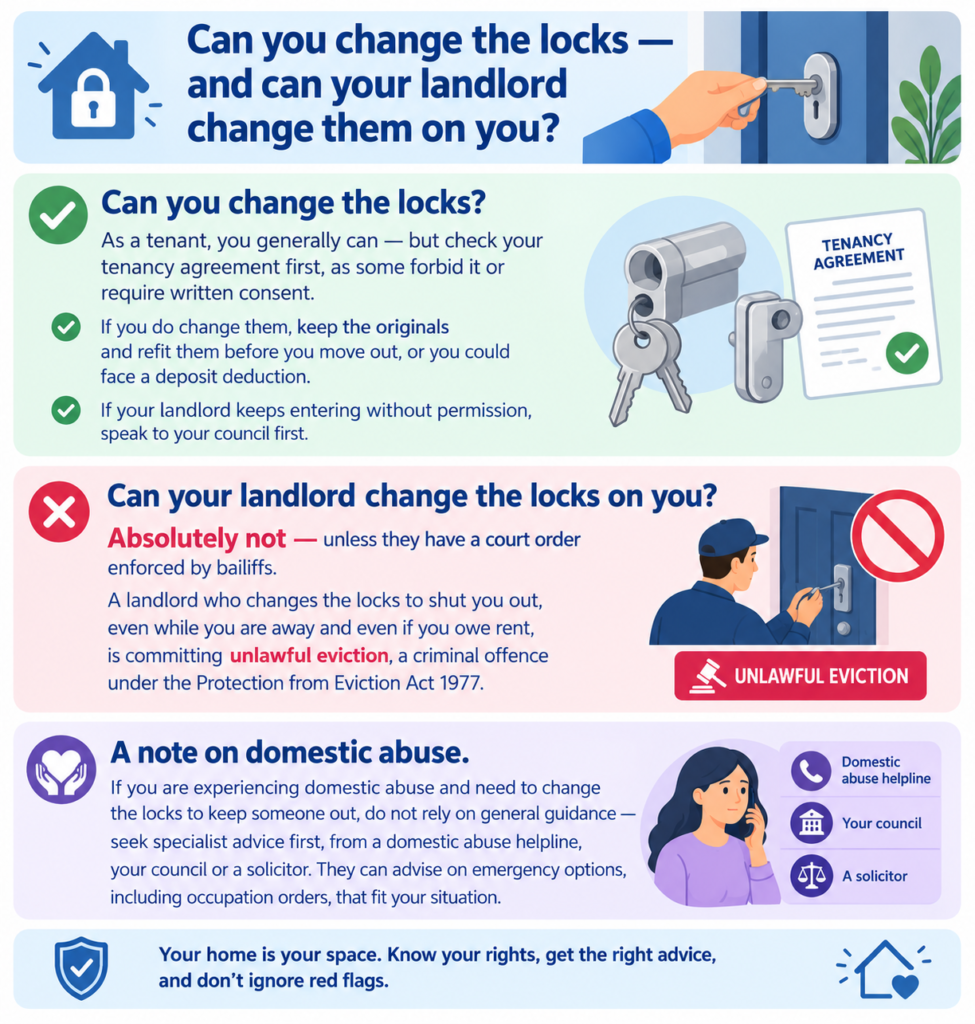
Can you change the locks? As a tenant, you generally can — but check your tenancy agreement first, as some forbid it or require written consent. If you do change them, keep the originals and refit them before you move out, or you could face a deposit deduction. If your landlord keeps entering without permission, speak to your council first.
Can your landlord change the locks on you? Absolutely not — unless they have a court order enforced by bailiffs. A landlord who changes the locks to shut you out, even while you are away and even if you owe rent, is committing unlawful eviction, a criminal offence under the Protection from Eviction Act 1977.
A note on domestic abuse. If you are experiencing domestic abuse and need to change the locks to keep someone out, do not rely on general guidance — seek specialist advice first, from a domestic abuse helpline, your council or a solicitor. They can advise on emergency options, including occupation orders, that fit your situation.
What counts as landlord harassment?
Harassment is not just shouting or threats. Under Section 1 of the Protection from Eviction Act 1977, a landlord (or their agent, or anyone acting for them) commits a criminal offence if they act — or deliberately fail to act — in ways likely to interfere with your peace and comfort, intending (or having reasonable cause to expect) to make you leave or give up part of the property. Repeated entries without consent sit squarely in this territory — which is why ‘can my landlord enter without permission’ matters well beyond a single visit.
The Protection from Harassment Act 1997 adds a second route: harassment as a course of conduct — behaviour on at least two occasions that a reasonable person would see as harassment — which can be pursued as a criminal offence or a civil claim for damages and an injunction.
| Behaviour | Likely position |
|---|---|
| Repeated unannounced entry, especially at night | Harassment |
| Entering your home without permission | Harassment; possible unlawful eviction offence |
| Cutting off gas, water or electricity to pressure you | Harassment |
| Threats, intimidation or abusive messages | Harassment |
| Excessive calls or messages demanding you leave | Harassment |
| Changing the locks or removing your belongings | Unlawful eviction — criminal offence |
| One polite, properly notified inspection visit | Not harassment |
A single badly handled visit is usually a breach of quiet enjoyment rather than a crime. Harassment is about a pattern — repeated behaviour meant to wear you down, frighten you or push you out.
What penalties can a landlord face for unlawful entry or harassment?
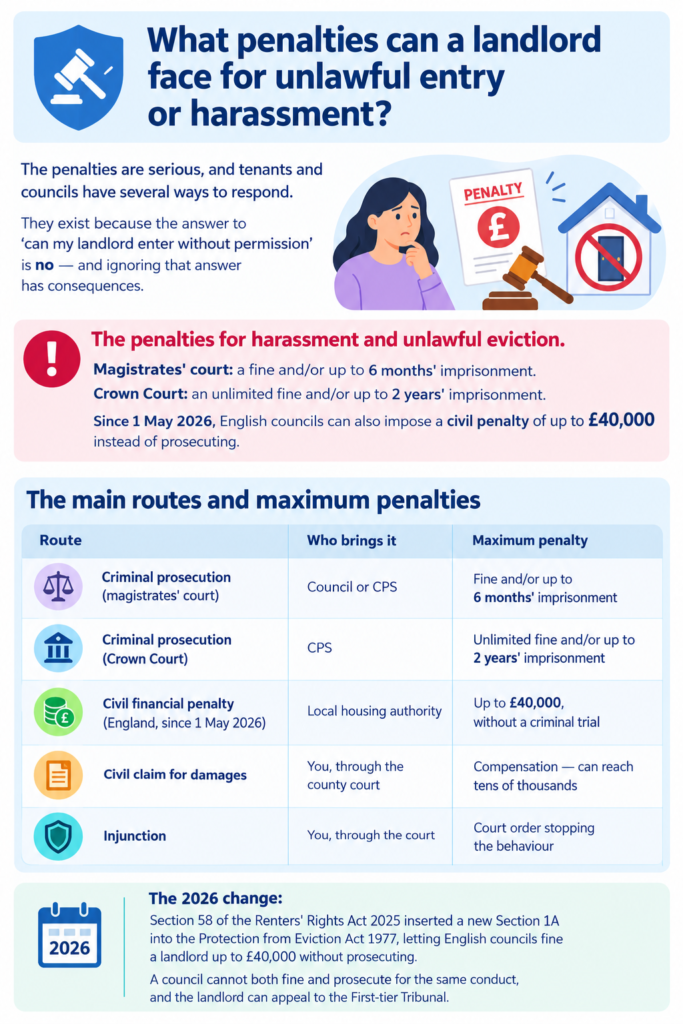
The penalties are serious, and tenants and councils have several ways to respond. They exist because the answer to ‘can my landlord enter without permission’ is no — and ignoring that answer has consequences.
The penalties for harassment and unlawful eviction. Magistrates’ court: a fine and/or up to 6 months’ imprisonment. Crown Court: an unlimited fine and/or up to 2 years’ imprisonment. Since 1 May 2026, English councils can also impose a civil penalty of up to £40,000 instead of prosecuting.
| Route | Who brings it | Maximum penalty |
|---|---|---|
| Criminal prosecution (magistrates’ court) | Council or CPS | Fine and/or up to 6 months’ imprisonment |
| Criminal prosecution (Crown Court) | CPS | Unlimited fine and/or up to 2 years’ imprisonment |
| Civil financial penalty (England, since 1 May 2026) | Local housing authority | Up to £40,000, without a criminal trial |
| Civil claim for damages | You, through the county court | Compensation — can reach tens of thousands |
| Injunction | You, through the court | Court order stopping the behaviour |
The 2026 change: Section 58 of the Renters’ Rights Act 2025 inserted a new Section 1A into the Protection from Eviction Act 1977, letting English councils fine a landlord up to £40,000 without prosecuting. A council cannot both fine and prosecute for the same conduct, and the landlord can appeal to the First-tier Tribunal.
Can my landlord enter without permission? What to do if they keep trying
If unannounced visits are becoming a pattern, act methodically — each step strengthens your position with the council, the police or a court. At the heart of every step is the same question — ‘can my landlord enter without permission’ — and the same answer: no.
Step 1 — Put it in writing. Tell your landlord or agent plainly: no unannounced visits; all access arranged with you in advance and confirmed in writing, at least 24 hours’ notice at a reasonable time. Keep a copy.
Step 2 — Keep a diary. For every incident, note the date, time, who entered and what they did. Save texts, emails and photos. A dated log turns “he keeps coming round” into evidence.
Step 3 — Contact your council. Ask for the tenancy relations officer or private housing team — they can investigate, warn the landlord and prosecute.
Step 4 — Call the police if you feel unsafe. Threats, intimidation or violence are police matters: 999 in an emergency, 101 otherwise.
Step 5 — Consider court action. You can seek an injunction to stop the harassment and claim compensation through the county court. Get advice from Shelter, Citizens Advice or a solicitor first — many tenants qualify for legal aid.
| Who | What they can do for you |
|---|---|
| Council tenancy relations officer | Investigate, warn the landlord, prosecute harassment offences |
| Police (999 / 101) | Act on threats, violence or intimidation |
| Shelter / Citizens Advice | Free advice on your rights and next steps |
| Solicitor or law centre | Injunctions and compensation claims; possible legal aid |
| County court | Injunction to stop harassment; damages for what you suffered |
If you feel unsafe right now, call 999. You do not need to wait for a pattern to develop before involving the police. Threats and intimidation are never an acceptable part of renting.
How do the rules differ in Scotland, Wales and Northern Ireland?
The core principle — your home, your permission — holds across the UK, but notice periods and enforcement routes differ. Wherever you live, ‘can my landlord enter without permission’ gets the same short answer: only with your permission, or in a genuine emergency.
| Nation | Notice rule | If you refuse access |
|---|---|---|
| England | At least 24 hours’ written notice; your agreement still needed | Landlord can seek a court injunction; cannot force entry |
| Scotland | 48 hours for a private residential tenancy; 24 hours for older assured/short assured tenancies | Landlord can apply to the First-tier Tribunal (Housing and Property Chamber) for a right-of-entry order — free to apply |
| Wales | At least 24 hours’ notice under the occupation contract (Renting Homes (Wales) Act 2016) | Breach of contract; landlord can go to the county court |
| Northern Ireland | “Reasonable” notice at reasonable times (Private Tenancies (NI) Order 2006) — 24 hours is the accepted minimum | Landlord can apply to the county court for an entry order; entering without permission counts as harassment under NI tenancy information rules |
A few national details worth knowing:
- Scotland: your landlord cannot enter without your permission except in an emergency — if you refuse, they must get an access order from the tribunal. Repeated unannounced entry can also affect a landlord’s “fit and proper” registration.
- Wales: the 24-hour notice rule is a fundamental term of the standard occupation contract. Report harassment to your council and to Rent Smart Wales.
- Northern Ireland: the statutory tenancy information every tenant receives lists entering without permission (outside emergencies) as harassment, and your council’s environmental health department can act.
Worked example: what could Oliver’s harassment claim be worth?
Oliver rents a one-bedroom flat in London for £1,650 a month. Over six weeks, his landlord lets himself in unannounced five times — twice while Oliver is at work, once at 9 pm. Then, after an argument about repairs, the landlord changes the locks while Oliver is away for the weekend. Oliver is locked out for three days and sleeps on his sister’s sofa.
The figures below are illustrative — they show how a court breaks down this kind of award, not what any particular case would receive:
| Element of the claim | Illustrative figure |
|---|---|
| Rent paid for 3 days he was locked out (£1,650 ÷ 30 × 3) | £165 |
| Travel and out-of-pocket expenses for the 3 days | £120 |
| General damages for distress and loss of amenity (5 unlawful entries + lockout) | £2,500 |
| Aggravated damages (landlord acted deliberately after a dispute) | £1,500 |
| Illustrative total | £4,285 |
On top of compensation, the council could prosecute for unlawful eviction — or, since 1 May 2026, impose a civil penalty of up to £40,000. The point of Oliver’s story is not the exact number: unlawful entry has a price, and courts have several ways to make a landlord pay it. Those penalties are the teeth behind the simple rule that ‘can my landlord enter without permission’ is answered ‘no’.

Worked example: Theo and the viewings he kept refusing
Theo rents in Manchester for £1,050 a month. In his final month, his agreement requires viewings with reasonable notice. His agent requests six; Theo refuses all of them without explanation or alternative times. The flat sits empty for two weeks after he moves out. The landlord claims damages for the lost rent.
| Line | Amount |
|---|---|
| Rent lost: 2 weeks at £1,050/month (£1,050 ÷ 30 × 14) | £490 |
| Agent’s fee for re-booking cancelled viewings | £95 |
| Total claimed by the landlord | £585 |
Would the landlord win? Possibly — Theo’s agreement required viewings and his refusal was blanket and unexplained. Had he agreed to two viewings a week at times that suited him, a court would likely have found that reasonable and the claim would fail. The lesson cuts both ways: landlords must ask properly, and tenants should engage reasonably rather than refusing outright. It is the same balance this whole guide returns to: ‘can my landlord enter without permission?’ is no, but courts also expect tenants to act reasonably.
Frequently Asked Questions
Does 24 hours’ notice mean my landlord can just walk in?
No — notice is a request for access, not a right of entry. Your landlord still needs your agreement.
Can my landlord enter while I am on holiday?
Not without your permission. The only exception is a genuine emergency, such as a burst pipe flooding the flat below — and even then, they should try to contact you first.
My landlord kept the spare key and uses it. Is that allowed?
Keeping a spare key for genuine emergencies is common. Using it to enter without your permission, with no emergency, breaches your tenancy — and repeated use can amount to harassment.
Can I change the locks on my rented flat?
Usually yes, but check your agreement first — some forbid it or require written consent. Keep the originals and refit them before you move out to avoid deposit deductions.
Can my landlord do inspections every month?
They can ask, but monthly inspections “just to check” are widely seen as excessive. An inspection every three to six months is the usual reasonable baseline.
Do I have to let estate agents and viewers into my home?
Only if your tenancy agreement requires viewings, and even then only with reasonable notice at reasonable times. Without a viewings clause, you can refuse.
What if my landlord claims there was an emergency when there wasn’t one?
Note the dates, times and what the “emergency” supposedly was. A false emergency claim seriously weakens a landlord’s position with the council or a court.
What should I do if a contractor I don’t recognise turns up?
Don’t let them in. You are entitled to advance written notice of who is coming and why. Ask for ID and confirm the visit with your landlord or agent before rebooking.
Does the 24-hour rule apply if I am a lodger?
Lodgers have fewer rights, but your landlord still should not enter your room without permission. Repairs, agreed services and genuine emergencies are the exceptions.
What happens if I refuse access and my landlord gets a court order?
Comply with it — ignoring a court order can mean contempt of court, with serious penalties. If you disagree, get legal advice immediately rather than defying it.
Final Thoughts
So, can my landlord enter without permission? In almost every situation, the answer is no. Your landlord needs your permission, proper written notice, and a reasonable time of day — and even then, notice is a request, not a right. Genuine emergencies are the only exception, and they are far narrower than many landlords pretend.
If your landlord respects the rules, say yes to reasonable requests — especially safety checks — and confirm every arrangement in writing. If they do not, work the ladder: a written objection, a dated diary, your council’s tenancy relations team, the police if you feel unsafe, and the courts. Since 2026, English councils can fine harassing landlords up to £40,000 without a criminal trial. Follow that ladder, and you will rarely need to ask ‘can my landlord enter without permission’ again.
Before you sign your next tenancy, run the numbers on the true moving cost with our first month rent calculator guide, check the rent is affordable on your income with our rent affordability rules guide, and protect your money with our tenancy deposit protection guide.
Further Reading
- Shelter England — Can your landlord enter without notice?
- Sheffield City Council — Landlord harassment
- legislation.gov.uk — Renters’ Rights Act 2025, Section 58: penalties for unlawful eviction or harassment