
£40,000 Salary Rent UK is an important topic for anyone planning to rent a home while earning this income. Earning £40,000 a year in the UK can provide a good standard of living, but the amount of rent you can comfortably afford depends on more than your annual salary.
Many renters make the mistake of looking only at their total income. For example, someone may see that they earn £40,000 per year and assume they can comfortably rent a £1,400 or £1,500 per month property. However, rent is only one part of the monthly budget.
Income tax, National Insurance, council tax, gas, electricity, water, high-speed internet, food, travel, insurance, loan repayments, and savings all need to be considered before signing a rental agreement.
A landlord may approve you for a property based on your gross income, but that does not always mean the rent will be affordable in practice.
So, how much rent can you afford on a £40,000 salary in the UK?
For most people, a sensible monthly rent for financial planning is usually between £900 and £1,100 per month. You may be able to stretch this to around £1,200 or £1,300 depending on your lifestyle and location, but anything higher can reduce your savings and leave little room for emergencies.
This guide explains your exact 2025/26 take-home pay, landlord and affordability rules, rent calculations, real-life financial planning examples, and answers to common questions.
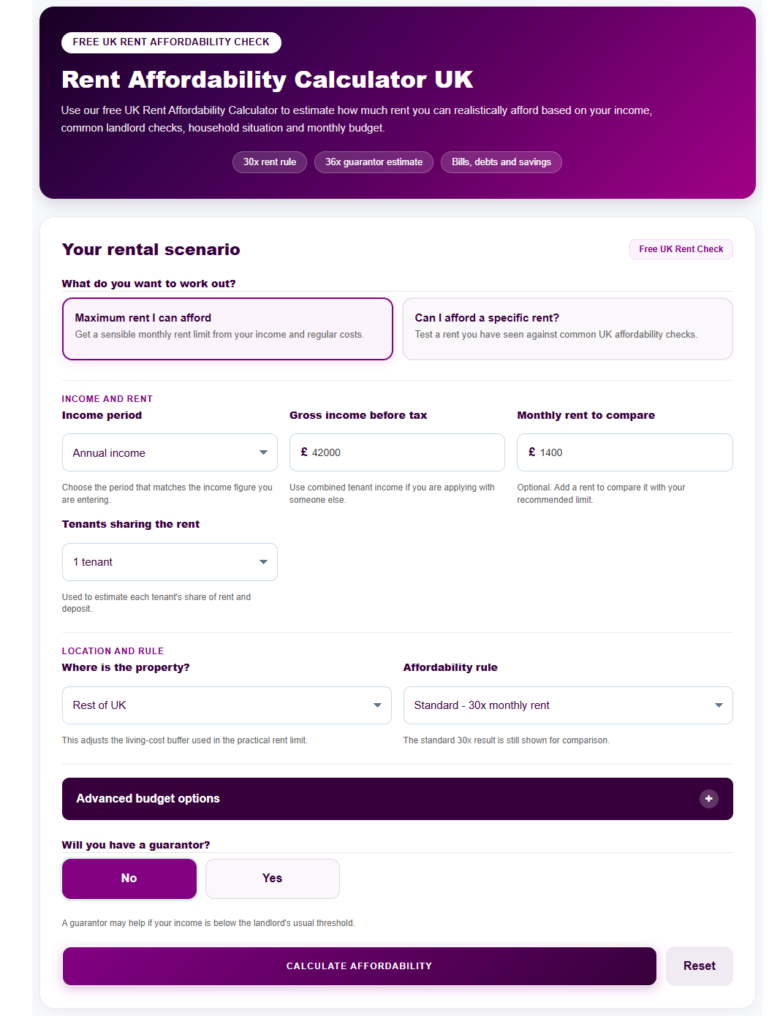
Click Here:Rent Affordability Calculator UK
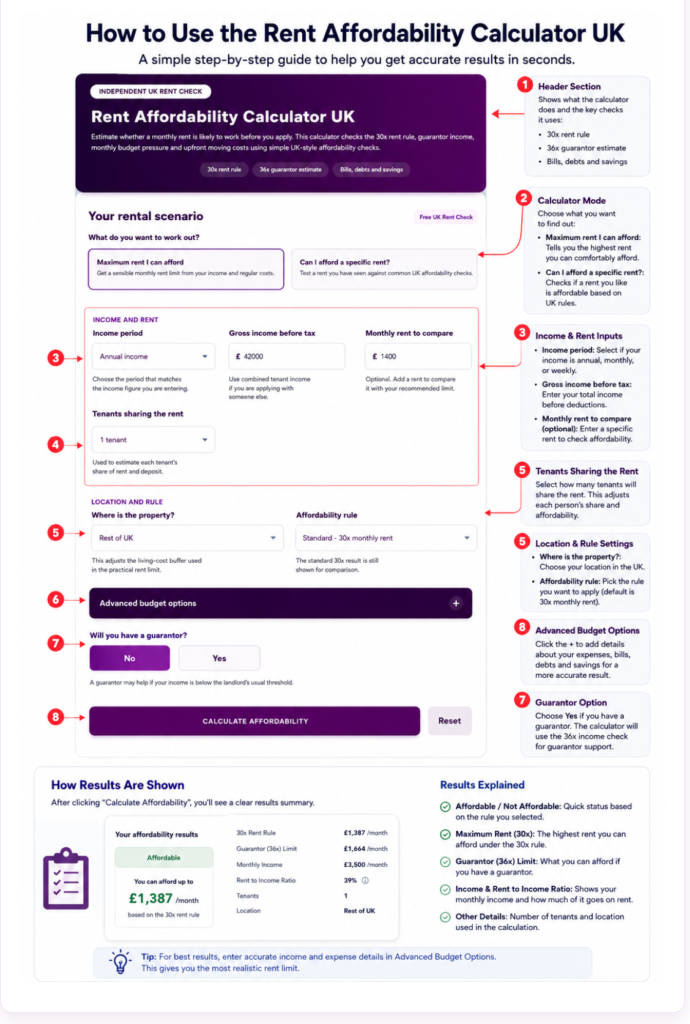
How to Use the Rent Affordability Calculator UK
£40,000 Salary Take-Home Pay in the UK for 2025/26
For the 2025/26 tax year, a person earning a gross annual salary of £40,000 in England, Wales, or Northern Ireland will usually take home around £32,319.60 per year after Income Tax and employee National Insurance.
This works out at approximately £2,693.30 per month.
These calculations assume that you have a standard tax code, do not make pension contributions through your salary, do not repay a student loan, and do not receive taxable workplace benefits.
| Calculation | Amount |
|---|---|
| Gross annual salary | £40,000 |
| Gross monthly salary | £3,333.33 |
| Personal Allowance | £12,570 |
| Taxable income | £27,430 |
| Income Tax at 20% | £5,486.00 |
| Employee National Insurance at 8% | £2,194.40 |
| Total annual deductions | £7,680.40 |
| Estimated annual take-home pay | £32,319.60 |
| Estimated monthly take-home pay | £2,693.30 |
| Estimated weekly take-home pay | £621.53 |
The standard Personal Allowance is £12,570 for 2025/26. Income between £12,571 and £50,270 is generally taxed at 20% in England, Wales, and Northern Ireland. Employee National Insurance is charged at 8% on earnings between the primary threshold and upper earnings limit.
Read more:How to Calculate Your Final Degree Classification in the UKHow Is the £40,000 Salary Calculation Worked Out?
| Step | Calculation | Result |
|---|---|---|
| Personal Allowance | The first £12,570 of your salary is covered by the Personal Allowance. This amount is not subject to income tax. | £12,570 tax-free |
| Taxable Earnings | £40,000 − £12,570 = £27,430 | £27,430 |
| Income Tax (20%) | All of this taxable income falls within the basic-rate tax band, so it is taxed at 20%. £27,430 × 20% = £5,486 | £5,486 Income Tax |
| National Insurance (8%) | For employee National Insurance, you pay 8% on earnings above the annual equivalent of the primary threshold. £40,000 − £12,570 = £27,430. £27,430 × 8% = £2,194.40 | £2,194.40 National Insurance |
| Annual Take-Home Pay | £40,000 − £5,486 − £2,194.40 = £32,319.60 per year | £32,319.60 |
| Monthly Take-Home Pay | This works out at approximately £2,693.30 per month. | £2,693.30/month |
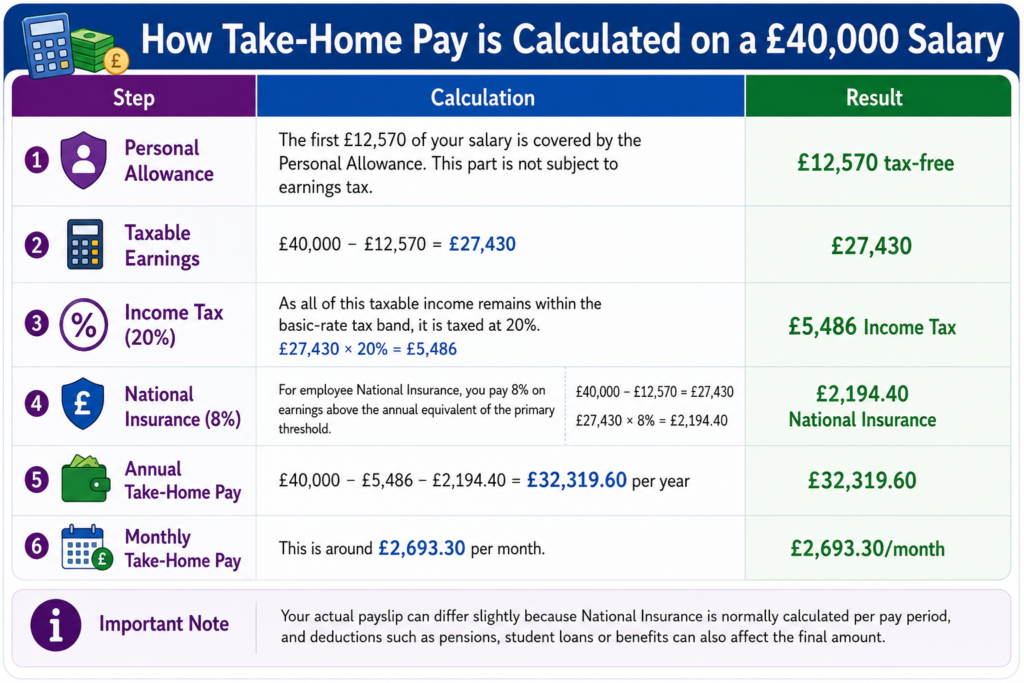
Important Tax Calculation Note
The £40,000 salary take-home pay figures in this guide are based on the official 2026/27 Income Tax and National Insurance rates for England, Wales, and Northern Ireland.
This calculation uses the standard Personal Allowance of £12,570. Income above this allowance is taxed at the 20% basic Income Tax rate until it reaches the higher-rate threshold. Employee National Insurance is calculated at 8% on eligible earnings above the primary threshold.
The estimated take-home pay of £32,319.60 per year, or £2,693.30 per month, assumes that you have a standard tax code and no workplace pension deductions, student loan repayments, salary sacrifice arrangements, taxable benefits, or additional income.
Your actual monthly pay may be lower or higher depending on your personal circumstances. If you live in Scotland, different Income Tax bands apply, so your take-home pay may also change.
To get a more personalised estimate, use our Income Tax Calculator UK, National Insurance Calculator UK, and Take-Home Pay Calculator UK. You can also use our Rent Affordability Calculator UK to compare your salary with your expected monthly rent and household bills.
For the latest official tax thresholds, allowances, and rates, check the current government guidance before making financial decisions.
Read more:£25,000 Salary Rent UK – How Much Rent Can You AffordHow Much Rent Can You Afford on a £40,000 Salary?
A common rent affordability guideline is to spend between 30% and 40% of your monthly take-home pay on rent.
With a monthly take-home income of approximately £2,693, your rent budget could look like this:
| Percentage of Take-Home Pay | Monthly Rent | Annual Rent |
|---|---|---|
| 30% | £808 | £9,696 |
| 35% | £943 | £11,316 |
| 40% | £1,077 | £12,924 |
| 45% | £1,212 | £14,544 |
| 50% | £1,347 | £16,164 |
For most renters, a reasonable target is between £900 and £1,100 per month.
A practical way to test this budget is to look at what you would have left after paying rent, rather than focusing only on the rent percentage. If your take-home pay is around £2,693 and you choose a £1,000 property, you would have about £1,693 left before paying your other monthly expenses. From this amount, you still need to cover council tax, energy, food, transport, insurance, debt repayments and savings. If these costs regularly use most of your remaining income, choosing a cheaper property may give you a much healthier monthly budget.
This range leaves room for household expenses, groceries, travel, savings, and personal spending. If you live in a more affordable area or share your rent with a partner, you may be able to spend less on rent and save more.
A rent of £1,200 to £1,300 per month may still be manageable, but only if your other monthly expenses are well controlled.
The 30% Rent Rule on a £40,000 Salary
| Section | Details |
|---|---|
| 30% Rent Rule | The 30% rent rule suggests that you should aim to spend no more than 30% of your take-home pay on rent. |
| Calculation | For someone taking home £2,693 per month, this would mean paying around: £2,693 × 30% = £808 per month |
| Recommended Rent Budget | A rent budget of around £800 per month may be suitable if you want to save money, pay off debt, invest, build an emergency fund, or prepare for a future house deposit. |
| Limitations of the Rule | However, the 30% rule may not be practical in every part of the UK. Renters in London, Bristol, Oxford, Cambridge, and some city-centre locations may have difficulty finding a suitable one-bedroom home within this budget. |
| Key Takeaway | The rule is a useful guideline, but it should not be treated as a strict requirement. Your personal financial situation matters more than following a fixed percentage. |
The 40% Rent Rule: Is It More Realistic?
For many renters in the UK, spending around 40% of take-home pay on rent may be more realistic.
On a £40,000 salary, 40% of monthly take-home pay is approximately:
£2,693 × 40% = £1,077 per month
A rent budget of around £1,050 to £1,100 can be manageable if you have stable employment, low debt, and reasonable living costs.
| Condition | Suitable? |
|---|---|
| You do not have expensive car finance. | ✓ |
| You have no large credit card repayments. | ✓ |
| Your commute is affordable. | ✓ |
| You do not have high childcare costs. | ✓ |
| You can control your food and lifestyle spending. | ✓ |
| You have at least some emergency savings. | ✓ |
Once rent goes above 45% or 50% of your take-home income, your finances can become much tighter.
Read more:£35,000 Salary Rent UK – How Much Rent Can You AffordCan You Afford £1,000 Rent on a £40,000 Salary?
Yes, £1,000 per month is generally a comfortable rent level for someone earning £40,000 per year.
It represents around 37% of an estimated £2,693 monthly take-home pay.
Here is an example budget:
| Monthly Expense | Estimated Cost |
|---|---|
| Take-home pay | £2,693 |
| Rent | £1,000 |
| Council tax | £145 |
| Gas and electricity | £145 |
| Water | £35 |
| Broadband and mobile | £55 |
| Groceries | £300 |
| Transport | £180 |
| Insurance and subscriptions | £100 |
| Savings | £300 |
| Personal spending | £250 |
| Remaining monthly buffer | £183 |
This budget is reasonably balanced. It covers regular expenses, allows you to put money into savings, and leaves some flexibility for unexpected costs.
Can You Afford £1,500 Rent on a £40,000 Salary?
For a single person, £1,500 in rent is usually too expensive on a £40,000 salary.
It would take more than half of your monthly take-home pay, leaving less money available for bills and other living costs.
| Monthly Expense | Estimated Cost |
|---|---|
| Take-home pay | £2,693 |
| Rent | £1,500 |
| Council tax | £160 |
| Gas, electricity and water | £190 |
| Broadband and mobile | £55 |
| Groceries | £300 |
| Transport | £180 |
| Insurance and subscriptions | £100 |
| Personal spending | £150 |
| Savings | £100 |
| Remaining monthly buffer | −£42 |
This example shows that £1,500 rent can push your budget into a deficit.
You may still pass a landlord’s affordability check, but the rent could leave you with very little money for unexpected expenses or additional costs. You could also struggle to save money or deal with unexpected financial pressures. A rent level like this may be more manageable when you share costs with a partner, spouse, or flatmate.
How Do Landlords Calculate Rent Affordability in the UK?
Many landlords and letting agents use an income multiple to assess whether you can afford a property.
A common rule is that your annual income should be at least 30 times the monthly rent.
For example, if a property costs £1,200 per month:
£1,200 × 30 = £36,000 required annual income
Because your salary is £40,000, you may meet this affordability requirement.
Another commonly used method is based on annual rent being no more than around 40% of your gross annual income.
On a £40,000 salary:
£40,000 × 40% = £16,000 annual rent
£16,000 ÷ 12 = £1,333 per month
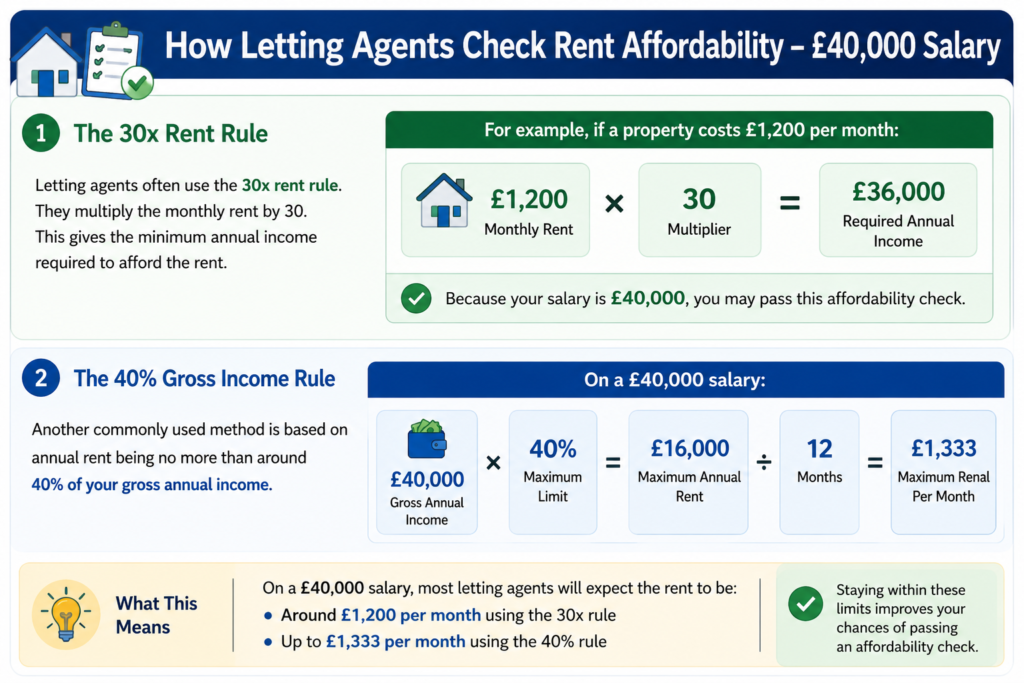
This means you may be approved for a property costing around £1,300 per month.
However, a landlord’s affordability check is not the same as a personal affordability assessment. Landlords mainly want to know whether you are likely to be able to pay the rent. You need to decide whether the property allows you to live comfortably while still managing your other expenses.
Read more:Rent-to-Income Percentage UK – Ideal Rent Ratio ExplainedHow Much Rent Can You Afford in London on £40,000?
London is one of the hardest places in the UK to rent alone on a £40,000 income.
More practical options may include renting a room in a shared house, choosing a shared apartment, living in outer London, selecting a studio apartment, or sharing a home with a partner.
If you can keep rent around £900 to £1,200 per month in London, your overall budget is likely to be more manageable.
Living outside central London may increase travel costs to work, so always compare the total monthly expenses rather than looking only at the rent.
How Much Rent Can You Afford Outside London?
| Section | Details |
|---|---|
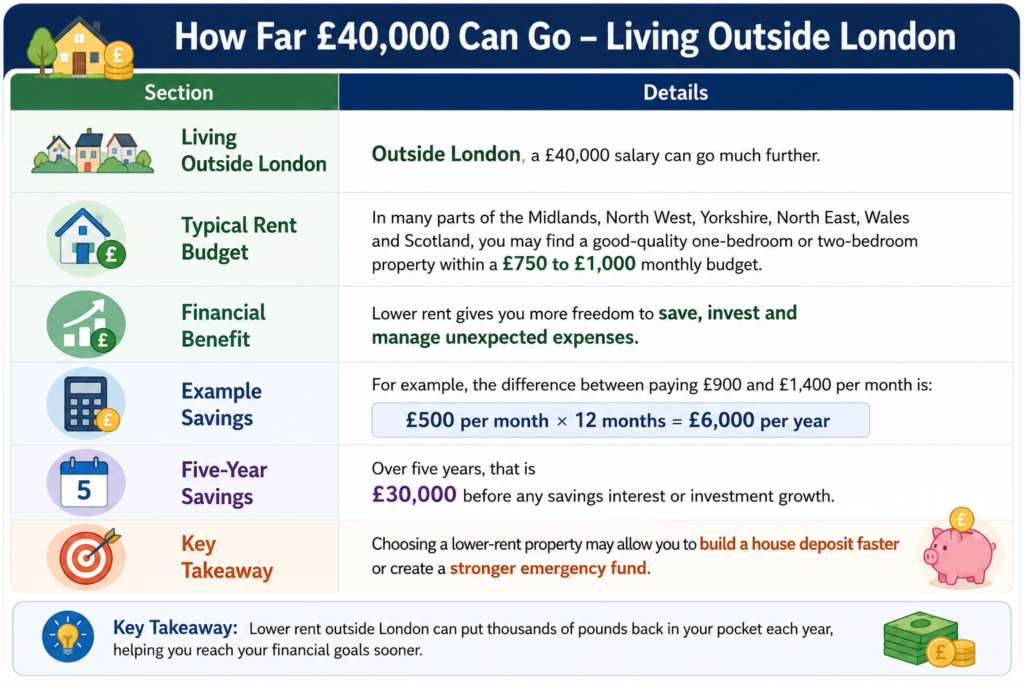
| Living Outside London | Outside London, a £40,000 salary can go much further. |
| Typical Rent Budget | In many parts of the Midlands, North West, Yorkshire, North East, Wales, and Scotland, you may find a good-quality one-bedroom or two-bedroom property within a £750 to £1,000 monthly budget. |
| Financial Benefit | Lower rent gives you more freedom to save, invest, and manage unexpected expenses. |
| Example Savings | For example, the difference between paying £900 and £1,400 per month is: £500 per month × 12 months = £6,000 per year. |
| Five-Year Savings | Over five years, that is £30,000 before accounting for any savings interest or investment growth. |
| Key Takeaway | Choosing a lower-rent property may allow you to build a house deposit faster or create a stronger emergency fund. |
Remember to Include Bills When Calculating Rent Affordability
The advertised rent is not the full cost of living in a property.
| Expense to Include | Add to Your Budget |
|---|---|
| Council tax | ✓ |
| Gas and electricity | ✓ |
| Water | ✓ |
| Broadband | ✓ |
| Mobile phone | ✓ |
| Contents insurance | ✓ |
| Food | ✓ |
| Transport | ✓ |
| Car finance or car insurance | ✓ |
| Credit card repayments | ✓ |
| Gym memberships and subscriptions | ✓ |
| Pension contributions | ✓ |
| Savings goals | ✓ |
| Childcare costs (if applicable) | ✓ |
A £950 property with high energy bills and expensive council tax may cost more than a £1,050 bills-included property.
Before deciding between properties, make a simple comparison of the full monthly cost. Write down the rent, council tax, estimated energy bills, water, broadband and transport for each property. For example, a £950 rental that requires a long daily commute and has higher energy costs may leave you with less money each month than a £1,050 property closer to work. Looking at the complete cost can help you avoid choosing a cheaper rent that becomes more expensive once everyday costs are added.
Always calculate your total housing cost before applying.
Upfront Costs of Renting on a £40,000 Salary
You also need to have some money set aside before moving into a rental property.
Typical upfront costs include a holding deposit, security deposit, first month’s rent, moving costs, and furniture.
| Upfront Cost | Example Amount for £1,100 Rent |
|---|---|
| Holding deposit | Around £250 |
| Security deposit | Around £1,250 to £1,350 |
| First month’s rent | £1,100 |
| Moving costs | £150 to £500 |
| Basic furniture or household items | Varies |
| Estimated minimum moving fund | £2,750+ |
A good target is to have enough savings to cover the deposit, first month’s rent, moving costs, and at least one month of emergency expenses.
Before applying for a rental, check how much money you will have left after paying the initial moving costs. It is risky to use almost all of your savings for the deposit and first month’s rent. Try to keep some money available after moving because unexpected costs can appear during the first few months, such as replacing household items, paying a higher-than-expected energy bill or dealing with an urgent travel expense. Having a small cash buffer can make the transition into a new rental much easier.
A Simple Formula to Work Out Your Safe Rent Budget
Instead of asking, “What rent will a landlord allow me to pay?”, use this calculation:
Monthly take-home pay
− bills and essentials
− debt repayments
− savings target
− personal spending
= maximum safe rent
For example:
| Monthly Budget Item | Amount |
|---|---|
| Monthly take-home pay | £2,693 |
| Bills, food and transport | −£850 |
| Savings target | −£300 |
| Debt repayments | −£150 |
| Personal spending | −£250 |
| Maximum safe rent | £1,143 |
This shows that £1,143 may be the maximum safe rent based on this example.
If you are unsure whether a higher rent will be comfortable, try a three-month rent test before moving. For example, if you currently pay £900 but are considering a £1,200 property, save the extra £300 each month for three months. If you can put aside £300 consistently without using credit or falling behind on other expenses, you have a better indication that the higher rent may fit your budget. After three months, you will also have £900 saved that can help with moving costs or your emergency fund.
However, it is usually wise to choose a rent amount below your maximum. A lower rent gives you more financial flexibility if your bills increase, your working hours are reduced, or an unexpected expense comes up.
Read more:Calculate House Rent in the UK: Step-by-Step GuideIs £40,000 a good salary in the UK?
Yes, £40,000 is a good salary in many parts of the UK. It can provide a comfortable lifestyle outside London and the South East, especially if your rent is reasonable. However, your financial comfort depends on your household size, debts, location and monthly bills.
How much is £40,000 after tax per month in 2026/27?
For England, Wales and Northern Ireland, £40,000 per year is approximately £2,693 per month after Income Tax and employee National Insurance. This assumes a standard tax code with no pension contributions or student loan repayments.
Can I rent a flat on a £40,000 salary?
Yes. Many landlords may approve you for rent between £1,000 and £1,300 per month, depending on their affordability checks. However, a personal budget closer to £900 to £1,100 is usually more comfortable.
Can I afford £1,200 rent on a £40,000 salary?
Yes, but it will take around 45% of your monthly take-home pay. It can be manageable if you have low debt, affordable bills and stable employment, but it leaves less room for savings and emergencies.
Can I afford £1,500 rent on a £40,000 salary?
For one person, £1,500 rent is usually not recommended. It can take more than half of your monthly take-home pay and may leave too little money for bills, food, transport and savings.
What is 30% of a £40,000 salary?
Thirty percent of a £40,000 gross salary is £12,000 per year, or £1,000 per month. However, for personal budgeting, it is better to use take-home pay. 30% of £2,693 in monthly take-home pay is around £808.
What is 40% of a £40,000 salary?
Forty percent of a £40,000 gross salary is £16,000 per year, or around £1,333 per month. 40% of estimated monthly take-home pay is around £1,077.
Should I include bills when working out rent affordability?
Yes. You should always include council tax, energy, water, broadband, transport, groceries and insurance. The full monthly cost matters more than the advertised rent alone.
How much should I save before renting?
A good target is enough to cover your holding deposit, security deposit, first month’s rent, moving costs and at least one month of emergency expenses. For many renters, this can mean saving between £2,500 and £5,000 before moving.
Conclusion
A £40,000 salary can support a comfortable rental lifestyle in the UK, especially outside London and other high-cost areas.
After Income Tax and National Insurance, your estimated monthly take-home pay is around £2,693. This means a rent budget of around £900 to £1,100 per month is usually a good balance between comfort and financial security.
You may be able to pay £1,200 to £1,300 per month if you have low debt and well-controlled expenses. However, rent above £1,400 can become difficult for a single person because it takes up too much of your monthly income before bills are included.
The smartest rental decision is not always the most expensive property you can technically afford. It is the property that allows you to pay comfortably, save money, enjoy your lifestyle, and remain financially secure if your circumstances change.